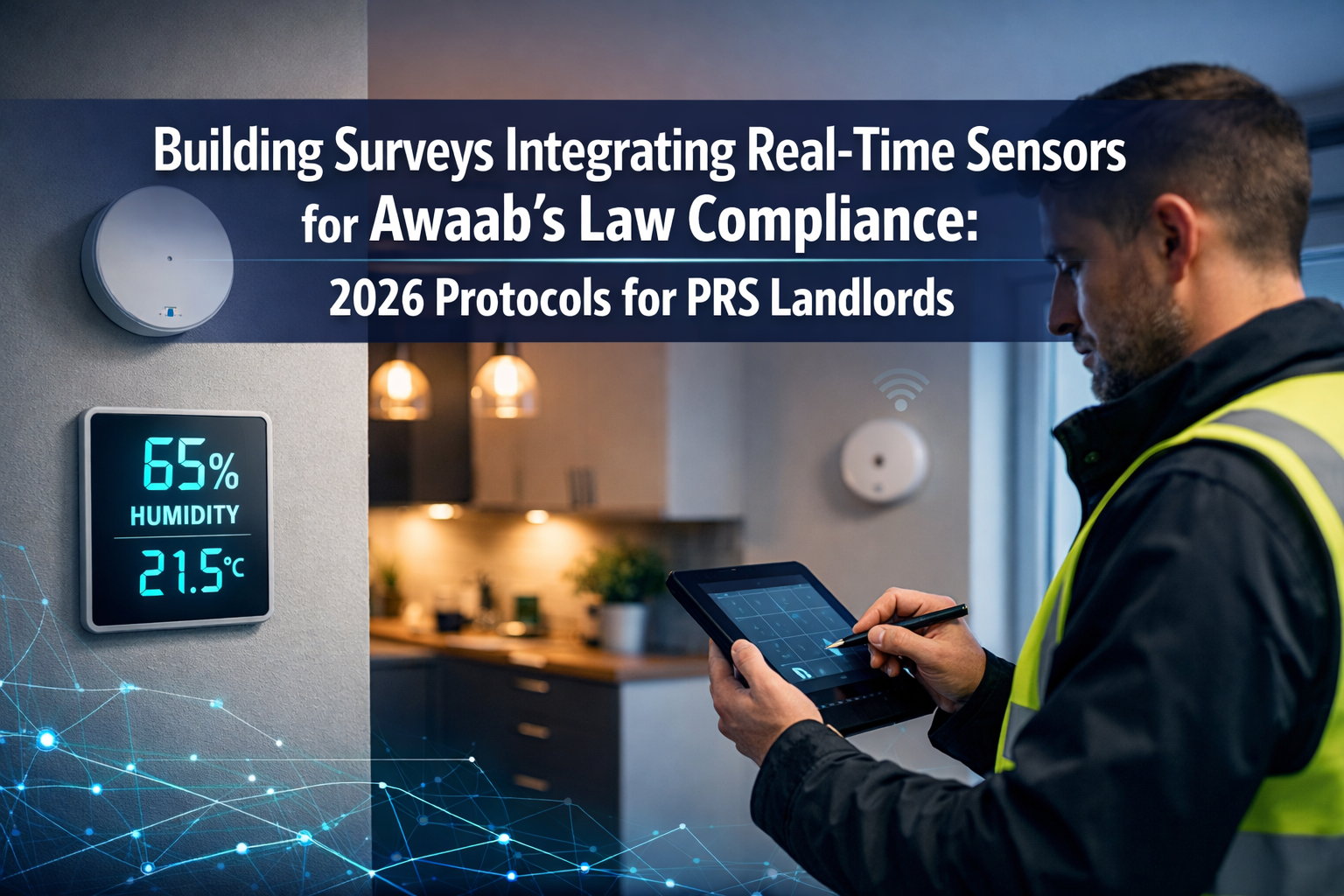

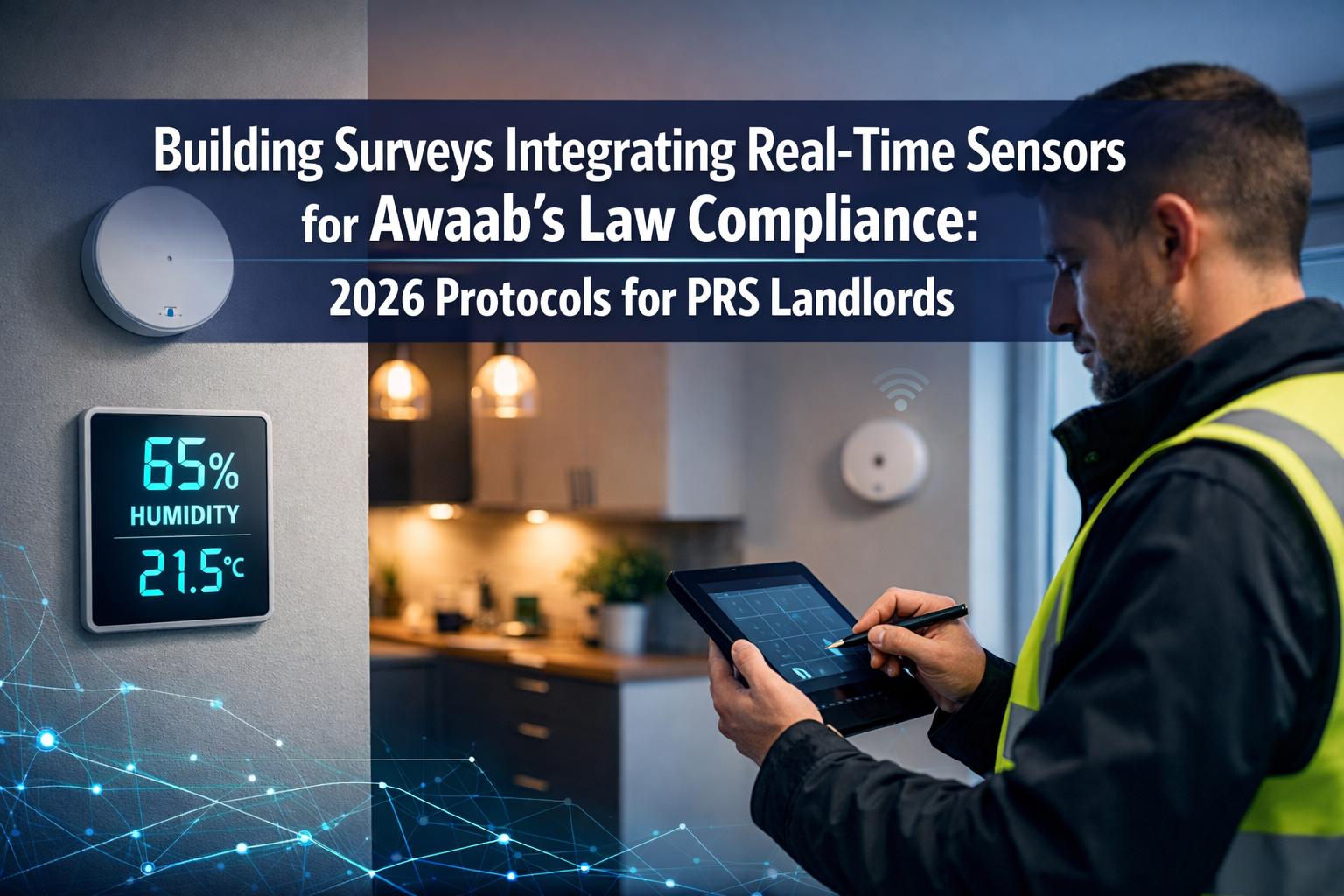
Awaab's Law Phase 1 enforcement across England's social housing sector since October 2025 has triggered a seismic shift in how landlords approach property health monitoring—and the Private Rented Sector (PRS) extension scheduled for 2026 will amplify this transformation exponentially. With emergency hazards requiring investigation and remediation within 24 hours, and significant damp or mould issues demanding action within 10 working days, traditional reactive inspection models have become obsolete overnight.[1] The integration of real-time environmental sensors into comprehensive building surveys now represents the only viable pathway for PRS landlords to demonstrate proactive compliance, detect hazards before tenant complaints escalate, and create defensible audit trails that withstand regulatory scrutiny.
Building Surveys Integrating Real-Time Sensors for Awaab's Law Compliance: 2026 Protocols for PRS Landlords combine traditional structural assessment methodologies with continuous environmental monitoring technology, creating a hybrid approach that identifies damp, temperature, and air quality hazards before they manifest as visible defects. This preventative strategy shifts the compliance burden from reactive crisis management to predictive risk mitigation, fundamentally altering the surveyor's role from periodic inspector to continuous property health guardian.
Key Takeaways
- Legislative timeline: Awaab's Law Phase 1 became enforceable in social housing on 27 October 2025, with PRS extension anticipated throughout 2026, imposing strict investigation (10 working days) and emergency response (24 hours) deadlines.[1][4]
- Sensor integration advantage: Real-time environmental monitoring detects humidity, temperature, dew point, CO2, and air quality parameters before damp and mould become visible, enabling pre-emptive action that traditional surveys cannot provide.[1][3]
- Compliance documentation: Sensor data creates time-stamped audit trails that prove proactive monitoring and rapid response, protecting landlords from Housing Ombudsman investigations and regulatory penalties.[1][4]
- Privacy compliance requirements: Sensor deployment must exclude photo/video capabilities, limit data collection to safety purposes only, and maintain UK GDPR compliance with transparent tenant communication.[1]
- Survey evolution: Building surveys now require integration with IoT platforms to deliver continuous compliance monitoring beyond traditional point-in-time assessments.
Understanding Awaab's Law: Legislative Framework and PRS Extension Timeline
Awaab's Law emerged from the tragic death of two-year-old Awaab Ishak in 2020, whose respiratory condition was directly linked to prolonged exposure to severe damp and mould in his family's social housing property. The legislation, embedded within the Social Housing (Regulation) Act 2023 and the Hazards in Social Housing (Prescribed Requirements) Act 2025, establishes non-negotiable timeframes for landlord response to environmental hazards.[4]
Core Requirements for Social Housing (Phase 1: October 2025)
The initial phase mandates that registered social housing providers must:
- Investigate significant damp or mould hazards within 10 working days of notification
- Complete remedial work within a reasonable timeframe determined by hazard severity
- Respond to Category 1 emergency hazards within 24 hours with both investigation and remedial action, or provide alternative accommodation if the hazard cannot be immediately controlled[4]
PRS Extension Protocols for 2026
While the precise implementation date for PRS properties remains subject to final regulatory confirmation, the anticipated 2026 extension will impose equivalent obligations on private landlords managing residential tenancies. Early guidance suggests the framework will mirror social housing requirements with potential modifications for portfolio size and property type.[5][6]
Critical distinction: For emergency hazards, the 24-hour requirement encompasses dual action—both investigation completion and remedial work initiation or tenant rehousing must occur within the same compressed timeframe.[4] This eliminates the traditional separation between assessment and remediation phases that characterised previous housing health protocols.
Hazard Categories Relevant to Sensor Integration
Awaab's Law specifically targets hazards assessable under the Housing Health and Safety Rating System (HHSRS), with particular focus on:
- Damp and mould growth (primary target)
- Excess cold (temperature-related hazards)
- Excess heat (overheating risks)
- Carbon monoxide and fuel combustion products
- Inadequate ventilation (contributing to condensation and air quality issues)
Environmental sensors directly monitor the physical parameters that create these hazard conditions—humidity levels, temperature fluctuations, dew point calculations, and CO2 concentrations—enabling detection before hazards reach Category 1 or Category 2 thresholds.[1][3]
Real-Time Environmental Sensors: Technology Specifications and Deployment Protocols
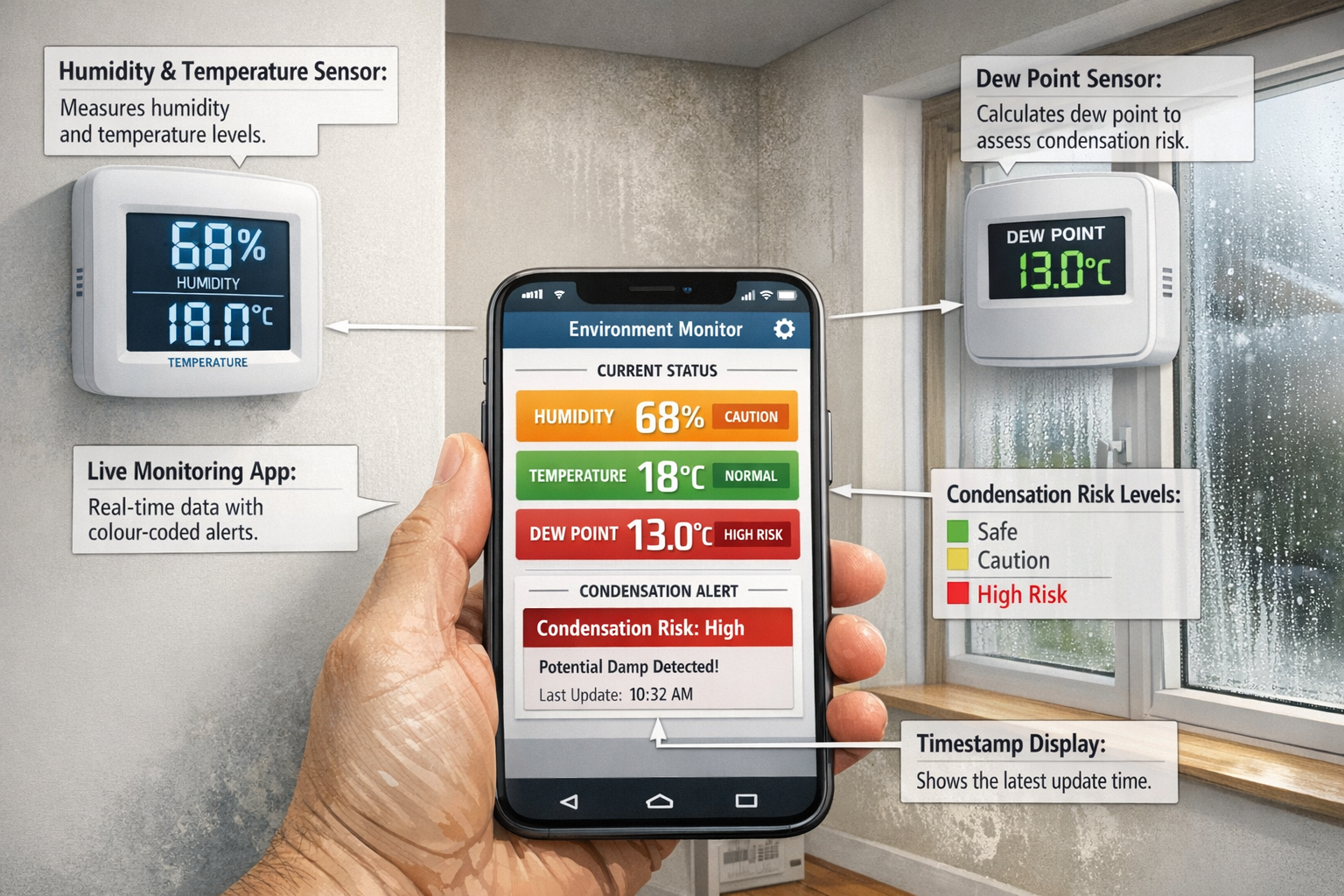
The technological foundation of Building Surveys Integrating Real-Time Sensors for Awaab's Law Compliance: 2026 Protocols for PRS Landlords rests on IoT environmental monitoring devices that capture continuous data streams from occupied properties. These systems transform static survey snapshots into dynamic property health dashboards.
Core Sensor Parameters and Hazard Detection
Modern environmental sensors monitor multiple interconnected parameters:
| Parameter | Hazard Detected | Alert Threshold Examples |
|---|---|---|
| Relative Humidity | Damp, mould risk, condensation | >65% sustained for 48+ hours |
| Temperature | Excess cold, excess heat | <16°C or >26°C in living spaces |
| Dew Point | Condensation risk on surfaces | Dew point within 2°C of surface temperature |
| Carbon Dioxide (CO2) | Inadequate ventilation, occupancy patterns | >1,000 ppm sustained levels |
| Air Quality (VOCs) | Indoor pollution, ventilation failure | Elevated volatile organic compounds |
Humidity and dew point calculations provide the most direct early warning for damp and mould hazards. When relative humidity exceeds 65% for extended periods, particularly in conjunction with surface temperatures approaching dew point, condensation becomes inevitable—creating the moisture conditions that support mould colonisation within 24-48 hours.[1][3]
Privacy-Compliant Sensor Specifications
Sensor deployment must adhere to strict privacy boundaries to maintain UK GDPR compliance:
✅ Permitted features:
- Temperature, humidity, and air quality monitoring
- CO2 level detection
- Motion detection (for occupancy patterns only)
- Wireless data transmission to secure cloud platforms
❌ Prohibited features:
- Photo or video recording capabilities (even if disabled)
- Audio recording functions
- Location tracking beyond room-level identification
- Any biometric data collection[1]
Critical privacy principle: CO2 readings can inadvertently reveal occupancy patterns—indicating the number of people in a property and which rooms they occupy most frequently. This data sensitivity requires explicit tenant consent and transparent communication about data usage limitations.[1]
Integration with Building Survey Methodologies
Real-time sensors complement rather than replace traditional building surveys. The optimal integration model combines:
- Initial comprehensive survey: A full Level 3 building survey establishes baseline property condition, identifies existing defects, and determines optimal sensor placement locations
- Strategic sensor deployment: Devices installed in high-risk zones (external walls, bathrooms, kitchens, poorly ventilated rooms) identified during physical inspection
- Continuous monitoring phase: Sensors provide 24/7 data streams that detect emerging hazards between periodic inspections
- Triggered intervention surveys: Sensor alerts prompt targeted specialist defect surveys or damp surveys to investigate and remediate specific hazards
This layered approach ensures that sensor data enhances rather than substitutes professional surveyor expertise, particularly for complex structural issues that require physical inspection and material testing.
Building Surveys Integrating Real-Time Sensors for Awaab's Law Compliance: Implementation Framework for PRS Landlords
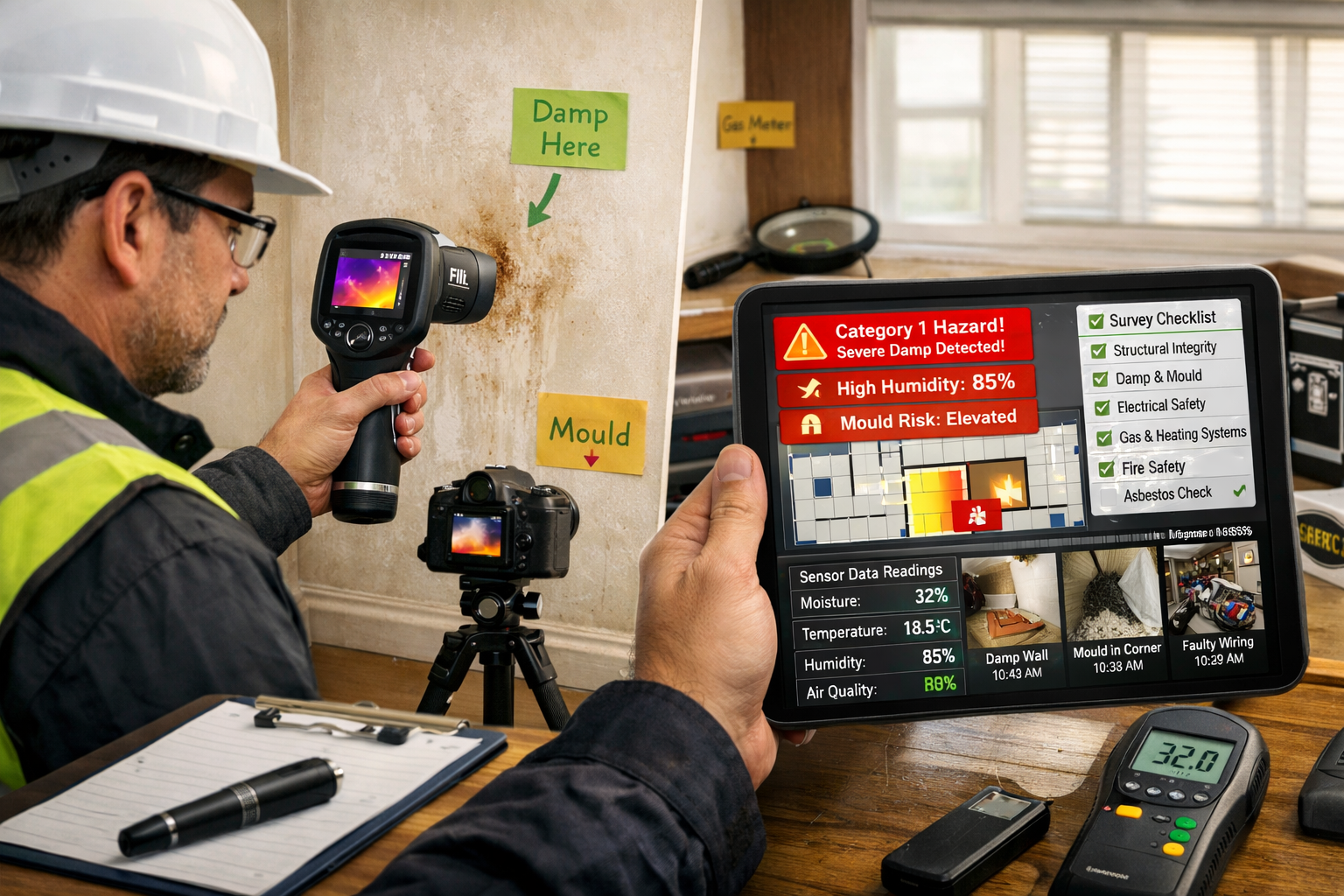
Successful implementation of sensor-enhanced building surveys requires systematic integration across property acquisition, routine monitoring, and emergency response protocols. PRS landlords must establish workflows that leverage sensor data to demonstrate proactive compliance before regulatory investigations commence.
Phase 1: Baseline Assessment and Sensor Installation
Step 1: Comprehensive building survey
Commission a thorough building survey that specifically assesses:
- Existing damp penetration or condensation issues
- Ventilation adequacy in all habitable rooms
- Thermal performance and insulation deficiencies
- Structural defects that may contribute to water ingress
- Heating system functionality and temperature distribution
Step 2: Risk zone identification
The surveyor's report should map high-risk locations requiring sensor coverage:
- External walls with north-facing or weather-exposed orientations
- Rooms with limited natural ventilation (bathrooms, internal kitchens)
- Properties with known condensation history
- Spaces with thermal bridging or insulation gaps
- Areas adjacent to unheated spaces (above garages, below flat roofs)
Step 3: Sensor deployment plan
Install environmental sensors with coverage density appropriate to property risk profile:
- Minimum coverage: One sensor per high-risk room (typically 3-5 sensors per dwelling)
- Enhanced coverage: Additional sensors in living areas and bedrooms for comprehensive monitoring (6-10 sensors per dwelling)
- Sensor positioning: Mount devices at breathing height (1.2-1.5m) away from direct heat sources, windows, and doors to ensure representative readings[3]
Phase 2: Continuous Monitoring and Alert Management
Cloud-based monitoring platforms consolidate sensor data into unified dashboards that track property health across entire portfolios. Leading systems provide:
- Real-time alert notifications when humidity, temperature, or air quality thresholds are breached
- Trend analysis showing seasonal patterns and gradual deterioration
- Comparative benchmarking across property types and locations
- Automated compliance reporting documenting response times and remedial actions[3][4]
Alert escalation protocols must align with Awaab's Law timeframes:
| Alert Type | Sensor Trigger | Response Timeframe | Required Action |
|---|---|---|---|
| Emergency (Category 1) | Severe condensation risk, extreme cold/heat | 24 hours | Investigation + remediation or rehousing |
| Significant (Category 2) | Sustained high humidity, ventilation failure | 10 working days | Investigation + remediation plan |
| Advisory | Moderate humidity elevation, minor temperature issues | 5 working days | Tenant guidance + monitoring escalation |
Documentation imperative: Every sensor alert and subsequent landlord action must be recorded with timestamps, creating an audit trail that demonstrates compliance if regulatory questions arise.[1][4]
Phase 3: Intervention Surveys and Remediation
When sensor data indicates hazard development, targeted surveys provide detailed investigation:
- Damp surveys: Moisture meter testing, thermal imaging, and material sampling to determine damp source (condensation, penetration, or rising damp)
- Specialist defect surveys: Focused assessment of specific building elements contributing to hazard conditions
- Monitoring surveys: Extended observation of structural movement or moisture patterns requiring long-term data collection
The integration of pre-existing sensor data with physical survey findings creates comprehensive evidence packages that support both remediation specification and compliance demonstration.
Phase 4: Tenant Communication and Consent Management
Transparency requirements under UK GDPR mandate clear communication about sensor deployment:
📋 Essential information for tenants:
- Purpose of sensors (safety monitoring, hazard prevention)
- Types of data collected (environmental parameters only)
- Data storage and security measures
- Absence of surveillance capabilities (no cameras or audio)
- Tenant rights regarding data access and deletion
- How sensor data benefits occupant health and safety[1]
Consent documentation should be obtained before sensor installation, with tenants retaining the right to refuse participation (though landlords should explain the compliance and safety implications of opting out).
Behavioural guidance: Sensor data revealing high humidity from lifestyle factors (inadequate heating, insufficient ventilation, drying laundry indoors) provides opportunities for constructive tenant education rather than punitive action. Landlords should offer practical advice on condensation management while ensuring property ventilation and heating systems meet minimum standards.[3]
Data Protection, Privacy Compliance, and Regulatory Considerations
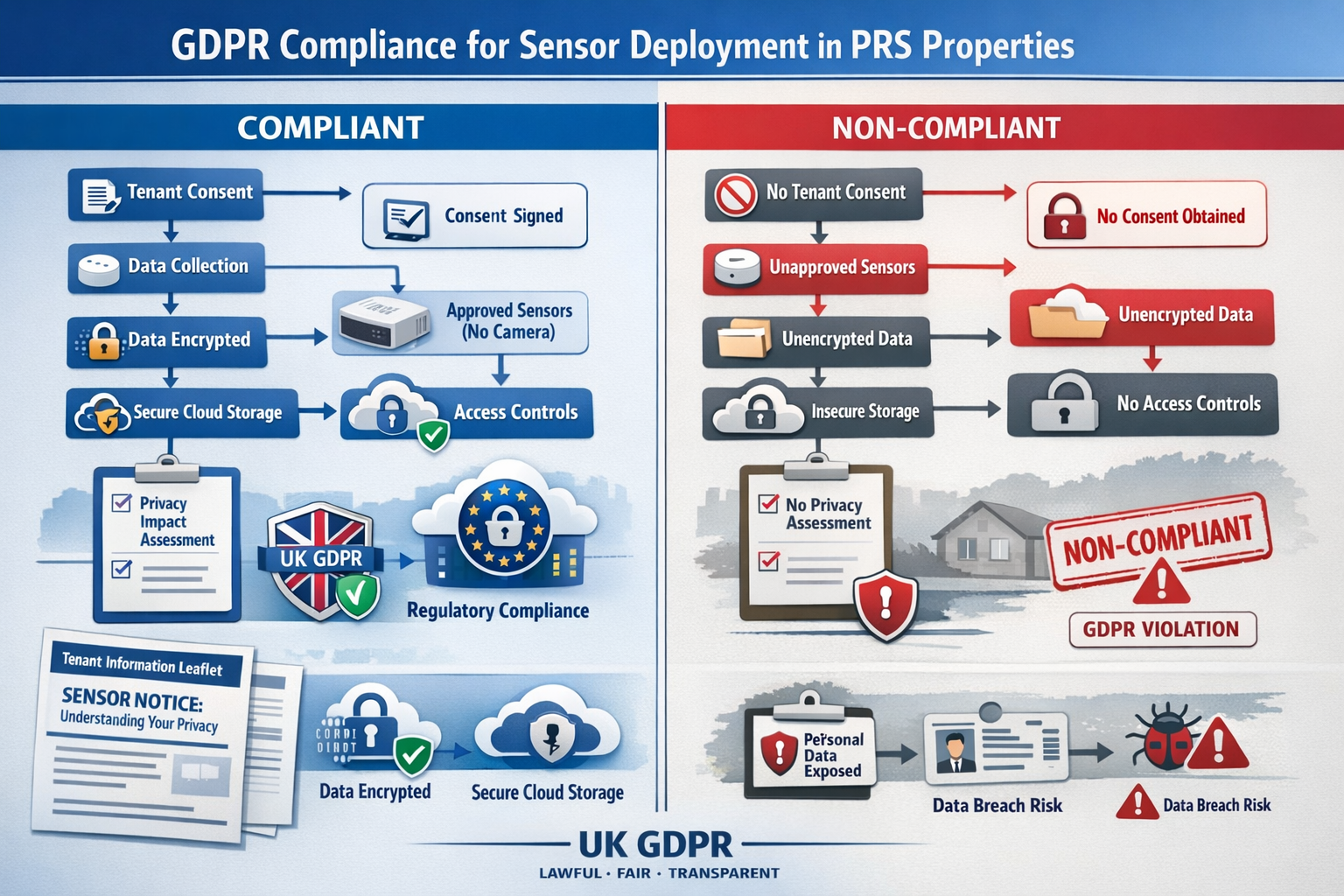
The legal framework governing sensor deployment extends beyond Awaab's Law into data protection legislation, creating dual compliance obligations that PRS landlords must navigate simultaneously.
UK GDPR and Data Protection Act 2018 Requirements
Environmental sensor data constitutes personal data when it relates to identifiable individuals (tenants), triggering full GDPR compliance obligations:
Lawful basis for processing: Landlords typically rely on:
- Legitimate interests (preventing health hazards, property maintenance)
- Legal obligation (compliance with Awaab's Law and housing health regulations)
- Consent (where tenant agreement is obtained for enhanced monitoring)
Data minimisation principle: Collection must be limited to parameters directly relevant to tenant safety—temperature, humidity, air quality—excluding any data that reveals unnecessary personal information about occupant behaviour.[1]
Security measures: Sensor data must be:
- Transmitted via encrypted connections
- Stored on secure cloud platforms with access controls
- Protected against unauthorised access or data breaches
- Retained only for necessary compliance periods (typically 6 years for legal defence purposes)
Sensor Data as Evidence in Regulatory Investigations
The Housing Ombudsman and local authority enforcement teams increasingly scrutinise landlord response to environmental hazards. Sensor data creates a double-edged evidential sword:
✅ Protective evidence: Demonstrates proactive monitoring, early detection, and prompt response to emerging hazards
⚠️ Liability evidence: If sensors detect hazards that landlords subsequently ignore or inadequately address, the data becomes proof of negligence and regulatory breach[1]
Critical compliance principle: Sensor deployment creates an obligation to act on the data collected. Landlords cannot claim ignorance of hazard conditions when their own monitoring systems have documented the problem. This transforms sensor adoption from optional enhancement to compliance necessity—once deployed, sensor alerts demand documented response.[1]
Technology Platform Selection Criteria
When evaluating sensor systems and data management platforms, PRS landlords should verify:
🔒 Security certifications:
- ISO 27001 information security management
- Cyber Essentials Plus certification
- SOC 2 compliance for cloud service providers
- GDPR-compliant data processing agreements
⚙️ Functional capabilities:
- Automated alert escalation mirroring Awaab's Law timeframes
- Integration with property management systems
- Mobile accessibility for field teams
- Offline data capture with automatic synchronisation
- Audit trail generation for compliance reporting[4]
📊 Reporting and analytics:
- Portfolio-wide hazard risk dashboards
- Trend analysis identifying systemic issues
- Compliance deadline tracking and flagging
- Tenant rehousing protocol workflows
- Evidence package generation for regulatory submissions
Cost-Benefit Analysis and Return on Compliance Investment
The financial case for sensor integration extends beyond regulatory compliance to encompass property preservation, tenant retention, and litigation avoidance.
Implementation Cost Structure
Initial investment per property:
- Environmental sensors (3-5 units): £150-£400
- Cloud platform subscription: £5-£15 per property per month
- Installation and configuration: £100-£200
- Enhanced building survey with sensor placement planning: £800-£1,500
Ongoing costs:
- Platform subscription fees: £60-£180 per property annually
- Sensor battery replacement or maintenance: £20-£50 per device every 2-3 years
- Periodic recalibration or sensor upgrades: £50-£100 annually
Total first-year cost per property: Approximately £1,200-£2,500 including comprehensive survey and sensor deployment.
Risk Mitigation Value
Avoided costs through early hazard detection:
- Mould remediation: £500-£3,000+ per incident (depending on extent)
- Structural damp repair: £2,000-£10,000+ for penetrating damp issues
- Emergency rehousing: £1,000-£3,000+ per month for temporary accommodation
- Regulatory fines: Up to £30,000 for serious housing health breaches
- Housing Ombudsman compensation: £500-£5,000+ for tenant distress and inconvenience
- Legal defence costs: £5,000-£20,000+ for tribunal or court proceedings
Property preservation benefits:
- Extended building fabric lifespan through early intervention
- Reduced insurance claims and premium increases
- Enhanced property value through documented maintenance history
- Improved Energy Performance Certificate (EPC) ratings via better environmental control
Tenant Retention and Reputation Protection
Properties with proactive environmental monitoring demonstrate landlord commitment to tenant health and safety, contributing to:
- Reduced void periods through positive tenant experiences and reviews
- Lower turnover costs (£1,000-£2,000 per tenancy change)
- Enhanced marketability to quality tenants prioritising property standards
- Reputation protection against negative publicity from hazard-related complaints
The reputational damage from a single Awaab's Law breach—particularly if resulting in tenant harm or media attention—can far exceed the entire cost of portfolio-wide sensor deployment.
Future-Proofing Compliance: Emerging Technologies and Regulatory Trends
As Awaab's Law extends to the PRS throughout 2026, parallel developments in building technology and housing regulation will shape compliance requirements for the remainder of the decade.
Predictive Analytics and AI-Enhanced Hazard Detection
Next-generation platforms are incorporating machine learning algorithms that analyse historical sensor data to predict hazard development before threshold breaches occur:
- Seasonal pattern recognition: Identifying properties at elevated risk during winter condensation periods
- Comparative analysis: Benchmarking individual properties against portfolio norms to flag anomalies
- Maintenance scheduling optimisation: Predicting optimal intervention timing to prevent hazard escalation
- Tenant behaviour profiling: Distinguishing structural issues from occupant-related condensation causes
These capabilities will enable increasingly proactive compliance strategies that intervene before hazards develop rather than reacting to sensor alerts.
Integration with Building Safety Act Requirements
The Building Safety Act 2022 introduces the "golden thread" concept—comprehensive digital records documenting building information throughout property lifecycles. Sensor data integration with building information management systems creates unified compliance records encompassing:
- Original construction specifications and materials
- Modification and renovation history
- Ongoing maintenance and inspection records
- Real-time environmental performance data
- Hazard detection and remediation documentation
This convergence positions sensor-enhanced building surveys as central components of broader building safety compliance frameworks extending beyond Awaab's Law.
Expansion to Additional Hazard Categories
While current Awaab's Law focus centres on damp, mould, and temperature hazards, regulatory trajectory suggests future expansion to encompass:
- Electrical safety monitoring: Temperature sensors detecting overheating circuits or appliances[5]
- Fire risk detection: Smoke particle sensors and heat pattern analysis
- Structural movement: Accelerometers and tilt sensors for subsidence monitoring
- Water leak detection: Moisture sensors for early pipe failure identification
- Air quality beyond CO2: Particulate matter, radon, and volatile organic compound monitoring
PRS landlords investing in scalable sensor platforms position themselves to accommodate these expanding requirements without complete system replacement.
Conclusion: Strategic Imperatives for PRS Landlords in 2026
Building Surveys Integrating Real-Time Sensors for Awaab's Law Compliance: 2026 Protocols for PRS Landlords represent a fundamental evolution in property management philosophy—from reactive maintenance to predictive health monitoring. As PRS extension implementation approaches throughout 2026, landlords face a strategic choice: adopt proactive sensor integration now, or await regulatory enforcement that will inevitably compel adoption under crisis conditions.
The compliance advantages are unequivocal: real-time environmental monitoring provides the only viable mechanism for meeting 24-hour emergency response requirements while simultaneously creating defensible audit trails that demonstrate due diligence. Traditional periodic inspections, even when conducted quarterly, cannot detect rapidly developing hazards or prove continuous oversight between survey appointments.
Actionable Next Steps for PRS Landlords
Immediate actions (Q1-Q2 2026):
- Commission comprehensive building surveys for all PRS properties, specifically requesting Level 3 surveys with sensor deployment planning
- Evaluate sensor technology providers based on security certifications, GDPR compliance, and Awaab's Law workflow integration
- Develop tenant communication protocols including consent documentation and privacy notices
- Establish alert response procedures with clear escalation pathways and responsibility assignments
- Train property management teams on sensor data interpretation and compliance timeframe requirements
Medium-term implementation (Q3-Q4 2026):
- Deploy sensors across portfolio prioritising highest-risk properties (older stock, known condensation issues, vulnerable tenants)
- Integrate sensor platforms with existing property management systems and maintenance workflows
- Conduct baseline monitoring to establish normal parameters and calibrate alert thresholds
- Document all sensor alerts and responses creating compliance evidence packages
- Review and refine protocols based on initial operational experience
Long-term strategic positioning (2027 onwards):
- Expand monitoring coverage to encompass additional hazard categories as technology and regulations evolve
- Leverage data analytics for portfolio-wide risk assessment and capital investment prioritisation
- Integrate sensor data with broader building safety compliance frameworks and digital record requirements
- Demonstrate compliance leadership as competitive differentiator in tenant acquisition and retention
The intersection of legislative mandate, technological capability, and professional surveying expertise creates unprecedented opportunities for landlords who embrace sensor integration proactively. Those who delay adoption until enforcement actions commence will face compressed implementation timelines, elevated costs, and potential regulatory penalties that far exceed the investment required for systematic preparation.
Awaab's Law compliance is not merely a regulatory burden—it represents a fundamental commitment to tenant health and safety that aligns legal obligation with moral responsibility. Building surveys enhanced by real-time sensor technology provide the tools to honour that commitment effectively, efficiently, and demonstrably.
References
[1] Will Environmental Sensors Help Social Housing Landlords Keep Up With Their Obligations – https://www.birketts.co.uk/legal-update/will-environmental-sensors-help-social-housing-landlords-keep-up-with-their-obligations/
[2] Scaling Confidence Unlocking Power Sensor Data Preparing Awaabs Law – https://www.housingevent.com/agenda-2025/scaling-confidence-unlocking-power-sensor-data-preparing-awaabs-law
[3] Preventing Damp And Mould Through Real Time Housing Insight In An Age Of Awaabs Law – https://www.twinview.com/resources/preventing-damp-and-mould-through-real-time-housing-insight-in-an-age-of-awaabs-law
[4] How Digital Tools Help Social Landlords Meet Awaabs Law – https://www.trimble.com/blog/construction/en-US/article/how-digital-tools-help-social-landlords-meet-awaabs-law
[5] Building Surveys And Awaabs Law 2026 Extensions Identifying Electrical Fire And Temperature Hazards In Prs Properties – https://nottinghillsurveyors.com/blog/building-surveys-and-awaabs-law-2026-extensions-identifying-electrical-fire-and-temperature-hazards-in-prs-properties
[6] Awaabs Law Extensions To Prs In 2026 Party Wall And Building Survey Protocols For New Hazard Categories – https://nottinghillsurveyors.com/blog/awaabs-law-extensions-to-prs-in-2026-party-wall-and-building-survey-protocols-for-new-hazard-categories