

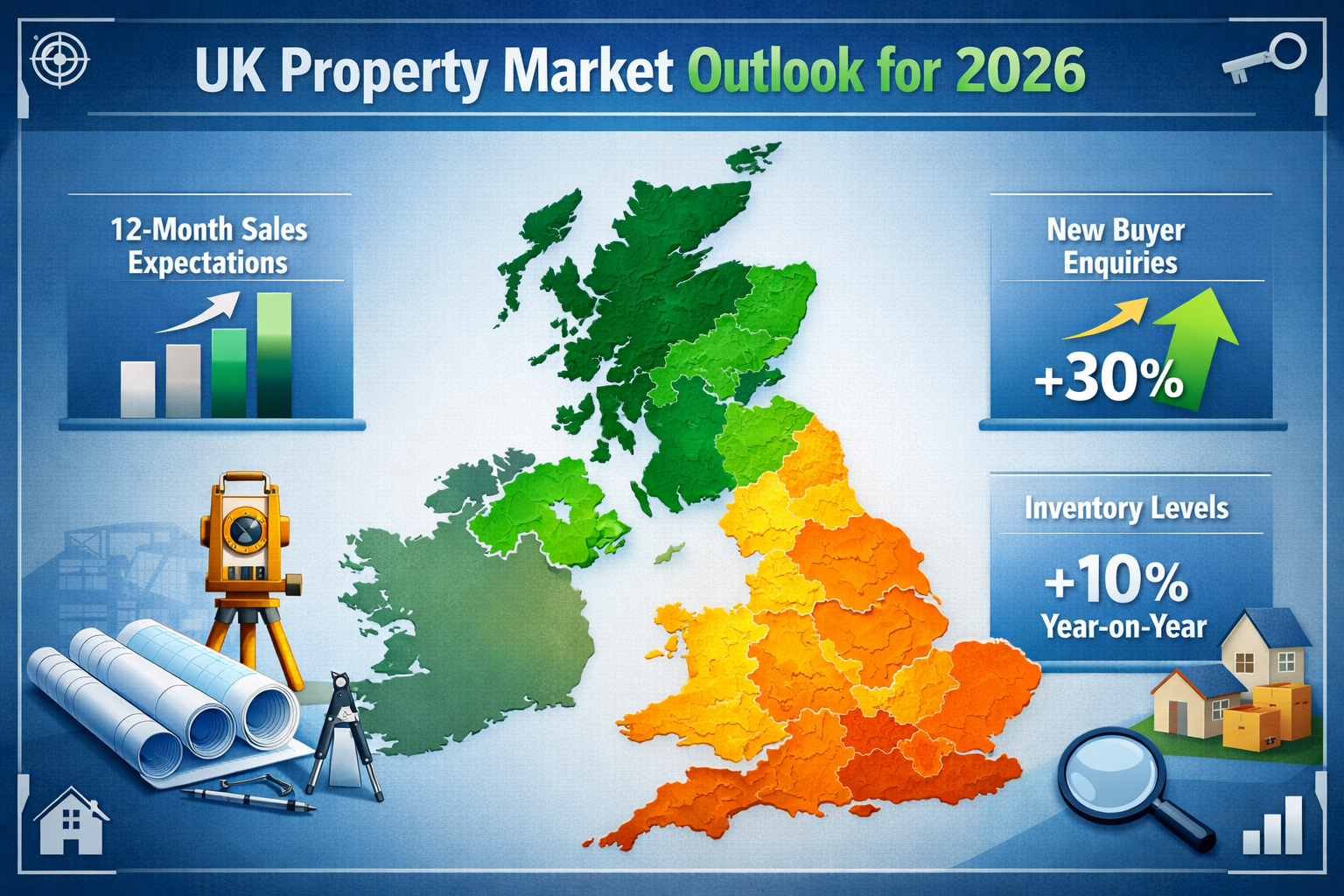
As the UK property market navigates through 2026, a cautious optimism is emerging from the shadows of recent affordability challenges. New buyer enquiries have climbed to -15%, a notable improvement from December's -21%, while 12-month sales expectations have surged to +35%[5]. This shifting landscape presents a unique opportunity for building surveyors to position themselves as essential advisors in a recovering but still cautious market. Understanding how Building Surveys in the 2026 Market Recovery: Capitalizing on Improving Buyer Confidence and Regional Growth intersect is crucial for professionals seeking to expand their practice and serve clients more effectively.
The property market's transformation isn't uniform across the UK. Scotland, Northern Ireland, and the North are experiencing particularly robust growth, creating regional hotspots where informed buyers are re-entering the market with renewed confidence but heightened scrutiny. These buyers understand that thorough property assessment is no longer optional—it's essential protection in an evolving market landscape.
Key Takeaways
- 📈 Buyer confidence is recovering gradually, with new enquiries improving from -21% to -15% and 12-month sales expectations reaching +35%, creating increased demand for professional building surveys
- 🏴 Regional growth patterns favor Scotland, Northern Ireland, and Northern England, presenting targeted opportunities for surveyors to expand their service areas
- 🏠 The remodeling market remains exceptionally strong with 24 consecutive quarters above 50 on the RMI, driving demand for pre-purchase surveys and renovation assessments[1]
- 💰 Price reductions and incentives remain elevated (36% of builders cutting prices, 65% offering incentives), making thorough surveys critical for buyers navigating complex negotiations[2]
- 🔍 Aging housing stock and mortgage rate lock-in effects are creating sustained demand for comprehensive property assessments and modification surveys[1]
Understanding the 2026 Market Recovery Landscape

Current Market Sentiment and Builder Confidence
The Housing Market Index (HMI) declined to 36 in February 2026, down from 37 in January, marking a second consecutive month of decline[2]. While this might seem discouraging, the context reveals a more nuanced picture. The prospective buyer traffic index fell to 22 in February, down 2 points from January, indicating that while buyers are cautious, they're increasingly engaging with the market[2].
What makes this particularly relevant for building surveyors is the disconnect between builder sentiment and actual buyer behavior. Future sales expectations fell to 46 in February, dropping below the neutral 50 threshold[2]. This builder caution translates into more realistic pricing and greater willingness to address property issues—creating an environment where comprehensive RICS Level 3 building surveys become powerful negotiation tools.
The data reveals that 36% of builders cut prices in February, down from 40% in January—the lowest rate since May 2025[2]. However, sales incentives remained elevated at 65%, marking 11 consecutive months above 60%[2]. For buyers, this means opportunities exist, but they require expert guidance to navigate complex transactions where structural issues might be masked by attractive pricing.
The Remodeling Market's Remarkable Resilience
Perhaps the most compelling trend for building surveyors is the extraordinary strength of the remodeling sector. The NAHB Remodeling Market Index (RMI) has sustained readings above 50 for 24 consecutive quarters, demonstrating post-pandemic resilience that significantly outpaces single-family and multifamily housing sentiment[1].
This sustained strength isn't accidental. Residential remodeling activity is forecast to increase 3% in 2026 in inflation-adjusted terms, with an additional 2% growth expected in 2027[1]. The drivers are structural and long-lasting:
- Aging housing stock requiring modernization and repair
- Mortgage rate lock-in effect keeping homeowners in place and investing in improvements
- Growing emphasis on aging-in-place modifications
- Increased home equity providing renovation capital
For building surveyors, this creates dual opportunities: conducting pre-purchase surveys that identify renovation potential, and providing specific defect reports that guide homeowners' improvement investments.
Inventory Growth and Pricing Dynamics
National inventory rose more than 10% year-over-year as of early February 2026, with new listings surging nearly 30% week-over-week in January—one of the strongest early-season increases since before 2020[3]. This inventory expansion fundamentally changes the buyer-seller dynamic, shifting power toward purchasers who can now be more selective.
Home price growth forecasts for 2026 remain modest across major forecasters:
| Forecaster | 2026 Price Growth Prediction |
|---|---|
| Zillow | 1.2% |
| Realtor.com | 2.2% |
| NAR | 2-3% |
| Mortgage Research | 2-4% |
These modest projections represent a significant deceleration from prior years[3], creating an environment where buyers can afford to be thorough in their due diligence. This is precisely when comprehensive building surveys become most valuable—not just for identifying defects, but for validating fair market value in a stabilizing market.
Building Surveys in the 2026 Market Recovery: Strategic Positioning for Surveyors
Adapting Services to Regional Growth Patterns
The recovery isn't happening uniformly across the UK. While national statistics provide context, the real opportunities lie in understanding regional variations. Scotland, Northern Ireland, and the North are experiencing stronger growth trajectories, driven by relative affordability, infrastructure investment, and demographic shifts[5].
For surveyors, this regional disparity demands strategic positioning:
🏴 Scotland: Focus on older stone-built properties requiring specialized knowledge of traditional construction methods, damp surveys for properties in wetter climates, and assessments of rural properties with unique challenges.
🇮🇪 Northern Ireland: Emphasize expertise in post-Troubles era construction quality variations, properties affected by historical pyrite issues, and the unique regulatory environment.
⬆️ Northern England: Highlight experience with Victorian terraces, former industrial properties requiring conversion assessments, and the growing market for urban regeneration projects.
Surveyors who develop regional specialization and market their expertise accordingly will capture disproportionate market share as buyer confidence returns to these high-growth areas.
Leveraging Technology for Competitive Advantage
The 2026 market recovery is occurring alongside rapid technological advancement in surveying. Buyers increasingly expect:
- Thermal imaging to identify insulation deficiencies and hidden moisture
- Drone surveys for comprehensive roof and chimney assessments
- Digital reporting with interactive floor plans and photo annotations
- 3D modeling for complex structural issues
Surveyors who invest in drone survey capabilities and modern reporting platforms can differentiate themselves in a competitive market. The ability to provide comprehensive roof surveys using aerial technology, for example, adds value that justifies premium pricing while reducing time on-site.
Moreover, technology enables faster turnaround times—critical when buyers are competing in markets with improving but still limited inventory. A surveyor who can deliver a comprehensive report within 48 hours has a significant competitive advantage over those requiring 7-10 days.
Addressing the Aging-in-Place Trend
One of the most significant structural trends driving both the remodeling market and survey demand is aging-in-place. 73% of remodelers indicated that requests for aging-in-place features have significantly or somewhat increased over the past five years[1], and 56% of NAHB remodelers are actively involved in home modification work relating to aging-in-place projects[1].
This trend creates specific opportunities for building surveyors:
- Pre-purchase assessments evaluating a property's suitability for aging-in-place modifications
- Accessibility audits identifying necessary changes for wheelchair access, grab rail installation points, and bathroom modifications
- Structural assessments for proposed modifications like stairlifts, through-floor lifts, or ground-floor bedroom additions
- Cost estimation support helping buyers understand the full investment required to make a property suitable for long-term residence
Surveyors who develop expertise in residential structural engineering aspects of aging-in-place modifications position themselves as valuable consultants beyond traditional survey work.
Capitalizing on Improving Buyer Confidence Through Enhanced Service Delivery
The Psychology of the Cautious Buyer
The 2026 buyer is fundamentally different from previous market cycles. Having witnessed affordability challenges, price volatility, and economic uncertainty, today's purchasers approach property acquisition with heightened caution. The improvement in buyer enquiries from -21% to -15% represents cautious re-engagement, not exuberant enthusiasm[5].
This psychological shift favors thorough, comprehensive surveying services. Buyers want reassurance, detailed information, and expert guidance. They're willing to invest in quality surveys because they understand the stakes. This creates an opportunity for surveyors to position building surveys not as a cost, but as risk mitigation and negotiation leverage.
Consider this messaging approach:
"In a market where 36% of builders are cutting prices and 65% are offering incentives, a comprehensive building survey isn't just about identifying defects—it's about understanding the property's true value and negotiating from a position of knowledge."
This reframes the survey as an investment tool rather than an expense, aligning with the cautious buyer's mindset.
Tiered Service Offerings for Different Buyer Segments
Not all buyers in the 2026 recovery have the same needs or budgets. Successful surveyors are developing tiered service offerings:
🥉 Essential Survey Package: Basic structural assessment for lower-value properties or confident buyers, focusing on critical safety issues and major defects.
🥈 Comprehensive Survey Package: Full RICS Level 3 survey with detailed reporting, suitable for most residential transactions.
🥇 Premium Advisory Package: Comprehensive survey plus renovation cost estimates, energy efficiency assessments, and ongoing consultation support for buyers planning significant modifications.
This tiered approach addresses different market segments while maintaining quality standards. It also creates upsell opportunities—a buyer who initially requests a basic survey might upgrade after understanding the value of comprehensive assessment.
Building Strategic Partnerships
The 2026 market recovery creates opportunities for surveyors to develop strategic partnerships that generate consistent referral streams:
Estate Agents: While maintaining independence, surveyors can become preferred providers for agents who want to facilitate smooth transactions. Offering fast turnaround times and clear, accessible reports makes agents more likely to recommend specific surveyors.
Mortgage Brokers: Many buyers work with brokers who guide them through the entire purchase process. Brokers value surveyors who help transactions proceed smoothly and identify issues early.
Renovation Contractors: The strong remodeling market means contractors frequently encounter buyers evaluating fixer-upper properties. Surveyors who provide accurate renovation cost guidance become valuable partners.
Solicitors: Legal professionals appreciate surveyors who identify issues that might affect conveyancing, such as boundary disputes, building regulation compliance, or structural concerns requiring specialist reports.
These partnerships work best when surveyors provide value beyond individual surveys—offering market insights, educational content, and responsive communication that makes partners' jobs easier.
Regional Growth Opportunities: Where to Focus Survey Marketing Efforts
Scotland: Unique Challenges and Opportunities
Scotland's property market presents distinct characteristics that informed surveyors can capitalize on:
Traditional Construction: Many Scottish properties feature stone construction, lime mortar, and traditional building techniques requiring specialized knowledge. Surveyors who understand these methods and can assess their condition accurately have significant competitive advantages.
Climate Considerations: Scotland's wetter climate creates specific challenges around damp and moisture ingress. Expertise in identifying and assessing damp-related issues is particularly valuable.
Rural Properties: Scotland's rural property market is active, with buyers seeking lifestyle changes. These properties often require specialist assessments of septic systems, private water supplies, and agricultural buildings.
Home Report System: Scotland's unique Home Report system means surveyors must understand how to work within this framework while providing additional value to buyers seeking more detailed assessments.
Marketing strategies for Scottish markets should emphasize local expertise, understanding of traditional construction, and familiarity with regional regulatory requirements.
Northern Ireland: Post-Recovery Growth Dynamics
Northern Ireland's property market has shown remarkable resilience and growth potential:
Affordability Advantage: Relative to other UK regions, Northern Ireland offers affordability that attracts first-time buyers and investors. These buyers often need comprehensive surveys to make confident decisions.
Construction Quality Variations: Properties built during different economic periods show varying quality standards. Surveyors who can identify era-specific issues provide valuable guidance.
Cross-Border Considerations: Proximity to the Republic of Ireland creates unique market dynamics, with some buyers comparing properties across borders. Understanding both regulatory environments adds value.
Development Opportunities: Significant infrastructure investment is driving development, creating demand for surveys of new-build properties and conversion projects.
Surveyors targeting Northern Ireland should emphasize comprehensive reporting that addresses buyer concerns about construction quality and long-term value.
Northern England: Urban Regeneration and Victorian Stock
Northern England's property markets are benefiting from several converging trends:
Urban Regeneration: Cities like Manchester, Liverpool, Leeds, and Newcastle are experiencing significant regeneration, creating demand for surveys of converted industrial properties, new developments, and urban infill projects.
Victorian and Edwardian Stock: The region's abundant Victorian terraces and Edwardian semis require surveyors who understand period property challenges—subsidence risks, original construction methods, and common defects.
First-Time Buyer Market: Relative affordability makes Northern England attractive to first-time buyers who particularly value thorough surveys as they lack property ownership experience.
Investment Properties: The rental market's strength drives investor purchases, with buyers seeking detailed assessments of maintenance requirements and renovation potential.
Effective marketing in Northern England emphasizes local knowledge, understanding of period properties, and ability to assess renovation potential—critical for buyers in these dynamic markets.
Practical Strategies for Building Surveys in the 2026 Market Recovery
Developing Market-Specific Expertise
As Building Surveys in the 2026 Market Recovery: Capitalizing on Improving Buyer Confidence and Regional Growth become increasingly important, surveyors must develop specialized knowledge that addresses current market conditions:
Price Negotiation Support: With 36% of builders cutting prices and elevated incentives continuing[2], buyers need surveys that clearly quantify defect remediation costs. Surveyors should provide:
- Detailed cost estimates for identified defects
- Prioritization of issues (safety-critical vs. cosmetic)
- Guidance on which issues justify price renegotiation
- Clear explanations of how defects affect property value
Renovation Potential Assessment: With the remodeling market forecast to grow 3% in 2026[1], many buyers are purchasing with improvement plans. Surveys should address:
- Structural feasibility of planned modifications
- Identification of hidden opportunities (loft conversion potential, extension possibilities)
- Regulatory considerations for proposed changes
- Rough cost estimates for common improvements
Energy Efficiency Evaluation: Rising energy costs make efficiency a key concern. Comprehensive surveys should include:
- Insulation assessment in walls, roofs, and floors
- Heating system condition and efficiency
- Window and door performance evaluation
- Recommendations for cost-effective improvements
Enhanced Reporting for Maximum Client Value
The quality of survey reporting directly impacts client satisfaction and referral generation. In the 2026 market, reports should be:
Visually Accessible: Use photographs, diagrams, and color-coding to make complex information understandable to non-technical buyers. Thermal imaging and annotated photos significantly enhance comprehension.
Action-Oriented: Rather than simply describing defects, provide clear recommendations:
- "Immediate action required" for safety issues
- "Address within 12 months" for progressive defects
- "Monitor" for minor concerns
- "Consider when budgeting future maintenance" for long-term items
Digitally Optimized: Provide reports in formats that work on tablets and smartphones, with clickable navigation and searchable content. Buyers increasingly review surveys on mobile devices.
Summary Sections: Include executive summaries that highlight key findings for busy buyers, with detailed technical sections available for those who want deeper information.
Marketing and Client Communication
Effective marketing for building surveys in 2026 requires understanding buyer psychology and communication preferences:
Educational Content Marketing: Create blog posts, videos, and guides that address common buyer concerns:
- "What to Look for When Viewing Properties in 2026"
- "Understanding Your Building Survey Report"
- "Common Defects in [Regional] Properties"
- "How a Survey Can Save You Thousands in Negotiations"
Transparent Pricing: With buyers being more cautious, clear pricing builds trust. Consider publishing price ranges for different property types and survey levels on your website, similar to choosing the right property survey guidance.
Fast Response Times: In a market with improving inventory but still competitive situations, responding quickly to enquiries can be decisive. Aim for same-day responses to all enquiries.
Client Testimonials: Showcase success stories where surveys identified significant issues, enabled successful negotiations, or gave buyers confidence to proceed. Video testimonials are particularly powerful.
Regional Presence: For surveyors targeting specific growth regions, establish visible local presence through:
- Location-specific website pages
- Local business directory listings
- Partnerships with regional estate agents
- Sponsorship of local property events
The Role of Specialized Surveys in the 2026 Recovery
Beyond Standard Building Surveys
While comprehensive building surveys form the core service, the 2026 market creates demand for specialized assessments:
Pre-Purchase Renovation Surveys: Buyers increasingly purchase properties planning significant renovations. These surveys focus on:
- Structural capacity for proposed changes
- Building regulation implications
- Hidden costs that might derail renovation budgets
- Sequencing recommendations for phased work
Aging-in-Place Assessments: With 73% of remodelers reporting increased aging-in-place requests[1], surveys evaluating properties for this purpose are increasingly valuable:
- Ground-floor bedroom and bathroom potential
- Accessibility modification feasibility
- Structural implications of lifts or ramps
- Future-proofing recommendations
Investment Property Surveys: The rental market drives significant purchase activity. Investment-focused surveys address:
- Maintenance cost projections over 5-10 years
- Tenant safety compliance (electrical, gas, fire safety)
- Energy efficiency and potential improvement ROI
- Structural issues affecting insurance or mortgageability
New Build Snagging Surveys: Despite builder caution, new construction continues. Snagging surveys identify defects before completion, protecting buyers' interests.
Integrating Specialist Reports
Comprehensive service often requires coordinating specialist reports. Surveyors who can arrange or conduct these create significant client value:
- Damp surveys for properties with moisture concerns
- Subsidence assessments for properties showing movement
- Electrical condition reports for older properties
- Drainage surveys using CCTV for properties with drainage concerns
- Timber and pest inspections for properties with infestation risks
Offering these as coordinated packages simplifies the buyer's experience and ensures comprehensive assessment.
Financial Considerations and Value Proposition

Pricing Strategies in a Recovering Market
The 2026 market recovery requires thoughtful pricing approaches:
Value-Based Pricing: Rather than competing solely on price, emphasize the value provided:
- Risk mitigation worth thousands in avoided problems
- Negotiation leverage that can reduce purchase price
- Peace of mind enabling confident decision-making
- Long-term maintenance planning that saves money
Transparent Cost Structures: Clearly explain what influences survey costs:
- Property size and complexity
- Property age and construction type
- Access challenges
- Specialist equipment required
- Report comprehensiveness
Package Pricing: Offer bundled services at attractive rates:
- Survey + specific defect investigation
- Survey + energy efficiency assessment
- Survey + renovation feasibility study
Regional Pricing: Recognize that pricing power varies by region. High-growth areas like Scotland and Northern England may support premium pricing for specialized expertise.
Demonstrating ROI to Clients
Help buyers understand survey ROI through concrete examples:
"A £800 comprehensive survey that identifies £15,000 in necessary roof repairs enables you to negotiate a price reduction or request repairs before completion—providing immediate 18x return on investment."
Case Studies: Develop anonymized case studies showing:
- Survey cost vs. defects identified
- Successful price negotiations based on survey findings
- Problems avoided through comprehensive assessment
- Long-term savings from maintenance planning
Comparison Tools: Create simple calculators showing potential savings from surveys versus costs of undiscovered defects.
Future-Proofing Your Survey Practice for Sustained Growth
Adapting to Continued Market Evolution
The 2026 recovery is just one phase in ongoing market evolution. Forward-thinking surveyors are preparing for continued change:
Sustainability Focus: Environmental concerns are increasingly influencing buyer decisions. Develop expertise in:
- Retrofit assessment for older properties
- Renewable energy system integration
- Sustainable material evaluation
- Climate resilience (flood risk, overheating potential)
Technology Integration: Continue investing in survey technology:
- Advanced thermal imaging
- 3D scanning and modeling
- AI-assisted defect identification
- Blockchain-based reporting for immutable records
Regulatory Awareness: Stay ahead of regulatory changes affecting property transactions:
- Building safety legislation
- Energy performance requirements
- Planning policy changes
- Professional indemnity insurance developments
Building Long-Term Client Relationships
The most successful survey practices in 2026 and beyond recognize that each survey is potentially the start of a long-term relationship:
Post-Survey Support: Offer ongoing consultation:
- Annual property health checks
- Advice on maintenance priorities
- Guidance on improvement projects
- Support during future sale preparations
Client Education: Provide resources that help clients maintain their properties:
- Seasonal maintenance checklists
- Problem identification guides
- Contractor recommendation lists
- Property improvement newsletters
Lifecycle Services: Position your practice to serve clients throughout property ownership:
- Pre-purchase surveys
- Post-purchase defect follow-up
- Renovation planning surveys
- Pre-sale condition assessments
- Stock condition surveys for landlords
This approach transforms one-time transactions into ongoing relationships that generate referrals and repeat business.
Conclusion: Seizing Opportunities in the 2026 Property Market Recovery
Building Surveys in the 2026 Market Recovery: Capitalizing on Improving Buyer Confidence and Regional Growth represents a significant opportunity for forward-thinking surveyors. With buyer enquiries improving from -21% to -15% and 12-month sales expectations reaching +35%[5], the market is demonstrating clear recovery signals—but this recovery is characterized by caution, selectivity, and heightened due diligence.
The key insights for surveyors navigating this landscape include:
Regional Focus Matters: Scotland, Northern Ireland, and Northern England offer disproportionate growth opportunities. Developing regional expertise and targeted marketing in these areas will yield superior results compared to generic national approaches.
Technology Creates Differentiation: Investment in modern survey technology—from thermal imaging to drone surveys and digital reporting—provides competitive advantages that justify premium pricing and accelerate client acquisition.
Specialization Drives Value: The strong remodeling market (24 consecutive quarters above 50 RMI)[1] and aging-in-place trends create demand for specialized survey services beyond standard building assessments. Surveyors who develop these capabilities access higher-value market segments.
Client Education Builds Trust: In a cautious market, buyers value expertise and guidance. Surveyors who position themselves as trusted advisors rather than mere service providers build stronger client relationships and generate more referrals.
Quality Reporting Matters: Comprehensive, accessible, action-oriented reports that clearly communicate findings and recommendations create exceptional client experiences that drive business growth.
Actionable Next Steps
To capitalize on the 2026 market recovery, surveyors should:
- Assess regional opportunities in your service area and develop targeted expertise in high-growth regions
- Invest in technology that enhances survey quality and differentiates your services
- Develop specialized offerings addressing aging-in-place, renovation assessment, and investment property evaluation
- Enhance reporting quality with visual elements, clear recommendations, and digital optimization
- Build strategic partnerships with estate agents, brokers, and contractors in target markets
- Create educational content that positions you as a market expert and attracts ideal clients
- Implement client relationship systems that nurture long-term connections beyond individual surveys
The 2026 property market recovery is underway, but it's a recovery built on informed decision-making rather than speculative enthusiasm. This environment strongly favors comprehensive, professional building surveys delivered by knowledgeable practitioners who understand both property assessment and market dynamics. Surveyors who recognize this opportunity and position themselves accordingly will thrive in this evolving landscape.
For those ready to expand their survey practice, now is the time to invest in capabilities, develop regional expertise, and build the systems that will drive sustained growth throughout 2026 and beyond. The market is recovering—are you positioned to capitalize on it?
References
[1] Nahb Expects Remodeling Growth 2026 – https://www.nahb.org/news-and-economics/press-releases/2026/02/nahb-expects-remodeling-growth-2026
[2] Builder Sentiment Edges Lower On Affordability Concerns – https://www.nahb.org/news-and-economics/press-releases/2026/02/builder-sentiment-edges-lower-on-affordability-concerns
[3] The Current State Of The Real Estate Market February 2026 A Shift Toward Stability – https://libtitle.com/the-current-state-of-the-real-estate-market-february-2026-a-shift-toward-stability/
[4] Builder Sentiment Loses Ground At Start Of 2026 – http://www.builddesmoines.com/builder-sentiment-loses-ground-at-start-of-2026/
[5] Industry Insight February 2026 – https://www.ccim.com/real-estate-insights/blog/industry-insight-february-2026
[6] Builder Sentiment Inches Higher But Ends The Year In Negative Territory – https://eyeonhousing.org/2025/12/builder-sentiment-inches-higher-but-ends-the-year-in-negative-territory/