

The property market is waking up. After years of uncertainty, buyer enquiries are climbing, transaction volumes are rising, and construction activity is rebounding across multiple sectors. For building surveyors, this recovery brings both opportunity and challenge. As demand increases and client expectations evolve in 2026, surveying practices must adapt quickly to capture market share while maintaining the quality standards that define professional excellence.
Building Surveys in the 2026 Market Recovery: Adapting Your Practice to Rising Buyer Demand and Changing Client Expectations represents more than just a business adjustment—it's a fundamental shift in how surveying practices operate, communicate value, and deliver services. With advanced scanning and surveying technologies now ranking among the highest-priority technology investments for contractors[1], and nonresidential construction growing approximately 13% in 2025[3], the landscape for building survey professionals has transformed dramatically.
This comprehensive guide explores how chartered surveyors can position their practices for success, manage increased capacity demands, integrate emerging technologies, and deliver exceptional value in a market characterized by rising buyer confidence and sophisticated client expectations.
Key Takeaways
- 🏗️ Market momentum is building: Nonresidential construction grew 13% in 2025, with data center construction reaching record levels and Build-to-Rent developments showing 110,000 units in pipeline[2][3]
- 💡 Technology investment is critical: Advanced surveying and positioning technologies rank as top investment priorities for contractors, with millimeter-level accuracy becoming the new standard[1]
- 📊 Capacity management is essential: Rising buyer demand requires strategic workflow optimization, technology integration, and service diversification to handle increased workload without compromising quality
- 🤝 Client expectations have evolved: Modern buyers demand faster turnaround times, digital reporting, comprehensive analysis, and clear communication throughout the survey process
- 🔮 Future-proofing requires adaptation: Practices that embrace AI-driven workflows, reality capture democratization, and value-based service delivery will capture market share in the recovery period
Understanding the 2026 Market Recovery Landscape
The Construction and Property Market Rebound
The 2026 property market presents a cautiously optimistic outlook following several challenging years. Multiple sectors are experiencing simultaneous growth, creating diverse opportunities for building survey professionals.
Nonresidential Construction Growth
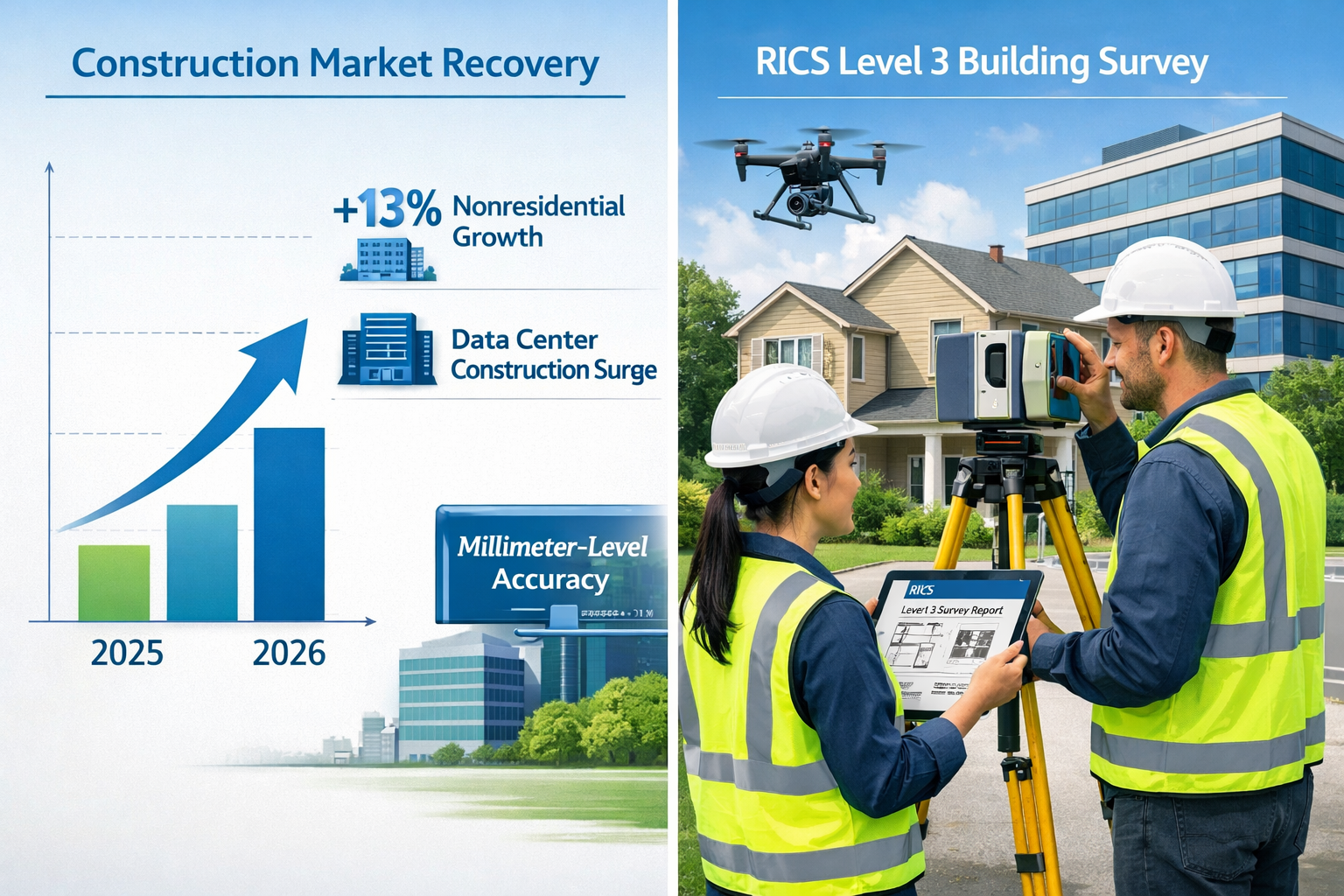
The nonresidential building sector demonstrated remarkable resilience in 2025, with starts growing approximately 13%[3]. This growth trajectory is expected to continue through 2026, driven by several key sectors:
- Education facilities: New school construction and university expansion projects
- Healthcare infrastructure: Hospital modernization and medical facility development
- Public safety buildings: Fire stations, police facilities, and emergency response centers
- Data center construction: Record-breaking growth driven by AI workload demands and cloud computing expansion[3][4]
This diversified growth creates sustained demand for commercial building surveys across multiple property types.
Manufacturing and Industrial Expansion
Manufacturing construction remains elevated throughout 2026, supported by federal incentives tied to:
- Semiconductor production facilities
- Electric vehicle manufacturing plants
- Clean-energy project infrastructure
- Battery production facilities
These large-scale industrial projects require comprehensive initial surveys, ongoing monitoring, and specialized structural assessments.
Build-to-Rent Market Momentum
The BTR sector shows particularly strong pipeline activity, with 110,000 units in combined construction and permitting stages[2]. Major markets driving this growth include:
| Market | Pipeline Strength | Key Drivers |
|---|---|---|
| Phoenix | High | Population growth, affordability |
| Dallas | High | Job market expansion, migration |
| Atlanta | Medium-High | Infrastructure investment |
| Houston | Medium-High | Energy sector recovery |
This sustained BTR development creates consistent demand for pre-acquisition surveys and development-phase inspections.
Residential Market Dynamics
While residential construction faces ongoing challenges including permit delays and tight margins, important positive indicators are emerging:
- 32% of homeowners plan renovation projects in 2026[6]
- Interest rate environment expected to improve, potentially accelerating residential construction response[5]
- First-time buyer activity increasing as market confidence returns
- Renovation and extension projects creating demand for RICS home surveys
The residential survey market in 2026 is characterized by selective activity rather than broad-based growth, requiring surveyors to target specific segments effectively.
Technology as Market Differentiator
Perhaps the most significant shift in the 2026 market recovery is the elevated importance of technology. According to a Trimble survey of 1,800 contractors conducted in November 2025, advanced scanning, surveying, and positioning technologies rank among the highest-priority technology investments[1].
Contractors specifically identified millimeter-level accuracy onsite as a key objective, reflecting the construction industry's emphasis on precision capture and positioning capabilities[1]. For building surveyors, this creates both pressure and opportunity—practices that can deliver technology-enhanced surveys with superior accuracy will command premium positioning in the recovering market.
Building Surveys in the 2026 Market Recovery: Strategic Positioning for Your Practice
Defining Your Market Position
As buyer demand rises and client expectations evolve, surveying practices must clearly define their market position. The 2026 recovery favors specialists who can articulate distinct value propositions.
Service Specialization Strategies
Consider focusing on specific survey types that align with market growth sectors:
- Pre-acquisition surveys for BTR developers: Rapid turnaround, consistent methodology, portfolio approach
- Data center and industrial surveys: Specialized structural assessment, foundation analysis, load-bearing capacity evaluation
- Residential renovation surveys: Detailed defect analysis, extension feasibility, structural surveys for alterations
- Commercial property surveys: Lease-related inspections, investment property due diligence, portfolio assessments
Geographic Focus
The 2026 market recovery is geographically uneven. Practices should analyze local market conditions:
- Construction permit trends in your service area
- Residential transaction volume changes
- Commercial development pipeline
- Infrastructure investment projects
Understanding local market dynamics enables targeted marketing and capacity planning.
Capacity Management in High-Demand Periods
Rising buyer demand creates capacity challenges. Surveying practices must balance growth opportunities against quality maintenance and surveyor wellbeing.
Workflow Optimization
Implement systematic approaches to increase throughput without compromising standards:
- Standardize documentation processes: Create templates for common survey types
- Implement digital reporting systems: Reduce report preparation time through technology
- Establish clear service tiers: Differentiate between Level 2 Homebuyer Surveys and Level 3 Building Surveys with appropriate resource allocation
- Batch similar survey types: Schedule geographically proximate surveys together
- Utilize pre-inspection data gathering: Request property information, plans, and documentation before site visits
Strategic Subcontracting and Collaboration
When demand exceeds internal capacity, consider:
- Establishing relationships with trusted associate surveyors
- Creating referral networks with complementary practices
- Developing partnerships for specialized surveys (drone surveys, asbestos surveys)
- Implementing quality control protocols for external work
Pricing Strategy During Recovery
The 2026 market recovery creates opportunities for strategic pricing adjustments:
- Value-based pricing: Charge based on complexity and value delivered, not just property value
- Service tier differentiation: Clear pricing distinction between survey levels
- Premium positioning: For technology-enhanced surveys with superior accuracy and faster turnaround
- Volume discounting: For BTR developers and portfolio clients requiring multiple surveys
"Practices that articulate clear value propositions and deliver technology-enhanced surveys with superior accuracy will command premium positioning in the recovering market."
Technology Integration for Competitive Advantage
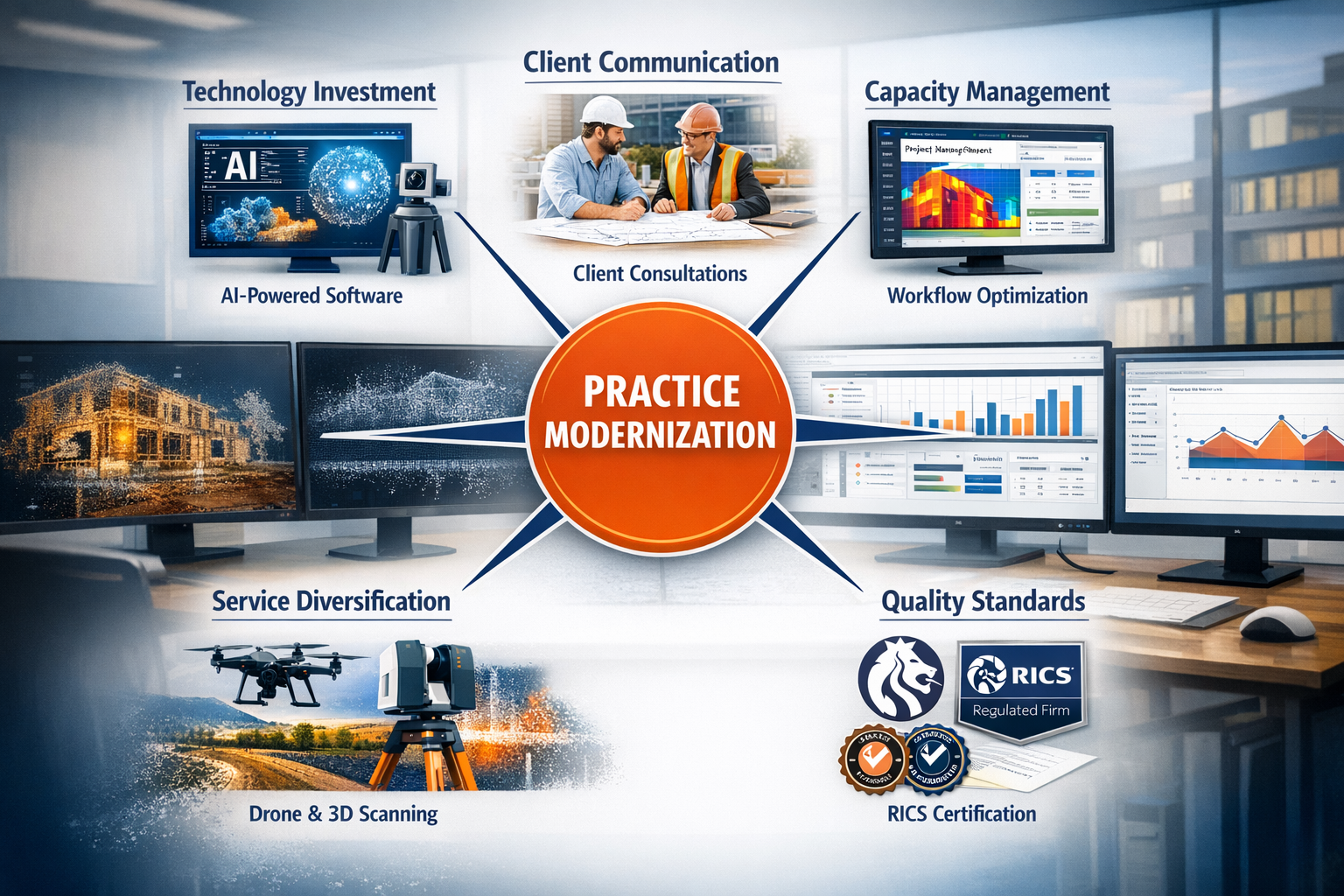
The 2026 market recovery is fundamentally a technology-driven recovery for surveying practices. Contractors' emphasis on millimeter-level accuracy and advanced positioning technologies[1] creates expectations that cascade to building surveyors.
Essential Technology Investments
Priority technology investments for surveying practices in 2026:
| Technology | Application | Business Impact |
|---|---|---|
| Laser scanning equipment | Rapid, accurate dimensional capture | Reduced site time, improved accuracy |
| Thermal imaging cameras | Moisture detection, insulation assessment | Enhanced defect identification |
| Drone survey capabilities | Roof inspection, large site surveys | Safety improvement, comprehensive coverage |
| Digital reporting platforms | Cloud-based report generation and delivery | Faster turnaround, client accessibility |
| AI-powered analysis tools | Defect pattern recognition, risk assessment | Consistency, quality enhancement |
| Mobile survey apps | On-site data capture and annotation | Real-time documentation, efficiency |
Reality Capture Democratization
Trimble's 2026 surveying trends identify reality capture democratization as a key trend[7]. This means advanced 3D scanning and modeling capabilities are becoming accessible to smaller practices, not just large firms.
Practical implementation steps:
- Start with smartphone-based photogrammetry: Low-cost entry point for 3D documentation
- Progress to handheld laser scanners: Mid-range investment for detailed interior capture
- Integrate with reporting systems: Embed 3D models and point clouds in survey reports
- Train all surveyors: Democratize technology use across your team, not just specialists
AI-Driven Surveying Workflows
Artificial intelligence integration into surveying workflows is identified as a top 2026 trend[7]. Practical applications include:
- Automated defect categorization: AI analysis of photographs to identify and classify defects
- Risk scoring algorithms: Consistent risk assessment based on defect patterns
- Report generation assistance: AI-powered drafting of standard report sections
- Historical data analysis: Pattern recognition across your practice's survey database
These technologies don't replace professional judgment—they enhance consistency and allow surveyors to focus on complex analysis and client communication.
Evolving Client Expectations in the 2026 Recovery
The Modern Survey Client Profile
Client expectations have fundamentally shifted. The 2026 buyer is more informed, technology-savvy, and demanding than previous generations.
Information Access and Pre-Survey Research
Modern clients arrive with:
- Extensive online property research completed
- Understanding of common defects from social media and forums
- Expectations shaped by digital service delivery in other industries
- Specific concerns identified from online property listings and virtual viewings
Surveyors must acknowledge this informed starting point and position surveys as professional validation and deeper analysis, not basic information gathering.
Speed and Responsiveness Expectations
The 2026 client expects:
- Rapid quotation response: Within 24 hours of enquiry
- Flexible scheduling: Weekend and evening survey appointments
- Fast report turnaround: 3-5 working days maximum for standard surveys
- Immediate communication: Quick responses to questions and concerns
These expectations require operational adjustments and clear communication protocols.
Communication Excellence as Differentiator
In a recovering market with rising demand, communication quality becomes a key competitive differentiator.
Pre-Survey Client Education
Effective practices invest time in client education before the survey:
- Explain the differences between survey levels clearly
- Set realistic expectations about what surveys can and cannot identify
- Provide guidance on choosing the right property survey for their needs
- Clarify the survey process timeline and deliverables
This upfront investment reduces misunderstandings and increases client satisfaction.
During-Survey Communication
Modern clients appreciate transparency during the survey process:
- Initial findings discussion: Brief on-site conversation about significant defects identified
- Timeline updates: Proactive communication if delays occur
- Preliminary concerns: Immediate notification of serious structural issues requiring urgent attention
- Photo sharing: Selected images sent during or immediately after inspection
Post-Survey Value Delivery
The survey report delivery is not the end of client service—it's a critical touchpoint:
- Report walkthrough calls: 30-minute discussion of key findings and recommendations
- Question availability: Dedicated time for client questions and clarification
- Action prioritization: Clear guidance on which defects require immediate attention versus monitoring
- Specialist referrals: Recommendations for contractors, structural engineers, or specific defect investigations
Digital Report Delivery and Accessibility
The 2026 client expects digital-first service delivery.
Essential Digital Report Features
Modern survey reports should include:
✅ Cloud-based access: Secure online portal for report retrieval and storage
✅ Mobile optimization: Reports readable on smartphones and tablets
✅ Photographic integration: High-quality images with clear annotations
✅ Interactive elements: Clickable table of contents, hyperlinked sections
✅ Summary dashboards: Visual representation of defect severity and priorities
✅ Downloadable formats: PDF for printing, sharing with solicitors and mortgage providers
Enhanced Visualization
Technology enables superior defect communication:
- Thermal imaging overlays: Visual representation of heat loss and moisture
- 3D floor plans: Spatial context for defect locations
- Annotated photographs: Clear marking of defects with arrows and labels
- Comparative images: Before/after or expected/actual condition comparisons
- Video walkthroughs: Recorded explanations of complex structural issues
These enhanced deliverables justify premium pricing and increase client satisfaction.
Building Surveys in the 2026 Market Recovery: Operational Excellence and Service Delivery
Quality Assurance in High-Volume Periods
As demand increases, maintaining consistent quality becomes challenging. Systematic quality assurance processes protect both clients and professional reputation.
Standardized Survey Protocols
Develop comprehensive checklists and protocols for each survey type:
- Pre-survey preparation: Document review, site research, equipment checklist
- On-site inspection sequence: Systematic property examination methodology
- Defect documentation standards: Photographic requirements, measurement protocols
- Safety procedures: Risk assessment, lone working protocols, equipment safety
- Post-survey verification: Completeness check before leaving site
Peer Review Systems
Implement quality control through structured peer review:
- Report review before issue: Second surveyor reviews all reports for completeness and accuracy
- Complex case consultation: Team discussion of unusual defects or challenging properties
- New surveyor mentoring: Experienced practitioners review work of junior team members
- Continuous improvement meetings: Monthly review of client feedback and quality metrics
Professional Development Investment
The 2026 market recovery demands ongoing skill development:
- Technology training: Regular updates on new equipment and software
- Construction methods education: Understanding modern building techniques and materials
- Regulatory updates: Changes to building regulations, RICS standards, safety requirements
- Specialist knowledge: Deep expertise in specific defect types (subsidence, damp, roof defects)
Service Diversification Strategies
The 2026 market recovery creates opportunities for service expansion beyond traditional pre-purchase surveys.
Complementary Survey Services
Expand your service portfolio to capture additional revenue from existing clients:
- Post-purchase reinspections: Follow-up surveys after remedial work completion
- Renovation planning surveys: Detailed analysis for extension and alteration projects
- Monitoring surveys: Ongoing crack monitoring and settlement tracking
- Insurance claim surveys: Damage assessment for insurance purposes
- Energy efficiency assessments: Thermal performance analysis and improvement recommendations
Specialist Defect Investigations
Position your practice as the go-to expert for specific defect types:
- Subsidence investigations: Detailed structural movement analysis
- Damp and moisture surveys: Comprehensive moisture investigation with remediation recommendations
- Roof condition surveys: Detailed roof structure and covering assessment
- Timber defect analysis: Decay, beetle infestation, and structural timber assessment
Commercial and Investment Property Services
The 13% growth in nonresidential construction[3] creates commercial survey opportunities:
- Pre-acquisition due diligence: Comprehensive building surveys for investment properties
- Lease-related surveys: Condition assessments for lease negotiations
- Portfolio surveys: Standardized assessments across multiple properties for institutional investors
- Development feasibility surveys: Site assessment for redevelopment potential
Managing Client Relationships for Long-Term Value
The 2026 market recovery is not just about capturing immediate transaction volume—it's about building sustainable client relationships.
Client Retention Strategies
Convert one-time survey clients into long-term relationships:
- Post-survey follow-up: 6-month and 12-month check-in calls
- Maintenance advice: Seasonal property care guidance
- Priority scheduling: Preferential booking for previous clients
- Loyalty discounting: Reduced rates for additional surveys or referrals
- Educational content: Regular newsletters with property maintenance tips
Referral Network Development
Systematic referral generation increases lead flow:
- Estate agent partnerships: Preferred surveyor arrangements with active agents
- Solicitor relationships: Professional connections with conveyancing firms
- Mortgage broker networks: Referral arrangements with financial advisors
- Client referral incentives: Structured rewards for client introductions
Reputation Management
In the digital age, online reputation directly impacts enquiry volume:
- Review generation: Systematic requests for Google and Trustpilot reviews
- Testimonial collection: Written testimonials for website and marketing materials
- Case study development: Detailed examples of complex surveys successfully completed
- Social media presence: Educational content demonstrating expertise and approachability
"The 2026 market recovery is not just about capturing immediate transaction volume—it's about building sustainable client relationships that generate referrals and repeat business."
Navigating Market Uncertainties and Risk Factors
Economic Headwinds and Market Volatility
Despite the overall recovery trajectory, the 2026 market contains significant uncertainties that surveying practices must navigate.
Interest Rate Sensitivity
While contractors anticipate a lower interest rate environment in 2026[5], rate movements remain unpredictable. Potential impacts include:
- Residential transaction volume fluctuations: Rate increases could quickly dampen buyer activity
- Commercial development delays: Higher financing costs may postpone projects
- Renovation project cancellations: Homeowners may defer improvement plans if borrowing costs rise
Practices should maintain financial reserves and flexible cost structures to weather demand volatility.
Material Cost and Supply Chain Disruption
Supply chain disruptions and evolving tariffs remain significant concerns affecting project timelines and cost projections[4]. For surveyors, this creates:
- Increased demand for baseline documentation: Developers requiring comprehensive pre-construction surveys
- Re-surveying requirements: Projects delayed and requiring updated assessments
- Cost estimation challenges: Difficulty providing accurate remediation cost guidance
- Client anxiety: Buyers concerned about renovation and repair costs
Surveyors should acknowledge these uncertainties in reports and recommendations, providing cost ranges rather than precise estimates.
Professional Liability in a Changing Market
The 2026 recovery brings heightened professional liability considerations.
Emerging Defect Types
Modern construction methods and materials create new defect patterns:
- Cladding and fire safety issues: Ongoing concerns following building safety legislation
- Modern methods of construction (MMC) defects: Unfamiliar failure modes in modular and prefabricated buildings
- Energy efficiency retrofits: Defects arising from insulation and airtightness improvements
- Smart home technology failures: Building systems integration issues
Surveyors must invest in continuous education to identify and assess these emerging defect types accurately.
Scope of Service Clarity
Clear scope definition protects against liability claims:
- Written terms of engagement: Explicit description of survey scope and limitations
- Exclusion documentation: Clear recording of areas not inspected and reasons
- Assumption statements: Documented assumptions about concealed construction
- Recommendation qualifications: Appropriate caveats on specialist investigation recommendations
Professional Indemnity Insurance
Review insurance coverage to ensure adequate protection:
- Coverage limits: Sufficient for property values in your service area
- Retroactive coverage: Protection for claims arising from previous work
- Technology coverage: Ensure new survey technologies are covered
- Aggregate limits: Adequate for increased survey volume in recovery period
Future-Proofing Your Surveying Practice
Embracing Digital Transformation
The 2026 market recovery accelerates the digital transformation of surveying practices. Firms that resist technology adoption risk obsolescence.
Cloud-Based Practice Management
Implement comprehensive digital systems:
- Client relationship management (CRM): Track enquiries, quotes, and follow-ups systematically
- Job scheduling and dispatch: Optimize surveyor routes and capacity utilization
- Document management: Centralized storage of reports, photographs, and correspondence
- Financial management: Integrated invoicing, payment tracking, and financial reporting
Data Analytics for Business Intelligence
Leverage accumulated data for strategic decisions:
- Service profitability analysis: Identify most profitable survey types and client segments
- Surveyor productivity metrics: Track surveys completed, report turnaround times, client satisfaction
- Market trend identification: Analyze enquiry patterns to anticipate demand shifts
- Pricing optimization: Data-driven pricing decisions based on market conditions and costs
Sustainability and Environmental Considerations
Environmental consciousness is increasingly important to 2026 clients.
Energy Efficiency Assessment Integration
Incorporate environmental performance into standard surveys:
- Thermal performance observations: Identify heat loss areas and insulation deficiencies
- Energy improvement recommendations: Practical suggestions for efficiency upgrades
- Renewable energy feasibility: Assessment of solar panel, heat pump suitability
- Environmental impact considerations: Sustainable material recommendations for repairs
Sustainable Practice Operations
Demonstrate environmental commitment through operational choices:
- Electric vehicle adoption: Transition survey fleet to electric vehicles
- Digital-first operations: Minimize paper use through digital reporting
- Carbon footprint tracking: Measure and reduce practice emissions
- Green certifications: Pursue environmental accreditations and memberships
Building Resilient Business Models
The 2026 recovery provides opportunity to strengthen business fundamentals for long-term sustainability.
Diversified Revenue Streams
Reduce dependence on single service types or market segments:
- Residential and commercial balance: Mix of property types
- Geographic diversification: Service multiple markets to reduce local market risk
- Service type variety: Combination of pre-purchase, specialist, and commercial surveys
- Recurring revenue development: Monitoring services, maintenance contracts, annual inspections
Financial Resilience
Build financial strength during recovery periods:
- Cash reserve accumulation: 3-6 months operating expenses in reserve
- Debt management: Conservative leverage and manageable repayment schedules
- Investment in growth: Strategic reinvestment in technology and capability development
- Profit margin protection: Resist pressure to discount during high-demand periods
Team Development and Retention
Your surveyors are your most valuable asset:
- Competitive compensation: Market-rate salaries and performance incentives
- Career development pathways: Clear progression from graduate to chartered status
- Work-life balance: Reasonable workload management even during busy periods
- Technology enablement: Provide tools that make surveyors' work easier and more effective
Conclusion: Positioning for Success in the 2026 Recovery

Building Surveys in the 2026 Market Recovery: Adapting Your Practice to Rising Buyer Demand and Changing Client Expectations requires strategic thinking, operational excellence, and technological adaptation. The market recovery is real—nonresidential construction grew 13% in 2025[3], data center construction continues at record levels[3][4], and the Build-to-Rent pipeline contains 110,000 units[2]. Buyer confidence is returning, and transaction volumes are increasing.
However, this recovery favors prepared practices. Surveyors who have invested in technology integration, developed clear value propositions, implemented systematic quality assurance, and built client-centric service delivery will capture disproportionate market share.
The key success factors for surveying practices in 2026 include:
🎯 Strategic positioning: Clear market focus and differentiated service offerings
⚙️ Technology adoption: Investment in scanning, imaging, and digital reporting capabilities
📊 Capacity management: Systematic workflow optimization to handle increased demand
🤝 Client communication: Superior service delivery and relationship management
💪 Quality assurance: Consistent standards even during high-volume periods
🔮 Future-proofing: Continuous adaptation to emerging technologies and market trends
Actionable Next Steps
To position your surveying practice for success in the 2026 market recovery, take these concrete actions:
Immediate Actions (Next 30 Days)
- Assess current capacity: Calculate maximum sustainable survey volume with existing resources
- Review technology stack: Identify critical technology gaps and create investment plan
- Audit client communication: Evaluate current communication touchpoints and identify improvements
- Analyze service profitability: Determine which survey types generate best margins
- Update marketing materials: Ensure website and materials reflect current capabilities and market position
Short-Term Initiatives (Next 90 Days)
- Implement priority technology: Acquire and train on one key technology (thermal imaging, digital reporting, or mobile survey app)
- Develop service tier clarity: Create clear differentiation between survey levels and pricing
- Establish quality protocols: Document standardized procedures for each survey type
- Build referral networks: Initiate conversations with estate agents, solicitors, and mortgage brokers
- Create client education content: Develop guides, FAQs, and resources that demonstrate expertise
Medium-Term Strategies (Next 12 Months)
- Complete digital transformation: Implement comprehensive practice management and reporting systems
- Diversify service portfolio: Add at least two complementary services to core offerings
- Develop specialist expertise: Build deep knowledge in specific defect types or property sectors
- Build financial reserves: Accumulate cash reserves for market volatility and investment opportunities
- Invest in team development: Provide technology training, professional development, and career pathways
The 2026 market recovery represents a pivotal moment for building surveying practices. Those who adapt strategically, invest wisely, and deliver exceptional client value will not only survive the recovery—they will thrive and establish market leadership for years to come.
The question is not whether the market is recovering—the data confirms it is. The question is whether your practice is positioned to capitalize on the opportunity. The time to act is now.
References
[1] Future Construction Technology Trends Contractor Survey – https://www.trimble.com/blog/trimble/en-US/article/future-construction-technology-trends-contractor-survey
[2] Best New Construction Markets 2026 – https://ahlend.com/best-new-construction-markets-2026/
[3] Construction Outlook For 2026 – https://www.pbmares.com/construction-outlook-for-2026/
[4] Engineering And Construction Industry Outlook – https://www.deloitte.com/us/en/insights/industry/engineering-and-construction/engineering-and-construction-industry-outlook.html
[5] constructiondive – https://www.constructiondive.com/news/5-construction-trends-2026/808904/
[6] 101898 Survey 23 Plan To Re Roof In 2026 – https://www.roofingcontractor.com/articles/101898-survey-23-plan-to-re-roof-in-2026
[7] Doubling Down On Digital Top 6 Surveying Trends Shaping 2026 From Trimble Experts – https://nottinghillsurveyors.com/blog/doubling-down-on-digital-top-6-surveying-trends-shaping-2026-from-trimble-experts