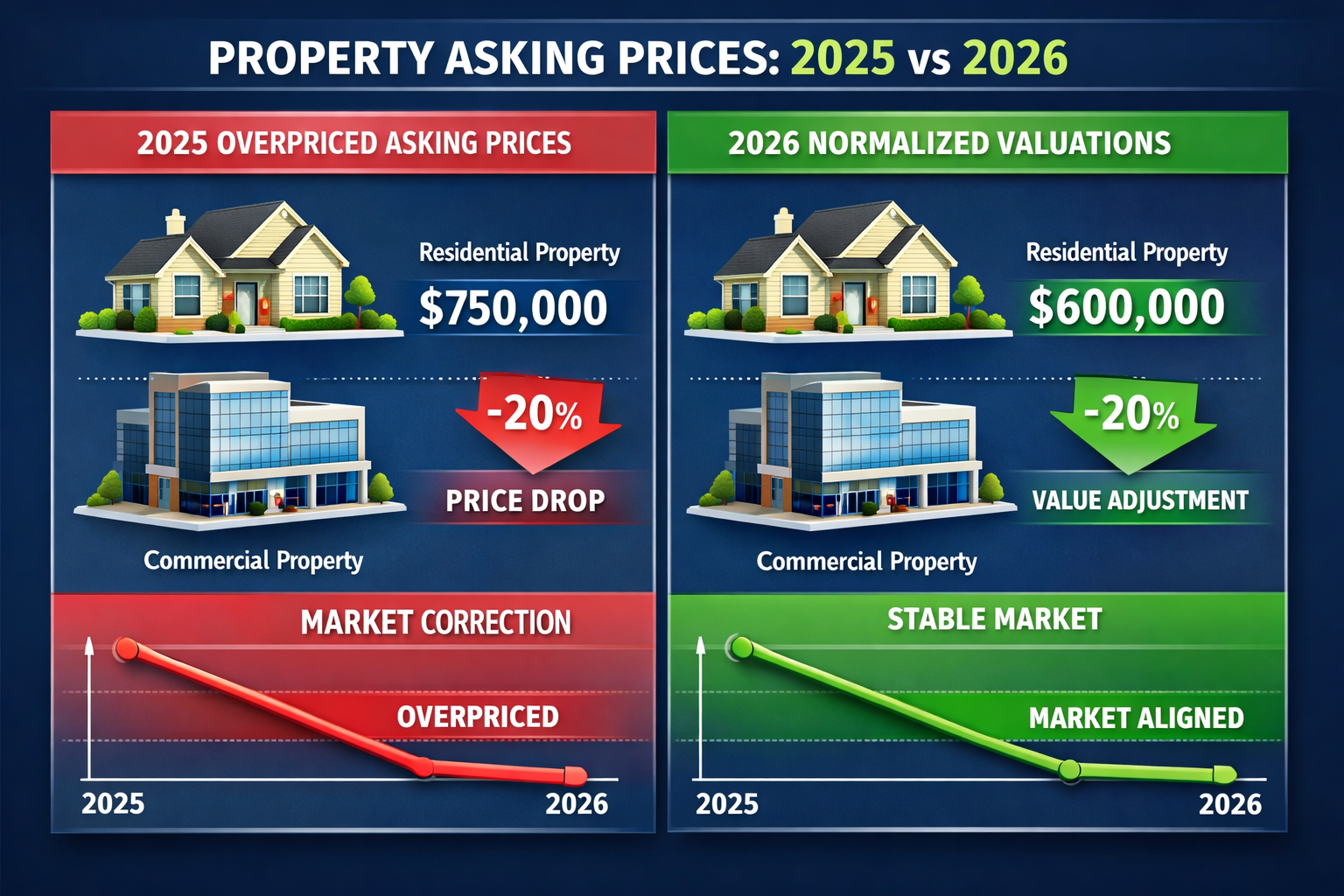
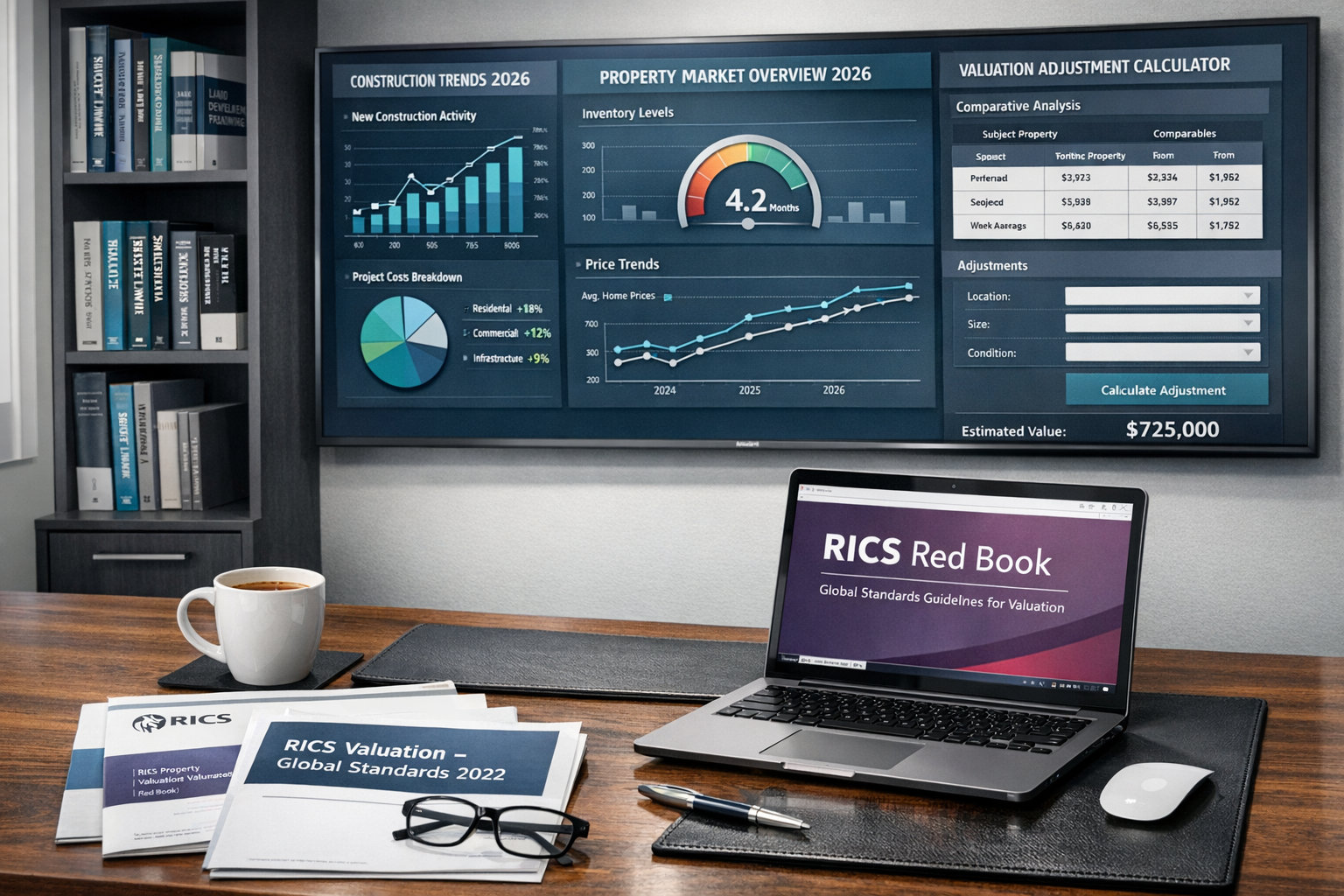
{"cover":"Professional landscape format (1536x1024) editorial hero image showing a modern chartered surveyor in business attire examining architectural blueprints and property valuation documents on a sleek desk, with dual computer monitors displaying property market graphs showing price normalization trends and inventory repositioning data for 2026, background features subtle imagery of residential and commercial buildings through office windows, color palette of deep navy blue, crisp white, and professional gold accents, high contrast lighting, magazine quality photography, sophisticated business aesthetic, no text overlays or labels on image","content":["Detailed landscape format (1536x1024) image depicting a professional surveyor conducting an on-site building inspection with modern digital tablet and laser measuring equipment, examining structural elements of a property interior including walls and ceiling, background shows clipboard with valuation checklists and property condition notes, foreground displays subtle overlay of transparent market data charts showing stock repositioning trends, warm natural lighting through windows, professional survey equipment visible including moisture meters and thermal imaging camera, color scheme of warm greys, professional blues, and natural wood tones, photorealistic quality with sharp focus on inspection activities","Comprehensive landscape format (1536x1024) infographic-style visualization showing the evolution of property asking prices from 2025 to 2026, featuring side-by-side comparison of identical residential and commercial properties with original inflated asking prices versus normalized 2026 valuations, includes visual elements such as downward trending arrows, percentage reduction indicators, market correction graphs with clear data points, professional color-coded zones showing overpriced versus market-aligned properties, clean modern design aesthetic with navy blue, coral red for reductions, and green for stable valuations, high-quality business presentation style with depth and dimensional elements","Detailed landscape format (1536x1024) image showing a modern surveyor's office workspace with large wall-mounted screens displaying comprehensive property market analytics for 2026, including interactive dashboards with construction sector trends, inventory levels, comparative market analysis charts, and valuation adjustment calculators, foreground shows professional desk with RICS valuation standards documentation, laptop displaying Red Book guidelines, coffee cup suggesting active work environment, background features bookshelf with property law references, color palette of professional charcoal grey, crisp white, and accent teal, bright professional lighting, contemporary business photography style"]
}

The property market in 2026 presents a unique challenge for building surveyors and valuation professionals. As unsold inventory from 2025 re-enters the market with adjusted asking prices, building surveyors must recalibrate their valuation methodologies to reflect genuine market recovery versus artificial price reductions. This shift requires a nuanced understanding of market dynamics, construction trends, and the factors driving price normalization across both residential and commercial sectors.
The transition from inflated asking prices to market-realistic valuations demands that surveyors adopt new analytical frameworks. Properties that sat unsold throughout 2025 are now being repositioned with adjusted expectations, creating a complex landscape where distinguishing between true market value and strategic pricing adjustments becomes essential for accurate surveying and valuation work.
Key Takeaways
✅ Market repositioning in 2026 requires surveyors to differentiate between genuine value recovery and tactical price reductions on previously unsold stock
📊 Construction sector trends including data center growth and commercial decline directly impact property valuations and survey methodologies
🏗️ Workforce challenges and material costs continue to influence replacement cost assessments and building condition evaluations
💡 Enhanced valuation frameworks must account for normalized asking prices while considering sector-specific construction activity patterns
🔍 RICS standards and Red Book guidelines provide essential frameworks for navigating the complexities of a recovering market environment
Understanding the 2026 Property Market Recovery Context

The Legacy of 2025's Unsold Inventory
The property market entering 2026 carries significant baggage from the previous year. Unsold inventory accumulated throughout 2025 due to several converging factors: elevated interest rates, buyer hesitancy, and asking prices that failed to align with market realities. Now, as sellers adjust their expectations and properties re-enter the market with corrected pricing, building surveyors face the challenge of determining whether these adjustments reflect true market conditions or merely temporary tactical repositioning.
For professionals conducting RICS building surveys, this environment demands heightened scrutiny. A property listed at £500,000 in 2025 that now appears at £450,000 may represent either a genuine market correction or an overpriced asset finally approaching realistic valuation. Distinguishing between these scenarios requires comprehensive market analysis beyond traditional survey methodologies.
Construction Sector Dynamics Influencing Valuations
The construction industry in 2026 exhibits mixed trends that directly impact property valuations. According to industry forecasts, data center construction continues its robust growth trajectory, driven by artificial intelligence and cloud computing demands[2][3]. This specialized sector growth creates localized property value impacts, particularly in areas with strong digital infrastructure.
Conversely, commercial and manufacturing construction face significant headwinds. Traditional office space development has declined as hybrid work models become permanent fixtures[3][5]. Manufacturing facility construction shows weakness amid economic uncertainty and shifting global supply chains[1][4]. These sector-specific trends require surveyors to apply different valuation approaches depending on property type and location.
| Construction Sector | 2026 Trend | Impact on Valuations |
|---|---|---|
| Data Centers | Strong Growth | Upward pressure on industrial land values |
| Healthcare Facilities | Moderate Growth | Stable institutional property values |
| Commercial Office | Decline | Downward pressure on office valuations |
| Manufacturing | Weakness | Cautious industrial property assessments |
| Residential | Stabilizing | Gradual normalization of housing prices |
Workforce and Material Cost Considerations
Building surveyors conducting commercial building surveys must account for persistent workforce challenges affecting construction costs. Contractor hiring remains difficult, with skilled labor shortages continuing throughout 2026[1][2][4]. These workforce constraints impact both replacement cost assessments and renovation feasibility evaluations within survey reports.
Material costs present another variable affecting valuations. While some commodity prices have stabilized from pandemic-era peaks, potential tariff implementations and immigration policy changes create uncertainty around future construction costs[1][3][4]. Surveyors must incorporate these cost dynamics when providing valuation guidance, particularly for properties requiring significant remedial work.
Building Surveys in a Recovering Market: Valuation Methodology Adjustments
Recalibrating Comparative Market Analysis
Traditional comparative market analysis (CMA) becomes more complex when asking prices undergo widespread normalization. Building surveyors must look beyond current listing prices to understand the true market position of comparable properties. This requires analyzing:
- Time on market for comparable properties
- Price reduction history revealing seller motivation and market resistance
- Actual transaction prices versus asking prices to identify market gaps
- Inventory levels in specific property segments indicating supply-demand balance
When conducting valuation reports, professionals should establish clear baselines distinguishing between properties priced at genuine market levels and those still undergoing price discovery. A property reduced 15% from its 2025 asking price may still be overvalued if comparable sales indicate a 25% market correction in that segment.
Incorporating Construction Trend Data
The divergent construction trends across sectors require surveyors to apply sector-specific valuation adjustments. For instance, properties in areas experiencing data center development may benefit from infrastructure improvements and employment growth, supporting higher valuations despite broader market softness[2][3].
Healthcare-related properties show resilience, with continued construction investment in medical facilities providing valuation support[1][5]. Surveyors assessing properties near expanding healthcare campuses should factor this sustained construction activity into their market analysis.
Conversely, properties dependent on traditional office demand face headwinds. The continued decline in commercial office construction reflects fundamental shifts in workplace patterns[3][5]. Building surveyors must adjust downward their valuation assumptions for office-adjacent properties, recognizing that reduced construction activity signals weakened long-term demand.
Enhanced Due Diligence for Repositioned Stock
Properties re-entering the market after extended listing periods require enhanced scrutiny. Sellers motivated by carrying costs may defer maintenance or conceal developing defects. When conducting specialist defect surveys, surveyors should pay particular attention to:
🔍 Deferred maintenance indicators suggesting financial pressure on sellers
🔍 Recent cosmetic improvements potentially masking underlying structural issues
🔍 Utility and system age that may require near-term capital expenditure
🔍 Environmental compliance gaps accumulated during extended vacancy periods
This enhanced due diligence protects buyers from overpaying for repositioned properties where price reductions don't fully account for condition issues or required remedial work.
Building Surveys in a Recovering Market: Practical Application Strategies
Developing Market-Adjusted Valuation Ranges
Rather than single-point valuations, the 2026 market environment favors valuation ranges that acknowledge ongoing price discovery. When preparing methods of valuation analyses, surveyors should present:
Conservative estimate: Based on distressed comparable sales and worst-case market scenarios
Mid-range estimate: Reflecting current normalized asking prices and typical transaction conditions
Optimistic estimate: Assuming continued market recovery and best-case property positioning
This range-based approach provides clients with realistic expectations while acknowledging market uncertainties. For Red Book valuations, surveyors should clearly document the assumptions underlying each valuation scenario and explain the factors that might move actual market value within the presented range.
Integrating Construction Cost Intelligence
Accurate replacement cost assessments require current construction cost intelligence. With workforce shortages and potential material cost volatility, surveyors must maintain updated cost databases reflecting 2026 market realities[1][4].
"The construction industry faces a perfect storm of labor shortages, regulatory complexity, and material cost uncertainty. Surveyors who fail to account for these factors risk significantly understating replacement costs in their valuations."
When preparing reinstatement cost valuations, professionals should:
- Consult current contractor pricing rather than relying on historical cost data
- Factor in extended construction timelines due to labor availability constraints
- Include contingency allowances for potential material cost increases
- Account for regulatory compliance costs that have increased in recent years
These adjustments ensure that insurance valuations and replacement cost assessments reflect genuine 2026 reconstruction costs rather than outdated assumptions.
Property-Specific Condition Adjustments
The condition of individual properties takes on heightened importance in a normalizing market. Properties with deferred maintenance face steeper valuation discounts as buyers become more selective. Comprehensive building surveys must quantify repair costs with precision, enabling accurate valuation adjustments.
Key condition factors affecting 2026 valuations:
- Roof condition and remaining lifespan – major capital item requiring specific assessment through roof surveys
- Mechanical and electrical systems age – replacement costs have increased significantly
- Energy efficiency ratings – growing importance in buyer decision-making
- Structural integrity – foundation, framing, and load-bearing element condition
- Moisture and damp issues – requiring specialized damp surveys for accurate cost estimation
Each identified defect should be costed at current 2026 contractor rates, with the aggregate repair burden factored into the final valuation assessment.
Geographic Market Segmentation
Not all markets are recovering at the same pace. Building surveyors must apply geographic segmentation to their valuation methodologies, recognizing that local market conditions vary significantly. Areas with strong employment growth, particularly in technology and healthcare sectors, show more robust recovery than regions dependent on declining industries[2][3].
When working with local chartered surveyors, professionals benefit from granular market knowledge that national data cannot provide. Local expertise reveals:
- Neighborhood-specific price trends that may diverge from regional patterns
- Development pipeline impacts on future supply and demand balance
- Infrastructure improvements affecting property accessibility and desirability
- School district quality changes influencing residential property values
- Commercial tenant mix shifts impacting retail and office property valuations
This localized approach prevents over-reliance on broad market trends that may not reflect specific property circumstances.
Navigating Regulatory and Professional Standards in 2026
RICS Standards in a Transitional Market
The Royal Institution of Chartered Surveyors (RICS) provides essential guidance for navigating uncertain market conditions. The RICS Valuation – Global Standards (Red Book) establishes principles that remain applicable regardless of market volatility. However, the 2026 environment requires particular attention to:
Uncertainty and material uncertainty clauses: When market evidence is limited or contradictory, surveyors must clearly communicate valuation uncertainty to clients. Properties in rapidly adjusting market segments may warrant material uncertainty declarations.
Valuation approaches: The income approach, cost approach, and market approach may yield divergent results in transitional markets. Surveyors should reconcile these approaches transparently, explaining which method receives primary weight and why.
Assumptions and special assumptions: Repositioned properties often require special assumptions about buyer motivation, financing availability, or market timing. These must be explicitly stated in valuation reports.
Documentation and Defensibility
In a market characterized by price adjustments and repositioning, thorough documentation becomes essential for professional liability protection. Surveyors should maintain comprehensive files including:
📋 Market data sources with collection dates and verification methods
📋 Comparable property analysis showing adjustments and reasoning
📋 Cost estimation support from contractors or cost databases
📋 Inspection photographs documenting property condition
📋 Client communication records confirming scope and assumptions
This documentation supports valuation conclusions and provides defensibility if market conditions change unexpectedly or if valuations are later questioned.
Continuing Professional Development
The evolving market requires surveyors to maintain current knowledge through ongoing professional development. Key learning areas for 2026 include:
- Construction sector economic trends and their valuation implications
- Emerging property technologies affecting building performance and value
- Regulatory changes impacting property compliance costs
- Market analysis techniques for transitional market conditions
- Risk assessment methodologies for repositioned properties
Engaging with professional organizations, attending industry conferences, and participating in specialized training ensures that surveyors maintain the expertise necessary for accurate valuations in complex market environments.
Strategic Considerations for Different Property Types
Residential Property Valuations
Residential markets show gradual stabilization in 2026, but regional variations remain significant. Surveyors conducting homebuyer surveys should recognize that:
First-time buyer segments remain price-sensitive, with affordability constraints limiting value growth in entry-level markets. Properties priced above realistic first-time buyer thresholds face extended marketing periods and further price reductions.
Move-up buyer segments show more resilience, particularly for properties offering home office space and outdoor amenities that became priorities during recent years. These properties may command premiums over pre-pandemic valuation ratios.
Luxury segments experience the most significant repositioning, with 2025's unsold high-end inventory undergoing substantial price corrections. Surveyors must carefully analyze comparable sales rather than relying on asking prices in this segment.
Commercial Property Challenges
Commercial property valuations require particularly careful analysis in 2026. The continued decline in office construction signals fundamental demand weakness[3][5]. When conducting commercial valuation work, surveyors should:
Analyze tenant quality and lease terms with heightened scrutiny, recognizing that tenant retention is uncertain in weak demand environments
Apply higher capitalization rates reflecting increased investment risk in office and retail properties
Consider alternative use potential for properties that may undergo conversion to residential or mixed-use formats
Assess location quality more critically, as flight-to-quality trends concentrate demand in premier locations while secondary markets weaken
Industrial and Specialized Properties
Industrial properties show divergent trends. Data center and logistics properties benefit from strong fundamentals, supporting stable or increasing valuations[2][3]. Conversely, traditional manufacturing facilities face uncertainty amid economic headwinds[1][4].
For specialized properties requiring dilapidations surveys, surveyors must account for the costs of bringing properties to required condition standards, which have increased due to labor and material cost pressures.
Risk Management and Client Communication
Managing Client Expectations
Effective communication becomes critical when valuations disappoint client expectations. Property owners who purchased or listed properties in 2024-2025 may resist accepting current market realities. Surveyors must:
Present objective market evidence supporting valuation conclusions
Explain market dynamics driving price normalization clearly and professionally
Provide context comparing current conditions to historical market cycles
Offer strategic guidance on timing decisions and property improvements that might enhance value
This educational approach helps clients understand that current valuations reflect market conditions rather than surveyor judgment, reducing conflict and supporting informed decision-making.
Identifying Red Flags in Repositioned Properties
Properties undergoing significant price reductions warrant additional scrutiny for potential issues. Surveyors should investigate:
⚠️ Unusual transaction history suggesting title or legal complications
⚠️ Extended vacancy periods potentially indicating hidden defects or location issues
⚠️ Incomplete renovations that may signal financial distress or permit problems
⚠️ Neighborhood decline indicators affecting long-term value prospects
⚠️ Environmental concerns that previous buyers may have discovered during due diligence
Identifying these red flags protects clients from properties where price reductions inadequately compensate for underlying problems.
Liability Considerations
Professional indemnity insurance becomes particularly important in volatile markets where valuations may be challenged. Surveyors should:
- Maintain adequate insurance coverage reflecting current practice volume and property values
- Document limitations on inspection scope and information availability
- Communicate uncertainty clearly when market evidence is ambiguous
- Avoid pressure to support predetermined valuations that lack market support
- Seek peer review for complex or high-value assignments
These practices protect both professional reputation and financial security in an environment where valuation disputes may increase.
Conclusion
Building surveys in a recovering market require surveyors to adapt their methodologies to the unique challenges of 2026. As unsold inventory from 2025 re-enters the market with adjusted asking prices, distinguishing between genuine market recovery and tactical price repositioning becomes essential for accurate valuations. The divergent construction sector trends—with data center growth contrasting against commercial and manufacturing weakness—create complex market dynamics that demand nuanced analysis.
Successful navigation of this environment requires surveyors to:
✅ Develop market-adjusted valuation ranges that acknowledge ongoing price discovery
✅ Incorporate current construction cost intelligence reflecting labor shortages and material cost pressures
✅ Apply enhanced due diligence to repositioned properties that may conceal deferred maintenance
✅ Utilize geographic market segmentation recognizing local variations in recovery pace
✅ Maintain rigorous documentation supporting valuation conclusions and professional defensibility
The property market's normalization process will continue throughout 2026, requiring ongoing adaptation of survey and valuation practices. Professionals who invest in market intelligence, maintain current technical knowledge, and communicate transparently with clients will successfully navigate this transitional period while providing the accurate, defensible valuations that market participants require.
Actionable Next Steps
For building surveyors and valuation professionals working in the 2026 market:
- Update market databases with recent transaction data, distinguishing between asking prices and actual sales
- Establish relationships with contractors to obtain current construction cost estimates
- Review RICS guidance on material uncertainty and valuation in transitional markets
- Enhance inspection protocols to identify deferred maintenance in repositioned properties
- Develop client communication materials explaining market normalization dynamics
- Invest in continuing education focused on construction sector trends and their valuation implications
- Implement robust documentation systems supporting valuation conclusions and professional liability protection
By taking these steps, surveyors position themselves to provide the expert guidance that clients need during this period of market adjustment, while maintaining the professional standards that protect both client interests and surveyor reputation.
References
[1] 2026 Construction Outlook Mixed Trends – https://dailyreporter.com/2026/01/14/2026-construction-outlook-mixed-trends/
[2] 2026 Pcl Construction Industry Outlook Key Trends Data And Sector Insights – https://www.pcl.com/us/en/insights/2026-pcl-construction-industry-outlook-key-trends-data-and-sector-insights
[3] Engineering And Construction Industry Outlook – https://www.deloitte.com/us/en/insights/industry/engineering-and-construction/engineering-and-construction-industry-outlook.html
[4] 2026 Construction Industry Outlook – https://news.agc.org/economics/2026-construction-industry-outlook/
[5] January 2026 – https://www.aia.org/resource-center/consensus-construction-forecast/january-2026