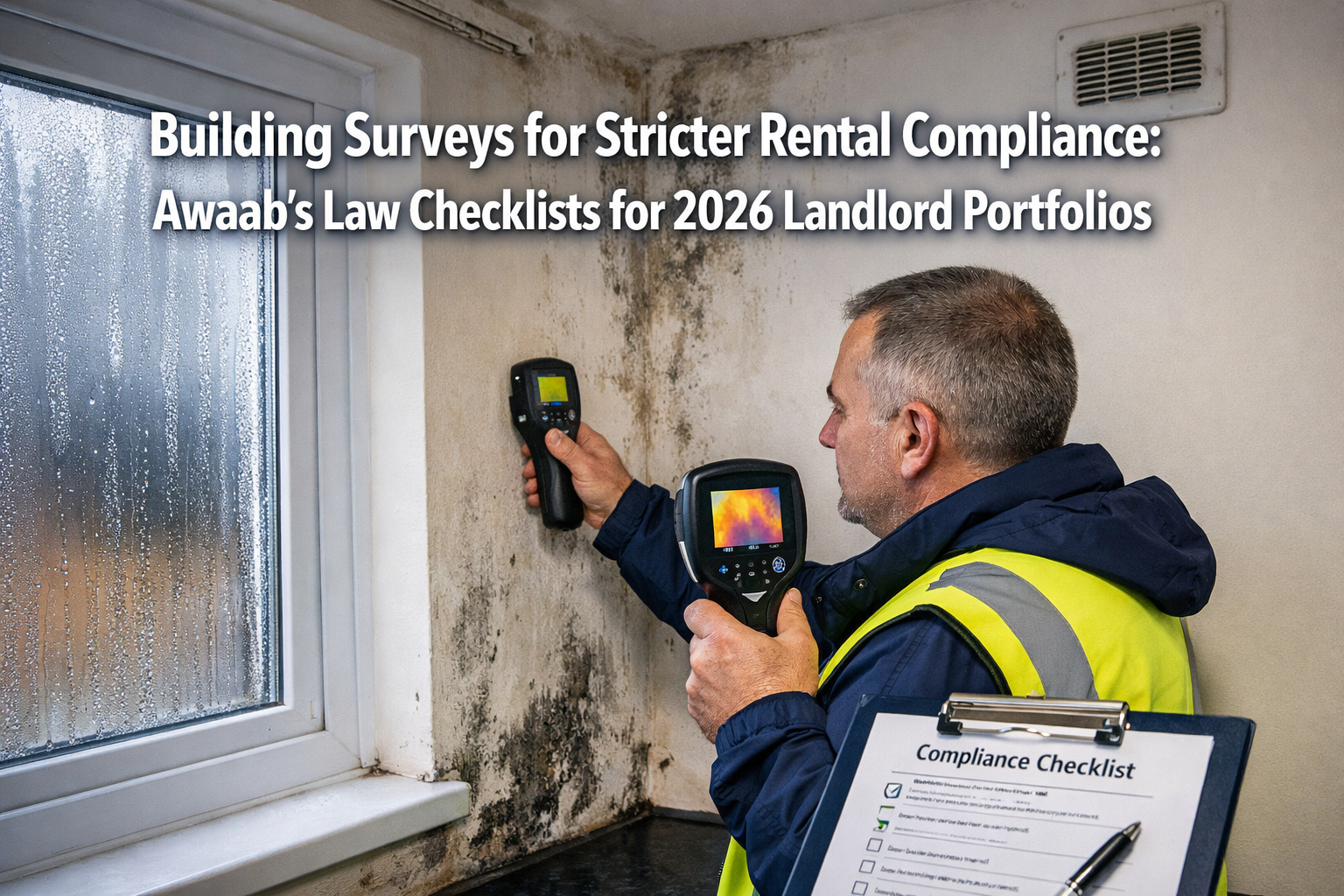

The enforcement of Awaab's Law has fundamentally changed how landlords and housing providers approach property maintenance in 2026. Following its official implementation in October 2025, Building Surveys for Stricter Rental Compliance: Awaab's Law Checklists for 2026 Landlord Portfolios have become essential tools for identifying damp, mould, and ventilation risks before they escalate into legal liabilities. Named after two-year-old Awaab Ishak, who tragically died from prolonged mould exposure in 2020, this legislation establishes mandatory investigation and repair timeframes that demand proactive property assessment strategies.
For institutional buy-to-let investors and portfolio landlords expanding their holdings, comprehensive building surveys now serve as the first line of defence against non-compliance penalties. These detailed inspections uncover hidden hazards that could trigger the law's strict 24-hour emergency response requirements or 10-day investigation deadlines. As the legislation expands to cover 11 additional hazard categories throughout 2026, surveyors have developed practical protocols specifically designed to support compliant portfolio growth.
Key Takeaways
- Awaab's Law mandates strict timeframes: Emergency hazards require investigation within 24 hours, while significant damp and mould issues must be investigated within 10 working days, with repairs completed within 5 working days thereafter
- Building surveys identify compliance risks early: Comprehensive building surveys detect damp, ventilation defects, and structural issues before they become reportable hazards under the legislation
- Phase 2 expansion in 2026 broadens scope: Eleven additional hazard categories including excess cold, fire risks, and structural collapse now fall under mandatory timeframes, requiring more thorough property assessments
- Documentation requirements are extensive: Social landlords must retain complete records of investigations, actions, and tenant communications for at least 6 years, making detailed survey reports critical compliance evidence
- Portfolio-wide compliance strategies are essential: Institutional investors need systematic survey protocols across multiple properties to manage risk exposure and meet expanding regulatory obligations
Understanding Awaab's Law: The 2026 Compliance Landscape
Awaab's Law officially took effect on 27 October 2025 for social housing providers in England, establishing unprecedented mandatory timeframes for addressing health hazards in rental properties.[1] The legislation emerged from the Social Housing (Regulation) Act passed in July 2023, providing a 27-month development period before full enforcement began.[5]
Who Must Comply with Awaab's Law?
The legislation applies exclusively to registered providers of social housing in England, including local authority landlords, housing associations, and registered social landlords under tenancy agreements.[3] Importantly, the law explicitly excludes homeowners, shared ownership arrangements, and unlicensed accommodation from its scope.
While private landlords are not currently subject to Awaab's Law timeframes, the regulatory direction signals broader expectations for the entire rental sector. Proactive private landlords are adopting similar compliance standards to mitigate future regulatory risk and demonstrate duty of care to tenants.
Mandatory Investigation and Repair Timeframes
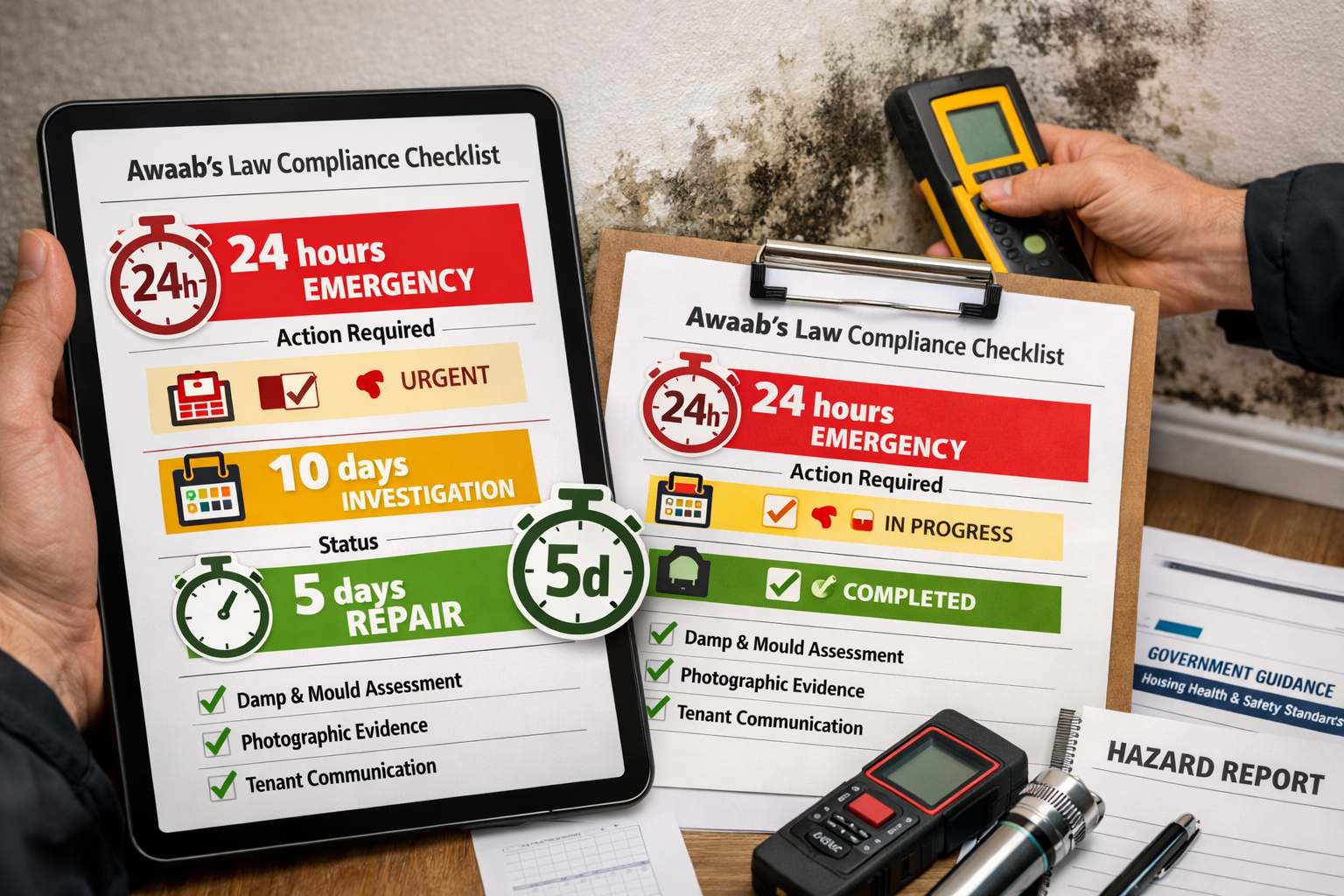
Awaab's Law establishes three critical timeframe categories that landlords must follow:
| Hazard Type | Investigation Deadline | Repair Completion | Documentation Required |
|---|---|---|---|
| Emergency hazards | 24 hours | Immediate action | Photographic evidence, inspection notes |
| Significant damp/mould | 10 working days | 5 working days after investigation | Written updates to tenants within 3 days |
| Preventive works | Investigation within 10 days | Begin within 5 days, complete within 12 weeks | Full action plans and progress reports |
Emergency hazards demand investigation within 24 hours, with photographic evidence and detailed inspection notes required as part of the investigation process.[2] This rapid response requirement means landlords must have immediate access to qualified surveyors or inspection teams capable of mobilizing on short notice.
Significant damp and mould hazards require investigation within 10 working days, representing the extended timeframe for non-emergency significant risks.[3] Following investigation, tenants must receive written updates on outcomes within 3 working days of inspection completion, and relevant safety repairs must be completed within 5 working days.[3]
Phase 2 Expansion: 11 Additional Hazard Categories in 2026
The 2026 expansion broadens Awaab's Law to include 11 additional hazard categories beyond the initial focus on damp and mould:[2]
- ❄️ Excess cold and heat – inadequate heating systems and thermal efficiency
- 🔥 Fire and electrical hazards – faulty wiring, inadequate fire safety measures
- 🏚️ Structural collapse risks – compromised load-bearing elements
- ⚠️ Falls hazards – unsafe stairs, balconies, and elevated surfaces
- 💥 Explosion risks – gas system defects and volatile material storage
- 🧼 Hygiene, sanitation, and drainage – inadequate facilities and blockages
- 🍽️ Food safety issues – kitchen facility defects
- ☠️ Carbon monoxide hazards – faulty combustion appliances
- 🧪 Chemical hazards including VOCs – volatile organic compound exposure
By 2027, all remaining hazards under the Housing Health and Safety Rating System (HHSRS) will come into scope, creating comprehensive coverage beyond the initial phase.[3] This phased approach gives landlords time to conduct thorough property assessments and address identified risks before they become legally actionable.
Record-Keeping Requirements and Legal Consequences
Social landlords must retain complete records of investigations, actions, and communications for at least 6 years, establishing a legally required documentation standard.[2] This extensive record-keeping obligation makes detailed survey reports and inspection documentation essential compliance evidence.
Non-compliance with Awaab's Law timescales can result in court action against housing providers who fail to meet mandatory investigation and repair deadlines.[5] The threat of legal proceedings, combined with potential reputational damage, makes proactive building surveys a risk management priority for portfolio landlords.
Building Surveys for Stricter Rental Compliance: Identifying Hidden Hazards Before They Escalate
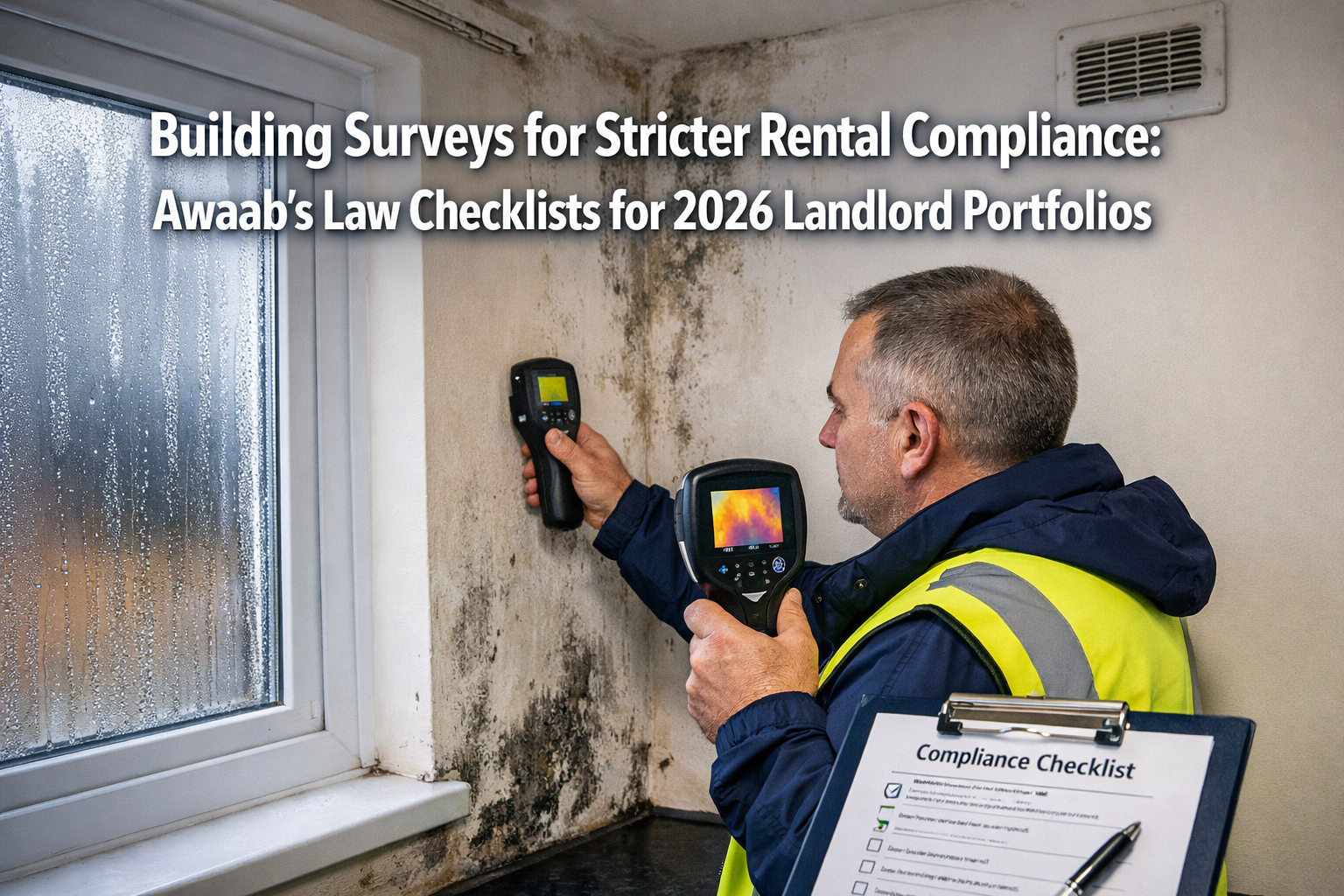
Comprehensive building surveys have become the cornerstone of Building Surveys for Stricter Rental Compliance: Awaab's Law Checklists for 2026 Landlord Portfolios. These detailed property assessments identify potential hazards before tenants report issues, allowing landlords to address problems proactively rather than reactively under strict legal timeframes.
The Role of RICS Building Surveys in Compliance Strategies
RICS building surveys provide the most thorough level of property inspection available, examining all accessible areas of a building to identify defects, hazards, and maintenance requirements. For landlords managing rental portfolios, these surveys serve multiple compliance functions:
Pre-acquisition risk assessment – Before purchasing additional properties, building surveys reveal existing damp, ventilation, or structural issues that would require immediate remediation under Awaab's Law. This information influences purchase decisions and negotiation strategies.
Portfolio-wide hazard mapping – Systematic surveys across existing holdings create a comprehensive risk register, prioritizing properties requiring urgent attention and those needing preventive maintenance.
Compliance documentation baseline – Detailed survey reports establish the property condition at specific points in time, providing essential evidence that landlords conducted reasonable inspections and took appropriate action.
Maintenance planning and budgeting – Survey findings enable accurate forecasting of repair costs and timeline requirements, ensuring adequate financial reserves for compliance-related works.
Damp and Mould Detection: The Primary Focus
Given Awaab's Law's initial emphasis on damp and mould hazards, damp surveys have become specialized compliance tools. Professional surveyors use multiple detection methods to identify moisture problems:
🔍 Visual inspection – Identifying visible mould growth, staining, peeling paint, and efflorescence indicating moisture presence
📊 Moisture meter readings – Electronic measurement of moisture content in walls, floors, and ceilings to detect hidden dampness
🌡️ Thermal imaging – Infrared cameras reveal temperature differentials indicating moisture penetration, thermal bridging, and insulation defects
💨 Ventilation assessment – Evaluating airflow, extraction systems, and condensation risk factors
Understanding damp survey costs helps landlords budget for regular inspections across portfolio properties. Early detection prevents minor moisture issues from developing into significant mould hazards requiring emergency response under Awaab's Law timeframes.
Ventilation System Evaluation: Preventing Condensation Hazards
Inadequate ventilation is frequently the root cause of condensation-related damp and mould growth. Building surveys specifically assess:
- Mechanical ventilation systems – Functionality and capacity of extraction fans in bathrooms, kitchens, and utility areas
- Natural ventilation provision – Adequacy of openable windows, trickle vents, and air bricks
- Positive input ventilation – Performance of whole-house ventilation systems where installed
- Structural ventilation – Sub-floor ventilation, cavity wall ventilation, and roof space airflow
Surveyors calculate air change rates and identify ventilation deficiencies that create condensation-prone environments. Addressing these issues proactively prevents the damp conditions that trigger Awaab's Law investigation requirements.
Structural and Building Fabric Assessment
The 2026 expansion of Awaab's Law to include structural collapse, excess cold, and other building fabric hazards makes comprehensive structural surveys increasingly important for compliance. Key assessment areas include:
Foundation and subsidence risks – Identifying movement, cracking, and subsidence indicators that could compromise structural integrity
Roof condition – Assessing weathertightness, structural adequacy, and insulation performance affecting both water ingress and thermal efficiency
Wall construction – Evaluating cavity wall ties, render condition, and masonry integrity
Windows and doors – Checking for defective seals, broken glazing, and inadequate thermal performance contributing to excess cold hazards
Heating systems – Assessing capacity, functionality, and distribution to prevent excess cold hazards
Electrical installations – Identifying outdated wiring, inadequate earthing, and fire risks
Drainage systems – Evaluating surface water and foul drainage to prevent hygiene and sanitation hazards
This comprehensive approach ensures surveyors identify the full range of hazards now covered under Awaab's Law's expanded scope.
Creating Property-Specific Compliance Checklists
Following detailed building surveys, surveyors develop property-specific Awaab's Law compliance checklists that translate technical findings into actionable maintenance plans. These checklists typically include:
✅ Immediate action items – Hazards requiring urgent attention to meet 24-hour emergency response requirements
⚠️ Priority repairs – Significant hazards needing investigation and remediation within 10-day timeframes
🔧 Preventive maintenance schedule – Works to address potential hazards before they become reportable issues
📋 Monitoring requirements – Ongoing inspection intervals for areas of concern
📅 Compliance timeline – Specific deadlines aligned with Awaab's Law investigation and repair timeframes
These tailored checklists become working documents for property managers, maintenance teams, and compliance officers, ensuring systematic hazard management across portfolio properties.
Implementing Building Surveys for Stricter Rental Compliance: Awaab's Law Checklists for 2026 Landlord Portfolios
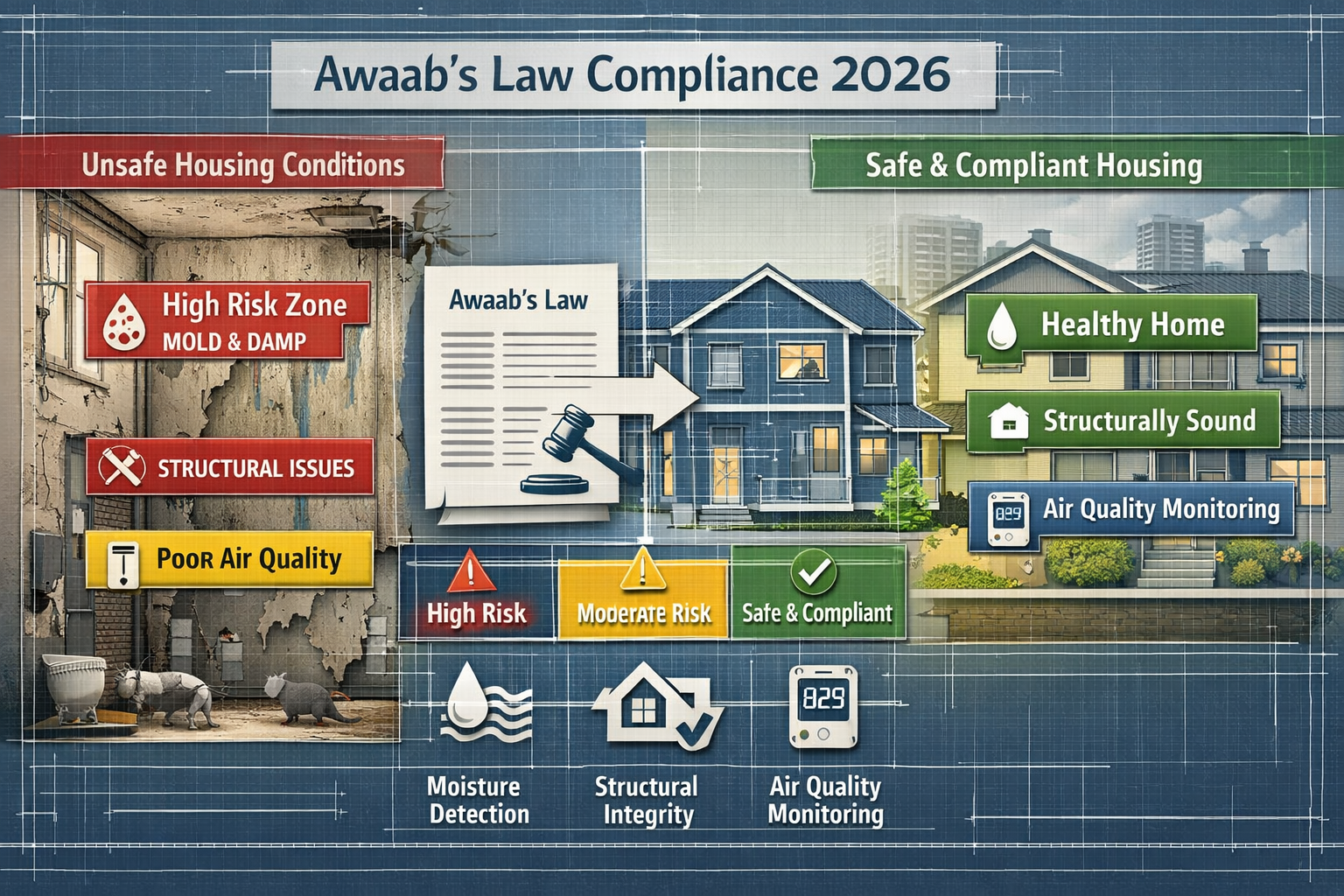
Institutional investors and portfolio landlords require systematic approaches to implement Building Surveys for Stricter Rental Compliance: Awaab's Law Checklists for 2026 Landlord Portfolios across multiple properties. Effective compliance strategies balance thoroughness with operational efficiency and cost management.
Portfolio-Wide Survey Scheduling and Prioritization
Large-scale landlords should implement risk-based survey scheduling that prioritizes properties most likely to contain Awaab's Law hazards:
High-priority properties requiring immediate comprehensive surveys:
- Older buildings (pre-1980s construction with limited insulation and ventilation)
- Properties with previous damp or mould reports
- Buildings with known structural issues or deferred maintenance
- Properties with vulnerable tenants (families with young children, elderly residents)
- Recently acquired properties without recent survey documentation
Medium-priority properties requiring surveys within 6-12 months:
- Mid-age properties (1980s-2000s) with standard construction
- Properties approaching routine maintenance cycles
- Buildings in areas with high rainfall or coastal exposure
- Properties with older heating systems or single-glazed windows
Lower-priority properties suitable for extended survey intervals:
- Recently constructed or comprehensively refurbished properties
- Buildings with documented recent surveys showing no significant issues
- Properties with modern ventilation and heating systems
- Well-maintained buildings with responsive maintenance records
This prioritization approach ensures limited survey budgets focus on highest-risk properties while maintaining oversight across entire portfolios.
Integrating Survey Findings into Maintenance Management Systems
Modern property management software enables systematic tracking of survey findings and compliance deadlines. Effective integration includes:
📊 Digital hazard registers – Centralized databases recording all identified hazards, severity ratings, and remediation status across portfolio properties
⏰ Automated deadline tracking – Calendar systems flagging approaching investigation and repair deadlines based on Awaab's Law timeframes
📸 Photographic evidence libraries – Organized image repositories documenting hazard conditions, investigation activities, and completed repairs
📧 Tenant communication logs – Records of all written updates provided to tenants within required 3-day timeframes
🔄 Work order integration – Direct links between survey findings and maintenance work orders, tracking repair progress and completion
This systematic approach ensures no compliance deadlines are missed and complete documentation exists for the required 6-year retention period.
Cost Considerations for Portfolio Surveys
Understanding structural survey pricing helps landlords budget effectively for compliance-focused building surveys. Several factors influence survey costs:
Property size and complexity – Larger properties with multiple units require more extensive inspection time
Survey scope and specialization – Comprehensive RICS Level 3 surveys cost more than targeted damp assessments but provide broader compliance coverage
Access requirements – Properties requiring scaffolding, drainage surveys, or specialist equipment incur additional costs
Report detail level – Detailed compliance checklists with photographic evidence require more surveyor time than standard reports
Portfolio discounts – Many surveying firms offer reduced per-property rates for multi-property survey programs
Institutional investors typically budget £500-£1,500 per property for comprehensive compliance-focused building surveys, with costs varying based on property characteristics and survey scope. This investment provides essential risk management protection against potential legal action and emergency remediation costs.
Building Surveyor Selection for Compliance Work
Choosing the right property survey provider is crucial for effective compliance management. Portfolio landlords should prioritize surveyors with:
🎓 RICS qualification and regulation – Chartered surveyors bound by professional standards and continuing education requirements
🏠 Residential rental sector experience – Familiarity with common rental property issues and landlord compliance obligations
📋 Awaab's Law knowledge – Understanding of specific hazard categories, investigation requirements, and documentation standards
🔬 Specialist equipment capability – Access to moisture meters, thermal imaging cameras, and other diagnostic tools
📝 Clear reporting standards – Detailed, actionable reports with photographic evidence and compliance-specific recommendations
💼 Professional indemnity insurance – Adequate coverage protecting landlords if survey findings are later disputed
Building long-term relationships with qualified surveying firms enables consistent assessment standards across portfolio properties and efficient coordination of multi-property survey programs.
Developing Rapid Response Protocols for Emergency Hazards
Awaab's Law's 24-hour emergency investigation requirement demands pre-established response protocols. Effective systems include:
24/7 emergency contact procedures – Clear tenant reporting channels with immediate escalation to property management teams
Pre-qualified emergency surveyor panels – Relationships with surveying firms capable of same-day mobilization for emergency inspections
Emergency investigation checklists – Standardized protocols ensuring consistent photographic evidence, moisture readings, and documentation during urgent inspections
Temporary remediation procedures – Immediate risk mitigation measures (dehumidifiers, temporary heating, emergency repairs) deployed while comprehensive solutions are planned
Tenant communication templates – Pre-drafted update letters and emails ensuring 3-day communication deadlines are met consistently
These protocols transform Awaab's Law's strict timeframes from compliance challenges into manageable operational procedures.
Preventive Maintenance Programs Informed by Survey Findings
The most cost-effective compliance strategy involves preventing hazards from developing rather than responding to reported issues. Building survey findings should inform preventive maintenance programs including:
🔧 Regular ventilation system servicing – Quarterly or bi-annual extraction fan cleaning and performance checks
🌡️ Annual heating system maintenance – Boiler servicing and radiator balancing preventing excess cold hazards
🏠 Cyclical external maintenance – Roof, gutter, and external wall maintenance preventing water ingress
🪟 Window and door seal replacement – Proactive renewal of weatherseals preventing drafts and condensation
🧱 Repointing and render repairs – Addressing minor masonry defects before they allow moisture penetration
📅 Scheduled property inspections – Regular internal inspections between tenancies identifying emerging issues
This proactive approach reduces emergency response requirements and demonstrates reasonable landlord diligence in compliance documentation.

Specialized Survey Considerations for Different Property Types
Different rental property types present unique compliance challenges requiring tailored survey approaches within Building Surveys for Stricter Rental Compliance: Awaab's Law Checklists for 2026 Landlord Portfolios.
Period Properties and Non-Standard Construction
Older properties and those with non-standard construction methods require specialized survey expertise. Common issues include:
Solid wall construction – Lack of cavity walls increasing condensation risk and excess cold hazards due to poor thermal performance
Lime mortar and breathable materials – Traditional construction requiring specific repair approaches; inappropriate cement repairs can trap moisture
Historic ventilation systems – Fireplaces, chimneys, and air bricks that may be blocked or removed, reducing natural ventilation
Single-glazed windows – Contributing to both excess cold and condensation issues
Aged drainage systems – Victorian-era drainage requiring specialist drainage surveys to assess functionality
Surveyors assessing period properties must understand traditional construction methods and recommend sympathetic improvements that maintain building character while achieving compliance standards.
Multi-Unit Buildings and HMOs
Houses in Multiple Occupation (HMOs) and multi-unit buildings present concentrated compliance risks requiring comprehensive assessment:
Shared ventilation systems – Central extraction systems serving multiple units requiring coordinated maintenance
Communal areas – Stairwells, hallways, and shared facilities needing regular inspection and maintenance
Multiple heating systems – Individual boilers or heating units requiring systematic servicing schedules
Higher occupancy density – Increased moisture generation from cooking, bathing, and breathing requiring enhanced ventilation
Complex ownership and responsibility structures – Clear documentation of landlord obligations for different building areas
Stock condition surveys provide systematic assessment of multi-unit buildings, creating comprehensive maintenance plans addressing all units and common areas.
Leasehold Properties and Service Charge Implications
Landlords of leasehold rental properties face additional complexity when building surveys identify hazards requiring remediation:
Shared responsibility structures – Determining whether identified hazards fall under landlord or freeholder maintenance obligations
Service charge recovery – Understanding which compliance works can be recovered through service charges versus direct landlord costs
Section 20 consultation requirements – Major works identified through surveys may trigger formal consultation processes with leaseholders
Schedule of dilapidations considerations – Documenting property condition relative to lease repair obligations
Surveyors assessing leasehold rental properties should clearly identify which party bears responsibility for addressing each identified hazard under lease terms.
The Future of Rental Compliance: Preparing for 2027 and Beyond
As Awaab's Law expands to cover all HHSRS hazards by 2027, landlords implementing comprehensive building survey programs in 2026 position themselves advantageously for future regulatory developments.
Anticipated Regulatory Developments
Several regulatory trends suggest continued tightening of rental property standards:
Potential private sector extension – While currently limited to social housing, political pressure may extend Awaab's Law principles to private rentals
Enhanced energy efficiency requirements – Minimum Energy Performance Certificate (EPC) standards continuing to rise, overlapping with excess cold hazard provisions
Electrical safety certification – Mandatory electrical installation condition reports becoming standard across all tenancies
Damp and mould prevention duties – Proactive landlord obligations to prevent hazards, not just respond to reported issues
Digital compliance reporting – Potential requirements for landlords to submit compliance data to regulatory authorities
Landlords adopting rigorous building survey protocols now will find future compliance requirements easier to meet.
Technology Integration in Compliance Monitoring
Emerging technologies are transforming how landlords monitor and manage compliance:
IoT environmental sensors – Wireless humidity, temperature, and air quality monitors providing real-time data on conditions conducive to mould growth
Predictive maintenance algorithms – Machine learning systems analyzing sensor data to predict when hazards are likely to develop
Digital twin property models – 3D building information models integrating survey data, maintenance records, and environmental monitoring
Blockchain compliance records – Immutable documentation of inspections, repairs, and tenant communications meeting 6-year retention requirements
Automated tenant reporting systems – Mobile apps enabling tenants to report issues with photographic evidence, automatically triggering investigation protocols
Forward-thinking landlords are integrating these technologies with traditional building survey programs, creating comprehensive compliance management ecosystems.
Building Surveyor Professional Development
The specialized demands of Awaab's Law compliance are driving professional development within the surveying sector:
Specialized compliance training – RICS and other professional bodies developing specific Awaab's Law assessment modules
Moisture and ventilation expertise – Enhanced focus on hygrothermal analysis and building physics in surveyor education
Legal and regulatory knowledge – Surveyors developing deeper understanding of housing legislation and landlord obligations
Interdisciplinary collaboration – Increased cooperation between building surveyors, environmental health officers, and housing lawyers
Landlords benefit from engaging surveyors who invest in this specialized professional development, ensuring assessments reflect current best practice and regulatory requirements.
Conclusion: Proactive Compliance Through Comprehensive Building Surveys
The enforcement of Awaab's Law in 2025 and its expansion throughout 2026 has fundamentally transformed rental property management in England. Building Surveys for Stricter Rental Compliance: Awaab's Law Checklists for 2026 Landlord Portfolios represent essential risk management tools for institutional investors and portfolio landlords navigating this stricter regulatory environment.
Comprehensive building surveys identify damp, mould, ventilation defects, and the expanding range of hazards covered under the legislation before they escalate into reportable issues requiring emergency response. By detecting problems early, landlords gain time to address issues systematically rather than reactively under strict 24-hour or 10-day deadlines.
The investment in professional building surveys delivers multiple returns: reduced emergency repair costs, protection against legal action, enhanced property values through improved condition, and demonstrated duty of care to tenants. As the legislation expands to cover all HHSRS hazards by 2027, landlords with established survey protocols will adapt more easily than those adopting reactive approaches.
Actionable Next Steps for Landlord Portfolios
Portfolio landlords should take the following actions to ensure compliance with Awaab's Law in 2026:
-
Conduct risk assessment across portfolio – Identify high-priority properties requiring immediate comprehensive building surveys based on age, condition, and tenant demographics
-
Engage qualified RICS surveyors – Establish relationships with chartered surveyors experienced in rental compliance and Awaab's Law requirements
-
Schedule systematic survey program – Develop multi-year survey schedule ensuring all properties receive appropriate assessment within reasonable timeframes
-
Implement digital compliance tracking – Deploy property management systems capable of monitoring hazards, deadlines, and documentation requirements
-
Establish emergency response protocols – Create 24/7 tenant reporting channels and pre-qualified emergency surveyor panels for rapid hazard investigation
-
Develop preventive maintenance programs – Use survey findings to inform proactive maintenance schedules preventing hazard development
-
Train property management teams – Ensure all staff understand Awaab's Law requirements, investigation timeframes, and documentation standards
-
Review insurance coverage – Confirm professional indemnity and liability insurance adequately covers compliance-related risks
-
Budget for compliance works – Allocate sufficient capital reserves for remediation works identified through building surveys
-
Stay informed on regulatory developments – Monitor government guidance and industry updates as the legislation continues evolving through 2027
The tragic circumstances that led to Awaab's Law serve as a sobering reminder of landlords' fundamental duty to provide safe, healthy housing. Comprehensive building surveys and systematic compliance management are not merely regulatory obligations—they represent ethical responsibilities to the tenants who call these properties home. By embracing proactive assessment and maintenance strategies in 2026, landlords protect both their residents and their investment portfolios in an increasingly regulated rental market.
References
[1] Awaabs Law Guidance For Social Landlords Timeframes For Repairs In The Social Rented Sector – https://www.gov.uk/government/publications/awaabs-law-guidance-for-social-landlords/awaabs-law-guidance-for-social-landlords-timeframes-for-repairs-in-the-social-rented-sector
[2] Awaabs Law – https://www.procurementhub.co.uk/news/awaabs-law/
[3] Awaabs Law – https://www.ecosafegroup.co.uk/post/awaabs-law
[4] Landlord Compliance Checklist Renters Rights Act – https://rentersactready.co.uk/blog/landlord-compliance-checklist-renters-rights-act/
[5] Preparing For Awaabs Law A Practical Guide To Social Housing Compliance – https://housingdigital.co.uk/preparing-for-awaabs-law-a-practical-guide-to-social-housing-compliance/