The private rental sector faces its most significant regulatory overhaul in decades: over 4.6 million rental properties across the UK must now meet stringent Decent Homes Standards by May 1, 2026, when the Renters' Rights Act officially takes effect [1]. For building surveyors, property managers, and landlords, this legislative shift transforms routine property assessments into critical compliance exercises that could determine financial viability and legal liability.
Understanding Building Surveys for Private Rental Sector Compliance: Navigating the Renters' Rights Act 2026 and Decent Homes Standards has become essential for anyone involved in the private rental market. The abolition of Section 21 no-fault evictions, combined with mandatory Decent Homes compliance, creates unprecedented scrutiny of property conditions and landlord obligations [1]. Building surveyors must now assess properties not just for structural integrity, but for comprehensive regulatory compliance that protects both landlords from liability and tenants from substandard living conditions.
This guide provides building surveyors with practical frameworks, detailed checklists, and risk assessment strategies for conducting thorough inspections that address the new legislative requirements.
Key Takeaways
- 📅 May 1, 2026 marks the enforcement date for the Renters' Rights Act, requiring all private rental properties to meet Decent Homes Standards
- 🏠 Building surveys must now assess four core compliance pillars: structural stability, modern facilities, thermal comfort, and reasonable repair standards
- ⚖️ Section 21 no-fault evictions are abolished, subjecting landlords to enhanced Section 8 procedures that require documented property condition evidence
- 💰 Rent increase restrictions (once yearly, capped at 2% or CPI, whichever is lower) directly impact property valuations and investment returns [2]
- 📋 Comprehensive survey checklists are essential for documenting compliance and protecting landlords from ombudsman disputes and tenant claims
Understanding the Renters' Rights Act 2026: Core Requirements for Building Surveyors
The Renters' Rights Act 2026 represents the most comprehensive reform of private rental legislation in modern history. For building surveyors, understanding these changes is crucial for conducting effective compliance assessments.
Legislative Timeline and Implementation
The Act officially comes into force on May 1, 2026, but several critical dates affect survey requirements [3]:
- December 27, 2025 – April 30, 2026: Investigation period where violations are subject to new penalty frameworks
- May 1, 2026: Full enforcement begins, including penalties for non-compliance
- July 31, 2026: Deadline for court applications on pre-existing Section 8 and Section 21 notices [3]
Landlords benefit from a grace period for initial breaches during early implementation, providing a window for remedial action without immediate financial penalties [3]. However, building surveyors should advise clients that this grace period does not eliminate liability—it simply delays enforcement.
Abolition of Section 21 No-Fault Evictions
Perhaps the most significant change, Section 21 no-fault evictions are completely abolished as of May 1, 2026 [1]. This fundamentally alters the landlord-tenant relationship and places enormous importance on documented property conditions.
Without Section 21, landlords must rely exclusively on Section 8 grounds for possession, which require:
✅ Specific justifiable reasons for eviction
✅ Documented evidence of property conditions
✅ Compliance with notice procedures under Section 114 [3]
✅ Proof that the property meets Decent Homes Standards
Building surveyors now play a critical role in providing the evidence base for legitimate Section 8 proceedings. A comprehensive structural survey conducted before tenancy commencement and at regular intervals provides essential documentation.
Decent Homes Standard: The New Compliance Benchmark
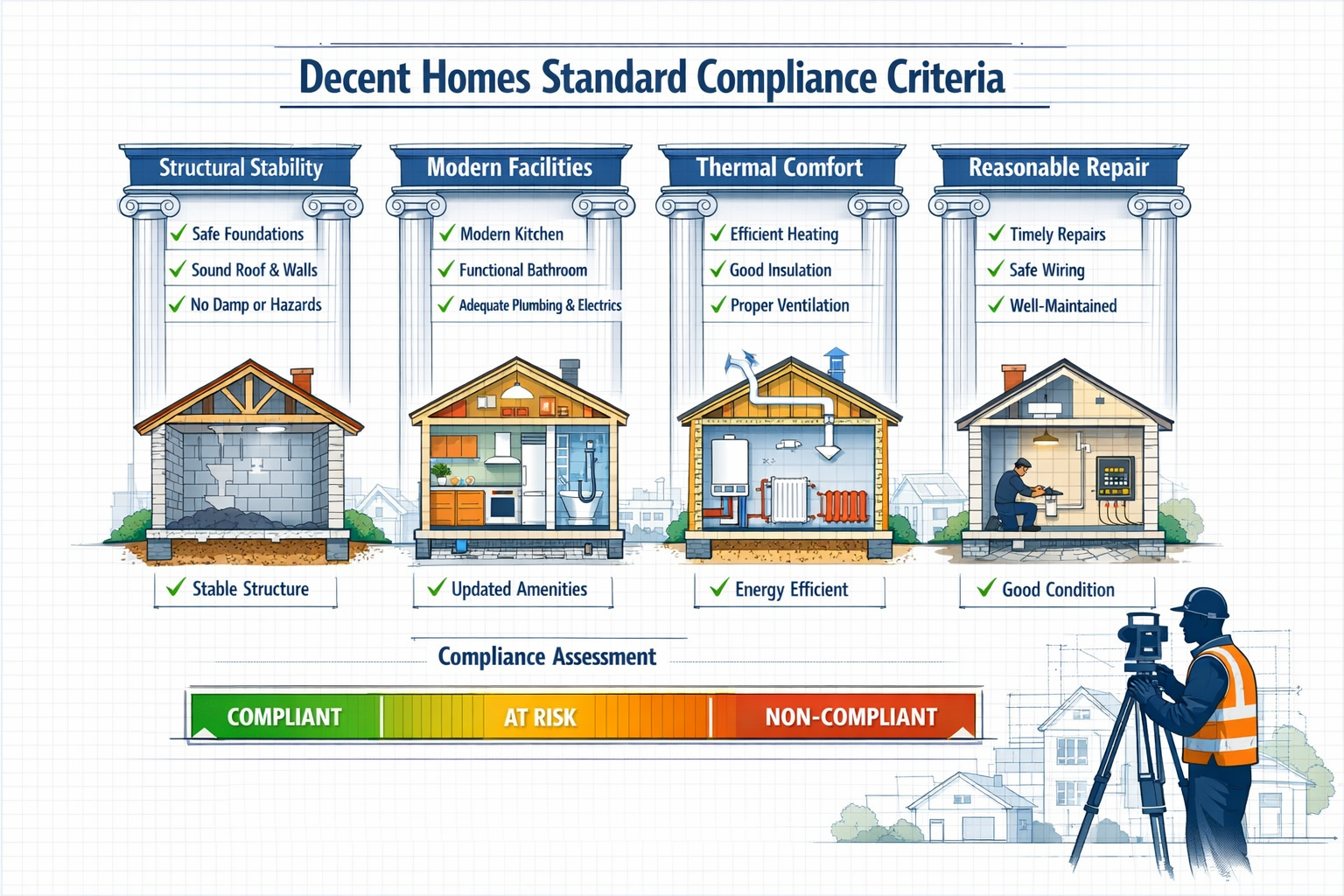
The Act introduces the Decent Homes Standard as a mandatory requirement for all private rental properties [3]. Originally developed for social housing, this standard is now extended to the private sector and encompasses four key criteria:
| Criterion | Requirement | Survey Focus |
|---|---|---|
| Structural Stability | Free from serious disrepair or Category 1 hazards | Foundation integrity, structural elements, load-bearing walls |
| Modern Facilities | Reasonably modern kitchen, bathroom, and heating | Functional appliances, adequate heating systems, updated fixtures |
| Thermal Comfort | Effective insulation and heating | Energy efficiency, draft prevention, heating capacity |
| Reasonable Repair | Good state of repair with no significant defects | General maintenance, decorative condition, functional systems |
Building surveyors must assess each criterion systematically, documenting compliance or identifying remedial actions required. A Level 3 RICS Building Survey provides the comprehensive assessment needed for Decent Homes compliance verification.
Integration of Awaab's Law
The Act incorporates Awaab's Law provisions, which specifically address health hazards from damp, mould, and poor ventilation [3]. Named after a child who died from prolonged exposure to mould, this legislation creates strict timelines for landlords to address hazardous conditions:
- 14 days to investigate reported hazards
- Additional timeframes for remediation based on hazard severity
Building surveyors must now include specific damp surveys as part of comprehensive rental property assessments, identifying moisture ingress, condensation risks, and ventilation adequacy.
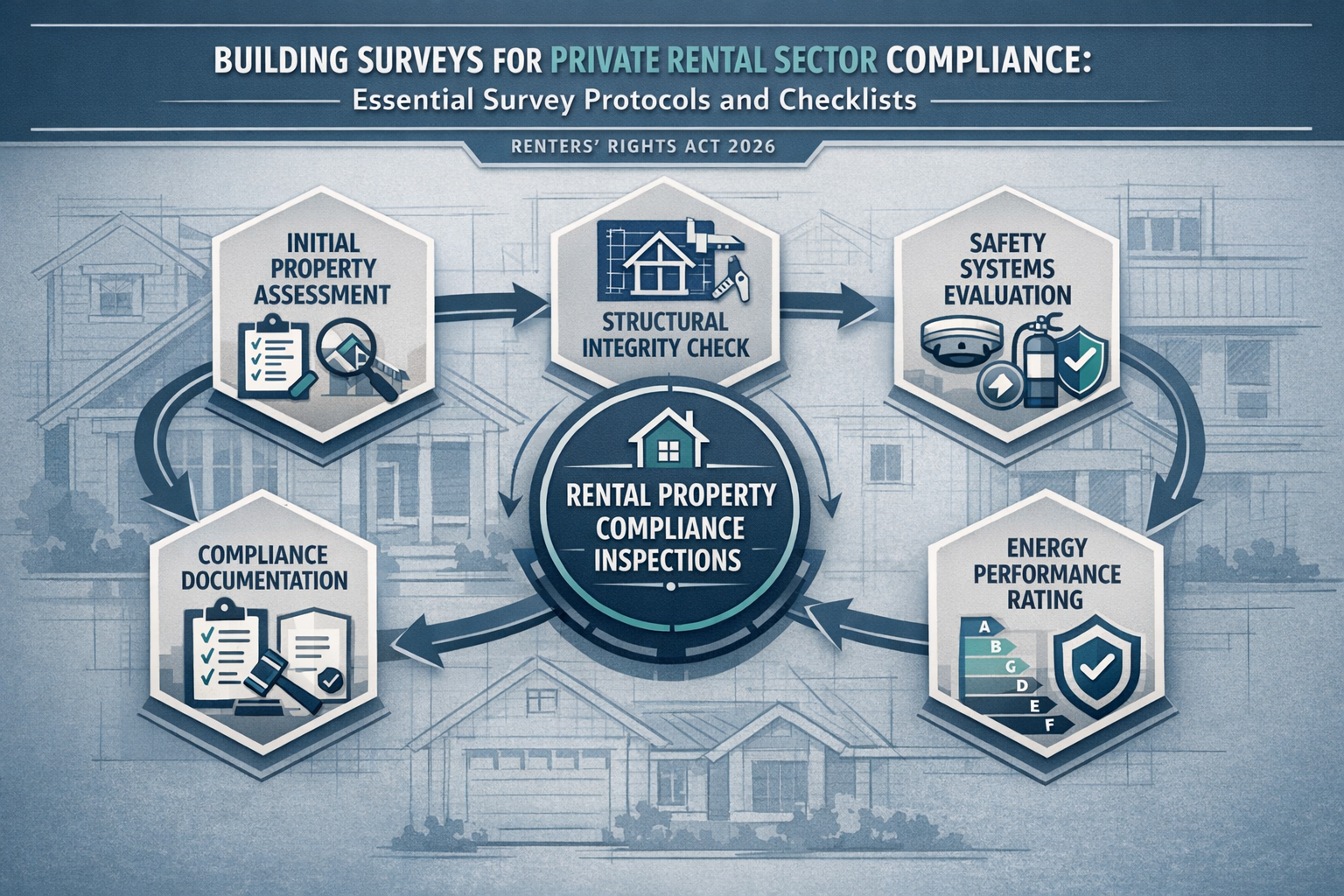
Building Surveys for Private Rental Sector Compliance: Essential Survey Protocols and Checklists
Conducting effective building surveys for private rental sector compliance requires systematic approaches that address both traditional structural concerns and new regulatory requirements. This section provides practical protocols for surveyors navigating the Renters' Rights Act 2026 and Decent Homes Standards.
Pre-Tenancy Compliance Surveys
Pre-tenancy surveys have become essential risk management tools for landlords. These baseline assessments document property conditions before tenant occupation, establishing clear evidence for future dispute resolution.
Recommended Survey Approach
For most private rental properties, a Level 2 Homebuyer Survey provides adequate coverage for standard properties in reasonable condition. However, properties with any of the following characteristics require a more comprehensive Level 3 survey:
- 🏚️ Properties over 50 years old
- 🔧 Evidence of previous structural alterations
- 💧 History of damp or water damage
- 🏗️ Non-standard construction methods
- ⚠️ Visible signs of structural movement
For properties with specific concerns, specialized assessments may be necessary, including subsidence surveys or roof surveys.
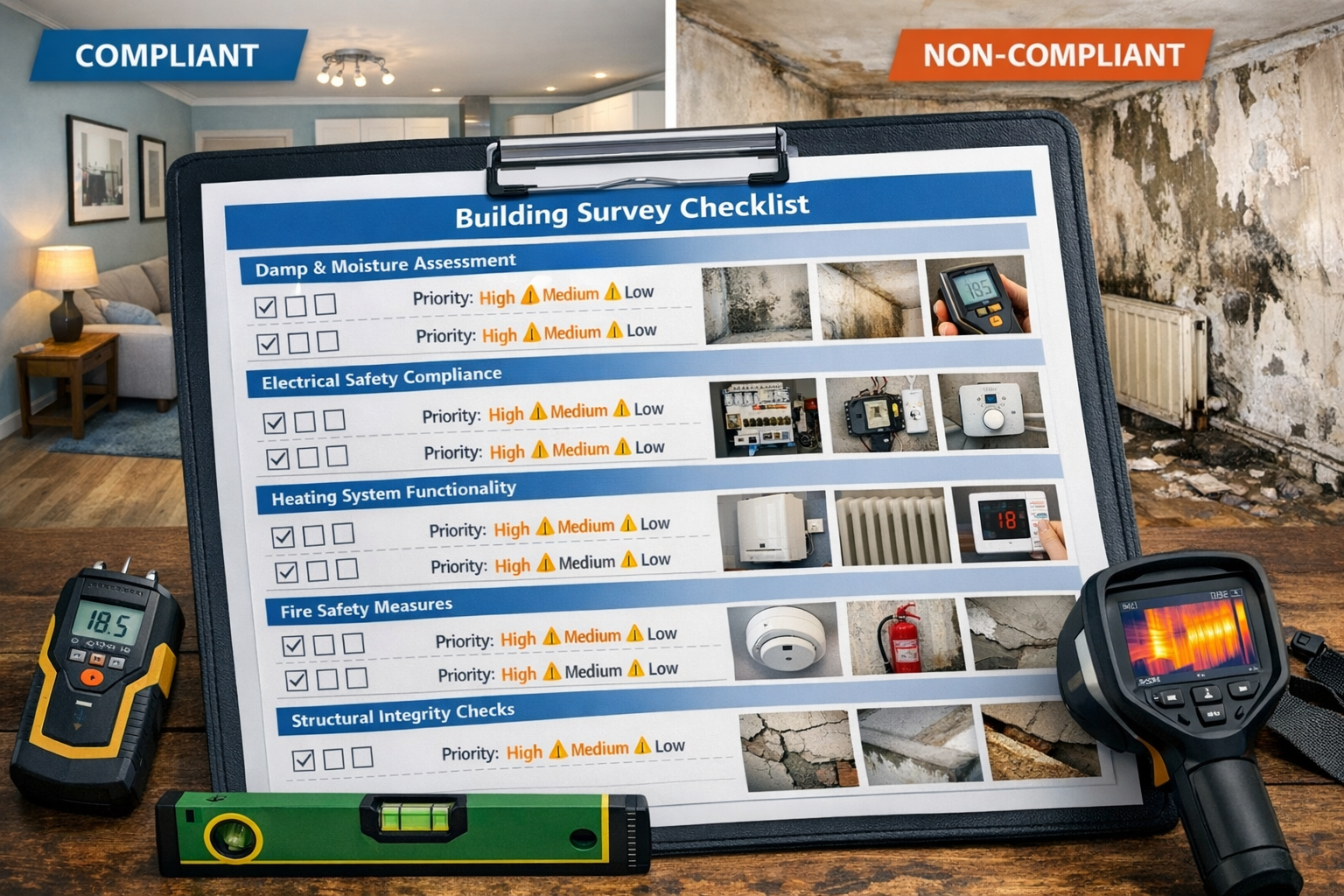
Comprehensive Compliance Checklist
Building surveyors should use a structured checklist that addresses all Decent Homes Standard criteria while documenting evidence for potential Section 8 proceedings or ombudsman disputes [1].
1. Structural Integrity Assessment
- ✅ Foundation condition and stability
- ✅ Load-bearing wall integrity
- ✅ Floor structure and levelness
- ✅ Roof structure and covering condition
- ✅ Chimney stability (if present)
- ✅ External wall condition and pointing
- ✅ Window and door frame integrity
- ✅ Absence of Category 1 hazards under HHSRS
Documentation Required: Photographs of all structural elements, measurements of any cracks or movement, thermal imaging where appropriate.
2. Damp, Moisture, and Ventilation (Awaab's Law Compliance)
This section has heightened importance under Awaab's Law provisions [3]:
- ✅ Rising damp assessment (DPC condition)
- ✅ Penetrating damp identification
- ✅ Condensation risk factors
- ✅ Ventilation adequacy in all rooms
- ✅ Bathroom and kitchen extraction systems
- ✅ Window trickle vents functionality
- ✅ Evidence of mould growth
- ✅ Moisture meter readings in suspect areas
Critical: Any evidence of damp or mould must be documented with moisture readings, photographs, and specific recommendations for remediation timelines. Consider commissioning a specialized damp survey for properties with moisture concerns.
3. Heating and Thermal Efficiency
- ✅ Central heating system presence and functionality
- ✅ Boiler age, condition, and service history
- ✅ Radiator coverage in all habitable rooms
- ✅ Insulation levels (loft, cavity walls, floor)
- ✅ Window glazing type and condition
- ✅ Draft exclusion measures
- ✅ Energy Performance Certificate (EPC) rating
- ✅ Thermostat and heating controls
Minimum Standard: Properties must achieve adequate thermal comfort, typically requiring EPC rating of E or above (though higher standards are recommended).
4. Modern Facilities and Amenities
- ✅ Kitchen facilities: sink, cooking facilities, food storage
- ✅ Kitchen age and condition (reasonably modern standard)
- ✅ Bathroom facilities: bath or shower, toilet, wash basin
- ✅ Bathroom age and condition
- ✅ Hot and cold water supply to all fixtures
- ✅ Adequate electrical outlets in all rooms
- ✅ Functional lighting in all areas
"Reasonably Modern" Definition: While not precisely defined, facilities should generally be less than 30 years old and meet current building regulations standards.
5. Electrical Safety
- ✅ Consumer unit condition and type
- ✅ RCD protection presence
- ✅ Electrical Installation Condition Report (EICR) validity
- ✅ Socket outlet quantity and condition
- ✅ Fixed electrical appliances safety
- ✅ External electrical installations
- ✅ Smoke and carbon monoxide detector presence and functionality
Regulatory Requirement: Valid EICR (less than 5 years old) is mandatory for all rental properties.
6. Fire Safety Measures
- ✅ Smoke alarms on each floor
- ✅ Carbon monoxide detectors near combustion appliances
- ✅ Fire door compliance (if applicable)
- ✅ Escape route adequacy
- ✅ Fire blanket in kitchen (recommended)
- ✅ Emergency lighting (HMOs only)
7. General Repair and Maintenance
- ✅ Internal decoration condition
- ✅ Floor covering condition and safety
- ✅ Window operation and security
- ✅ Door operation and security
- ✅ Plumbing system condition
- ✅ Drainage system functionality
- ✅ Guttering and downpipe condition
- ✅ External areas (gardens, paths, boundaries)
Periodic Compliance Reviews
Beyond pre-tenancy surveys, landlords should commission periodic compliance reviews to maintain Decent Homes Standards throughout tenancies:
- 📅 Annual inspections: Basic compliance check
- 📅 Mid-tenancy surveys: Comprehensive assessment at 2-3 year intervals
- 📅 Pre-renewal surveys: Before tenancy renewal or rent review
- 📅 Responsive surveys: Following tenant maintenance requests or complaints
These periodic assessments help landlords identify emerging issues before they become Category 1 hazards or grounds for tenant complaints to the ombudsman.
Risk Assessment and Landlord Liability Management Under the Renters' Rights Act 2026
The Renters' Rights Act 2026 fundamentally changes the risk landscape for private landlords. Building surveyors must now assess not only physical property conditions but also the legal and financial risks associated with non-compliance.
Understanding Penalty Frameworks and Enforcement
Penalties under the Act come into force on May 1, 2026, with investigations conducted from December 27, 2025 through April 30, 2026 subject to the new framework [3]. While landlords receive a grace period for initial breaches, subsequent violations carry significant financial consequences.
Penalty Categories:
- 💰 Minor violations: Warnings and improvement notices
- 💰 Moderate violations: Fines ranging from £1,000-£7,000
- 💰 Serious violations: Fines up to £30,000
- 💰 Repeated violations: Enhanced penalties and potential rental license revocation
Building surveyors play a crucial role in helping landlords avoid these penalties by identifying compliance gaps before enforcement action.
Section 8 Eviction Evidence Requirements
With Section 21 abolished, landlords must rely exclusively on Section 8 grounds for possession [1]. Building survey documentation becomes critical evidence in possession proceedings:
Evidence Building Surveyors Must Provide:
- Baseline Property Condition: Pre-tenancy survey establishing original condition
- Tenant-Caused Damage Documentation: Comparative assessments showing deterioration beyond normal wear and tear
- Compliance Verification: Evidence that property met Decent Homes Standards at tenancy commencement
- Maintenance Records: Documentation of landlord's responsive repairs and statutory compliance
- Hazard Assessments: Professional evaluation of any Category 1 hazards
A comprehensive schedule of condition report at tenancy commencement provides essential baseline evidence for future Section 8 proceedings.
Ombudsman Dispute Preparation
The Act strengthens tenant rights to raise disputes through the Private Rented Sector Ombudsman [1]. Building surveyors should prepare documentation that withstands ombudsman scrutiny:
Ombudsman-Ready Documentation Includes:
- 📸 Comprehensive photographic evidence with timestamps
- 📊 Quantitative measurements (moisture readings, temperature data, structural measurements)
- 📋 Professional opinions on compliance with Decent Homes Standards
- 🔍 Specific recommendations with cost estimates for remedial works
- 📅 Timeline documentation showing landlord responsiveness to issues
Rent Increase Restrictions and Valuation Impacts
The Act introduces strict rent increase limitations: rent can only be increased once per year by 2% or the Consumer Price Index (CPI), whichever is lower [2]. This fundamentally affects property valuations and investment returns.
Valuation Adjustments Required [5]:
Building surveyors conducting rental property valuations must account for:
- 📉 Reduced rental growth potential: Capped annual increases limit income appreciation
- 📉 Enhanced tenant security: Longer average tenancies reduce turnover income opportunities
- 📉 Compliance cost capitalization: Decent Homes Standard upgrades reduce net yields
- 📉 Increased void risk: Section 8 eviction complexity extends void periods
Example Valuation Impact:
A property previously valued at £300,000 with 5% annual rental growth projections may require valuation adjustment to reflect 2% maximum increases, potentially reducing capital value by 10-15% depending on yield expectations [5].
Proactive Risk Mitigation Strategies
Building surveyors should advise landlords on proactive strategies to minimize liability:
Strategy 1: Pre-Emptive Compliance Upgrades
Rather than reactive repairs, conduct comprehensive surveys identifying all potential Decent Homes Standard gaps and implement upgrades before May 1, 2026.
Priority Upgrade Areas:
- 🔧 Heating system replacements (boilers over 10 years old)
- 🔧 Electrical rewiring (properties without valid EICR)
- 🔧 Damp remediation (any evidence of moisture issues)
- 🔧 Insulation improvements (loft and cavity wall)
- 🔧 Window replacements (single-glazed or deteriorated frames)
Strategy 2: Enhanced Documentation Systems
Implement systematic documentation protocols:
- 📁 Digital survey archives with cloud backup
- 📁 Maintenance log systems with tenant acknowledgment
- 📁 Photographic evidence libraries updated quarterly
- 📁 Compliance certificate repositories (EICR, gas safety, EPC)
Strategy 3: Tenant Communication Frameworks
Establish clear communication protocols that demonstrate landlord responsiveness:
- 📧 Written acknowledgment of all maintenance requests within 24 hours
- 📧 Detailed action plans with timelines for repairs
- 📧 Follow-up documentation confirming work completion
- 📧 Regular property condition updates and inspection scheduling
These communication records provide crucial evidence of landlord diligence in ombudsman disputes and Section 8 proceedings.
Awaab's Law Compliance Timeline Management
Building surveyors must help landlords understand and meet Awaab's Law timelines [3]:
Response Framework:
| Hazard Reported | Investigation Deadline | Remediation Deadline |
|---|---|---|
| Emergency (immediate danger) | 24 hours | 24-48 hours |
| Urgent (health risk) | 7 days | 14 days |
| Non-urgent (potential hazard) | 14 days | 28 days |
Building surveyors should be available for rapid response assessments when tenants report damp, mould, or ventilation issues, providing landlords with professional documentation to meet investigation deadlines.
Pet Accommodation Assessments
The Act introduces tenant rights to request pets, requiring landlords to have reasonable grounds for refusal [3]. Building surveyors may be asked to assess:
- 🐕 Property suitability for pet accommodation
- 🐕 Potential damage risks to specific property features
- 🐕 Garden security and boundary adequacy
- 🐕 Flooring type and damage susceptibility
- 🐕 Neighboring property considerations (noise transmission)
Professional survey evidence supporting pet accommodation decisions protects landlords from discrimination claims while ensuring property protection.
Specialized Survey Considerations for Different Property Types
Different rental property types present unique compliance challenges under the Renters' Rights Act 2026. Building surveyors must adapt assessment approaches accordingly.
Houses in Multiple Occupation (HMOs)
HMOs face enhanced compliance requirements beyond standard Decent Homes Standards:
- 🏢 Mandatory licensing requirements
- 🏢 Enhanced fire safety measures (fire doors, emergency lighting, fire detection systems)
- 🏢 Minimum room size standards
- 🏢 Adequate bathroom and kitchen facilities ratios
- 🏢 Management regulation compliance
A specialized commercial building survey approach may be appropriate for larger HMOs due to their commercial-scale operations.
Period and Listed Properties
Older properties present particular challenges:
- 🏛️ Balancing conservation requirements with Decent Homes Standards
- 🏛️ Listed building consent limitations on modifications
- 🏛️ Traditional construction methods requiring specialist knowledge
- 🏛️ Higher maintenance requirements and costs
Building surveyors should have expertise in non-standard construction when assessing period rental properties.
Purpose-Built Flats and Apartments
Leasehold rental properties require consideration of:
- 🏢 Service charge implications for compliance upgrades
- 🏢 Building-wide systems (communal heating, fire safety)
- 🏢 Freeholder cooperation requirements for major works
- 🏢 Lease restriction considerations
New Build and Modern Properties
Even newer properties require compliance verification:
- ✨ NHBC warranty coverage and limitations
- ✨ Snagging issues affecting Decent Homes compliance
- ✨ Building regulation compliance verification
- ✨ Energy efficiency standard confirmation
Consider commissioning a snagging survey for new build rental properties to identify defects before tenant occupation.
Preparing for May 1, 2026: Implementation Action Plan
With the enforcement date approaching, building surveyors should guide landlords through a structured preparation process.
90-Day Countdown (February 2026)
- 📋 Commission comprehensive compliance surveys on all rental properties
- 📋 Identify all Decent Homes Standard gaps
- 📋 Obtain cost estimates for remedial works
- 📋 Prioritize properties by compliance risk level
60-Day Countdown (March 2026)
- 🔧 Begin priority remedial works (damp issues, heating systems, electrical compliance)
- 🔧 Update all compliance certificates (EICR, gas safety, EPC)
- 🔧 Implement documentation systems for maintenance records
- 🔧 Review and update tenancy agreements for Act compliance
30-Day Countdown (April 2026)
- ✅ Complete all critical compliance works
- ✅ Conduct final compliance verification surveys
- ✅ Organize all documentation (surveys, certificates, maintenance records)
- ✅ Communicate with tenants regarding property improvements and new rights
- ✅ Ensure Section 114 information requirements are met [3]
Post-Implementation (May 2026 onwards)
- 🔄 Establish quarterly property condition monitoring
- 🔄 Implement rapid response protocols for tenant maintenance requests
- 🔄 Schedule annual compliance review surveys
- 🔄 Maintain continuous documentation of all property-related communications
Conclusion
The Renters' Rights Act 2026 and Decent Homes Standards represent a fundamental transformation of the private rental sector, placing building surveyors at the center of compliance verification and risk management. With the May 1, 2026 enforcement date rapidly approaching, landlords must act decisively to ensure their properties meet the new regulatory framework.
Building Surveys for Private Rental Sector Compliance: Navigating the Renters' Rights Act 2026 and Decent Homes Standards requires systematic assessment protocols that address structural integrity, modern facilities, thermal comfort, and general repair standards. The abolition of Section 21 no-fault evictions and introduction of Awaab's Law provisions create unprecedented documentation requirements, making comprehensive building surveys essential rather than optional.
Immediate Action Steps for Landlords and Property Managers
- Commission Pre-Compliance Surveys: Engage qualified building surveyors to assess all rental properties against Decent Homes Standards before May 1, 2026
- Prioritize Remedial Works: Focus first on damp/mould issues (Awaab's Law compliance), heating systems, and electrical safety
- Establish Documentation Systems: Implement robust record-keeping for all surveys, certificates, maintenance requests, and repairs
- Review Rent Increase Strategies: Adjust financial projections to reflect 2% or CPI annual increase caps [2]
- Prepare Section 8 Evidence: Ensure baseline condition documentation exists for all current tenancies
For Building Surveyors: Professional Development Priorities
- 📚 Deepen understanding of Decent Homes Standard criteria and assessment methodologies
- 📚 Develop expertise in rapid response damp and mould assessments (Awaab's Law requirements)
- 📚 Create standardized compliance checklists and reporting templates
- 📚 Establish relationships with remedial contractors for client referrals
- 📚 Stay updated on ombudsman dispute precedents and evidence requirements
The private rental sector's regulatory landscape has permanently changed. Building surveyors who develop specialized expertise in Building Surveys for Private Rental Sector Compliance: Navigating the Renters' Rights Act 2026 and Decent Homes Standards will find themselves in high demand as landlords seek to navigate these complex new requirements while protecting their investments and maintaining positive tenant relationships.
For landlords, the choice is clear: proactive compliance through comprehensive building surveys, or reactive enforcement through penalties, disputes, and potential loss of rental income. The surveyors who guide them through this transition will play an invaluable role in maintaining housing quality and availability in the private rental sector.
References
[1] Renters Rights Act 2026 Building Survey Checklists For Section 8 Evictions And Ombudsman Disputes – https://nottinghillsurveyors.com/blog/renters-rights-act-2026-building-survey-checklists-for-section-8-evictions-and-ombudsman-disputes
[2] Setting And Reviewing Private Rents – https://rtb.ie/renting/setting-and-reviewing-private-rents/
[3] Watch – https://www.youtube.com/watch?v=QszOm-Qmmh4
[4] Build To Rent Restrictions Undermine Benefits Of Federal Housing Legislation – https://www.pew.org/en/research-and-analysis/speeches-and-testimony/2026/03/10/build-to-rent-restrictions-undermine-benefits-of-federal-housing-legislation
[5] Valuation Adjustments For Renters Rights Act 2026 How Building Surveyors Must Assess Landlord Tenant Compliance – https://nottinghillsurveyors.com/blog/valuation-adjustments-for-renters-rights-act-2026-how-building-surveyors-must-assess-landlord-tenant-compliance