
The London property market has entered 2026 with a fundamentally different character than previous years. While national house prices edge cautiously upward, the capital displays a more measured pace—creating what industry experts describe as a "balanced market" where neither buyers nor sellers hold decisive advantage.[1] This equilibrium presents both opportunity and risk, making Building Surveys for London's 2026 Price Sensitivity: Spotting Risks in a Balanced Market more critical than ever for property purchasers navigating uncertain terrain.
London currently experiences the largest stock increases of any UK region, yet ongoing price adjustments continue across many boroughs. This paradox—more properties available but prices still falling in key areas—signals a market in transition. For buyers, this environment demands heightened scrutiny of property condition, retrofit requirements, and hidden defects that could transform an apparent bargain into a costly burden.
Key Takeaways
✅ Market balance creates inspection urgency: London's 2026 balanced market means comprehensive building surveys are essential risk management tools, not optional extras
✅ Regional disparities require location-specific assessment: Price sensitivity varies dramatically across London boroughs, making local defect patterns and retrofit needs critical evaluation factors
✅ Hidden defects pose amplified financial risk: In a price-sensitive market, undiscovered structural issues, damp problems, or retrofit requirements can eliminate negotiation advantages and create unexpected costs
✅ Survey level selection impacts buyer protection: Choosing between RICS survey levels based on property age, construction type, and market conditions directly affects risk exposure in 2026's balanced environment
✅ Spring selling season uncertainty demands due diligence: With market outcomes dependent on spring activity and political factors, thorough property inspections provide crucial decision-making confidence
Understanding London's 2026 Market Dynamics and Price Sensitivity
The Balanced Market Phenomenon
London's property market has entered what analysts characterize as a balanced market—a condition where supply and demand reach relative equilibrium. According to the RICS residential market survey for January 2026, "house prices appear to have stabilised at a national level, although regional disparities are widening."[3] This stabilization masks significant variation across different London areas, creating pockets of opportunity alongside zones of continued price pressure.
The capital's unique position becomes evident when examining reservation rates and buyer behavior. Barratt Redrow reported a net private weekly reservation rate of 0.59 for the period from December 29, 2025 to February 1, 2026, compared to 0.60 in the previous year—indicating stable but not rising demand.[3] Meanwhile, MJ Gleeson saw net reservation rates increase to 0.75 per site per week, suggesting certain market segments outperform others significantly.[3]
Regional Disparities Within London
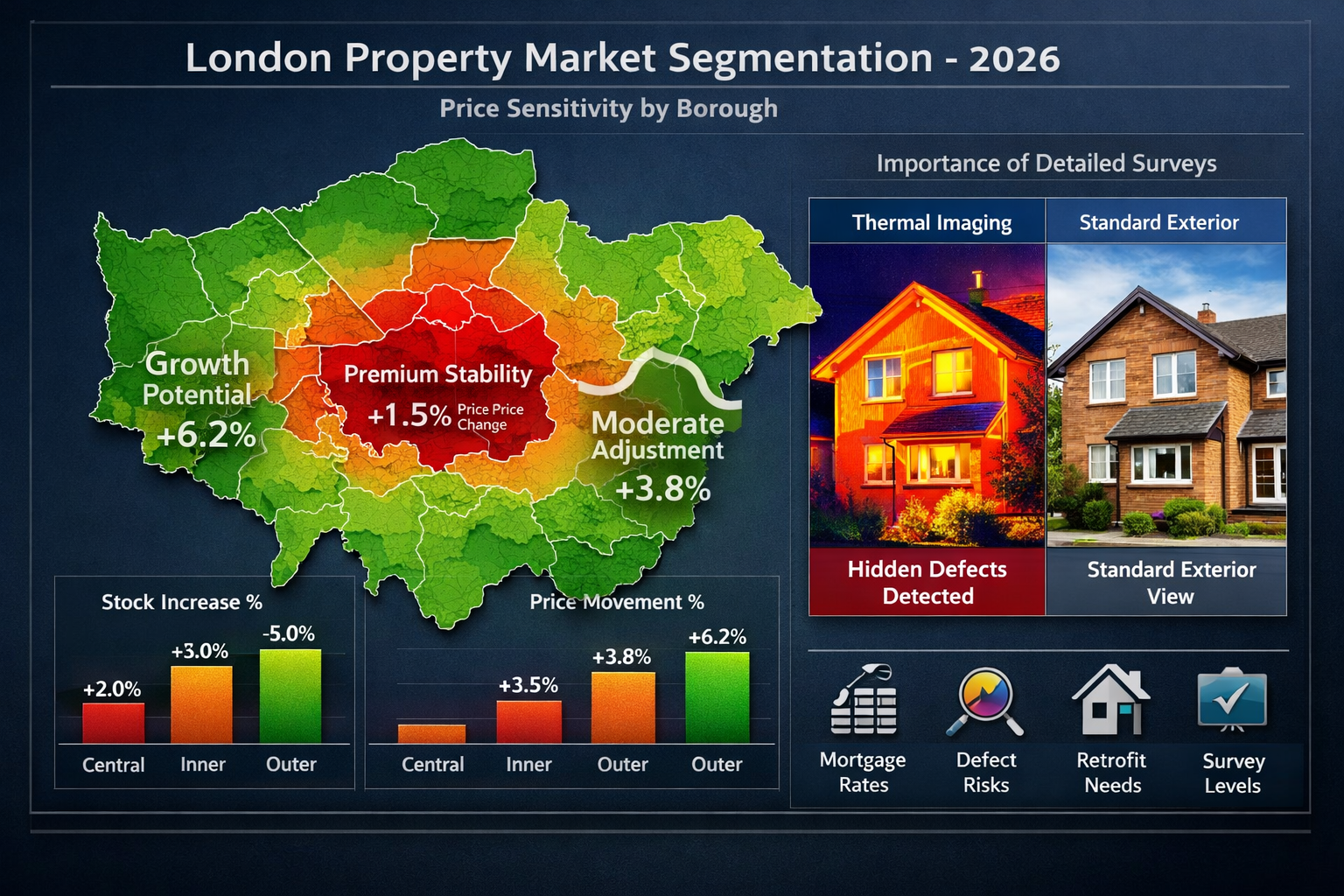
The widening regional disparities reported in market surveys demand location-specific risk assessment. Central London's high-end market undergoes "a subtle but significant evolution in February 2026," with security emerging as a key decision factor for wealthy buyers and renters.[2] This contrasts sharply with outer London boroughs where affordability constraints and mortgage sensitivity dominate buyer concerns.
| London Zone | Price Trend | Stock Levels | Primary Risk Factors |
|---|---|---|---|
| Central London | Stable/Premium | Moderate | Security features, retrofit compliance |
| Inner Boroughs | Mixed adjustment | Increasing | Structural defects, leasehold issues |
| Outer Boroughs | Selective growth | High increases | Mortgage affordability, hidden maintenance |
For buyers navigating this fragmented landscape, choosing the right property survey becomes paramount to understanding location-specific risks.
Mortgage Affordability and Market Sensitivity
Market sources consistently note the "sensitivity of customer demand to mortgage affordability and the evolving economic backdrop" as a key risk factor for price stability.[3] This sensitivity creates a feedback loop: buyers stretched to afford properties have less financial cushion to absorb unexpected repair costs discovered post-purchase.
In this environment, price sensitivity manifests in several ways:
- Negotiation leverage: Buyers use survey findings to renegotiate prices downward
- Transaction failures: Significant defects cause buyers to withdraw entirely
- Financing complications: Lenders refuse mortgages on properties with structural issues
- Future resale concerns: Buyers factor in retrofit costs and defect remediation when calculating value
The spring selling season brings additional uncertainty, with market outcomes "dependent on sales activity through the Spring selling season, as well as any impacts from both the Spring statement and political uncertainty or volatility created by the local elections in May."[3] This temporal risk makes thorough property assessment even more valuable.
Building Surveys for London's 2026 Price Sensitivity: The Critical Role of Professional Inspections
Why Building Surveys Matter More in Balanced Markets
In seller's markets, buyers often waive survey contingencies or accept properties "as-is" to secure deals. Conversely, in buyer's markets, sellers may complete repairs proactively. Balanced markets eliminate both extremes, creating conditions where building surveys serve as crucial negotiation tools and risk mitigation instruments.
Professional RICS building surveys provide several strategic advantages in 2026's London market:
🔍 Objective condition assessment: Independent evaluation removes emotional decision-making
💰 Price justification: Documentary evidence supports renegotiation requests
⚠️ Risk quantification: Identifies immediate safety concerns versus long-term maintenance needs
📊 Retrofit planning: Highlights energy efficiency improvements required for future compliance
🏗️ Structural integrity verification: Confirms building stability and identifies subsidence, settlement, or movement
Understanding RICS Survey Levels for London Properties
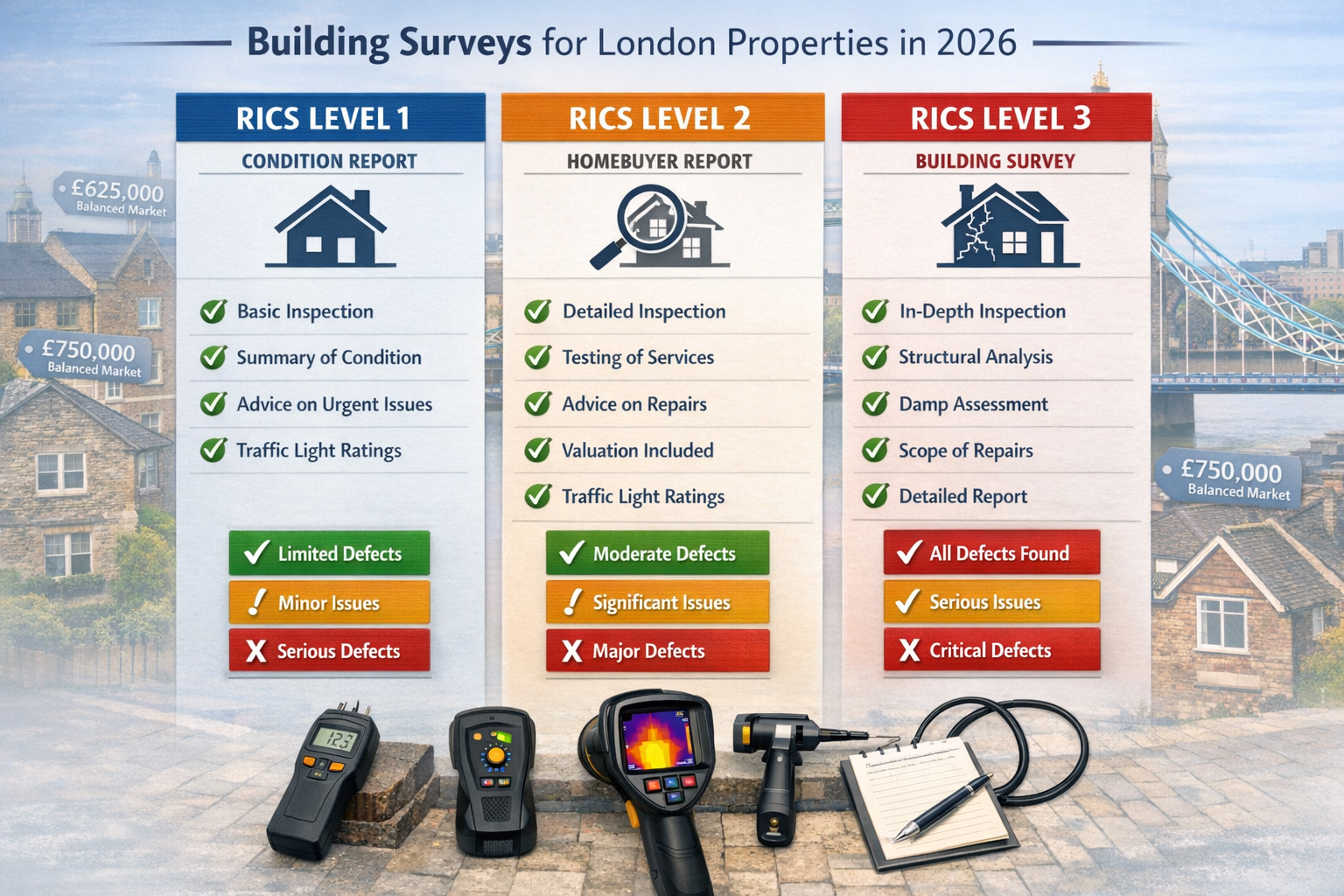
The Royal Institution of Chartered Surveyors (RICS) defines three survey levels, each appropriate for different property types and buyer needs. Selecting the correct level directly impacts risk detection capability.
RICS Level 1 (Condition Report): Provides basic traffic-light system assessment of property condition. Suitable only for conventional, newer properties in good condition. In London's 2026 market, this level offers insufficient protection for most purchases given the prevalence of older housing stock.
RICS Level 2 (HomeBuyer Report): Offers more detailed inspection including visible defects, urgent repairs, and significant issues affecting value. Appropriate for conventional properties in reasonable condition. This represents the minimum recommended level for most London purchases.
RICS Level 3 (Building Survey): Delivers comprehensive analysis of property construction, condition, and defects. Includes detailed descriptions of repair methods and maintenance advice. Essential for older properties, listed buildings, properties of unusual construction, or those requiring significant renovation.
For London's predominantly Victorian and Edwardian housing stock, RICS Building Surveys Level 3 typically provides the most appropriate protection. These comprehensive inspections reveal hidden defects that could substantially impact property value in a price-sensitive market.
Common Defects in London Properties Requiring Survey Detection
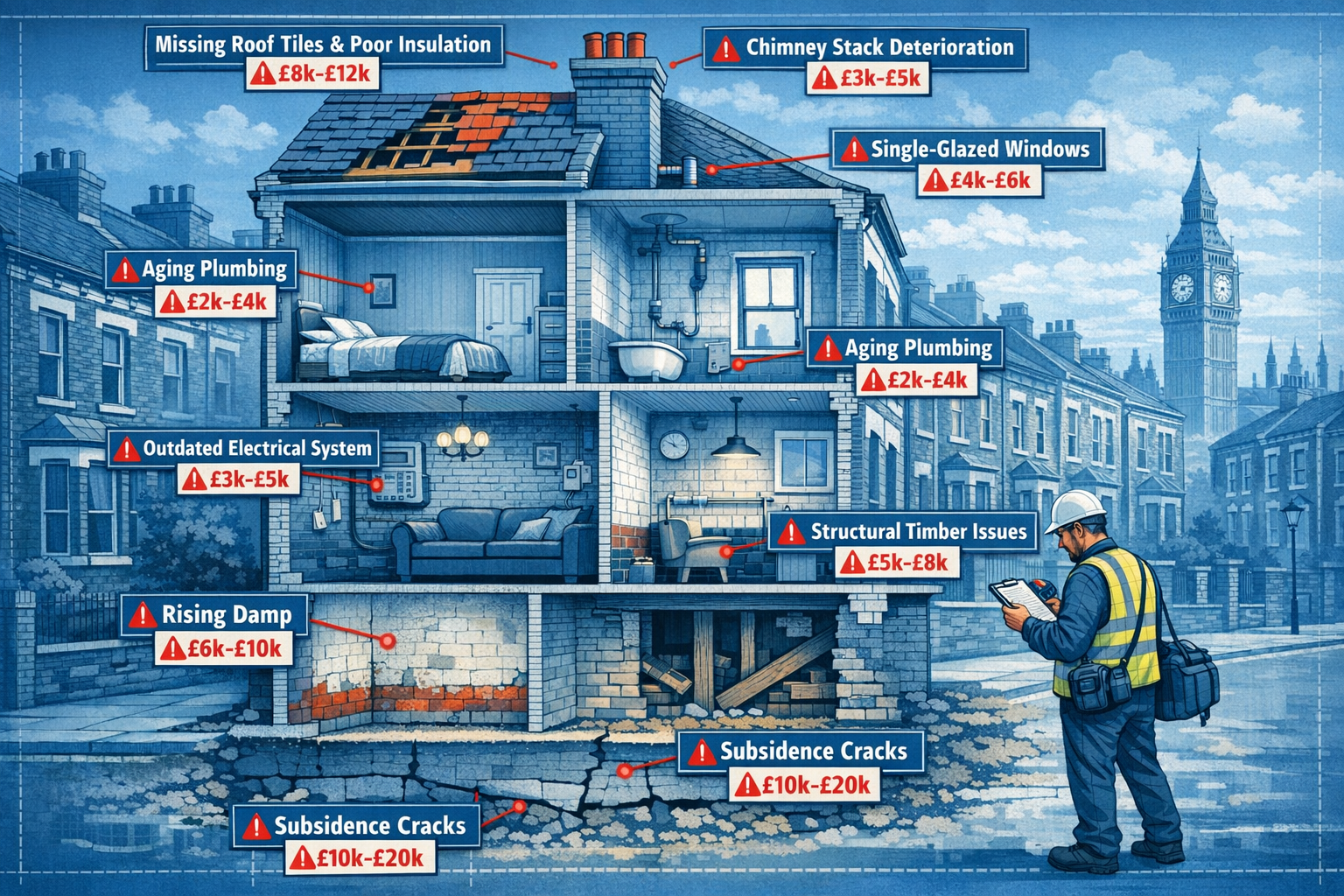
London's building stock presents characteristic defect patterns that professional surveys must identify:
Victorian and Edwardian Properties (1837-1910):
- Solid wall construction without cavity insulation
- Lime mortar deterioration requiring repointing
- Original single-glazed sash windows
- Aging drainage systems with potential root ingress
- Chimney stack deterioration and flashing failures
- Rising damp from absent or failed damp-proof courses
Interwar Properties (1918-1939):
- Cavity wall tie corrosion
- Original electrical systems requiring replacement
- Asbestos in various forms (insulation, textured coatings, floor tiles)
- Roof covering approaching end of service life
- Subsidence in clay soil areas
Post-War Properties (1945-1980):
- Non-standard construction methods (concrete frames, steel frames, timber frames)
- Flat roof deterioration
- Concrete carbonation and reinforcement corrosion
- Inadequate insulation by current standards
Specialist defect surveys can investigate specific concerns in greater depth when initial inspections raise red flags.
Spotting Risks Through Comprehensive Building Surveys
Structural Movement and Subsidence Detection
Subsidence represents one of the most significant risks in London properties, particularly in areas with clay soil that shrinks during dry periods and expands when wet. The capital's aging tree stock and Victorian drainage systems compound this risk.
Professional surveyors identify subsidence through:
- Crack pattern analysis (diagonal cracks wider at top, tapering toward bottom)
- Door and window frame distortion
- External ground level changes
- Drainage inspection for leaks causing soil erosion
- Historical movement assessment through previous repair evidence
In price-sensitive markets, subsidence findings dramatically affect property values. Buyers discovering subsidence can negotiate substantial price reductions or require sellers to complete underpinning and repairs before completion. Surveys for subsidence provide specialized investigation when general surveys indicate potential movement.
Damp and Moisture Penetration Issues
Damp problems plague London properties across all ages and construction types. In 2026's balanced market, moisture issues carry particular weight because they:
- Indicate potential structural deterioration
- Create health hazards (mold, respiratory issues)
- Require expensive remediation
- Affect mortgage lender willingness to finance
Professional building surveys identify three main damp categories:
Rising Damp: Groundwater ascending through walls via capillary action, typically due to failed or absent damp-proof courses. Common in pre-1920s properties.
Penetrating Damp: Water ingress through walls, roofs, or windows from external sources. Results from defective pointing, roof coverings, gutters, or window seals.
Condensation: Moisture from internal activities (cooking, bathing) condensing on cold surfaces. Often misdiagnosed but indicates inadequate ventilation and insulation.
Damp surveys using electronic moisture meters and thermal imaging cameras provide definitive diagnosis. Given that damp remediation costs range from £500 for minor condensation improvements to £5,000+ for rising damp treatment, accurate identification proves essential for price negotiation.
Roof Condition and Replacement Costs
Roof failures represent another major financial risk that building surveys must identify. London's housing stock includes roofs approaching or exceeding typical service life:
- Clay tiles: 60-100 years
- Concrete tiles: 40-60 years
- Slate: 80-100+ years
- Flat roofs (felt): 10-20 years
- Flat roofs (modern membranes): 20-30 years
A comprehensive roof survey examines:
- Covering condition and remaining service life
- Structural timber condition (rot, beetle infestation)
- Flashing and weatherproofing details
- Gutter and downpipe adequacy
- Chimney stack stability
- Insulation levels and ventilation
Roof replacement costs in London typically range from £5,000-£12,000 for terraced houses to £15,000+ for larger detached properties. Discovering imminent roof replacement needs during survey provides powerful negotiation leverage in balanced markets.
Retrofit Requirements and Energy Efficiency Compliance
London's 2026 property market operates under increasing pressure to improve energy efficiency. The government's trajectory toward higher Energy Performance Certificate (EPC) requirements for rental properties creates retrofit obligations that affect property values.
Building surveys should assess:
Insulation Deficiencies:
- Loft insulation (current standard: 270mm)
- Cavity wall insulation (where applicable)
- Solid wall insulation requirements
- Floor insulation
Heating System Efficiency:
- Boiler age and efficiency rating
- Heating controls adequacy
- Radiator sizing and distribution
Window and Door Performance:
- Glazing type (single, double, triple)
- Frame condition and air-tightness
- Draught-proofing effectiveness
Renewable Energy Potential:
- Solar panel installation feasibility
- Heat pump suitability
- Battery storage options
Retrofit costs vary enormously—from £5,000 for basic improvements to £50,000+ for comprehensive deep retrofits of solid-wall properties. In price-sensitive markets, buyers increasingly factor these costs into purchase decisions, making survey identification of retrofit needs essential.
Electrical and Plumbing System Assessment
Electrical systems in older London properties frequently require complete replacement. Properties with original or 1960s-1980s wiring present safety risks and fail to meet current regulations. Building surveys should identify:
- Consumer unit type (modern RCD protection versus old fuse boxes)
- Wiring age and condition
- Earthing and bonding adequacy
- Socket and lighting circuit capacity
- Electrical safety certificate availability
Plumbing systems similarly require assessment:
- Water supply pipe materials (lead pipes require replacement)
- Heating system age and condition
- Drainage adequacy and condition
- Bathroom and kitchen installation quality
Electrical rewiring costs £3,000-£6,000 for typical London terraced houses, while complete heating system replacement runs £4,000-£8,000. These substantial costs significantly affect property value in balanced markets.
Building Surveys for London's 2026 Price Sensitivity: Strategic Survey Selection and Implementation
Matching Survey Level to Property Type and Risk Profile
Selecting the appropriate survey level requires balancing thoroughness against cost while considering property characteristics and market conditions.
When RICS Level 3 Building Survey is Essential:
- Properties built before 1900
- Listed buildings or properties in conservation areas
- Properties of unusual construction
- Properties requiring significant renovation
- Properties showing visible signs of structural movement
- Properties where you plan major alterations
When RICS Level 2 HomeBuyer Report May Suffice:
- Conventional construction properties built after 1950
- Properties in good apparent condition
- Properties where budget constraints exist
- Properties in areas with stable ground conditions
When Additional Specialist Surveys are Recommended:
- Structural surveys for significant movement or alterations
- Damp and timber surveys for moisture concerns
- Drainage surveys for older properties or those with tree proximity
- Electrical condition reports for properties with old wiring
- Asbestos surveys for properties built 1950-1990
Working with chartered surveyors in Central London, West London, or North London ensures local knowledge of area-specific defect patterns and construction methods.
Timing Surveys Within the Transaction Process
Optimal survey timing in London's 2026 balanced market involves strategic consideration:
After Offer Acceptance, Before Exchange: Standard approach allowing renegotiation based on findings without legal commitment.
Pre-Offer Survey: Increasingly popular in competitive situations, providing confidence to make strong offers and accelerate transactions.
Survey Contingency Period: Negotiate specific timeframes for survey completion and renegotiation within offer terms.
Understanding how long building surveys take helps buyers plan transaction timelines effectively. Typical turnaround runs 5-10 working days from instruction to report delivery.
Interpreting Survey Reports and Negotiating Price Adjustments
Professional building survey reports categorize defects by urgency and significance:
Category 1 (Condition Rating 1): No repair currently needed
Category 2 (Condition Rating 2): Repairs or replacement requiring future attention, but estimates are still advised
Category 3 (Condition Rating 3): Defects that are serious and/or need to be repaired, replaced or investigated urgently
In price-sensitive markets, negotiation strategies based on survey findings include:
Direct Price Reduction: Request purchase price reduction equivalent to estimated repair costs plus contingency (typically 10-20% above quoted costs).
Seller Completion of Repairs: Require seller to complete specific repairs before exchange, with evidence of professional workmanship.
Retention Arrangements: Agree purchase price with retention of funds in escrow until specified repairs are completed post-purchase.
Transaction Withdrawal: Exercise right to withdraw from purchase if defects exceed acceptable risk levels.
Leveraging Survey Findings for Long-Term Property Planning
Beyond immediate transaction negotiations, comprehensive building surveys provide valuable long-term planning information:
📋 Maintenance Scheduling: Prioritize repairs and replacements over 5-10 year timeframes
💵 Budget Planning: Allocate funds for anticipated major works
🏡 Renovation Prioritization: Identify which improvements deliver best value
📈 Resale Value Protection: Address defects that would concern future buyers
🔧 Warranty Claims: Document pre-existing defects for insurance purposes
Commercial Building Surveys and Investment Property Considerations
Specialized Requirements for Commercial Properties
Investors purchasing commercial properties in London's 2026 market face additional complexity requiring commercial building surveys that address:
- Multi-occupancy implications: Shared services, fire safety, accessibility compliance
- Business use suitability: Planning permission, building regulation compliance for intended use
- Lease obligations: Repairing covenants, dilapidations liability assessment
- Investment viability: Rental yield impact of required repairs and upgrades
- Statutory compliance: Asbestos management, fire risk assessments, disability access
Buy-to-Let Property Survey Priorities
Buy-to-let investors in London's price-sensitive 2026 market should prioritize survey identification of:
Regulatory Compliance Issues:
- EPC rating (minimum E rating required for rentals)
- Gas and electrical safety certificate requirements
- HMO licensing compliance (if applicable)
- Fire safety provisions
Tenant-Attractiveness Factors:
- Modern bathroom and kitchen condition
- Heating system efficiency and reliability
- Decoration and presentation quality
- Security features
Maintenance Cost Projections:
- Major component replacement timelines
- Ongoing maintenance requirements
- Void period implications of major works
Yield Impact Assessment:
- How defects affect achievable rental income
- Whether repairs enable rental increases
- Competition positioning in local market
The Role of Valuation in Price-Sensitive Markets
Survey-Informed Valuation Adjustments
Building survey findings directly impact property valuations in balanced markets. Professional valuers adjust comparable property prices based on:
- Immediate repair costs: Direct deduction for urgent Category 3 defects
- Deferred maintenance: Discounted present value of future repair obligations
- Functional obsolescence: Value reduction for outdated systems requiring replacement
- Market perception: Additional discount reflecting buyer reluctance toward problem properties
Understanding valuation factors helps buyers assess whether survey-justified price reductions align with market realities.
Mortgage Lender Requirements and Survey Implications
Mortgage lenders commission basic valuations to protect their security interest, but these do not protect buyer interests. Lender valuations:
- Focus solely on whether property provides adequate lending security
- Identify only major defects affecting mortgageability
- Provide no detailed condition information
- Offer no legal recourse to buyers for missed defects
Mortgage retention occurs when lenders identify defects requiring remediation before releasing full loan amounts. Common retention triggers include:
- Structural movement or subsidence evidence
- Significant damp problems
- Roof defects requiring immediate attention
- Electrical safety concerns
- Drainage failures
Building surveys identify these issues before offer stage, preventing mortgage complications and transaction delays.
Navigating London's Specific Survey Challenges in 2026
Conservation Areas and Listed Building Considerations
London contains extensive conservation areas and listed buildings requiring specialized survey approaches. Properties with heritage designations face:
Repair Methodology Constraints: Traditional materials and techniques required, increasing costs
Alteration Restrictions: Planning permission and listed building consent requirements
Specialist Contractor Requirements: Limited pool of appropriately skilled tradespeople
Insurance Complications: Higher premiums and specialized coverage needs
Retrofit Limitations: Energy efficiency improvements restricted by heritage protection
Surveyors experienced with heritage properties understand these constraints and provide realistic cost assessments reflecting required approaches.
Leasehold Property Survey Considerations
London's predominance of leasehold properties creates additional survey priorities:
Building Insurance Adequacy: Whether freeholder's insurance covers identified defects
Service Charge Implications: Anticipated major works and Section 20 consultation processes
Lease Terms Impact: Repairing obligations and restrictions on alterations
Share of Freehold Considerations: Collective responsibility for building maintenance
Lease Extension Requirements: How remaining lease term affects value and mortgageability
Access Limitations in Dense Urban Environments
London's dense urban fabric creates survey access challenges:
Restricted External Inspection: Terraced properties with limited side or rear access
Shared Spaces: Communal areas requiring freeholder or neighbor cooperation
Height and Safety: Multi-story buildings requiring specialist access equipment
Occupied Properties: Tenant cooperation requirements for investment purchases
Professional surveyors navigate these constraints through experience and appropriate access arrangements, though buyers should understand that access limitations may prevent complete inspection of certain areas.
Cost-Benefit Analysis of Building Surveys in Balanced Markets
Survey Costs Versus Risk Exposure
Building survey costs represent small percentages of property purchase prices but provide disproportionate risk protection:
| Survey Type | Typical London Cost | Property Value Range | Risk Protection Value |
|---|---|---|---|
| RICS Level 2 | £500-£800 | £300,000-£600,000 | £5,000-£50,000+ |
| RICS Level 3 | £800-£1,500 | £300,000-£600,000 | £10,000-£100,000+ |
| Specialist Surveys | £300-£800 each | Any | £5,000-£50,000+ |
The return on investment from building surveys manifests through:
💰 Direct price reductions: Negotiated savings based on defect identification
⚠️ Avoided problem purchases: Withdrawal from properties with unacceptable defects
📊 Informed decision-making: Confidence in purchase decisions with full condition knowledge
🔧 Maintenance planning: Budgeting accuracy for future property ownership costs
Understanding structural survey pricing and surveyor rates helps buyers budget appropriately while recognizing value delivered.
False Economy of Survey Omission
In price-sensitive markets, buyers sometimes omit building surveys to reduce transaction costs—a decision that frequently proves costly:
Hidden Defect Discovery Post-Purchase: No recourse for undiscovered problems after completion
Mortgage Complications: Lender-identified issues causing transaction delays or failures
Renovation Budget Overruns: Unexpected structural issues discovered during works
Resale Difficulties: Future buyers' surveys identifying problems affecting resale value
Safety Risks: Unidentified structural or electrical hazards creating liability exposure
The balanced market conditions of London's 2026 property landscape make survey omission particularly risky, as neither buyer nor seller holds decisive negotiating advantage that might offset condition uncertainty.
Future-Proofing Property Purchases Through Comprehensive Surveys
Climate Resilience and Flood Risk Assessment
London's 2026 property market increasingly considers climate resilience as a value factor. Building surveys should assess:
Flood Risk Indicators:
- Proximity to watercourses and flood plains
- Ground floor construction and damp-proof measures
- Drainage capacity and surface water management
- Historical flooding evidence
Climate Adaptation Features:
- Overheating risk in upper floors
- Ventilation adequacy for warmer summers
- Water efficiency measures
- Green infrastructure (gardens, permeable surfaces)
Storm Damage Vulnerability:
- Roof and chimney stability in high winds
- Tree proximity and condition
- Boundary wall and fence stability
Technology Integration and Smart Home Readiness
Modern buyers increasingly value technology integration capabilities. Surveys should consider:
- Electrical capacity for EV charging points
- Broadband infrastructure and connectivity
- Smart heating control compatibility
- Home automation potential
- Security system integration options
Accessibility and Lifetime Home Standards
Demographic trends toward aging populations make accessibility features increasingly valuable:
- Level access potential
- Bathroom adaptation feasibility
- Bedroom/bathroom ground floor location
- Circulation space adequacy
- Stair lift installation potential
Properties offering accessibility features or adaptation potential command premiums in forward-looking markets.
Expert Survey Selection: Finding the Right Professionals
Qualifications and Accreditations to Verify
When selecting building surveyors for London property inspections, verify:
✅ RICS Membership: Chartered status (MRICS or FRICS) ensures professional standards
✅ Professional Indemnity Insurance: Minimum £1 million coverage protects against negligent advice
✅ Specialist Accreditations: Additional qualifications for heritage properties, specific construction types
✅ Local Experience: Knowledge of London construction methods and common defect patterns
✅ Independent Status: No conflicts of interest with estate agents or sellers
Questions to Ask Prospective Surveyors
Before instructing building surveyors, buyers should ask:
- What survey level do you recommend for this specific property and why?
- How many similar properties have you surveyed in this London area?
- What is your typical report turnaround time?
- Do you provide follow-up consultation to discuss findings?
- Can you recommend specialist contractors for identified defects?
- What access arrangements do you require?
- Are there any areas you anticipate being unable to inspect?
- Do you provide cost estimates for identified repairs?
Local Knowledge Advantages
Working with local chartered surveyors familiar with specific London areas provides advantages:
- Recognition of area-specific construction methods
- Knowledge of local ground conditions and subsidence patterns
- Familiarity with conservation area requirements
- Understanding of local market conditions affecting value
- Established relationships with specialist contractors
- Experience with common defect patterns in local housing stock
Conclusion: Empowering Confident Property Decisions in London's 2026 Market
London's property market in 2026 presents a unique combination of opportunity and risk. The balanced market conditions—characterized by increasing stock levels yet ongoing price sensitivity—create an environment where Building Surveys for London's 2026 Price Sensitivity: Spotting Risks in a Balanced Market becomes not merely advisable but essential for prudent property acquisition.
The capital's predominantly older housing stock, combined with increasing retrofit requirements, mortgage affordability constraints, and widening regional disparities, demands thorough due diligence. Professional building surveys provide the objective, comprehensive condition assessment necessary to navigate this complex landscape successfully.
Key Strategic Recommendations
For All London Property Buyers:
- Commission appropriate RICS survey levels based on property age, type, and condition
- Engage chartered surveyors with specific London experience and local knowledge
- Use survey findings as negotiation tools in price-sensitive market conditions
- Plan long-term maintenance and retrofit budgets based on survey recommendations
- Consider specialist surveys for specific concerns (damp, structural movement, drainage)
For Investment Property Buyers:
- Prioritize regulatory compliance assessment (EPC ratings, safety certificates)
- Evaluate maintenance cost implications for rental yield calculations
- Assess tenant-attractiveness factors identified in surveys
- Consider commercial building surveys for mixed-use or business properties
For Heritage Property Buyers:
- Engage surveyors with listed building and conservation area expertise
- Obtain realistic cost estimates reflecting traditional repair methodology requirements
- Understand planning and consent implications for identified repairs
- Budget substantially higher contingencies for heritage property maintenance
Actionable Next Steps
-
Research survey requirements: Review different types of survey comparison to understand options
-
Select appropriate survey level: Match survey comprehensiveness to property risk profile and personal risk tolerance
-
Identify qualified surveyors: Verify RICS membership, insurance, and London-specific experience
-
Coordinate survey timing: Schedule inspections to allow renegotiation before legal commitment
-
Prepare access arrangements: Ensure property access for comprehensive inspection
-
Review reports thoroughly: Read survey reports completely and request clarification of unclear items
-
Obtain repair quotations: Commission specialist contractor estimates for significant defects
-
Negotiate strategically: Use survey findings to justify price adjustments or seller repairs
-
Plan long-term: Incorporate survey recommendations into property ownership budgets
-
Maintain documentation: Retain survey reports for future reference, insurance claims, and resale purposes
The London property market's 2026 characteristics—balanced conditions with price sensitivity, increasing stock but ongoing adjustments, mortgage affordability constraints, and retrofit pressures—create an environment where information asymmetry carries substantial financial consequences. Professional building surveys eliminate this asymmetry, empowering buyers with the comprehensive condition knowledge necessary for confident, informed property decisions.
In markets where neither buyers nor sellers hold decisive advantage, knowledge becomes the critical differentiator. Comprehensive building surveys provide this knowledge, transforming property purchases from uncertain gambles into calculated, strategic investments. For London's price-sensitive 2026 market, thorough professional property inspection represents not an optional expense but an essential component of prudent property acquisition strategy.
References
[1] London Property Market Update 2026 A Market Reset Or Opportunity – https://www.lysshomes.co.uk/london-property-market-update-2026-a-market-reset-or-opportunity/
[2] Londons Property Market In 2026 Security Price Adjustments And Why The Wealthiest Are Renting – https://londonproperty.co.uk/en/londons-property-market-in-2026-security-price-adjustments-and-why-the-wealthiest-are-renting/
[3] Weekly Summary 13th February 2026 – https://builtplace.com/weekly-summary-13th-february-2026/