
{"cover":"Professional landscape format (1536×1024) hero image featuring bold text overlay 'Building Surveys for London Office-to-Resi Conversions: Identifying Structural Risks in 2026's Underpriced Market Revival' in extra large 72pt white sans-serif font with dark shadow and semi-transparent overlay box, positioned in upper third. Background shows split composition: left side displays historic London office building exterior with Georgian or Victorian architecture, right side reveals exposed structural elements including steel beams, concrete floors, and building survey equipment like laser measuring tools. Color scheme: deep navy blue, white text, orange accent highlights on structural elements. High contrast, magazine cover quality, editorial style with professional architectural photography aesthetic, subtle grid overlay suggesting technical assessment and conversion planning.","content":["Landscape format (1536×1024) detailed illustration showing comprehensive building survey checklist for office-to-residential conversion. Visual features annotated cross-section of London office building with labeled structural elements: load-bearing walls highlighted in red, floor slab thickness measurements, ceiling height annotations showing 2.4m minimum requirement, HVAC ductwork in blue, plumbing risers in green, fire escape routes marked with orange arrows. Include surveyor with digital tablet and laser measuring device in foreground. Professional technical drawing style with clean lines, color-coded systems, measurement callouts, and checklist overlay showing ticked items. Modern architectural visualization aesthetic.","Landscape format (1536×1024) infographic displaying common structural defects found in London office-to-residential conversions. Split into four quadrants showing: top-left depicts concrete spalling and rebar corrosion with close-up detail, top-right shows inadequate floor loading capacity with stress diagram and weight calculations, bottom-left illustrates asbestos locations in ceiling tiles and pipe insulation with hazard symbols, bottom-right displays damp penetration and water damage with thermal imaging color gradient. Each quadrant includes cost impact figures in British pounds and remediation timeline estimates. Professional construction documentation style with technical photography, warning symbols, and data visualization elements.","Landscape format (1536×1024) ROI projection dashboard for London office-to-residential conversion project in 2026. Central focus shows before-and-after property valuations with upward trending arrow: office space valued at £450 per sq ft transforming to residential at £750 per sq ft. Surrounding elements include: pie chart breaking down conversion costs (structural works 35%, M&E systems 25%, compliance 15%, finishes 25%), timeline Gantt chart showing 12-18 month project duration, bar graph comparing conversion costs versus new-build alternatives, and map of London highlighting prime conversion zones in Central, East, and South East London with price heat mapping. Clean financial aesthetic with navy, green, and gold color scheme, professional data visualization style."]"}
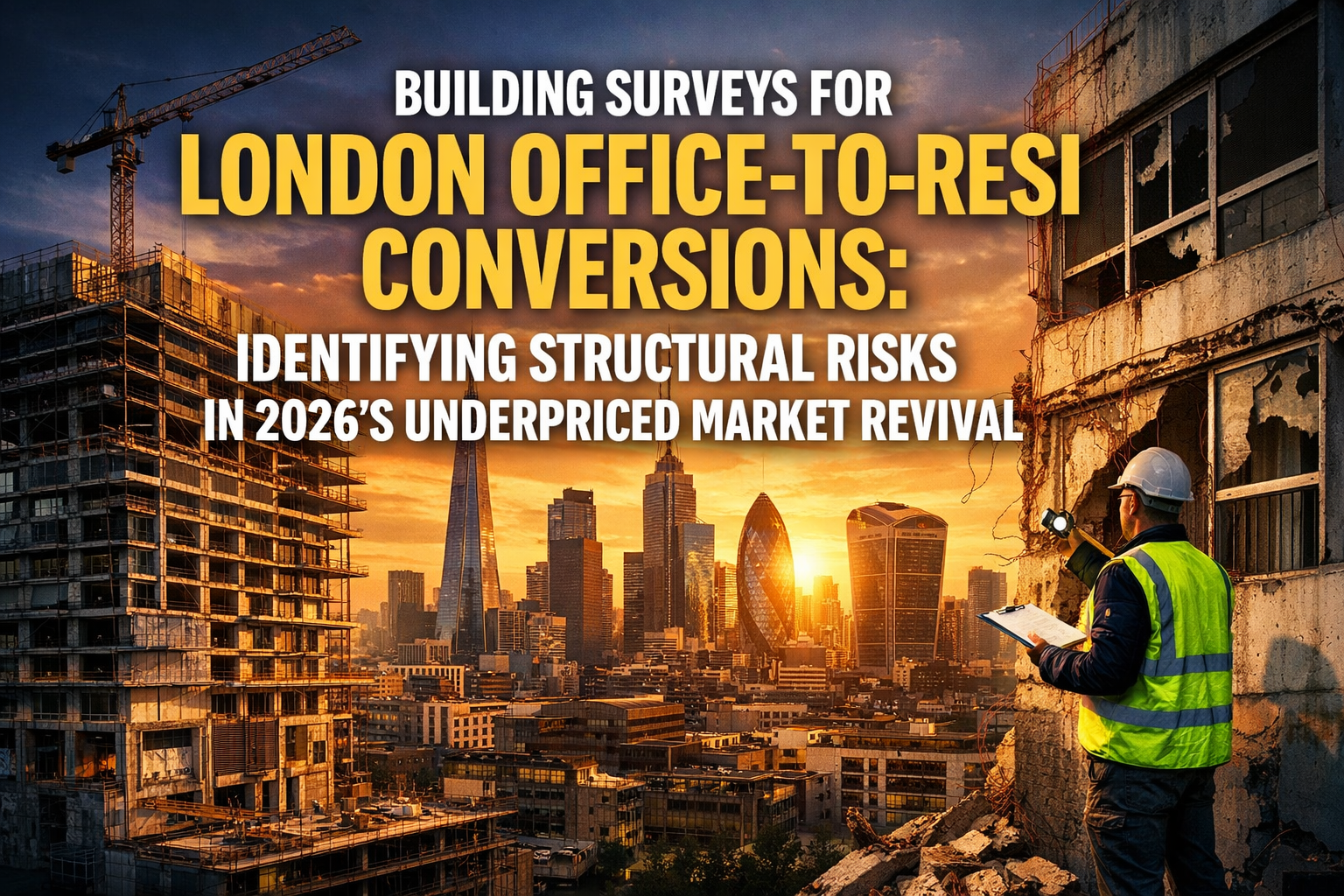
London's commercial property landscape is experiencing a seismic shift in 2026. With office spaces emerging as the most undervalued asset class in the current market, savvy developers and investors are turning their attention to office-to-residential conversions. However, the path from vacant workspace to profitable living space is fraught with hidden structural challenges that can derail even the most promising projects. Building Surveys for London Office-to-Resi Conversions: Identifying Structural Risks in 2026's Underpriced Market Revival has become essential knowledge for anyone looking to capitalize on this emerging opportunity.
The convergence of regulatory changes, market conditions, and evolving housing demands has created a perfect storm for conversion projects. Yet beneath the attractive ROI projections lies a complex web of structural, compliance, and safety considerations that demand expert assessment before any transformation begins.
Key Takeaways
- 🏢 Office spaces represent 2026's most undervalued asset class, creating unprecedented conversion opportunities with potential value uplifts of 40-60% when properly executed
- 🔍 Comprehensive building surveys are non-negotiable for identifying load-bearing limitations, fire safety deficiencies, and hidden structural defects that can cost £150,000+ in remediation
- ⚖️ Regulatory changes in March 2024 removed the three-month vacancy requirement for permitted development conversions, accelerating project timelines but increasing due diligence importance
- 💰 ROI projections show conversion costs averaging £250-350 per sq ft versus £450+ per sq ft for new builds, but structural risks can eliminate profit margins without proper assessment
- 🛡️ Fire safety compliance and building regulation adherence now account for 20-30% of total conversion budgets, making early structural surveys critical for accurate financial modeling
Understanding the 2026 London Office-to-Residential Conversion Landscape
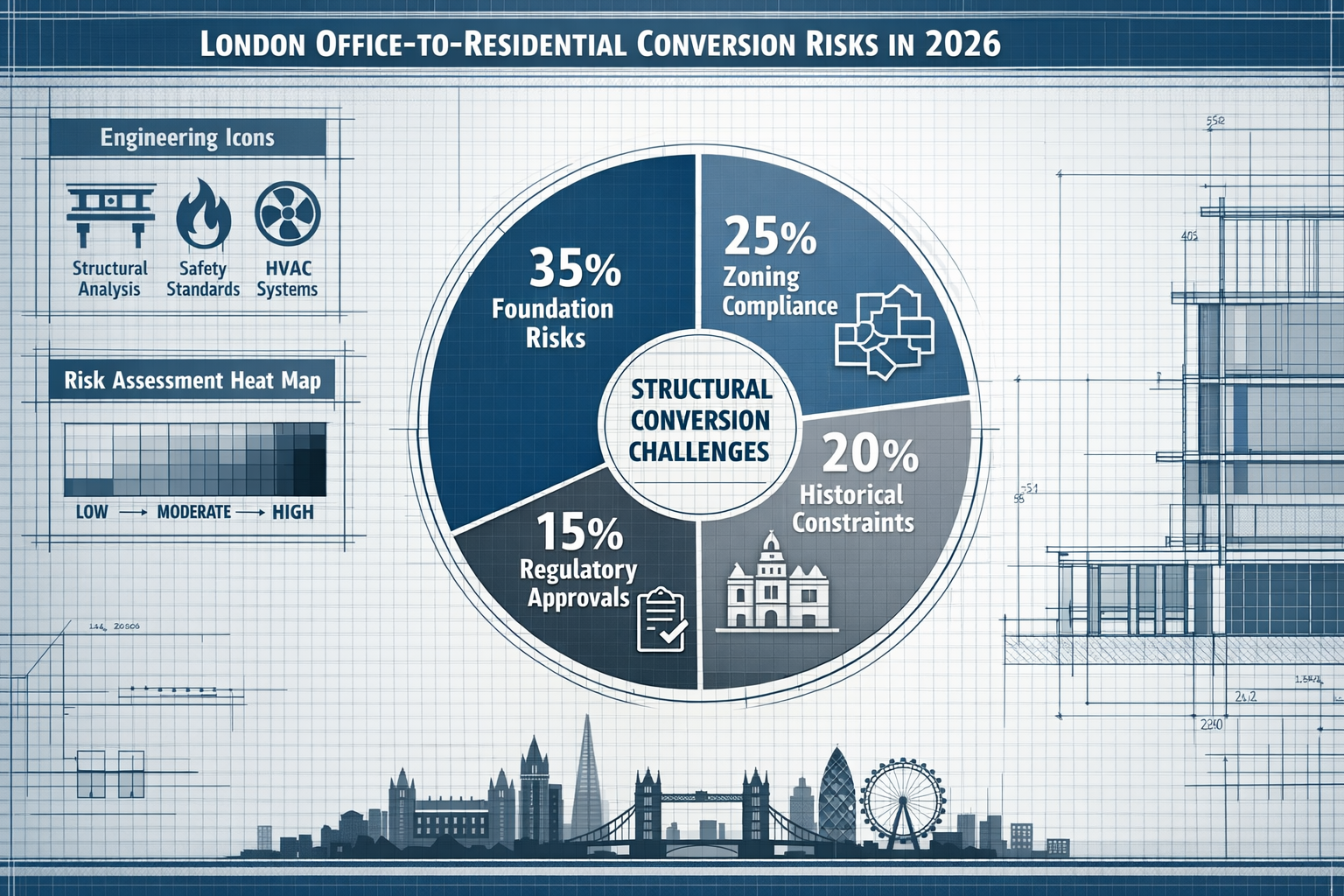
The London property market has witnessed a dramatic transformation in recent years. The shift toward hybrid working models has left substantial office space vacant, while housing demand continues to outpace supply. This imbalance has created what industry experts are calling the "conversion opportunity of a decade."
Market Dynamics Driving Conversion Demand
Several factors are converging to make Building Surveys for London Office-to-Resi Conversions: Identifying Structural Risks in 2026's Underpriced Market Revival a critical consideration:
Vacancy Rates and Valuation Gaps 📊
London's office vacancy rates have stabilized at elevated levels, with secondary and tertiary office buildings trading at significant discounts to residential equivalents. Properties in areas like East London and South East London are showing particularly attractive conversion metrics.
Regulatory Framework Evolution
The UK's permitted development rights under Class MA have undergone significant changes. The March 2024 amendments removed the three-month vacancy requirement, streamlining the conversion process[2]. However, this regulatory ease has paradoxically increased the importance of thorough structural assessment, as developers rush to capitalize on opportunities without adequate due diligence.
Housing Supply Pressures
With traditional residential development constrained by land availability and planning restrictions, office conversions offer a viable pathway to increase housing stock. The demand for one and two-bedroom units in urban centers remains particularly strong.
Incentive Programs and Financial Support
While London, Ontario's Office-to-Residential CIP Incentive Program offers substantial grants (approximately $20,000 per one-bedroom unit and $28,000 per two-bedroom unit)[5], UK developers must rely primarily on market fundamentals and planning advantages. The absence of direct financial incentives makes accurate cost assessment through comprehensive commercial building surveys even more critical.
Critical Building Survey Components for Office-to-Resi Conversions
When undertaking Building Surveys for London Office-to-Resi Conversions: Identifying Structural Risks in 2026's Underpriced Market Revival, developers must address multiple structural and technical considerations that differ substantially from standard residential surveys.
Structural Load-Bearing Assessment
Office buildings are designed for different loading requirements than residential properties. This fundamental difference creates several critical assessment areas:
Floor Loading Capacity 🏗️
Office floors typically accommodate 2.5-4.0 kN/m² imposed loads, while residential floors require different specifications. The addition of:
- Partition walls for bedroom separation
- Kitchen equipment and appliances
- Bathroom fixtures with water loading
- Built-in storage and furniture
These elements can exceed original design parameters. A comprehensive structural engineering assessment must verify whether existing floor slabs can accommodate residential loading without reinforcement.
Ceiling Height Compliance
National space standards mandate minimum ceiling heights of 2.3-2.4 meters for habitable rooms. Many office buildings, particularly those from the 1960s-1980s, feature suspended ceilings concealing services. The actual structural ceiling height may fall below residential requirements once services are accommodated.
| Building Era | Typical Floor-to-Ceiling Height | Residential Compliance Risk |
|---|---|---|
| Pre-1960 | 3.0-3.5m | ✅ Low |
| 1960-1990 | 2.6-2.8m | ⚠️ Medium |
| 1990-2010 | 2.4-2.7m | ⚠️ Medium-High |
| Post-2010 | 2.5-3.0m | ✅ Low-Medium |
Building Services and MEP Infrastructure
Mechanical, Electrical, and Plumbing (MEP) systems in office buildings rarely align with residential requirements. Survey assessments must evaluate:
Plumbing and Drainage Capacity 💧
Office buildings typically have limited plumbing infrastructure concentrated in core areas. Converting to residential requires:
- Multiple bathroom and kitchen installations per floor
- Hot water generation and distribution systems
- Drainage capacity for residential waste volumes
- Water pressure adequacy for upper floors
A specialized drainage survey can identify capacity constraints and required upgrades before cost commitments.
HVAC System Compatibility
Office HVAC systems are designed for:
- Large open-plan spaces with centralized control
- Daytime-only operation
- Different air change rates than residential requirements
Residential conversions need individual unit control, 24-hour operation capability, and compliance with residential ventilation standards. Retrofit costs can range from £8,000-15,000 per unit depending on existing infrastructure.
Fire Safety and Means of Escape
Fire safety represents one of the most complex and expensive aspects of office-to-residential conversions. Post-Grenfell regulatory scrutiny has intensified requirements significantly.
Compartmentation and Fire Resistance 🔥
Survey assessments must verify:
- Fire resistance ratings of existing floors and walls (typically 60-90 minutes required)
- Compartmentation integrity between units and common areas
- Fire stopping around service penetrations
- Protected escape routes meeting current Building Regulations
"Fire safety compliance now accounts for 20-30% of total conversion budgets. Developers who skip detailed fire safety surveys during due diligence often face project-killing cost overruns during construction." — RICS Building Control Specialist
Means of Escape Analysis
Residential buildings require different escape provisions than offices:
- Maximum travel distances to stairs (typically 7.5m for single-direction, 18m for alternative routes)
- Protected stairwell specifications
- Emergency lighting and signage
- Smoke detection and alarm systems
Buildings with central cores may struggle to meet residential escape distance requirements without costly reconfiguration.
Common Structural Defects in London Office-to-Resi Conversions
Understanding typical defects found during Building Surveys for London Office-to-Resi Conversions: Identifying Structural Risks in 2026's Underpriced Market Revival helps developers budget appropriately and avoid costly surprises.
Concrete Frame Deterioration
Many conversion candidates date from the 1960s-1980s concrete construction boom. Common issues include:
Concrete Carbonation and Spalling 🏚️
Concrete carbonation reduces alkalinity, leading to rebar corrosion. Survey indicators include:
- Surface spalling and delamination
- Rust staining on concrete surfaces
- Exposed or corroded reinforcement
- Structural cracks wider than 0.3mm
Remediation costs: £150-300 per square meter of affected area, potentially adding £200,000-500,000 to project budgets for severely affected buildings.
Inadequate Structural Redundancy
Older office buildings may lack structural redundancy required for residential conversions. Creating new openings for windows, doors, or layout modifications can compromise structural integrity without proper engineering assessment and reinforcement.
Envelope and Weatherproofing Issues
The building envelope requires particular attention, as residential standards exceed office requirements for thermal performance and weatherproofing.
Curtain Wall and Glazing Systems 🪟
Many office buildings feature extensive curtain wall systems that:
- Fail to meet residential thermal performance standards (U-values)
- Lack adequate acoustic insulation for residential use
- Show signs of seal failure and water penetration
- Require complete replacement at £400-800 per square meter
A thorough roof survey and envelope assessment identifies these costly items early in the feasibility process.
Damp and Water Ingress
Vacant office buildings often develop damp issues that worsen over time. Critical assessment areas include:
- Roof membrane condition and drainage
- Parapet wall weatherproofing
- Below-ground waterproofing and tanking
- Window and door seal integrity
Professional damp surveys using thermal imaging and moisture meters can identify hidden problems before they escalate during construction.
Hazardous Materials Presence
Pre-2000 office buildings frequently contain hazardous materials requiring remediation:
Asbestos-Containing Materials (ACMs) ⚠️
Common locations include:
- Ceiling tiles and suspended ceiling systems
- Pipe insulation and lagging
- Floor tiles and adhesives
- Textured coatings and sealants
- Electrical panel components
Asbestos removal costs: £15-50 per square meter for licensed removal, with whole-building surveys costing £500-2,000 depending on size and complexity.
Lead Paint and Other Contaminants
Older buildings may contain lead-based paints, PCBs in electrical equipment, or other hazardous materials requiring specialist removal and disposal.
Building Survey Checklist for Conversion Viability Assessment

A systematic approach to Building Surveys for London Office-to-Resi Conversions: Identifying Structural Risks in 2026's Underpriced Market Revival ensures no critical issues are overlooked.
Pre-Acquisition Survey Priorities
Before committing to purchase, developers should commission surveys covering:
Essential Structural Elements ✅
- Foundation and substructure assessment – Verify capacity for additional loading and identify settlement issues
- Structural frame integrity – Evaluate concrete, steel, or masonry load-bearing systems
- Floor slab condition and capacity – Confirm residential loading adequacy
- Roof structure and covering – Assess remaining service life and replacement requirements
- External walls and envelope – Evaluate weatherproofing and thermal performance
Building Services Infrastructure
- Electrical distribution capacity – Verify adequacy for multiple residential units
- Plumbing and drainage systems – Assess capacity and condition
- Heating and ventilation infrastructure – Determine retrofit requirements
- Lift installations – Evaluate condition, capacity, and residential suitability
- Fire detection and suppression systems – Identify upgrade requirements
Compliance and Regulatory Factors
- Planning and permitted development eligibility – Confirm conversion rights applicability
- Building Regulations compliance gaps – Identify required upgrades
- Fire safety assessment – Evaluate compartmentation and escape provisions
- Accessibility requirements – Assess Part M compliance for residential use
- Environmental performance – Determine EPC improvement requirements
Specialist Survey Requirements
Depending on building characteristics, additional specialist surveys may be necessary:
Ground Conditions and Contamination
For buildings with basement or ground-floor residential units, soil and water contamination surveys identify potential environmental liabilities.
Structural Calculations and Engineering
Complex conversions require detailed structural engineering calculations for:
- New openings and layout modifications
- Floor reinforcement requirements
- Beam and column load assessments
- Foundation capacity verification
ROI Projections and Financial Modeling for 2026 Conversions
Understanding the financial implications of Building Surveys for London Office-to-Resi Conversions: Identifying Structural Risks in 2026's Underpriced Market Revival is essential for investment decision-making.
Conversion Cost Benchmarks
Based on 2026 market data, typical conversion costs break down as follows:
Cost Components per Square Foot 💷
| Cost Category | Range (£/sq ft) | Percentage of Total |
|---|---|---|
| Structural works | 85-120 | 30-35% |
| MEP installations | 60-90 | 25-30% |
| Fire safety & compliance | 40-60 | 15-20% |
| Finishes & fixtures | 55-80 | 20-25% |
| Professional fees | 15-25 | 5-8% |
| Total Conversion Cost | £255-375 | 100% |
These figures assume buildings in reasonable structural condition. Properties with significant defects identified during surveys can see costs increase by 30-50%.
Value Uplift Analysis
The financial case for conversions rests on the gap between office and residential values:
Typical London Value Metrics (2026)
- Office value (secondary locations): £350-500 per sq ft
- Residential value (converted units): £650-850 per sq ft
- Potential gross uplift: £300-350 per sq ft
- Less conversion costs: £255-375 per sq ft
- Net value creation: £0-95 per sq ft (before acquisition and financing costs)
This narrow margin explains why thorough building surveys are critical. Unexpected structural issues costing £50-100 per sq ft can eliminate profitability entirely.
Case Study: Central London Conversion Project
A recent conversion in Central London illustrates the importance of comprehensive surveys:
Project Parameters:
- 1970s office building, 8,500 sq ft
- Acquired at £425 per sq ft (£3.6M)
- Initial conversion budget: £280 per sq ft (£2.4M)
- Expected residential value: £750 per sq ft (£6.4M)
Survey Findings:
- Concrete spalling requiring £180,000 remediation
- Inadequate floor loading necessitating £120,000 reinforcement
- Asbestos removal adding £65,000
- Fire safety upgrades exceeding budget by £95,000
Revised Economics:
- Total additional costs: £460,000 (£54 per sq ft)
- Revised conversion cost: £334 per sq ft
- Net value creation reduced from £170 to £116 per sq ft
- ROI decreased from 28% to 19%
The project remained viable, but only because comprehensive surveys identified issues during due diligence, allowing renegotiation of the acquisition price.
Regulatory Compliance and Prior Approval Requirements
Navigating the regulatory landscape is a crucial aspect of Building Surveys for London Office-to-Resi Conversions: Identifying Structural Risks in 2026's Underpriced Market Revival.
Permitted Development Rights (Class MA)
The Class MA permitted development route offers significant advantages but requires careful compliance:
Key Requirements for Prior Approval Applications 📋
Applications must address:
- Transport and highways impacts – Parking provision and traffic generation
- Contamination risks – Environmental assessment for residential use
- Flooding risks – Flood zone assessment and mitigation
- Noise impacts – Acoustic performance for residential standards
- Adequate natural light – Habitable room lighting requirements
- Space standards – Compliance with nationally described space standards[2][3]
The removal of the three-month vacancy requirement in March 2024[2] has accelerated conversion timelines, but developers must still demonstrate compliance with all other criteria.
Building Regulations Compliance
Full Building Regulations approval is required regardless of permitted development status. Critical areas include:
Part B (Fire Safety) 🚨
- Means of escape provisions
- Internal fire spread (linings and structure)
- External fire spread
- Facilities for fire service access
Part L (Conservation of Fuel and Power)
- Thermal performance standards
- Energy efficiency requirements
- Renewable energy provisions
- EPC rating targets (minimum E, target C by 2025)
Part M (Access to and Use of Buildings)
- Accessible and adaptable dwelling provisions
- Wheelchair-accessible unit requirements (10% of units in many London boroughs)
- Common area accessibility
A comprehensive RICS commercial building survey identifies compliance gaps early, allowing accurate cost estimation for required upgrades.
Risk Mitigation Strategies for Conversion Projects
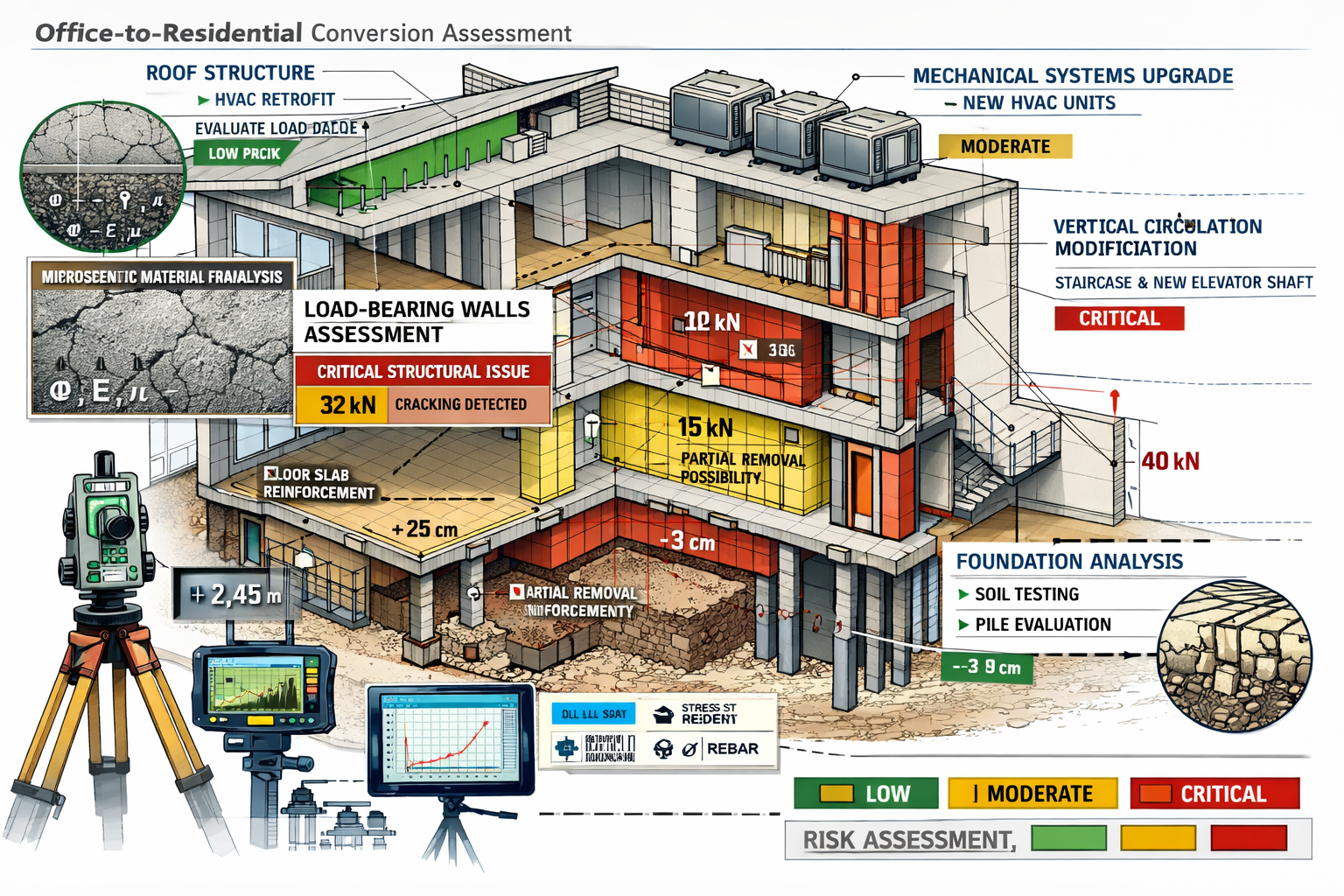
Successful developers employ systematic approaches to managing risks identified during Building Surveys for London Office-to-Resi Conversions: Identifying Structural Risks in 2026's Underpriced Market Revival.
Phased Survey Approach
Rather than commissioning all surveys simultaneously, a phased approach manages costs and risk:
Phase 1: Desktop Assessment and Initial Inspection 🔍
- Planning and permitted development eligibility review
- Visual inspection of accessible areas
- Review of existing building documentation
- Preliminary feasibility assessment
- Cost: £2,000-5,000
Phase 2: Detailed Structural and Services Survey
- Comprehensive structural assessment
- MEP systems evaluation
- Hazardous materials survey
- Envelope condition assessment
- Cost: £8,000-15,000
Phase 3: Specialist Investigations
- Intrusive structural testing
- Concrete condition surveys
- Ground investigation (if required)
- Detailed fire engineering assessment
- Cost: £10,000-25,000
This approach allows developers to exit projects early if Phase 1 or 2 reveals deal-breaking issues, minimizing sunk costs.
Contingency Planning and Budget Management
Survey findings should inform contingency allocation:
Recommended Contingency Levels 💰
- Buildings with comprehensive survey data: 10-15% contingency
- Buildings with limited survey access: 20-25% contingency
- Buildings with known defects: 25-35% contingency
- Buildings without intrusive surveys: 30-40% contingency
These contingencies protect against cost overruns from unforeseen structural issues discovered during construction.
Professional Team Assembly
Successful conversions require coordinated expertise:
Essential Professional Roles
- Chartered Building Surveyor – Overall condition assessment and project monitoring
- Structural Engineer – Load calculations, structural alterations, and reinforcement design
- MEP Engineer – Building services design and capacity assessment
- Fire Safety Consultant – Fire engineering and compliance strategy
- Planning Consultant – Permitted development and prior approval navigation
- Quantity Surveyor – Cost estimation and budget management
Engaging experienced professionals familiar with office-to-residential conversions significantly reduces risk exposure.
Conclusion: Maximizing Returns Through Comprehensive Building Surveys
The opportunity presented by Building Surveys for London Office-to-Resi Conversions: Identifying Structural Risks in 2026's Underpriced Market Revival is substantial, but success requires rigorous due diligence and risk management. As office spaces continue to represent the most undervalued asset class in London's property market, developers who approach conversions with comprehensive survey strategies will capture value while avoiding costly pitfalls.
The key lessons for successful conversion projects include:
Critical Success Factors ✨
-
Invest in comprehensive surveys before acquisition – The £15,000-40,000 cost of thorough surveys pales compared to the £200,000-500,000 in unexpected costs that inadequate assessment can reveal mid-project
-
Prioritize structural and fire safety assessment – These areas represent the highest cost risk and the most common sources of project delays and budget overruns
-
Build realistic contingencies based on survey findings – Aggressive budgeting without adequate contingency leads to stalled projects and distressed sales
-
Engage specialist professionals early – Experienced conversion specialists identify issues that generalist surveyors may overlook
-
Understand the regulatory landscape – Permitted development rights offer advantages, but compliance requirements remain stringent and costly
Next Steps for Developers and Investors
For those considering office-to-residential conversions in 2026:
Immediate Actions 📝
-
Identify target properties in areas with strong residential demand and favorable office-to-residential value gaps, particularly in East London, South East London, and other emerging conversion hotspots
-
Commission preliminary feasibility surveys on shortlisted properties to assess basic conversion viability before making offers
-
Assemble professional teams with proven office-to-residential conversion experience
-
Develop financial models that incorporate realistic conversion costs based on survey findings and appropriate contingencies
-
Review permitted development eligibility and prior approval requirements for target properties
The convergence of undervalued office assets, regulatory support for conversions, and persistent housing demand creates a compelling opportunity. However, this opportunity rewards only those developers who approach projects with comprehensive building surveys, realistic cost assessment, and professional risk management.
By prioritizing thorough structural assessment and understanding the specific challenges of Building Surveys for London Office-to-Resi Conversions: Identifying Structural Risks in 2026's Underpriced Market Revival, developers can navigate this complex landscape successfully, creating value while delivering much-needed housing to London's market.
The office-to-residential conversion wave is here. Those equipped with comprehensive survey knowledge and professional expertise will ride it to profitability, while those who cut corners on due diligence will find themselves overwhelmed by structural risks and compliance costs that eliminate returns.
References
[1] City London Approves First Application New Office Residential Cip Incentive Program – https://london.ca/newsroom/city-london-approves-first-application-new-office-residential-cip-incentive-program
[2] How To Convert Offices Into Homes Without Planning Permission – https://urbanistarchitecture.co.uk/how-to-convert-offices-into-homes-without-planning-permission/
[3] How To Successfully Convert Offices Into Homes – https://www.garnessjones.co.uk/news/how-to-successfully-convert-offices-into-homes
[4] Public Notices January 15 2026 – https://london.ca/newsroom/public-notice/public-notices-january-15-2026
[5] London Ontario Office Conversions Incentives – https://storeys.com/london-ontario-office-conversions-incentives/