
The buy-to-let market in 2026 is experiencing a dramatic transformation. Professional landlords and institutional investors are rapidly replacing amateur property investors, bringing sophisticated analysis and rigorous due diligence to every acquisition decision. This shift makes Building Surveys for Institutional Buy-to-Let Investment Surge 2026: Assessing Quality and Yield Potential more critical than ever before. As capital flows into rental property portfolios, comprehensive building assessments have evolved from optional extras to essential investment tools that directly impact yield calculations and risk management strategies.
While institutional investors have recently shifted some allocations away from real estate toward infrastructure and private credit[1], those remaining in the property sector are demanding unprecedented levels of technical insight. The stakes are higher, the competition is fiercer, and the margin for error has virtually disappeared. 🏢
Key Takeaways
- Institutional investors dominate 2026 buy-to-let markets, requiring professional-grade building surveys that go far beyond basic homebuyer assessments
- Comprehensive building surveys directly impact yield potential by identifying hidden costs, maintenance requirements, and value-add opportunities that affect ROI calculations
- HMO properties with 3+ bedrooms deliver strongest rental yields but demand more rigorous structural and regulatory assessments[5]
- Real estate debt funds have outperformed traditional property equity investments, making accurate property condition assessments critical for lending decisions[1]
- Only 15% of investors expect real estate to underperform in 2026, signaling renewed confidence that rewards thorough due diligence[7]
Why Institutional Investors Demand Professional Building Surveys
The Shift from Amateur to Professional Landlords
The buy-to-let landscape has fundamentally changed. Gone are the days when individual investors could purchase properties based on gut feeling or superficial inspections. Institutional investors now control significant market share, bringing corporate governance standards and fiduciary responsibilities that demand evidence-based decision-making.
These professional operators require detailed documentation for:
- Board-level investment approvals 📊
- Lender due diligence requirements
- Portfolio risk management frameworks
- Insurance underwriting accuracy
- Long-term capital expenditure planning
A comprehensive building survey provides the technical foundation for these critical business processes. Unlike basic valuation reports, professional surveys deliver granular detail about structural integrity, building systems, and potential liabilities that directly affect investment returns.
Connecting Survey Findings to Yield Calculations
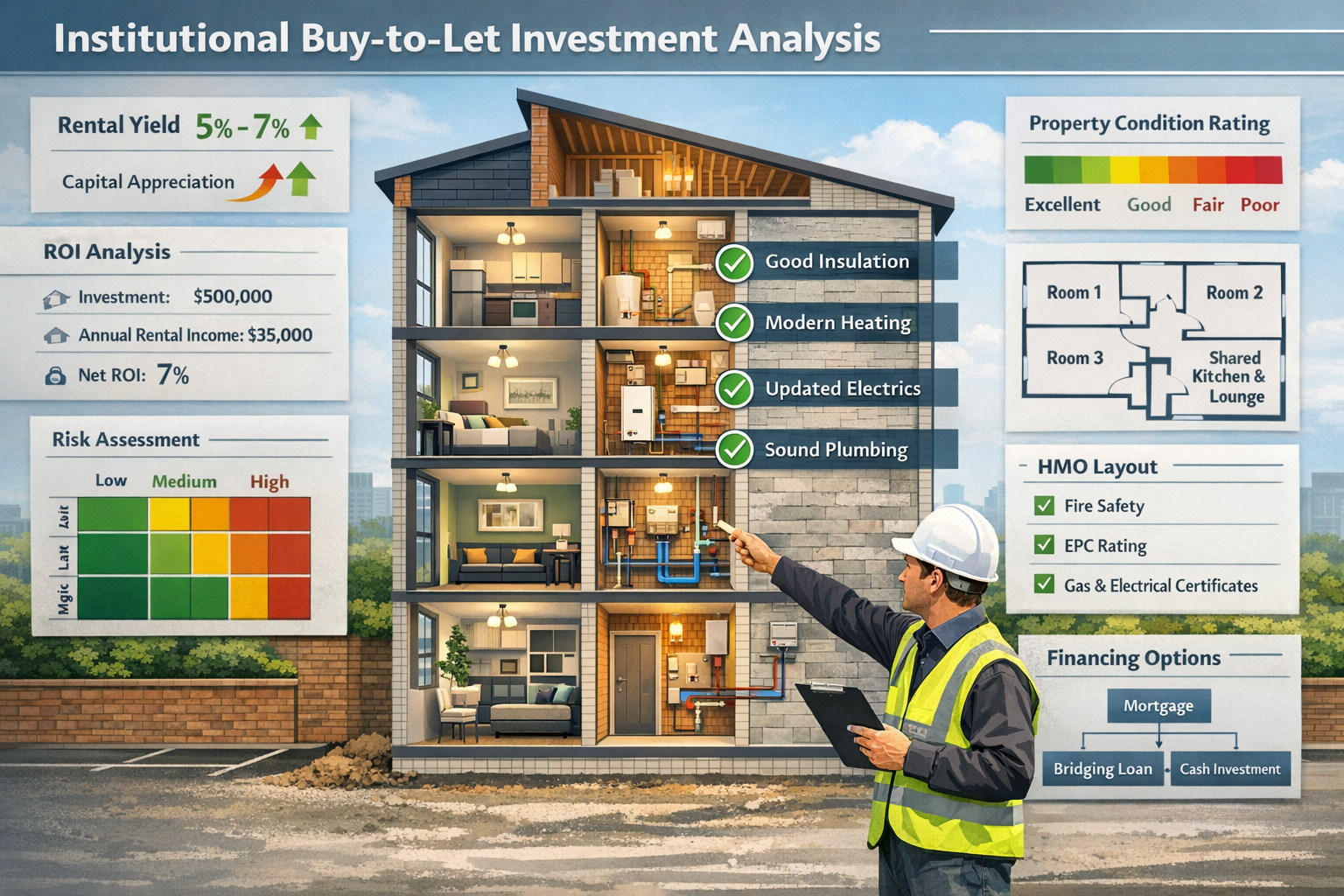
Building Surveys for Institutional Buy-to-Let Investment Surge 2026: Assessing Quality and Yield Potential represents more than property inspection—it's financial intelligence gathering. Every defect identified, every maintenance requirement documented, and every upgrade opportunity assessed feeds directly into sophisticated yield models.
Consider this practical example:
| Survey Finding | Financial Impact | Yield Effect |
|---|---|---|
| Outdated boiler system | £4,500 replacement cost | Reduces net yield by 0.3% |
| Rising damp in basement | £8,000 remediation + lost rental income | Reduces net yield by 0.6% |
| Roof requires re-tiling within 3 years | £12,000 future expenditure | Affects 5-year ROI projection |
| Energy efficiency improvements possible | £6,000 investment, £800/year savings | Increases net yield by 0.5% |
Professional investors incorporate these findings into discounted cash flow models, adjusting purchase prices or walking away from deals that don't meet return thresholds. A RICS Level 3 building survey provides the detailed intelligence needed for these calculations.
Risk Mitigation Through Comprehensive Assessment
Institutional investors operate under strict risk management frameworks. Building surveys serve as primary risk mitigation tools, identifying potential liabilities before they become financial disasters:
- Structural defects that could require six-figure remediation
- Subsidence indicators that threaten property values and insurability
- Fire safety compliance gaps in multi-occupancy buildings
- Asbestos presence requiring specialist removal
- Building regulation violations demanding costly corrections
For HMO investments specifically, which deliver the strongest monthly rental yields among property types[5], surveys must assess additional factors like fire door compliance, means of escape adequacy, and compartmentation integrity. These properties face more stringent regulations that make thorough specialist defect surveys absolutely essential.
Assessing Quality: What Institutional Investors Look For in Building Surveys
Structural Integrity and Long-Term Durability
Professional landlords think in decades, not years. They need building surveys that assess not just current condition but projected longevity and maintenance trajectories. Key structural elements under scrutiny include:
Foundation and Substructure:
- Evidence of movement or settlement
- Drainage adequacy around foundations
- Basement or cellar condition
- Subsidence risk factors
Superstructure:
- Load-bearing wall integrity
- Timber frame condition (if applicable)
- Lintel and beam performance
- Crack patterns and their significance
Roof Structure:
- Rafter and purlin condition
- Ridge board integrity
- Roof spread indicators
- Roof covering lifespan
Institutional investors particularly value surveys that quantify remaining service life for major building components. This information feeds directly into capital replacement reserves and lifecycle costing models.
Building Services and Energy Efficiency
Modern tenants demand comfort and efficiency. Building surveys for institutional buy-to-let investments must thoroughly assess mechanical and electrical systems that directly impact rental demand and operating costs:
Heating Systems:
- Boiler age, efficiency rating, and condition
- Central heating distribution effectiveness
- Thermostat and control sophistication
- Annual service history
Electrical Systems:
- Consumer unit compliance with current regulations
- Circuit capacity for modern appliance loads
- Earthing and bonding adequacy
- Periodic inspection test certificate status
Plumbing and Drainage:
- Water supply pipe materials and condition
- Hot water system capacity and efficiency
- Waste pipe routing and condition
- Damp issues from plumbing leaks
Energy Performance:
- Current EPC rating and improvement potential
- Insulation levels in walls, roof, and floors
- Window efficiency and glazing type
- Renewable energy installation opportunities
Properties with poor energy efficiency face increasing regulatory pressure and reduced tenant appeal. Surveys that identify cost-effective upgrade pathways add significant value to investment decisions.
Regulatory Compliance and Licensing Requirements
For HMO properties and multi-unit buildings, regulatory compliance represents a critical survey component. Non-compliance can result in:
- Prohibition orders preventing occupation
- Unlimited fines for serious violations
- Inability to obtain mandatory HMO licenses
- Tenant rent repayment claims
Essential compliance areas include:
✅ Fire Safety:
- Fire detection and alarm systems
- Emergency lighting provision
- Fire door specifications and self-closers
- Means of escape adequacy
- Compartmentation integrity
✅ Amenity Standards:
- Minimum room sizes for sleeping accommodation
- Kitchen and bathroom facility ratios
- Food preparation and storage adequacy
- Washing and toilet facility standards
✅ Building Regulations:
- Structural alteration approvals
- Electrical installation certificates
- Gas safety compliance
- Ventilation adequacy
Professional building surveys for institutional investors must explicitly address these regulatory dimensions, not merely structural and decorative condition.
Maximizing Yield Potential Through Strategic Survey Insights
Identifying Value-Add Opportunities
The most valuable building surveys don't just catalog problems—they identify opportunities that enhance rental yields and capital appreciation. Experienced surveyors spot potential improvements that institutional investors can leverage:
Space Optimization:
- Loft conversion feasibility for additional bedrooms
- Basement conversion potential
- Layout reconfiguration to increase bedroom count
- HMO conversion viability analysis
Rental Premium Enhancements:
- Modern kitchen and bathroom upgrade ROI
- En-suite bathroom addition potential
- Garden or outdoor space improvements
- Smart home technology integration points
Operational Efficiency Gains:
- Energy efficiency improvements reducing tenant bills
- Low-maintenance material substitutions
- Water efficiency measures lowering operating costs
- Security system enhancements
Consider a practical scenario: A building survey identifies a property with a large, underutilized loft space. The surveyor notes adequate headroom, suitable roof structure, and accessible stairwell location. Converting this space to a bedroom could increase rental income by £400-600 monthly while requiring £15,000-20,000 investment—delivering 24-32% annual return on the improvement cost alone.
Portfolio Standardization and Scalability
Institutional investors managing multiple properties need consistent assessment frameworks that enable portfolio-wide analysis. Building Surveys for Institutional Buy-to-Let Investment Surge 2026: Assessing Quality and Yield Potential must deliver:
Standardized Reporting:
- Consistent defect categorization systems
- Comparable condition rating scales
- Uniform cost estimation methodologies
- Portfolio-wide data aggregation capability
Benchmarking Capability:
- Property condition comparison across portfolio
- Maintenance cost forecasting accuracy
- Capital expenditure priority ranking
- Performance metric standardization
Scalable Due Diligence:
- Streamlined survey commissioning processes
- Predictable turnaround times
- Digital report delivery and archiving
- Integration with property management systems
Professional surveying firms that understand these institutional requirements position themselves as strategic partners rather than transactional service providers. The difference between Level 2 homebuyer surveys and comprehensive Level 3 building surveys becomes particularly important here—institutional investors typically require the deeper analysis that only full building surveys provide.
Financing and Lender Requirements
Real estate debt funds have significantly outperformed private equity real estate investments in recent years[1], making lender relationships increasingly important for buy-to-let investors. Building surveys play a crucial role in securing favorable financing terms:
Lender Due Diligence:
- Structural adequacy confirmation for loan security
- Major defect identification affecting property value
- Repair cost quantification for loan structuring
- Reinstatement cost assessment for insurance
Loan-to-Value Optimization:
- Accurate property condition supporting valuation
- Improvement potential justifying higher valuations
- Risk mitigation reducing lender margin requirements
- Portfolio quality demonstrating management competence
Specialist Lending Scenarios:
- HMO-specific compliance verification
- Conversion project feasibility assessment
- Refurbishment cost validation
- Development exit strategy support
Institutional investors understand that comprehensive building surveys often pay for themselves through improved financing terms. A survey that identifies and quantifies a £30,000 structural issue might enable price renegotiation that covers both the survey cost and the repair expenditure multiple times over.
Long-Term Maintenance Planning and Lifecycle Costing
Professional landlords operate with 10-year financial models that require accurate maintenance and replacement forecasting. Building surveys must provide the technical foundation for these projections:
Component Lifecycle Analysis:
- Roof covering: 15-25 years remaining life
- Boiler system: 5-8 years remaining life
- Windows and doors: 10-15 years remaining life
- External decoration: 3-5 year cycle
- Kitchen and bathroom fittings: 10-15 years
Capital Replacement Reserves:
Institutional investors typically reserve 0.5-1.5% of property value annually for major repairs and replacements. Building surveys inform these calculations by providing specific component condition assessments and replacement timelines.
Planned Maintenance Programs:
- Annual service requirements and costs
- Cyclical decoration schedules
- Statutory inspection frequencies
- Preventive maintenance priorities
This forward-looking approach distinguishes institutional investors from amateur landlords. A comprehensive RICS home survey provides the detailed component analysis needed for sophisticated lifecycle cost modeling.
Selecting the Right Survey Level for Buy-to-Let Investments
Understanding RICS Survey Levels
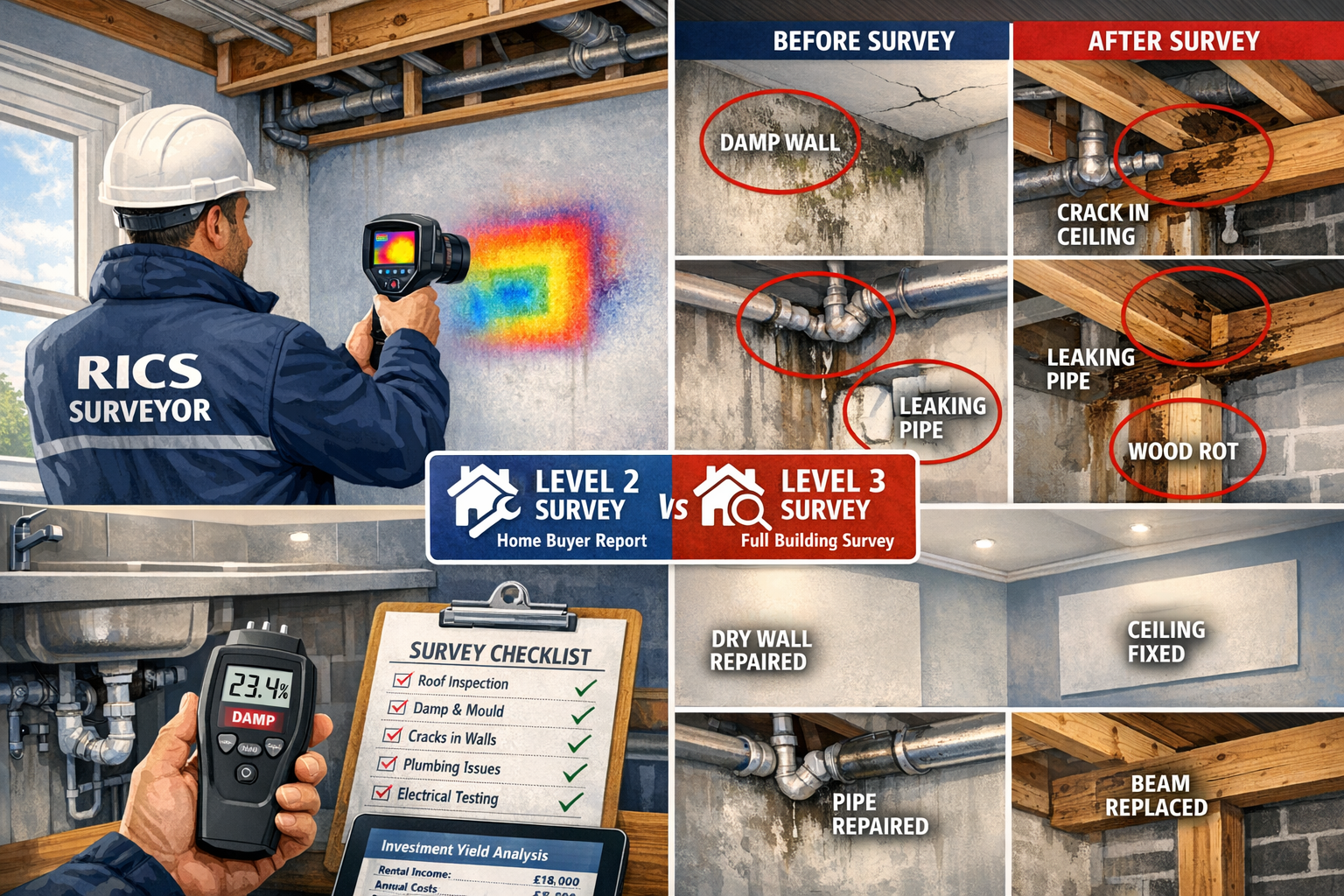
Not all building surveys deliver equal value for institutional buy-to-let investors. Understanding the difference between Level 2 and Level 3 surveys is essential:
Level 2 (HomeBuyer Survey):
- Suitable for conventional properties in reasonable condition
- Non-intrusive visual inspection
- Traffic light condition rating system
- Market valuation included
- Limited suitability for investment properties
Level 3 (Building Survey):
- Comprehensive inspection of accessible areas
- Detailed defect analysis and causation
- Extensive reporting on construction and condition
- Repair and maintenance advice
- Essential for older, altered, or complex properties
For institutional buy-to-let investments, Level 3 building surveys typically represent the minimum acceptable standard. The additional cost (usually £200-400 more than Level 2) is negligible compared to the investment value and risk exposure.
When to Commission Specialist Surveys
Comprehensive building surveys often identify issues requiring specialist investigation:
🔍 Structural Engineering Assessment:
When surveyors identify significant cracking, movement, or structural alterations, structural surveys by chartered engineers provide detailed analysis and remediation specifications.
🔍 Damp and Timber Surveys:
Moisture-related issues require specialist investigation to determine causes, extent, and appropriate remediation. Damp surveys using moisture meters and thermal imaging provide definitive diagnosis.
🔍 Drone Roof Surveys:
For tall buildings or complex roof structures, drone surveys enable detailed inspection without expensive scaffolding or access equipment.
🔍 Electrical Installation Condition Reports:
Properties without recent electrical certification require EICR testing to confirm safety and regulatory compliance.
Institutional investors budget for these specialist investigations as part of comprehensive due diligence. The cost is minimal compared to acquiring a property with hidden defects that could cost tens of thousands to remediate.
Survey Timing and Transaction Management
Strategic survey timing optimizes the investment process:
Pre-Offer Surveys:
- Enable accurate offer pricing incorporating defect costs
- Demonstrate serious buyer credentials
- Accelerate transaction timelines
- Reduce abortive transaction costs
Post-Offer, Pre-Exchange Surveys:
- Standard approach for most transactions
- Survey findings inform price renegotiation
- Provides withdrawal option if serious issues emerge
- Typical survey duration is 3-5 working days
Portfolio Acquisition Surveys:
- Coordinated survey programs across multiple properties
- Consistent reporting enabling comparative analysis
- Volume negotiation potential with surveying firms
- Staggered scheduling to manage transaction timelines
Professional investors work with local chartered surveyors who understand regional property characteristics and can deliver rapid turnaround when transaction timelines demand it.
The Future of Building Surveys in Institutional Buy-to-Let

Technology Integration and Digital Reporting
The surveying profession is embracing technology that delivers enhanced value to institutional clients:
Digital Survey Tools:
- Thermal imaging cameras identifying insulation defects and moisture issues
- Laser measuring devices ensuring accurate dimensions
- Moisture meters providing quantified dampness readings
- Drone technology enabling comprehensive roof inspection
Enhanced Reporting:
- Interactive digital reports with embedded photographs
- Defect location plans and annotated images
- Hyperlinked recommendations and cost estimates
- Cloud-based access and archiving
Data Analytics:
- Portfolio-wide condition trending
- Predictive maintenance modeling
- Benchmarking against comparable properties
- Integration with property management software
Institutional investors increasingly demand these technological capabilities from their surveying partners. Traditional paper reports with limited photography no longer meet professional standards.
ESG Considerations and Sustainability Assessment
Environmental, Social, and Governance (ESG) factors are becoming central to institutional investment decisions. Building surveys must evolve to address these priorities:
Environmental Performance:
- Current and potential EPC ratings
- Carbon footprint assessment
- Renewable energy installation feasibility
- Water efficiency opportunities
- Sustainable material usage
Social Responsibility:
- Tenant health and wellbeing factors
- Accessibility for disabled occupants
- Community impact considerations
- Affordable housing contribution potential
Governance Standards:
- Regulatory compliance verification
- Safety standard adherence
- Maintenance and management quality
- Tenant satisfaction enablers
Surveys that integrate ESG assessment alongside traditional structural and condition analysis position institutional investors to meet evolving stakeholder expectations and regulatory requirements.
Market Outlook for 2026 and Beyond
Despite recent capital allocation shifts toward infrastructure and private credit[1], real estate remains a core institutional investment class. Only 15% of investors expect real estate to underperform benchmarks[7], suggesting sustained demand for quality buy-to-let opportunities.
Key Market Drivers:
- Housing supply shortages maintaining rental demand
- Demographic trends favoring rental accommodation
- Professional landlord market consolidation
- Regulatory changes favoring institutional operators
- Debt fund growth supporting property acquisition[1]
Survey Industry Implications:
- Increased demand for institutional-grade assessments
- Premium pricing for surveyors with investment expertise
- Technology adoption becoming competitive necessity
- Specialization in HMO and multi-unit properties
- Long-term client relationships with portfolio investors
Building surveyors who position themselves as strategic investment partners rather than transactional service providers will capture disproportionate value from the institutional buy-to-let surge.
Conclusion
Building Surveys for Institutional Buy-to-Let Investment Surge 2026: Assessing Quality and Yield Potential represents far more than property inspection—it's the technical foundation for sophisticated investment decision-making. As professional landlords and institutional investors dominate the buy-to-let market, comprehensive building assessments have evolved from optional extras to essential due diligence tools that directly impact acquisition pricing, financing terms, and long-term returns.
The most successful institutional investors understand that thorough building surveys deliver multiple layers of value:
✅ Risk mitigation through early defect identification
✅ Yield optimization via accurate cost forecasting
✅ Value-add opportunities that enhance returns
✅ Regulatory compliance verification
✅ Financing support through lender confidence
✅ Portfolio management enablement
Actionable Next Steps
For institutional investors and professional landlords:
- Establish surveying partnerships with firms experienced in investment property assessment
- Standardize survey requirements across your portfolio for consistent analysis
- Budget appropriately for Level 3 building surveys and specialist investigations
- Integrate survey findings into financial models and yield calculations
- Leverage survey intelligence in price negotiations and acquisition decisions
- Maintain survey archives for portfolio management and future disposal decisions
For building surveyors:
- Develop institutional client expertise understanding investment decision frameworks
- Invest in technology that delivers enhanced reporting and analysis
- Create standardized reporting formats that enable portfolio comparison
- Build specialist knowledge in HMO regulations and multi-unit properties
- Establish lender relationships that generate referral opportunities
- Position as strategic partners rather than transactional service providers
The institutional buy-to-let surge of 2026 creates unprecedented opportunities for building surveyors who understand that their role extends far beyond defect identification to become essential partners in investment success. Those who embrace this strategic positioning will thrive in the evolving professional landlord marketplace.
References
[1] Real Assets In Focus Trends To Watch For 2026 – https://www.msci.com/research-and-insights/blog-post/real-assets-in-focus-trends-to-watch-for-2026
[5] 2026size Property Investors – https://www.buyassociationgroup.com/en-us/news/2026size-property-investors/
[7] Perspectives 2026 Investors Rekindle Their Ambitions For Private Real Estate – https://www.perenews.com/perspectives-2026-investors-rekindle-their-ambitions-for-private-real-estate/