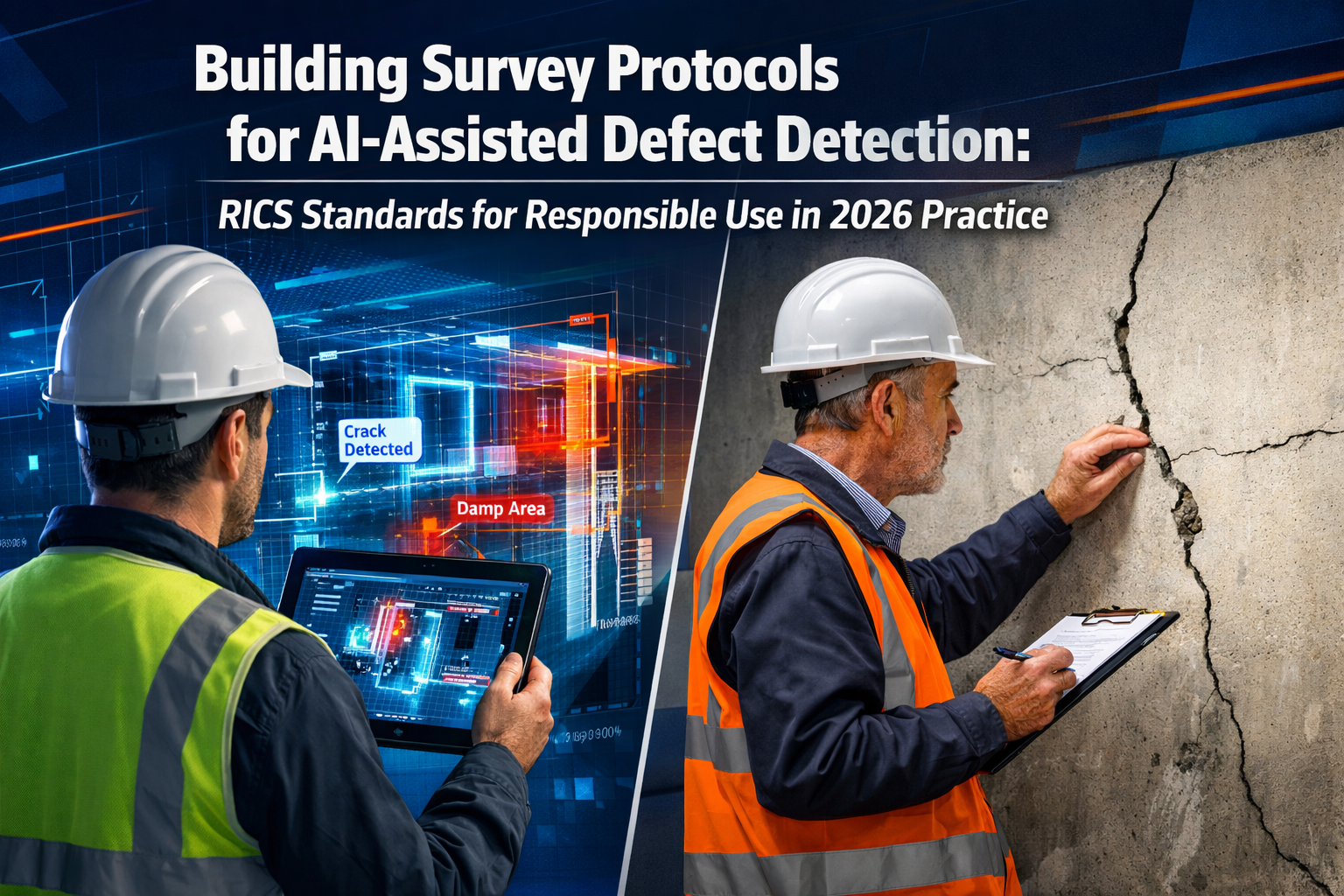
The Royal Institution of Chartered Surveyors (RICS) made history on March 9, 2026, when its groundbreaking AI standard became mandatory for all members and regulated firms worldwide—marking the first time a global professional body has enforced comprehensive protocols for artificial intelligence use in property surveying. [4] This watershed moment transforms how surveyors approach Building Survey Protocols for AI-Assisted Defect Detection: RICS Standards for Responsible Use in 2026 Practice, establishing clear boundaries between technological innovation and professional accountability.
The implications are immediate and far-reaching. Every RICS building survey conducted in 2026 must now comply with rigorous governance frameworks that validate AI tools before deployment, document material impacts, and maintain human expertise as the ultimate authority. For property professionals navigating damp detection, structural assessments, and construction phase monitoring, these standards represent both an opportunity to enhance accuracy and a mandate to avoid liability risks.
Key Takeaways
- Mandatory compliance: The RICS AI standard became effective March 9, 2026, requiring all members and regulated firms to follow structured governance protocols for AI deployment [4]
- Human expertise remains paramount: AI systems must support—not replace—professional judgment, with surveyors responsible for interpreting and validating all AI-generated outputs [1]
- Documentation is non-negotiable: Firms must maintain risk registers, conduct due diligence checks, and record material impact assessments in writing before implementing AI tools [5]
- Input quality determines accuracy: Poor lighting, low resolution, or obstructed views can distort AI defect detection results, requiring careful data collection protocols [1]
- Transparency builds trust: Surveyors must communicate clearly with clients about AI use, limitations, and how technology enhances traditional survey methodologies [3]
Understanding the RICS AI Standard Framework for Building Survey Protocols
The RICS "Responsible use of AI in surveying practice" standard represents a fundamental shift in how the profession integrates technology into daily operations. Published in September 2025 and mandatory since March 2026, this framework establishes clear expectations for Building Survey Protocols for AI-Assisted Defect Detection: RICS Standards for Responsible Use in 2026 Practice across all surveying disciplines. [2]
Core Governance Requirements
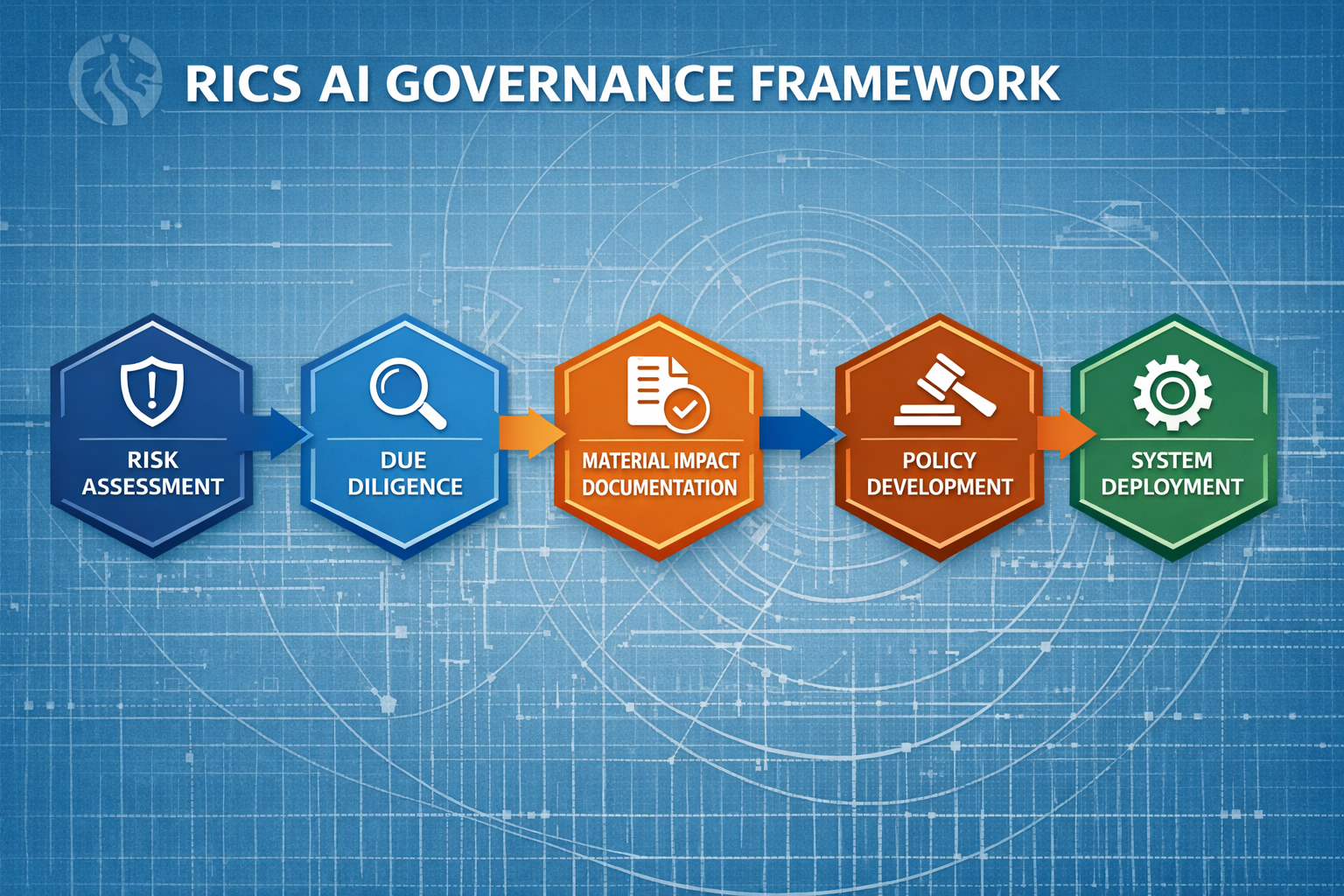
The standard mandates a structured approach to AI adoption that prioritizes accountability and transparency. Before deploying any AI system for defect detection, firms must complete several critical steps:
Risk Register Development 📋
Every AI tool must be logged in a comprehensive risk register that documents:
- System capabilities and limitations
- Data sources and quality requirements
- Potential failure modes
- Mitigation strategies
- Review and update schedules [5]
Material Impact Assessment
Surveyors must determine and record in writing whether AI use will materially affect service delivery. This assessment considers factors such as:
- The complexity of the property being surveyed
- The type of defects being investigated
- Client expectations and risk tolerance
- Insurance and liability implications [2]
Due Diligence Protocols
Before implementation, firms must conduct thorough checks on AI vendors and systems, including:
- Validation of algorithm accuracy rates
- Review of training data quality and bias
- Assessment of system transparency and explainability
- Evaluation of vendor support and update commitments [5]
Policy Development Requirements
The standard requires firms to create clear, documented policies for AI selection and use. These policies must address:
| Policy Component | Required Elements |
|---|---|
| Scope Definition | Which survey types permit AI assistance |
| Quality Standards | Minimum accuracy thresholds for AI outputs |
| Human Oversight | Mandatory review protocols by qualified surveyors |
| Client Communication | Disclosure requirements and consent procedures |
| Data Management | Storage, security, and retention protocols |
| Continuous Improvement | Regular performance reviews and updates |
For RICS Level 3 building surveys, which demand comprehensive property assessments, these policies become particularly critical as AI tools must complement—not compromise—the depth of professional analysis required.
AI-Assisted Defect Detection Technologies: Applications and Limitations
Machine learning and computer vision algorithms have transformed how surveyors identify structural defects, offering capabilities that extend human perception while introducing new considerations for Building Survey Protocols for AI-Assisted Defect Detection: RICS Standards for Responsible Use in 2026 Practice.
Current Detection Capabilities
AI systems excel at analyzing high-resolution images and videos to identify specific defect types:
Structural Defect Recognition 🏗️
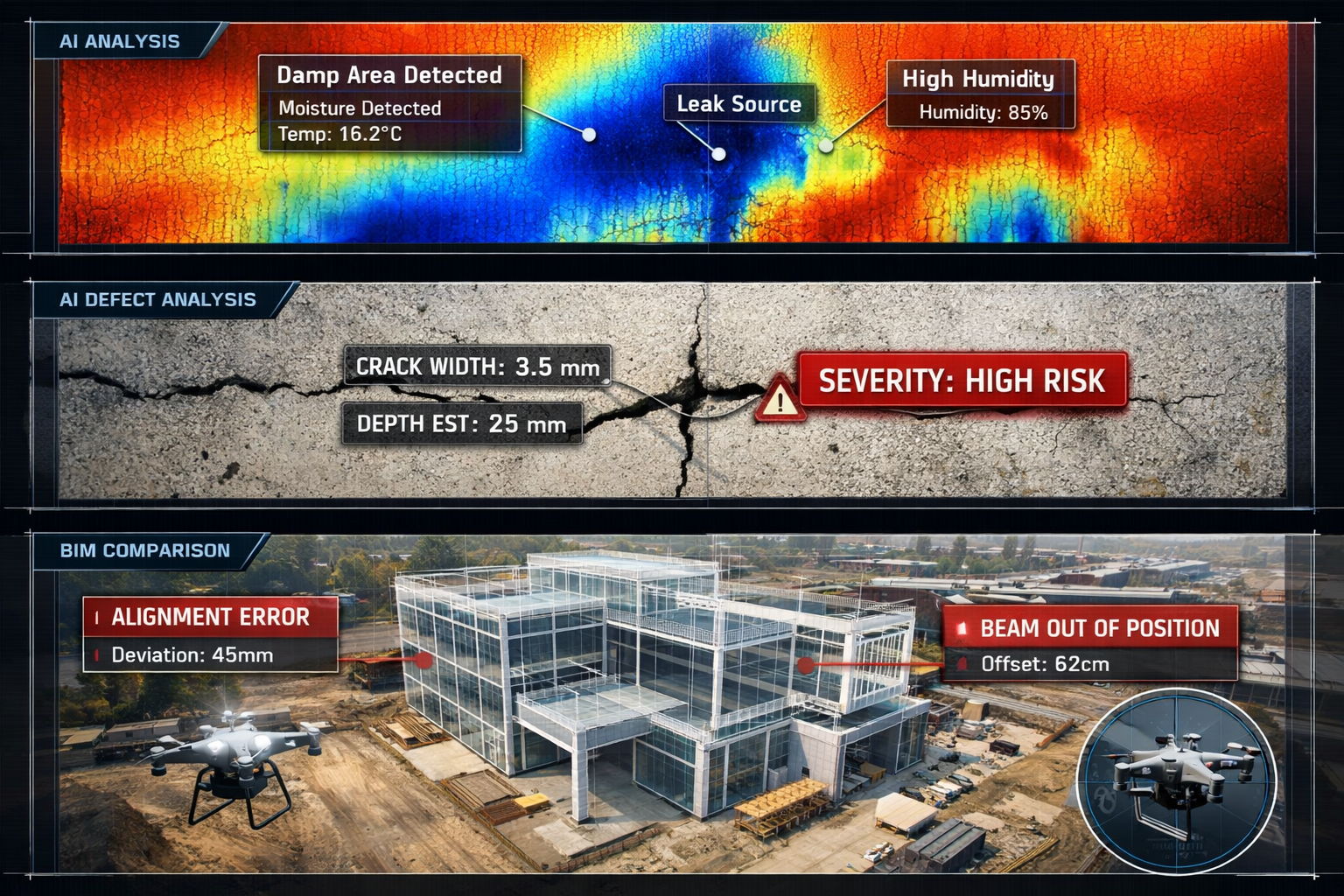
Modern AI tools can detect and classify:
- Cracks: Width measurement, depth estimation, and severity classification
- Damp and moisture intrusion: Thermal imaging analysis and pattern recognition
- Corrosion: Metal degradation assessment in structural elements
- Settlement indicators: Foundation movement and subsidence evidence [1]
Construction Phase Monitoring
During active construction, AI systems compare visual site data to Building Information Modeling (BIM) specifications in real time, identifying:
- Deviations from original design
- Incomplete installations
- Quality control failures
- Safety compliance issues [1]
This proactive approach helps project managers address defects before rework becomes necessary, reducing costs and timeline delays. For commercial building surveys, this capability proves particularly valuable in large-scale developments.
Residential Property Assessments
In residential contexts, AI supports basic condition evaluations for:
- Rental property listings
- Mortgage pre-approval assessments
- Initial condition documentation
- Property quality scoring from listing photographs [1]
Critical Limitations and Dependencies
The RICS standard explicitly acknowledges that AI accuracy depends heavily on input quality. Surveyors must understand these constraints:
Data Quality Requirements ⚠️
- Lighting conditions: Poor illumination creates shadows that obscure defects or generate false positives
- Image resolution: Low-quality photos lack detail needed for accurate defect classification
- Viewing angles: Obstructed or limited perspectives prevent comprehensive assessment
- Environmental factors: Weather, dust, or temporary coverings can mask underlying issues [1]
Algorithm Training Limitations
AI systems perform best on defect types present in their training datasets. Novel or unusual conditions may be:
- Misclassified or overlooked entirely
- Assigned incorrect severity ratings
- Confused with similar but unrelated features
Context Understanding Gaps
Unlike experienced surveyors, AI systems struggle with:
- Historical building characteristics and acceptable tolerances
- Regional construction practices and material variations
- Cumulative defect patterns that indicate systemic issues
- Distinguishing cosmetic concerns from structural problems
For structural surveys requiring nuanced interpretation of building behavior over time, these limitations underscore why the RICS standard insists on human professional oversight.
Implementing Compliant Building Survey Protocols for AI-Assisted Defect Detection
Translating RICS requirements into practical workflows demands systematic integration of AI tools within established surveying methodologies while maintaining professional standards.
Pre-Survey Planning and Tool Selection
Client Consultation and Consent 🤝
The standard mandates transparency from the outset. Surveyors must:
- Explain how AI will be used during the survey
- Describe the benefits and limitations of AI-assisted detection
- Obtain explicit consent for AI deployment
- Clarify that human expertise remains the primary authority [3]
Tool Validation Process
Before using AI systems on client projects, firms should:
- Conduct controlled testing: Run the AI tool on properties with known defects to verify accuracy
- Compare against manual inspection: Validate AI findings against traditional survey results
- Document performance metrics: Record detection rates, false positives, and missed defects
- Establish confidence thresholds: Define minimum accuracy levels for different defect types
Site-Specific Risk Assessment
Each property presents unique challenges. Consider:
- Building age and construction type
- Accessibility constraints that may limit data collection
- Known defect history requiring particular attention
- Environmental conditions affecting imaging quality
On-Site Data Collection Protocols
Effective AI-assisted surveys require rigorous data capture standards:
Image Acquisition Guidelines 📸
- Consistency: Use standardized camera settings and angles
- Coverage: Capture multiple views of each area from different perspectives
- Lighting: Supplement natural light with artificial sources to eliminate shadows
- Scale reference: Include measurement markers for dimensional analysis
- Metadata: Record location, orientation, and timestamp for each image
Traditional Survey Integration
AI tools should augment, not replace, conventional survey techniques:
- Conduct manual inspections of all accessible areas
- Use moisture meters, borescopes, and other diagnostic equipment
- Document observations independently before reviewing AI outputs
- Cross-reference AI findings with physical evidence
For damp surveys, this dual approach proves essential as AI thermal imaging analysis must be validated against moisture meter readings and visual inspection of staining patterns.
Post-Survey Analysis and Reporting
AI Output Validation ✅
The RICS standard requires surveyors to:
- Review all AI-flagged defects personally
- Verify severity classifications through professional judgment
- Investigate false positives and understand system limitations
- Document instances where AI missed defects identified manually [1]
Professional Interpretation
Surveyors must apply their expertise to:
- Assess defect causes and likely progression
- Recommend appropriate remedial actions
- Prioritize issues based on risk and urgency
- Consider building-specific context and history
Report Documentation Standards
Survey reports must clearly indicate:
- Which elements were assessed using AI assistance
- How AI findings were validated by the surveyor
- Any limitations or uncertainties in AI-generated data
- The surveyor's professional conclusions independent of AI input [3]
This transparency ensures clients understand the methodology while maintaining professional accountability for all survey conclusions.
Professional Judgment and Human Oversight in AI-Assisted Surveys
The RICS standard's most emphatic requirement is that AI must support—never replace—human professional expertise. This principle shapes every aspect of Building Survey Protocols for AI-Assisted Defect Detection: RICS Standards for Responsible Use in 2026 Practice.
The Non-Negotiable Role of Surveyor Expertise
Critical Thinking Requirements 🧠
Surveyors must actively question and validate AI outputs:
- Plausibility checks: Does the AI finding align with building type and age?
- Pattern recognition: Do multiple defects suggest a systemic issue?
- Historical context: Are identified defects consistent with known building behavior?
- Risk assessment: What are the implications for structural integrity and safety?
Professional Responsibility
The standard makes clear that surveyors remain fully accountable for:
- All conclusions and recommendations in survey reports
- Defects missed by AI systems but identifiable through professional inspection
- Incorrect AI classifications that a competent surveyor should have corrected
- Client advice based on survey findings, regardless of AI involvement [1]
Quality Assurance Protocols
Continuous Performance Monitoring
Firms should implement ongoing evaluation systems:
- Track AI accuracy rates across different property types
- Analyze false positive and false negative patterns
- Compare AI-assisted survey outcomes to traditional methods
- Adjust protocols based on performance data
Competency Development
Surveyors using AI tools require training in:
- Understanding AI system capabilities and limitations
- Interpreting confidence scores and uncertainty measures
- Recognizing algorithm bias and failure modes
- Maintaining professional skepticism toward automated outputs
For home surveys where clients depend on surveyor expertise for major purchase decisions, this competency becomes crucial to maintaining trust and professional standards.
Liability and Insurance Considerations
Professional Indemnity Coverage 📄
The introduction of AI into survey practice has insurance implications:
- Insurers may require disclosure of AI tool usage
- Policy terms may specify conditions for AI deployment
- Claims involving AI-assisted surveys may face additional scrutiny
- Premium adjustments may reflect AI-related risk profiles [6]
Risk Mitigation Strategies
To protect against liability exposure:
- Maintain comprehensive documentation of AI validation processes
- Ensure all survey staff understand RICS compliance requirements
- Implement robust quality control procedures
- Review and update AI policies regularly
- Communicate clearly with clients about methodology and limitations
Building Trust Through Transparent Client Communication
The RICS standard recognizes that client confidence depends on clear, honest communication about AI use in surveying services.
Disclosure Requirements
Initial Engagement 💬
When proposing survey services, firms should:
- Explain whether AI tools will be used and for what purposes
- Describe how AI enhances traditional survey methodologies
- Clarify that professional surveyors remain responsible for all findings
- Address any client concerns about technology reliability
Terms of Engagement
Written agreements must specify:
- The scope of AI-assisted inspection
- Data collection and processing methods
- How AI outputs will be validated
- Client rights regarding data usage and retention [3]
Managing Client Expectations
Realistic Capability Communication
Avoid overselling AI capabilities:
- ❌ "AI detects all hidden defects"
- ✅ "AI assists in identifying visible defects in photographed areas, which our surveyor then validates"
Limitation Acknowledgment
Be transparent about constraints:
- Areas inaccessible to imaging remain unassessed by AI
- Some defect types require physical testing beyond AI capabilities
- Professional judgment remains essential for interpretation
- AI provides supporting data, not definitive conclusions
Report Presentation Standards
Clear Methodology Sections
Survey reports should include:
- Description of AI tools used and their functions
- Explanation of data collection procedures
- Statement of surveyor validation process
- Clarification of professional responsibility for conclusions
Defect Documentation
For each identified issue:
- Note whether AI flagged the defect
- Describe surveyor verification method
- Provide professional assessment of severity and urgency
- Recommend appropriate actions based on expert judgment
This transparent approach builds client confidence while ensuring compliance with RICS standards for responsible AI use.
Future-Proofing Survey Practices: Adapting to Evolving AI Standards
The 2026 RICS standard represents the beginning, not the end, of professional guidance on AI integration in surveying practice.
Anticipated Developments
Technology Evolution 🚀
AI capabilities continue advancing rapidly:
- Enhanced defect classification accuracy
- Real-time 3D modeling and analysis
- Predictive maintenance algorithms
- Integration with IoT sensors for continuous monitoring
Regulatory Refinement
RICS will likely update standards as:
- Use cases expand and mature
- New risks and challenges emerge
- Best practices become established
- International harmonization progresses [4]
Organizational Preparedness
Flexible Policy Frameworks
Design AI policies that:
- Allow for technology updates without complete rewrites
- Include review and revision schedules
- Incorporate feedback loops from practical experience
- Align with broader organizational quality management systems
Staff Development Investment
Commit to ongoing professional development:
- Regular training on new AI capabilities
- Updates on RICS guidance and industry best practices
- Cross-functional learning between surveyors and technology specialists
- Participation in professional forums and working groups
Competitive Positioning
Firms that master responsible AI integration gain advantages:
- Enhanced service quality and efficiency
- Differentiation in competitive markets
- Stronger client relationships through transparency
- Reduced liability exposure through robust protocols
For practices offering building surveys across residential and commercial sectors, strategic AI adoption aligned with RICS standards positions them for sustained success in an evolving professional landscape.
Practical Implementation Checklist
To ensure compliance with Building Survey Protocols for AI-Assisted Defect Detection: RICS Standards for Responsible Use in 2026 Practice, firms should complete these essential steps:
Immediate Actions (Within 30 Days)
✅ Review current AI tool usage across all survey types
✅ Establish or update risk register documenting all AI systems
✅ Conduct material impact assessments for existing AI deployments
✅ Draft or revise AI use policies incorporating RICS requirements
✅ Update client engagement documents to include AI disclosures
✅ Brief all survey staff on new compliance obligations
Short-Term Implementation (Within 90 Days)
✅ Complete due diligence reviews of AI vendors and systems
✅ Develop validation protocols for AI-generated defect findings
✅ Create training programs for surveyors using AI tools
✅ Update report templates to document AI methodology
✅ Review professional indemnity insurance coverage for AI use
✅ Establish performance monitoring systems for AI accuracy tracking
Ongoing Maintenance
✅ Quarterly policy reviews and updates as needed
✅ Regular staff training refreshers on responsible AI use
✅ Continuous performance monitoring of AI systems
✅ Client feedback collection on AI-assisted surveys
✅ Industry engagement to stay current with evolving standards
✅ Annual comprehensive audits of AI governance compliance

Conclusion
The mandatory RICS standard for responsible AI use marks a defining moment in surveying practice. Building Survey Protocols for AI-Assisted Defect Detection: RICS Standards for Responsible Use in 2026 Practice requires a fundamental shift in how firms approach technology integration—moving from ad-hoc adoption to structured governance frameworks that prioritize accountability, transparency, and professional expertise.
The opportunities are substantial. AI-assisted defect detection enhances survey accuracy, improves efficiency, and provides clients with more comprehensive property assessments. Machine learning algorithms excel at pattern recognition across vast datasets, identifying subtle indicators that might escape human observation during time-constrained site visits. When properly validated and integrated within professional workflows, these tools strengthen the value proposition of RICS building surveys across residential and commercial sectors.
Yet the risks are equally significant. Uncritical reliance on AI outputs, inadequate validation protocols, or failure to maintain human oversight can lead to missed defects, incorrect classifications, and professional liability exposure. The RICS standard addresses these concerns by establishing clear boundaries: AI supports professional judgment but never replaces it; surveyors remain fully accountable for all survey conclusions; and transparency with clients is non-negotiable.
Next Steps for Survey Professionals
For Individual Surveyors:
- Familiarize yourself thoroughly with the RICS standard requirements [3]
- Seek training on AI tools used in your practice
- Develop critical evaluation skills for AI outputs
- Maintain detailed documentation of validation processes
- Engage with professional forums discussing AI implementation
For Survey Firms:
- Conduct comprehensive audits of current AI usage
- Implement robust governance frameworks before March 2026 deadlines
- Invest in staff training and competency development
- Review and update professional indemnity insurance coverage
- Establish clear client communication protocols
- Monitor AI system performance continuously
For Clients:
- Ask surveyors about their AI use policies and validation procedures
- Ensure written agreements specify AI deployment scope
- Understand that AI enhances but doesn't replace professional expertise
- Request clarity on methodology in survey reports
- Consider structural surveys from RICS-compliant professionals
The integration of AI into building survey practice represents progress, not peril—provided the profession maintains its commitment to ethical standards, professional judgment, and client service. The RICS framework provides the roadmap; implementation success depends on individual and organizational dedication to responsible technology adoption.
As AI capabilities continue evolving, surveyors who master these tools within proper governance frameworks will deliver superior service while maintaining the trust and professional accountability that define the chartered surveying profession. The future of building surveys lies not in choosing between human expertise and artificial intelligence, but in their thoughtful integration under clear ethical guidelines.
References
[1] Ruai Case Studies 06 – https://www.rics.org/profession-standards/rics-standards-and-guidance/conduct-competence/responsible-use-of-ai/ruai-case-studies-06
[2] Ai Responsible Use Standard – https://ww3.rics.org/uk/en/journals/construction-journal/ai-responsible-use-standard.html
[3] Responsible Use Of Ai – https://www.rics.org/profession-standards/rics-standards-and-guidance/conduct-competence/responsible-use-of-ai
[4] Rics First Ever Standard On Responsible Ai Use Now In Effect – https://www.rics.org/news-insights/rics-first-ever-standard-on-responsible-ai-use-now-in-effect
[5] Rics Ai Standards For Surveyors – https://goreport.com/rics-ai-standards-for-surveyors/
[6] Rics Introduces Mandatory Ai Standard For Surveyors What Insurers And Their Clients Need To Know – https://cms.law/en/gbr/legal-updates/rics-introduces-mandatory-ai-standard-for-surveyors-what-insurers-and-their-clients-need-to-know