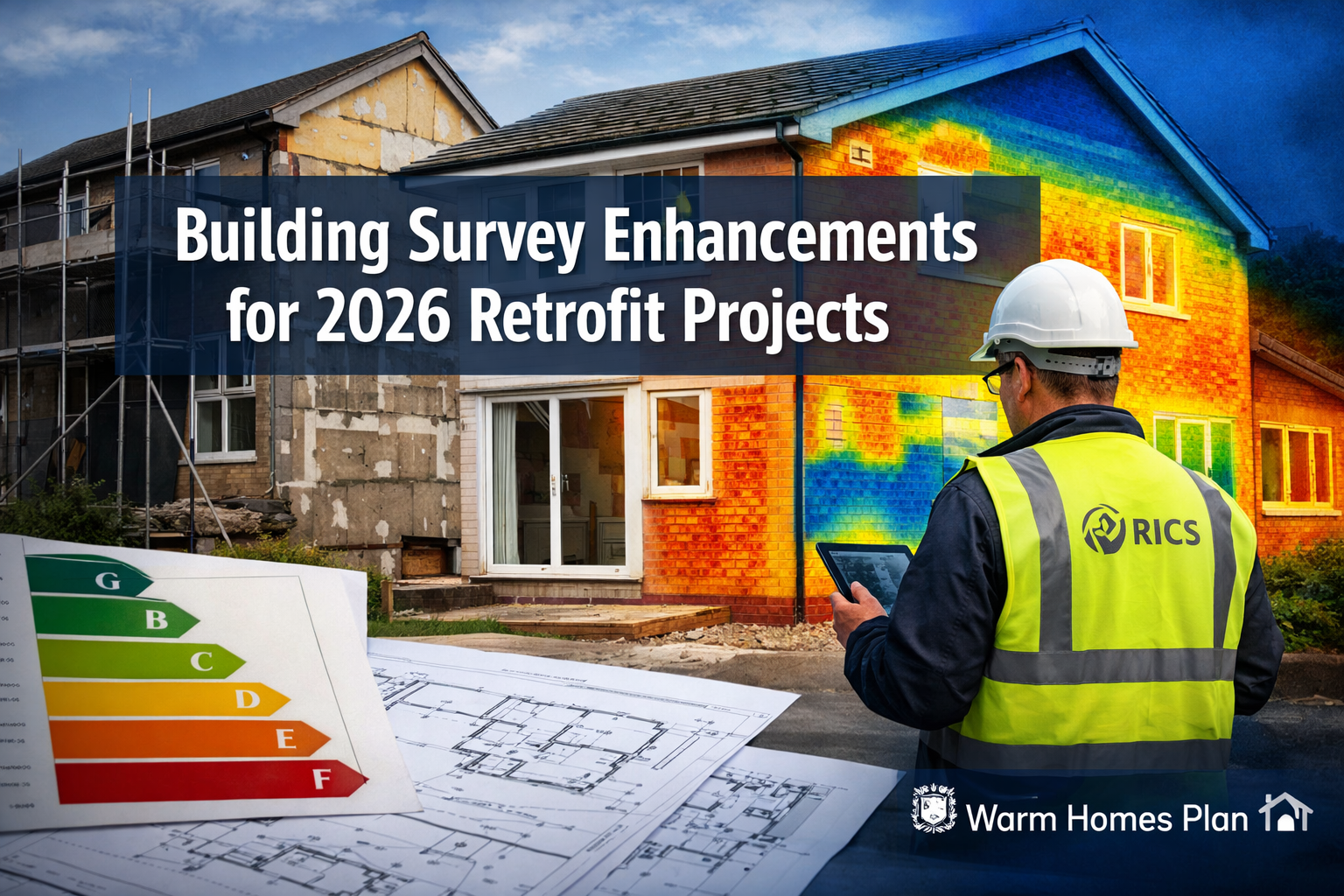
The UK's residential retrofit sector stands at a critical juncture in 2026. Following the Royal Institution of Chartered Surveyors' Quality in Retrofit Summit, building surveyors face unprecedented opportunities—and responsibilities—as the nation accelerates toward its net-zero targets. The Building Survey Enhancements for 2026 Retrofit Projects: RICS Updates Post-Quality in Retrofit Summit represent a fundamental shift in how professionals assess, plan, and deliver energy efficiency improvements across the UK's housing stock. 🏠
With government mandates requiring 500,000 residential retrofits annually from 2025, scaling to one million by 2030, the surveying profession must evolve rapidly.[5] This article examines the enhanced building survey methodologies, new professional pathways, and practical assessment frameworks that define retrofit excellence in 2026.
Key Takeaways
- Mandatory RICS Residential Retrofit Standard became effective in October 2024, establishing comprehensive professional requirements for all retrofit surveying work[1]
- New AssocRICS pathway specifically for Residential Retrofit Surveying creates dedicated entry route for specialists, addressing critical skills gaps[2]
- BS 40104 standardized assessment framework is now mandatory for retrofit inspections, ensuring whole-house evaluation prevents performance gaps and unintended consequences[1]
- Government's Warm Homes Plan creates distinct professional opportunities across three pillars: targeted low-income support, universal homeowner offers, and rental property protections[2]
- Enhanced competency requirements blend traditional building surveying skills with specialized retrofit knowledge in energy efficiency, building physics, and performance verification[1]
Understanding the RICS Residential Retrofit Standard Framework
Mandatory Professional Requirements Since October 2024
The RICS Residential Retrofit Standard represents the most significant professional framework update for building surveyors in recent years. Effective from October 2024, this standard establishes both mandatory and recommended instructions for all RICS members and regulated firms delivering retrofit services.[1]
The standard fundamentally redefines retrofit assessment as not merely an administrative step but the foundation of effective, safe, and sustainable retrofit.[1] This philosophical shift recognizes that inadequate assessment has led to numerous retrofit failures, including projects that failed to deliver intended carbon savings and, in some cases, caused significant defects or exacerbated issues like damp, mould, and condensation.[1]
Core Components of Enhanced Building Surveys
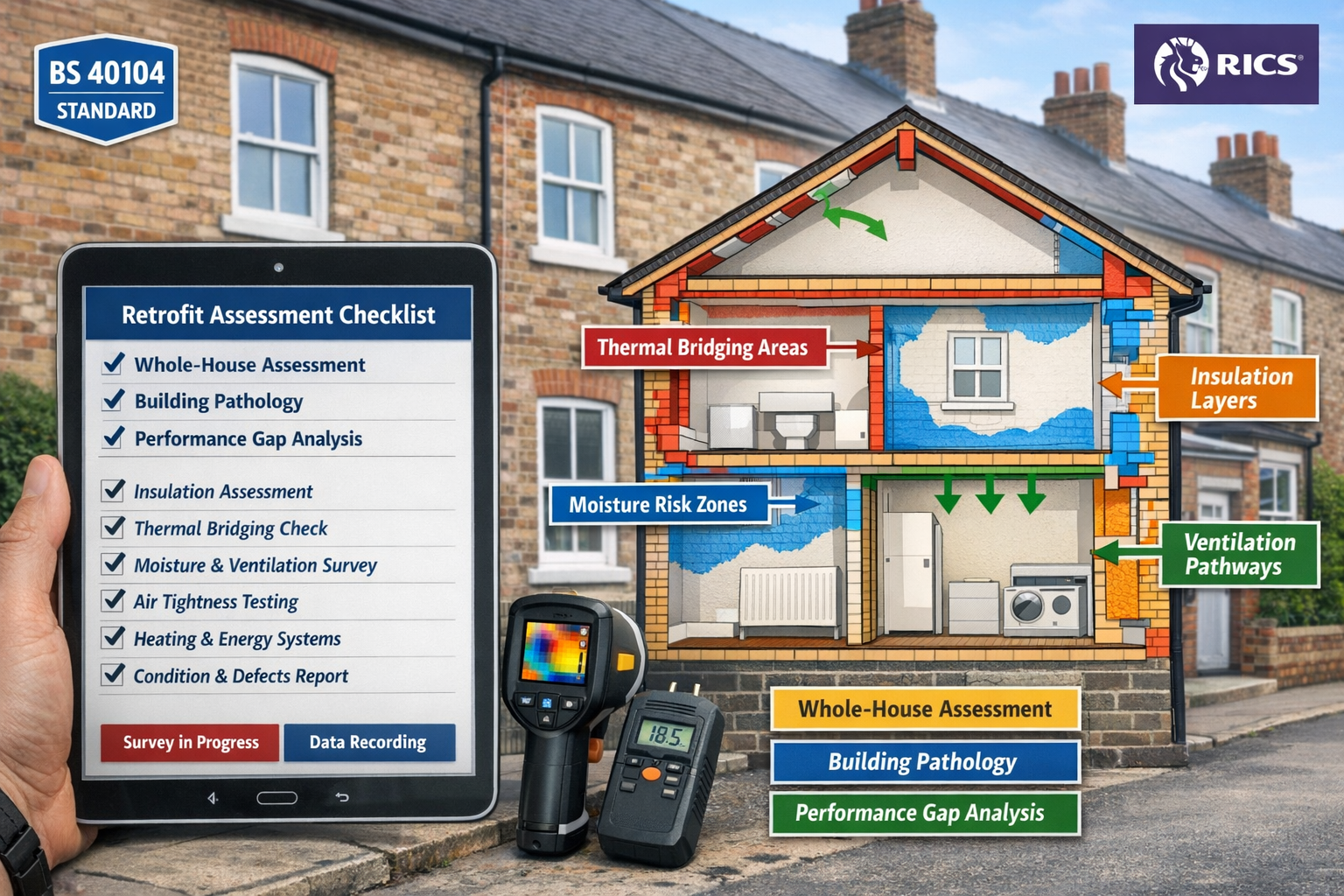
Building surveyors conducting RICS building surveys for retrofit projects must now integrate several enhanced assessment areas:
Whole-House Assessment Requirements 📋
- Complete building fabric analysis (walls, roofs, floors, windows, doors)
- Thermal performance evaluation of existing construction
- Moisture movement patterns and condensation risk zones
- Ventilation pathways and indoor air quality considerations
- Heritage and conservation constraints
- Occupant needs and lifestyle patterns
- Existing services and utilities capacity
Building Pathology Expertise
According to Professor Richard Fitton FRICS, chair of the BS 40104 drafting panel, robust assessment is fundamental to delivering meaningful improvements in energy performance while preventing performance gaps and unintended consequences.[1] This requires surveyors to understand:
- Construction typology and historical building methods
- Material compatibility for retrofit interventions
- Moisture behavior in traditional and modern construction
- Thermal bridging identification and mitigation
- Structural implications of proposed measures
Performance Gap Analysis
Enhanced surveys must move beyond theoretical modeling to measure actual building performance. This includes:
| Assessment Method | Purpose | Key Metrics |
|---|---|---|
| Thermal imaging | Identify heat loss patterns | Temperature differentials, thermal bridges |
| Blower door testing | Measure air tightness | Air changes per hour (ACH) |
| Moisture monitoring | Detect dampness risks | Relative humidity, material moisture content |
| Indoor air quality testing | Ensure ventilation adequacy | CO₂ levels, VOCs, particulates |
| In-situ U-value measurement | Verify actual thermal performance | W/m²K for building elements |
This data-driven approach contrasts sharply with reliance on RdSAP-based Energy Performance Certificates (EPCs), which use standardized assumptions rather than actual building conditions.[3]
Building Survey Enhancements for 2026 Retrofit Projects: New Professional Pathways
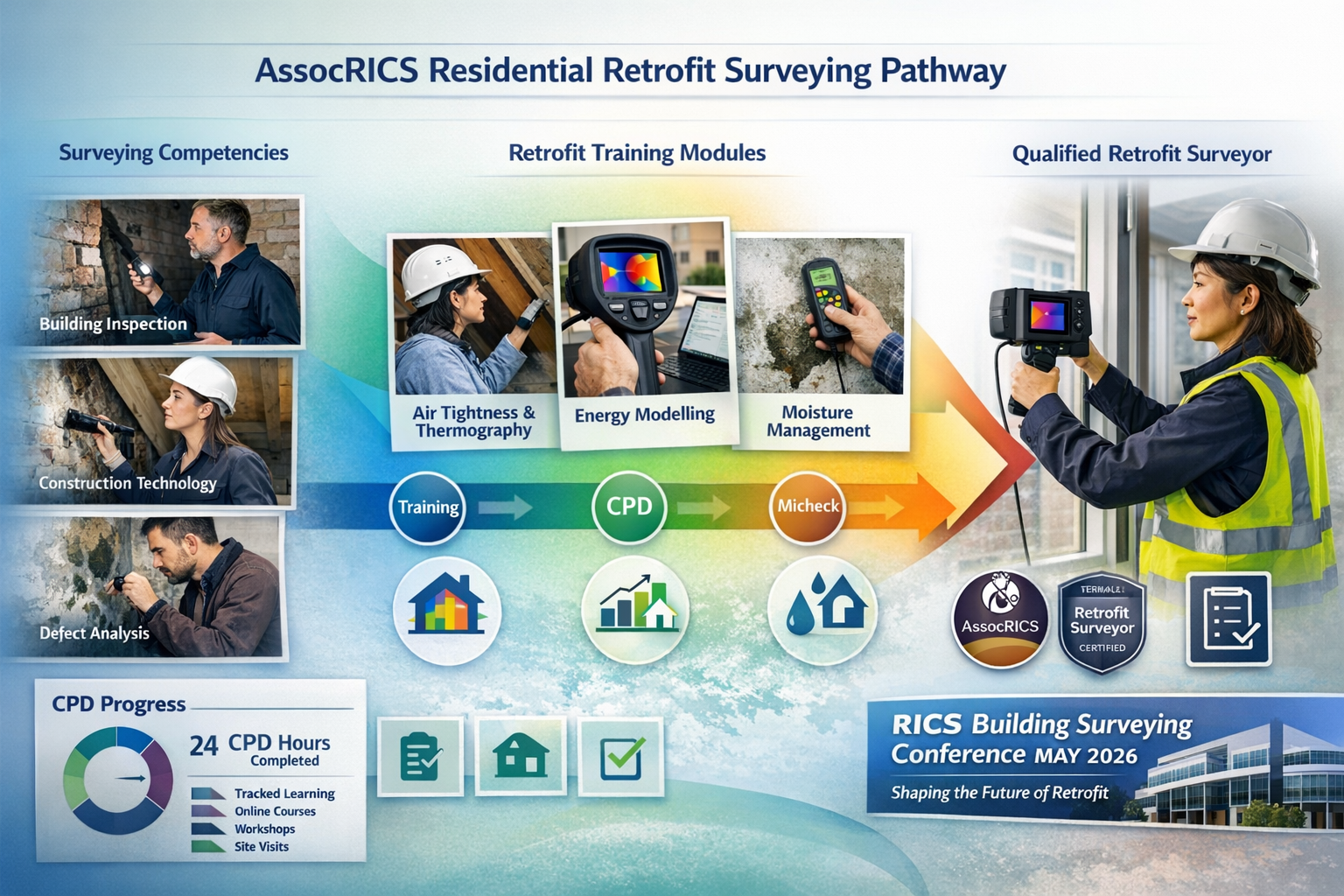
The AssocRICS Residential Retrofit Surveying Route
In direct response to the skills gap identified at the Quality in Retrofit Summit, RICS launched a pilot AssocRICS Residential Retrofit Surveying pathway in 2026.[2] Developed in consultation with the Retrofit Academy and industry partners, this dedicated entry route acknowledges that retrofit surveying requires a distinct blend of competencies.
Core Competencies Required 🎓
The pathway combines traditional surveying foundations with specialized retrofit knowledge:
Traditional Surveying Skills:
- Physical inspection of residential building types
- Building pathology and defect diagnosis
- Construction technology understanding
- Moisture movement and building physics
- Legal and regulatory compliance
Specialized Retrofit Competencies:
- Retrofit testing methodologies (thermal imaging, air tightness, moisture analysis)
- Monitoring and evaluation of retrofit performance
- Risk assessment for retrofit interventions
- Energy efficiency measure specification
- Retrofit design principles
- Occupant engagement and behavior change
Structured CPD Requirements
The new pathway includes ongoing continuing professional development to ensure practitioners maintain currency with evolving technologies, materials, and methodologies.[1] This addresses the reality that retrofit is a rapidly advancing field where yesterday's best practices may be superseded by improved approaches.
Integration with Existing Survey Services
The enhanced retrofit competencies complement existing building survey services, creating opportunities for surveyors to offer comprehensive assessments. For example:
- RICS specialist defect surveys can now incorporate retrofit readiness assessments
- Level 2 homebuyer surveys can include energy efficiency improvement recommendations
- Commercial building surveys can address non-domestic retrofit requirements
BS 40104: The Standardized Retrofit Assessment Framework
Mandatory Use for Retrofit Inspections
The RICS Residential Retrofit Standard mandates use of BS 40104: Assessment of Dwellings for Retrofit for all retrofit inspection tasks.[1] This British Standard provides a structured, consistent framework that ensures no critical assessment areas are overlooked.
Key Principles of BS 40104 📐
-
Individual Building Treatment: Each property is assessed based on its unique construction, condition, occupancy, and heritage context rather than applying one-size-fits-all solutions[1]
-
Sequential Assessment Process: The standard establishes a logical progression from initial desktop review through detailed on-site inspection to post-installation verification
-
Risk-Based Approach: Potential unintended consequences (moisture accumulation, overheating, indoor air quality degradation) are systematically evaluated before intervention design
-
Performance Verification: Post-installation testing confirms that theoretical improvements translate to actual energy savings and occupant comfort
Practical Assessment Checklists for Surveyors
Building surveyors implementing BS 40104 should utilize comprehensive checklists covering:
Pre-Retrofit Desktop Assessment 💻
- Historical records review (planning applications, previous surveys, building control approvals)
- Construction age and typology determination
- Conservation area or listed building constraints
- Existing EPC data and limitations
- Utility consumption history analysis
- Flood risk and climate resilience considerations
On-Site Inspection Protocol
External Fabric:
- Wall construction type and condition
- Roof structure and covering
- Window and door types, glazing, seals
- Rainwater goods and drainage
- External ground levels and damp-proof course integrity
- Thermal bridging at junctions
Internal Assessment:
- Room-by-room condition survey
- Existing insulation levels (loft, walls, floors)
- Heating system type, age, efficiency
- Ventilation provision (natural, mechanical)
- Evidence of moisture issues (condensation, mould, dampness)
- Occupant lifestyle and heating patterns
Building Physics Measurements:
- Thermal imaging of building envelope
- Spot U-value measurements of key elements
- Air tightness testing (blower door)
- Moisture meter readings at risk areas
- Indoor temperature and humidity monitoring
Post-Installation Verification
Following retrofit implementation, enhanced surveys must verify:
- Workmanship quality and specification compliance
- Thermal performance improvements (repeat thermal imaging)
- Air tightness improvements (post-retrofit blower door test)
- Absence of unintended moisture issues
- Occupant satisfaction and comfort levels
- Actual energy consumption reduction
Building Survey Enhancements for 2026 Retrofit Projects: Government Policy Alignment
The Warm Homes Plan Three-Pillar Structure
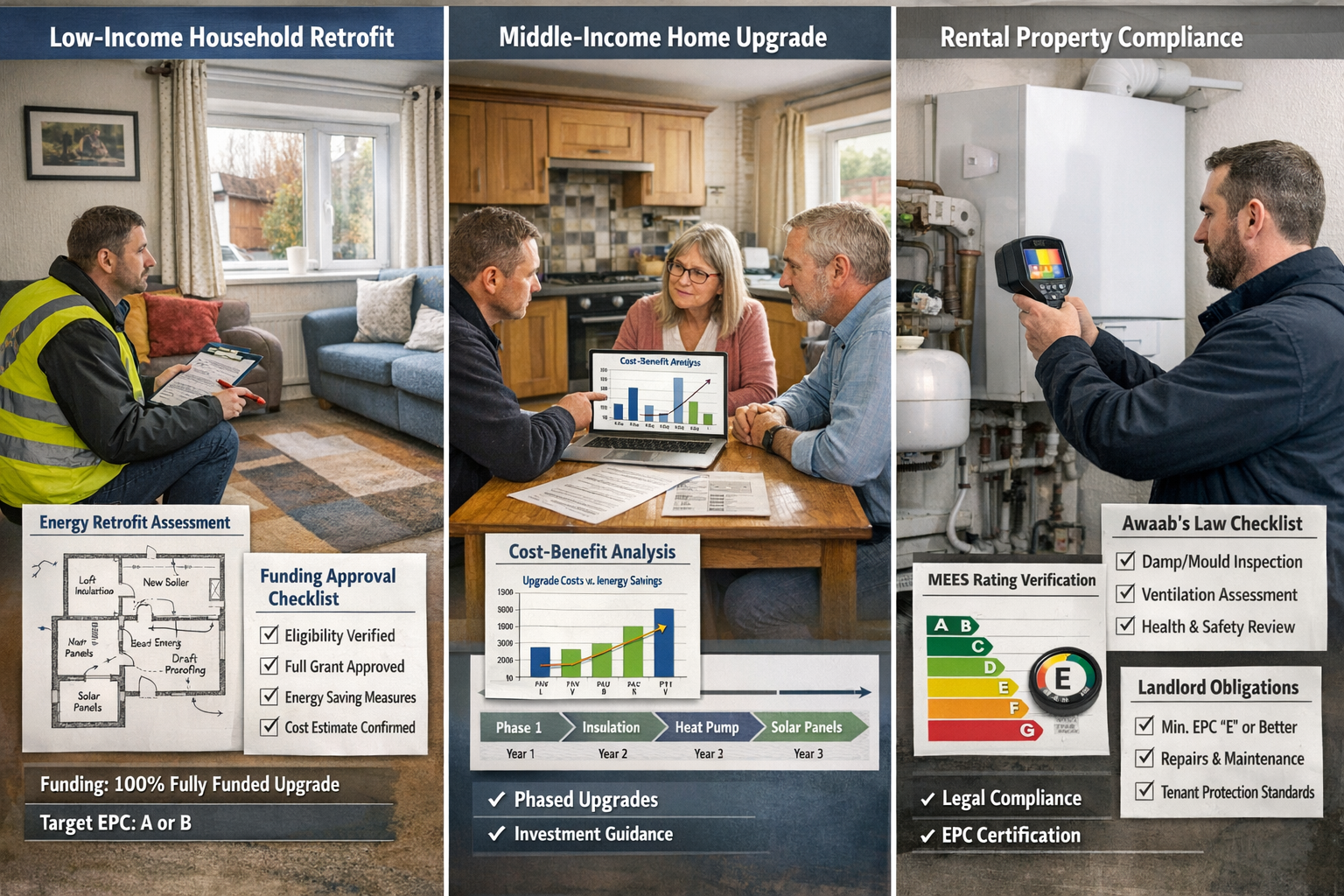
The UK Government's Warm Homes Plan creates distinct professional opportunities for building surveyors across three strategic pillars.[2] Understanding these pillars helps surveyors position their services effectively.
Pillar 1: Targeted Support for Low-Income Households 🏘️
This pillar involves fully funded whole-house upgrades for eligible households, creating demand for:
- Comprehensive stock condition surveys
- Retrofit suitability assessments
- Quality assurance inspections during installation
- Post-completion verification surveys
- Ongoing performance monitoring
Surveyors working in this sector must understand funding eligibility criteria, coordinate with local authorities and housing associations, and ensure interventions deliver maximum benefit to vulnerable occupants.
Pillar 2: Universal Offer for Investing Households
Middle-income homeowners seeking to improve energy efficiency require:
- Independent pre-purchase retrofit assessments
- Cost-benefit analysis of intervention options
- Phased improvement planning
- Contractor specification and tender support
- Installation oversight and snagging
- Performance certification
This pillar represents significant commercial opportunity for surveyors offering consultancy services to private clients making substantial investments in their properties.
Pillar 3: Stronger Protections for Renters
Landlord compliance with Minimum Energy Efficiency Standards (MEES) and Awaab's Law creates mandatory survey requirements:
- MEES compliance verification
- Damp and mould risk assessments
- Tenant health and safety evaluations
- Remedial works specifications
- Regulatory compliance certification
Surveyors must understand landlord obligations, enforcement mechanisms, and tenant rights to provide effective services in this sector.
Awaab's Law Integration
Following the tragic death of two-year-old Awaab Ishak from prolonged exposure to mould, Awaab's Law now requires social landlords to investigate and fix reported health hazards within strict timeframes.[2]
Building surveyors play a critical role in:
- Conducting condition surveys identifying damp and mould risks
- Determining root causes (condensation, penetrating damp, rising damp, leaks)
- Specifying appropriate remedial measures
- Verifying effectiveness of interventions
- Supporting landlord compliance documentation
This legislative requirement creates ongoing demand for damp surveys and specialist moisture investigations as part of retrofit projects.
Practical Implementation: Surveyor Checklists for Consumer-Driven Retrofits
Pre-Engagement Client Consultation
When homeowners or landlords approach surveyors for retrofit advice, the initial consultation should establish:
Client Objectives Clarification 🎯
- Primary motivation (cost savings, comfort, environmental concern, compliance)
- Budget constraints and funding availability
- Timeline expectations
- Planned occupancy duration
- Future property plans (sale, rental, long-term residence)
- Specific problem areas (cold rooms, high bills, condensation)
Property Information Gathering
- Construction age and type
- Previous improvements or extensions
- Known defects or issues
- Existing heating system details
- Current energy costs
- EPC rating (if available)
Staged Assessment Approach
Rather than overwhelming clients with comprehensive assessments, surveyors can offer staged approaches:
Stage 1: Initial Retrofit Readiness Assessment (Half-day visit)
- Visual inspection of building fabric
- Identification of obvious defects requiring remediation
- Assessment of retrofit suitability
- Preliminary recommendations for priority interventions
- Budget estimate for detailed assessment
Stage 2: Comprehensive BS 40104 Assessment (Full-day visit with testing)
- Complete building survey following BS 40104 framework
- Thermal imaging and air tightness testing
- Moisture surveys at risk areas
- Detailed retrofit specification
- Cost-benefit analysis of intervention options
- Phasing recommendations
Stage 3: Installation Oversight (Multiple visits)
- Pre-installation site meeting with contractors
- Mid-installation quality checks
- Final completion inspection
- Snagging list preparation
Stage 4: Post-Installation Verification (Follow-up visit after occupation)
- Performance testing (thermal imaging, air tightness)
- Occupant feedback collection
- Energy consumption comparison
- Handover documentation and maintenance guidance
Quality Assurance Protocols
Recent retrofit failures underscore the importance of robust quality assurance.[1] Surveyors should implement:
Contractor Selection Support
- Specification of required competencies and certifications
- Review of contractor proposals against design specification
- Reference checking and previous work inspection
- Insurance and warranty verification
Installation Monitoring
- Photographic documentation at key stages
- Material verification (insulation type, thickness, thermal performance)
- Workmanship inspection (air barrier continuity, thermal bridge mitigation)
- Compliance with building regulations and manufacturer specifications
Defect Identification and Resolution
Common retrofit defects to monitor include:
- Inadequate air barrier continuity (gaps, tears, unsealed penetrations)
- Thermal bridging at junctions (wall-floor, wall-roof, window reveals)
- Compressed insulation (reduced R-value)
- Inadequate ventilation provision (risk of condensation)
- Moisture trapping within building fabric
- Poor detailing at service penetrations
Early identification allows corrective action before completion, avoiding costly remediation.
Advanced Survey Technologies for Retrofit Assessment
Thermal Imaging Applications
Thermal imaging cameras have become essential tools for retrofit surveyors, revealing:
- Heat loss patterns through building fabric
- Thermal bridging locations
- Air leakage points (when combined with blower door testing)
- Insulation defects or gaps
- Moisture accumulation (evaporative cooling effect)
Best Practice Thermal Imaging Protocol 📸
- Minimum 10°C temperature differential between inside and outside
- Stabilized internal temperature (heating on for several hours)
- External survey for heat loss identification
- Internal survey for thermal bridging and air leakage
- Multiple viewing angles at critical junctions
- Calibrated equipment with emissivity correction
- Photographic documentation with temperature scales
Air Tightness Testing
Blower door testing quantifies air leakage, providing:
- Baseline air change rate before retrofit
- Post-retrofit verification of improvements
- Identification of major leakage paths (using thermal imaging during test)
- Compliance verification with building regulations
Target air permeability rates for retrofit projects typically range from 5-7 m³/(h·m²) at 50 Pa, though higher performance may be achievable with comprehensive measures.
Moisture Monitoring Systems
Advanced moisture monitoring helps prevent retrofit-induced dampness:
- Capacitance moisture meters for surface and subsurface readings
- Hygrometers for relative humidity measurement
- Data loggers for continuous monitoring over weeks or months
- Thermal hygrometers combining temperature and humidity
- Infrared thermography for moisture detection
Critical Monitoring Locations:
- External wall interiors (especially solid walls)
- Window reveals and corners
- Bathroom and kitchen areas
- Basement and ground floor perimeters
- Roof spaces and loft conversions
Emerging Technologies
Forward-thinking surveyors are adopting:
- Drone surveys for roof condition assessment and thermal imaging
- 3D laser scanning for accurate dimensional surveys
- Building Information Modeling (BIM) for retrofit design coordination
- Artificial intelligence analysis of thermal images
- Predictive modeling software for energy performance forecasting
The upcoming RICS Building Surveying Conference on May 7, 2026 will feature sessions on AI applications in building surveying, providing professional development opportunities.[3]
Regional Considerations and Local Expertise
Climate and Construction Variations
Retrofit approaches must account for regional variations in:
Climate Factors:
- Annual heating degree days
- Rainfall and driving rain exposure
- Wind exposure and air infiltration risks
- Overheating risk (southern regions)
- Flood risk and climate resilience
Construction Typology:
- Victorian terraced housing (solid wall construction)
- 1930s semi-detached (cavity walls, often unfilled)
- Post-war system-built housing (non-standard construction)
- Modern timber frame construction
- Historic and listed buildings requiring sympathetic approaches
Surveyors operating across different regions should develop expertise in local construction types. For example, chartered surveyors in London frequently encounter Victorian and Georgian terraced properties requiring specialized solid wall insulation approaches, while chartered surveyors in Essex may work more extensively with post-war suburban housing stock.
Conservation and Heritage Constraints
Approximately 500,000 listed buildings exist in England, requiring careful retrofit approaches that:
- Preserve historic fabric and character
- Use breathable, compatible materials
- Respect original construction principles
- Obtain necessary consents (listed building consent, conservation area approval)
- Balance energy efficiency with heritage preservation
The RICS guidance on retrofitting historic buildings sustainably emphasizes that traditional buildings often perform better than theoretical models suggest, and inappropriate interventions can cause significant harm.[3]
Commercial and Non-Domestic Retrofit Opportunities
While residential retrofit dominates current policy focus, commercial and non-domestic buildings represent substantial opportunities:
Commercial Building Retrofit
Commercial property surveyors can offer:
- Portfolio-wide energy audits
- MEES compliance assessments for commercial lettings
- Tenant improvement specifications
- Lease negotiation support (green lease clauses)
- Valuation impacts of energy efficiency improvements
Public Sector Retrofit
Schools, hospitals, and government buildings face ambitious decarbonization targets, requiring:
- Occupied building retrofit strategies (minimal disruption)
- Phased improvement programs
- Performance monitoring and verification
- Post-occupancy evaluation
Professional Development and Continuing Education
Immediate Actions for Surveyors
Building surveyors seeking to capitalize on retrofit opportunities should:
1. Assess Current Competency Gaps 📚
- Review RICS Residential Retrofit Standard requirements
- Identify areas requiring additional training
- Consider AssocRICS Residential Retrofit Surveying pathway
- Evaluate equipment needs (thermal camera, moisture meters, blower door)
2. Pursue Targeted CPD
- Attend RICS Building Surveying Conference (May 7, 2026)[3]
- Complete Retrofit Academy training modules
- Obtain building physics and hygrothermal modeling training
- Study BS 40104 standard in detail
- Learn retrofit design software and modeling tools
3. Develop Strategic Partnerships
- Establish relationships with retrofit coordinators
- Partner with specialist contractors (insulation, HVAC, renewable energy)
- Connect with local authority retrofit programs
- Join retrofit industry networks and forums
4. Market Enhanced Capabilities
- Update professional profiles highlighting retrofit competencies
- Develop case studies of successful retrofit assessments
- Create educational content for potential clients
- Offer introductory retrofit readiness assessments
Long-Term Career Development
The retrofit sector offers sustained career opportunities as the UK progresses toward net-zero. Surveyors can position themselves as:
- Retrofit Coordinators: Overseeing entire retrofit projects from assessment through completion
- Quality Assurance Specialists: Independent verification of retrofit installations
- Expert Witnesses: Providing professional opinions in retrofit disputes
- Training Providers: Teaching next-generation retrofit professionals
- Policy Advisors: Contributing to evolving standards and regulations
Risk Management and Professional Indemnity
Liability Considerations in Retrofit Work
Retrofit surveying carries specific professional risks:
Performance Gap Liability
If recommended measures fail to deliver promised energy savings, clients may pursue claims. Mitigation strategies include:
- Clear disclaimers about modeling limitations
- Use of conservative assumptions in predictions
- Recommendation of post-installation monitoring
- Documentation of client decisions overriding professional advice
Unintended Consequence Claims
Retrofit-induced damp, mould, or condensation can result in significant claims. Protection requires:
- Comprehensive moisture risk assessments
- Clear warnings about ventilation requirements
- Specification of appropriate materials for building type
- Post-installation moisture monitoring recommendations
- Detailed record-keeping of assessment findings and advice
Contractor Performance Issues
When surveyors recommend contractors or oversee installations, they may face claims for defective work. Risk management includes:
- Clear contractual separation between surveyor and contractor roles
- Written disclaimers about contractor selection responsibility
- Thorough installation monitoring and snagging
- Prompt notification of observed defects
Insurance Requirements
Surveyors should verify their professional indemnity insurance covers retrofit-specific activities, including:
- Thermal performance assessments and predictions
- Energy modeling and EPC-related advice
- Specification of retrofit measures
- Installation oversight and quality assurance
- Post-installation performance verification
Some insurers may require additional premiums or exclusions for retrofit work, making early consultation essential.
Future Developments and Emerging Trends
Regulatory Evolution
The retrofit regulatory landscape continues to evolve:
Anticipated Changes:
- Strengthened MEES requirements (potential EPC C minimum by 2028)
- Expanded Awaab's Law coverage to private rental sector
- New building regulations Part L revisions
- Potential retrofit obligations at point of sale
- Enhanced enforcement mechanisms
Staying informed through RICS updates, such as the UK Influence and Advocacy Update, helps surveyors anticipate and prepare for changes.[4]
Technology Integration
Emerging technologies will transform retrofit assessment:
- Digital twins: Virtual building models updated with real-time performance data
- Machine learning: Automated defect detection from thermal images
- IoT sensors: Continuous building performance monitoring
- Blockchain: Immutable records of retrofit work and performance
- Virtual reality: Client visualization of proposed improvements
Whole-Life Carbon Considerations
Beyond operational energy, retrofit assessments increasingly consider:
- Embodied carbon in retrofit materials
- Circular economy principles (reuse, recycling)
- Life-cycle assessment of intervention options
- Climate resilience and adaptation measures
- Biodiversity net gain opportunities
Conclusion
The Building Survey Enhancements for 2026 Retrofit Projects: RICS Updates Post-Quality in Retrofit Summit mark a transformative moment for the surveying profession. With mandatory standards, new professional pathways, and standardized assessment frameworks now in place, building surveyors possess the tools and recognition to lead the UK's retrofit acceleration.
The scale of opportunity is unprecedented—500,000 retrofits annually from 2025, scaling to one million by 2030—creating sustained demand for competent professionals who can deliver safe, effective, and sustainable improvements.[5] However, this opportunity comes with significant responsibility. Recent retrofit failures demonstrate that inadequate assessment and poor-quality installation can cause serious harm, undermining confidence in the sector and damaging properties and occupants alike.[1]
Actionable Next Steps for Surveyors
Immediate Actions (Next 30 Days): ⚡
- Review the RICS Residential Retrofit Standard and assess personal competency gaps
- Register for the RICS Building Surveying Conference on May 7, 2026[3]
- Acquire or upgrade thermal imaging and moisture monitoring equipment
- Study BS 40104 standard and develop assessment checklists
- Update professional profiles to highlight retrofit capabilities
Medium-Term Development (3-6 Months):
- Complete targeted CPD in building physics, hygrothermal modeling, and retrofit design
- Consider enrollment in AssocRICS Residential Retrofit Surveying pathway[2]
- Develop strategic partnerships with retrofit coordinators and specialist contractors
- Create case studies and marketing materials for retrofit assessment services
- Establish relationships with local authority retrofit programs and housing associations
Long-Term Strategic Positioning (6-12 Months):
- Build portfolio of completed retrofit assessments with performance verification data
- Develop specialist expertise in specific building types or retrofit approaches
- Contribute to industry knowledge through publications, presentations, or training
- Expand service offerings to include retrofit coordination and quality assurance
- Position practice as regional retrofit excellence center
The retrofit revolution is underway, and building surveyors who embrace enhanced assessment methodologies, pursue professional development, and commit to quality will find themselves at the forefront of one of the most significant transformations in UK housing history. The framework is established, the demand is proven, and the professional recognition is secured—now is the time for action. 🚀
References
[1] Retrofit Assessment Surveyors Upskilling – https://ww3.rics.org/uk/en/journals/property-journal/retrofit-assessment-surveyors-upskilling.html
[2] Retrofit Leaders Meet Rics Hq Discuss Importance Transformative Projects – https://www.rics.org/news-insights/retrofit-leaders-meet-rics-hq-discuss-importance-transformative-projects
[3] Retrofitting Historic Buildings Sustainably – https://ww3.rics.org/uk/en/journals/built-environment-journal/retrofitting-historic-buildings-sustainably.html
[4] Uk Influence And Advocacy Update January 2026 – https://www.rics.org/news-insights/uk-influence-and-advocacy-update-january-2026
[5] Retrofit Improving Energy Efficiency For Residential Property – https://www.ricsfirms.com/residential/improvements/going-green/retrofit-improving-energy-efficiency-for-residential-property/
[6] Building Surveys For Retrofit Compliance Navigating Rics Standards And Consumer Insights In 2026 – https://nottinghillsurveyors.com/blog/building-surveys-for-retrofit-compliance-navigating-rics-standards-and-consumer-insights-in-2026