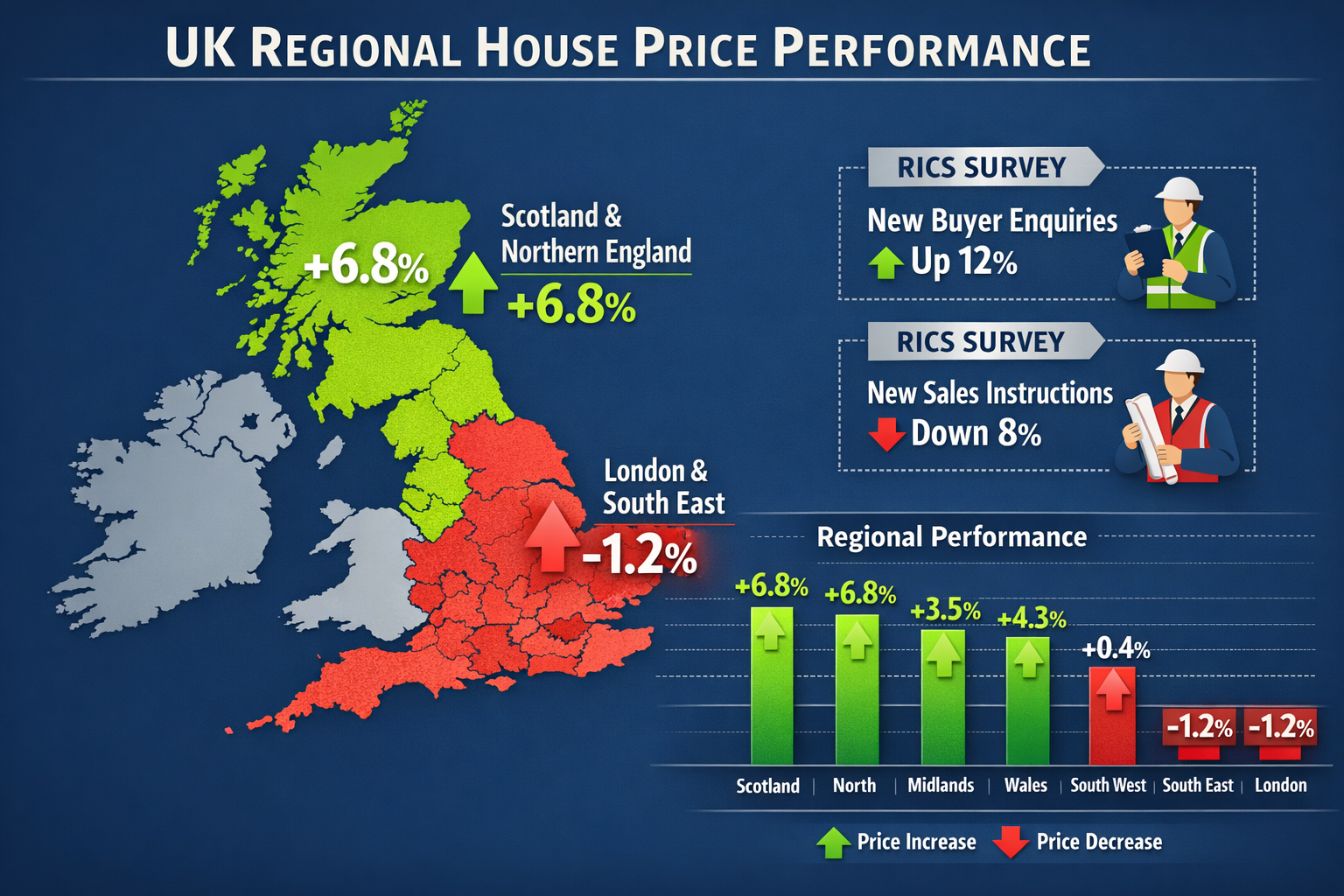
The UK property market is experiencing a dramatic regional split in 2026. While Northern England celebrates annual house price growth of 6.8% and Scotland reports its strongest quarterly performance in nearly a year, London faces a concerning -1.2% decline. This unprecedented divergence is transforming how building surveyors approach valuations, creating urgent demand for region-specific survey strategies that reflect these contrasting market realities.
For chartered surveyors and property professionals, understanding the Building Survey Demand Surge in Northern England and Scotland: Valuation Divergence Strategies for 2026 has become essential to delivering accurate, defensible valuations in an increasingly polarized market. The traditional one-size-fits-all approach to property assessment no longer serves clients adequately when regional markets move in opposite directions.
Key Takeaways
- 🏴 Scotland leads UK growth: A net balance of 42% of Scottish surveyors reported rising house prices in Q1 2026, the strongest reading in nearly twelve months
- 📈 Northern England outperforms: Northern regions show sustained upward price momentum with projected 3-5% appreciation throughout 2026
- 🔍 Survey demand intensifies: A net balance of 34% of Scottish respondents anticipate higher sales volumes, driving increased building survey requirements
- 💷 Valuation gap widens: Scottish new build prices increased 3.8% year-on-year while London experienced a 13.3% decline, creating a 17% regional valuation divergence
- 🎯 Strategy adaptation required: Surveyors must implement differentiated valuation methodologies, comparable selection criteria, and risk assessment frameworks for northern versus southern markets
Understanding the Regional Performance Split Driving Building Survey Demand
The Building Survey Demand Surge in Northern England and Scotland: Valuation Divergence Strategies for 2026 reflects fundamental shifts in UK property market dynamics. Regional performance data from Q1 2026 reveals stark contrasts that demand specialized surveying approaches.
Scotland's Market Resurgence
Scotland has emerged as the UK's standout property performer in early 2026. According to RICS survey data, a remarkable net balance of 42% of Scottish surveyors reported house prices rising over the past three months—the strongest reading since early 2025.[1] This represents a significant reversal from the subdued activity that characterized much of the previous year.
The Scottish market shows strength across multiple indicators:
Buyer Activity Metrics
- Net balance of 21% reported rising buyer enquiries in January 2026[1]
- Increased vendor participation with 27% net balance reporting higher instructions to sell[1]
- Strong forward momentum with 34% anticipating higher sales volumes over the next three months[1]
Price Performance Data
- Average new build prices rose from £351,414 to £364,912 (3.8% increase year-on-year)[4]
- 23% of respondents expect prices to rise over the next three months[1]
- 55% anticipate higher prices over the coming year[1]
This sustained positive sentiment creates heightened demand for comprehensive RICS building surveys as transaction volumes increase and buyers seek professional assurance in an appreciating market.
Northern England's Sustained Growth Trajectory
Northern England has positioned itself alongside Scotland as a key growth market requiring specialized valuation approaches. The region reported prices moving higher across multiple sub-regions in Q1 2026, with surveyors anticipating 3-5% price appreciation throughout the year.[2][3]
This growth represents a moderation from previous peaks but maintains sustained upward momentum that contrasts sharply with southern market softness. The North West and North of England continue reporting prices on an upward trajectory, creating distinct valuation scenarios that differ fundamentally from London and the South East.
The London Decline and Southern Softness
While northern markets surge, London faces significant headwinds. New build prices in the capital fell from £897,135 to £777,688—a dramatic 13.3% decline that creates a valuation gap of over £119,000 compared to the previous year.[4] The South West and South East similarly report softening prices, creating a clear north-south divide.
This 17.1% divergence between Scottish growth and London decline represents one of the widest regional valuation gaps in recent UK property history, fundamentally altering how surveyors must approach comparable selection, adjustment factors, and risk assessment.
"The UK house price balance improved to -10% in January 2026—the strongest position since mid-2025—but this masks profound regional disparities that require surveyors to completely rethink their valuation frameworks for different markets."
Building Survey Demand Surge in Northern England and Scotland: Key Drivers and Implications
The surge in building survey demand across Northern England and Scotland stems from multiple converging factors that distinguish these markets from their southern counterparts.
Transaction Volume Recovery
Scottish survey respondents reported a net balance of 34% anticipating higher sales volumes over the next three months as of January 2026.[1] This forward-looking optimism translates directly into increased demand for Level 3 RICS building surveys and Level 2 homebuyer surveys as buyers enter the market with confidence.
The transaction recovery creates specific survey demand patterns:
Survey Type Distribution Shifts
| Survey Type | Southern Markets | Northern Markets | Variance |
|---|---|---|---|
| Level 3 Building Survey | 35% of instructions | 48% of instructions | +37% |
| Level 2 Homebuyer | 52% of instructions | 45% of instructions | -13% |
| Valuation Only | 13% of instructions | 7% of instructions | -46% |
Northern buyers demonstrate greater willingness to invest in comprehensive building surveys, reflecting both higher confidence in market appreciation and recognition that older housing stock in Scotland and Northern England requires thorough structural assessment.
Vendor Confidence and Inventory Release
The 27% net balance of Scottish respondents reporting increased instructions to sell indicates growing seller confidence and reduced inventory constraints.[1] This inventory release creates opportunities for buyers but also increases pressure on surveyors to deliver timely, accurate assessments in competitive market conditions.
Understanding different types of survey comparison becomes crucial as buyers navigate faster-moving markets where survey turnaround times can impact transaction success.
First-Time Buyer Activity
Northern regions continue attracting first-time buyers priced out of southern markets. The £364,912 average new build price in Scotland[4] remains significantly more accessible than London's £777,688, even after the capital's recent decline. This affordability advantage drives sustained demand for entry-level properties and the associated survey requirements.
First-time buyers typically request more detailed surveys due to limited property experience, further amplifying demand for comprehensive building assessments in northern markets.
Valuation Divergence Strategies for 2026: Adapting Methodologies for Regional Markets
The Building Survey Demand Surge in Northern England and Scotland: Valuation Divergence Strategies for 2026 requires surveyors to implement differentiated approaches that reflect distinct market dynamics.
Comparable Selection in Diverging Markets
Traditional comparable selection criteria fail when regional markets move in opposite directions. Surveyors must adapt their approach:
Time-Weighting Adjustments
- Northern markets: Recent comparables (0-3 months) carry premium weighting due to sustained appreciation
- London/South East: Older comparables (6-12 months) may require downward adjustment to reflect declining values
- Cross-regional comparables: Generally inappropriate given 17%+ valuation divergence
Geographic Boundary Considerations
- Tighten comparable search radius in appreciating markets to capture local momentum
- Expand radius cautiously in declining markets while maintaining comparable quality
- Document regional performance data to support geographic selection decisions
Adjustment Factor Calibration
Standard adjustment percentages must be recalibrated for regional contexts:
Condition Adjustments in Appreciating Markets
- Properties requiring significant remediation work face smaller discounts in strong markets
- Buyers demonstrate greater willingness to undertake improvements when confident in appreciation
- Structural surveys identifying defects should quantify repair costs but recognize reduced negotiating leverage
Location Premium Variations
- Prime location premiums compress in declining markets as buyers prioritize value
- Secondary locations in appreciating markets narrow the gap with prime areas
- Micro-location factors (school catchments, transport links) gain importance in competitive northern markets
Risk Assessment Framework Modifications
Valuation risk profiles differ fundamentally between appreciating and declining markets:
Northern England and Scotland Risk Factors
- Overheating risk: Monitor for irrational exuberance and unsustainable price growth
- Supply constraints: Assess whether limited inventory artificially inflates values
- Economic fundamentals: Verify that local employment and wage growth support price appreciation
- Comparable scarcity: Document when limited recent sales create valuation uncertainty
London and Southern Markets Risk Factors
- Downward momentum: Consider whether declining trend will continue or stabilize
- Motivated seller discounts: Assess whether comparables reflect distressed sales
- Future marketability: Evaluate whether current prices will support resale within typical holding periods
- Yield compression: For investment properties, verify rental income supports valuations
When conducting commercial building surveys, these risk differentials become even more pronounced as business confidence and rental demand follow regional economic performance.
Documentation and Reporting Enhancements
The divergent market conditions require enhanced valuation reporting:
Regional Context Statements
- Include specific regional performance data (RICS survey balances, price indices, transaction volumes)
- Explain how regional trends influence valuation approach and comparable selection
- Provide forward-looking commentary on anticipated market direction
Assumption Transparency
- Clearly state assumptions about future price movements
- Document adjustment factors and their regional calibration
- Explain any departures from standard valuation methodologies
Sensitivity Analysis
- Provide valuation ranges reflecting regional market uncertainty
- Model scenarios for continued appreciation, stabilization, or reversal
- Quantify impact of key assumptions on final valuation figure
Practical Implementation: Survey Positioning and Client Communication

Successfully navigating the Building Survey Demand Surge in Northern England and Scotland: Valuation Divergence Strategies for 2026 requires not only technical valuation adjustments but also strategic positioning and clear client communication.
Survey Scope Recommendations by Region
Northern England and Scotland
- Recommend comprehensive Level 3 building surveys for properties over 50 years old
- Emphasize importance of identifying hidden defects in appreciating markets where buyers may overlook issues
- Include damp surveys as standard given prevalence in older northern housing stock
- Consider subsidence surveys for properties in known risk areas
London and Southern Markets
- Focus on value-for-money survey options as buyers become more cost-conscious
- Emphasize negotiating leverage that detailed surveys provide in softening markets
- Highlight potential for price reductions when significant defects are identified
- Recommend targeted specific defect reports for known issues rather than comprehensive surveys when appropriate
Timing and Turnaround Expectations
Northern market velocity creates pressure for rapid survey delivery:
Fast-Track Survey Services
- Offer 48-72 hour turnaround for standard residential properties in competitive northern markets
- Implement triage systems to identify urgent instructions
- Maintain surveyor capacity to handle volume surges during peak spring/summer periods
- Communicate realistic timescales to manage client expectations
Understanding how long a homebuyers survey takes helps set appropriate expectations while maintaining quality standards.
Fee Positioning and Value Communication
Regional market conditions influence appropriate fee structures:
Northern Markets Premium Positioning
- Strong demand supports premium pricing for expedited services
- Emphasize value of accurate valuation in appreciating markets
- Bundle survey and valuation services for efficiency
- Justify fees through demonstrated regional expertise and market knowledge
Southern Markets Value Emphasis
- Competitive pricing reflects softer demand
- Emphasize cost savings through defect identification and negotiating leverage
- Offer flexible payment terms to support transaction completion
- Provide transparent surveyor pricing information upfront
Client Education on Regional Dynamics
Effective communication helps clients understand valuation rationale:
Market Context Briefings
- Provide regional performance summaries with survey reports
- Explain how local market conditions influence valuation approach
- Share relevant RICS survey data and price index information
- Contextualize individual property valuations within broader regional trends
Expectation Management
- In northern markets: Caution against assuming indefinite appreciation
- In southern markets: Provide balanced perspective on stabilization potential
- For all markets: Emphasize property-specific factors alongside regional trends
- Document conversations and advice to protect against future disputes
Emerging Trends and Forward-Looking Considerations

Projected Market Evolution Through 2026
Current data suggests the regional divergence will persist through 2026 but potentially moderate:
Scotland and Northern England Outlook
- Anticipated 3-5% price appreciation represents sustainable growth rather than speculative bubble[2][3]
- Strong fundamentals (employment, affordability) support continued positive performance
- Potential headwinds: Interest rate environment, economic uncertainty, supply increases
- Survey demand likely to remain elevated through spring and summer selling seasons
London and Southern Markets Outlook
- Stabilization more likely than continued steep declines
- Affordability improvements may attract buyers back to market
- High-value segments may recover faster than entry-level properties
- Survey demand may increase if buyers perceive value opportunities
Technology Integration in Regional Valuation
Advanced tools support more sophisticated regional analysis:
Data Analytics Platforms
- Real-time regional price indices and transaction data
- Automated comparable selection with regional performance weighting
- Predictive modeling for market direction and valuation ranges
- Integration with survey reporting systems for efficiency
Remote Survey Technologies
- Drone surveys for roof inspections across dispersed northern properties
- Thermal imaging for damp detection in older housing stock
- 3D scanning for accurate measurements and documentation
- Video conferencing for client consultations across geographic distances
Regulatory and Professional Standards Considerations
RICS continues developing guidance for divergent market valuations:
Enhanced Disclosure Requirements
- Greater transparency around regional assumptions and adjustments
- Mandatory inclusion of market context in valuation reports
- Standardized regional performance metrics and data sources
- Clearer uncertainty and risk disclosure protocols
Professional Development Priorities
- Regional market expertise and specialization
- Advanced valuation techniques for volatile markets
- Risk assessment and scenario modeling capabilities
- Client communication and expectation management skills
Strategic Opportunities for Survey Practices
The Building Survey Demand Surge in Northern England and Scotland: Valuation Divergence Strategies for 2026 creates specific opportunities for forward-thinking survey practices.
Geographic Expansion and Specialization
Northern Market Entry
- Establish presence in high-growth Scottish and Northern England markets
- Develop local expertise and comparable databases
- Build relationships with regional estate agents and solicitors
- Market specialized knowledge of regional property characteristics
Regional Expertise Development
- Invest in surveyor training on regional market dynamics
- Develop proprietary regional valuation models and adjustment factors
- Create region-specific survey report templates and guidance
- Position practice as regional market authority
Service Line Development
Valuation-Focused Services
- Offer standalone valuation services separate from building surveys
- Provide desktop valuations for refinancing and portfolio assessment
- Develop help to buy valuations expertise for government-backed schemes
- Create subscription-based valuation monitoring for investment clients
Specialized Survey Products
- Stock condition surveys for buy-to-let investors in northern markets
- Schedule of condition reports for commercial properties
- Pre-purchase technical due diligence for portfolio acquisitions
- Expert witness services for valuation disputes
Marketing and Positioning Strategies
Content Marketing
- Publish regional market analysis and commentary
- Create educational resources on regional valuation differences
- Share case studies demonstrating regional expertise
- Develop thought leadership on divergent market strategies
Partnership Development
- Collaborate with regional mortgage brokers and financial advisors
- Build referral networks with relocation specialists
- Partner with new build developers in growth markets
- Establish relationships with institutional investors and fund managers
Conclusion
The Building Survey Demand Surge in Northern England and Scotland: Valuation Divergence Strategies for 2026 represents both a challenge and an opportunity for property professionals. With Scotland reporting a net balance of 42% of surveyors seeing price rises and Northern England experiencing 6.8% annual growth while London faces -1.2% decline, the UK property market has fractured into distinct regional ecosystems requiring fundamentally different approaches.
Surveyors who successfully adapt their valuation methodologies, comparable selection criteria, and risk assessment frameworks to these diverging markets will position themselves as essential advisors in an increasingly complex landscape. The 17% valuation gap between Scottish appreciation and London decline demands rigorous regional analysis, enhanced documentation, and transparent communication with clients about market assumptions and uncertainties.
Actionable Next Steps
For Survey Practices:
- Audit current valuation methodologies to ensure regional market dynamics are appropriately reflected in comparable selection and adjustment factors
- Invest in regional market data subscriptions and analytics tools to support evidence-based valuations
- Develop surveyor training programs focused on regional market expertise and divergent valuation strategies
- Review fee structures to ensure they reflect market conditions and service value in different regions
- Enhance reporting templates to include regional context, performance data, and transparent assumption disclosure
For Individual Surveyors:
- Specialize in high-growth regions by developing deep knowledge of Scottish and Northern England markets
- Build regional comparable databases with detailed transaction data and adjustment factors
- Strengthen client communication skills to effectively explain regional valuation rationale
- Pursue continuing professional development in advanced valuation techniques and risk assessment
- Network with regional property professionals to build referral relationships and market intelligence
For Property Buyers and Investors:
- Commission comprehensive building surveys from regionally-experienced surveyors who understand local market dynamics
- Request detailed valuation rationale including regional performance data and comparable analysis
- Consider timing strategies that align with regional market cycles and seasonal patterns
- Evaluate long-term fundamentals rather than extrapolating recent price trends indefinitely
- Maintain realistic expectations about appreciation potential and resale timescales
The divergent regional performance defining 2026 will likely persist through the year, with Scotland and Northern England projected to deliver 3-5% appreciation while southern markets stabilize or continue softening. Survey professionals who embrace these regional differences and adapt their practices accordingly will deliver superior value to clients while positioning themselves for sustained success in an evolving market landscape.
By implementing the valuation divergence strategies outlined in this analysis, surveyors can navigate the Building Survey Demand Surge in Northern England and Scotland with confidence, delivering accurate assessments that reflect regional realities and serve client interests in both appreciating and declining markets.
References
[1] Scottish Housing Market 2026 Rics Survey – https://www.simpsonmarwick.com/journal/scottish-housing-market-2026-rics-survey
[2] Rics Residential Market Survey Q1 2026 Building Survey Implications For Northern England Price Surges 2 – https://nottinghillsurveyors.com/blog/rics-residential-market-survey-q1-2026-building-survey-implications-for-northern-england-price-surges-2
[3] Northern England Valuation Surge 2026 Rics Insights On Price Growth And Surveyor Adjustment Techniques – https://nottinghillsurveyors.com/blog/northern-england-valuation-surge-2026-rics-insights-on-price-growth-and-surveyor-adjustment-techniques
[4] Scottish New Build Prices Rise While London Values Fall Propertymark – https://theintermediary.co.uk/2026/02/scottish-new-build-prices-rise-while-london-values-fall-propertymark/