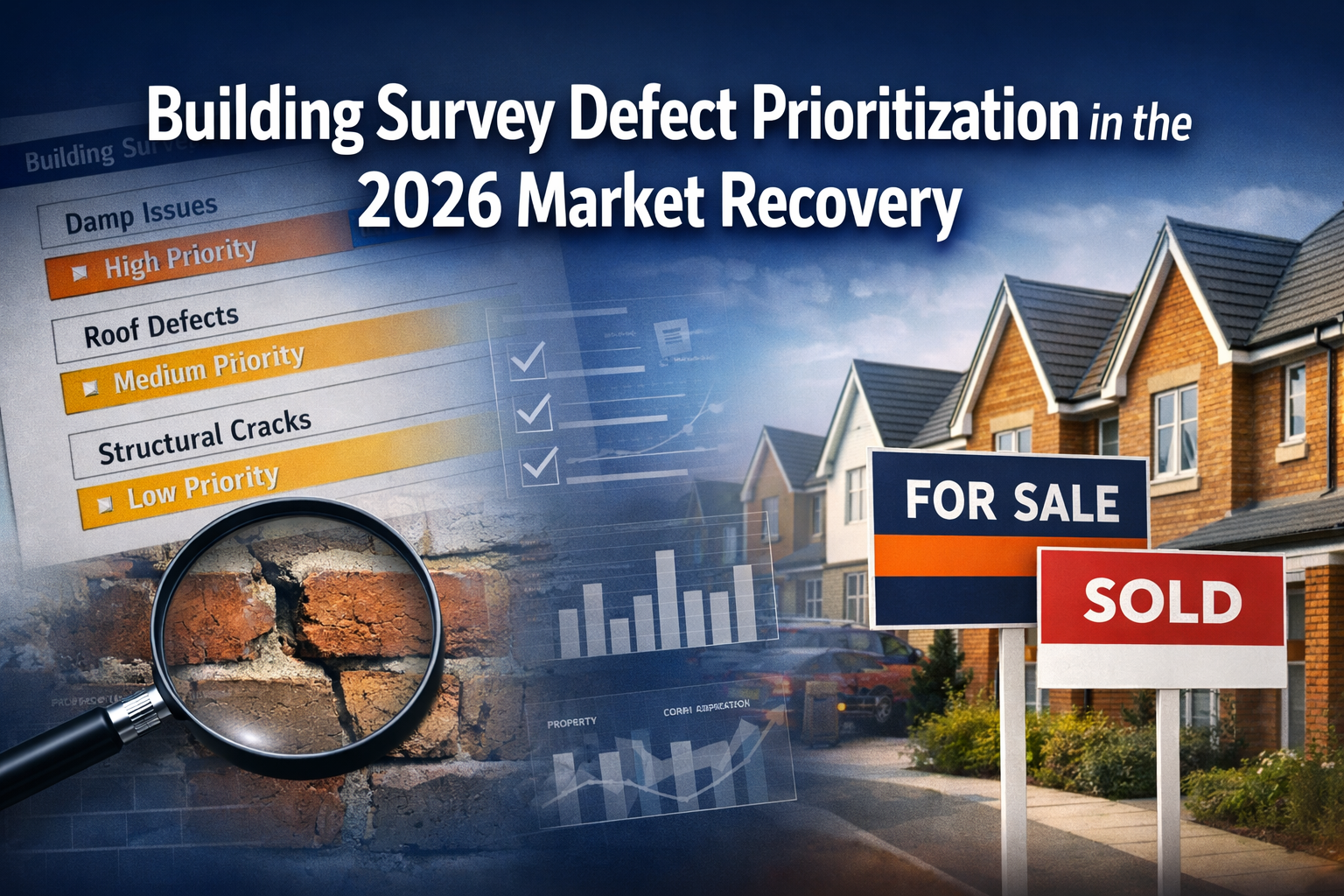
The UK property market in 2026 presents a unique opportunity for buyers. With rising inventory levels and increasing days on market, prospective homeowners find themselves in a position they haven't experienced in years: genuine choice. Yet this abundance of options brings its own challenge. When comparing multiple properties—each with its own survey revealing various defects—how should buyers prioritize issues to make informed decisions?
Building Survey Defect Prioritization in the 2026 Market Recovery: Helping Buyers Navigate Competing Properties has become an essential skill for both property professionals and buyers themselves. As buyer enquiries surge between 4% and 35% year-over-year according to RICS data, chartered surveyors face mounting pressure to deliver not just comprehensive defect identification, but actionable prioritization frameworks that help clients choose between competing properties. This shift from a seller's market to a more balanced environment means buyers need sophisticated tools to evaluate which defects are deal-breakers, which present negotiation opportunities, and which can be safely deferred.
The stakes are high. With home improvement spending projected to slow through late 2026[6] and construction costs remaining elevated due to labor constraints[1], understanding the true cost and urgency of identified defects has never been more critical. This comprehensive guide explores the frameworks, methodologies, and strategies that empower buyers to navigate the 2026 market recovery with confidence.
Key Takeaways
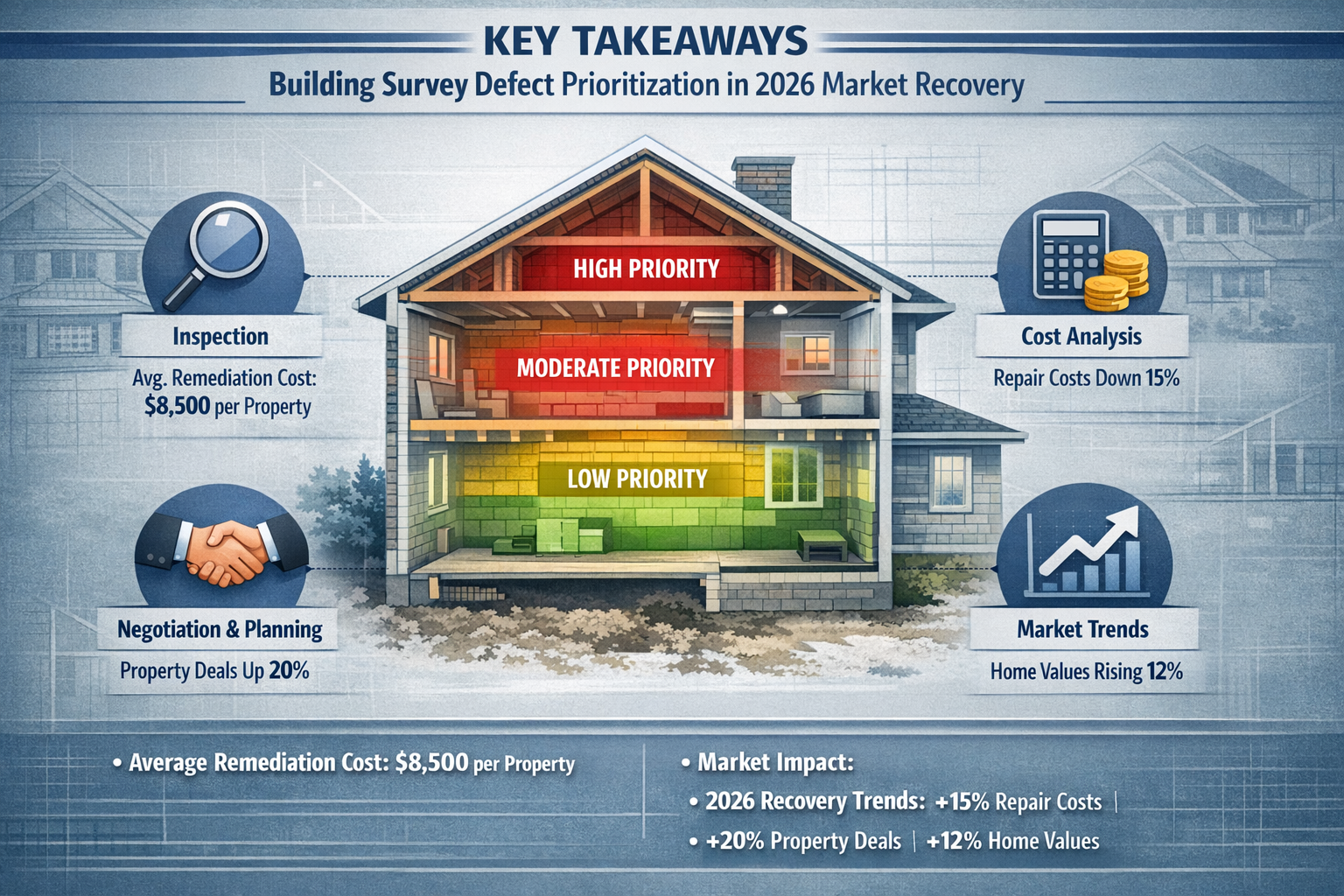
✅ Defect triage frameworks help buyers categorize issues into critical structural concerns, significant compliance matters, and minor cosmetic repairs—enabling clear comparison across multiple properties
✅ Cost-benefit analysis in the 2026 market must account for rising remediation expenses, slowing home improvement spending, and new energy performance requirements that affect long-term property value
✅ Negotiation leverage increases substantially when buyers can demonstrate comprehensive understanding of defect severity, remediation timelines, and market-appropriate price adjustments
✅ Energy efficiency compliance now ranks alongside traditional structural defects as a priority consideration, with EPC upgrade mandates creating significant financial implications for UK buyers[5]
✅ Multi-property comparison matrices provide systematic evaluation tools that prevent emotional decision-making and ensure buyers select properties with the most favorable defect-to-value ratio
Understanding the 2026 Market Context for Building Survey Defect Prioritization
The Shifting Buyer's Landscape
The 2026 property market represents a significant departure from the seller-dominated environment of recent years. Home sales inventory has risen steadily, while days on market have increased and home price appreciation has slowed or even reversed in some areas[2]. For buyers, this translates to genuine negotiating power—but only when armed with comprehensive defect intelligence.
This market shift fundamentally changes how RICS building surveys should be utilized. Rather than simply identifying whether a property is acceptable, surveys now serve as comparative tools. Buyers frequently commission Level 3 building surveys on multiple properties simultaneously, creating a need for standardized prioritization frameworks that enable apples-to-apples comparison.
Economic Factors Influencing Defect Prioritization
Several economic trends directly impact how buyers should prioritize defects in 2026:
Construction Cost Pressures 🏗️
The construction market outlook for 2026 shows continued labor constraints and rising compliance costs[1]. This means that defect remediation—particularly for complex structural issues—will likely cost more than historical averages. Buyers must factor these elevated costs into their decision-making processes.
Home Improvement Spending Slowdown 💰
Annual spending on home improvements and maintenance is expected to gradually slow through late 2026[6]. This trend suggests buyers should be cautious about properties requiring extensive immediate work, as both material costs and contractor availability may present challenges.
Energy Performance Mandates ⚡
Building surveys in 2026 increasingly address energy performance standards and retrofit mandates, particularly for UK properties[5]. Defect assessment frameworks must now accommodate regulatory compliance issues alongside traditional structural concerns, as EPC upgrade requirements can represent substantial unexpected costs.
The Role of Professional Survey Services
In this complex environment, engaging qualified professionals becomes paramount. Specialist defect surveys provide detailed analysis of specific concerns, while comprehensive building surveys offer holistic property evaluation. Understanding different types of survey comparison helps buyers select the appropriate level of investigation for their circumstances.
Building Survey Defect Prioritization Framework: The Three-Tier System
Tier One: Critical Structural Defects (Deal-Breakers)
Critical defects represent issues that fundamentally compromise a property's structural integrity, safety, or habitability. In the context of Building Survey Defect Prioritization in the 2026 Market Recovery: Helping Buyers Navigate Competing Properties, these defects typically warrant either walking away from a purchase or negotiating substantial price reductions.
Structural Movement and Subsidence 🏚️
Active subsidence, heave, or significant structural movement represents the most serious category of defects. Surveys for subsidence can identify these issues, which often require extensive underpinning or foundation repairs costing tens of thousands of pounds. In a 2026 market with multiple property options, buyers should seriously consider whether the potential discount justifies the remediation complexity.
Severe Damp and Water Penetration
Rising damp, penetrating damp, or condensation that has caused significant structural damage falls into this critical category. Unlike minor moisture issues, severe damp can compromise timber structures, cause rot in load-bearing elements, and create health hazards. The cost of damp surveys and subsequent remediation must be carefully evaluated against alternative properties.
Major Roof Defects
Complete roof failure, extensive rot in roof timbers, or structural issues with roof trusses constitute critical defects. Given construction cost pressures in 2026[1], roof replacement can easily exceed £15,000-£30,000 for typical residential properties, making this a significant factor in property comparison.
Serious Electrical or Heating System Failures
Outdated electrical systems requiring complete rewiring or failed heating systems needing full replacement represent substantial immediate costs. These issues affect habitability and often cannot be deferred, making them critical considerations in competitive property evaluation.
Tier Two: Significant Compliance and Performance Issues
The second tier encompasses defects that, while not immediately threatening structural integrity, create legal, financial, or practical challenges requiring attention within 1-3 years.
Energy Performance Certificate (EPC) Deficiencies 🌡️
In 2026, EPC ratings carry increased weight due to emerging retrofit mandates[5]. Properties with ratings below Band C may face future rental restrictions or sale difficulties. Upgrading insulation, windows, heating systems, and installing renewable energy sources can cost £10,000-£50,000 depending on property size and current condition. This category has risen dramatically in importance for Building Survey Defect Prioritization in the 2026 Market Recovery.
Building Regulation Non-Compliance
Unauthorized alterations, extensions without proper building control approval, or historical work that doesn't meet current standards create potential legal and insurance complications. While not immediately dangerous, these issues can affect mortgageability and future sale prospects.
Fire Safety Deficiencies
Inadequate fire separation, missing fire doors, or insufficient escape routes—particularly in converted flats—represent serious compliance concerns that require remediation but may not necessitate walking away from a purchase if appropriately priced.
Moderate Damp or Drainage Issues
Localized damp problems, inadequate ventilation, or minor drainage defects that haven't yet caused structural damage fall into this category. These issues require attention but offer more flexibility in timing and remediation approach.
Tier Three: Minor Repairs and Cosmetic Issues
The third tier includes defects that, while noted in surveys, represent routine maintenance or cosmetic concerns that shouldn't significantly influence property selection decisions.
Decorative Repairs 🎨
Worn decoration, minor plaster cracks, or cosmetic damage to fixtures and fittings represent normal wear and tear. In competitive property evaluations, these issues should carry minimal weight unless extensive.
Minor Joinery Repairs
Sticking doors, minor window repairs, or routine maintenance to joinery elements are expected in most properties and should be factored into general maintenance budgets rather than treated as significant defects.
Garden and External Minor Works
Boundary fence repairs, minor paving issues, or garden maintenance needs rarely justify significant price negotiation in the 2026 market context.
Routine Maintenance Items
Gutter cleaning, minor pointing repairs, or routine service requirements for heating systems represent ongoing ownership costs rather than defects requiring prioritization in property comparison.
Cost-Benefit Analysis for Defect Remediation in 2026
Establishing Accurate Remediation Cost Estimates
Accurate cost estimation forms the foundation of effective Building Survey Defect Prioritization in the 2026 Market Recovery: Helping Buyers Navigate Competing Properties. However, obtaining reliable figures presents challenges in the current economic environment.
Obtaining Professional Quotations 📋
For significant defects, buyers should commission detailed quotations from qualified contractors before finalizing property decisions. While this adds time and expense to the purchase process, it eliminates guesswork and provides concrete negotiation data. When comparing multiple properties, prioritize obtaining quotes for Tier One and high-value Tier Two defects.
Understanding 2026 Construction Market Conditions
The construction market outlook for 2026 indicates continued sectoral variation, with labor constraints affecting availability and pricing[1]. Specialist trades—particularly for structural repairs, roofing, and electrical work—command premium rates. Buyers should add 15-25% contingency to initial estimates to account for market conditions and potential additional work discovered during remediation.
Long-Term Value Considerations
Not all remediation spending offers equal return on investment. Energy efficiency upgrades, while costly, may enhance property value and reduce ongoing costs[5]. Conversely, some structural repairs simply restore a property to baseline condition without adding value. This distinction becomes crucial when comparing properties with different defect profiles.
Creating Comparative Defect-Cost Matrices
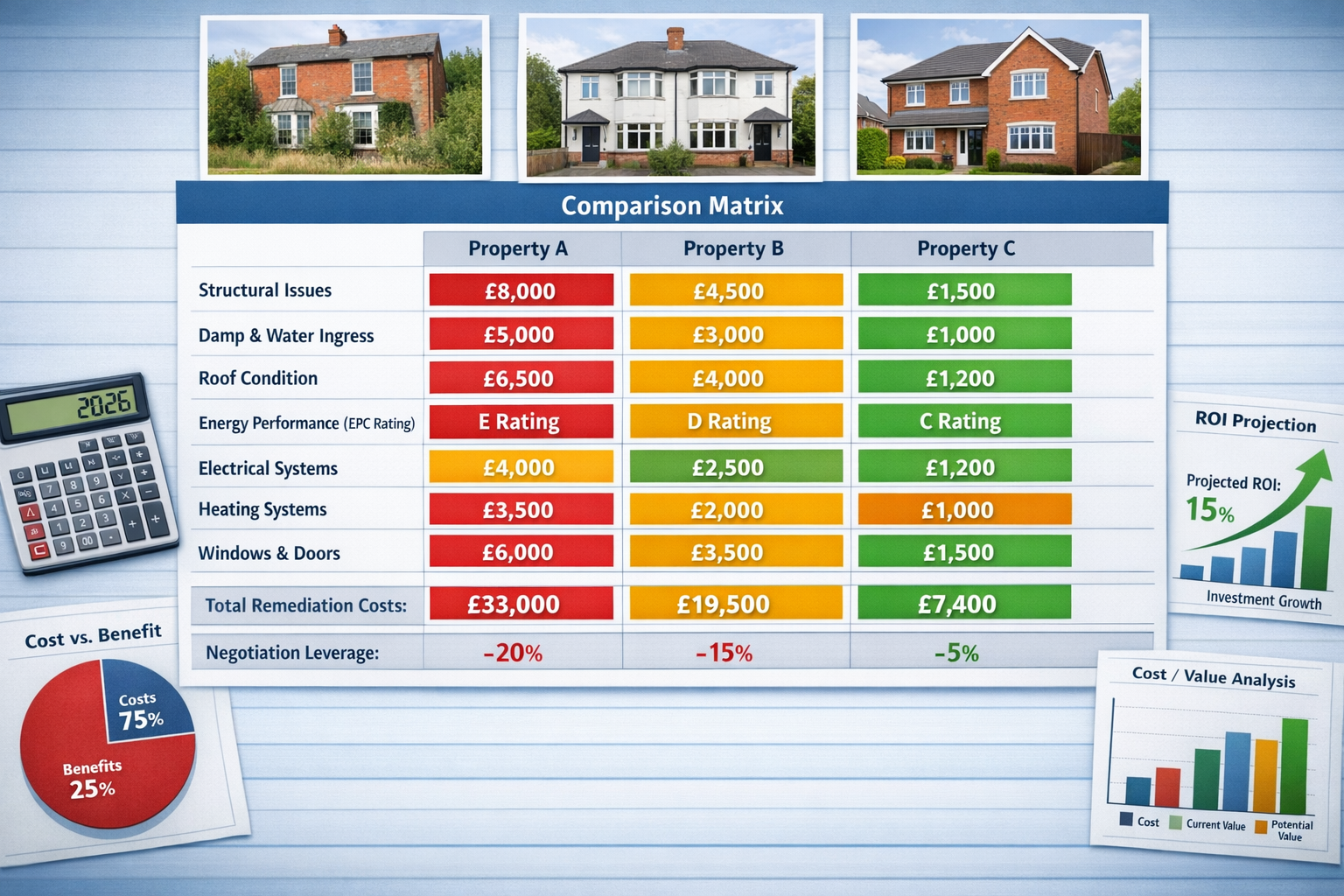
A systematic approach to comparing defect costs across multiple properties enables rational decision-making. The following framework provides structure:
| Defect Category | Property A | Property B | Property C |
|---|---|---|---|
| Critical Structural | £8,500 (roof timbers) | £0 | £22,000 (subsidence) |
| Severe Damp/Water | £3,200 (rising damp) | £1,500 (minor penetrating damp) | £0 |
| Electrical Systems | £0 | £6,500 (full rewire) | £0 |
| Heating Systems | £4,200 (boiler replacement) | £0 | £3,800 (boiler replacement) |
| EPC Upgrades | £12,000 (Band D→C) | £8,500 (Band C→B) | £15,000 (Band E→C) |
| Building Regs Issues | £2,100 (retrospective approval) | £0 | £0 |
| Minor/Cosmetic | £3,500 | £2,200 | £4,100 |
| Total Estimated | £33,500 | £18,700 | £44,900 |
| Asking Price | £425,000 | £445,000 | £410,000 |
| Adjusted Value | £391,500 | £426,300 | £365,100 |
This matrix approach transforms abstract survey findings into concrete financial comparisons, enabling buyers to identify which property offers the best overall value proposition.
Timing and Cashflow Considerations
Beyond total remediation costs, buyers must consider timing and cashflow implications:
Immediate vs. Deferred Work ⏰
Some defects require immediate attention (failed heating in winter, active leaks), while others can be scheduled over several years. Properties requiring substantial immediate work may strain buyers' finances, even if the total adjusted value appears favorable.
Impact on Mortgage Availability
Certain defects—particularly structural issues or severe damp—may affect mortgage lender willingness to provide financing. Properties requiring cash purchases or bridging finance inherently carry higher barriers to entry, affecting their practical viability regardless of theoretical value.
Disruption and Habitability
Major remediation work may render properties partially or fully uninhabitable during repairs. Buyers must factor in alternative accommodation costs and lifestyle disruption when comparing properties with different defect profiles.
Building Survey Defect Prioritization in the 2026 Market Recovery: Strategic Negotiation Approaches
Leveraging Survey Findings for Price Negotiation
The increased buyer power in the 2026 market recovery[2] creates opportunities for effective negotiation based on comprehensive defect documentation.
Presenting Professional Evidence 📊
Negotiations grounded in detailed RICS building survey reports carry substantially more weight than general concerns. Buyers should provide sellers with:
- Complete survey reports from qualified chartered surveyors
- Professional remediation quotations from licensed contractors
- Photographic evidence of critical defects
- Comparative market analysis showing adjusted values
Calculating Appropriate Adjustments
Market-appropriate price reductions typically range from 80-100% of Tier One defect costs, 50-75% of Tier Two issues, and 25-50% of significant Tier Three concerns. The exact percentage depends on market conditions, property demand, and seller motivation. In the 2026 recovery environment with rising inventory[2], buyers hold stronger negotiating positions than in recent years.
Alternative Negotiation Structures 💡
Beyond simple price reductions, buyers can propose:
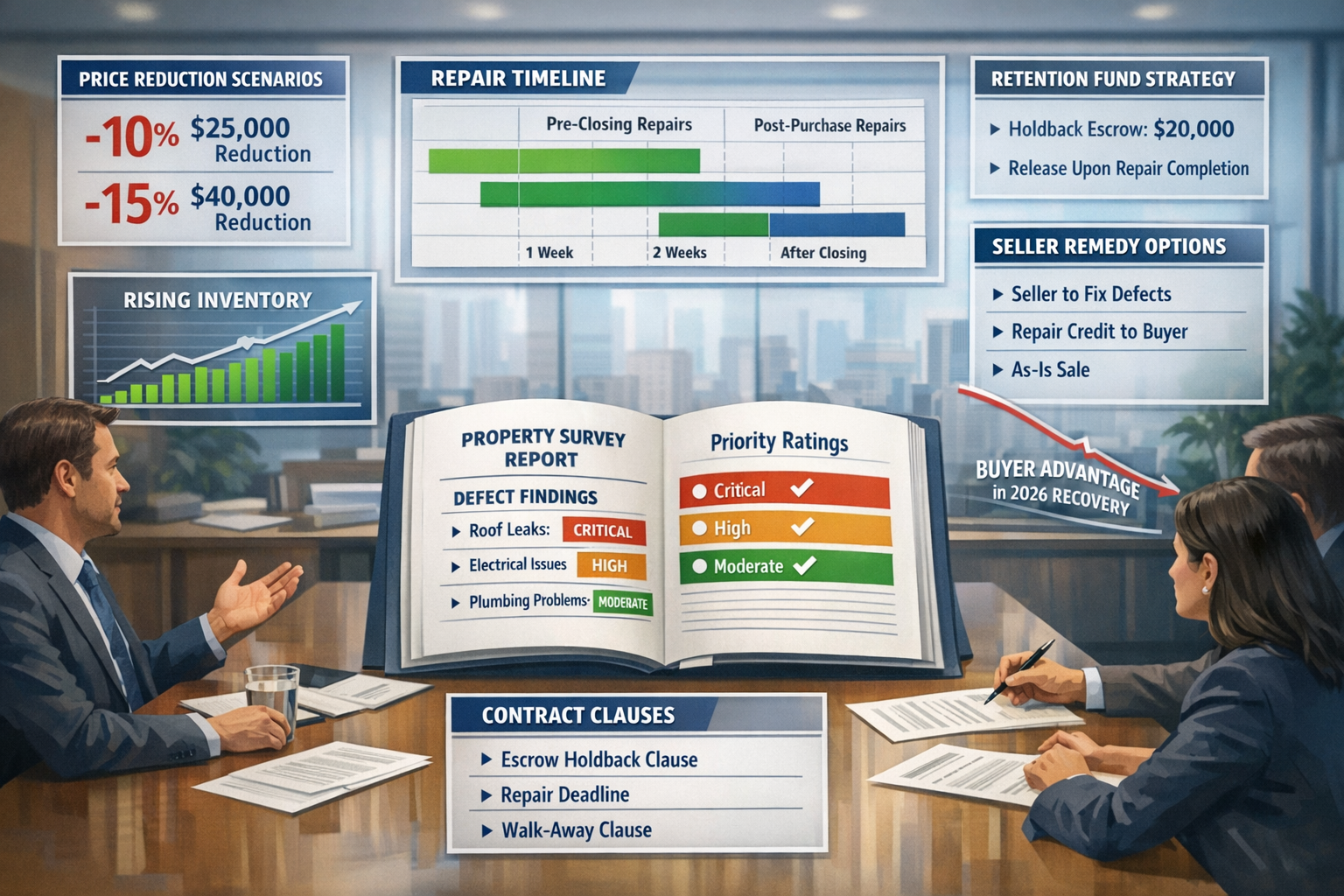
- Retention funds: Holding back agreed amounts from completion pending repair completion
- Seller remediation: Requiring sellers to complete specific repairs before completion
- Extended completion timelines: Allowing sellers time to address issues while securing the purchase price
- Warranty provisions: Obtaining insurance-backed warranties for specific defect categories
Multi-Property Competitive Bidding Strategies
When evaluating multiple properties simultaneously, strategic approaches maximize buyer advantage:
Transparent Comparison Communication
Informing estate agents that multiple properties are under active consideration—with specific defect-adjusted valuations—creates competitive pressure. Sellers facing extended marketing periods in the 2026 market[2] may become more flexible when aware of genuine competing options.
Sequential Negotiation Approach
Rather than negotiating all properties simultaneously, buyers can:
- Identify the preferred property based on defect-adjusted value
- Negotiate aggressively on that property
- If negotiations stall, pivot to the second-choice property
- Use competing offers to leverage improved terms
Time-Limited Offers
In a market with rising inventory, time-limited offers based on comprehensive survey findings create urgency while demonstrating serious buyer intent backed by professional due diligence.
Working with Professional Advisors
Effective negotiation in the context of Building Survey Defect Prioritization in the 2026 Market Recovery requires coordination among multiple professionals:
Chartered Surveyors 🏛️
Engaging local chartered surveyors with specific market knowledge ensures survey findings reflect regional construction practices, typical defect patterns, and local remediation costs. Surveyors can also provide post-survey consultation to help buyers interpret findings and develop negotiation strategies.
Solicitors and Conveyancers
Legal professionals ensure negotiated remediation agreements are properly documented in contracts, protecting buyers' interests if sellers fail to complete agreed repairs or if retention funds are utilized.
Mortgage Brokers and Financial Advisors
Financial professionals help buyers understand how defect remediation costs affect affordability calculations, ensuring purchase decisions remain within sustainable budgets even after accounting for necessary repairs.
Specialized Defect Considerations for 2026
Energy Performance and Retrofit Requirements
Energy efficiency has evolved from a minor consideration to a critical priority in Building Survey Defect Prioritization in the 2026 Market Recovery: Helping Buyers Navigate Competing Properties.
Understanding EPC Upgrade Pathways ⚡
Properties with poor EPC ratings require systematic improvement strategies[5]:
- Band F/G to Band C: Typically requires comprehensive intervention including wall insulation, window replacement, heating system upgrade, and often renewable energy installation (£25,000-£50,000+)
- Band D/E to Band C: May achieve compliance through targeted improvements like loft insulation, heating controls, and draught-proofing (£8,000-£15,000)
- Band C to Band B: Often involves solar panels, heat pumps, or advanced glazing systems (£10,000-£25,000)
Regulatory Compliance Timelines
While specific mandates vary by property type and tenure, buyers should anticipate increasing regulatory pressure on energy performance throughout 2026 and beyond. Properties requiring substantial EPC improvements should be valued accordingly, with remediation costs treated similarly to structural defects in priority ranking.
Long-Term Operating Cost Analysis
Beyond compliance requirements, energy efficiency directly impacts ongoing heating and electricity costs. Properties with poor thermal performance may cost £1,500-£3,000 more annually to heat compared to well-insulated equivalents. Over typical ownership periods of 7-10 years, these operating cost differences represent £10,000-£30,000 in additional expense—comparable to many structural defect remediation costs.
Non-Standard Construction Considerations
Properties built with non-standard construction methods require specialized defect assessment:
Mortgageability Implications 🏦
Concrete construction, timber-frame properties, or other non-traditional building methods may face mortgage lending restrictions. Even minor defects in non-standard properties can trigger lender concerns, making these properties inherently higher risk in competitive evaluations.
Specialist Survey Requirements
Non-standard construction often requires structural surveys beyond standard RICS building surveys. The additional cost and complexity of proper due diligence should factor into property comparison decisions.
Insurance and Resale Considerations
Properties with non-standard construction may face higher insurance premiums and more limited buyer pools upon resale. These factors affect long-term value and should influence defect prioritization—even apparently minor issues may create disproportionate complications in non-standard properties.
Drainage and Environmental Defects
Underground and environmental issues present unique challenges in defect prioritization:
Drainage Survey Importance 🚰
Drainage surveys using CCTV inspection reveal defects invisible during standard building surveys. Collapsed drains, root ingress, or inadequate drainage systems can cost £5,000-£20,000 to remediate. In competitive property evaluation, buyers should consider commissioning drainage surveys on shortlisted properties before final selection.
Contamination and Environmental Concerns
Properties on former industrial sites or near contamination sources require specialist assessment. Remediation costs for contaminated land can reach tens or hundreds of thousands of pounds, placing these issues firmly in Tier One critical defects.
Practical Implementation: Step-by-Step Buyer's Guide
Phase One: Initial Property Identification (Weeks 1-2)
Step 1: Define Search Criteria and Budget 💷
Establish maximum purchase price and separate remediation budget (typically 10-20% of purchase price for properties requiring work). Identify must-have features and acceptable compromise areas.
Step 2: Engage Professional Team
Appoint mortgage broker, solicitor, and identify preferred chartered surveyor before viewing properties. Understanding surveyor pricing helps budget appropriately for multiple surveys.
Step 3: Conduct Initial Viewings
View 8-12 properties, taking detailed notes and photographs. Look for obvious defect indicators: cracks, damp patches, roof condition, window condition, heating system age.
Phase Two: Shortlist Development and Survey Commissioning (Weeks 3-4)
Step 4: Create Initial Shortlist
Narrow to 3-5 properties based on location, features, and apparent condition. Consider choosing the right property survey level for each property based on age, construction type, and apparent condition.
Step 5: Commission Building Surveys
Engage chartered surveyors for comprehensive surveys on shortlisted properties. For older or more complex properties, Level 3 surveys provide the detailed defect analysis necessary for effective prioritization. Understand how long surveys take to schedule appropriately.
Step 6: Review Survey Reports
Carefully review each survey report, highlighting all identified defects. Request surveyor clarification on any unclear findings or recommendations for further specialist investigation.
Phase Three: Defect Analysis and Cost Estimation (Weeks 5-6)
Step 7: Categorize Defects Using Three-Tier Framework 📋
For each property, classify all identified defects into Tier One (critical), Tier Two (significant), or Tier Three (minor) categories. Focus detailed cost analysis on Tier One and Two issues.
Step 8: Obtain Remediation Quotations
Commission quotations from qualified contractors for significant defects. For Tier One structural issues, obtain at least two independent quotes. For Tier Two issues, single quotes or surveyor estimates may suffice.
Step 9: Create Comparative Analysis Matrix
Build comprehensive comparison matrix showing all defects, estimated costs, timing requirements, and adjusted property values for each shortlisted property.
Phase Four: Decision Making and Negotiation (Weeks 7-8)
Step 10: Identify Preferred Property
Select the property offering the best combination of location, features, and defect-adjusted value. Ensure remediation requirements align with available budget and acceptable timeline.
Step 11: Develop Negotiation Strategy
Prepare negotiation position including target price, minimum acceptable outcome, and alternative structures (retention, seller remediation, extended completion).
Step 12: Conduct Negotiations
Present survey findings and remediation costs to seller. In the 2026 market environment[2], maintain willingness to walk away and pivot to alternative properties if negotiations don't achieve acceptable outcomes.
Step 13: Finalize Purchase Terms
Once negotiation reaches acceptable conclusion, ensure all agreements regarding defect remediation, price adjustments, or retention funds are properly documented in legal contracts.
Phase Five: Post-Purchase Remediation Planning (Weeks 9+)
Step 14: Prioritize Remediation Timeline ⏱️
Create detailed remediation schedule addressing Tier One issues immediately, Tier Two issues within 1-2 years, and Tier Three issues as budget and time permit.
Step 15: Engage Contractors and Manage Works
Appoint qualified contractors for remediation works, ensuring proper insurance, guarantees, and building control compliance where required.
Step 16: Document All Works
Maintain comprehensive records of all remediation work, including invoices, guarantees, building control certificates, and before/after photographs. This documentation protects future resale value and provides evidence of proper defect remediation.
Common Pitfalls and How to Avoid Them
Emotional Decision-Making Overriding Defect Analysis
The Pitfall ❌
Buyers fall in love with a property's location, character, or specific features, minimizing serious defects identified in surveys. This emotional attachment leads to purchasing properties with unfavorable defect-to-value ratios.
The Solution ✅
Implement strict decision-making protocols requiring all properties to pass objective defect-adjusted value thresholds regardless of emotional appeal. Involve trusted advisors in final decisions to provide objective perspective.
Underestimating Remediation Costs and Timelines
The Pitfall
Buyers rely on optimistic cost estimates or fail to account for project contingencies, leading to budget overruns and financial stress post-purchase.
The Solution
Always obtain professional quotations for significant work. Add minimum 20% contingency to all estimates. Research typical timelines for remediation work and plan conservatively, particularly in the 2026 market with labor constraints[1].
Neglecting Energy Performance Implications
The Pitfall ⚡
Buyers focus exclusively on traditional structural defects while ignoring poor EPC ratings and the substantial costs required to achieve compliance with emerging standards[5].
The Solution
Treat EPC upgrade requirements as Tier Two defects requiring comprehensive cost analysis. Factor long-term operating costs into property comparison matrices alongside remediation expenses.
Failing to Obtain Specialist Surveys When Needed
The Pitfall
Buyers rely solely on general building surveys for properties with specific concerns (drainage, structural movement, damp), missing critical defect information that emerges only through specialist investigation.
The Solution
When building surveys identify potential serious issues or recommend further investigation, always commission appropriate specialist surveys before finalizing purchase decisions. The additional cost is minimal compared to discovering major defects post-purchase.
Inadequate Documentation of Negotiated Terms
The Pitfall 📄
Buyers reach verbal agreements with sellers regarding defect remediation or price adjustments but fail to properly document these agreements in legal contracts, leading to disputes or unmet expectations.
The Solution
Ensure all negotiated terms relating to defects—whether price reductions, retention funds, or seller remediation commitments—are explicitly documented in purchase contracts with clear completion criteria and remedies for non-compliance.
Future-Proofing Property Decisions in the 2026 Market
Anticipating Regulatory Changes
The regulatory environment for property continues evolving. Buyers engaging in Building Survey Defect Prioritization in the 2026 Market Recovery: Helping Buyers Navigate Competing Properties should consider likely future requirements:
Energy Performance Trajectory 🌍
Expect continued tightening of EPC requirements. Properties currently at Band C may face future pressure to reach Band B or A. Prioritize properties with good thermal performance or straightforward upgrade pathways.
Fire Safety Standards
Following high-profile incidents, fire safety regulations continue evolving, particularly for flats and converted properties. Properties with clear fire safety compliance offer better long-term value protection.
Building Safety and Certification
Increasing emphasis on building control compliance and proper certification for alterations suggests properties with comprehensive documentation will command premiums over those with questionable modification histories.
Climate Resilience Considerations
Flood Risk Assessment 🌊
With changing weather patterns, flood risk increasingly affects property values and insurability. Properties in flood zones should be valued accordingly, with appropriate defenses and insurance costs factored into total ownership expenses.
Thermal Resilience
Both winter heating efficiency and summer overheating resistance affect habitability and operating costs. Properties with good thermal mass, appropriate orientation, and effective ventilation offer better long-term resilience.
Technology Integration Readiness
Modern properties increasingly require technology infrastructure. Defect assessments should consider:
- Electrical capacity for electric vehicle charging and heat pumps
- Broadband connectivity infrastructure
- Smart home system compatibility
- Renewable energy installation potential
Properties lacking these capabilities may require additional investment to meet evolving buyer expectations.
Conclusion: Empowered Decision-Making in the 2026 Property Market
Building Survey Defect Prioritization in the 2026 Market Recovery: Helping Buyers Navigate Competing Properties represents a fundamental shift in how property purchases should be approached. The combination of increased inventory, rising buyer enquiries, and complex defect landscapes—particularly around energy performance—demands systematic, professional evaluation frameworks.
The three-tier defect prioritization system provides clarity: Tier One critical structural issues warrant serious consideration of walking away or substantial price negotiation; Tier Two significant compliance and performance concerns require comprehensive cost analysis and appropriate value adjustments; Tier Three minor repairs should influence decisions minimally. By categorizing defects systematically and obtaining accurate remediation cost estimates, buyers transform abstract survey findings into concrete financial comparisons.
The 2026 market recovery offers genuine opportunities for informed buyers. Rising inventory and increased days on market[2] create negotiating leverage unavailable in recent seller-dominated years. However, this advantage only materializes when buyers possess comprehensive defect intelligence and deploy it strategically. Professional building surveys from qualified chartered surveyors form the foundation, but buyers must actively analyze, compare, and negotiate based on findings.
Actionable Next Steps
For Buyers Currently in the Market: 🎯
- Engage professional advisors immediately: Appoint chartered surveyor, solicitor, and mortgage broker before making offers
- Commission comprehensive surveys on all shortlisted properties: Don't rely on basic valuations—invest in detailed defect analysis
- Build comparative defect-cost matrices: Create systematic comparison tools rather than relying on intuition
- Obtain professional remediation quotations: Replace guesswork with concrete cost data for significant defects
- Negotiate confidently: Use the 2026 market environment and comprehensive defect documentation to achieve fair value adjustments
- Plan remediation systematically: Prioritize critical issues, schedule significant work appropriately, and defer minor concerns
For Buyers Preparing to Enter the Market:
- Research typical defect patterns in your target property types and locations
- Understand current remediation costs by consulting contractors and reviewing recent project costs
- Build financial buffers of 15-25% beyond purchase price for defect remediation
- Identify preferred professionals including chartered surveyors with strong local market knowledge
- Study energy performance requirements and typical upgrade costs for properties in your target EPC bands
The property market will always involve uncertainty and risk. However, systematic defect prioritization, professional guidance, and comprehensive due diligence transform property purchase from speculation into informed investment. In the 2026 market recovery, buyers who master these skills will identify opportunities others miss, negotiate outcomes others can't achieve, and ultimately secure properties offering superior long-term value.
The abundance of choice in today's market is only valuable when paired with the analytical tools to evaluate options effectively. Building Survey Defect Prioritization in the 2026 Market Recovery: Helping Buyers Navigate Competing Properties provides those tools—transforming survey reports from concerning lists of problems into strategic decision-making frameworks that empower confident, informed property purchases.
References
[1] Construction Market Outlook 2026 – https://www.gallagherbassett.com/-/media/files/gallagher-bassett/us/news-and-insights/construction-market-outlook-2026.pdf
[2] Housing Market Outlook 2026 Resets Risks And Road To Recovery – https://themortgagepoint.com/2025/11/26/housing-market-outlook-2026-resets-risks-and-road-to-recovery/
[5] Building Surveys For Energy Performance Certificates In 2026 Navigating Epc Upgrades And Retrofit Mandates For Uk Buyers – https://nottinghillsurveyors.com/blog/building-surveys-for-energy-performance-certificates-in-2026-navigating-epc-upgrades-and-retrofit-mandates-for-uk-buyers
[6] Remodeling Growth Set Downshift Late 2026 – https://www.jchs.harvard.edu/blog/remodeling-growth-set-downshift-late-2026