
The UK housing market stands at a critical crossroads in 2026. After months of uncertainty, Building Survey Checklists for Stabilizing National House Prices: RICS Q1 2026 Indicators for Buyer Confidence reveal a market showing early signs of recovery—yet fraught with volatility. For chartered surveyors, this presents both challenge and opportunity: comprehensive building surveys are no longer just due diligence tools but essential instruments for restoring buyer confidence and stabilizing property valuations during an uncertain recovery phase.
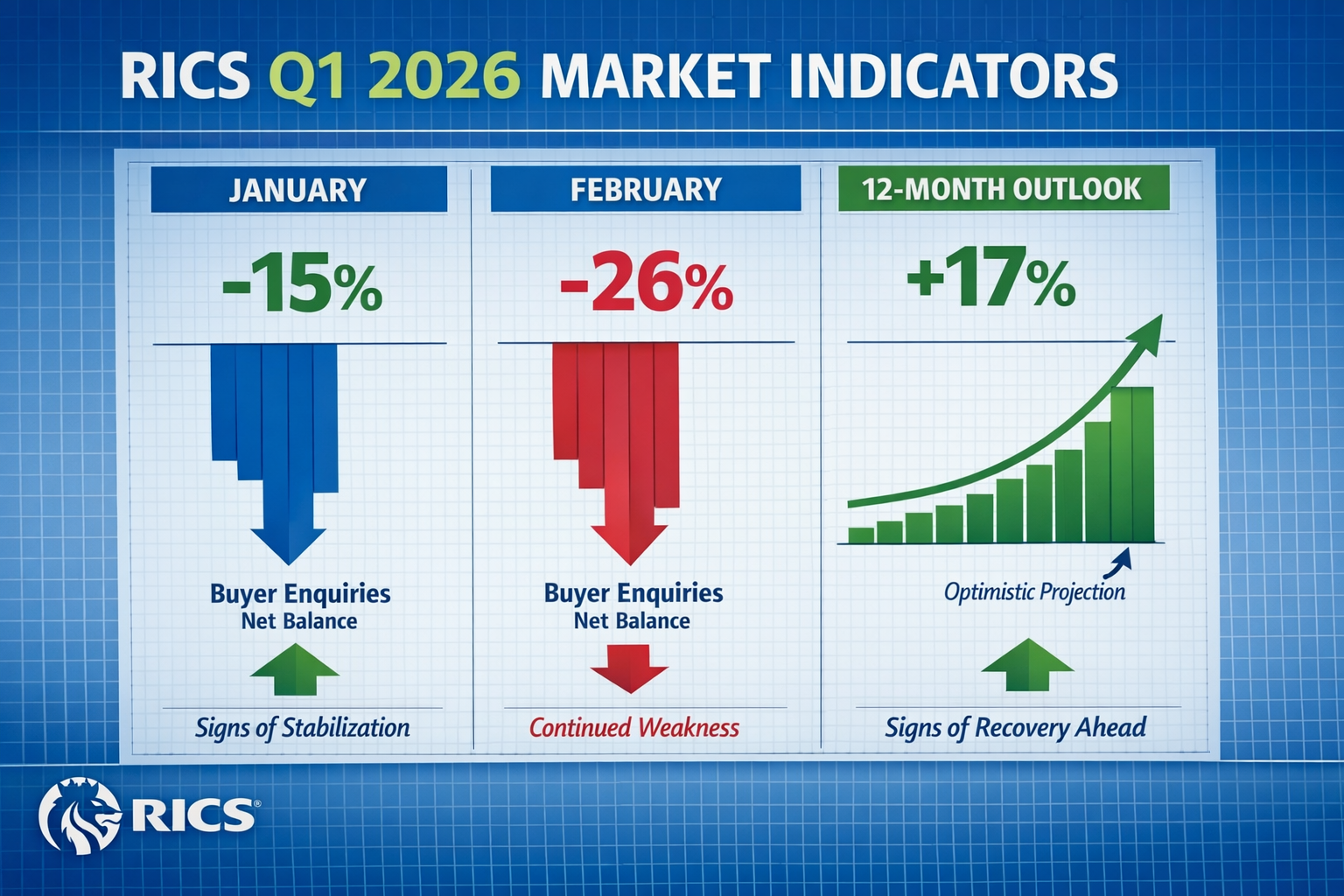
The Royal Institution of Chartered Surveyors (RICS) data from Q1 2026 paints a complex picture. January saw promising improvements with new buyer enquiries rising to -15% (from -21% in December 2025), while 12-month sales optimism surged to +35%—the strongest reading since December 2024.[1] However, February brought renewed weakness as geopolitical tensions and macroeconomic uncertainty pushed buyer demand back down to -26%.[7] This whipsaw pattern underscores why detailed building surveys have become critical risk management tools for both buyers and lenders navigating early-stage market recovery.
Key Takeaways
✅ Market volatility demands rigorous surveys: RICS Q1 2026 data shows buyer enquiries fluctuating from -15% to -26% within one month, making comprehensive property assessments essential for confident decision-making.
✅ Price stabilization creates survey opportunities: With house prices approaching their trough at -10% net balance, detailed defect identification through Level 3 surveys helps buyers negotiate fairly in stabilizing markets.
✅ First-time buyers lead recovery: Increased property supply and improving mortgage conditions position first-time buyers as recovery drivers, requiring accessible survey guidance and clear defect prioritization.
✅ 12-month outlook remains positive: Despite short-term volatility, 43% of RICS respondents anticipate higher prices over the year ahead,[1] creating urgency for buyers to secure thorough surveys before market momentum accelerates.
✅ Survey checklists restore confidence: Standardized RICS-aligned inspection protocols help surveyors identify critical defects systematically, providing buyers with actionable intelligence during uncertain market conditions.
Understanding the RICS Q1 2026 Market Context
The January Recovery Signal
January 2026 marked a turning point for market sentiment. New buyer enquiries improved significantly to a net balance of -15%, up from -21% in December 2025 and -29% in November 2025.[1] This improvement signaled easing downward pressure on demand, with agreed sales showing the least negative reading since June 2025 at -9%.[3]
The most striking indicator emerged in forward-looking confidence metrics. Twelve-month sales optimism surged to +35%, representing the strongest reading since December 2024.[1] Simultaneously, price expectations turned highly positive with 43% of respondents anticipating higher prices over the year ahead—the most optimistic outlook since February 2025.[1]
RICS Chief Economist Simon Rubinsohn noted that "whether this tentative improvement develops into sustained momentum will depend heavily on the trajectory of mortgage rates and broader macro confidence over the coming months."[1] This observation highlights why comprehensive RICS home surveys became increasingly valuable during this period—they provide the detailed property intelligence buyers need to commit confidently despite lingering uncertainty.
The February Setback
February 2026 delivered a sobering reality check. New buyer enquiries declined sharply to -26%, a marked deterioration from January's -15%, driven by geopolitical and macroeconomic uncertainty.[7] Agreed sales remained subdued at -12% net balance, with near-term sales expectations softening to -2%.[7]
The volatility stemmed from multiple factors:
- Geopolitical tensions intensifying concerns over inflation and interest rates
- Global instability creating hesitation among potential buyers
- Mortgage rate uncertainty despite earlier optimism about declining borrowing costs
- Supply constraints continuing to affect market dynamics
Despite these headwinds, the 12-month outlook remained resilient with a net balance of +17% of respondents expecting sales activity to rise over the next 12 months.[7] This divergence between short-term caution and medium-term optimism creates a unique environment where thorough property assessments become critical decision-making tools.
Regional Disparities and Price Stabilization
House prices stabilized nationally at the start of 2026, though regional disparities widened significantly.[2] RICS' three-month price metric reinforced the view that price falls may be nearing their trough, creating opportunities for strategic buyers equipped with detailed survey intelligence.
Tim Green FRICS identified "the increased number of properties coming to the market" as the best early sign of activity, with recovery expected to be led by first-time buyers.[4] This demographic shift makes accessible, comprehensive survey guidance particularly important—first-time buyers typically have less property experience and benefit most from clear defect prioritization frameworks.
Building Survey Checklists for Stabilizing National House Prices: RICS Q1 2026 Indicators for Buyer Confidence Through Systematic Inspection
The Role of Level 3 Building Surveys in Market Stabilization
Level 3 building surveys (formerly Full Structural Surveys) represent the most comprehensive inspection available to property buyers. In a stabilizing but volatile market like Q1 2026, these detailed assessments serve multiple critical functions:
- Risk quantification: Identifying defects and estimating repair costs allows buyers to make informed offers
- Negotiation leverage: Documented issues provide evidence for price reductions or seller remediation
- Lender confidence: Comprehensive reports reassure mortgage providers about property condition
- Long-term planning: Detailed maintenance recommendations help buyers budget for future expenses
The RICS guidance for Level 3 surveys emphasizes thorough investigation of all accessible areas, with particular attention to structural integrity, moisture ingress, and building services. For surveyors working in the Q1 2026 market environment, this comprehensive approach helps counteract the uncertainty that suppressed buyer confidence in February.
Core Inspection Checklist Aligned with RICS Standards
Professional surveyors should structure their Level 3 inspections around these priority areas, with enhanced focus on defects most likely to affect valuation in stabilizing markets:
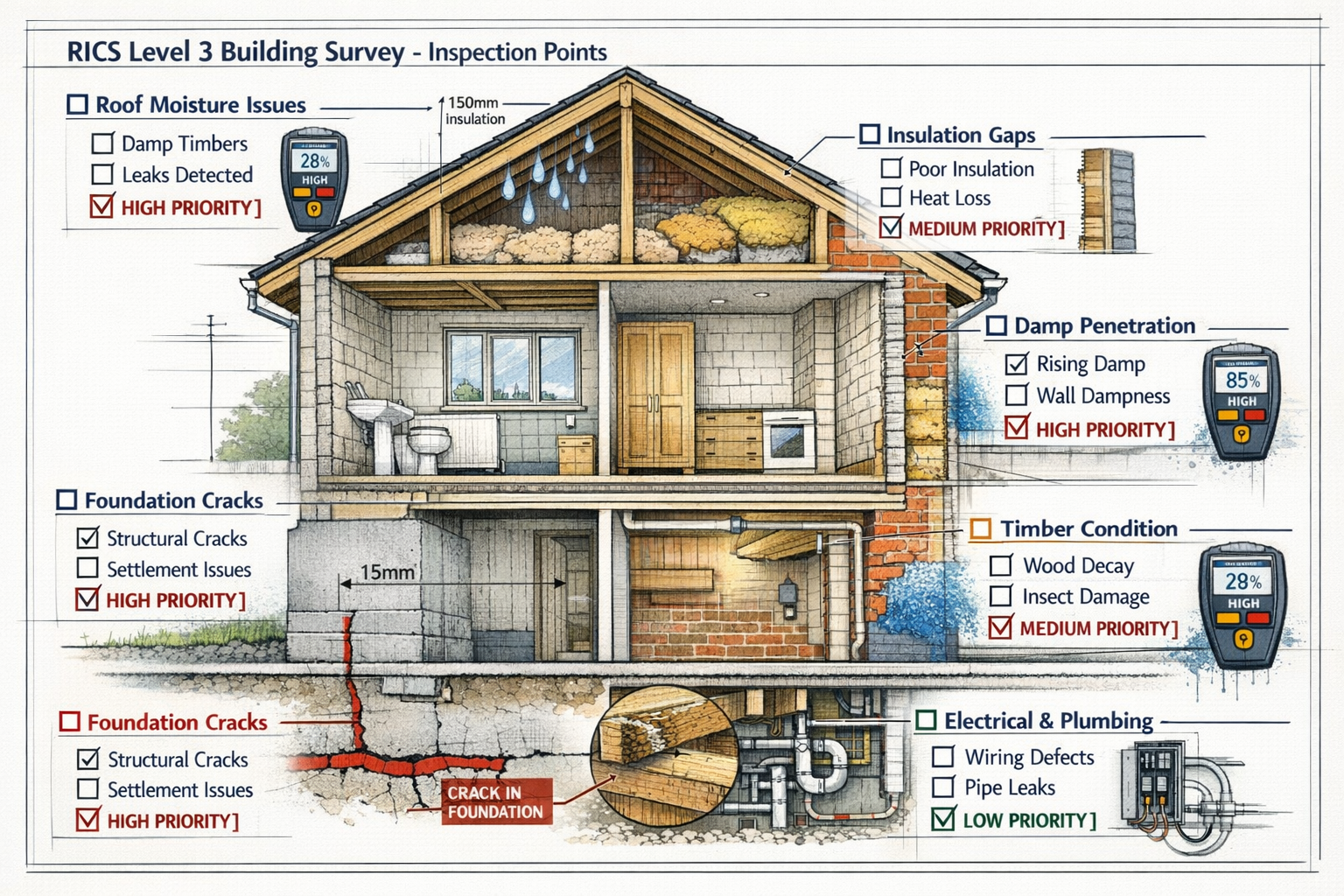
🏗️ Structural Elements (Critical Priority)
| Component | Inspection Focus | Market Impact |
|---|---|---|
| Foundations | Settlement cracks, movement indicators, drainage adequacy | High—affects mortgage availability |
| Load-bearing walls | Structural cracks, bulging, tie integrity | High—immediate safety concerns |
| Roof structure | Timber condition, rafter deflection, truss integrity | Medium—expensive repairs deter buyers |
| Floor structures | Joist condition, deflection, support adequacy | Medium—affects habitability |
| Lintels and beams | Deflection, corrosion, load capacity | Medium—progressive failure risk |
Structural defects carry the greatest weight in buyer decision-making during uncertain markets. A Level 2 homebuyer survey may identify obvious issues, but Level 3 surveys provide the depth of investigation needed to quantify risks and costs accurately.
💧 Moisture and Weatherproofing (High Priority)
Damp-related defects consistently rank among buyers' top concerns. In Q1 2026's stabilizing market, clear identification and costing of moisture issues helps prevent deal collapse:
- Rising damp: DPC condition, ground level relationships, moisture meter readings
- Penetrating damp: Wall condition, pointing quality, render integrity, window seals
- Condensation: Ventilation adequacy, insulation levels, mold growth patterns
- Roof weatherproofing: Tile/slate condition, flashing integrity, valley gutters
- Below-ground waterproofing: Basement tanking, drainage systems, sump pumps
Specialized damp surveys can supplement Level 3 reports when moisture issues require detailed investigation beyond visual inspection and moisture meter readings.
⚡ Building Services and Modern Standards
Building services increasingly affect property valuations as energy efficiency becomes a priority for buyers and regulators:
- Electrical systems: Consumer unit condition, earthing adequacy, circuit capacity, testing certificates
- Heating systems: Boiler age and condition, radiator functionality, controls, efficiency ratings
- Plumbing: Pipe materials, water pressure, drainage adequacy, leak evidence
- Insulation: Loft depth, cavity wall treatment, glazing performance
- Ventilation: Extractor fans, trickle vents, whole-house systems
In the current market context, properties with poor EPC ratings face valuation penalties. Surveyors should clearly document energy efficiency deficiencies and estimate improvement costs.
🏠 External Elements and Maintenance
External condition significantly affects buyer perception and negotiating position:
- Roof coverings: Tile/slate condition, remaining lifespan, repair history
- Rainwater goods: Gutter condition, downpipe adequacy, drainage connections
- External walls: Brickwork condition, render quality, timber cladding
- Windows and doors: Frame condition, glazing integrity, operation, security
- Boundary structures: Fence/wall condition, ownership, maintenance responsibility
For properties with specific external concerns, targeted roof surveys can provide additional detail beyond the main building survey.
Defect Prioritization Framework for Q1 2026 Market Conditions
Given the market volatility evidenced in RICS Q1 2026 data, surveyors should categorize defects using a three-tier priority system that helps buyers make confident decisions:
🔴 Category 1: Critical Defects (Immediate Action Required)
These defects pose safety risks, affect structural integrity, or significantly impact property value:
- Active structural movement requiring monitoring or repair
- Major roof defects causing water ingress
- Dangerous electrical installations
- Failed drainage systems causing foundation risk
- Severe timber decay in structural elements
🟡 Category 2: Significant Defects (Action Within 12-24 Months)
These issues require attention but don't pose immediate risks:
- Moderate damp penetration requiring remediation
- Aging building services approaching end-of-life
- External maintenance needs (repointing, redecoration)
- Minor structural cracks requiring monitoring
- Insulation improvements for energy efficiency
🟢 Category 3: Maintenance Items (Ongoing Attention)
Routine maintenance requirements that don't significantly affect value:
- Gutter cleaning and minor repairs
- Redecoration requirements
- Garden boundary maintenance
- Minor plumbing adjustments
- Routine appliance servicing
This prioritization helps buyers understand which issues require immediate negotiation or budget allocation versus longer-term planning.
Building Survey Checklists for Stabilizing National House Prices: RICS Q1 2026 Indicators for Buyer Confidence in Practice
Case Study: First-Time Buyer in Stabilizing Market
Consider a typical Q1 2026 scenario: A first-time buyer identified a 1930s semi-detached property listed at £325,000 in January when buyer enquiries showed early recovery signs. The homebuyer survey revealed several concerns warranting a full Level 3 investigation:
Survey Findings:
- Category 1: Active settlement crack in rear extension (estimated repair: £8,000-£12,000)
- Category 2: Roof covering nearing end-of-life (replacement: £6,500-£8,500)
- Category 2: Outdated electrical consumer unit (upgrade: £1,200-£1,800)
- Category 3: Various minor maintenance items (£2,000-£3,000)
Total identified costs: £17,700-£25,300
Armed with this detailed intelligence, the buyer successfully negotiated a £15,000 price reduction to £310,000. The comprehensive survey report provided:
✅ Confidence to proceed despite identified defects
✅ Negotiation leverage backed by professional cost estimates
✅ Lender reassurance through expert structural assessment
✅ Maintenance roadmap for the first five years of ownership
This example illustrates how Building Survey Checklists for Stabilizing National House Prices: RICS Q1 2026 Indicators for Buyer Confidence translate into practical buyer protection during uncertain market conditions.
Survey Report Communication Best Practices
The Q1 2026 market environment demands clear, accessible survey communication. RICS members should structure reports to maximize buyer comprehension:
Executive Summary Requirements:
- Traffic-light condition rating (Red/Amber/Green)
- Total estimated repair costs with ranges
- Priority ranking of identified defects
- Clear recommendations for immediate action
- Summary of property's overall condition
Detailed Section Organization:
- Element-by-element inspection findings
- Photographic evidence of key defects
- Explanation of implications and risks
- Cost estimates for remediation
- Maintenance recommendations
Technical Appendices:
- Moisture meter readings and locations
- Measurement data and calculations
- Regulatory compliance notes
- Specialist investigation recommendations
Clear communication helps buyers make confident decisions even when surveys reveal significant defects—critical for maintaining market momentum during the recovery phase.
Integration with Mortgage Valuation Process
In the Q1 2026 market context, coordination between building surveys and mortgage valuations becomes particularly important. Lenders remain cautious despite improving sentiment, making comprehensive survey reports valuable supporting documentation.
Surveyors should:
- Highlight mortgage-relevant issues: Structural defects, damp problems, or non-standard construction that may affect lending decisions
- Provide retention recommendations: Suggest appropriate retention amounts for Category 1 defects requiring remediation before completion
- Document down-valuation justification: When defects justify reducing the property's market value below the agreed purchase price
- Recommend specialist investigations: Identify issues requiring specific defect reports or structural engineer assessment
This integrated approach helps buyers secure mortgage approval while ensuring lenders have confidence in the property's condition and value.

Leveraging RICS Q1 2026 Data for Survey Strategy
Aligning Survey Depth with Market Conditions
The volatility between January's optimism and February's retreat creates strategic considerations for survey recommendations:
In Improving Markets (January 2026 conditions):
- Buyers face increased competition and time pressure
- Faster survey turnaround becomes competitive advantage
- Focus on deal-critical defects to avoid analysis paralysis
- Provide clear "proceed/renegotiate/withdraw" guidance
In Uncertain Markets (February 2026 conditions):
- Buyers have more negotiating power and time
- Comprehensive investigation justifies extended inspection
- Detailed cost analysis supports price negotiation
- Risk quantification helps buyers commit despite uncertainty
Surveyors must adjust their approach based on current market sentiment while maintaining RICS professional standards. Understanding whether the market is in a January-like recovery phase or February-like retreat helps calibrate survey depth and reporting emphasis.
Regional Variation Considerations
RICS Q1 2026 data highlighted widening regional disparities in price trends and market activity.[2] Surveyors should adjust their inspection focus based on local market characteristics:
High-Demand Areas:
- Emphasize defects affecting immediate habitability
- Provide rapid turnaround to support competitive offers
- Focus on issues that significantly affect value
- Consider choosing the right property survey level based on property type and buyer risk tolerance
Stabilizing/Declining Areas:
- Comprehensive defect documentation supports negotiation
- Detailed maintenance planning helps buyers commit long-term
- Energy efficiency improvements gain importance
- Market value context becomes critical for lending decisions
Regional market knowledge allows surveyors to provide context-appropriate advice that reflects local conditions rather than national averages.
First-Time Buyer Focus
Tim Green FRICS identified first-time buyers as likely recovery leaders in 2026.[4] This demographic requires particular consideration in survey approach:
First-Time Buyer Survey Needs:
- Clear explanations: Avoid technical jargon; explain implications in accessible language
- Cost transparency: Provide detailed repair cost estimates with ranges
- Priority guidance: Clearly distinguish deal-breakers from manageable issues
- Maintenance education: Include preventive maintenance recommendations
- Regulatory context: Explain building regulation implications of identified defects
Surveyors who effectively communicate with first-time buyers contribute to market stability by enabling confident, informed purchasing decisions during uncertain conditions.
The Mortgage Rate Connection
RICS Chief Economist Simon Rubinsohn emphasized that sustained market recovery "will depend heavily on the trajectory of mortgage rates."[1] This connection has direct implications for building survey strategy:
Interest Rate Sensitivity in Survey Recommendations
When mortgage rates remain elevated or uncertain:
- Emphasize energy efficiency defects: Higher borrowing costs make ongoing energy expenses more significant
- Quantify financing implications: Calculate monthly payment impact of required repairs if buyers need additional borrowing
- Highlight maintenance costs: Help buyers understand total ownership costs beyond mortgage payments
- Document value-adding improvements: Identify opportunities for buyers to increase property value post-purchase
Survey Timing Optimization
In volatile rate environments, survey timing becomes strategically important:
- Rate-lock coordination: Schedule surveys to align with mortgage offer validity periods
- Rapid turnaround options: Offer expedited services when buyers face rate-lock deadlines
- Conditional survey approaches: Consider preliminary inspections followed by detailed investigation after offer acceptance
Understanding the mortgage market context helps surveyors provide timely, relevant guidance that supports successful transactions.
Technology and Modern Survey Practice
Digital Survey Tools for Q1 2026 Markets
Modern survey practice increasingly incorporates technology to improve accuracy, efficiency, and communication:
Inspection Technology:
- Thermal imaging cameras: Identify hidden moisture, insulation gaps, and air leakage
- Moisture meters: Quantify damp readings for objective assessment
- Laser measuring devices: Ensure accurate dimensional recording
- Borescopes: Inspect concealed spaces without destructive investigation
- Drone photography: Document roof condition and inaccessible areas safely
Reporting Technology:
- Cloud-based platforms: Enable real-time report generation and client access
- Interactive reports: Allow clients to navigate findings by priority or location
- Photographic annotation: Clearly mark defects on images for client understanding
- Cost estimation databases: Provide accurate, up-to-date repair cost ranges
- Digital delivery: Ensure rapid report turnaround to support transaction timelines
Technology adoption helps surveyors meet the demands of Q1 2026's fast-moving yet uncertain market conditions.
Data-Driven Survey Insights
RICS Q1 2026 indicators demonstrate the value of market data in professional practice. Surveyors can leverage data in several ways:
- Benchmark defect prevalence: Compare property condition against regional norms
- Validate repair costs: Reference local construction cost data for accurate estimates
- Contextualize market value: Explain how identified defects affect value in current market conditions
- Forecast maintenance needs: Use building age and type data to predict future requirements
Data-informed survey practice enhances credibility and provides clients with valuable context beyond individual property assessment.
Professional Standards and Continuous Development
RICS Professional Standards Compliance
Adherence to RICS standards remains fundamental regardless of market conditions. Key requirements for building survey practice include:
Inspection Standards:
- Inspect all accessible areas without destructive investigation
- Use appropriate equipment for thorough assessment
- Document limitations where access is restricted
- Follow RICS Guidance Note for Home Surveys (current edition)
Reporting Standards:
- Provide clear, objective findings without bias
- Include appropriate caveats and limitations
- Offer proportionate recommendations based on findings
- Maintain professional indemnity insurance coverage
Ethical Standards:
- Maintain independence from parties with vested interests
- Disclose any conflicts of interest
- Provide competent service within areas of expertise
- Recommend specialist investigation when appropriate
These standards ensure that Building Survey Checklists for Stabilizing National House Prices: RICS Q1 2026 Indicators for Buyer Confidence rest on a foundation of professional integrity and technical competence.
Continuing Professional Development
The evolving market conditions evidenced in Q1 2026 highlight the importance of ongoing professional development:
Priority CPD Areas for 2026:
- Market analysis skills: Understanding and interpreting RICS market indicators
- Energy efficiency assessment: EPC implications and improvement strategies
- Modern construction methods: Non-traditional construction techniques and materials
- Technology adoption: New inspection tools and reporting platforms
- Client communication: Effective explanation of complex technical issues
Surveyors who invest in continuous learning position themselves to provide maximum value during uncertain market conditions.
Conclusion: Building Confidence Through Professional Excellence
The RICS Q1 2026 indicators reveal a housing market at an inflection point—showing signs of recovery yet vulnerable to external shocks. January's optimism, with buyer enquiries improving to -15% and 12-month sales expectations reaching +35%,[1] gave way to February's renewed uncertainty as demand fell back to -26%.[7] This volatility underscores a fundamental truth: buyer confidence remains fragile and requires professional support to sustain market momentum.
Building Survey Checklists for Stabilizing National House Prices: RICS Q1 2026 Indicators for Buyer Confidence provide the framework for this essential support. Comprehensive Level 3 surveys deliver the detailed property intelligence buyers need to commit confidently despite macroeconomic uncertainty. By systematically identifying and prioritizing defects, quantifying repair costs, and providing clear recommendations, chartered surveyors enable informed decision-making that supports market stability.
Actionable Next Steps for Buyers
🏡 Commission comprehensive surveys early: Don't wait until after offer acceptance—understand property condition before committing
📊 Request priority-ranked findings: Ensure your survey clearly distinguishes critical defects from routine maintenance
💰 Obtain detailed cost estimates: Use professional repair cost assessments to negotiate fairly and budget accurately
🔍 Follow specialist investigation recommendations: When surveys identify concerns requiring deeper analysis, invest in targeted reports
📅 Plan long-term maintenance: Use survey recommendations to budget for property upkeep over the first 5-10 years
Actionable Next Steps for Surveyors
📋 Adopt systematic inspection protocols: Implement comprehensive checklists aligned with RICS standards and Q1 2026 market priorities
🎯 Prioritize defect categorization: Use clear traffic-light systems to help clients understand urgency and implications
💬 Enhance client communication: Develop accessible reporting formats that explain technical findings in plain language
📈 Monitor market indicators: Stay informed about RICS data releases to provide context-appropriate advice
🔧 Invest in technology: Adopt modern inspection and reporting tools to improve accuracy and efficiency
The path to sustained housing market recovery in 2026 depends on multiple factors—mortgage rate trajectories, geopolitical stability, and broader economic confidence. While surveyors cannot control these variables, they can provide the professional intelligence that enables buyers to navigate uncertainty with confidence. As the market continues its uneven recovery from the volatility of Q1 2026, comprehensive building surveys remain essential tools for stabilizing prices, supporting transactions, and protecting buyers' interests.
By maintaining rigorous professional standards, communicating clearly, and adapting to evolving market conditions, RICS members fulfill their critical role in supporting a healthy, transparent housing market that serves all participants fairly.
References
[1] Uk Resi Survey Jan 2026 Report Shows Early Signs Market Recovery Despite Caution – https://www.rics.org/news-insights/uk-resi-survey-jan-2026-report-shows-early-signs-market-recovery-despite-caution
[2] Market Confidence Edges Higher In Early 2026 – https://www.winkworth.co.uk/articles/market-confidence-edges-higher-in-early-2026
[3] Property Market Turning Corner Rics Survey Suggests – https://todaysconveyancer.co.uk/property-market-turning-corner-rics-survey-suggests/
[4] Latest Rics Survey Reveals Global Headwinds Are Weighing On Housing Market Confidence – https://www.buyassociationgroup.com/en-gb/news/latest-rics-survey-reveals-global-headwinds-are-weighing-on-housing-market-confidence/
[7] Uk Residential Survey February 2026 – https://www.rics.org/news-insights/uk-residential-survey-february-2026