
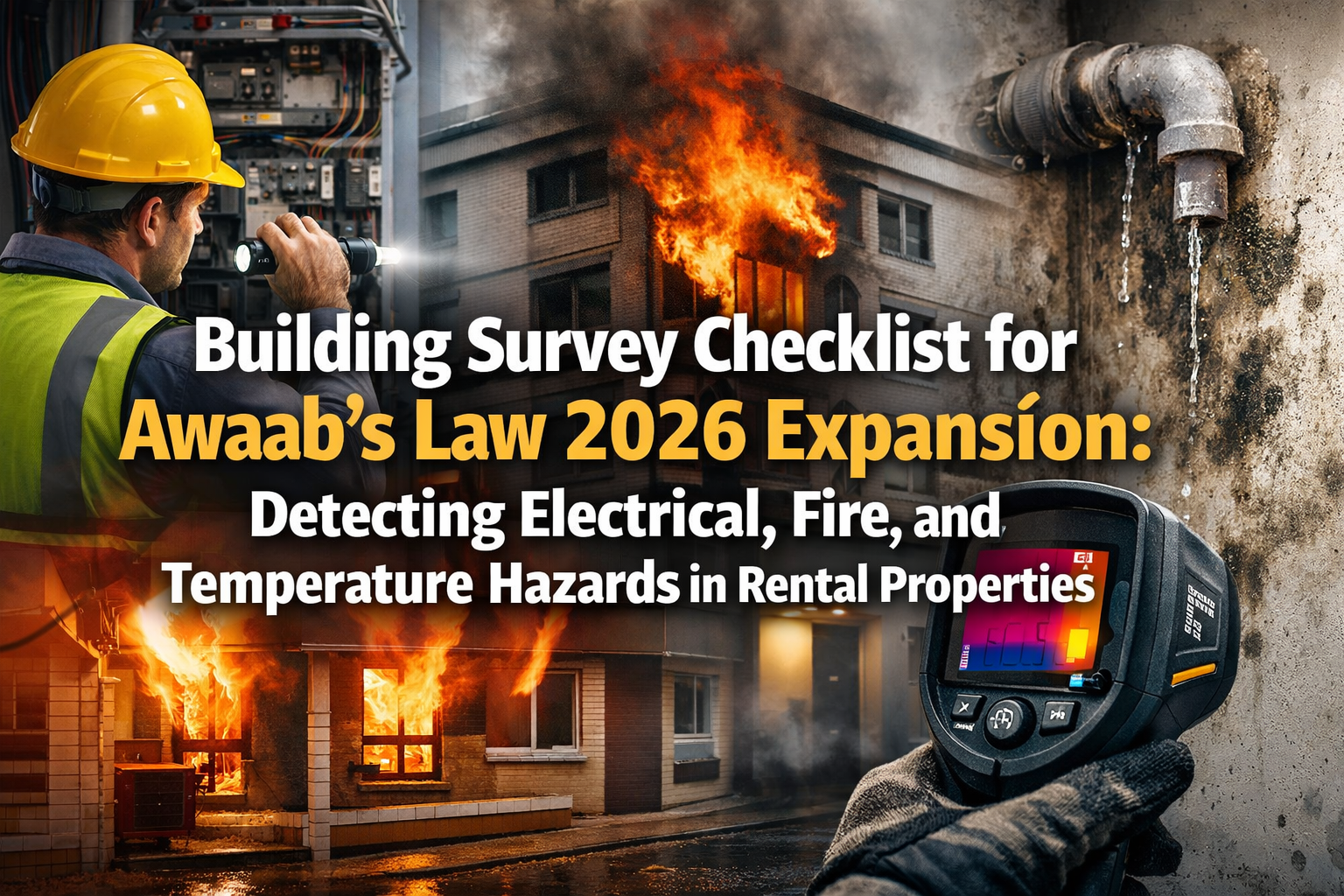
{"cover":"Professional landscape format (1536×1024) hero image featuring bold text overlay 'Building Survey Checklist for Awaab's Law 2026 Expansion' in extra large 72pt white sans-serif font with dark shadow effect, centered in upper third. Background shows professional surveyor with thermal imaging camera inspecting rental property electrical panel and exposed wiring, split-screen composition showing fire safety equipment and temperature monitoring devices. Color scheme: deep navy blue, safety orange, white accents. High contrast, magazine cover quality, editorial style with subtle hazard warning iconography overlaid.","content":["Detailed landscape format (1536×1024) image showing professional surveyor conducting electrical hazard inspection in rental property, close-up of hands using digital multimeter testing exposed wiring in consumer unit, thermal imaging camera displaying heat signatures on electrical outlets, clipboard with detailed checklist visible in foreground, yellow hazard warning tape, modern testing equipment, natural lighting from window, realistic documentation scene, professional safety gear, high-resolution editorial quality with technical accuracy and workplace safety emphasis","Landscape format (1536×1024) composite image displaying fire safety assessment in residential rental property, smoke detector being tested with aerosol spray, fire extinguisher inspection with pressure gauge close-up, fire blanket mounted on kitchen wall, escape route signage, surveyor marking deficiencies on tablet device, split-level view showing stairwell with emergency lighting, red and white color scheme emphasizing fire safety compliance, professional documentation aesthetic with regulatory compliance focus","Landscape format (1536×1024) image showing temperature hazard detection in rental accommodation, professional surveyor using infrared thermal imaging camera pointed at poorly insulated external wall with visible heat loss patterns displayed on camera screen, digital thermometer showing cold temperature reading, condensation on single-glazed window, inadequate heating radiator, moisture meter testing wall dampness, color-coded thermal gradient overlay showing blue cold zones and red heat zones, winter setting with tenant comfort assessment focus, technical measurement equipment prominent"}
The death of two-year-old Awaab Ishak from prolonged exposure to mould in 2020 sparked legislative reform that has fundamentally transformed landlord obligations across England. As of 2026, Phase 2 of Awaab's Law extends far beyond damp and mould, introducing strict investigation and remediation timescales for electrical hazards, fire safety deficiencies, and temperature control failures in rental properties [1]. For surveyors and landlords, this expansion creates immediate compliance requirements and significant liability risks for properties with undetected hazards.
The Building Survey Checklist for Awaab's Law 2026 Expansion: Detecting Electrical, Fire, and Temperature Hazards in Rental Properties provides essential protocols for identifying these newly regulated hazard categories before they trigger statutory breach notices or harm tenants.
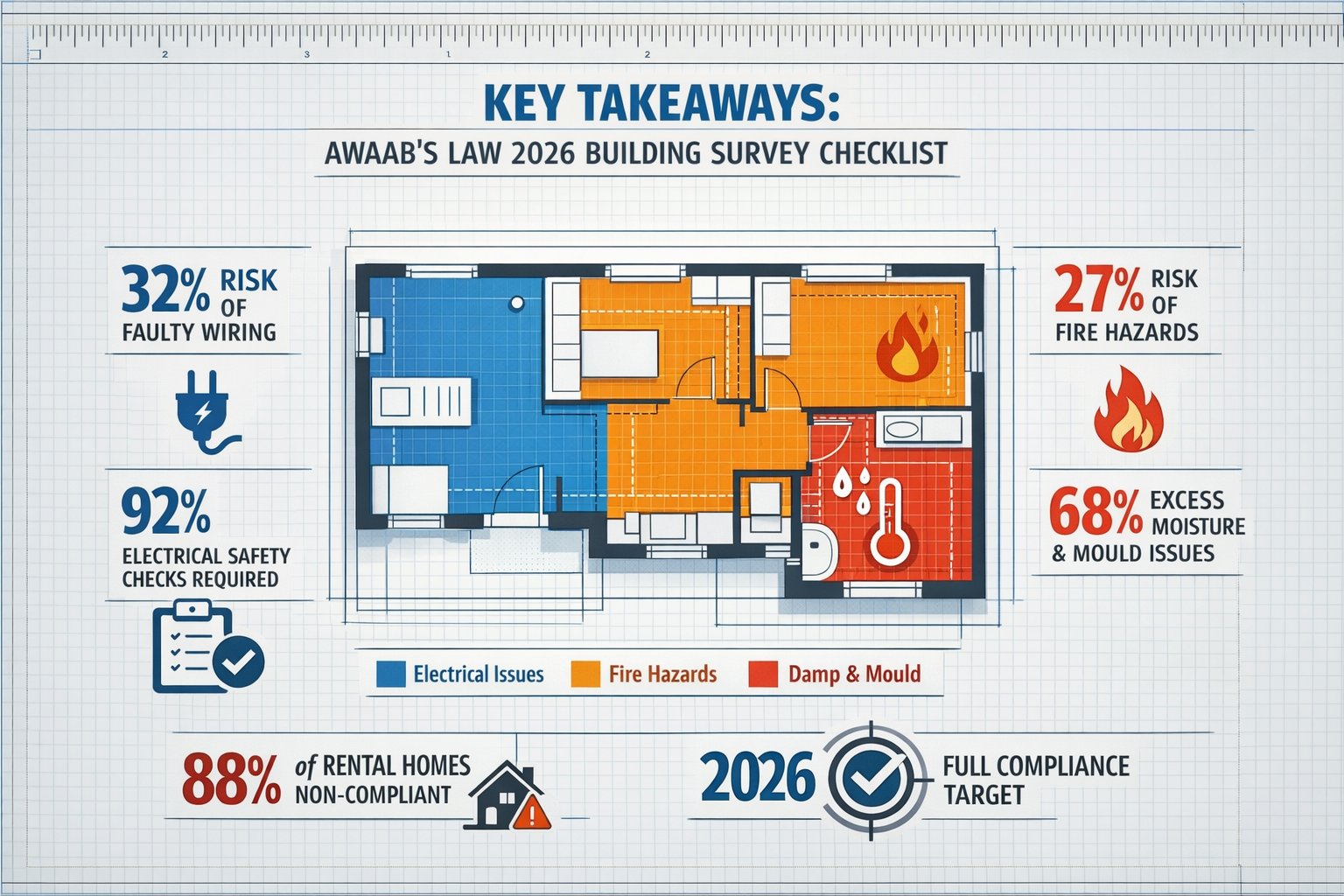
Key Takeaways
- ⚡ Phase 2 of Awaab's Law (2026) mandates specific investigation and repair timescales for electrical hazards, fire safety deficiencies, and temperature control failures in addition to the original damp and mould requirements [2]
- 🔥 Landlords must now identify and remediate fire risks including inadequate detection systems, blocked escape routes, and combustible materials within defined statutory timeframes [3]
- 🌡️ Excess cold and excess heat are distinct regulated hazard categories requiring assessment and remediation, with temperature control failures no longer treated as minor maintenance issues [4]
- 📋 Comprehensive building surveys must now incorporate expanded HHSRS (Housing Health and Safety Rating System) hazard detection protocols to identify risks that could trigger landlord liability under the new legislation
- 📊 Documentation and data management of hazard investigations, timelines, and remediation decisions are now compliance requirements, not optional record-keeping practices [2]
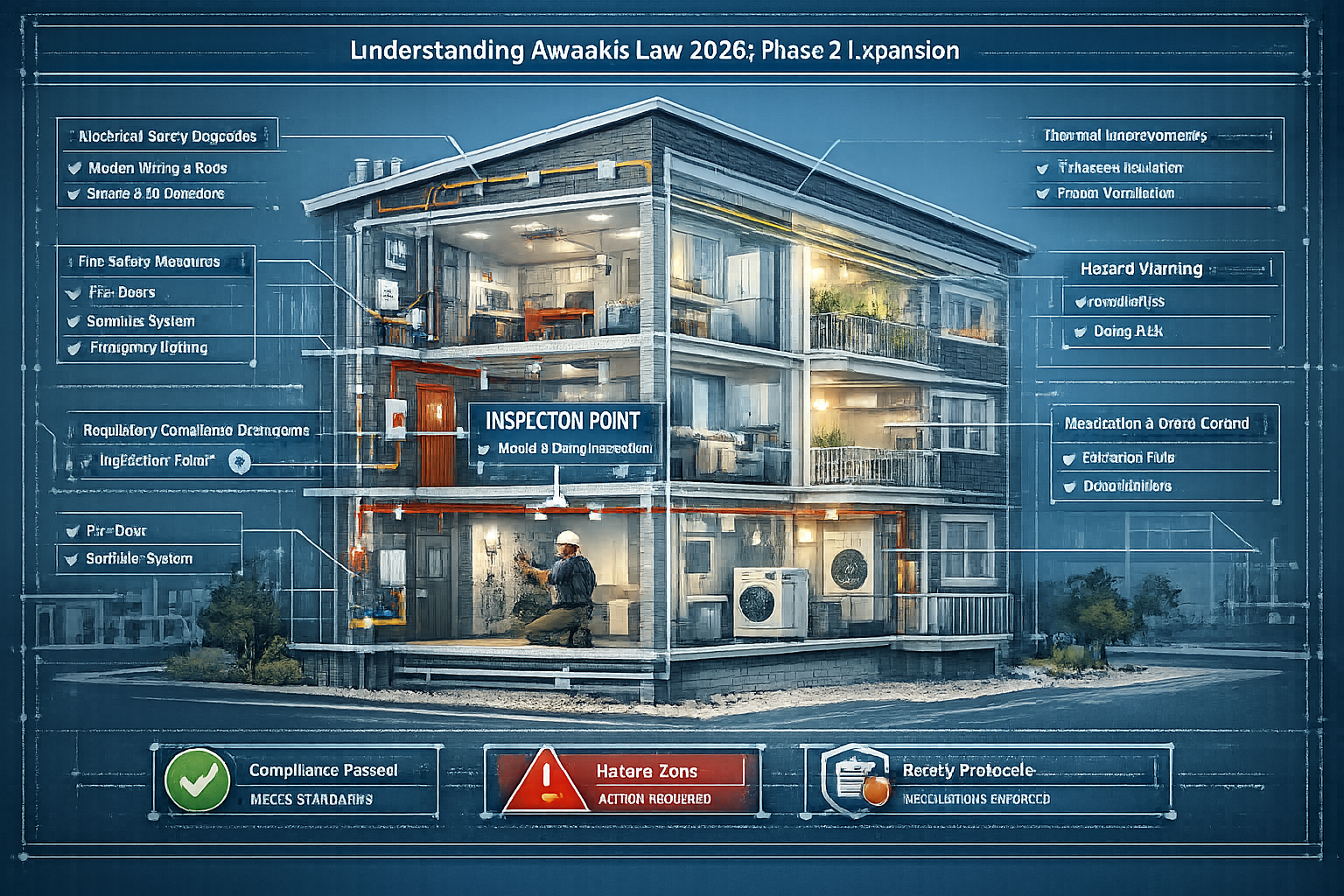
Understanding Awaab's Law 2026 Phase 2 Expansion
What Changed in 2026?
Phase 1 of Awaab's Law, implemented in October 2025, established strict timescales for social landlords to investigate and remediate damp and mould hazards. Phase 2, which began in 2026, dramatically expands the scope to include multiple additional hazard categories that pose significant harm risks to tenants [1].
The newly regulated hazards under Phase 2 include:
- Electrical hazards (exposed wiring, faulty installations, inadequate earthing)
- Fire safety deficiencies (inadequate detection, blocked escape routes, combustible materials)
- Excess cold (inadequate heating, poor insulation, thermal inefficiency)
- Excess heat (overheating, inadequate ventilation, thermal discomfort)
- Structural collapse risks (instability, deterioration, load-bearing failures)
- Falls hazards (stairs, baths, level surfaces, between-level transitions)
- Explosions (gas leaks, improper installations)
- Domestic hygiene and sanitation (drainage, food safety, personal hygiene facilities) [1]
Why This Matters for Building Surveys
Traditional RICS building surveys have always identified defects and hazards, but Awaab's Law 2026 expansion transforms these observations into statutory compliance requirements with defined investigation and remediation timescales. Landlords can no longer defer action on electrical, fire, or temperature hazards without risking breach notices and potential prosecution [2].
For surveyors, this means adopting more rigorous detection protocols specifically designed to identify HHSRS hazards that trigger Awaab's Law obligations. A structural survey must now explicitly assess and document electrical, fire, and temperature hazards using standardized criteria that align with regulatory requirements.
Statutory Timescales and Compliance Requirements
Under Phase 2, landlords must:
- Investigate reported hazards within defined timescales (typically 14 days for Category 1 hazards)
- Complete remediation within specified timeframes based on hazard severity
- Document all investigation findings, decisions, and actions taken
- Link hazards to individual properties in repairs data systems
- Evidence compliance through auditable records [2]
Failure to meet these timescales results in breach notices, enforcement action, and potential prosecution. For landlords, comprehensive building surveys that identify hazards before tenant reports become a critical risk management tool.
Building Survey Checklist for Electrical Hazards Under Awaab's Law 2026
Electrical hazards are now explicitly regulated under Phase 2, requiring landlords to identify and remediate risks that could cause electric shock, burns, or fire [4]. Professional damp surveys have long included electrical safety observations, but the 2026 expansion demands more systematic electrical hazard detection protocols.
Primary Electrical Hazards to Detect
1. Consumer Unit and Distribution Board Issues
What to Check:
- ✅ Age and type of consumer unit (plastic units pre-2016 are fire risks)
- ✅ Presence of RCD (Residual Current Device) protection on all circuits
- ✅ Evidence of overheating (discoloration, burning smell, melted plastic)
- ✅ Adequate circuit labeling and documentation
- ✅ Signs of DIY modifications or unauthorized additions
- ✅ Proper earthing and bonding connections
HHSRS Indicators:
A consumer unit showing signs of overheating, lacking RCD protection, or with evidence of unauthorized modifications constitutes a Category 1 electrical hazard requiring immediate investigation [4].
2. Fixed Wiring and Installation Defects
What to Check:
- ✅ Exposed live conductors or damaged cable insulation
- ✅ Surface-mounted wiring in poor condition or insecurely fixed
- ✅ Evidence of rodent damage to cables
- ✅ Inadequate cable support or strain relief
- ✅ Cables running through areas exposed to moisture or heat
- ✅ Use of inappropriate cable types for the installation environment
Detection Protocol:
Visual inspection should cover all accessible areas including lofts, basements, and service cupboards. Thermal imaging can identify overheating cables hidden behind walls or ceilings, providing early warning of electrical faults before they cause fires [4].
3. Socket Outlets and Switches
What to Check:
- ✅ Loose or damaged socket faceplates
- ✅ Scorch marks or discoloration around outlets
- ✅ Sockets that feel warm to touch during use
- ✅ Inadequate number of sockets leading to overuse of extension leads
- ✅ Sockets located in inappropriate positions (near water sources)
- ✅ Evidence of arcing or sparking
Compliance Note:
The Electrical Safety Standards in the Private Rented Sector (England) Regulations 2020 require landlords to ensure electrical installations are inspected and tested at least every five years. However, Awaab's Law 2026 expansion means visible electrical hazards must be investigated and remediated within statutory timescales regardless of the next scheduled inspection date [3].
4. Lighting Circuits and Fixtures
What to Check:
- ✅ Inadequate lighting creating safety hazards (stairs, bathrooms)
- ✅ Damaged or missing light fittings
- ✅ Improper installation of bathroom lighting (zone requirements)
- ✅ Overheating downlights in contact with insulation
- ✅ Flickering lights indicating circuit faults
Electrical Hazard Documentation Requirements
For compliance with Awaab's Law 2026, surveyors should document:
| Hazard Element | Documentation Required | HHSRS Category |
|---|---|---|
| Exposed live wiring | Location, extent, immediate risk assessment | Category 1 |
| Consumer unit defects | Age, type, RCD status, condition assessment | Category 1 or 2 |
| Socket/switch damage | Number affected, location, severity | Category 2 |
| Inadequate earthing | Test results, affected circuits | Category 1 |
| Overheating indicators | Thermal imaging evidence, location | Category 1 |
This documentation enables landlords to prioritize remediation actions and demonstrate compliance with investigation timescales [2].
Building Survey Checklist for Fire Hazards Under Awaab's Law 2026
Fire safety is now a distinct regulated hazard category under Phase 2, requiring landlords to assess and address fire risks within defined timeframes [1]. While the Regulatory Reform (Fire Safety) Order 2005 already imposes fire safety duties, Awaab's Law 2026 expansion creates additional obligations specific to residential rental properties.
Primary Fire Hazards to Detect
1. Fire Detection and Alarm Systems
What to Check:
- ✅ Presence of working smoke alarms on each floor
- ✅ Smoke alarm age (replace every 10 years)
- ✅ Alarm location (hallways, landings, near bedrooms)
- ✅ Carbon monoxide detectors in rooms with fuel-burning appliances
- ✅ Interconnected alarm systems in larger properties
- ✅ Evidence of alarm testing and maintenance
Regulatory Requirement:
The Smoke and Carbon Monoxide Alarm (England) Regulations 2015 require working smoke alarms on each storey and carbon monoxide alarms in rooms with solid fuel appliances. However, Awaab's Law 2026 means missing or non-functional alarms must be investigated and remediated within statutory timescales once reported or identified [3].
2. Means of Escape and Emergency Egress
What to Check:
- ✅ Clear and unobstructed escape routes from all habitable rooms
- ✅ Adequate number and width of escape routes
- ✅ Window egress options from upper floors (size, accessibility)
- ✅ Security bars or grilles that prevent emergency escape
- ✅ Locked doors or gates blocking escape routes
- ✅ Adequate emergency lighting in common areas (HMOs)
HHSRS Assessment:
Blocked or inadequate escape routes constitute Category 1 fire hazards requiring immediate remediation. Surveyors should measure window openings and assess whether they meet egress requirements (minimum 450mm wide x 450mm high opening) [4].
3. Fire Separation and Compartmentation
What to Check:
- ✅ Integrity of fire doors (self-closing mechanisms, intumescent strips, smoke seals)
- ✅ Breaches in fire-resistant walls or floors (service penetrations, damaged plasterboard)
- ✅ Missing or damaged fire stopping around pipes and cables
- ✅ Combustible materials in escape routes (storage, furnishings)
- ✅ Adequate fire resistance of structural elements
Detection Protocol:
Visual inspection should identify obvious breaches in fire compartmentation. For HMOs and larger properties, specialist fire safety surveys may be required to assess compliance with Building Regulations Approved Document B [4].
4. Ignition Sources and Combustible Materials
What to Check:
- ✅ Proximity of combustible materials to heat sources (curtains near heaters)
- ✅ Unsafe use of portable heaters or cooking appliances
- ✅ Accumulation of combustible waste or storage
- ✅ Flammable materials stored near electrical panels or boilers
- ✅ Damaged or poorly maintained fuel-burning appliances
Fire Hazard Risk Matrix
| Fire Hazard Type | Category 1 Indicators | Category 2 Indicators | Investigation Timescale |
|---|---|---|---|
| No smoke alarms | Entire property without alarms | Single floor missing alarm | 14 days |
| Blocked escape route | Primary escape route obstructed | Secondary route partially blocked | 14 days |
| Fire door defects | Missing self-closer, severe damage | Minor damage, worn seals | 28 days |
| Combustible storage | Escape route blocked with flammables | Storage near ignition source | 14-28 days |
Understanding these risk categories helps landlords prioritize remediation efforts and comply with Awaab's Law 2026 timescales [2].
Building Survey Checklist for Temperature Hazards Under Awaab's Law 2026
Temperature control hazards—both excess cold and excess heat—are now prioritized as distinct hazard categories requiring assessment and remediation within defined timeframes [1]. This represents a significant shift from treating heating and insulation deficiencies as minor maintenance issues.
Excess Cold Hazards
Excess cold occurs when inadequate heating, poor insulation, or thermal inefficiency exposes occupants to temperatures that pose health risks, particularly to vulnerable groups including children, elderly persons, and those with chronic health conditions [3].
What to Check for Excess Cold
Heating System Assessment:
- ✅ Presence and functionality of adequate heating in all habitable rooms
- ✅ Heating system capacity appropriate for property size
- ✅ Age and efficiency of boiler or heating appliances
- ✅ Radiator size and distribution throughout property
- ✅ Thermostat presence and functionality
- ✅ Evidence of heating system failures or breakdowns
Insulation and Thermal Performance:
- ✅ Loft insulation depth and condition (minimum 270mm recommended)
- ✅ Cavity wall insulation presence
- ✅ Single-glazed windows or failed double-glazing units
- ✅ Draughts from windows, doors, or service penetrations
- ✅ Uninsulated solid walls (particularly in older properties)
- ✅ Cold bridging at junctions and structural elements
Detection Protocol:
Thermal imaging surveys can identify heat loss patterns, cold spots, and insulation deficiencies that contribute to excess cold hazards. Temperature measurements should be taken in multiple rooms during winter months to assess actual thermal performance [4].
HHSRS Assessment for Excess Cold
The Housing Health and Safety Rating System assesses excess cold based on:
- Indoor temperature achieved (below 18°C in living areas or 16°C in bedrooms indicates potential hazard)
- Thermal efficiency of the building fabric
- Heating system adequacy and affordability of heating costs
- Vulnerability of occupants to cold-related health impacts
Category 1 Excess Cold Indicators:
- No functioning heating system during winter months
- Indoor temperatures consistently below 16°C
- Severe insulation deficiencies combined with inadequate heating
- Evidence of condensation, mould growth, or cold-related health issues [3]
Excess Heat Hazards
Excess heat has gained prominence as a distinct hazard category due to increasing summer temperatures and climate change impacts. Properties that overheat during warm weather pose health risks including heat stress, dehydration, and cardiovascular strain [1].
What to Check for Excess Heat
Building Design and Orientation:
- ✅ Extensive south or west-facing glazing without shading
- ✅ Inadequate ventilation (fixed windows, no opening lights)
- ✅ Poor cross-ventilation design
- ✅ Heat-retaining roof construction (flat roofs, inadequate ventilation)
- ✅ Dark external finishes that absorb solar radiation
Ventilation and Cooling:
- ✅ Trickle vents in windows (presence and functionality)
- ✅ Mechanical ventilation systems (operation and maintenance)
- ✅ Ability to achieve adequate air changes per hour
- ✅ Presence of shading devices (blinds, awnings, external shutters)
- ✅ Restrictions on tenant ability to control ventilation
Detection Protocol:
Summer temperature monitoring and thermal modeling can identify properties at risk of overheating. Surveyors should assess ventilation adequacy and identify design features that contribute to heat retention [4].
HHSRS Assessment for Excess Heat
Category 1 Excess Heat Indicators:
- Indoor temperatures regularly exceeding 26°C during summer
- Inadequate ventilation preventing heat dissipation
- Vulnerable occupants (elderly, young children, chronic health conditions)
- Evidence of heat-related health impacts or complaints [3]
Temperature Hazard Documentation Template
Property Address: _________________________
Survey Date: _________________________
Temperature Hazard Assessment:
| Element | Condition | Hazard Rating | Remediation Required |
|---|---|---|---|
| Heating system | Functional / Deficient / Absent | Category 1 / 2 / None | Yes / No |
| Loft insulation | Adequate / Inadequate / Absent | Category 1 / 2 / None | Yes / No |
| Window glazing | Double / Single / Failed | Category 1 / 2 / None | Yes / No |
| Ventilation | Adequate / Inadequate | Category 1 / 2 / None | Yes / No |
| Solar shading | Present / Absent | Category 1 / 2 / None | Yes / No |
Thermal Imaging Evidence: Attached / Not applicable
Temperature Measurements: _________________________
HHSRS Category: 1 / 2 / None
Recommended Actions: _________________________
Investigation Timescale: _________________________
This documentation framework ensures compliance with Awaab's Law 2026 requirements for temperature hazard investigation and remediation [2].
Implementing Comprehensive Detection Protocols
Training Requirements for Surveyors and Frontline Staff
Phase 2 of Awaab's Law requires expanded training for surveyors, frontline staff, and contractors to recognize when everyday repair requests point to wider HHSRS hazards beyond damp and mould [2]. This training should cover:
- HHSRS hazard identification for electrical, fire, and temperature categories
- Statutory investigation timescales and compliance requirements
- Documentation standards for hazard assessment and remediation
- Escalation protocols for Category 1 hazards requiring immediate action
Professional surveyors conducting homebuyer surveys or RICS home surveys for rental properties should incorporate Awaab's Law hazard detection protocols into their standard inspection procedures.
Data Management and Compliance Systems
High-quality repairs data for compliance is no longer optional under Awaab's Law 2026. Landlords must implement systems that:
- Link hazards to individual properties with unique identifiers
- Track investigation and resolution timelines against statutory requirements
- Document decision-making for hazard assessment and remediation prioritization
- Generate compliance reports for regulatory oversight and audits [2]
Stock condition surveys can provide baseline hazard assessments across rental portfolios, enabling landlords to identify and prioritize properties requiring remediation before tenant reports trigger statutory investigation timescales.
Integration with Existing Survey Types
The Building Survey Checklist for Awaab's Law 2026 Expansion should be integrated with existing survey types to ensure comprehensive hazard detection:
- RICS Building Surveys should include explicit HHSRS hazard assessment sections for electrical, fire, and temperature risks
- Damp Surveys should be expanded to cover temperature control hazards that contribute to condensation and mould growth
- Specific Defect Reports can provide detailed investigation of individual hazards identified during initial assessments
Understanding the difference between Level 2 and Level 3 surveys helps landlords select appropriate survey types for Awaab's Law compliance purposes.
Phase 3 Expansion: Preparing for 2027
While Phase 2 (2026) focuses on electrical, fire, and temperature hazards, Phase 3 (planned for 2027) will extend Awaab's Law to all HHSRS hazards, including:
- Asbestos and manufactured mineral fibers
- Biocides and chemical hazards
- Carbon monoxide and fuel combustion products
- Lead contamination
- Radiation (radon and non-ionizing)
- Inadequate lighting
- Noise disturbance
- Water supply issues
- Flames and hot surfaces
- Poor security and entry systems [1]
Landlords should begin assessing these additional hazard categories now to prepare for Phase 3 compliance requirements. Comprehensive RICS commercial building surveys and residential surveys can identify these hazards in advance of statutory obligations.
Conclusion
The Building Survey Checklist for Awaab's Law 2026 Expansion represents a fundamental shift in rental property compliance, transforming electrical, fire, and temperature hazards from maintenance issues into statutory obligations with defined investigation and remediation timescales. For landlords and surveyors, implementing comprehensive detection protocols is no longer optional—it's a legal requirement that carries significant liability risks for non-compliance.
Actionable Next Steps
- Conduct comprehensive building surveys of rental properties using Awaab's Law hazard detection protocols for electrical, fire, and temperature risks
- Implement data management systems that track hazard investigations, timelines, and remediation actions to demonstrate compliance
- Train frontline staff and contractors to recognize HHSRS hazards in everyday repair requests and escalate appropriately
- Prioritize remediation based on HHSRS Category 1 and Category 2 classifications, focusing on hazards posing immediate harm risks
- Document all assessments, decisions, and actions to create auditable compliance records
- Prepare for Phase 3 (2027) by beginning assessment of additional HHSRS hazard categories including asbestos, carbon monoxide, and inadequate lighting
For professional building surveys that incorporate Awaab's Law 2026 compliance protocols, choosing the right property survey ensures comprehensive hazard detection and documentation. Working with experienced local chartered surveyors who understand the expanded regulatory requirements provides landlords with the expert assessment needed to protect tenants and avoid statutory breaches.
The 2026 expansion of Awaab's Law sends a clear message: tenant safety is non-negotiable, and landlords must proactively identify and remediate hazards before they cause harm. Comprehensive building surveys using the detection protocols outlined in this checklist provide the foundation for compliance, risk management, and ultimately, safer rental housing across England.
References
[1] Awaabs Law – https://www.procurementhub.co.uk/news/awaabs-law/
[2] Awaabs Law Phase 2 Is Coming What Social Landlords Need To Know About Additional Hazard Compliance In 2026 – https://www.mobysoft.com/resources/blogs/awaabs-law-phase-2-is-coming-what-social-landlords-need-to-know-about-additional-hazard-compliance-in-2026/
[3] Awaabs Law What Does It Mean For Landlords – https://humanfocus.co.uk/blog/awaabs-law-what-does-it-mean-for-landlords/
[4] Awaabs Law 2026 Hazard Expansions Surveyor Protocols For Electrical Fire And Excess Heat Risks In Rentals – https://nottinghillsurveyors.com/blog/awaabs-law-2026-hazard-expansions-surveyor-protocols-for-electrical-fire-and-excess-heat-risks-in-rentals