Agreed Surveyor Party Wall: Your Complete Guide to Streamlined Dispute Resolution in 2025
When neighbors embark on construction projects that affect shared walls, fences, or boundaries, the potential for conflict looms large. Yet there’s a lesser-known solution that can save both time and money while maintaining neighborly relations: the agreed surveyor party wall arrangement. This streamlined approach to managing party wall matters under the Party Wall Act 1996 offers property owners a practical alternative to the traditional two-surveyor model, but understanding when and how to use it effectively requires careful consideration.
Key Takeaways
- ✅ An agreed surveyor party wall arrangement involves appointing a single surveyor to represent both the building owner and adjoining owner, reducing costs and simplifying the process
- 💰 Using one agreed surveyor typically costs 40-60% less than appointing two separate surveyors, making it an economical choice for straightforward party wall matters
- ⚖️ The agreed surveyor must remain impartial and act fairly for both parties, with the same legal duties as if two surveyors were appointed
- 📋 Both property owners must consent in writing to the agreed surveyor appointment, and either party can withdraw consent and appoint their own surveyor at any time
- 🏗️ This approach works best for simple, non-contentious projects where neighbors have a good relationship and the proposed works are straightforward
Understanding the Agreed Surveyor Party Wall Concept
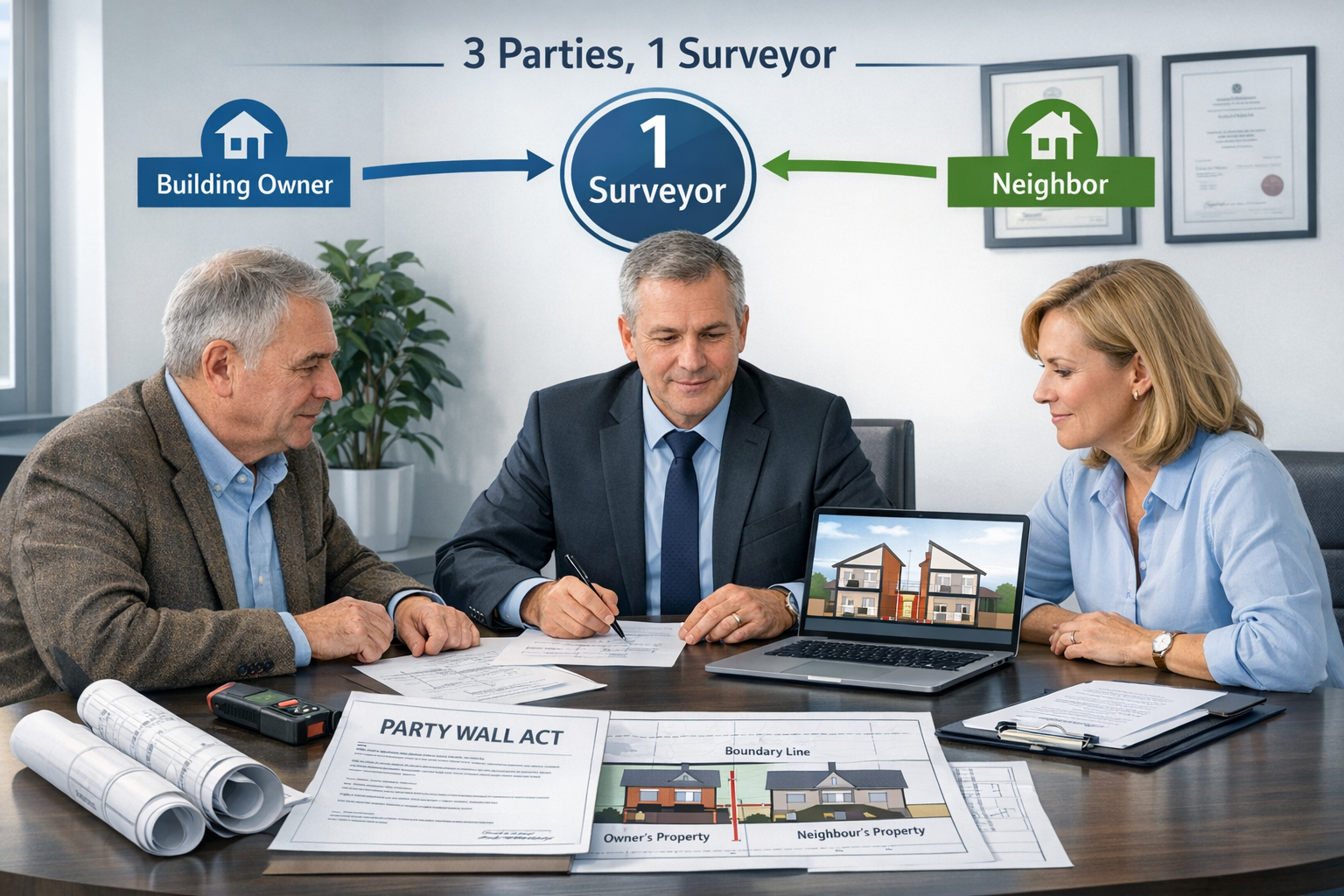
The agreed surveyor party wall mechanism represents one of the most efficient pathways available under the Party Wall etc. Act 1996. When a building owner serves notice of intended works that fall under the Act, the adjoining owner has several options for responding. Rather than each party appointing their own surveyor—which creates a two-surveyor arrangement—both parties can mutually agree to appoint a single surveyor to act for both of them.
This single professional, known as the agreed surveyor, assumes responsibility for preparing the party wall award, inspecting the works, and ensuring compliance with the Act. The role carries significant responsibility, as the agreed surveyor must balance the interests of both the building owner and the adjoining owner while maintaining strict impartiality.
What Makes an Agreed Surveyor Different?
Unlike a surveyor appointed by just one party, an agreed surveyor owes duties to both property owners equally. This dual responsibility means they cannot favor either party’s interests. They must:
- Assess the proposed works objectively without bias toward either neighbor
- Prepare a fair party wall award that protects both properties
- Communicate transparently with both the building owner and adjoining owner
- Maintain professional independence throughout the process
- Ensure compliance with all statutory requirements under the Act
The agreed surveyor essentially performs the same functions that two separate surveyors would undertake, but does so as a single, impartial professional. This consolidation of roles is what creates both the efficiency gains and the cost savings that make this approach attractive.
When to Choose an Agreed Surveyor Party Wall Arrangement
Not every party wall situation suits the agreed surveyor model. Success depends heavily on the relationship between neighbors, the complexity of the proposed works, and the level of trust both parties can establish with a single professional.
Ideal Scenarios for Agreed Surveyors
Simple Construction Projects 🏠
When the proposed works are straightforward—such as building a single-story extension, inserting a damp-proof course, or cutting into a party wall for a new beam—an agreed surveyor arrangement often proves ideal. These projects typically involve:
- Clear, well-defined scope of works
- Minimal risk of significant damage
- Standard construction methods
- Short project duration
- Predictable outcomes
Cooperative Neighbor Relations 🤝
The agreed surveyor model thrives when neighbors maintain a positive relationship and share common goals. Property owners who communicate well and trust each other’s intentions find this approach particularly beneficial. Signs that an agreed surveyor might work include:
- Previous successful collaborations between neighbors
- Open, honest communication about the project
- Mutual understanding of each other’s concerns
- Willingness to compromise on minor details
- Shared interest in minimizing costs
Cost-Conscious Situations 💷
For many property owners, budget considerations drive the decision to pursue an agreed surveyor arrangement. When both neighbors recognize that their interests align and that the works pose minimal risk, sharing the cost of a single surveyor makes financial sense.
According to professional surveyor guidance, the typical cost structure breaks down as follows:
| Surveyor Arrangement | Estimated Cost Range | Who Pays |
|---|---|---|
| Agreed Surveyor | £700 – £1,500 | Building owner pays all fees |
| Two Surveyors | £1,400 – £3,000+ | Building owner pays both surveyors’ fees |
| Three Surveyors (with third surveyor) | £2,500 – £5,000+ | Building owner pays all fees |
When to Avoid the Agreed Surveyor Route
Complex or High-Risk Projects ⚠️
Large-scale construction work, basement excavations, or projects involving significant structural alterations often benefit from the two-surveyor approach. When works carry substantial risk of damage or require extensive technical analysis, having independent representation for each party provides important safeguards.
Strained Neighbor Relations 😟
If neighbors already have a contentious relationship or disagree about the proposed works, attempting to use an agreed surveyor can backfire. The adjoining owner may feel they lack adequate representation, leading to:
- Withdrawal of consent for the agreed surveyor
- Appointment of their own surveyor mid-process
- Increased overall costs and delays
- Potential disputes about the surveyor’s impartiality
- Legal challenges to the party wall award
Significant Property Value Differences 🏘️
When one property is substantially more valuable than the other, the owners may have different risk tolerances and priorities. The adjoining owner of a high-value property might prefer independent representation to ensure their interests receive full attention.
The Legal Framework Governing Agreed Surveyor Party Wall Matters
The Party Wall etc. Act 1996 provides the statutory foundation for all party wall procedures in England and Wales, including the agreed surveyor party wall arrangement. Understanding this legal framework helps property owners make informed decisions about their approach.
Statutory Requirements Under the Act
Section 10 of the Party Wall Act specifically addresses surveyor appointments and establishes the agreed surveyor mechanism. The Act states that:
“Where a dispute arises or is deemed to have arisen between a building owner and an adjoining owner… the dispute shall be determined in accordance with the provisions of this section.”
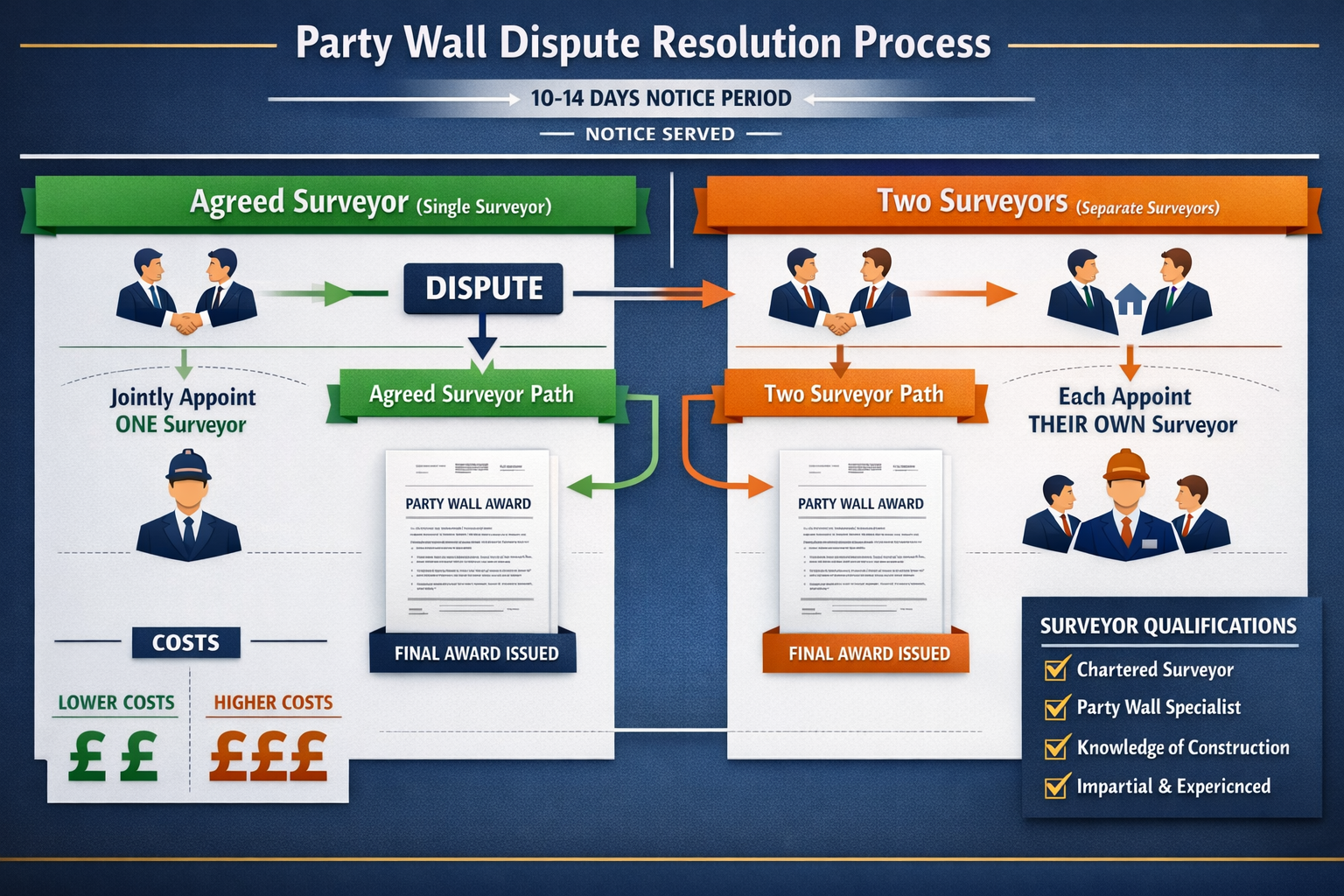
The dispute resolution process allows for three possible surveyor arrangements:
- Agreed Surveyor: Both parties appoint the same surveyor
- Two Surveyors: Each party appoints their own surveyor, who then select a third surveyor
- Three Surveyors: The two appointed surveyors disagree and the third surveyor makes determinations
Rights and Obligations of All Parties
Building Owner Responsibilities 📝
The building owner who initiates the works must:
- Serve proper notice under the Act (typically 2 months for most works, 1 month for excavations)
- Pay all surveyor fees, regardless of the arrangement chosen
- Provide accurate information about the proposed works
- Allow the surveyor(s) reasonable access to the property
- Comply with the conditions set out in the party wall award
Adjoining Owner Rights 🛡️
The adjoining owner enjoys important protections, including the right to:
- Consent to or dissent from the proposed works
- Appoint their own surveyor or agree to a single surveyor
- Withdraw consent for an agreed surveyor at any time
- Request a schedule of condition before works commence
- Claim compensation for any damage caused by the works
Agreed Surveyor Duties ⚖️
The agreed surveyor must fulfill statutory obligations that include:
- Acting impartially between both parties
- Inspecting both properties as necessary
- Preparing a comprehensive party wall award
- Resolving disputes fairly and in accordance with the Act
- Maintaining professional indemnity insurance
- Keeping proper records of all decisions and communications
For property owners seeking expert guidance on these matters, professional party wall services can provide clarity on the legal requirements and best practices.
The Agreed Surveyor Party Wall Appointment Process
Appointing an agreed surveyor involves several critical steps that must be followed correctly to ensure the arrangement is legally valid and effective.
Step 1: Serving the Party Wall Notice
Before any surveyor appointment occurs, the building owner must serve the appropriate notice under the Act. This notice must include:
- Clear description of the proposed works with sufficient detail
- Drawings or plans showing the extent of the works
- Start date for the construction (at least 2 months in the future for most works)
- Building owner’s details including full name and address
The notice triggers a 14-day response period during which the adjoining owner must respond.
Step 2: The Adjoining Owner’s Response
The adjoining owner has three options:
- Consent to the works in writing (no surveyor needed, though still advisable)
- Dissent or fail to respond (triggers the dispute resolution process)
- Propose an agreed surveyor if a dispute arises or is deemed to arise
If the adjoining owner dissents or doesn’t respond within 14 days, a dispute is deemed to have arisen, and the surveyor appointment process begins.
Step 3: Mutual Agreement on the Surveyor
For an agreed surveyor party wall arrangement to work, both parties must:
- Identify a suitable surveyor with appropriate qualifications and experience
- Agree in writing to the appointment
- Confirm the surveyor’s acceptance of the appointment
- Understand the fee structure and payment arrangements
The written agreement should clearly state that both parties consent to the named surveyor acting for both of them. This documentation is crucial for the validity of the arrangement.
Step 4: The Surveyor’s Acceptance
Once proposed, the surveyor must:
- Confirm they can act impartially for both parties
- Declare any conflicts of interest that might affect their independence
- Accept the appointment in writing to both property owners
- Outline their fee structure and expected timeline
- Explain the process and what both parties can expect
Professional surveyors will typically request initial information about the properties and proposed works before accepting the appointment.
Step 5: Preparation of the Party Wall Award
The agreed surveyor then proceeds to:
- Inspect both properties and prepare schedules of condition
- Review the proposed works in detail
- Assess potential risks and necessary precautions
- Draft the party wall award setting out conditions and safeguards
- Serve the award on both parties
The party wall award is a legally binding document that governs how the works must be carried out. It typically includes:
- Detailed description of the permitted works
- Conditions for protecting the adjoining owner’s property
- Hours of working
- Access requirements
- Insurance provisions
- Dispute resolution mechanisms
Cost Considerations for Agreed Surveyor Party Wall Arrangements
Understanding the financial implications of the agreed surveyor party wall approach helps property owners make informed decisions and budget appropriately.
Fee Structures and Typical Costs
Agreed Surveyor Fees 💰
Most agreed surveyors charge fees based on:
- Hourly rates: Typically £150-£300 per hour depending on experience and location
- Fixed fees: £700-£1,500 for straightforward residential projects
- Percentage of works: Occasionally 1-2% of the construction cost for larger projects
The total cost depends on several factors:
- Complexity of the proposed works
- Number of properties affected
- Geographic location (London and Southeast typically higher)
- Surveyor’s experience and qualifications
- Time required for inspections and award preparation
Cost Comparison: Agreed vs. Two Surveyors
| Cost Element | Agreed Surveyor | Two Surveyors |
|---|---|---|
| Initial appointment | £200-£400 | £400-£800 |
| Site inspections | £300-£600 | £600-£1,200 |
| Award preparation | £200-£500 | £400-£1,000 |
| Total Typical Range | £700-£1,500 | £1,400-£3,000 |
These figures represent typical residential projects. Complex commercial work or projects involving multiple properties will incur higher fees.
Who Pays the Surveyor Fees?
Under the Party Wall Act, the building owner is responsible for all surveyor fees, regardless of the arrangement chosen. This includes:
- The agreed surveyor’s fees (if that route is chosen)
- Both surveyors’ fees (if each party appoints their own)
- The third surveyor’s fees (if one becomes necessary)
This statutory requirement means that building owners have a strong financial incentive to propose an agreed surveyor arrangement, as it can reduce their total costs by 40-60%.
Hidden Costs to Consider
Beyond the surveyor fees themselves, property owners should budget for:
- Schedule of condition photography: £150-£300
- Additional inspections: £100-£200 per visit if issues arise
- Award amendments: £200-£500 if changes to the works require updates
- Dispute resolution: Potentially thousands if the arrangement breaks down
For comprehensive guidance on surveying costs across different types of property assessments, property owners can review detailed pricing information that helps contextualize party wall expenses.
Advantages and Disadvantages of the Agreed Surveyor Party Wall Model
Like any approach to dispute resolution, the agreed surveyor arrangement offers distinct benefits and potential drawbacks that property owners should carefully weigh.
Key Advantages ✅
1. Significant Cost Savings
The most obvious benefit is financial. By appointing a single surveyor instead of two (or potentially three), building owners can reduce their surveyor fees by approximately 40-60%. For a typical residential extension, this might mean saving £700-£1,500—money that can be redirected toward the construction project itself.
2. Faster Resolution
With only one surveyor to coordinate schedules, arrange inspections, and prepare documentation, the process typically moves more quickly. Instead of two surveyors needing to communicate, schedule joint inspections, and potentially disagree on technical points, a single professional can:
- Schedule inspections more flexibly
- Make decisions without consultation
- Prepare the award more quickly
- Respond to queries from both parties directly
3. Simplified Communication
Both property owners deal with the same professional, which creates clarity and reduces the potential for miscommunication. There’s no risk of receiving conflicting advice or having to reconcile different perspectives from two separate surveyors.
4. Reduced Formality
The agreed surveyor arrangement often feels less adversarial than having separate representation. This can help maintain or even improve neighbor relations, as both parties are working collaboratively rather than positioning themselves as opponents.
5. Consistent Decision-Making
A single surveyor applies one consistent set of standards and judgments throughout the process, eliminating the possibility of conflicting opinions that might arise between two surveyors.
Potential Disadvantages ❌
1. Perceived Lack of Independent Representation
Some adjoining owners feel more comfortable with their own surveyor advocating specifically for their interests. Even though an agreed surveyor must act impartially, the perception of having dedicated representation can be important for peace of mind.
2. Potential for Bias Concerns
If the building owner suggests a particular surveyor, the adjoining owner might worry about whether that professional will truly remain impartial. These concerns can undermine trust in the process, even if they’re unfounded.
3. Limited Recourse if Disagreements Arise
If the adjoining owner becomes dissatisfied with the agreed surveyor’s approach or decisions, their options are limited. While they can withdraw consent and appoint their own surveyor, this creates additional costs and delays that might have been avoided with separate representation from the start.
4. Complexity in Multi-Party Situations
When works affect multiple adjoining properties, using an agreed surveyor becomes more complicated. The surveyor must balance the interests of several parties, and achieving unanimous consent for the appointment can be challenging.
5. Risk of Process Breakdown
If the agreed surveyor arrangement fails and one party decides to appoint their own surveyor mid-process, the building owner ends up paying for both the agreed surveyor’s work to date and the new two-surveyor arrangement going forward—potentially the worst of both worlds financially.
Selecting the Right Agreed Surveyor for Party Wall Matters
Choosing an appropriate surveyor is crucial to the success of the agreed surveyor party wall arrangement. Both property owners should feel confident in the professional’s qualifications, experience, and ability to act impartially.
Essential Qualifications and Credentials 🎓
Professional Memberships
Look for surveyors who hold membership in recognized professional bodies:
- RICS (Royal Institution of Chartered Surveyors): The gold standard for surveying professionals in the UK
- FPWS (Faculty of Party Wall Surveyors): Specialized organization focused specifically on party wall matters
- CIOB (Chartered Institute of Building): Relevant for surveyors with building backgrounds
These memberships indicate that the surveyor adheres to professional standards, maintains continuing professional development, and carries appropriate insurance.
Relevant Experience
The ideal agreed surveyor should have:
- Minimum 5 years of party wall experience
- Track record of handling similar projects
- Local knowledge of construction practices in your area
- Technical expertise relevant to your specific works
- Proven impartiality in previous agreed surveyor appointments
Professional Indemnity Insurance
Ensure the surveyor carries adequate professional indemnity insurance (typically minimum £1 million, preferably £2-5 million for residential work). This protects both parties if the surveyor makes errors or omissions.
Questions to Ask Potential Surveyors
Before agreeing on an appointment, both property owners should ask:
- “How many party wall cases have you handled as an agreed surveyor?”
- Look for substantial experience in this specific role
- “What is your typical fee structure for this type of project?”
- Ensure transparency about costs upfront
- “How do you ensure impartiality between both parties?”
- Assess their understanding of their dual duties
- “What is your expected timeline for completing the award?”
- Ensure it aligns with the building owner’s construction schedule
- “Can you provide references from previous agreed surveyor appointments?”
- Verify their track record with both building owners and adjoining owners
- “Do you have any conflicts of interest with either property or party?”
- Critical for maintaining independence
Red Flags to Watch For 🚩
Be cautious of surveyors who:
- Have a pre-existing relationship with one party
- Seem to favor the building owner’s interests during initial discussions
- Are vague about fees or timelines
- Lack specific party wall experience
- Cannot provide evidence of professional memberships
- Seem dismissive of the adjoining owner’s concerns
- Have limited availability or seem rushed
For property owners seeking qualified professionals, experienced chartered surveyors can provide the expertise and impartiality necessary for successful agreed surveyor appointments.
Common Challenges in Agreed Surveyor Party Wall Cases
Even well-intentioned agreed surveyor arrangements can encounter difficulties. Understanding common challenges helps property owners anticipate and address potential issues.
Challenge 1: Breakdown of Trust Mid-Process
The Situation: The adjoining owner loses confidence in the agreed surveyor’s impartiality, perhaps because they perceive the surveyor as favoring the building owner’s interests.
Solutions:
- Transparent communication: The surveyor should proactively explain all decisions to both parties
- Documented reasoning: Written explanations for key determinations help demonstrate fairness
- Regular updates: Keeping both parties informed prevents surprises
- Willingness to listen: The surveyor should genuinely consider concerns from both sides
If trust cannot be restored: The adjoining owner has the right to withdraw consent and appoint their own surveyor, though this increases costs and timelines.
Challenge 2: Scope Creep in the Proposed Works
The Situation: The building owner modifies or expands the planned works after the initial notice and surveyor appointment.
Solutions:
- New notices: Significant changes may require fresh party wall notices
- Award amendments: The agreed surveyor can amend the award to cover additional works
- Re-consultation: Both parties should agree to the changes
- Additional fees: The surveyor may charge extra for assessing and documenting the modifications
Challenge 3: Discovery of Pre-Existing Damage
The Situation: The schedule of condition reveals existing damage to the adjoining owner’s property, creating disputes about responsibility.
Solutions:
- Detailed photography: Comprehensive schedules of condition protect all parties
- Clear documentation: The award should explicitly note pre-existing conditions
- Separate issues: Pre-existing damage should be addressed separately from party wall matters
- Professional assessment: The surveyor should clearly distinguish old damage from new
Challenge 4: Disagreement About Award Conditions
The Situation: One party believes the conditions in the draft award are too restrictive or too lenient.
Solutions:
- Explanation of reasoning: The surveyor should justify each condition
- Reference to standards: Citing industry best practices and legal requirements
- Reasonable adjustments: The surveyor should consider legitimate concerns
- Statutory framework: Remind parties that the award must comply with the Act
If agreement cannot be reached, the dissatisfied party may need to appoint their own surveyor, converting the arrangement to a two-surveyor model.
Challenge 5: Access Disputes
The Situation: The building owner needs access to the adjoining owner’s property for inspections or works, but the adjoining owner is uncooperative.
Solutions:
- Clear award provisions: The award should specify access rights and reasonable notice periods
- Flexible scheduling: The surveyor should help coordinate mutually convenient times
- Legal remedies: The Act provides mechanisms to compel reasonable access if necessary
- Mediation: The surveyor can facilitate discussions to resolve access issues
For property owners dealing with particularly complex situations, understanding consent requirements for party wall work can provide valuable context.
Best Practices for a Successful Agreed Surveyor Party Wall Experience
Property owners can maximize the chances of a smooth, successful agreed surveyor arrangement by following proven best practices.
For Building Owners 🏗️
1. Communicate Early and Often
Before serving formal notices, have informal conversations with your neighbor about the planned works. Explain:
- What you’re planning to build
- Why you’re undertaking the project
- How you’ll minimize disruption
- Your willingness to address concerns
2. Propose Multiple Surveyor Options
Rather than suggesting a single surveyor, offer your neighbor a choice of 2-3 qualified professionals. This demonstrates fairness and gives the adjoining owner some control over the selection.
3. Offer to Share Background Information
Provide your neighbor with:
- Detailed plans and drawings
- Information about your builder
- Expected project timeline
- Your contact details for questions
4. Be Responsive to Concerns
Take your neighbor’s worries seriously, even if they seem minor to you. Address questions promptly and thoroughly.
5. Budget Appropriately
Remember that you’ll pay all surveyor fees. Build in contingency for potential complications or additional inspections.
For Adjoining Owners 🏡
1. Respond Promptly to Notices
Don’t ignore party wall notices or miss the 14-day response deadline. Engage with the process early to protect your rights.
2. Research Proposed Surveyors
If the building owner suggests an agreed surveyor, do your due diligence:
- Check their qualifications and memberships
- Review their website and experience
- Ask for references
- Have an initial conversation to assess their approach
3. Ask Questions
Don’t be afraid to seek clarification about:
- The proposed works
- The surveyor’s role and duties
- Your rights under the Act
- The timeline and process
- Potential impacts on your property
4. Consider Your Relationship
Honestly assess your relationship with your neighbor. If it’s already strained, you might be better served by appointing your own surveyor from the outset.
5. Document Everything
Keep copies of all notices, correspondence, and agreements. Take your own photographs of your property’s current condition.
For Agreed Surveyors ⚖️
1. Establish Independence Immediately
Make clear from your first communication with both parties that you owe equal duties to each of them and will not favor either side.
2. Maintain Balanced Communication
Ensure both parties receive the same information at the same time. Copy both on all substantive emails and correspondence.
3. Document Thoroughly
Keep detailed records of:
- All site inspections and findings
- Communications with both parties
- Decisions and the reasoning behind them
- Any changes to the proposed works
4. Explain Your Reasoning
When making determinations, explain why you’ve reached particular conclusions. This transparency builds trust and demonstrates impartiality.
5. Be Proactive About Potential Issues
If you identify concerns during inspections or award preparation, raise them with both parties early rather than waiting for problems to develop.
The Future of Agreed Surveyor Party Wall Arrangements in 2025
As we progress through 2025, several trends are shaping how property owners approach party wall matters and the role of agreed surveyors.
Increasing Awareness and Education 📚
More property owners now understand their rights and obligations under the Party Wall Act, thanks to:
- Online resources providing accessible information about the Act
- Professional guidance from organizations like RICS and FPWS
- Media coverage of party wall disputes highlighting the importance of proper procedures
- Solicitor involvement in property transactions ensuring compliance
This increased awareness leads to more informed decisions about surveyor appointments, with property owners better equipped to assess whether an agreed surveyor arrangement suits their situation.
Technology Integration
Modern surveyors increasingly use technology to enhance the agreed surveyor process:
- Digital schedules of condition with high-resolution photography and 360° imaging
- Video conferencing for initial consultations and progress updates
- Electronic document signing for faster award execution
- Project management software for tracking inspections and communications
- Drone surveys for assessing roof and chimney works
These tools can make the agreed surveyor arrangement even more efficient and cost-effective.
Growing Preference for Collaborative Approaches
There’s a broader cultural shift toward collaborative dispute resolution across many areas of property law. The agreed surveyor model aligns with this trend, offering a less adversarial alternative to separate representation.
Property owners increasingly recognize that:
- Maintaining good neighbor relations has long-term value
- Collaborative approaches often produce better outcomes for everyone
- Cost savings benefit the building owner without disadvantaging the adjoining owner
- Professional impartiality can be more valuable than partisan advocacy
Regulatory Developments
While the Party Wall Act 1996 remains the primary legislation, there’s ongoing discussion about:
- Standardization of fees to increase transparency and predictability
- Enhanced qualification requirements for party wall surveyors
- Clearer guidance on surveyor duties and responsibilities
- Streamlined procedures for simple, low-risk works
Any future regulatory changes will likely emphasize the importance of professional competence and impartiality—qualities central to successful agreed surveyor arrangements.
For property owners navigating these evolving landscapes, staying informed through professional surveying resources helps ensure they make the best decisions for their specific circumstances.
Case Studies: Agreed Surveyor Party Wall Arrangements in Practice
Real-world examples illustrate how the agreed surveyor party wall approach works in different scenarios.
Case Study 1: Single-Story Extension Success ✅
The Situation: A homeowner in Surrey planned a single-story rear extension that would involve building up to the boundary line with their neighbor’s property. The works required a party wall notice under Section 1 of the Act.
The Approach: The building owner had a good relationship with their neighbor and discussed the project informally before serving the notice. Both parties agreed to appoint a local RICS surveyor with extensive party wall experience.
The Outcome:
- The agreed surveyor completed the schedule of condition within one week
- The party wall award was prepared and served within three weeks
- Total surveyor fees: £950
- The works proceeded without disputes
- Post-construction inspection confirmed no damage to the adjoining property
- Both neighbors remained on good terms
Key Success Factors:
- Strong pre-existing relationship between neighbors
- Clear, simple scope of works
- Experienced, communicative surveyor
- Realistic timelines and expectations
Case Study 2: Basement Excavation Complexity ⚠️
The Situation: A London homeowner planned a basement excavation that would involve digging within three meters of the neighbor’s foundations—notifiable under Section 6 of the Act.
The Approach: The building owner proposed an agreed surveyor to save costs. The adjoining owner initially agreed but became concerned about the risks to their Victorian property.
The Outcome:
- The agreed surveyor prepared a detailed schedule of condition
- During the initial assessment, the adjoining owner became uncomfortable with the perceived risks
- After two weeks, the adjoining owner withdrew consent and appointed their own surveyor
- The process converted to a two-surveyor arrangement
- Total surveyor fees increased from an estimated £1,200 to £2,800
- The works eventually proceeded successfully with enhanced monitoring
Key Lessons:
- Complex, high-risk works may not suit the agreed surveyor model
- Adjoining owners should assess their comfort level early
- Converting mid-process increases costs significantly
- The right to appoint your own surveyor is an important safeguard
Case Study 3: Multiple Properties, Single Surveyor 🏘️
The Situation: A building owner planned a loft conversion affecting party walls with two separate neighbors in a terraced property in Hertfordshire.
The Approach: The building owner proposed a single agreed surveyor to act for all three parties, which would require consent from both adjoining owners.
The Outcome:
- One neighbor readily agreed to the proposed surveyor
- The second neighbor preferred to appoint their own surveyor
- The arrangement became a hybrid: one agreed surveyor for the building owner and one neighbor, plus a separate surveyor for the other neighbor
- The two surveyors worked cooperatively and selected a third surveyor
- Total fees: approximately £2,200
- All parties received adequate representation
- The works proceeded smoothly
Key Lessons:
- Multi-party situations add complexity to agreed surveyor arrangements
- Flexibility in approach can accommodate different comfort levels
- Cooperative surveyors can minimize costs even in mixed arrangements
- Clear communication among all parties is essential
These case studies demonstrate that while the agreed surveyor party wall model offers significant advantages in the right circumstances, it’s not a one-size-fits-all solution. Success depends on careful assessment of the specific situation, the relationship between neighbors, and the complexity of the proposed works.
Frequently Asked Questions About Agreed Surveyor Party Wall Matters
Can I insist on using an agreed surveyor?
No. The agreed surveyor arrangement requires mutual consent from both the building owner and the adjoining owner. If the adjoining owner prefers to appoint their own surveyor, they have an absolute right to do so under the Party Wall Act. You cannot force them to accept an agreed surveyor, even if it would save money.
What happens if I’m unhappy with the agreed surveyor’s decisions?
If you believe the agreed surveyor is not acting impartially or has made errors, you have several options:
- Raise concerns directly with the surveyor and request explanations
- Withdraw consent and appoint your own surveyor (adjoining owners only)
- Appeal the award through the county court within 14 days of service
- Seek legal advice about your rights and options
However, remember that the surveyor’s role is to act fairly, not to advocate for your position exclusively.
How long does the agreed surveyor process typically take?
For straightforward residential projects, the timeline usually looks like:
- Week 1-2: Surveyor accepts appointment and arranges initial inspections
- Week 2-3: Schedule of condition prepared
- Week 3-4: Award drafted and reviewed
- Week 4-5: Award finalized and served on both parties
More complex projects may take 8-12 weeks or longer. The surveyor should provide a realistic timeline at the outset.
Can the agreed surveyor be someone I already know?
While there’s no absolute prohibition, using a surveyor with whom you have a pre-existing relationship can create perceived conflicts of interest. The adjoining owner must have full confidence in the surveyor’s impartiality. If you have a professional relationship with a surveyor, it’s usually better to suggest them as one option among several, allowing the neighbor to make an informed choice.
What if the agreed surveyor makes a mistake?
Professional surveyors carry indemnity insurance precisely for this reason. If the agreed surveyor makes a genuine error that causes loss or damage, their insurance should provide compensation. Both parties have the same rights to claim against the surveyor’s insurance as they would if separate surveyors had been appointed.
Do I need a solicitor as well as an agreed surveyor?
For most residential party wall matters, a solicitor is not necessary. The agreed surveyor handles the technical and procedural aspects under the Act. However, you might want legal advice if:
- The dispute involves complex legal issues beyond the party wall works
- You’re considering appealing the award
- There are broader neighbor disputes affecting the situation
- The property is commercial or involves significant value
Can I change from an agreed surveyor to separate surveyors?
Yes. The adjoining owner can withdraw consent for the agreed surveyor arrangement at any time and appoint their own surveyor. However, the building owner remains responsible for paying the agreed surveyor for work completed to that point, plus the fees of both surveyors going forward. This makes changing mid-process expensive.
For additional guidance on party wall matters and related property issues, expert resources can provide personalized advice for your specific situation.
Conclusion: Making the Right Choice for Your Party Wall Matter
The agreed surveyor party wall arrangement represents an efficient, cost-effective approach to managing construction projects that affect shared boundaries and structures. When neighbors enjoy a positive relationship, the proposed works are straightforward, and both parties trust a single professional to act impartially, this model delivers significant benefits—typically reducing costs by 40-60% while streamlining the process and maintaining good neighborly relations.
However, success requires careful consideration of multiple factors: the complexity of the proposed works, the relationship between neighbors, the value and condition of the affected properties, and each party’s comfort level with shared representation. Not every situation suits the agreed surveyor model, and attempting to force this arrangement when conditions aren’t right can backfire, leading to increased costs, delays, and damaged relationships.
Your Next Steps 🎯
If you’re a building owner planning works:
- Assess your project honestly—is it straightforward enough for an agreed surveyor approach?
- Evaluate your neighbor relationship—do you communicate well and trust each other?
- Research qualified surveyors in your area with strong party wall credentials
- Have preliminary conversations with your neighbor before serving formal notices
- Propose multiple options rather than a single surveyor to demonstrate fairness
- Budget appropriately for surveyor fees (remember, you pay regardless of the arrangement)
If you’re an adjoining owner who has received a party wall notice:
- Don’t ignore the notice—respond within the 14-day period
- Request detailed information about the proposed works if it’s not already clear
- Research any proposed agreed surveyor thoroughly before consenting
- Trust your instincts—if you’re uncomfortable with the arrangement, appoint your own surveyor
- Understand your rights—you can withdraw consent and appoint your own surveyor at any time
- Document everything—take photographs and keep all correspondence
If you’re considering professional assistance:
The Party Wall Act 1996 exists to protect property owners and facilitate necessary construction work while safeguarding everyone’s interests. Whether you choose an agreed surveyor or separate representation, working with qualified professionals ensures compliance with the Act and helps prevent disputes.
For property owners seeking experienced guidance through party wall matters, professional chartered surveyors offer the expertise, impartiality, and technical knowledge necessary to navigate these processes successfully. The right professional support—whether through an agreed surveyor arrangement or separate representation—protects your property, preserves neighbor relations, and ensures your construction project proceeds smoothly and legally.
The agreed surveyor party wall model isn’t right for every situation, but when conditions align, it offers a collaborative, efficient pathway through the party wall process that benefits everyone involved. By understanding the framework, assessing your specific circumstances honestly, and choosing qualified professionals, you can make informed decisions that protect your interests while maintaining the positive relationships that make neighborhoods thrive.