

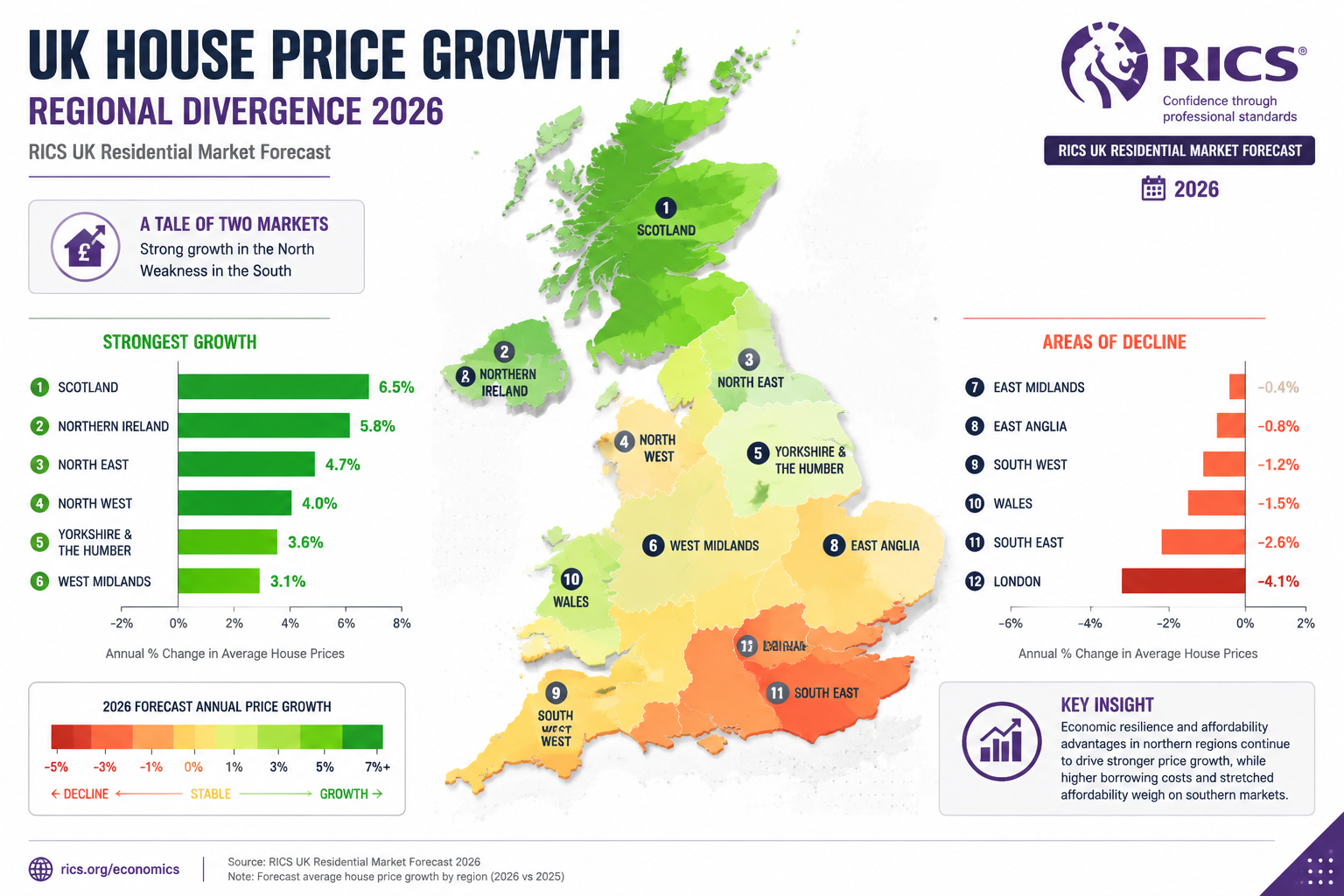
Northern Ireland recorded some of the strongest house price growth anywhere in the UK in the year to January 2026 — while London, the South East, and the South West posted outright price declines over the same period [5]. That gap is not a temporary blip. It represents a structural shift in UK property market dynamics that has direct, practical consequences for how valuation surveys are commissioned, conducted, and interpreted across different regions.
For buyers, investors, lenders, and professional valuers, understanding valuation surveys in regional markets: capitalizing on price growth divergence between Scotland, Northern Ireland, and Southern England in 2026 is no longer optional — it is a core competency. The methodology, risk weighting, and comparable evidence that a surveyor applies in Belfast or Edinburgh must differ meaningfully from the approach used in Surrey or Central London, because the underlying market conditions are fundamentally different.
Key Takeaways
- Northern Ireland and parts of Scotland are leading UK house price growth in 2026, while London, the South East, and the South West are recording price declines or stagnation.
- Valuation surveyors must adapt their comparable selection, risk weighting, and commentary to reflect these regional divergences rather than applying a uniform UK methodology.
- CBRE's Q1 2026 Prestige Residential Valuer Insights confirm that prime Southern England valuations remain below 2022 peaks, increasing the risk of down-valuations for buyers relying on outdated price expectations.
- Capital flows and institutional valuation assumptions are actively rotating toward affordable regional markets with demonstrable wage-adjusted price growth, including Northern Ireland and parts of Scotland.
- Commissioning the right level of survey and valuation for the specific regional market — not just the property type — is essential to accurate pricing and informed decision-making in 2026.
Why Regional Divergence Is Reshaping UK Valuation Practice in 2026
The UK property market has never been a single, uniform entity. But the divergence visible in early 2026 data is unusually sharp. According to a January 2026 UK residential market overview, Northern Ireland, the North West, and Yorkshire and the Humber led house price growth over the year to January 2026, while London, the South East, and the South West recorded price declines over the same period [5].
This creates a two-speed environment for valuation professionals. In growth regions, surveyors must ensure their comparable evidence is current enough to capture recent upward momentum — otherwise valuations will lag the market and potentially undervalue properties. In declining regions, the opposite risk applies: stale comparables drawn from the 2021-2022 price peak will produce inflated valuations that lenders will challenge and buyers will overpay against.
The Drivers Behind the Divergence
Several structural factors explain why Scotland and Northern Ireland are outperforming Southern England in 2026:
- Affordability: Average house prices in Northern Ireland and many Scottish cities remain significantly lower than Southern England equivalents, making them accessible to first-time buyers and domestic movers even at current mortgage rates.
- Real wage-adjusted growth: Capital flows and valuation assumptions are rotating toward lower-priced regions demonstrating real wage-adjusted growth [1], which in the UK context includes Northern Ireland and parts of Scotland.
- Supply constraints in growth markets: Limited new-build completions in Belfast and secondary Scottish cities have supported prices despite broader economic headwinds.
- Southern England correction: London and the Home Counties are still working through a correction from the 2021-2022 peak, amplified by higher mortgage costs affecting affordability at elevated price points.
"Valuers report that price expectations in top-end Southern England postcodes remain below 2022 peaks, while regional cities and devolved nations with stronger affordability show more resilient valuations and fewer down-valuations." — CBRE Prestige Residential Valuer Insights Q1 2026 [6]
For anyone commissioning or interpreting a property valuation, these regional dynamics must inform every stage of the process.
How Valuation Surveys in Regional Markets Must Adapt to Price Growth Divergence Between Scotland, Northern Ireland, and Southern England in 2026
The technical methodology of a RICS-compliant valuation does not change by region. What changes is the evidence base, the risk commentary, and the professional judgement applied to comparable selection. Getting this right requires surveyors and their clients to understand what the data is actually saying in each specific market.

Comparable Evidence: The Critical Difference
In a rising market such as Northern Ireland in early 2026, a surveyor using comparables from 12 months ago risks undervaluing a property. Lenders, buyers, and sellers all suffer when valuations fail to reflect current market reality. Conversely, in parts of Southern England where prices have fallen, using comparables from 18 months ago produces an inflated figure that a lender's mortgage valuation will likely challenge — creating delays, renegotiations, or collapsed transactions.
Best practice for regional valuation in 2026:
| Region | Market Condition | Comparable Window | Key Risk |
|---|---|---|---|
| Northern Ireland | Strong growth | 3-6 months preferred | Under-valuation if comparables are too old |
| Scotland (major cities) | Moderate-to-strong growth | 6 months | Under-valuation in fast-moving submarkets |
| South East England | Price decline/flat | 3-6 months | Over-valuation against stale peak-era data |
| Prime London | Soft/recovering slowly | 6 months with adjustment | Down-valuation risk for buyers |
| North West / Yorkshire | Growth | 6 months | Under-valuation if regional momentum not captured |
Survey Type Selection by Regional Market
The regional market context also influences which survey level is appropriate. A buyer purchasing in a competitive Northern Irish market where properties are selling quickly and sometimes above asking price needs a survey that can be turned around efficiently without sacrificing accuracy. Understanding the difference between a Level 2 and Level 3 survey is essential to matching the survey scope to both the property condition and the market pace.
In Southern England, where buyers have more negotiating power due to softer demand, a more detailed RICS Level 3 building survey can provide the leverage needed to renegotiate on price or request remedial works — particularly given that many properties in the region were purchased at peak prices and may now have deferred maintenance issues.
Down-Valuation Risk: A Southern England Problem in 2026
CBRE's Prestige Residential Valuer Insights Q1 2026 highlight ongoing softness in London's prime market, citing cautious buyer sentiment and a slower recovery in high-end Southern England stock relative to more affordable UK regions [6]. For buyers in these markets, the risk of a mortgage down-valuation — where the lender's surveyor values the property below the agreed purchase price — is materially higher than in growth regions.
Practical steps to reduce down-valuation risk in Southern England include:
- Requesting a Red Book valuation before exchange to establish an independent, RICS-compliant market value.
- Ensuring the surveyor has recent, local comparable evidence from the past three to six months.
- Being prepared to renegotiate the purchase price if the valuation comes in below the agreed figure.
Investor Strategy: Capitalizing on Price Growth Divergence Between Scotland, Northern Ireland, and Southern England in 2026
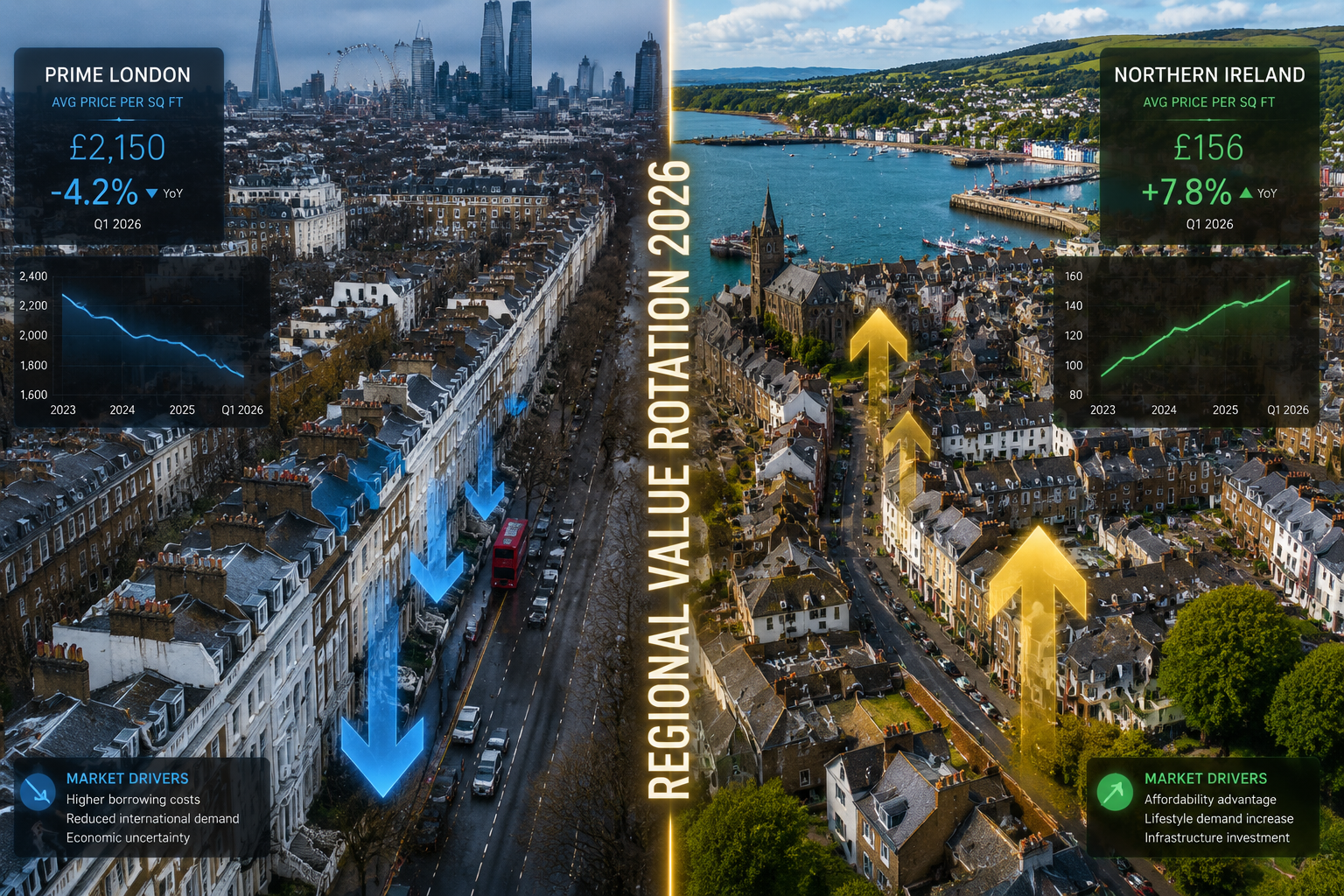
Institutional and private investors are already responding to the regional divergence visible in 2026 data. The April 2026 Global Analyst Survey by RBC Capital Markets reports that real estate analysts are increasingly favouring regional residential markets with better affordability and stronger recent price growth over traditionally dominant but more volatile prime markets [1]. UK commentary within that survey specifically notes capital flows rotating toward lower-priced regions demonstrating real wage-adjusted growth — a description that fits Northern Ireland and parts of Scotland precisely.
For private investors, this "value rotation" theme has direct implications for how surveys and valuations should be used as decision-support tools.
Using Valuation Surveys as Investment Intelligence
A professional valuation survey does more than confirm a price. In a divergent regional market, it provides:
- Market trend commentary: A skilled valuer will note whether the local market is rising, falling, or flat, and how quickly stock is moving.
- Comparable sale analysis: This reveals whether recent transactions support the asking price or suggest a negotiating opportunity.
- Condition risk assessment: Properties in growth markets sometimes have deferred maintenance that sellers have not addressed because demand is strong. A building survey will identify these issues before they become the buyer's problem.
- Reinstatement cost data: For insurance purposes, a reinstatement cost valuation ensures the property is correctly insured regardless of market value fluctuations.
The 87% Optimism Signal — And Why Regional Focus Still Matters
A Cotality report from early 2026 found that 87% of surveyed property professionals expect dwelling values to rise over the year ahead, with only 3.5% expecting prices to fall [4]. That broad optimism is encouraging, but it masks the regional variation that makes the difference between a sound investment and an expensive mistake.
The same research and associated market analysis stresses that investors should pay close attention to regions with strong 2025-early 2026 price momentum — specifically the North West, Yorkshire and the Humber, and Northern Ireland — when calibrating valuation assumptions and forward-looking discount rates, rather than assuming a uniform UK recovery [5].
Actionable investor checklist for regional valuation in 2026:
- Commission a valuation with explicit regional market commentary, not just a headline figure.
- Verify that the valuer has demonstrable experience in the specific regional market — a London-based firm valuing in Belfast without local knowledge is a risk.
- Cross-reference the valuation with recent Land Registry and Registers of Scotland transaction data.
- For portfolio investors, consider a stock condition survey across multiple properties to identify where deferred maintenance may be eroding value in softening markets.
- Factor regional stamp duty and transaction cost differences (Scotland uses LBTT, Northern Ireland uses SDLT) into net return calculations.
Specific Valuation Considerations for Scotland, Northern Ireland, and Southern England
Scotland
Scotland's property market operates under a distinct legal and regulatory framework, with the Home Report system requiring a survey and valuation before a property is marketed. This means buyers in Scotland typically receive more upfront information than their English and Welsh counterparts. In 2026, with many Scottish city markets showing positive momentum, the Home Report valuation can sometimes lag behind rapidly rising prices — meaning buyers in competitive submarkets such as Edinburgh and Glasgow should consider supplementary valuation advice if they are bidding significantly above the Home Report figure.
For structural concerns in older Scottish properties — particularly traditional stone-built tenements — a detailed structural assessment is advisable. Issues such as damp and subsidence are common in older Scottish stock and can materially affect value if not identified and priced correctly.
Northern Ireland
Northern Ireland's position as one of the UK's top-performing markets in early 2026 [5] means that speed and accuracy are both at a premium. Properties are moving faster, and buyers who rely on outdated desktop valuations or automated valuation models risk losing out or overpaying. A desktop house valuation can provide a rapid initial indication, but it should be followed by a full RICS valuation for any transaction above a modest threshold.
The Northern Irish market also has a higher proportion of older housing stock, which increases the importance of structural surveys. Buyers should not allow competitive market conditions to pressure them into waiving survey contingencies.
Southern England
In Southern England — particularly London, the South East, and the South West — the 2026 market requires a more cautious valuation approach. CBRE's Q1 2026 data confirms that prime market valuations remain below 2022 peaks [6], and buyers who purchased at peak prices may find that current valuations do not support the equity they assumed they had built.
For those involved in specialist valuation scenarios — such as divorce valuations, probate valuations, or shared ownership property valuations — the regional price correction in Southern England has direct implications for the figures produced. A probate valuation in Surrey based on 2022 comparables would be materially misleading in 2026. Instructing a surveyor with current, local market knowledge is not just best practice — it is a professional and legal obligation.
Conclusion: Actionable Next Steps for 2026
The regional price growth divergence visible in UK property markets in 2026 is not a temporary anomaly — it reflects deep structural differences in affordability, supply, and demand that will persist throughout the year and likely beyond. For anyone involved in commissioning, conducting, or acting on property valuations, the following steps are essential:
For buyers and investors:
- Always commission a valuation from a surveyor with demonstrable, recent experience in the specific regional market — not just the property type.
- In growth markets such as Northern Ireland and parts of Scotland, ensure comparable evidence is no more than six months old to avoid under-valuation.
- In softening Southern England markets, use a full RICS valuation to establish a defensible market value before exchange, reducing down-valuation risk.
- Consider the full survey scope appropriate to the property and market — choosing the right property survey is the first decision that protects every subsequent one.
For valuation professionals:
- Update regional market commentary in every valuation report to reflect the specific conditions in the subject market, not a generic UK narrative.
- Tighten comparable windows in fast-moving regional markets and apply appropriate adjustments where recent transactions are limited.
- Flag down-valuation risk explicitly in Southern England reports where agreed purchase prices are close to or above recent comparable evidence.
The property market in 2026 rewards those who understand that regional context is not a footnote — it is the central variable in every valuation decision. Commissioning accurate, regionally calibrated valuation surveys is the most direct way to capitalize on price growth divergence between Scotland, Northern Ireland, and Southern England in 2026, and to avoid the costly mistakes that come from treating the UK as a single, uniform market.
References
[4] Cotality HVI Jan 2026 Final – https://discover.cotality.com/hubfs/Article-Reports/COTALITY%20HVI%20Jan%202026%20FINAL.pdf
[5] Res Property Surveyors – https://www.res-prop.com/res-property-surveyors/
[6] Prestige Residential Valuer Insights Q1 2026 – https://www.cbre.com/insights/reports/prestige-residential-valuer-insights-q1-2026
