
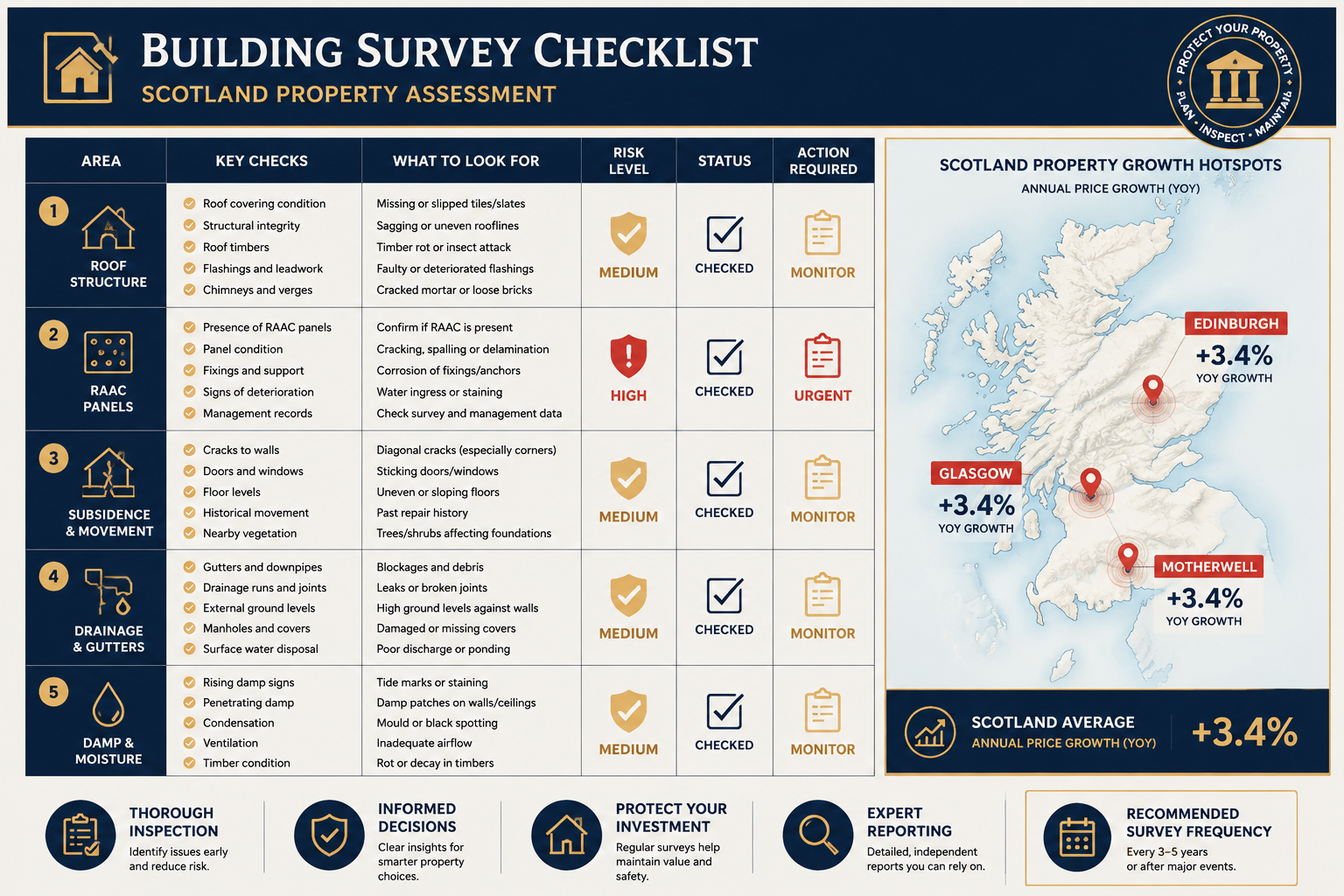
Scotland's housing market is expanding at a pace that is outrunning the supply of completed homes. Cities like Edinburgh, Glasgow, and Motherwell are projected to record house price growth of up to 3.4% in 2026, yet annual completions fell to just 17,336 homes in 2025 — the second-lowest total since 2016 [1][8]. That gap between demand and delivery creates a specific and underappreciated risk: buyers and investors moving quickly in competitive markets are more likely to skip or underestimate the importance of a thorough building survey. Building Survey Checklists for Scotland's 2026 Housing Surge: Identifying Risks in +3% Growth Areas addresses exactly that problem, offering a structured approach to defect identification at a time when getting the assessment right has never mattered more.
Key Takeaways
- Scotland's +3% growth hotspots are creating pressure on buyers to act fast, increasing the risk of inadequate pre-purchase surveys.
- A Level 3 (RICS Building Survey) is the appropriate standard for most Scottish properties, particularly older stone-built stock and new build-to-rent developments.
- Damp penetration, structural movement, subsidence, and the presence of RAAC (Reinforced Autoclaved Aerated Concrete) are the highest-priority defect categories in 2026.
- Regional price disparities — Edinburgh averaging £289,857 versus Aberdeen at £133,906 — mean survey scope and cost must be calibrated to local market conditions [3].
- The Scottish Government's target of 110,000 affordable homes by 2032 is accelerating construction timelines, making snagging and structural checks on new builds essential [7].
Why Scotland's 2026 Market Demands a Rigorous Survey Approach
The average residential property price in Scotland reached £186,000 as of February 2026, representing a 2.3% annual increase [2]. That figure, however, masks significant regional variation. Edinburgh sits at £289,857, while Aberdeen records just £133,906 [3]. For buyers operating in high-growth corridors, the financial stakes attached to a missed defect are proportionally higher.
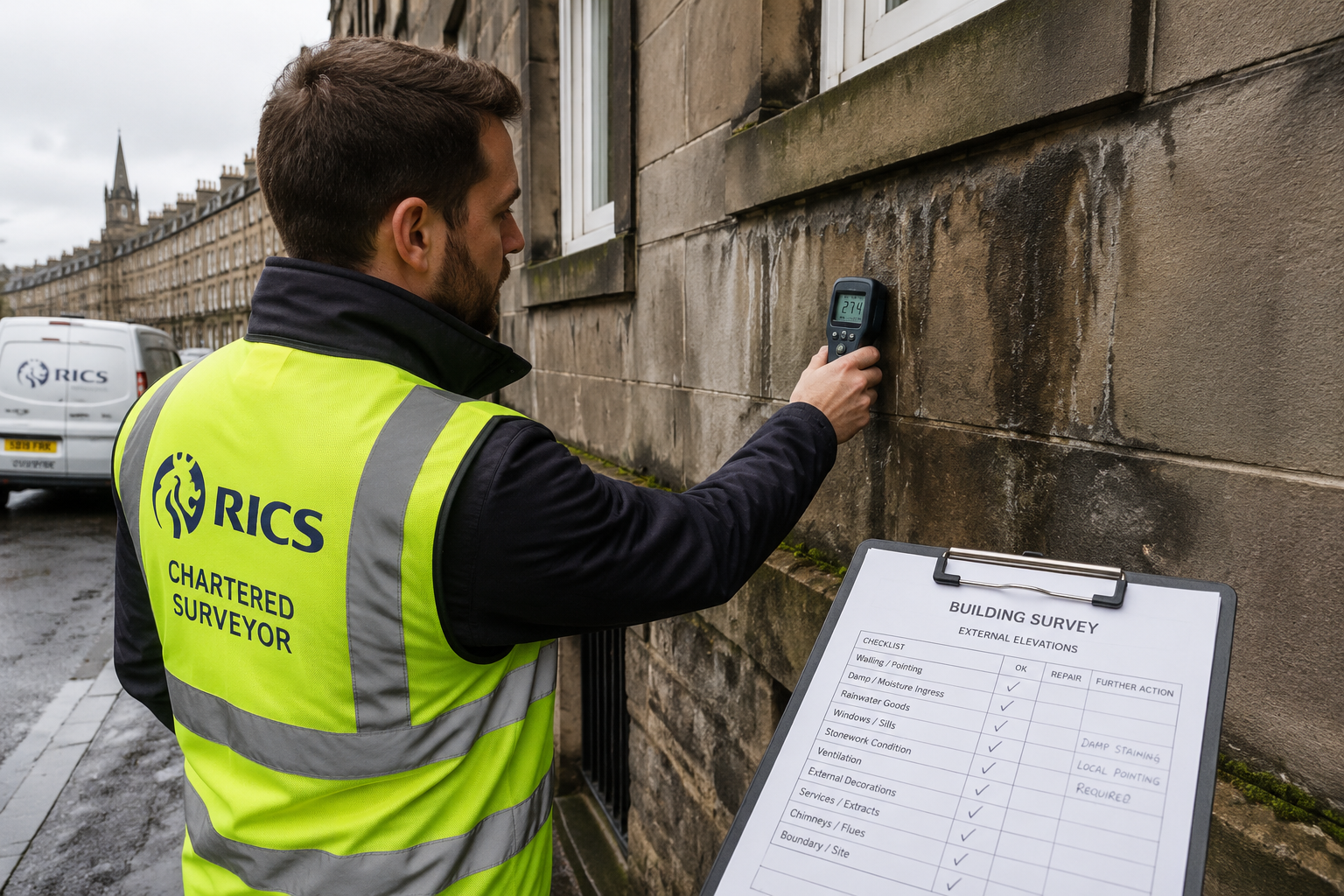
Scotland's housing stock presents a particular set of structural challenges. The country's climate — high rainfall, freeze-thaw cycles, and persistent humidity — accelerates deterioration in masonry, roofing, and drainage systems. Older stone-built tenements and Victorian terraces dominate the urban core of every major Scottish city, and these property types are especially prone to:
- Rising and penetrating damp driven by failed pointing and inadequate damp-proof courses
- Roof deterioration, including failing lead flashings, cracked ridge tiles, and rotten sarking boards
- Structural movement caused by differential settlement in clay-rich soils
- Subsidence linked to historic mining activity, particularly in Lanarkshire and Fife
Beyond the traditional stock, a new risk category has emerged. The presence of RAAC (Reinforced Autoclaved Aerated Concrete) in post-war public and residential buildings has become a material concern across the UK. In Scotland, where significant social housing was constructed between the 1950s and 1980s, surveyors must now include RAAC identification as a standard checklist item.
Scotland's housing market remains more resilient than most UK regions, recording a 1.9% average price increase over the past year [9]. That resilience attracts both first-time buyers and buy-to-let investors who may be unfamiliar with the specific defect profile of Scottish properties. A comprehensive building survey is not a discretionary extra in this environment — it is the primary tool for protecting a significant financial commitment.
Industry experts describe 2026 as a year of "recalibration" for Scotland's property market, with evolving challenges requiring adaptable survey methodologies [10]. That recalibration must include updated checklist protocols that reflect both the age of existing stock and the accelerating pace of new construction.
Building Survey Checklists for Scotland's 2026 Housing Surge: A Category-by-Category Framework
A well-structured building survey checklist organises defect risk into logical inspection zones. The RICS inspection framework — the professional standard for all Level 2 and Level 3 surveys — covers roof structures, external walls, windows, internal spaces, services, and site drainage [6]. The table below maps these zones to the specific risks most relevant to Scotland's 2026 growth areas.
| Inspection Zone | Key Risk Factors in Scotland | Priority Level |
|---|---|---|
| Roof structure and covering | Failing slates, rotten sarking, blocked gutters, chimney stack movement | High |
| External walls | Damp penetration, failed pointing, RAAC panels, cavity wall insulation failure | Critical |
| Windows and doors | Timber rot, failed double-glazing seals, condensation damage | Medium |
| Internal floors and ceilings | Wet rot in suspended timber floors, cracked plasterwork indicating movement | High |
| Drainage and services | Blocked or collapsed drains, outdated wiring, inadequate heating systems | High |
| Foundations and substructure | Subsidence, heave, proximity to historic mine workings | Critical |
| Site and grounds | Drainage gradients, retaining wall stability, Japanese knotweed | Medium |
Roof Surveys: The First Line of Defence
Scotland's rainfall statistics make the roof the single most important inspection zone. A professional roof survey should assess not only the covering material but the underlying structure. Sarking boards — the timber boarding beneath slates — are common in Scottish construction and are vulnerable to rot when flashings fail. Chimney stacks on older properties frequently show mortar erosion and displaced flaunching, creating pathways for water ingress that can travel deep into the structure before becoming visible internally.
Checklist items for roofs in Scottish growth areas:
- Condition and fixings of all slate or tile coverings
- State of lead flashings at abutments, valleys, and chimney bases
- Sarking board integrity (probe testing where accessible)
- Guttering and downpipe condition, including blockages and joint failures
- Chimney stack stability and pointing condition
Damp and Structural Movement: The Persistent Defects
Damp is the most frequently identified defect in Scottish building surveys [5]. Understanding the full cost implications of a damp survey before commissioning work is essential, as remediation costs vary considerably depending on whether the source is rising damp, penetrating damp, or condensation. Each requires a different treatment approach, and misdiagnosis is common.
"Dampness in Scottish properties is rarely a single-source problem. A thorough survey will identify multiple contributing factors — failed pointing, inadequate subfloor ventilation, and blocked air bricks often combine to create conditions that basic visual inspection misses."
Structural movement must be assessed in context. Hairline cracks in plasterwork are common in older properties and may be historic and stable. However, diagonal cracking at window and door openings, stepped cracking in brickwork or stonework, and tapered gaps in masonry can indicate active settlement. In areas with historic coal mining — including parts of Lanarkshire, Fife, and Ayrshire — subsidence surveys should be treated as mandatory rather than optional.
Drainage: The Overlooked Category
Drainage failures are consistently underweighted in pre-purchase assessments. A drainage survey using CCTV inspection can identify root intrusion, pipe collapse, and misaligned joints that would not be visible through standard inspection. In Scotland's older urban cores, combined drainage systems — where surface water and foul drainage share the same pipework — are common and carry specific risk profiles.
Applying Building Survey Checklists for Scotland's 2026 Housing Surge to Growth-Specific Scenarios
The context in which a survey is commissioned shapes which checklist elements deserve the most attention. Three distinct scenarios define the 2026 Scottish market.
Scenario 1: First-Time Buyers in Urban Growth Corridors
Edinburgh and Glasgow are the primary markets for first-time buyers in 2026. Properties in these cities tend to be tenement flats or converted Victorian houses, where shared structural elements — common roofs, shared drainage, party walls — create complex defect profiles. A Level 2 Homebuyer Survey may be sufficient for a well-maintained, post-2000 flat, but for any property built before 1970, a Level 3 Building Survey is the appropriate standard.
Key checklist additions for first-time buyers in tenement properties:
- Condition of the common roof and responsibility for maintenance costs
- State of shared close (stairwell) and any structural walls
- Evidence of previous insurance claims for water damage
- Factoring arrangements and whether a factor's report is available
Scenario 2: Buy-to-Let and Build-to-Rent Investors
Clarifications in the Housing (Scotland) Bill have unlocked over 8,000 stalled rental homes, particularly in Edinburgh and Glasgow [4]. This build-to-rent resurgence brings a specific survey challenge: new-build properties are not defect-free. Snagging surveys — systematic inspections of newly completed homes — are essential for identifying construction defects before handover. Common issues in new builds include:
- Poor external render application leading to early cracking
- Inadequate cavity wall insulation installation
- Drainage gradients that fail to meet specification
- Window and door frame misalignment
For investors acquiring existing rental stock, a structural survey that specifically addresses the condition of services — heating, electrics, and plumbing — is critical, as these systems directly affect rental compliance and tenant safety obligations under Scottish law.
Scenario 3: Affordable Housing and Social Rent Developments
The Scottish Government's target of 110,000 affordable homes by 2032 is placing significant pressure on construction timelines [7]. Accelerated build programmes carry elevated defect risk. Surveyors assessing affordable housing completions should apply a checklist that includes:
- Compliance with Scottish Building Standards (SBS) energy efficiency requirements
- Verification of insulation installation in walls, floors, and roofs
- Fire stopping and compartmentation in flatted developments
- External envelope weathertightness testing
Understanding the difference between Level 2 and Level 3 surveys is particularly important for housing associations and registered social landlords commissioning assessments on newly completed affordable homes, as the depth of inspection required typically exceeds the Level 2 standard.

RAAC, Asbestos, and Emerging Risk Categories in 2026
Two legacy material risks demand specific checklist sections in any Scottish survey conducted in 2026.
RAAC (Reinforced Autoclaved Aerated Concrete)
RAAC was widely used in flat-roofed public and residential buildings constructed between approximately 1950 and 1990. It has a design life of around 30 years and is now well beyond that threshold in most installations. RAAC panels can fail without warning, and identification requires specialist inspection. Any Scottish property with a flat or shallow-pitched roof constructed during this period should be assessed for RAAC as a priority item.
Asbestos
Asbestos-containing materials (ACMs) remain present in a large proportion of Scottish properties built before 2000. An asbestos survey should be included in the scope of any Level 3 survey on pre-2000 stock, particularly where renovation or alteration work is planned. Common locations for ACMs in Scottish residential properties include:
- Artex ceilings and textured coatings
- Floor tiles and adhesives
- Pipe lagging in older heating systems
- Roof felt and soffit boards
Non-Standard Construction
Scotland has a higher proportion of non-standard construction types than most UK regions, including timber-frame, large-panel system (LPS) builds, and prefabricated concrete homes. These property types require specialist non-standard construction assessments that go beyond the standard RICS checklist framework.
Selecting the Right Survey Level for Scotland's 2026 Market
Not every property requires the same depth of inspection. The table below provides a practical guide to survey selection in the context of Scotland's current market conditions.
| Property Type | Recommended Survey Level | Key Checklist Focus |
|---|---|---|
| Post-2000 flat, good condition | Level 2 Homebuyer Survey | Services, damp, EPC compliance |
| Pre-1970 tenement flat | Level 3 Building Survey | Roof, damp, structural movement, RAAC |
| Victorian terraced house | Level 3 Building Survey | All zones, drainage, asbestos |
| New build (private sale) | Snagging survey + Level 2 | Workmanship, drainage, envelope |
| New build (affordable/BTR) | Level 3 + specialist checks | Structural, fire stopping, insulation |
| Commercial residential conversion | Level 3 + structural engineering | Structural integrity, services, compliance |
Understanding surveyor pricing before commissioning a survey allows buyers and investors to budget appropriately and avoid selecting a lower survey level purely on cost grounds — a decision that frequently proves far more expensive when defects are discovered post-purchase.
Conclusion: Actionable Next Steps for Scotland's 2026 Property Market
Scotland's housing market in 2026 is characterised by genuine resilience, significant regional variation, and a structural supply deficit that is unlikely to resolve quickly [1][9]. For buyers, investors, and housing providers operating in +3% growth areas, the combination of competitive pricing pressure and accelerating construction timelines creates conditions where survey quality is most likely to be compromised — and where the consequences of that compromise are most severe.
Actionable next steps:
-
Commission a Level 3 survey as the default standard for any Scottish property built before 1980, regardless of apparent condition. The cost of a thorough survey is a fraction of the cost of undisclosed structural defects.
-
Add RAAC and asbestos identification to every survey checklist for post-war properties. These are no longer optional specialist additions — they are standard risk categories in 2026.
-
Insist on a drainage survey as part of any assessment in urban growth areas. CCTV drainage inspection is low-cost relative to the remediation work that failed drainage systems require.
-
For new builds and build-to-rent acquisitions, commission a snagging survey before legal completion. Defects identified at this stage are the developer's responsibility to rectify.
-
Calibrate survey scope to regional price levels. A property in Edinburgh at £289,857 warrants a more comprehensive assessment than the survey cost alone might suggest. The financial exposure is asymmetric.
-
Engage a RICS-qualified chartered surveyor with demonstrable experience in Scottish property types. The defect profile of a Glasgow tenement differs materially from an English semi-detached, and local knowledge is not a luxury — it is a professional requirement.
The building survey checklist is not a bureaucratic formality. In Scotland's 2026 housing market, it is the most reliable mechanism available for translating market confidence into informed, protected decision-making.
References
[1] Savills Scotlanda S Housing Delivery Crisis Deepens As Completions Fall Sharply Despite Urgent Ne Ce7f5cdedc89f026 – https://uk.marketscreener.com/news/savills-scotlanda-s-housing-delivery-crisis-deepens-as-completions-fall-sharply-despite-urgent-ne-ce7f5cdedc89f026?utm_source=openai
[2] parliament.scot – https://www.parliament.scot/chamber-and-committees/research-prepared-for-parliament/research-briefings/2026/6/11/sb-2632/pdf?utm_source=openai
[3] Uk House Price Index Scotland March 2026 – https://www.gov.uk/government/statistics/uk-house-price-index-for-march-2026/uk-house-price-index-scotland-march-2026?utm_source=openai
[4] Jll Scotland Set For Build To Rent Resurgence – https://www.scottishhousingnews.com/articles/jll-scotland-set-for-build-to-rent-resurgence?utm_source=openai
[5] Building Surveys For Scotlands 2026 Housing Recovery Capturing Upward Price Momentum – https://wimbledonsurveyors.com/building-surveys-for-scotlands-2026-housing-recovery-capturing-upward-price-momentum/?utm_source=openai
[6] Building Surveys For New Build Defects In Scotlands Stable 2026 Market Rics Checklists – https://nottinghillsurveyors.com/blog/building-surveys-for-new-build-defects-in-scotlands-stable-2026-market-rics-checklists?utm_source=openai
[7] Foi%2b202500495859%2b %2binformation%2breleased%2b %2bdocuments – https://www.gov.scot/binaries/content/documents/govscot/publications/foi-eir-release/2026/02-b/foi-202500495859/documents/foi-202500495859—information-released—documents/foi-202500495859—information-released—documents/govscot%3Adocument/FOI%2B202500495859%2B-%2BInformation%2BReleased%2B-%2BDocuments.pdf?utm_source=openai
[8] Uk House Prices Set To Rise 15 In 2026 Scotland Leads Growth 93ch 4443626 – https://www.investing.com/news/economic-indicators/uk-house-prices-set-to-rise-15-in-2026-scotland-leads-growth-93CH-4443626?utm_source=openai
[9] House Price Growth Slows In Scotland – https://landlordassociation.org.uk/house-price-growth-slows-in-scotland/?utm_source=openai
[10] Marcus Di Rollo Six Themes That Will Define Scotlands Property Market In 2026 – https://www.scottishhousingnews.com/articles/marcus-di-rollo-six-themes-that-will-define-scotlands-property-market-in-2026?utm_source=openai