
A 2023 study of UK property litigation found that disputes involving a Single Joint Expert resolved, on average, 40% faster than those with opposing party-appointed experts — yet fewer than one in three property cases actually uses this model from the outset. That gap between what courts prefer and what practitioners instinctively choose sits at the heart of one of the most consequential decisions in property litigation: whether to pursue a joint instruction or a single-party appointment when engaging an expert witness surveyor.
Understanding how to navigate this choice — and how to manage conflicts of interest, privilege, and overriding duties once that choice is made — is essential for solicitors, property owners, and surveyors alike. The question of "Joint Instruction or Single-Party Appointment? How Expert Witness Surveyors Should Navigate Conflicts, Privilege and Duties" is not merely procedural. It shapes the credibility of expert evidence, the cost of proceedings, and ultimately the outcome of disputes involving valuation, structural defects, boundaries, and party wall matters.
Key Takeaways
- Courts increasingly favour Single Joint Expert appointments in property disputes to reduce costs, limit conflicting opinions, and streamline proceedings.
- An expert witness surveyor's overriding duty is to the court, not to the instructing party — a principle enforced under CPR Part 35 and RICS professional standards.
- Conflicts of interest must be identified and disclosed before accepting any instruction; undisclosed conflicts can invalidate expert evidence entirely.
- Without-prejudice joint expert meetings produce a joint statement that carries significant weight in proceedings and must reflect the experts' own independent views.
- The dual role of advocate and expert witness is prohibited — surveyors must maintain a clear boundary between advisory and testimonial functions.
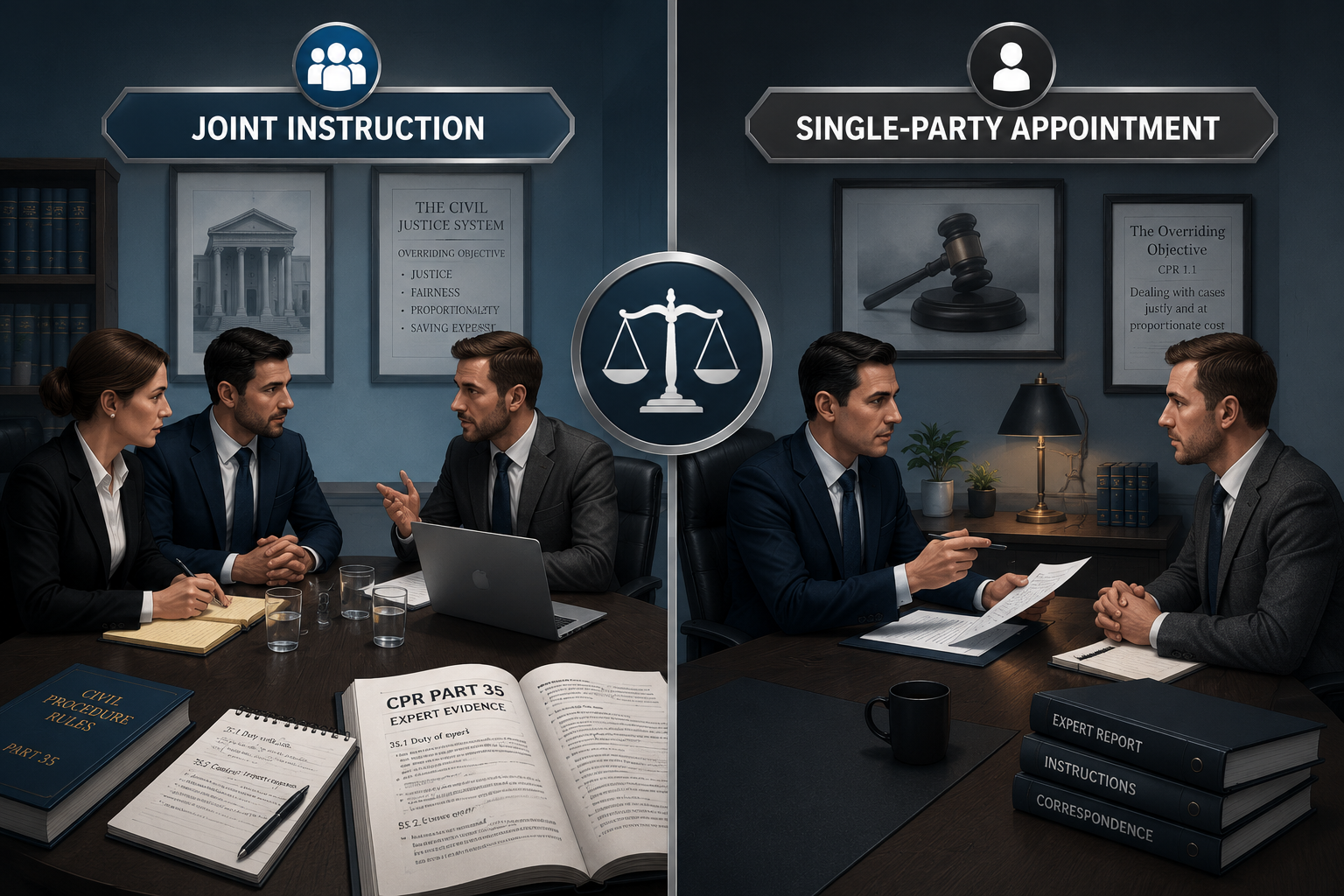
Understanding the Two Models: Joint Instruction vs Single-Party Appointment
Before examining how expert witness surveyors should navigate conflicts, privilege, and duties, it is important to understand what each appointment model actually involves.
What Is a Single-Party Appointment?
Under a single-party appointment, each litigant instructs their own expert witness surveyor independently. The surveyor's role is to form and express an independent professional opinion — but they are briefed, paid, and managed by one side. This model is common in high-value or technically complex disputes where each party believes specialist analysis will support their position.
The critical legal constraint is that, despite being instructed by one party, the surveyor's duty runs to the court first. CPR Part 35 makes this explicit: expert evidence must be the independent product of the expert, uninfluenced by the litigation's demands [8]. A surveyor who tailors conclusions to suit their instructing solicitor risks having their evidence dismissed or, worse, facing professional sanctions from RICS.
What Is a Single Joint Expert (SJE)?
A Single Joint Expert is jointly instructed by all parties to a dispute. Both sides agree on the appointment, share the cost, and submit questions through a coordinated process. The SJE's report is addressed to the court, not to any individual party [3].
Courts have shown a consistent preference for SJE appointments in property disputes, particularly where the case involves valuation, standard defects, or boundary issues of moderate value [2]. The rationale is straightforward: one authoritative, impartial report reduces the risk of a "battle of experts" that inflates costs without improving the quality of evidence before the tribunal.
RICS draws a further distinction between these roles and that of an independent expert, who acts as a tribunal — making a binding decision rather than advising one. This third category is most commonly seen in rent reviews and lease renewals [3].
How Conflicts of Interest, Privilege and Duties Shape Each Appointment
The question of "Joint Instruction or Single-Party Appointment? How Expert Witness Surveyors Should Navigate Conflicts, Privilege and Duties" becomes most acute when examining the practical obligations that attach to each model.
Conflicts of Interest: Identifying and Disclosing Early
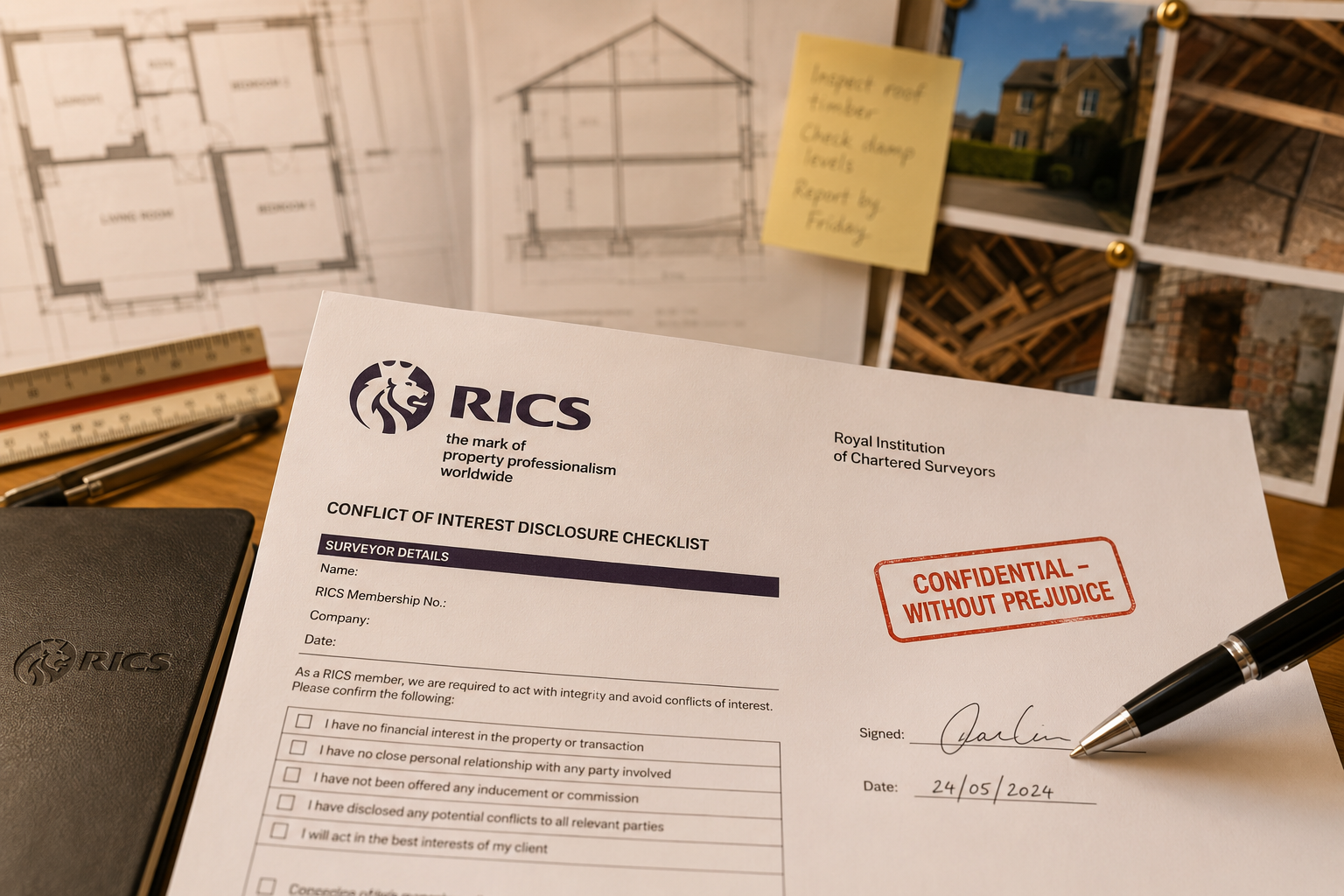
Whether acting as a party-appointed expert or an SJE, a surveyor must conduct a thorough conflicts check before accepting any instruction. RICS guidance is explicit: any conflict of interest must be disclosed in the expert's report, and a surveyor should decline to act if an undeclared conflict exists [4].
Common conflict scenarios in property disputes include:
- Prior advisory work: Having previously advised one party on the same property or transaction.
- Financial interests: Holding a direct or indirect stake in the outcome of the dispute.
- Professional relationships: An ongoing commercial relationship with one party's solicitors that could compromise independence.
- Previous opinions: Having already expressed a firm view on the matter in a non-expert capacity.
For SJE appointments, the conflict threshold is higher. Because the expert serves all parties simultaneously, even the appearance of partiality can undermine the entire process. Both parties must be satisfied with the surveyor's independence before instruction proceeds.
Early instruction is particularly valuable here. Engaging a qualified surveyor promptly — before positions become entrenched — allows time for a thorough conflicts check and gives the expert space to investigate without the pressure of imminent court deadlines [7]. For complex matters such as damage to property in party wall disputes, early expert involvement can prevent minor disagreements from escalating into costly litigation.
Privilege: What Is Protected and What Is Not
Privilege rules differ significantly between the two appointment models, and misunderstanding them is a common source of procedural difficulty.
Under a single-party appointment, communications between the instructing solicitor and the expert are generally covered by litigation privilege — provided the dominant purpose of those communications is the conduct of litigation. Draft reports, preparatory notes, and instructions from solicitors typically attract privilege and need not be disclosed to the opposing party.
However, privilege does not protect the final expert report once it is served. Nor does it protect the expert's underlying data, methodology, or the factual basis of their opinion — all of which are subject to scrutiny under CPR Part 35.
Under an SJE appointment, the privilege landscape changes materially. Because the expert serves all parties, communications with the SJE are generally not privileged as between those parties. Each side can see the questions the other has submitted and, in most cases, the responses given. This transparency is a feature, not a flaw — it reinforces the SJE's impartiality and prevents one party from secretly influencing the expert's conclusions.
| Feature | Single-Party Expert | Single Joint Expert |
|---|---|---|
| Instructing party | One party only | All parties jointly |
| Cost allocation | Each party pays own expert | Shared between parties |
| Privilege over communications | Generally yes (litigation privilege) | Generally no (shared access) |
| Overriding duty | To the court | To the court |
| Court preference | Complex/high-value cases | Lower-value/standard disputes |
| Risk of conflicting evidence | High | Eliminated |
The Overriding Duty to the Court
Regardless of appointment model, the surveyor's paramount obligation is to the court. This duty overrides any duty owed to the instructing party [1]. In practical terms, it means:
- Opinions must be genuinely held and founded on adequate knowledge and technical competence [10].
- The expert must acknowledge the limits of their expertise and decline to opine on matters outside their specialism.
- If new evidence emerges that changes the expert's view, they must update their report — even if that change disadvantages the instructing party.
- The expert must not act as an advocate for the party that appointed them.
The prohibition on dual roles is absolute. A surveyor cannot act simultaneously as an expert witness and as an advocate or party representative in the same matter [6]. This boundary protects the integrity of the court process and the surveyor's own professional standing.
For surveyors who regularly provide expert witness services, maintaining this separation in every instruction is a non-negotiable professional discipline.
Practical Navigation: Joint Expert Meetings, Joint Statements and CPR Compliance
Joint Expert Meetings: Purpose and Protocol
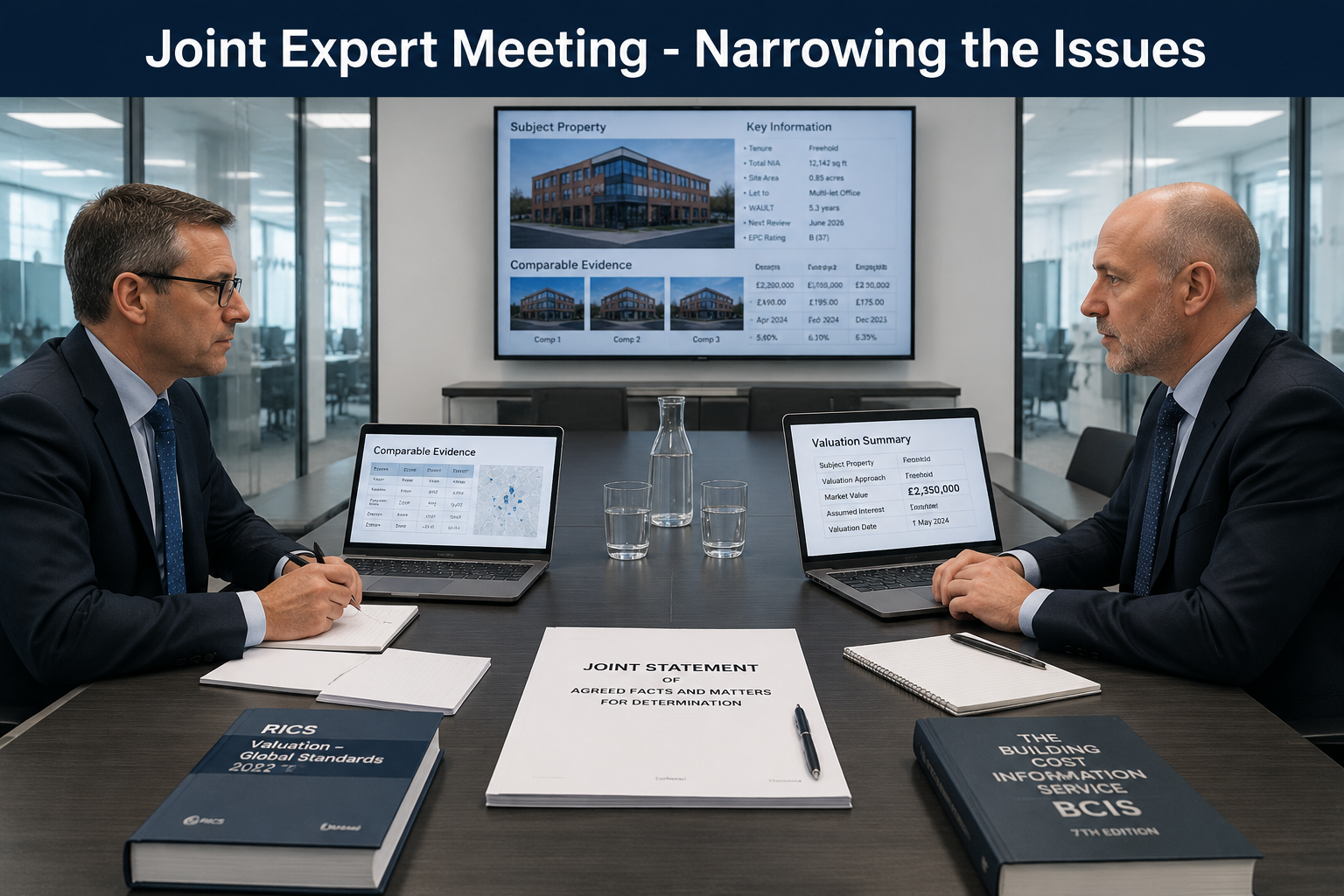
When opposing party-appointed experts are used, courts frequently direct them to meet — without their clients or solicitors present — to narrow the issues in dispute. These without-prejudice meetings are a cornerstone of modern expert evidence practice [5].
The purpose is not to negotiate a settlement but to identify:
- Points on which the experts agree.
- Points on which they disagree, with reasons clearly articulated.
- Whether any disagreement stems from differing facts, different methodologies, or a genuine difference of professional opinion.
The output is a joint statement, which is filed with the court. This document carries significant evidential weight. Critically, it must represent the experts' own independent views. Solicitors and clients are not permitted to amend the joint statement — a rule that RICS guidance reinforces explicitly [5].
"The joint statement is the experts' document. It must reflect what they genuinely believe, not what their clients wish them to believe."
Surveyors who allow solicitor pressure to influence the content of a joint statement risk their credibility before the court and potential disciplinary action by RICS.
Credibility Under CPR Part 35
To be credible under CPR Part 35, an expert witness surveyor must satisfy several overlapping requirements [8]:
- Independence: The report must be the expert's own work, not a document shaped by the instructing party.
- Transparency: The factual basis for every opinion must be disclosed, including any assumptions made.
- Competence: The expert must only opine on matters within their area of expertise.
- Completeness: Material facts that cut against the expert's conclusions must be acknowledged, not suppressed.
- Declaration: Every expert report must include a signed declaration confirming awareness of the duty to the court.
Failure on any of these points can lead to the report being given little or no weight by the judge — or being excluded altogether.
For surveyors working on structural matters, such as structural surveys or surveys for subsidence, CPR compliance requires that technical methodology is explained in plain language accessible to a non-specialist judge.
The RICS Consultation: Emerging Issues for 2026
In October 2025, RICS launched a public consultation to update its Expert Witness Professional Statement [1]. The revision addresses several emerging risks that are directly relevant to both joint and single-party appointments:
- Conditional fees: Growing use of success-based fee arrangements raises serious questions about independence. An expert whose fee depends on the outcome of litigation cannot credibly claim impartiality.
- Technology and AI: The use of automated valuation models and AI-assisted analysis in expert reports requires clear disclosure of methodology and limitations.
- Integrity and impartiality: The updated statement reinforces that surveyors must act within their area of expertise and must not allow commercial relationships to compromise their independence [4].
These developments make it more important than ever for surveyors to stay current with RICS guidance and to review their appointment practices regularly.
Choosing the Right Model: A Decision Framework
The choice between joint instruction and single-party appointment is not always within the parties' control — courts can direct either model. But where discretion exists, the following factors should guide the decision:
Factors favouring a Single Joint Expert:
- The dispute is of moderate value and the core issue is factual (e.g., standard valuation or a straightforward defect).
- Both parties want to minimise costs and reach resolution quickly.
- The technical issues are within a well-defined specialism where a single authoritative view is achievable.
- The court has indicated a preference for SJE appointment.
Factors favouring separate party-appointed experts:
- The case is high-value and the technical issues are genuinely complex or contested.
- The parties hold fundamentally different views on methodology, not just conclusions.
- One party has reason to believe a single expert cannot adequately represent the complexity of the evidence.
- The matter involves novel or cutting-edge technical questions where professional opinion is genuinely divided.
For disputes involving party wall costs or party wall awards, the appointed surveyor framework under the Party Wall etc. Act 1996 operates separately from the CPR expert witness regime — though the underlying duties of impartiality and competence apply equally.
Similarly, surveyors providing RICS specialist defect surveys may find their survey reports relied upon as expert evidence in subsequent litigation, making it essential that the original report meets the standards of transparency and independence required by CPR Part 35 from the outset.
Common Pitfalls and How to Avoid Them
Even experienced surveyors can fall into traps that undermine their expert evidence. The most common include:
- Accepting instruction without a proper conflicts check: A conflict discovered mid-proceedings can derail an entire case.
- Allowing the report to be drafted by the instructing solicitor: The expert must author their own report. Solicitor input on structure or presentation is acceptable; substantive amendments to opinions are not.
- Overstating certainty: Courts value experts who acknowledge the limits of their knowledge. Overconfident conclusions invite aggressive cross-examination.
- Failing to update opinions: If the factual basis of an opinion changes — new survey data emerges, for example — the expert must notify the court promptly.
- Blurring the advisory and testimonial roles: Surveyors who have advised a client on strategy should not then act as their expert witness on the same matter [6].
Conclusion
The decision between joint instruction and single-party appointment is one of the most strategically significant choices in property dispute litigation — and it is one that expert witness surveyors must be equipped to advise on clearly and confidently. Navigating "Joint Instruction or Single-Party Appointment? How Expert Witness Surveyors Should Navigate Conflicts, Privilege and Duties" requires a thorough understanding of CPR Part 35, RICS professional standards, and the practical realities of how courts use expert evidence.
Actionable next steps for surveyors and instructing solicitors in 2026:
- Conduct a rigorous conflicts check at the earliest possible stage — before any substantive engagement with the case.
- Review the updated RICS Expert Witness Professional Statement once finalised, and ensure internal practices align with its requirements on conditional fees and technology use.
- Establish clear written protocols distinguishing advisory work from expert witness work — and never allow the two roles to overlap in the same matter.
- In joint expert meetings, protect the independence of the joint statement from client or solicitor interference.
- Where the case involves structural or technical complexity, consider whether the appointed expert's specialism genuinely covers the issues — and instruct a specialist if not.
For those seeking expert surveying support across London and the South East, experienced professionals are available to assist with the full range of property dispute and litigation support needs.
References
[1] Surveyors Acting As Expert Witnesses – https://www.rics.org/profession-standards/rics-standards-and-guidance/sector-standards/dispute-resolution-standards/surveyors-acting-as-expert-witnesses?utm_source=openai
[2] The Duty And Necessity Of A Single Joint Expert In Property Disputes – https://www.res-prop.com/the-duty-and-necessity-of-a-single-joint-expert-in-property-disputes/?utm_source=openai
[3] Expert Witnesses Single Joint Experts And Independent Experts – https://www.rics.org/dispute-resolution-service/drs-information-hub/expert-witnesses-single-joint-experts-and-independent-experts?utm_source=openai
[4] View – https://consultations.rics.org/surveyorsasexpertwitness/view?objectID=257116997&utm_source=openai
[5] Surveyors Acting As Expert Witnesses (Feb 2023 Amendment) – https://www.rics.org/content/dam/ricsglobal/documents/standards/Surveyors%2520acting%2520as%2520expert%2520witnesses_Feb2023amend.pdf?utm_source=openai
[6] Viewcompounddoc – https://consultations.rics.org/surveyorsasexpertwitness/viewCompoundDoc?docid=16251220&partId=16253940&sessionid=&voteid=&utm_source=openai
[7] Expert Witness Surveyors In Boundary And Access Disputes What Evidence Courts Expect Beyond Title Plans – https://kingstonsurveyors.com/expert-witness-surveyors-in-boundary-and-access-disputes-what-evidence-courts-expect-beyond-title-plans/?utm_source=openai
[8] What Makes An Expert Witness Surveyor Credible Under CPR Part 35 And RICS Guidance – https://manchestersurveyors.com/what-makes-an-expert-witness-surveyor-credible-under-cpr-part-35-and-rics-guidance/?utm_source=openai
[9] When Do You Need An Expert Witness Surveyor A UK Guide To Valuation Defect And Boundary Disputes – https://manchestersurveyors.com/when-do-you-need-an-expert-witness-surveyor-a-uk-guide-to-valuation-defect-and-boundary-disputes/?utm_source=openai
[10] N H Admin Code SS Lan 501 – https://www.law.cornell.edu/regulations/new-hampshire/N-H-Admin-Code-SS-Lan-501.03?utm_source=openai