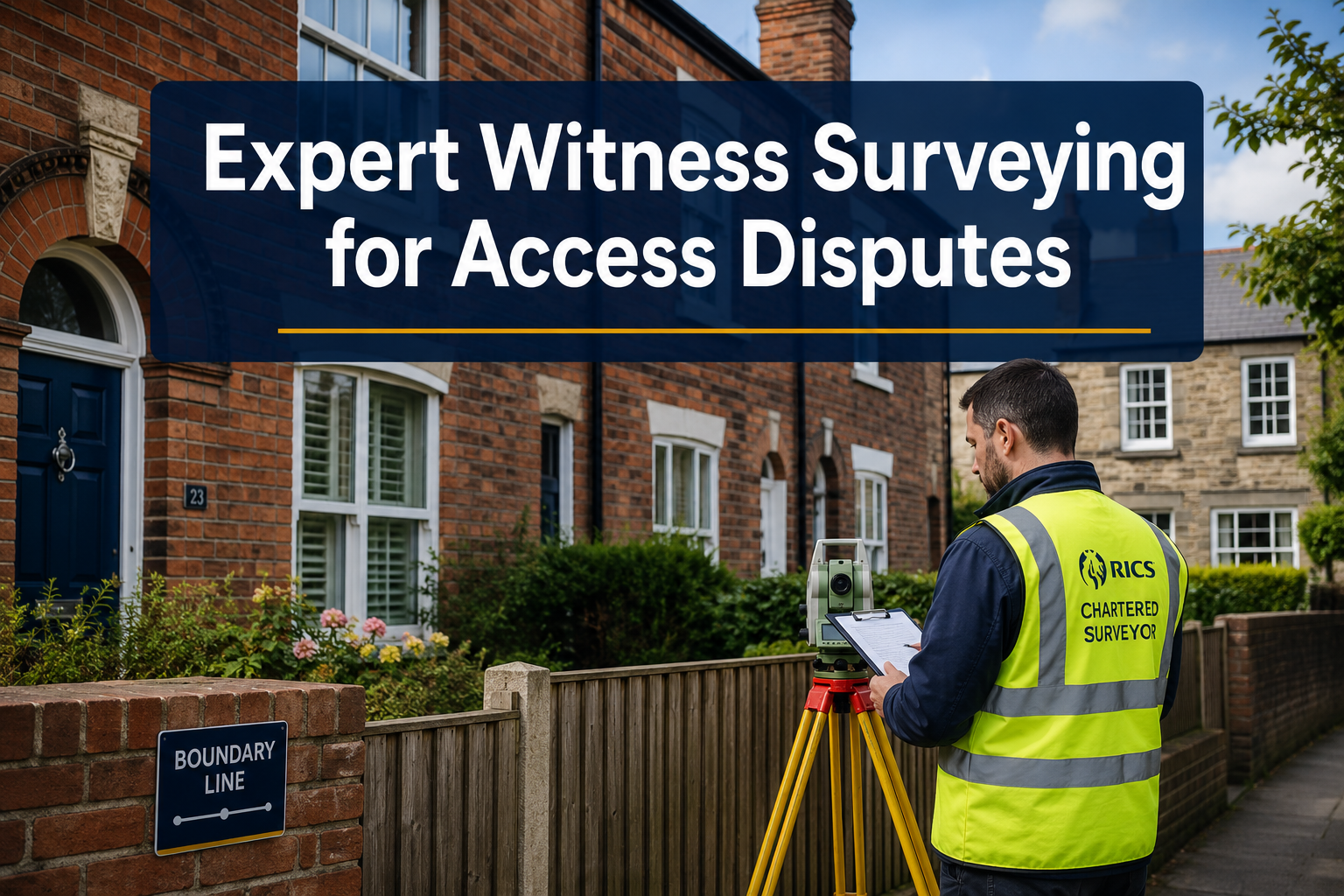

Nearly one in three property disputes that reach the courts in England and Wales involves some element of contested access — yet many property owners are unaware that a qualified surveyor can play a decisive role long before a judge is needed. Expert witness surveying for access disputes, when a neighbour refuses entry for repairs or investigations, sits at a powerful crossover between party wall practice, defect investigation, and civil litigation support. Understanding how this process works can mean the difference between a costly legal battle and a swift, evidence-led resolution.
Key Takeaways
- A chartered surveyor acting as an expert witness can document the need for access, assess its reasonableness, and produce court-admissible evidence when a neighbour refuses entry.
- Legal frameworks — including the Party Wall etc. Act 1996 in England and Wales — provide statutory rights of access that a surveyor can help enforce or defend.
- Expert witness reports must comply with Civil Procedure Rules Part 35 to be admissible in court proceedings.
- Early instruction of an expert witness surveyor often prevents disputes from escalating to full litigation.
- The surveyor's duty is to the court, not to the instructing party — impartiality is a professional and legal requirement.
What Is Expert Witness Surveying for Access Disputes
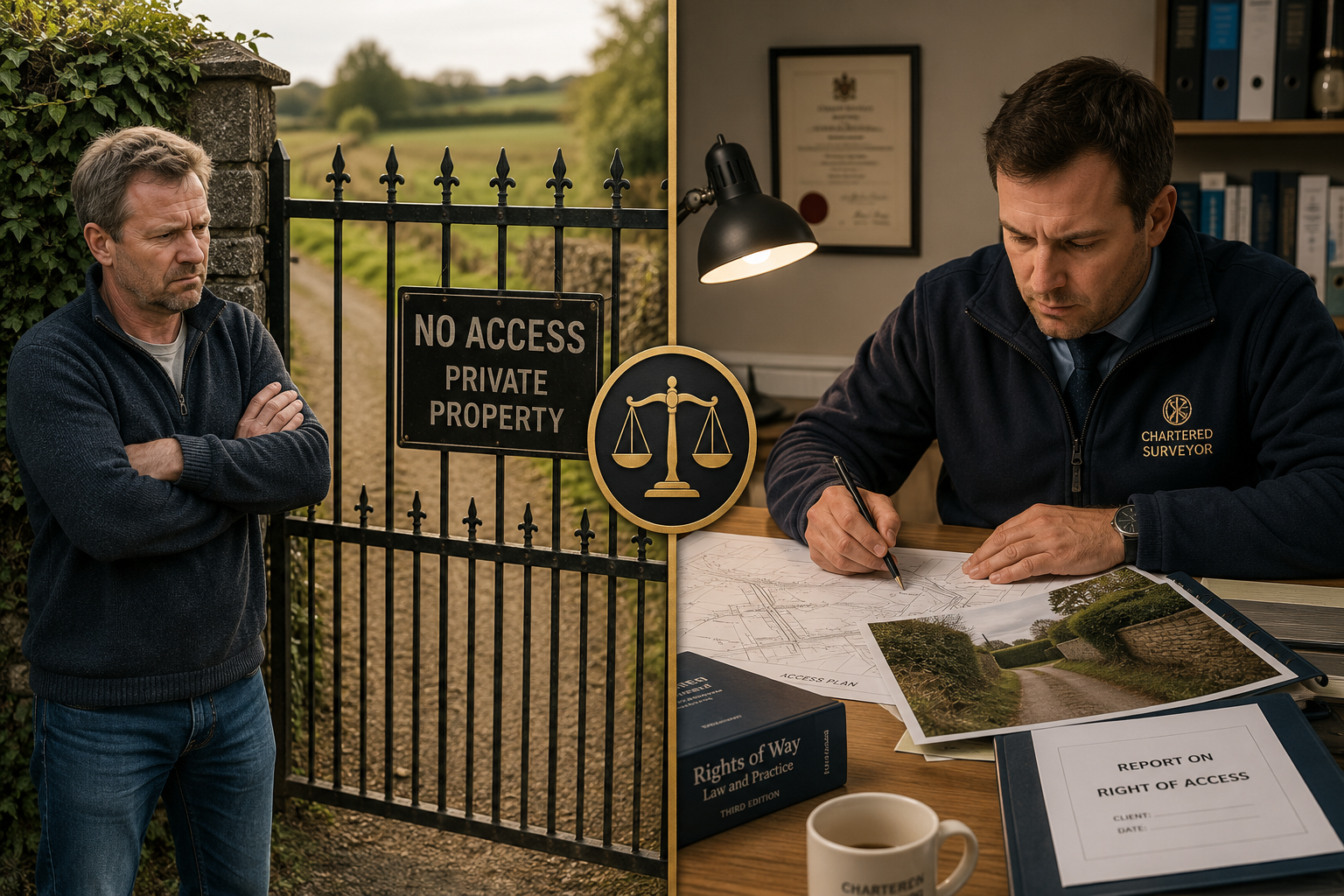
When a property owner needs to carry out repairs, investigate defects, or undertake construction work that physically requires entry onto a neighbouring property, and that neighbour refuses, the situation quickly becomes both legally and technically complex. Expert witness surveying for access disputes is the practice of instructing a suitably qualified chartered surveyor to assess, document, and report on the access need — and, if proceedings follow, to provide impartial expert testimony to the court.
This is not the same as instructing a surveyor simply to inspect your own property. The expert witness role is governed by strict professional and legal obligations. In the UK, RICS-accredited chartered surveyors providing expert witness services must produce reports that comply with Civil Procedure Rules (CPR) Part 35, ensuring the evidence is admissible and carries weight before a judge [5]. The surveyor's overriding duty is to the court, not to the party paying their fee — a distinction that gives their evidence particular authority.
Access disputes of this kind arise in several common scenarios:
- Repair of shared or adjoining structures — such as a leaking roof, cracked chimney stack, or failing render that can only be reached from the neighbour's land.
- Drainage investigations — where a blocked or collapsed drain runs beneath a neighbouring garden or driveway.
- Damp and timber investigations — where the source of penetrating damp originates from an adjoining property.
- Structural defect surveys — where subsidence, cracking, or movement requires inspection of foundations accessible only from next door.
- Party wall works — where statutory notice has been served but the adjoining owner obstructs access.
For a broader understanding of how expert witness surveying services operate in property disputes, it is worth reviewing what a qualified firm can offer before instructing anyone.
The Legal Framework: Rights of Access and What Happens When They Are Refused
Statutory Access Rights in England and Wales
In England and Wales, the primary statutory mechanism for compelling access to a neighbouring property is the Party Wall etc. Act 1996. Section 8 of the Act grants a building owner — and their surveyor — the right to enter an adjoining owner's property at reasonable times to carry out works permitted under the Act. Refusal to allow entry after proper notice constitutes an obstruction, which can be addressed through the courts.
Beyond party wall matters, the Access to Neighbouring Land Act 1992 provides a separate route. It allows a property owner to apply to the county court for an Access Order when basic preservation works to their own land cannot reasonably be carried out without entering the neighbour's property. Courts have discretion over the terms, including timing, supervision, and compensation for any inconvenience caused.
Understanding what constitutes an obstruction under party wall legislation is an important first step before escalating any dispute.
The Role of Reasonableness
Courts and surveyors alike apply a test of reasonableness when assessing access disputes. The access sought must be:
| Factor | What the Court Considers |
|---|---|
| Necessity | Can the work be done without access? |
| Proportionality | Is the scope of access proportionate to the need? |
| Timing | Is the proposed timing reasonable for the neighbour? |
| Duration | How long will access be required? |
| Damage risk | What is the likelihood of damage to the neighbour's property? |
An expert witness surveyor is uniquely placed to address each of these factors with technical evidence rather than assertion. Their report can demonstrate — objectively — that access is not merely convenient but genuinely necessary, and that the proposed method of working is proportionate and professionally managed [5].
When There Is No Party Wall Agreement
Where works fall outside the Party Wall Act, or where a party wall notice was never served, the situation becomes more complicated. Property owners in this position should understand the implications of proceeding without a party wall agreement before taking any further steps. An expert witness surveyor can help establish what the position should have been and what evidence exists to support or challenge a claim.
How Expert Witness Surveying for Access Disputes Works in Practice
Stage One: Initial Assessment and Documentation
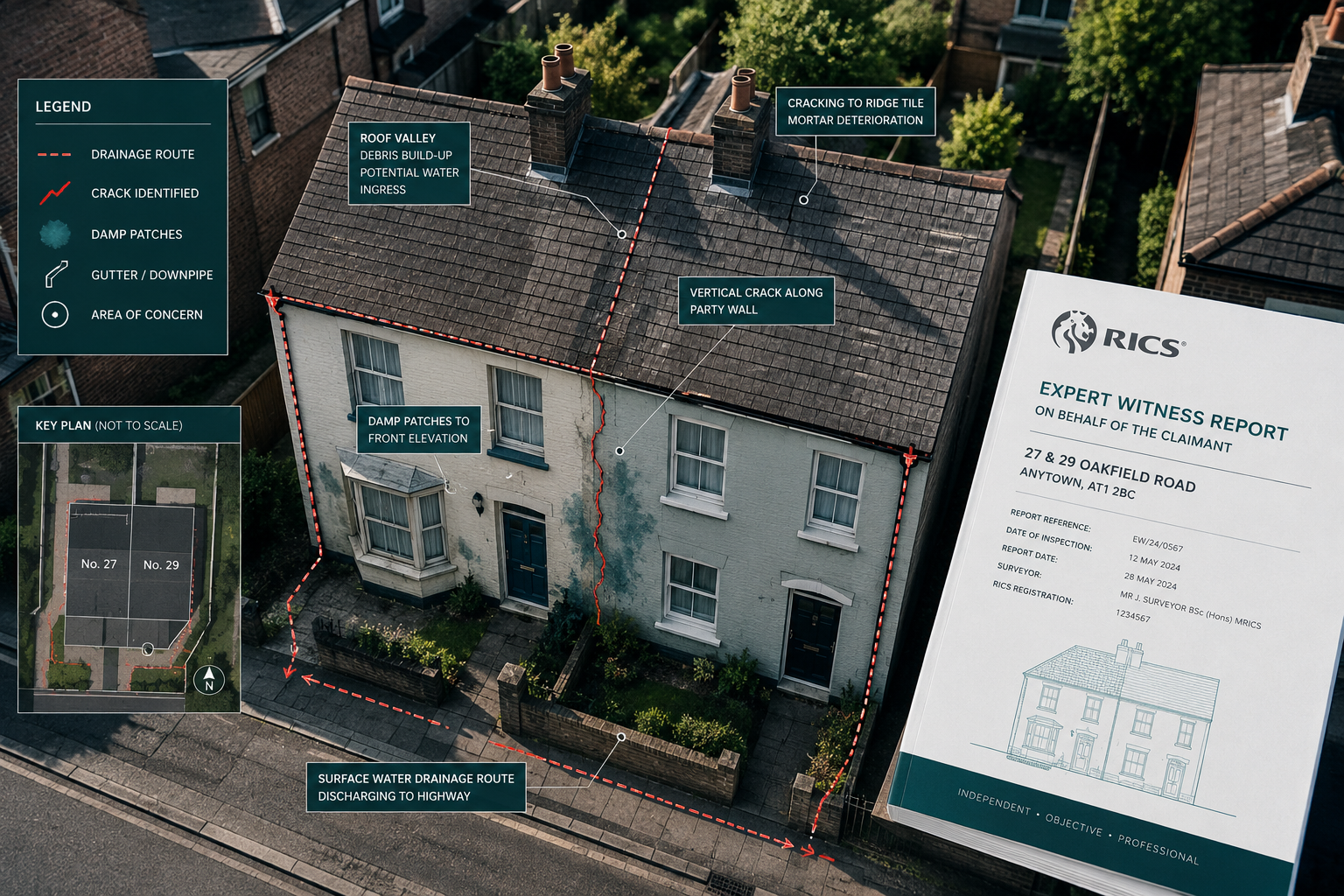
The first task of an expert witness surveyor instructed in an access dispute is to carry out a thorough assessment of the access need. This involves:
- Inspecting the instructing party's property to identify and record the defect or repair requirement.
- Producing photographic evidence, measured drawings, and written condition records.
- Establishing — through technical analysis — why access to the neighbouring property is necessary.
- Reviewing any existing reports, correspondence, or prior surveys.
For example, if a homeowner suspects that penetrating damp is entering through a shared flank wall, the surveyor will conduct a specialist damp survey to trace the source, document the moisture readings, and confirm whether the remedial works genuinely require access from next door.
Similarly, if the dispute involves drainage — a collapsed pipe running beneath a shared boundary, for instance — a drainage survey using CCTV equipment can produce video evidence of the defect's location and extent, making the case for access far harder to dispute.
Stage Two: Preparing the Expert Witness Report
Once the technical evidence is gathered, the surveyor prepares a formal expert witness report. In England and Wales, this document must:
- Contain a declaration of the surveyor's duty to the court.
- Set out the surveyor's qualifications and experience.
- Clearly distinguish between fact, opinion, and assumption.
- Address the specific questions put by the instructing solicitor or court.
- Comply with CPR Part 35 in its structure and content [5].
The report will typically include a schedule of the proposed works, a method statement, and an assessment of the likely impact on the neighbouring property. If the neighbour has raised specific objections, the expert witness report should address each one with evidence-based reasoning.
"The expert's overriding duty is to help the court on matters within their expertise. This duty overrides any obligation to the person from whom the expert has received instructions."
— Civil Procedure Rules Part 35.3
Stage Three: Supporting Mediation or Court Proceedings
Armed with a compliant expert witness report, the instructing party's solicitor is in a much stronger position — whether in mediation, at a hearing under the Access to Neighbouring Land Act 1992, or in full county court proceedings.
Expert witness surveyors may also be called upon to:
- Attend joint meetings with the opposing party's expert.
- Produce a Scott Schedule — a structured document setting out agreed and disputed points.
- Give oral evidence at trial.
- Advise on the reasonableness of any access terms proposed by the other side.
Firms with deep experience in this area — including those offering RICS specialist defect surveys — are well positioned to bridge the gap between technical investigation and litigation support.
Common Scenarios Where Expert Witness Surveyors Are Instructed
Roof and Chimney Repairs
A failing roof or chimney stack on a mid-terrace or semi-detached property often cannot be safely repaired without erecting scaffolding that overhangs the neighbour's garden or attaches to their wall. If the neighbour refuses consent, a surveyor can document the structural risk, the proposed scaffolding arrangement, and the absence of any viable alternative method. Roof surveys that capture condition evidence before any dispute escalates are particularly valuable in these cases.
Boundary and Encroachment Disputes
Where a structure — a wall, extension, or outbuilding — appears to encroach onto a neighbouring plot, a boundary survey can establish the legal boundary position with precision. If the neighbour refuses access for this investigation, an expert witness surveyor can work from available title deeds, Ordnance Survey data, and physical measurements from accessible vantage points to produce a defensible opinion.
Drainage and Subsidence Investigations
Subsidence affecting one property may have its root cause in drainage failure or tree root activity originating on neighbouring land. Establishing this causal link requires technical investigation — and often, access. An expert witness surveyor can document the progression of damage, model the likely cause, and present this evidence in a form that courts find persuasive.
Party Wall Disputes
The party wall process has its own built-in dispute resolution mechanism, but it is not uncommon for adjoining owners to obstruct surveyors appointed under the Act. Understanding the guidance for party wall awards and the rights that flow from them is essential context for any expert witness instructed in this area.
Choosing the Right Expert Witness Surveyor
Not every chartered surveyor is qualified or experienced to act as an expert witness. The following criteria should guide the selection process:
Professional accreditation: The surveyor should be a Member or Fellow of the Royal Institution of Chartered Surveyors (MRICS or FRICS). In the UK, RICS-accredited expert witnesses are trained to meet the standards required by CPR Part 35 [5].
Relevant technical specialism: The surveyor's expertise should match the nature of the dispute. A drainage access dispute calls for different technical knowledge than a boundary encroachment case.
Expert witness experience: Prior experience of preparing CPR-compliant reports, attending joint expert meetings, and giving oral evidence is highly valuable. Surveyors with a strong track record — such as those who have handled over 200 cases without a successful challenge to their methodology [4] — provide a higher level of confidence.
Impartiality: The surveyor must be able to demonstrate independence from the instructing party. Courts are alert to experts who appear to be advocates rather than independent witnesses.
Local knowledge: Familiarity with local planning history, property types, and regional construction methods can strengthen the technical analysis considerably.
The Cost and Practical Implications of Expert Witness Surveying
Expert witness surveying is a specialist service, and the fees reflect the level of professional input required. Costs typically cover:
- Initial site inspection and condition recording.
- Research into title documents, planning records, and prior surveys.
- Report preparation and review.
- Attendance at joint expert meetings.
- Court attendance, if required.
For context on how surveyor fees are structured more broadly, a guide to surveyor pricing provides useful background. In access disputes, the cost of expert witness surveying is almost always modest compared to the legal costs of protracted litigation — or the cost of leaving a defect unaddressed.
It is also worth noting that surveyors entering a neighbouring property — whether under a court order or by agreement — carry professional liability for any unnecessary damage caused during their investigations [1]. This provides the refusing neighbour with a degree of protection and is a point that expert witness surveyors routinely address in their method statements.
When Early Instruction Makes the Biggest Difference
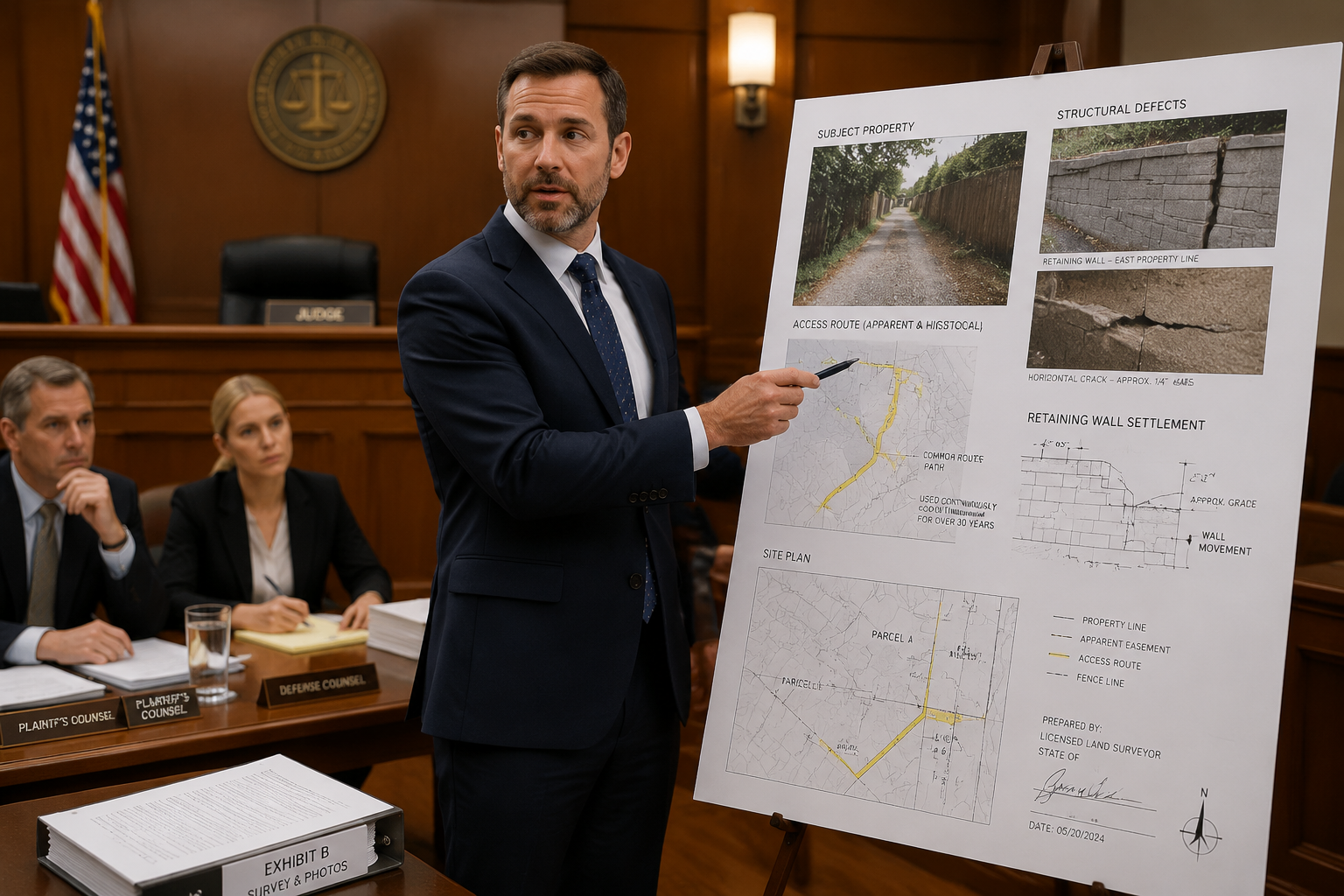
One of the most consistent findings in access dispute cases is that early instruction of an expert witness surveyor dramatically improves outcomes. When a neighbour first refuses entry, the instinct is often to write letters, involve solicitors, and allow the dispute to harden over weeks or months. In practice, a well-prepared surveyor's report — produced promptly and served on the refusing party — frequently prompts a change of position without any court involvement.
The report demonstrates that:
- The access need is genuine and technically documented, not merely asserted.
- The proposed works are proportionate and professionally managed.
- The instructing party has taken a reasonable, evidence-led approach.
This shifts the dynamic of the dispute considerably. Courts take a dim view of parties who refuse reasonable, evidenced access requests — and a CPR-compliant expert witness report makes it clear that the requesting party has done everything correctly [2].
Where the dispute does proceed to court, early instruction also means the evidence is gathered before conditions change — before a defect worsens, before temporary repairs obscure the original cause, or before the neighbour makes alterations that complicate the picture.
Conclusion
Expert witness surveying for access disputes, when a neighbour refuses entry for repairs or investigations, is one of the most effective tools available to property owners facing obstruction. It combines rigorous technical investigation with the formal authority of court-admissible evidence, and it operates at the intersection of party wall practice, defect analysis, and civil litigation support.
Actionable next steps for property owners facing a refused access situation:
- Document everything immediately — photograph the defect, keep all correspondence, and note dates of any verbal refusals.
- Seek specialist surveying advice early — before instructing solicitors, understand the technical picture. A specialist defect survey or drainage investigation may establish the access need clearly.
- Instruct a RICS-accredited expert witness surveyor — ensure they have relevant technical expertise and experience of CPR Part 35 compliance.
- Use the report proactively — serve the expert's findings on the refusing neighbour before issuing court proceedings. Many disputes resolve at this stage.
- Understand your statutory rights — the Party Wall etc. Act 1996 and the Access to Neighbouring Land Act 1992 both provide enforceable routes to access. A surveyor experienced in party wall matters can advise on which applies.
The surveyor's role in these disputes is not to take sides — it is to provide the court, and the parties, with the clearest possible picture of the technical facts. That clarity, delivered early and professionally, is often all that is needed to resolve what might otherwise become a prolonged and expensive conflict.
References
[1] Why Would A Surveyor Be On My Property – https://legalclarity.org/why-would-a-surveyor-be-on-my-property/?utm_source=openai
[2] CLM Litigation Related To Accessing Neighbors Property For Building – https://www.clm.com/wp-content/uploads/2020/09/CLM-Litigation-Related-to-Accessing-Neighbors-Property-for-Building.pdf?utm_source=openai
[3] Consultation Expert Witness – https://mmsurveyors.com/survey/consultation-expert-witness/?utm_source=openai
[4] cnettleman – https://cnettleman.net/?utm_source=openai
[5] expertwitnesssurveyors.co.uk – https://expertwitnesssurveyors.co.uk/?utm_source=openai
[6] Easements And Access Surveys – https://www.highlandsurveying.com/easements-and-access-surveys/?utm_source=openai
[7] Expert Witness – https://www.survtechsolutions.com/expert-witness?utm_source=openai
[8] jamesgrantsurveyor – https://www.jamesgrantsurveyor.com/?utm_source=openai
[9] Services – https://www.bascombenjamin.com/services.html?utm_source=openai
[10] Land Surveying – https://www.expertinstitute.com/expert-witness/land-surveying/?utm_source=openai