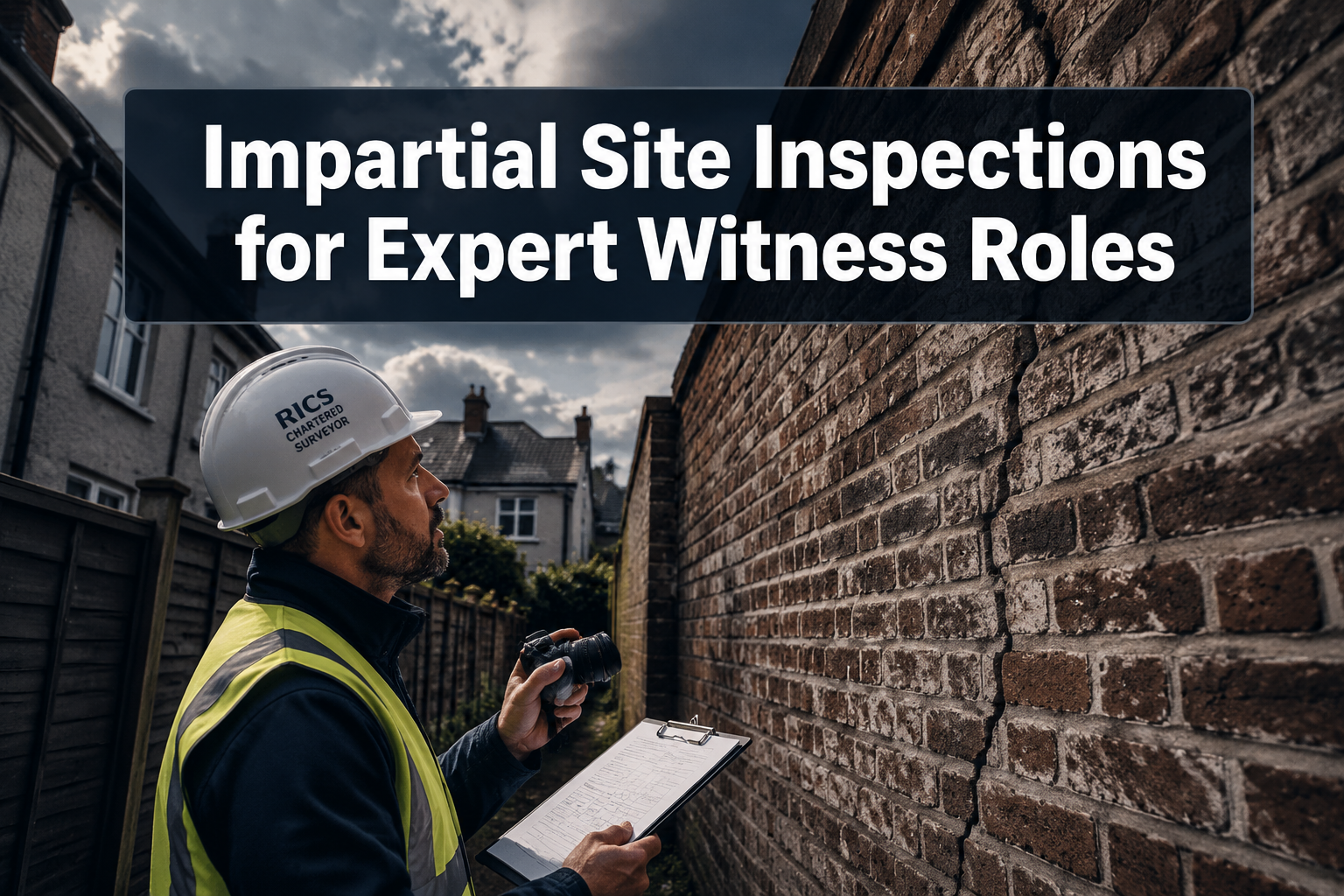

Over 40% of party wall disputes that reach formal proceedings are complicated by poorly documented site evidence — a problem that impartial, protocol-driven inspections are specifically designed to prevent. When a surveyor steps into an expert witness role, the standards governing their conduct shift dramatically. Impartial site inspections for expert witness roles: protocols for building and party wall disputes represent a distinct discipline, one that demands rigorous methodology, strict legal compliance, and the professional courage to report findings that may not favour the instructing party.
This guide sets out the core protocols that chartered surveyors must follow when conducting site inspections for expert witness purposes, drawing on established legal frameworks, RICS guidance, and real-world practice from firms such as Brian Gale Surveyors.
Key Takeaways
- Expert witnesses in building and party wall disputes owe their primary duty to the court, not to the instructing party.
- Compliance with Civil Procedure Rules (CPR) Part 35 and Practice Direction 35 is mandatory for all expert witness reports submitted to court.
- Systematic pre-inspection preparation, including document review and chronology mapping, is as important as the physical site visit itself.
- Photographic evidence, precise measurements, and contemporaneous notes form the evidentiary backbone of a credible expert witness report.
- Distinguishing pre-existing conditions from new damage is one of the most technically demanding — and legally significant — tasks an expert witness faces.
The Legal Framework Governing Expert Witness Site Inspections
CPR Part 35 and Practice Direction 35
Any surveyor accepting an expert witness instruction in England and Wales must understand that their overriding duty is to the court. Civil Procedure Rules (CPR) Part 35 makes this explicit: the expert's function is to assist the court on matters within their expertise, and that duty overrides any obligation to the person who instructs or pays them [1].
Practice Direction 35 supplements CPR Part 35 by specifying the precise requirements for expert reports. Reports must state the substance of all instructions received, confirm that the expert understands their duty to the court, and include a statement of truth [6]. Firms such as Brian Gale Surveyors, which provides expert witness reports for party wall and building disputes, structure their reports to comply fully with these requirements, ensuring that every opinion expressed is clearly distinguished from factual findings [6].
Key obligations under CPR Part 35 include:
- Providing an objective, unbiased opinion on matters within the expert's competence
- Disclosing any limitation on the expert's knowledge or expertise
- Informing the court if the expert's opinion changes after a report is filed
- Restricting the scope of evidence to the expert's genuine area of specialisation
Failure to comply with these obligations can result in reports being excluded from proceedings, costs penalties, or damage to the surveyor's professional reputation.
The Party Wall etc. Act 1996 Context
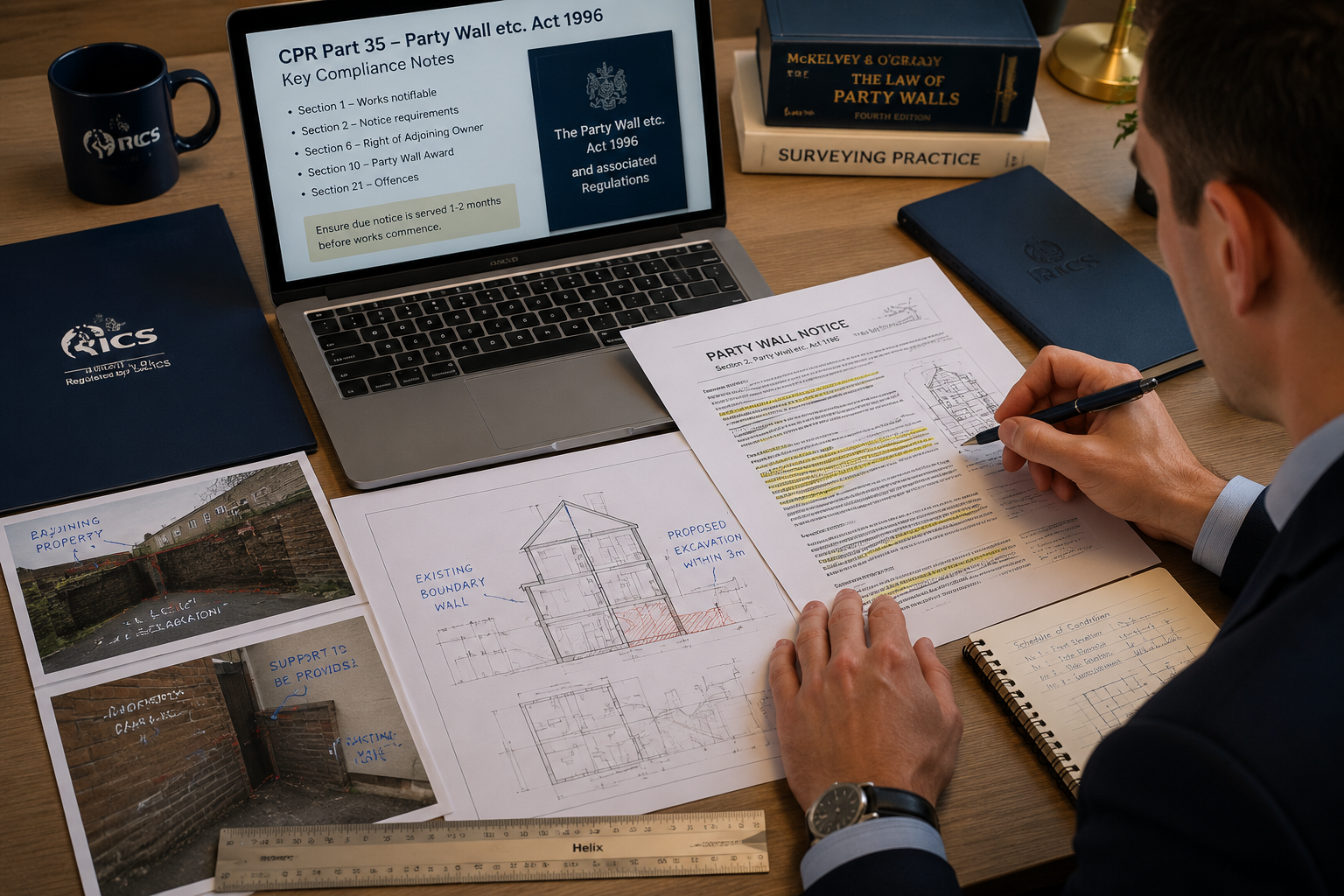
Many expert witness instructions in the building sector arise directly from disputes under the Party Wall etc. Act 1996. This legislation governs works to shared walls, excavations near neighbouring properties, and new boundary structures. When a party wall dispute escalates beyond the standard surveyor appointment process and enters litigation or formal adjudication, an independent expert witness may be required to provide technical evidence to the tribunal or court.
The expert witness in this context must be entirely separate from any surveyor who has previously acted as a party wall surveyor in the same dispute. Acting in both capacities creates an irreconcilable conflict of interest and would undermine the impartiality that CPR Part 35 demands [3].
Pre-Inspection Preparation: The Foundation of Credible Evidence
Document Review and Chronology Mapping
Thorough pre-inspection preparation is not optional — it is the foundation upon which a credible expert witness report is built [4]. Before setting foot on site, the expert witness should have reviewed and understood the following:
| Document Category | Examples |
|---|---|
| Legal and procedural | Party wall notices, awards, court orders |
| Technical | Building plans, structural calculations, specifications |
| Historical condition | Schedules of condition, estate agent photographs, insurance surveys |
| Correspondence | Letters between parties, solicitor exchanges |
| Expert reports | Any previously commissioned reports on the same property |
Mapping the chronology of events is particularly important in party wall disputes. The sequence of when notices were served, when works commenced, and when damage was first reported is often central to determining liability [4]. A surveyor who arrives on site without this chronological understanding risks misinterpreting what they observe.
Identifying Technical Issues in Advance
Before the inspection, the expert witness should identify the specific technical questions the court needs answered. In a typical party wall dispute, these might include:
- Whether observed cracking is consistent with the construction method used by the building owner
- Whether excavation depths were sufficient to underpin the adjoining owner's foundations
- Whether a notice for excavation near a neighbour was correctly served and complied with
- Whether damage pre-existed the notified works
Identifying these questions in advance allows the expert to design an inspection methodology that will generate the specific evidence needed, rather than conducting a generic walkthrough.
Arranging Access and Permissions
Access to both the building owner's and adjoining owner's properties is frequently necessary. The expert witness must arrange this formally, confirm it in writing, and note any restrictions imposed. If access is refused or limited, this must be clearly stated in the report, along with its effect on the expert's ability to reach conclusions [2].
Conducting Impartial Site Inspections for Expert Witness Roles: Protocols for Building and Party Wall Disputes
Systematic Inspection Methodology
The physical site inspection is where evidence is gathered, but its value depends entirely on the rigour of the methodology applied. A systematic approach ensures that nothing significant is overlooked and that the inspection can withstand scrutiny in cross-examination [2].
A structured site inspection protocol should include the following stages:
- Initial walkthrough — Gain an overall understanding of the property and the scope of alleged damage before detailed recording begins
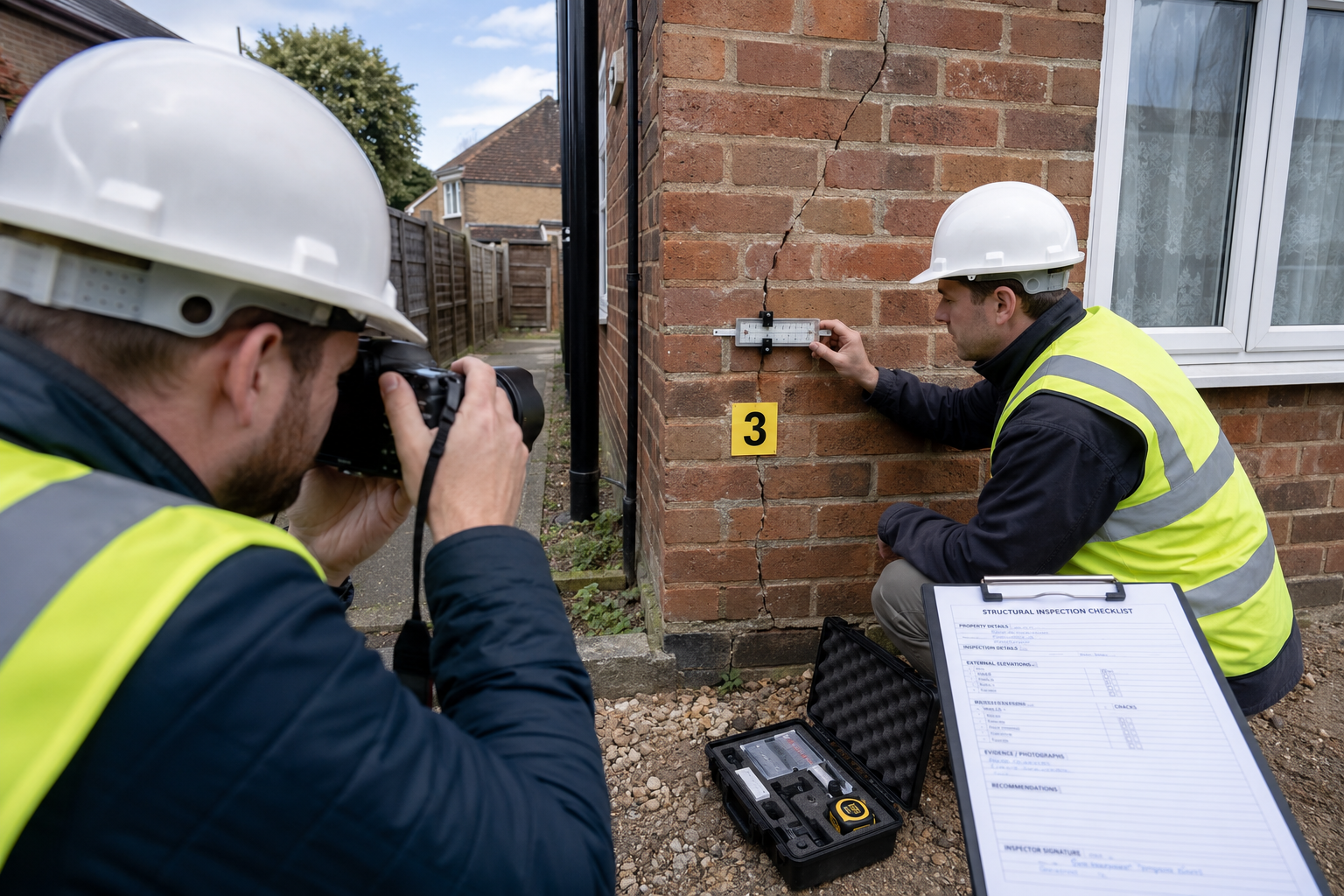
- Photographic documentation — Photograph all relevant areas using consistent framing, with scale references and location markers
- Precise measurement — Record crack widths, settlement levels, and distances from works using calibrated instruments
- Contemporaneous note-taking — Write observations in real time, not from memory after leaving site
- Material sampling — Where appropriate and with proper permissions, collect samples for laboratory analysis
- Third-party observations — Note the presence of any other person on site and record any statements made
"The credibility of an expert witness report rests not on the conclusions reached, but on the transparency and rigour of the methodology used to reach them."
Photographic Standards for Expert Evidence
Photographs submitted as part of an expert witness report are subject to scrutiny. Poor-quality, undated, or inadequately labelled photographs can undermine an otherwise sound report. The following standards should be applied:
- Use a camera with automatic date and time stamping, or photograph a dated reference card
- Capture wide-angle context shots before close-up detail shots
- Include a recognised scale reference (ruler, scale card) in all detail photographs
- Photograph from consistent positions to allow comparison with earlier or later images
- Maintain an indexed photographic schedule that cross-references each image to the relevant section of the report
Technical Investigation Methods
Depending on the nature of the alleged damage, specialist investigation techniques may be required [4]. These include:
- Crack monitoring gauges — To determine whether structural movement is active or historic
- Level surveys — To identify differential settlement across floor or wall surfaces
- Endoscopic inspections — To examine concealed cavities or voids without destructive opening up
- Ground investigations — Where foundation failure or soil movement is suspected, particularly relevant when works have involved excavation near shared boundaries
- Drainage surveys — To identify whether leaking drainage has contributed to ground movement
The expert witness must be transparent about which techniques were used, why they were selected, and what their limitations are. If a technique was not used but would have been informative, the report should explain why it was omitted.
Distinguishing Pre-Existing Conditions from New Damage
This is frequently the most technically demanding aspect of an expert witness inspection in party wall and building disputes [4]. The legal significance is substantial: if damage pre-existed the notified works, the building owner cannot be held liable for it.
Evidence sources used to distinguish pre-existing conditions from new damage include:
- Schedules of condition prepared before works commenced — these are the gold standard, and their absence significantly complicates the expert's task
- Estate agent photographs from property listings predating the works
- Insurance survey reports and historical valuation documents
- Crack pattern analysis — the morphology, direction, and width of cracks can indicate their age and likely cause
- RICS Level 3 Building Survey reports commissioned before works began
Where the evidence is genuinely ambiguous, the expert witness must say so. Overstating certainty to favour one party is a breach of the duty owed to the court and a serious professional failing.
Disclosing the Limits of Expertise
CPR Part 35 requires expert witnesses to disclose the limits of their knowledge [1]. A chartered building surveyor instructed in a party wall dispute may have strong expertise in structural defects but limited expertise in, for example, geotechnical engineering. Where a question falls outside the expert's genuine competence, the report must say so clearly and, where appropriate, recommend that a specialist in the relevant discipline be instructed.
This transparency is not a weakness — it is a mark of professional integrity that courts and legal practitioners respect.
Preparing the Expert Witness Report
Structure and Content Requirements
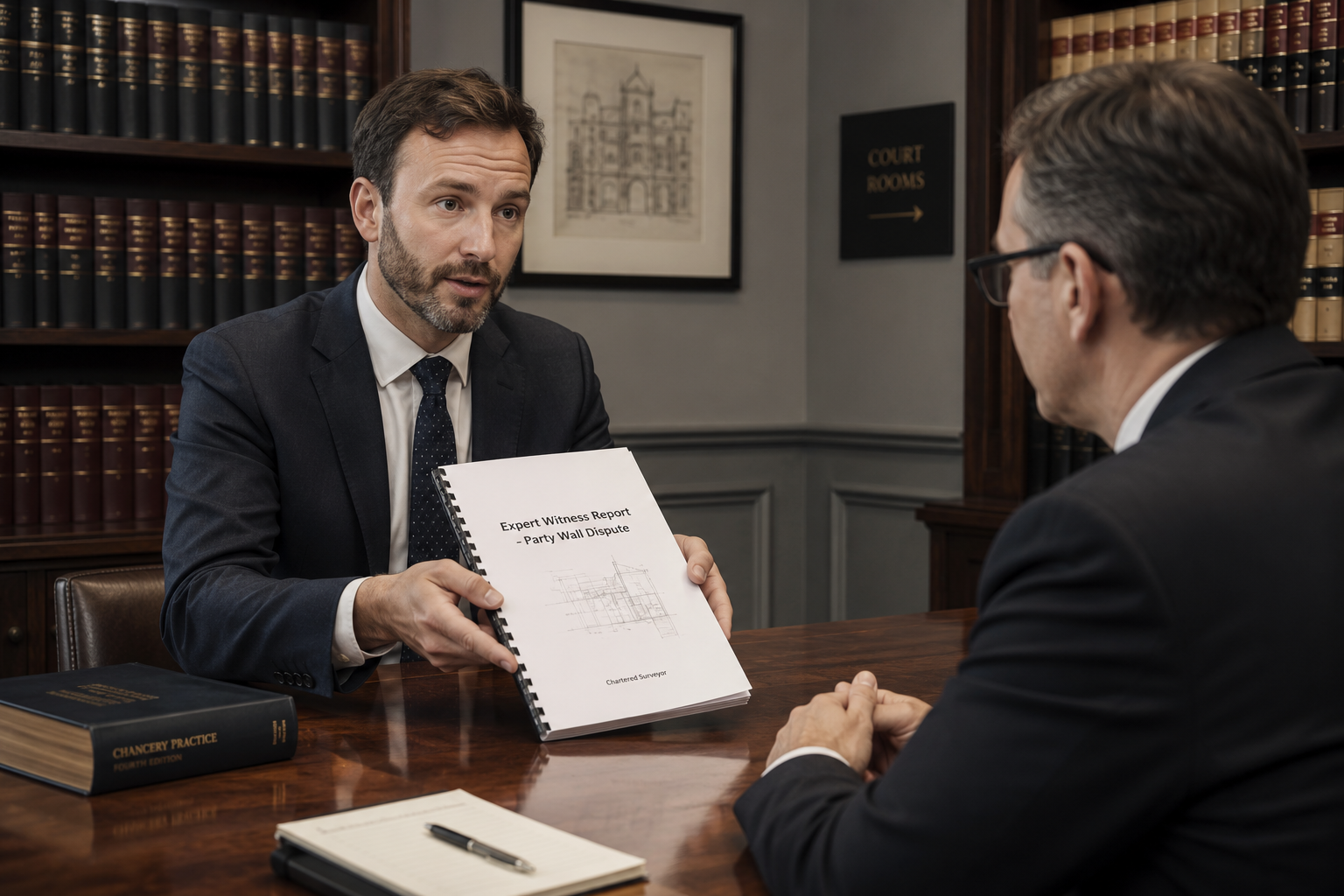
An expert witness report for a building or party wall dispute should follow a clear, logical structure. Practice Direction 35 specifies mandatory content, but best practice goes further [6]:
| Section | Content |
|---|---|
| Introduction | Instructions received, scope of report, documents reviewed |
| Methodology | How the inspection was conducted, tools used, access limitations |
| Factual findings | Observations recorded on site, supported by photographs and measurements |
| Technical analysis | Expert interpretation of findings, referenced to relevant standards |
| Opinions | Clear, reasoned conclusions on each question posed |
| Limitations | Areas of uncertainty, matters outside expertise |
| Statement of truth | Mandatory declaration per CPR Part 35 |
Handling Joint Expert Instructions
In some disputes, the parties agree to instruct a single joint expert (SJE). This arrangement is increasingly common in lower-value cases where the cost of competing experts is disproportionate. The SJE must be scrupulously neutral, communicating with both parties equally and avoiding any private communication that could be perceived as partial [1].
Where separate experts are instructed, the court may direct a without-prejudice meeting between them to produce a joint statement identifying agreed and disputed matters. This process — known as expert conferencing — requires each expert to engage honestly and constructively, prioritising the court's need for clarity over their instructing party's preferred outcome.
Monitoring Surveys and Ongoing Evidence
In some cases, a single site inspection is insufficient. Where active structural movement is suspected, monitoring surveys over a period of weeks or months may be necessary to establish whether movement is continuing, accelerating, or stabilising. The expert witness should recommend this approach where the evidence gathered on a single visit cannot support a reliable conclusion about the cause or progression of damage.
Common Pitfalls and How to Avoid Them
Even experienced surveyors can fall into traps when moving from advisory roles into expert witness functions. The most common failures include:
- Advocacy creep — Unconsciously adopting the instructing party's position rather than maintaining independence
- Scope overreach — Expressing opinions on matters outside the surveyor's genuine expertise
- Inadequate documentation — Relying on memory rather than contemporaneous records
- Failure to address the right questions — Producing a technically sound report that does not answer the specific issues in dispute
- Ignoring contradictory evidence — Selectively reporting findings that support one conclusion while omitting evidence that points the other way
RICS-accredited expert witnesses are trained to recognise and resist these tendencies [1]. Firms specialising in party wall and building dispute expert evidence, including those serving clients across London and the wider South East, build quality assurance processes into their report preparation to catch these errors before submission.
Conclusion
Impartial site inspections for expert witness roles: protocols for building and party wall disputes demand a level of rigour, transparency, and legal awareness that goes well beyond standard surveying practice. The expert witness who follows these protocols — thorough pre-inspection preparation, systematic evidence collection, honest disclosure of limitations, and strict compliance with CPR Part 35 and Practice Direction 35 — provides genuine value to the court and to the parties seeking resolution.
Actionable next steps for surveyors taking on expert witness instructions:
- Confirm that your RICS accreditation and professional indemnity insurance cover expert witness work before accepting instructions.
- Obtain and review all relevant documents before attending site — never inspect blind.
- Design your inspection methodology around the specific technical questions the court needs answered.
- Apply consistent photographic and measurement standards on every visit, and maintain a contemporaneous inspection log.
- Disclose clearly any area where your expertise reaches its limit, and recommend specialist input where needed.
- If the dispute involves a party wall notice that was not properly served or a situation where no party wall agreement exists, ensure the procedural history is fully documented in your report.
The integrity of the expert witness process depends on surveyors who prioritise the truth of what they find over the preferences of those who instruct them. That commitment to impartiality is not just a legal requirement — it is the foundation of professional credibility.
References
[1] expertwitnesssurveyors.co.uk – https://expertwitnesssurveyors.co.uk/?utm_source=openai
[2] Site Inspection Checklist For Expert Witnesses – https://www.expertinstitute.com/resources/insights/site-inspection-checklist-for-expert-witnesses/?utm_source=openai
[3] expertwitnesssurveyor – https://expertwitnesssurveyor.com/?utm_source=openai
[4] Expert Witness Valuations In Party Wall Disputes Building Credible Cases Under Practice Direction 35 – https://www.canterburysurveyors.com/blog/expert-witness-valuations-in-party-wall-disputes-building-credible-cases-under-practice-direction-35/?utm_source=openai
[5] Expert Witness – https://antinoandassociates.com/expert-witness?utm_source=openai
[6] Expert Witness Reports – https://www.briangalesurveyors.com/expert-witness-reports/?utm_source=openai