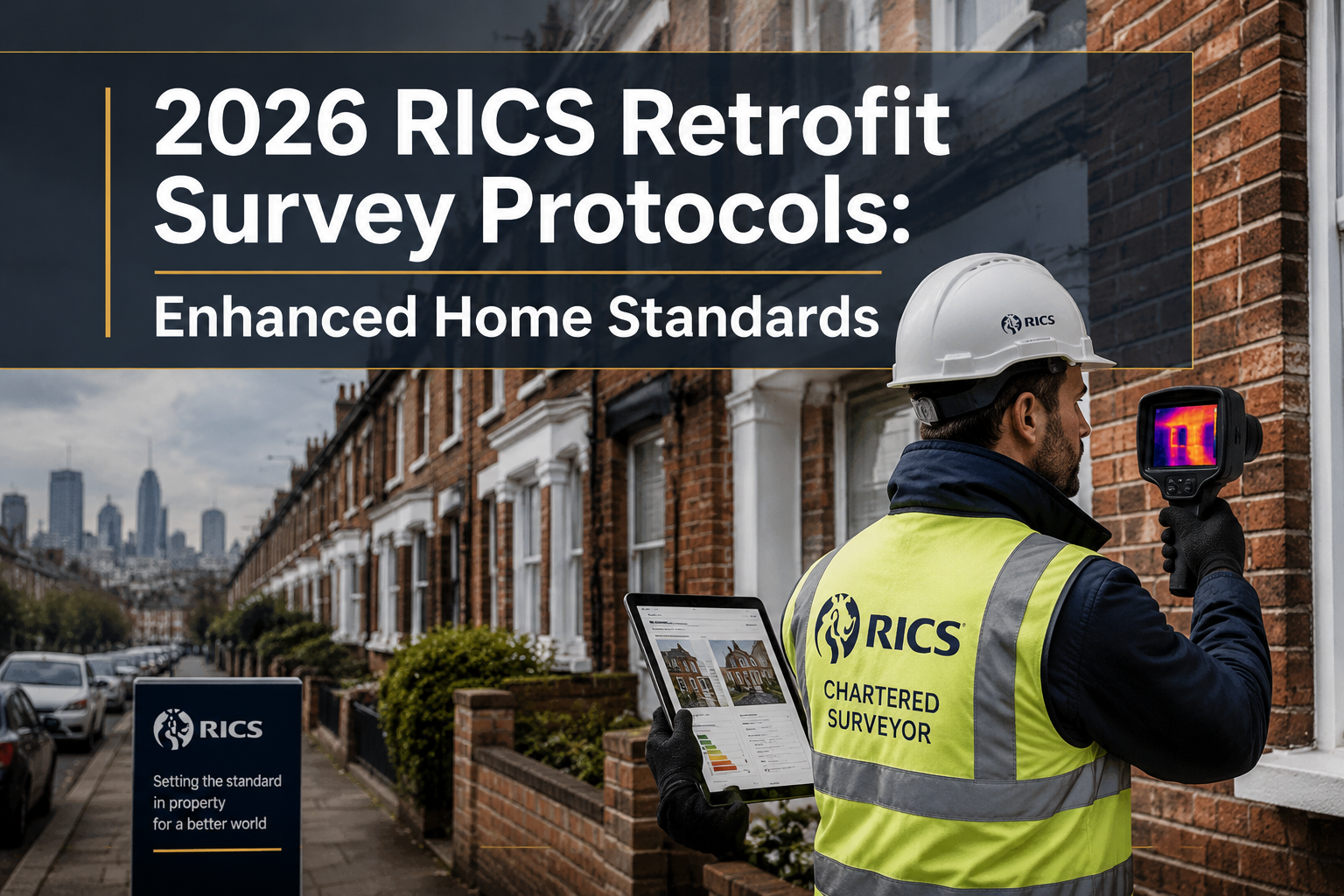
Retrofit failures now affect an estimated one in five UK homes that have undergone energy improvement works — a statistic that prompted RICS to convene its landmark Quality in Retrofit Summit and set in motion a sweeping overhaul of professional practice. The resulting building survey protocols post-RICS Quality in Retrofit Summit represent the most significant update to enhanced home standards in over a decade, reshaping how surveyors detect defects, deploy technology, and protect consumers across every level of residential assessment.
This article breaks down what those changes mean in practice for building surveyors, property owners, and anyone commissioning a survey in 2026.
Key Takeaways
- The RICS Residential Retrofit Standard became mandatory for all RICS members from October 31, 2024, establishing binding requirements that now define survey practice in 2026.
- BS 40104 has replaced component-by-component inspection with a systems-based approach, demanding more holistic retrofit assessments.
- Standardized reporting templates and improved defect categorization guidance are now embedded in Level 2 and Level 3 survey protocols.
- Advanced diagnostic technologies — including thermal imaging and moisture mapping — are now formally advocated within 2026 RICS quality standards.
- A new Residential Retrofit Surveying Pathway to RICS associate membership has been launched, with demand already outpacing available places.
Why the Quality in Retrofit Summit Changed Everything
The Quality in Retrofit Summit, convened at RICS headquarters, brought together retrofit leaders, surveyors, housing associations, and government representatives to confront a sector-wide trust deficit [4]. Years of poorly executed retrofit projects — insulation installed without adequate moisture management, ventilation systems overlooked, structural implications ignored — had eroded public confidence and generated costly remediation bills for homeowners.
The summit's central conclusion was unambiguous: competent, regulated professionals must lead retrofit projects, and the survey protocols underpinning those projects must be fundamentally strengthened [4]. That conclusion has since translated into binding standards, new credentials, and revised reporting frameworks that are now active across the profession.
The Trust Deficit: What Went Wrong
Widespread retrofit failures stemmed from a fragmented market where unregulated contractors often conducted assessments without the independence or technical depth that qualified surveyors provide. The result was a pattern of unintended consequences: damp penetration behind external wall insulation, condensation within poorly specified roof assemblies, and heating systems oversized for newly insulated buildings [1].
RICS and industry leaders identified professional independence and quality assessment as the primary levers for restoring trust [6]. The building survey protocols post-RICS Quality in Retrofit Summit: 2026 updates for enhanced home standards are the structural response to that diagnosis.
The Mandatory Framework: RICS Residential Retrofit Standard and BS 40104
Binding Requirements from October 2024 Onwards
Effective October 31, 2024, the RICS Residential Retrofit Standard became compulsory for all RICS members and regulated firms [1]. This is not guidance — it is a binding requirement governing how retrofit service delivery must be structured, documented, and quality-assured. By 2026, surveyors who have not aligned their practice with this standard are operating outside professional compliance.
The standard establishes clear obligations around:
- Pre-retrofit physical surveys conducted by qualified professionals before any measures are specified
- Impartial assessment free from commercial relationships with contractors or product suppliers
- Documented evidence of the building's existing condition, thermal performance, and moisture dynamics
- Risk identification covering structural, ventilation, and heritage considerations
For property owners, this means any retrofit assessment carried out by an RICS-regulated firm must now meet these baseline requirements. For surveyors, it means that cutting corners on pre-works inspection is no longer a professional option.
BS 40104: From Components to Systems
The introduction of the BS 40104 framework marks a philosophical shift in how retrofit assessments are conducted [1]. Previous approaches often evaluated individual components in isolation — checking the loft insulation, noting the boiler age, flagging single-glazed windows. BS 40104 mandates a systems-based approach that treats the building as an integrated whole.
Under this framework, a surveyor assessing a Victorian terrace must consider how adding wall insulation will interact with the existing ventilation strategy, how floor insulation might affect underfloor moisture movement, and how the heating system will perform once the thermal envelope changes. No single measure can be evaluated without reference to its effect on the wider building system.
This has direct implications for survey scope and duration. A systems-based assessment is inherently more complex than a component checklist. Surveyors need broader technical knowledge, more time on site, and more sophisticated diagnostic tools to meet the BS 40104 standard. Those commissioning a Level 3 building survey should now expect this integrated systems perspective to be embedded in the report.
2026 Updates to Survey Protocols: Defect Detection, Technology, and Reporting
Enhanced Defect Categorization Guidance
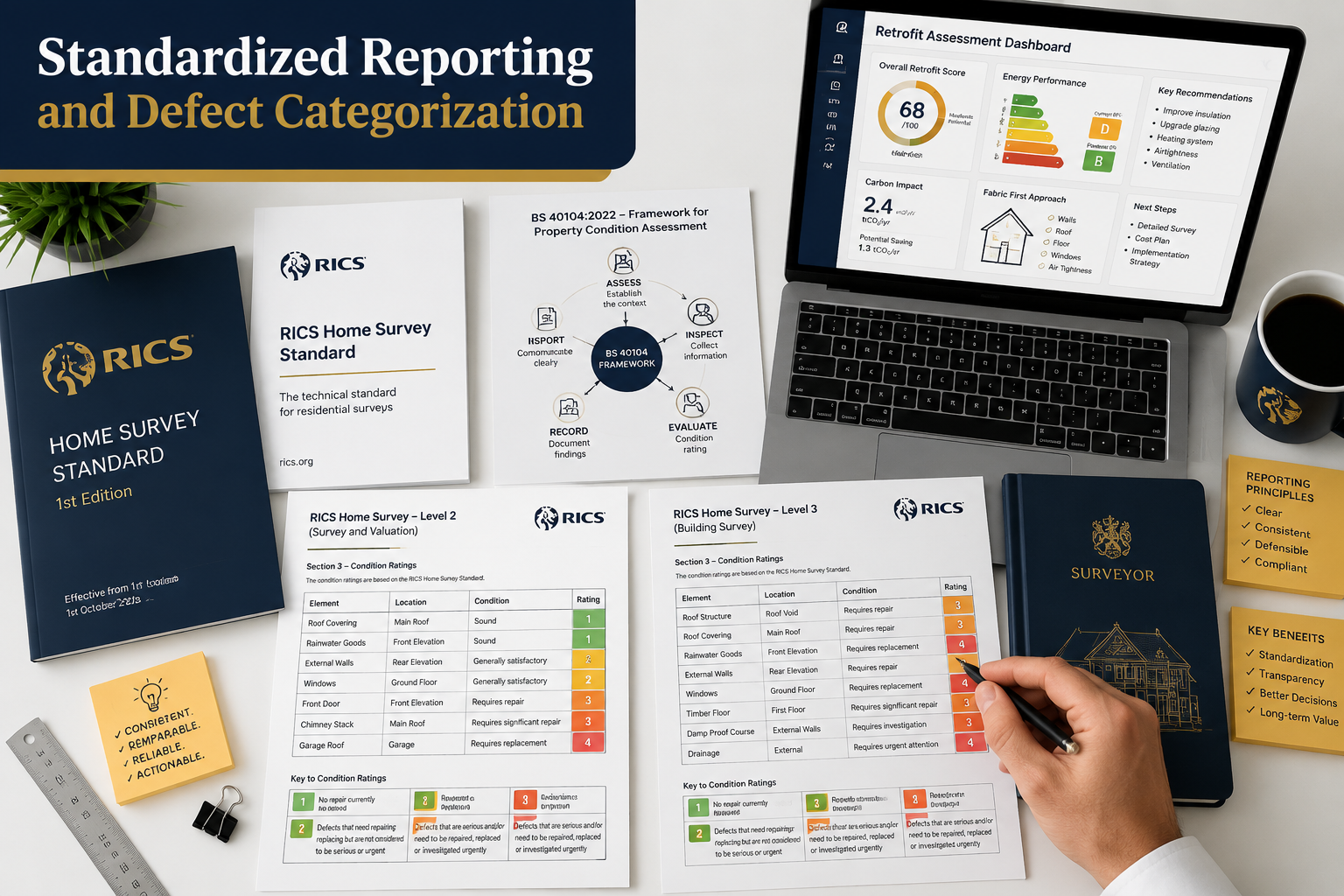
One of the most practically significant changes within the building survey protocols post-RICS Quality in Retrofit Summit: 2026 updates for enhanced home standards is the improved guidance on defect categorization and condition ratings [5]. The previous system left too much room for inconsistency between surveyors, making it difficult for clients to compare reports or understand the relative urgency of identified issues.
The 2026 updates provide clearer definitions for condition ratings across all survey levels, with particular attention to:
| Condition Rating | Description | Action Required |
|---|---|---|
| Rating 1 | No repair currently needed | Monitor at next inspection |
| Rating 2 | Defects requiring attention but not urgent | Plan repairs within agreed timeframe |
| Rating 3 | Serious defects requiring urgent attention | Obtain specialist advice immediately |
Improved guidance also covers how surveyors should categorize defects that are specifically related to retrofit works — such as insulation-induced damp or ventilation inadequacy — which previously fell into an ambiguous zone between standard building defects and specialist retrofit findings.
For anyone considering a specialist defect survey on a property that has undergone retrofit works, this enhanced categorization framework means findings will be more precise and actionable than under previous standards.
Standardized Reporting Templates for Level 2 and Level 3 Surveys
Consistency in reporting has long been a challenge across the surveying profession. The 2026 standards address this directly through standardized reporting templates for both Level 2 and Level 3 surveys [5]. These templates ensure that:
- All surveyors cover the same core inspection elements
- Clients receive reports in a consistent format that is easier to navigate
- Retrofit-specific considerations are formally embedded in the report structure
- Condition ratings are applied using shared definitions rather than individual interpretation
For those commissioning a Level 2 homebuyer survey, the standardized template means the report will now include dedicated sections on energy performance, retrofit potential, and any risks associated with previous improvement works — elements that were previously at the discretion of individual surveyors.
Integration of Advanced Diagnostic Technologies
The 2026 RICS quality standards formally advocate for the incorporation of advanced diagnostic tools to enhance the accuracy and comprehensiveness of building assessments [5]. This is a significant development because it moves technology integration from best practice into the expected standard of care.
Key diagnostic technologies now referenced in updated protocols include:
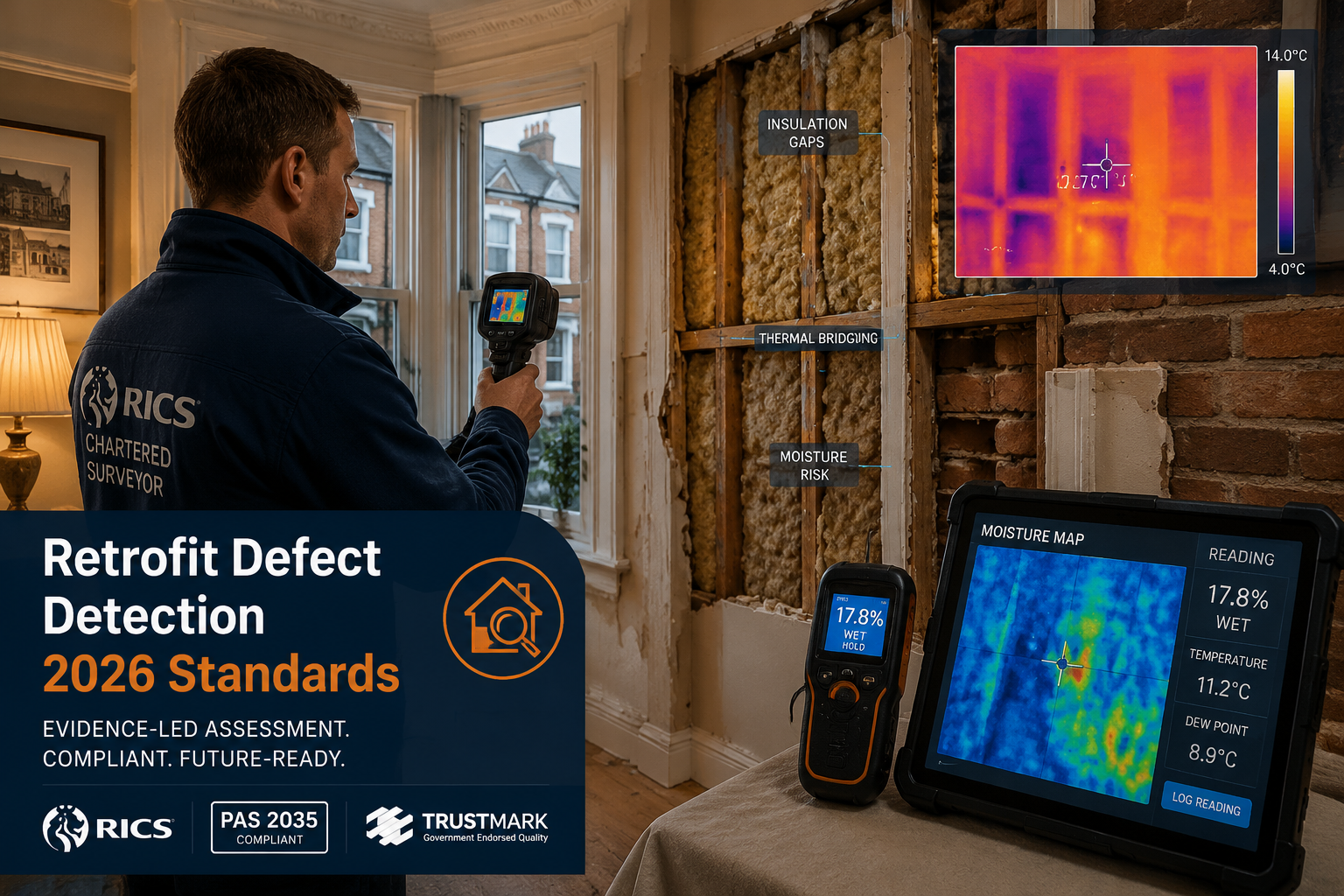
- Thermal imaging cameras — for identifying heat loss pathways, cold bridges, and insulation voids without invasive investigation
- Moisture mapping equipment — for detecting elevated moisture levels within walls, floors, and roofs, particularly relevant in post-retrofit assessments
- Air pressure testing — for evaluating airtightness in buildings where draught-proofing or insulation has been applied
- Drone-assisted roof inspection — enabling detailed visual assessment of roof coverings and flashings without scaffold
The formal inclusion of these tools in survey protocols responds directly to the failures identified at the Quality in Retrofit Summit. Many retrofit-related defects — particularly moisture accumulation behind insulation — are invisible to the naked eye and require diagnostic technology to detect reliably.
Surveyors offering drone surveys and damp surveys are now better positioned than ever to demonstrate compliance with 2026 standards, as these services directly align with the diagnostic requirements embedded in the updated protocols.
The Home Survey Standard 2nd Edition: April 2026 Progress
As of April 2026, RICS is actively reviewing consultation responses for the second edition of the Home Survey Standard, incorporating detailed and multifaceted feedback from across the profession [2]. This review process is expected to produce further refinements to survey scope, reporting requirements, and the treatment of retrofit-related findings.
The second edition is anticipated to provide even clearer guidance on how surveyors should handle properties that have received government-funded retrofit measures — a growing category given the scale of energy improvement schemes operating across the UK. Surveyors should monitor RICS communications closely, as the second edition may introduce additional mandatory requirements before the end of 2026.
Professional Credentials, Carbon Reporting, and Consumer Protections
The New Residential Retrofit Surveying Pathway
The launch of a dedicated RICS pathway to associate membership in Residential Retrofit Surveying represents a structural response to the competence gap identified at the Quality in Retrofit Summit [1]. This pathway creates a formal credential for surveyors specialising in retrofit assessment, distinct from general residential surveying qualifications.
Demand for the pathway has already outpaced available places, reflecting both the scale of the UK's retrofit challenge and the profession's recognition that specialist credentials will become increasingly valuable — and potentially required — for certain types of work [1].
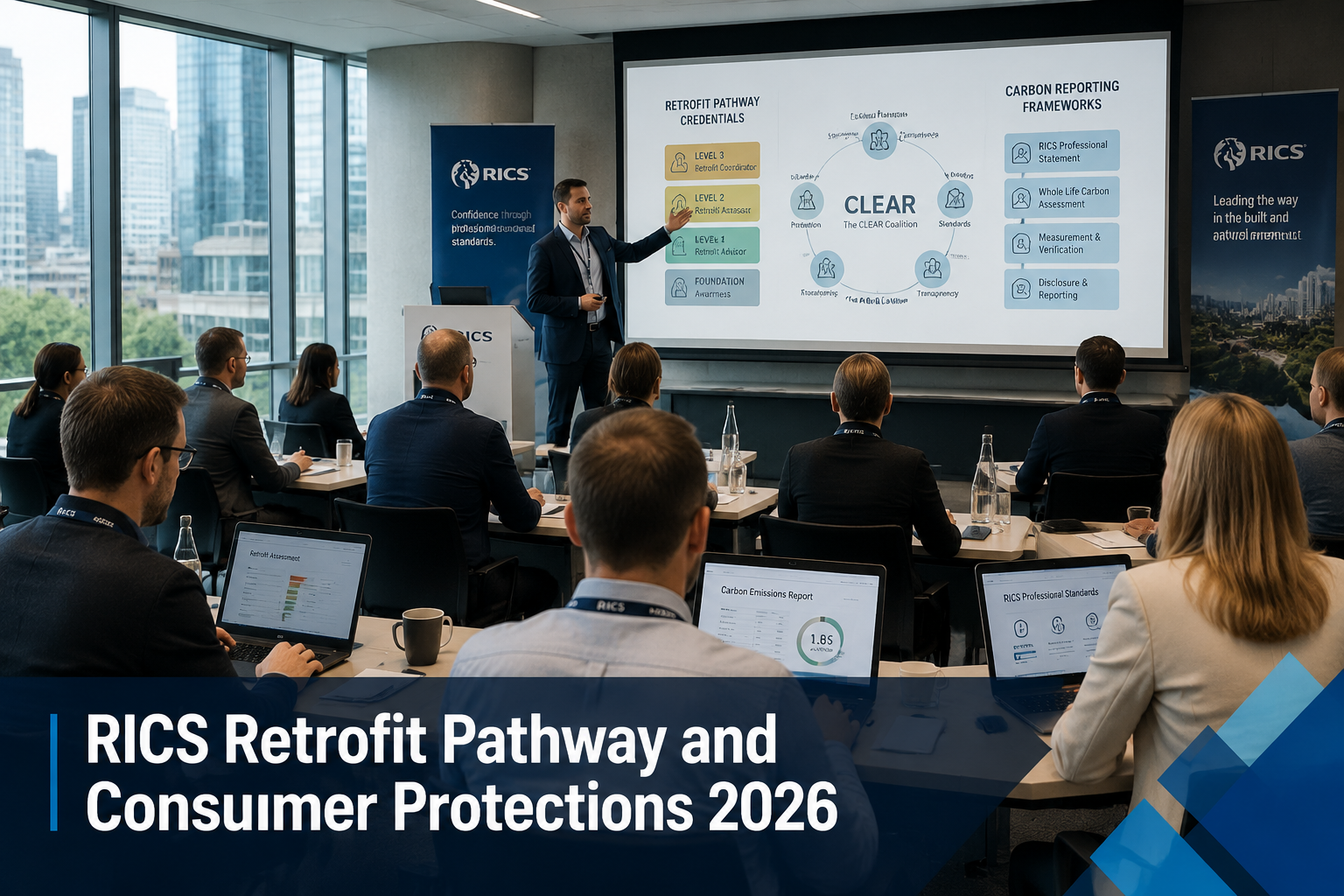
The Retrofit Academy supports this professional development through comprehensive Continuing Professional Development (CPD), technical events, and practical support for graduates and members working in the retrofit sector [7]. For surveyors building a retrofit practice in 2026, engagement with this CPD ecosystem is a professional necessity rather than an optional enhancement.
CLEAR: Whole-Life Carbon Reporting Enters the Survey Landscape
Launched at the Sustainable Buildings and Construction Summit in April 2026, the Coalition for Life Cycle Emissions Alignment and Reporting (CLEAR) aims to bring consistency and transparency to the measurement and reporting of whole-life carbon emissions in the built environment [3]. While CLEAR operates at a sector-wide level, its implications for building survey protocols are direct and growing.
Surveyors are increasingly expected to provide clients with information that goes beyond immediate physical condition — including an assessment of the carbon implications of recommended works, the embodied carbon of proposed retrofit materials, and the operational carbon savings achievable through different improvement pathways. CLEAR's framework provides the measurement and reporting consistency that makes such assessments credible and comparable.
"Physical surveys conducted by qualified professionals are essential to ensure cost-effective and efficient retrofit measures, reducing the risk of unintended consequences." — RICS Retrofit Standards [6]
Consumer Protections Embedded in 2026 Protocols
The building survey protocols post-RICS Quality in Retrofit Summit: 2026 updates for enhanced home standards place notable emphasis on consumer protection — a direct response to the harm caused by substandard retrofit assessments. Key consumer-facing protections now embedded in survey protocols include:
- Mandatory disclosure of any commercial relationships between the surveyor and retrofit contractors or product suppliers
- Independent assessment requirements that prohibit surveyors from both specifying and delivering retrofit measures on the same project
- Clear escalation pathways for clients who believe a survey has failed to identify retrofit-related defects
- Enhanced duty of care obligations when surveying properties occupied by vulnerable residents
For homeowners considering a structural survey or a specific defect report on a property with prior retrofit works, these protections mean the surveyor they engage is operating within a significantly more accountable framework than was the case even two years ago.
Practical Implications for Surveyors and Property Owners in 2026
What Surveyors Must Do Now
The updated protocols create a clear action list for practising surveyors:
- Confirm compliance with the RICS Residential Retrofit Standard — this is mandatory, not optional
- Adopt the BS 40104 systems-based approach for all retrofit-related assessments
- Invest in diagnostic technology or establish referral relationships with specialists who hold the required equipment
- Use standardized reporting templates for Level 2 and Level 3 surveys
- Pursue CPD aligned with retrofit competence, including engagement with the Retrofit Academy programme
- Monitor the Home Survey Standard 2nd Edition consultation outcomes for additional requirements
Surveyors working across London and the South East — including those serving clients through chartered surveyors in Central London and chartered surveyors in South East London — should be particularly attentive to the retrofit protocols, given the high proportion of older housing stock in these areas that is subject to energy improvement programmes.
What Property Owners Should Expect
Property owners commissioning surveys in 2026 should expect — and demand — a higher standard of assessment than was available under previous protocols. Specifically:
- Reports should address the building as an integrated system, not a list of isolated components
- Any prior retrofit works should be specifically assessed for quality, compliance, and unintended consequences
- Surveyors should be able to explain their diagnostic methodology and the tools used
- Condition ratings should be clearly defined and consistently applied
- The report should include explicit commentary on retrofit potential and associated risks
Those purchasing older properties or homes that have received energy improvement grants should consider whether a Level 3 RICS building survey is more appropriate than a Level 2 assessment, given the additional complexity that retrofit works introduce.
Conclusion
The building survey protocols post-RICS Quality in Retrofit Summit: 2026 updates for enhanced home standards represent a profession-wide reset — one driven by evidence of real harm to real homeowners and a determination to prevent its recurrence. The mandatory RICS Residential Retrofit Standard, the systems-based BS 40104 framework, standardized reporting templates, enhanced defect categorization, and the formal integration of diagnostic technology collectively raise the floor of acceptable survey practice.
Actionable next steps for surveyors:
- Audit current survey processes against the RICS Residential Retrofit Standard immediately
- Invest in or access thermal imaging and moisture mapping capability before taking on retrofit-related instructions
- Register interest in the RICS Residential Retrofit Surveying Pathway to formalise specialist credentials
- Engage with Retrofit Academy CPD to maintain competence as standards continue to evolve
Actionable next steps for property owners:
- When commissioning any survey on a property with prior retrofit works, specifically ask the surveyor how they will assess the quality and consequences of those works
- Request confirmation that the surveyor is operating under the 2026 RICS standards
- Consider whether a specialist defect survey or damp survey is warranted alongside a standard home survey, particularly for properties with external wall insulation or significant draught-proofing works
The retrofit challenge facing UK housing stock is enormous. The updated survey protocols are the profession's commitment to ensuring that challenge is met with the competence, independence, and rigour it demands.
References
[1] Adapting Building Surveys For 2026 Retrofit Projects Rics Guidance Post Quality In Retrofit Summit – https://nottinghillsurveyors.com/blog/adapting-building-surveys-for-2026-retrofit-projects-rics-guidance-post-quality-in-retrofit-summit?utm_source=openai
[2] Home Survey Standard 2nd Edition April 2026 Update – https://www.rics.org/news-insights/home-survey-standard-2nd-edition-april-2026-update?utm_source=openai
[3] Rics At The Sustainable Buildings And Construction Summit 2026 – https://www.rics.org/news-insights/rics-at-the-sustainable-buildings-and-construction-summit-2026?utm_source=openai
[4] Retrofit Leaders Meet Rics Hq Discuss Importance Transformative Projects – https://www.rics.org/news-insights/retrofit-leaders-meet-rics-hq-discuss-importance-transformative-projects?utm_source=openai
[5] Rics Quality Standards In Home Surveys Implementing 2026 Strengthened Assessment Protocols – https://wimbledonsurveyors.com/rics-quality-standards-in-home-surveys-implementing-2026-strengthened-assessment-protocols/?utm_source=openai
[6] Retrofit – https://www.rics.org/profession-standards/rics-standards-and-guidance/sector-standards/real-estate-standards/retrofit?utm_source=openai
[7] Quality In Retrofit Summit 2026 – https://retrofitacademy.org/quality-in-retrofit-summit-2026/?utm_source=openai