End-of-lease repair claims in the UK commercial property market have surged sharply as recovering asset values push landlords to pursue maximum recovery — yet fewer than half of all terminal dilapidations claims survive a Section 18(1) challenge intact. That single statutory cap, embedded in the Landlord and Tenant Act 1927, continues to reshape how expert witnesses approach Dilapidations Valuations in Commercial Leases: Expert Witness Tactics for Terminal Schedule Negotiations 2026, making diminution methodology the most powerful tool in any negotiation arsenal.
As commercial markets stabilise following years of post-pandemic volatility [8], lease expiries are accelerating across office, retail, and industrial sectors. Both landlords and tenants need to understand not just what repairs are owed — but what those repairs are actually worth in law.
Key Takeaways 📋
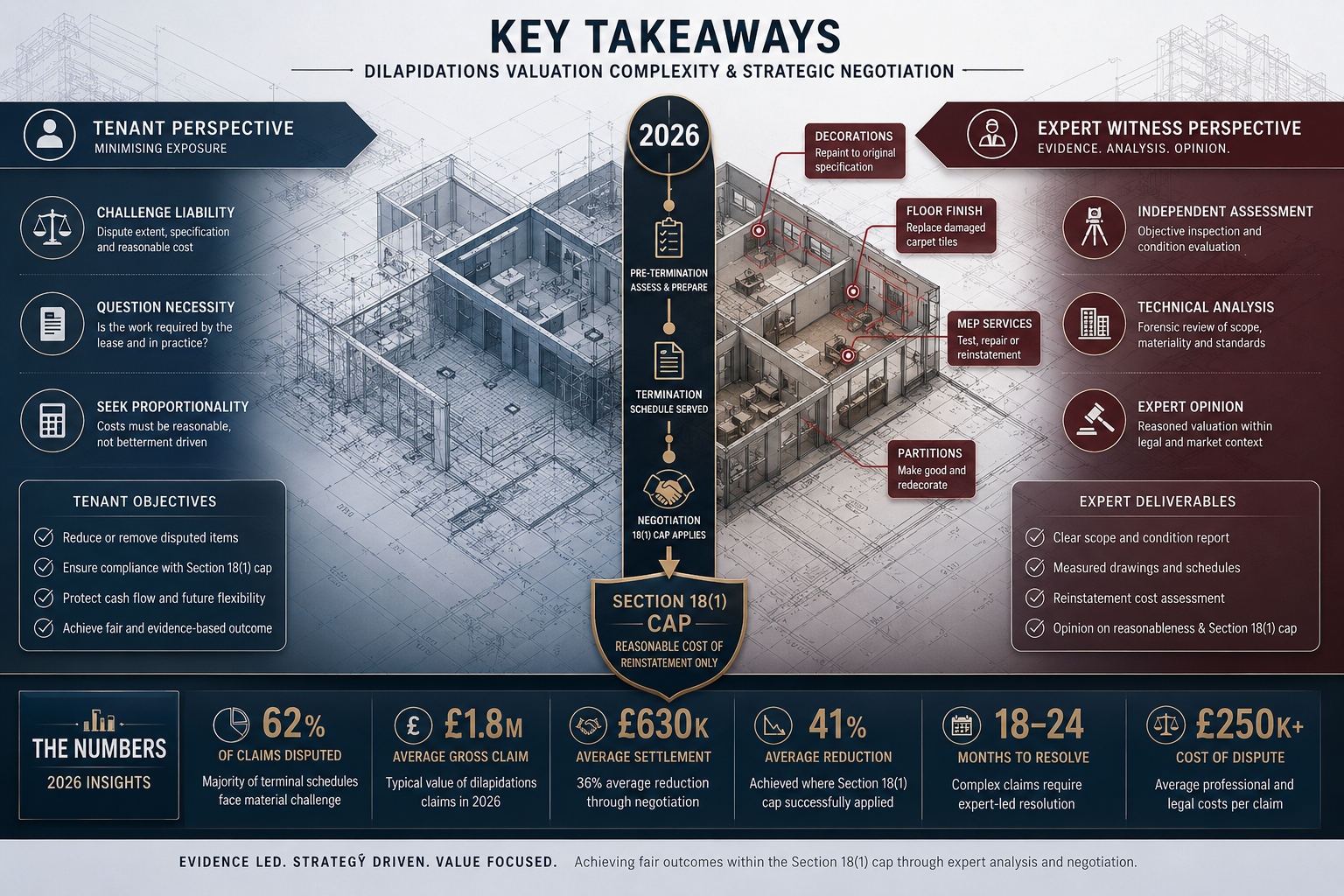
- Section 18(1) LTA 1927 caps terminal dilapidations damages at the lower of repair cost or diminution in the landlord's reversionary value — not automatically the full cost of works [1][2].
- Diminution valuations are now a standard expert witness tool and may be required under the Dilapidations Protocol before litigation commences [1].
- RICS-endorsed quantification methods — particularly the dual hypothetical auction approach — set the benchmark for credible expert evidence.
- Single Joint Experts (SJEs) are increasingly used in disputes, demanding a higher standard of objectivity and methodology transparency.
- Rising commercial property values in 2026 mean landlords face stronger scrutiny of windfall claims, while tenants have more to gain from robust diminution evidence [3][8].
Understanding the Section 18(1) Cap: The Foundation of Expert Witness Strategy
Every credible approach to Dilapidations Valuations in Commercial Leases begins with a firm grasp of Section 18(1) of the Landlord and Tenant Act 1927. This provision does two things simultaneously:
- It limits a landlord's damages to the diminution in value of the landlord's reversionary interest caused by the tenant's breaches.
- It provides a superimposed cap: if the landlord intends to demolish or substantially alter the premises, no damages are recoverable at all for disrepair.
💡 Pull Quote: "Even if works cost £200,000, if the impact on the landlord's reversionary value is only £100,000, damages are capped at £100,000." [1]
This is not a technicality — it is the central battleground in most terminal schedule disputes. Landlords cannot recover a "windfall" beyond their actual financial loss [2]. Expert witnesses who fail to address this point directly expose their clients to costs sanctions and weakened negotiating positions.
Why the Cap Matters More in 2026
Commercial real estate valuations are recovering in many UK sectors [3][8], meaning that well-maintained properties command meaningfully higher prices than distressed ones. Paradoxically, this recovery increases the risk of inflated dilapidations claims — landlords see rising values and assume repair costs translate directly into recoverable damages. They often do not.
A commercial property surveyor instructed as an expert witness must demonstrate, through evidence-based valuation, exactly how much the disrepair has depressed the reversionary value — no more, no less.
RICS-Endorsed Quantification Methods for Diminution Valuations
The RICS Guidance Note on Dilapidations in England and Wales (and its associated professional standards) sets out the methodology that expert witnesses are expected to follow. Understanding these methods is central to Dilapidations Valuations in Commercial Leases: Expert Witness Tactics for Terminal Schedule Negotiations 2026.
The Dual Hypothetical Auction Method
The standard approach involves two hypothetical valuations conducted at the lease expiry date:
| Valuation | Scenario | Purpose |
|---|---|---|
| Valuation A | Property in its actual dilapidated state | Establishes current market value |
| Valuation B | Property as if all tenant covenants were fully complied with | Establishes "repaired" market value |
| Difference (B − A) | The Section 18(1) cap | Maximum recoverable damages |
The Dilapidations Protocol in England and Wales requires that, in some cases, a landlord must commission a diminution valuation before issuing proceedings [1]. A landlord who proceeds directly to a cost-of-works claim without addressing diminution risks challenge and potential costs sanctions under the Protocol's proportionality objectives [2].
This dual-auction method is not simply an arithmetic exercise. It demands genuine market expertise — knowledge of comparable transactions, investor appetite, and how buyers in the open market would actually price the specific defects identified in the terminal schedule.
Comparable Evidence and Market Conditions
Expert witnesses must anchor both hypothetical valuations in real comparable evidence. In 2026, with commercial real estate showing differentiated recovery across sectors [6][8], this means:
- Office sector: Vacancy rates remain elevated in some locations; buyers may discount dilapidated stock heavily, widening the diminution gap.
- Industrial/logistics: Strong occupier demand means well-maintained stock commands a premium; diminution for disrepair can be significant.
- Retail: Highly location-dependent; expert witnesses must be granular about sub-market conditions.
For a deeper understanding of how property condition and market factors interact in formal valuations, the key factors affecting property valuation are worth reviewing before instructing an expert.
The Cost-of-Works Schedule: Still Essential
Even where a diminution valuation caps the claim, a detailed dilapidation survey and costed schedule of works remains essential. It serves multiple functions:
- Establishes the prima facie claim before the Section 18(1) test is applied.
- Provides the landlord's opening position in negotiations.
- Identifies which items of disrepair genuinely affect market value (and which do not).
- Supports any claim for loss of rent during a notional repair period.
⚠️ Key Point: Not every item in a terminal schedule will affect reversionary value. A cracked internal partition in a building scheduled for refurbishment may cost £5,000 to repair but contribute £0 to diminution. Expert witnesses must be selective and evidence-led.

Expert Witness Tactics for Terminal Schedule Negotiations 2026
The role of the expert witness in Dilapidations Valuations in Commercial Leases: Expert Witness Tactics for Terminal Schedule Negotiations 2026 has evolved significantly. Courts and parties alike now expect a higher standard of transparency, methodology disclosure, and genuine independence.
Instructing the Right Expert
The choice of expert witness is itself a tactical decision. The expert must hold appropriate RICS qualifications and be able to demonstrate:
- Relevant experience in the specific property type and geographic market.
- Independence — the expert's duty is to the court, not the instructing party.
- Methodology transparency — the ability to explain and defend the valuation approach under cross-examination.
Working with registered RICS valuers ensures that the expert's credentials meet the standards expected in both pre-action negotiations and litigation.
Single Joint Experts: Opportunities and Risks 🤝
Single Joint Experts (SJEs) are increasingly appointed in dilapidations disputes, particularly where the claim value does not justify two sets of expert costs. An SJE is instructed jointly by both parties and owes a duty to the court rather than to either side.
For landlords, an SJE appointment removes the risk of a tenant's expert producing a dramatically lower diminution figure unchallenged — but it also limits the ability to present a partisan valuation.
For tenants, an SJE can be highly advantageous if the landlord's initial claim significantly overstates diminution. A well-briefed SJE, provided with strong comparable evidence by the tenant's solicitors, will apply the Section 18(1) cap rigorously.
Tactical considerations for SJE appointments:
- Submit detailed written questions and comparable evidence to the SJE early.
- Ensure the SJE's instructions are comprehensive and agreed before appointment.
- Review the SJE's draft report carefully — parties can seek clarification but cannot direct the expert's conclusions.
- Consider whether a Part 35 CPR application to appoint separate experts is justified by the claim value.
The Negotiation Phase: Pre-Action Protocol Compliance
The Dilapidations Protocol sets out a structured pre-action process that both parties must follow before litigation. Key steps include:
- 📄 Terminal Schedule: Served by the landlord (typically within 56 days of lease expiry).
- 📝 Quantified Demand: A costed schedule with supporting evidence.
- 🔍 Scott Schedule: A structured document identifying each item of claim, the tenant's response, and the expert's assessment.
- 🤝 Without Prejudice Meeting: Experts meet to narrow the issues in dispute.
- ⚖️ Diminution Valuation: Provided by the landlord where required by the Protocol.
Failure to follow the Protocol can result in costs sanctions, even if the substantive claim succeeds. In 2026, courts continue to take Protocol compliance seriously as part of the proportionality agenda in civil litigation.
Negotiating the Scott Schedule
The Scott Schedule is the working document of terminal schedule negotiations. Each item is typically presented in columns:
| Column | Content |
|---|---|
| Item | Description of alleged breach |
| Landlord's Claim | Cost of remedial works |
| Tenant's Response | Admission, denial, or alternative cost |
| Expert's Comment | Independent assessment |
| Agreed/Disputed | Status |
Expert witnesses should approach the Scott Schedule with precision. Conceding items where the tenant has a clear defence (e.g., fair wear and tear, supersession by landlord's intended works) strengthens credibility on the items that are genuinely disputed.
Supersession: The Second Major Defence 🏗️
Alongside Section 18(1), supersession is the other critical tactical concept. If a landlord intends to demolish or significantly alter the premises after lease expiry, any dilapidations claim for works that would be superseded by those alterations is extinguished.
Expert witnesses for tenants should always investigate:
- Planning applications submitted by the landlord.
- Landlord's own correspondence about intended use.
- Evidence of marketing the property for redevelopment.
A commercial building survey conducted at or near lease expiry can provide objective condition evidence that supports either party's position on which items are genuinely in disrepair and which have been superseded.
Dispute Resolution: From Negotiation to Adjudication
When pre-action negotiations fail, parties have several routes to resolution. Understanding these options shapes expert witness preparation from the outset.
Mediation
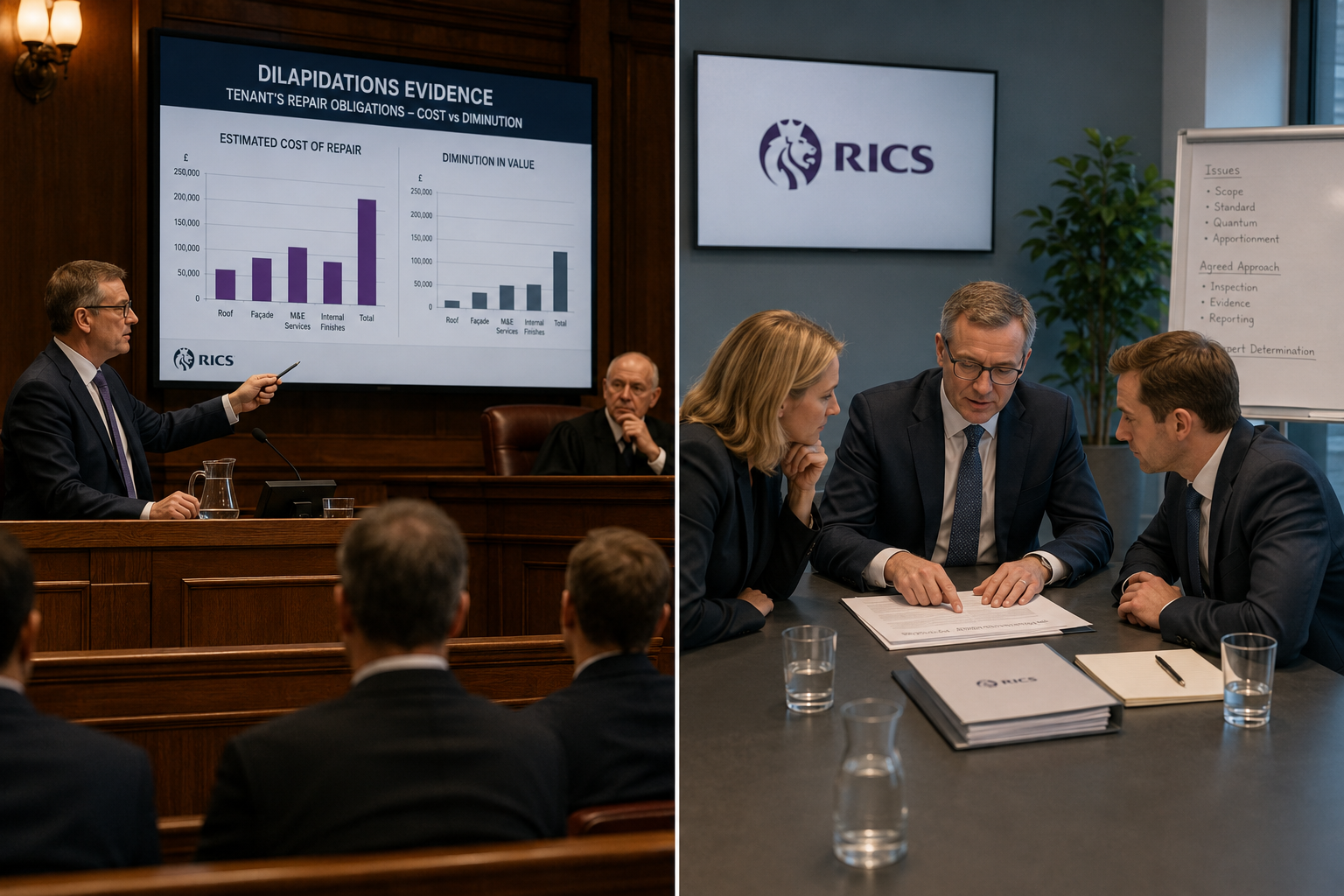
Mediation is strongly encouraged by the courts and is often the most cost-effective route for mid-range dilapidations disputes (typically £50,000–£500,000). The expert witness plays a supporting role — preparing a clear, accessible summary of the valuation evidence for the mediator and the opposing party.
Effective mediation preparation includes:
- A concise expert summary (not the full report) explaining the Section 18(1) position.
- A clear statement of which items are agreed and which remain disputed.
- A realistic assessment of litigation risk for the instructing party.
RICS Dispute Resolution Service
The RICS offers an independent expert determination service for dilapidations disputes. This is binding on both parties and is often faster and cheaper than court proceedings. The expert determiner will typically be a senior RICS member with specific dilapidations experience.
County Court and High Court Litigation
For larger or more complex claims, litigation remains the ultimate backstop. Expert witnesses in court proceedings must comply fully with CPR Part 35 and the accompanying Practice Direction. Key obligations include:
- The expert's overriding duty is to the court.
- The report must contain a statement of truth.
- Experts must attend a without-prejudice meeting and produce a joint statement of agreed and disputed issues.
Understanding the methods of valuation used in expert reports helps legal teams scrutinise the opposing expert's evidence effectively.
Practical Checklist for Landlords and Tenants in 2026 ✅
For Landlords:
- Instruct a qualified surveyor to prepare a terminal schedule promptly after lease expiry.
- Commission a diminution valuation early — do not wait for the tenant to challenge.
- Investigate and document the landlord's intended use of the property post-expiry.
- Ensure the quantified demand complies with the Dilapidations Protocol.
- Consider the cost-benefit of litigation versus a negotiated settlement.
For Tenants:
- Obtain an independent review of the terminal schedule as soon as it is received.
- Commission a counter-schedule identifying items disputed on liability and quantum.
- Gather evidence of the landlord's intended works (planning applications, marketing materials).
- Instruct a valuer to prepare a Section 18(1) diminution valuation.
- Engage proactively in the Protocol process to demonstrate good faith.
For tenants and landlords navigating complex lease-end obligations, understanding rent review valuation principles can also provide useful context for how commercial property values are assessed at key lease events.
The 2026 Market Context: Why Valuations Are More Contested Than Ever
Commercial real estate valuations in 2026 are shaped by a complex mix of recovering investor confidence, elevated construction costs, and sector-specific demand patterns [3][4]. These conditions directly affect both sides of the Section 18(1) equation:
- Rising construction costs inflate the cost-of-works schedule, making the Section 18(1) cap more likely to bite.
- Recovering capital values in prime locations mean diminution evidence must be carefully calibrated — a property in a strong market may recover value quickly even from a dilapidated state.
- Distressed secondary stock in weaker locations may show a larger diminution gap, supporting higher landlord recoveries [9].
Expert witnesses must stay current with market data. The use of outdated comparables — even six months old in a fast-moving market — can fatally undermine a valuation opinion under cross-examination [4][7].
💡 Pull Quote: "In a recovering market, the gap between a dilapidated and a compliant property narrows — and so does the Section 18(1) cap. Tenants who commission timely diminution valuations in 2026 are consistently achieving better negotiated outcomes."
Conclusion: Actionable Next Steps for 2026
Dilapidations Valuations in Commercial Leases: Expert Witness Tactics for Terminal Schedule Negotiations 2026 demand a rigorous, evidence-based approach from both sides of the negotiating table. The Section 18(1) cap remains the most powerful tool available to tenants — and the most important constraint on landlord recoveries — but it only works when properly evidenced through a credible diminution valuation.
Actionable next steps:
- Instruct early. Whether acting for landlord or tenant, engage a qualified RICS surveyor before the lease expires — not after the terminal schedule lands.
- Commission a diminution valuation. Do not rely solely on a cost-of-works schedule. A dual hypothetical auction valuation is now standard practice and expected under the Protocol.
- Investigate supersession. Check planning records and landlord correspondence for evidence of intended works that would extinguish part of the claim.
- Engage with the Protocol. Courts take compliance seriously. A well-managed pre-action process almost always produces better outcomes than rushing to litigation.
- Choose your expert carefully. In SJE appointments especially, the quality and methodology of the expert's evidence will determine the outcome. Work with registered RICS valuers who have demonstrable dilapidations experience.
- Use mediation. For most mid-range disputes, a well-prepared mediation — supported by clear expert evidence — will deliver a faster and more cost-effective resolution than court proceedings.
The commercial property market's recovery in 2026 makes terminal dilapidations claims both more common and more contested [8][10]. Parties who invest in expert, RICS-compliant valuation evidence from the outset will consistently outperform those who rely on inflated schedules or underprepared defences.
References
[1] Watch – https://www.youtube.com/watch?v=5OEx0nMl-oI
[2] Dilapidations Explained What Commercial Tenants And Landlords Need To Know – https://www.mogersdrewett.com/dilapidations-explained-what-commercial-tenants-and-landlords-need-to-know/
[3] Commercial Real Estate Valuations 2026 – https://svncornerstone.com/commercial-real-estate-valuations-2026/
[4] What Affects A Commercial Property's Appraised Value In 2026 – https://rweiler.com/blog/what-affects-a-commercial-propertys-appraised-value-in-2026/
[5] A Layman's Guide To Dilapidations – https://www.savills.co.uk/blog/article/215099/commercial-property/a-laymans-guide-to-dilapidations.aspx
[6] Commercial Real Estate Trends – https://www.jpmorgan.com/insights/real-estate/commercial-real-estate/commercial-real-estate-trends
[7] Major Methods Commercial Real Estate Valuation – https://www.altusgroup.com/insights/major-methods-commercial-real-estate-valuation/
[8] Will Commercial Real Estate Valuations Improve 2026 – https://privatewealth.brookfield.com/insight/will-commercial-real-estate-valuations-improve-2026
[9] Navigating Distressed Properties In Commercial Real Estate – https://www.forvismazars.us/forsights/2026/03/navigating-distressed-properties-in-commercial-real-estate
[10] A New Dawn In Real Estate 2026 U.S. Commercial Real Estate Outlook – https://www.marketsgroup.org/strategic-insights/a-new-dawn-in-real-estate-2026-u-s-commercial-real-estate-outlook/