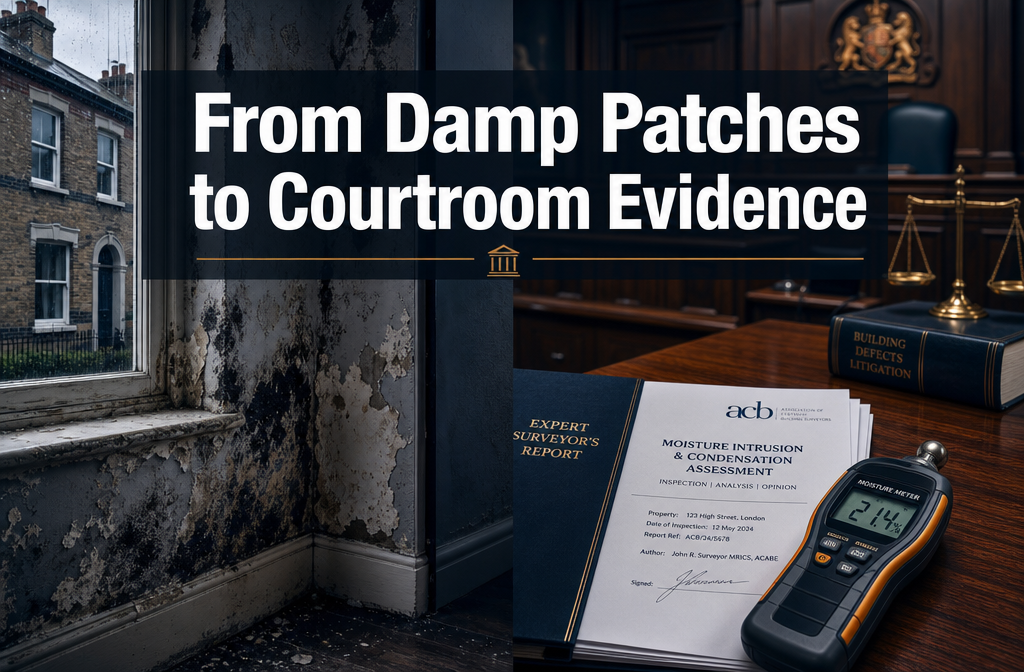
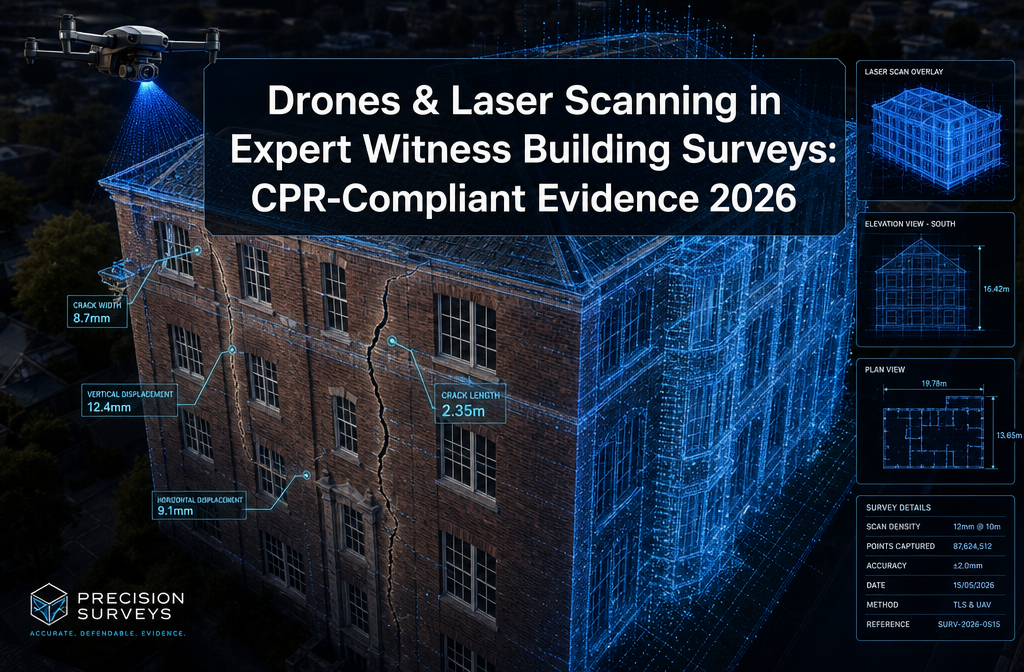
Damp and mould are now classified as a Category 1 hazard under the Housing Health and Safety Rating System — the same category as exposed wiring and structural collapse. Yet moisture misdiagnosis remains one of the most common triggers for professional negligence claims against UK building surveyors. The gap between a damp patch on a wall and a defensible expert witness report is wider than many practitioners realise, and in 2026, that gap carries serious professional and legal consequences.
This article examines the full journey — from damp patches to courtroom evidence: handling moisture and mould defects as a UK building surveyor in 2026 — covering diagnostic best practice, report writing standards, valuation implications, and the expert witness expectations that are reshaping how surveyors work.
Key Takeaways
- 🏠 Damp and mould are a Category 1 HHSRS hazard — government guidance frames them as a health risk, not a lifestyle issue, and courts are using this benchmark to assess surveyor reports.
- 🔬 Diagnosis must be multi-method — moisture meters alone are insufficient; thermal imaging, salt analysis, and whole-building context are all expected.
- 📋 Report language matters in court — vague or unexplained readings can be challenged under cross-examination; clear causal reasoning is essential.
- ⚖️ Expert witness standards apply more broadly — even standard Level 2 and Level 3 survey reports are increasingly scrutinised in post-purchase disputes.
- 💷 Moisture defects affect valuation — surveyors must quantify remediation costs and flag risk clearly, or face negligence exposure.
Why Moisture Defects Have Become a Legal Flashpoint in 2026
The death of two-year-old Awaab Ishak in 2020 — caused by prolonged exposure to mould in a social housing property — fundamentally changed the legal and regulatory landscape for damp and mould in the UK. By 2026, the ripple effects are felt across every tier of the profession.
The UK Government's guidance, Understanding and Addressing the Health Risks of Damp and Mould in the Home, states unequivocally that damp and mould are not the tenant's fault and must be treated as serious health hazards requiring timely, evidence-based investigation and remediation [6]. This framing is now routinely used in disrepair litigation, coroners' inquiries, and housing tribunal proceedings — and surveyors' reports are measured against it.
For building surveyors, this creates a dual obligation:
- Diagnostic accuracy — correctly identifying the type, cause, and extent of moisture.
- Evidential quality — producing written records that can withstand legal scrutiny.
Surveyors who conduct professional damp surveys must now treat every instruction as potentially litigation-adjacent. A report written casually for a homebuyer today may appear as exhibit A in a negligence claim two years from now.
The Three Moisture Types: Getting the Diagnosis Right
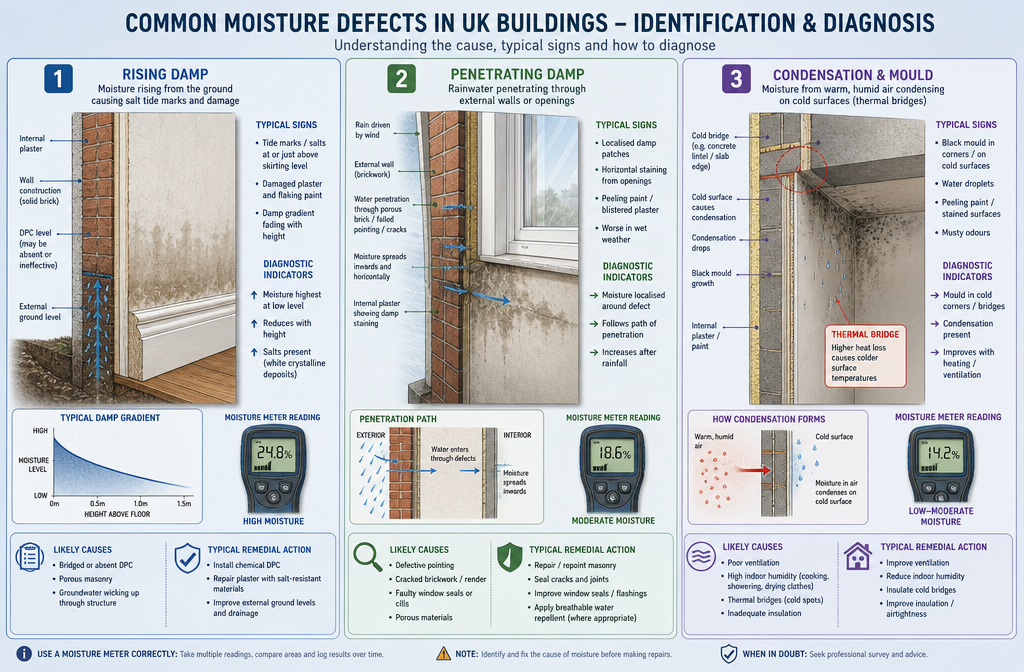
The foundation of defensible moisture reporting is accurate classification. Current professional guidance — and the courts — expect surveyors to distinguish clearly between three distinct moisture pathways [1]:
🔵 Condensation
- Cause: Warm, humid air meeting cold surfaces; inadequate ventilation; cold bridging.
- Visual signs: Mould growth on external walls, window reveals, ceiling corners.
- Key diagnostic clue: Mould follows thermal patterns, not water ingress routes.
- 2026 context: High-airtightness new builds without adequate mechanical ventilation are generating a new wave of condensation-related mould claims [5].
🟠 Penetrating Damp
- Cause: Defective roofing, guttering, flashings, pointing, window seals, or drainage.
- Visual signs: Horizontal staining, damp patches correlating with external defects.
- Key diagnostic clue: Moisture follows the path of ingress; readings elevated near specific building elements.
- Drainage failures are a particularly common cause — a drainage survey can identify blocked or cracked runs that drive persistent penetrating damp.
🟡 Rising Damp
- Cause: Failed or absent damp-proof course (DPC); bridged DPC; ground levels too high.
- Visual signs: Tide marks at low level, salt crystallisation, deteriorating plaster.
- Key diagnostic clue: True rising damp rarely exceeds 1.2 metres; salt analysis confirms hygroscopic moisture absorption.
💬 Pull Quote: "Failing to distinguish between condensation and rising damp is not just a technical error — it is the kind of misdiagnosis that ends up in front of a judge."
Specialist technical guidance on diagnosing rising damp emphasises that surveyors must avoid over-reliance on simple surface moisture readings. Salt analysis, DPC history, and differentiation from other moisture sources are all required for a defensible conclusion [8].
Diagnostic Tools: What the Courts Expect Surveyors to Use
The RICS, Historic England, and the Property Care Association's Joint Position Statement on moisture in traditional buildings sets the current gold standard [2]. Its core requirements:
| Tool / Method | Purpose | Limitation |
|---|---|---|
| Moisture meter (resistance type) | Quick surface reading; flags elevated moisture | Affected by salts, plaster type, temperature |
| Moisture meter (capacitance type) | Non-invasive; useful for mapping | Cannot confirm depth of moisture |
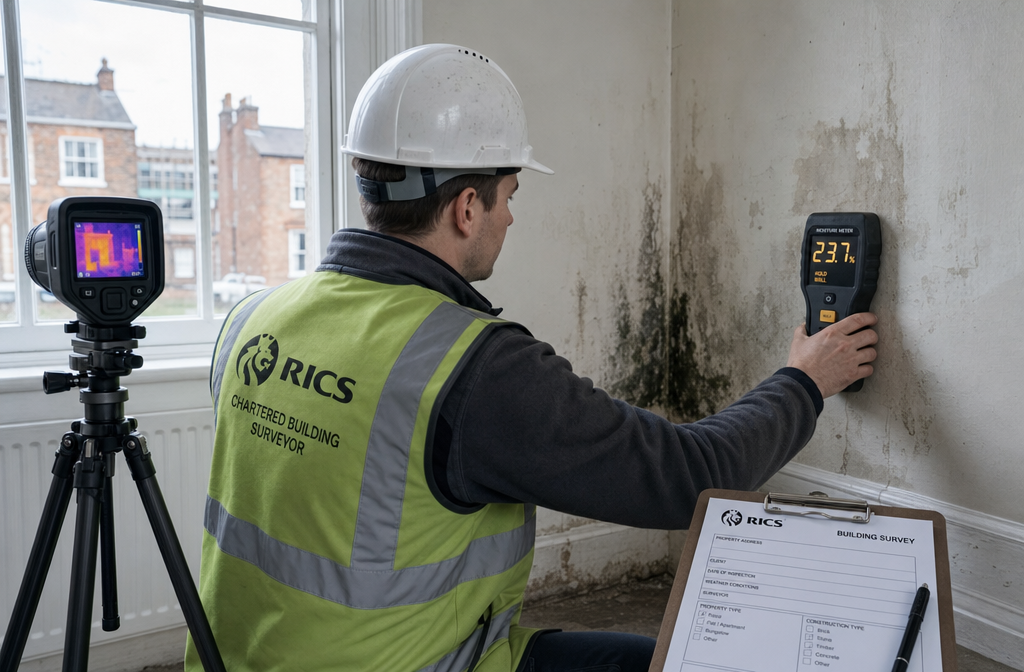
| Thermal imaging camera | Identifies cold bridges, hidden moisture patterns | Requires temperature differential; not definitive alone |
| Salt analysis | Confirms hygroscopic salts; supports rising damp diagnosis | Requires laboratory or field test kit |
| Relative humidity monitoring | Tracks condensation risk over time | Requires extended monitoring period |
| Invasive investigation | Exposes concealed defects | Requires client consent; may need specialist |
The RICS Joint Position Statement warns explicitly against relying on single data points or uncritical damp meter readings when forming opinions that may later be scrutinised in court [2]. This is a direct response to the kind of practitioner discussions now appearing publicly — for example, debates around what a "42% moisture reading" on a handheld meter actually means, and whether the report explained the instrument's scale and implications clearly enough [9].
Best practice in 2026: Surveyors should:
- State the type of meter used and its measurement scale.
- Explain what the reading means for material condition.
- Combine at least two diagnostic methods before forming a causal opinion.
- Document findings with photographs, moisture maps, and measured evidence.
This approach is consistent with the whole-building diagnostic methodology required by the RICS Joint Position Statement, which demands understanding of the building's construction, climate, maintenance history, and occupancy patterns — not just a spot reading [2].
Reporting Language That Survives Cross-Examination
The journey from damp patches to courtroom evidence: handling moisture and mould defects as a UK building surveyor in 2026 depends as much on how findings are written as on what is found. Vague language is a liability.
❌ Weak Reporting Language
- "Some dampness was noted to the north wall."
- "Moisture readings were elevated in places."
- "The cause of the damp is unclear but may relate to penetrating damp or condensation."
✅ Defensible Reporting Language
- "Resistance moisture meter readings of 78–85% WME were recorded to the base of the north wall, consistent with hygroscopic salt contamination from a defective or bridged DPC. Salt analysis confirmed the presence of nitrates and chlorides. The pattern is consistent with rising damp rather than condensation or penetrating damp."
- "Thermal imaging identified a cold bridge at the junction of the flat roof and the external wall, correlating with the location of mould growth. This is consistent with condensation caused by inadequate insulation detailing rather than water ingress."
The difference is causal reasoning — linking the reading to the mechanism, and the mechanism to a specific defect. This is exactly what solicitors, barristers, and expert witnesses look for when a report enters legal proceedings [7].
For surveyors conducting RICS Level 3 building surveys, this level of detail is expected as standard. But even Level 2 homebuyer surveys are increasingly scrutinised in post-purchase disputes, meaning the bar for moisture reporting has effectively risen across all survey types [4].
Structuring the Moisture Section of a Survey Report
A robust moisture section should include:
- Location and extent — precise room, wall, height above floor level.
- Visual description — staining, mould, tide marks, salt crystallisation.
- Instrument readings — meter type, scale, values recorded.
- Diagnostic interpretation — most likely cause with reasoning.
- Risk rating — aligned to RICS condition ratings (1, 2, or 3).
- Recommended action — further investigation, specialist report, or remediation.
- Photographs — numbered, dated, and cross-referenced in the text.
Moisture Defects and Valuation: Quantifying the Risk
Moisture defects are not just a technical matter — they carry direct financial implications that surveyors must communicate clearly. Failing to flag the cost implications of damp is a common thread in negligence claims.
When moisture defects are identified, surveyors should consider:
- Remediation cost estimates — even indicative ranges help clients make informed decisions. Understanding damp survey costs and damp and timber report costs gives clients a realistic picture of what specialist follow-up involves.
- Impact on mortgage valuation — lenders may retain funds or decline to lend against properties with active moisture defects.
- Negotiation leverage — a well-evidenced moisture report gives buyers a quantified basis for price renegotiation.
- Insurance implications — undisclosed or misdiagnosed moisture can void building insurance claims.
💬 Pull Quote: "A surveyor who identifies a damp patch but fails to explain its remediation cost or its impact on the property's value has only done half the job."
The damp and timber report is often the appropriate next step after a survey flags moisture concern — and surveyors should recommend this explicitly, in writing, rather than leaving clients to infer the need.
From Survey Report to Expert Witness: The Legal Journey
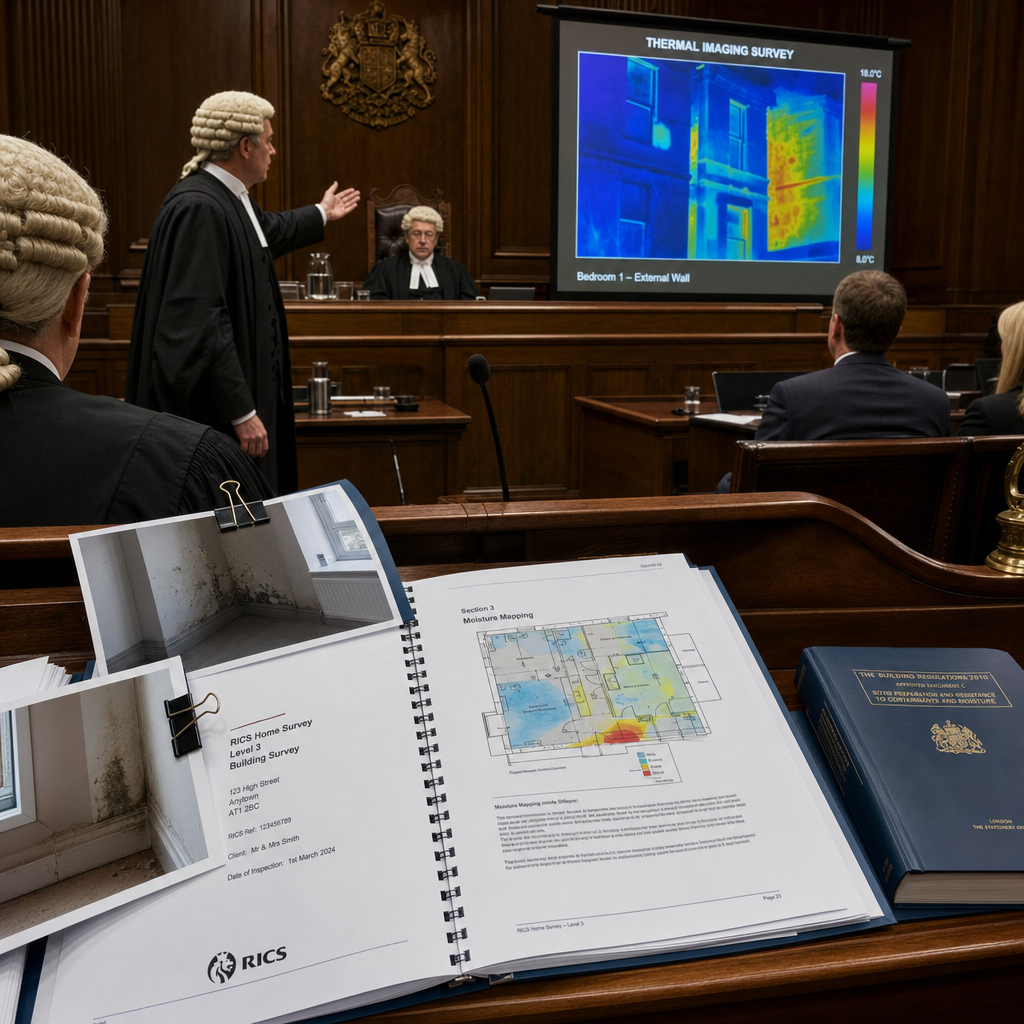
When moisture disputes escalate — whether in disrepair claims, post-purchase negligence actions, or landlord-tenant proceedings — surveyors may be called upon as expert witnesses. This is where the standards of from damp patches to courtroom evidence: handling moisture and mould defects as a UK building surveyor in 2026 become most acute.
Civil Procedure Rules (CPR) and the Expert's Duty
Under CPR Part 35, an expert witness's primary duty is to the court, not to the instructing party. This means:
- Opinions must be objective and evidence-based.
- Limitations and uncertainties must be acknowledged, not concealed.
- The methodology used must be explained and defensible.
The RICS Joint Position Statement aligns closely with these requirements, emphasising clear record-keeping, proportional investigation, and evidence-based recommendations [2]. Surveyors whose original reports were prepared to this standard are far better placed when cross-examined.
What Solicitors Look for in Moisture Reports
When instructing an expert witness or reviewing a surveyor's original report, solicitors and barristers typically assess:
- ✅ Was the correct diagnostic methodology followed?
- ✅ Were findings corroborated by multiple data sources?
- ✅ Is the causal reasoning clear and logical?
- ✅ Were the limitations of the investigation acknowledged?
- ✅ Does the report comply with RICS guidance and government standards?
Specialist surveying services in 2026 increasingly position their reports as explicitly suitable for legal disputes and insurance claims, combining moisture mapping, photographic evidence, and clear causal analysis [7]. This is now the benchmark, not the exception.
Common Expert Witness Pitfalls for Moisture Cases
| Pitfall | Risk |
|---|---|
| Unexplained meter readings | Challenged as meaningless without context |
| Single-method diagnosis | Undermined by alternative explanations |
| Failure to acknowledge limitations | Damages credibility under cross-examination |
| Vague causal language | Cannot support a finding of liability |
| Missing photographs | Leaves findings unverifiable |
New Build Moisture Risks: A Growing Area of Liability
New builds are no longer assumed to be moisture-free. In 2026, ventilation failures and high-airtightness construction without adequate mechanical ventilation are a key driver of condensation and mould in recently built homes [5]. Surveyors inspecting new builds must:
- Assess the ventilation strategy — is it adequate for the airtightness level?
- Identify cold bridges — poorly detailed insulation at junctions is a common latent defect.
- Check drainage and waterproofing details — defective materials or poor workmanship may not be visible without invasive investigation.
Where latent defects or fitness-for-habitation disputes reach court, these technical observations often become central to allocating liability between builder, landlord, and designer [5]. Surveyors who flag these risks clearly — and explain them in plain language — provide genuine protection for their clients and themselves.
For buyers uncertain about which survey level is appropriate, understanding the difference between Level 2 and Level 3 surveys is an important first step, particularly where moisture risk is a concern.
Conclusion: Actionable Steps for Surveyors in 2026
The professional and legal environment around moisture and mould has fundamentally shifted. From damp patches to courtroom evidence: handling moisture and mould defects as a UK building surveyor in 2026 is not a hypothetical journey — it is a path that thousands of survey reports travel every year, often without the surveyor realising it at the time of writing.
Actionable Next Steps for UK Building Surveyors
- Audit your diagnostic toolkit — ensure you are using at least two methods for moisture investigation and documenting both.
- Review your report language — replace vague descriptions with precise, causally reasoned findings.
- Explain your instruments — always state the meter type, scale, and what the reading means for material condition.
- Align with government guidance — the HHSRS Category 1 framework and the government's damp and mould health guidance [6] are the benchmarks courts use.
- Follow the RICS Joint Position Statement — the whole-building diagnostic approach [2] is not optional for traditional buildings.
- Recommend specialist follow-up explicitly — don't leave clients to infer the need for a damp and timber report or drainage survey.
- Treat every report as potential evidence — the standard of care expected in court is the standard of care that should be applied on every instruction.
The surveyor who investigates thoroughly, reasons clearly, and writes precisely is not just protecting their client — they are protecting their professional reputation, their indemnity insurer, and ultimately their career.
References
[1] Rics Surveyors Identify Mould And Damp – https://propertyinspect.com/blog/rics-surveyors-identify-mould-and-damp/
[2] Investigation Of Moisture And Its Effect On Traditional Building – https://www.rics.org/profession-standards/rics-standards-and-guidance/sector-standards/building-surveying-standards/investigation-of-moisture-and-its-effect-on-traditional-building
[3] Q Damp Mould & Condensation Surveyor Surveyor Jobs – https://uk.indeed.com/q-damp-mould-&-condensation-surveyor-surveyor-jobs.html
[4] Survey For Bungalows 2025 – https://surveymatch.co.uk/survey-for-bungalows-2025/
[5] Building Survey Standards For New Builds In 2026 Spotting Latent Defects Amid 2 5 Price Growth Forecasts – https://manchestersurveyors.com/building-survey-standards-for-new-builds-in-2026-spotting-latent-defects-amid-2-5-price-growth-forecasts/
[6] Understanding And Addressing The Health Risks Of Damp And Mould In The Home 2 – https://www.gov.uk/government/publications/damp-and-mould-understanding-and-addressing-the-health-risks-for-rented-housing-providers/understanding-and-addressing-the-health-risks-of-damp-and-mould-in-the-home–2
[7] Mold – https://www.lembuildingsurveying.co.uk/mold
[8] Diagnosing Rising Damp – https://buildingdefectanalysis.co.uk/diagnosing-rising-damp/
[9] Rics Level 3 Building Survey42 Moisture Reading – https://www.reddit.com/r/HousingUK/comments/1onhfst/rics_level_3_building_survey42_moisture_reading/