Last updated: May 21, 2026
Quick Answer: South East Kent house prices are softening in 2026, with the South East region down around 1.6% and homes for sale at an 11-year seasonal high. For buyers, that means more choice, more negotiating room — and more reason than ever to commission a RICS Level 2 or Level 3 building survey before exchanging contracts on Kent's older housing stock.
Key Takeaways
- The South East is one of the weakest-performing UK regions in 2026, down approximately 1.6% year-on-year, while the UK average sits at around £299,313 (Halifax, May 2026).
- High stock levels give buyers genuine leverage — but only if they know what defects they're negotiating on.
- Kent's housing stock is unusually old and varied: flint cottages, timber-frame farmhouses, Victorian terraces, and oast house conversions all carry specific risks.
- A RICS Level 2 HomeBuyer Survey typically costs £400–£650 for a standard Kent property; a Level 3 Building Survey runs £600–£1,200+.
- Survey findings routinely support price renegotiations worth several times the survey fee.
- Common defects in South East Kent include penetrating and rising damp, clay-soil subsidence, failing roofs, and deteriorating timber.
- Buyers skipping a survey on a period property in a softening market are taking on risk they could easily price in.
Table of Contents
- What Are Average House Prices in South East Kent Right Now?
- Will House Prices Drop Further in East Kent in 2026?
- Best Areas to Buy in South East Kent for First-Time Buyers
- How Whitstable Compares to Deal, Sandwich, and Ramsgate
- Why South East Kent House Prices 2026 Make Building Surveys More Valuable
- Should You Get a HomeBuyer Report or Full Building Survey?
- How Much Does a Building Survey Cost in Canterbury or Folkestone?
- What Do Building Surveyors Look For in a Kent Property?
- Common Problems Found in Older Kent Coastal Properties
- Risks of Buying Without a Professional Survey in South East Kent
- FAQ
What Are Average House Prices in South East Kent Right Now? {#prices}
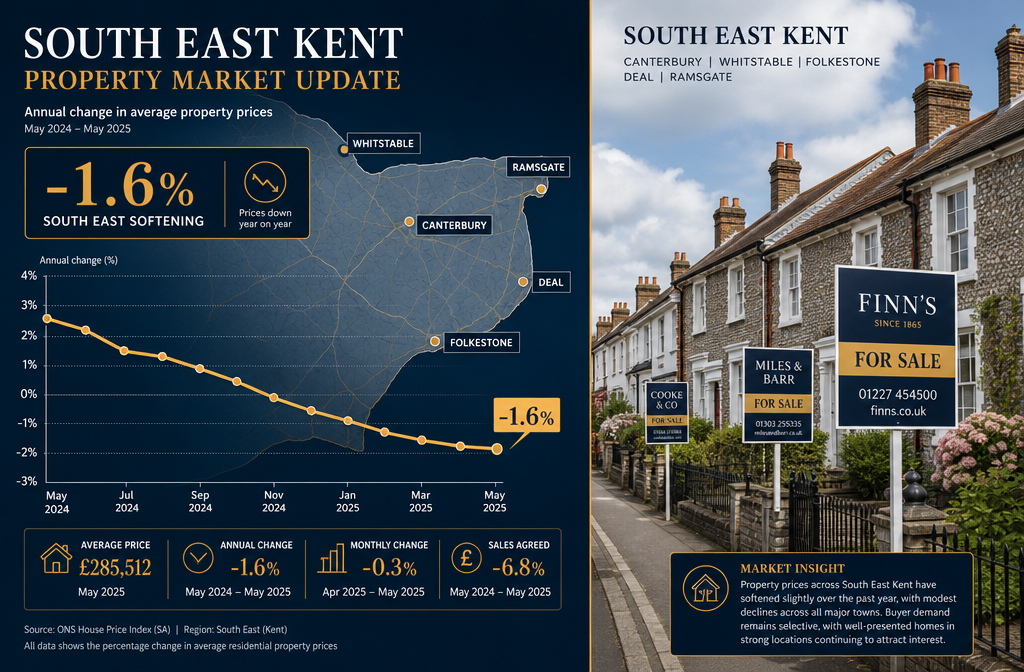
The South East England region is seeing prices soften by approximately 1.6% year-on-year as of May 2026, according to Halifax data. The UK average house price stands at around £299,313, down 0.1% month-on-month. Within Kent, prices vary considerably by town and property type.
Approximate average asking prices across key South East Kent towns in 2026 (based on Rightmove and Land Registry data trends — figures are indicative and change regularly):
| Town | Approx. Average Price | Property Type Notes |
|---|---|---|
| Canterbury | £340,000–£380,000 | Mix of Victorian, Edwardian, new-build |
| Whitstable | £360,000–£420,000 | High coastal premium |
| Folkestone | £230,000–£280,000 | Regeneration area, wider range |
| Deal | £290,000–£340,000 | Period stock, stable demand |
| Ramsgate | £210,000–£260,000 | Lower entry point, older stock |
| Sandwich | £280,000–£330,000 | Conservation area, period homes |
| Herne Bay | £250,000–£300,000 | Family market, mixed stock |
Note: These figures are estimates based on available market data trends. Prices vary significantly by street, condition, and property type. Always verify current figures with a local agent or registered RICS valuer.
Will House Prices Drop Further in East Kent in 2026? {#outlook}
The South East is underperforming the UK average, but a sharp crash is not the consensus view. The region is experiencing a correction rather than a collapse, driven by affordability pressures, higher mortgage rates compared to the pandemic era, and elevated stock levels.
Key factors shaping the East Kent outlook:
- Stock at an 11-year seasonal high means buyers have more choice and less urgency to overbid.
- North-south divide is real: The North East (+2.7%) and North West (+2.6%) are growing; the South East (-1.6%) and London (-2.4%) are not. This reflects affordability ceilings rather than structural weakness.
- Coastal towns with lifestyle appeal (Whitstable, Deal) tend to hold value better than inland commuter towns.
- Regeneration areas like Folkestone's Creative Quarter may see localised resilience.
This is factual market commentary, not financial advice. Property values can fall as well as rise, and local conditions vary.
Best Areas to Buy in South East Kent for First-Time Buyers {#areas}
For first-time buyers, the best areas balance affordability with long-term demand. Ramsgate and Herne Bay offer the lowest entry points in the region, with average prices well below the UK mean. Folkestone has seen significant regeneration investment and offers genuine value relative to Canterbury or Whitstable.
Choose Ramsgate if: you want the lowest entry price in Thanet with a Victorian seafront property and can absorb renovation costs.
Choose Folkestone if: you want regeneration upside, good rail links to London (under an hour on HS1), and a creative community.
Choose Herne Bay if: you want a family-friendly coastal town with more modern stock and slightly less competition than Whitstable.
Avoid over-stretching for Whitstable unless the lifestyle premium is genuinely worth it to you — the gap between Whitstable and Herne Bay prices is substantial for comparable properties.
How Whitstable Compares to Deal, Sandwich, and Ramsgate {#comparisons}
Whitstable commands the highest coastal premium in South East Kent, typically 20–35% above comparable properties in Herne Bay just six miles away. Deal sits in the mid-range, valued for its Georgian and Regency architecture and relative scarcity of new-build dilution. Sandwich, as a designated conservation area, has constrained supply which supports prices. Ramsgate offers the most affordable entry point among the coastal towns.
Approximate price-per-square-metre estimates (indicative, 2026):
- Whitstable: £3,800–£4,500/m²
- Deal: £3,200–£3,800/m²
- Sandwich: £3,000–£3,600/m²
- Ramsgate: £2,200–£2,800/m²
The older the property, the more these figures diverge based on condition — which is exactly why a survey matters more in these towns than in a new-build estate.
Why South East Kent House Prices 2026 Make Building Surveys More Valuable {#value}
In a softening market with high stock, a building survey is one of the most financially effective tools a buyer has. When South East Kent house prices 2026 are already under downward pressure, survey findings give buyers documented, professional grounds to renegotiate — not just a gut feeling.
Here's the logic: in a hot market, sellers can dismiss survey-based price reductions. In a market where homes are sitting for longer and buyers have alternatives, a surveyor's report detailing £15,000 of roof repairs or £8,000 of damp remediation carries real weight. Sellers who want to proceed have reason to negotiate.
A RICS building survey provides:
- A condition rating for every major element (traffic-light system: 1 = satisfactory, 2 = attention needed, 3 = urgent)
- Estimated repair costs or recommendations to obtain specialist quotes
- Legal and environmental issues to flag to your solicitor
- A basis for price renegotiation or requesting repairs before completion
💡 Pull quote: "A survey fee of £600 that uncovers £12,000 of defects — and supports a successful price reduction — is one of the best-value professional services in property."
Should You Get a HomeBuyer Report or Full Building Survey? {#survey-choice}
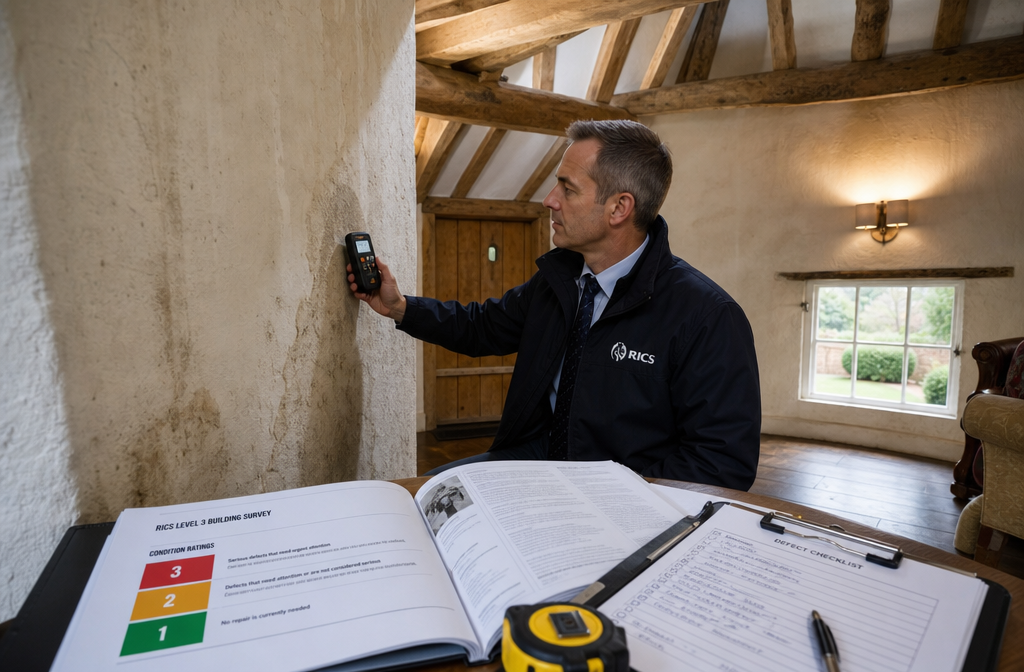
A RICS Level 2 HomeBuyer Survey suits standard, reasonably modern properties in good condition. A RICS Level 3 Building Survey is the right choice for older, larger, or non-standard properties — which describes a large proportion of South East Kent's housing stock.
Choose a Level 2 (HomeBuyer Survey) if:
- The property was built after approximately 1930
- It's of conventional brick construction
- It appears in good condition with no obvious alterations
- It's a flat or smaller terraced house
Choose a Level 3 (Building Survey) if:
- The property is pre-1919 (very common in Kent coastal towns)
- It has flint, timber frame, or non-standard construction
- It's an oast house conversion, barn conversion, or listed building
- There are visible signs of damp, cracking, or previous alterations
- It's a large detached or semi-detached home
For a detailed comparison, see the difference between Level 2 and Level 3 surveys.
If you're unsure which applies to your property, a specialist defect survey can address a specific concern (damp, cracks, roof) without the full survey cost.
How Much Does a Building Survey Cost in Canterbury or Folkestone? {#costs}
Survey costs in Kent depend on property value, size, age, and survey level. As a general guide for 2026:
| Survey Type | Typical Cost Range (Kent) | Best For |
|---|---|---|
| RICS Level 2 HomeBuyer | £400–£650 | Standard post-1930 homes |
| RICS Level 3 Building Survey | £600–£1,200+ | Period, non-standard, larger homes |
| Specialist Defect Survey | £300–£600 | Single issue (damp, roof, cracks) |
| Structural Survey | £500–£900 | Suspected structural movement |
For a fuller breakdown of what drives surveyor fees, see this guide to surveyor pricing.
A damp survey or subsidence survey may be recommended as a follow-up if the main survey flags concerns.
What Do Building Surveyors Look For in a Kent Property? {#what-surveyors-find}
A RICS surveyor inspects every accessible part of the property, inside and out. For Kent properties specifically, surveyors pay close attention to issues that are disproportionately common in the region's older stock.
Key inspection areas:
- Roof: Condition of tiles, slates, or flat roof coverings; chimney stacks (very common in period Kent homes); flashings and guttering
- Walls: Flint, brick, or timber frame condition; pointing; signs of movement or bulging
- Damp: Rising damp at ground level, penetrating damp through walls or roofs, condensation patterns
- Floors: Suspended timber floors for rot and beetle infestation; solid floors for damp
- Structure: Cracks in walls (distinguishing settlement from active movement), lintels, foundations
- Services: Condition of visible electrics, plumbing, heating (not tested, but visually assessed)
- Drainage: Signs of blocked or failing drainage (a drainage survey may be recommended separately)
- Outbuildings and boundaries: Garages, garden walls, boundary structures
For properties with suspected structural issues, a structural survey provides deeper analysis.
Common Problems Found in Older Kent Coastal Properties {#common-defects}
Kent's coastal and rural housing stock has some of the most characterful — and most challenging — properties in the South East. Surveyors working in the region regularly encounter the following:
1. Damp (penetrating and rising)
Flint and rubble-filled walls are porous by nature. Coastal exposure accelerates weathering of pointing and renders. Rising damp is common where original slate damp-proof courses have failed.
2. Roof deterioration
Many period Kent homes have clay peg tiles or plain tiles that are reaching the end of their serviceable life (typically 60–100 years). Re-roofing costs in Kent range from approximately £8,000 to £25,000+ depending on size and material.
3. Clay-soil subsidence
Large parts of Kent — particularly the Weald and areas around Canterbury — sit on shrink-swell clay. In dry summers, clay shrinks; in wet winters, it expands. This cycle causes differential settlement, visible as diagonal cracking from window and door corners. A subsidence survey can determine whether movement is historic or ongoing.
4. Timber decay and beetle infestation
Older suspended timber floors and roof timbers are susceptible to woodworm and wet rot, particularly in properties with inadequate sub-floor ventilation.
5. Non-standard construction
Oast houses, flint cottages, and timber-frame buildings require specialist knowledge. Standard mortgage lenders may require additional reports for non-standard construction.
6. Asbestos
Properties built or significantly altered between 1950 and 1999 may contain asbestos in textured coatings, floor tiles, or roof sheets. An asbestos survey is advisable before any renovation work.
Risks of Buying Without a Professional Survey in South East Kent {#risks}
Skipping a survey on a Kent period property in a softening market is a false economy. The risks are concrete and quantifiable.
What buyers miss without a survey:
- Hidden damp behind freshly decorated walls (a common pre-sale tactic)
- Roof defects not visible from ground level
- Active subsidence misread as cosmetic cracking
- Timber decay in sub-floor voids and roof spaces
- Electrical installations that don't meet current safety standards
- Drainage problems that only emerge after purchase
In a market where South East Kent house prices 2026 are already softening and sellers have more motivation to negotiate, a survey report is not just protection — it's leverage. Buyers who skip it are negotiating blind.
The RICS HomeBuyer Survey is the minimum recommended for any property purchase. For anything pre-1919 or of non-standard construction, a Level 3 is the appropriate choice.
FAQ {#faq}
Q: Are house prices falling in Canterbury in 2026?
A: Canterbury is part of the South East region, which is seeing prices soften by approximately 1.6% year-on-year as of May 2026. Local variation is significant — well-presented homes in sought-after streets continue to sell close to asking price, while properties needing work are seeing more negotiation. Figures change regularly; check current Land Registry and Rightmove data for the latest.
Q: Is a HomeBuyer Survey enough for a Victorian terrace in Folkestone?
A: For most Victorian terraces, a RICS Level 3 Building Survey is more appropriate than a Level 2 HomeBuyer Report. Victorian properties frequently have original roofs, lime mortar, suspended timber floors, and no cavity wall insulation — all areas where a more detailed inspection adds real value.
Q: How long does a building survey take in Kent?
A: A Level 2 survey typically takes 2–4 hours on site; a Level 3 survey for a larger or more complex property can take 4–8 hours. Reports are usually delivered within 3–5 working days. For more detail, see how long a HomeBuyer Survey takes.
Q: Can I use a building survey to renegotiate the purchase price?
A: Yes. A RICS survey report provides professional, documented evidence of defects and their likely remediation costs. In a softening Kent market with high stock levels, sellers are generally more willing to accept price reductions or agree to repairs before completion when presented with a formal surveyor's report.
Q: What is the risk of subsidence in Canterbury and the Kent Weald?
A: Higher than average. Much of Kent sits on shrink-swell clay geology, which causes seasonal ground movement. This is a known risk factor in the region and a key reason why a Level 3 survey — which includes more detailed structural assessment — is recommended for older properties on these soils.
Q: Do I need a survey if the property is new-build?
A: New-build properties are covered by a developer warranty (typically NHBC Buildmark for 10 years), but a snagging survey before legal completion is still strongly advisable. It is separate from a RICS building survey and focuses on defects and incomplete work that the developer should rectify at no cost.
Conclusion
The softening of South East Kent house prices in 2026 is not a crisis — it's a rebalancing that hands buyers more power than they've had in years. Homes are sitting on the market longer, stock is at an 11-year seasonal high, and sellers are more open to negotiation. But that negotiating power is only useful when it's backed by evidence.
Kent's housing stock — flint cottages, Victorian terraces, oast conversions, timber-frame farmhouses — is among the most characterful in England, and also among the most likely to carry hidden defects. Clay-soil subsidence, failing roofs, penetrating damp, and decaying timber are not rare edge cases here; they're routine findings.
Actionable next steps for buyers in 2026:
- Instruct a RICS-registered surveyor before exchanging contracts — not after.
- Match the survey level to the property: Level 2 for post-1930 standard construction; Level 3 for anything older, larger, or non-standard.
- Use the report actively: Share relevant sections with your solicitor and use condition ratings to support any price renegotiation.
- Budget for follow-up specialists if the survey flags damp, drainage, or structural concerns — a specialist report costs far less than a post-purchase repair bill.
- Check current local prices with a Canterbury property valuation to ensure you're not overpaying in a market that's still adjusting.
In a market like this, a few hundred pounds spent on a survey can save thousands — and give buyers the confidence to proceed, renegotiate, or walk away with their eyes open.
References
- Halifax House Price Index, May 2026 — halifax.co.uk
- RICS Home Survey Standard — Royal Institution of Chartered Surveyors, 2021 — rics.org
- Land Registry UK House Price Index — HM Land Registry (updated monthly) — gov.uk/government/collections/uk-house-price-index-reports
- Rightmove House Price Index, May 2026 — rightmove.co.uk
- British Geological Survey: Shrink-Swell Hazard Data for Kent — bgs.ac.uk