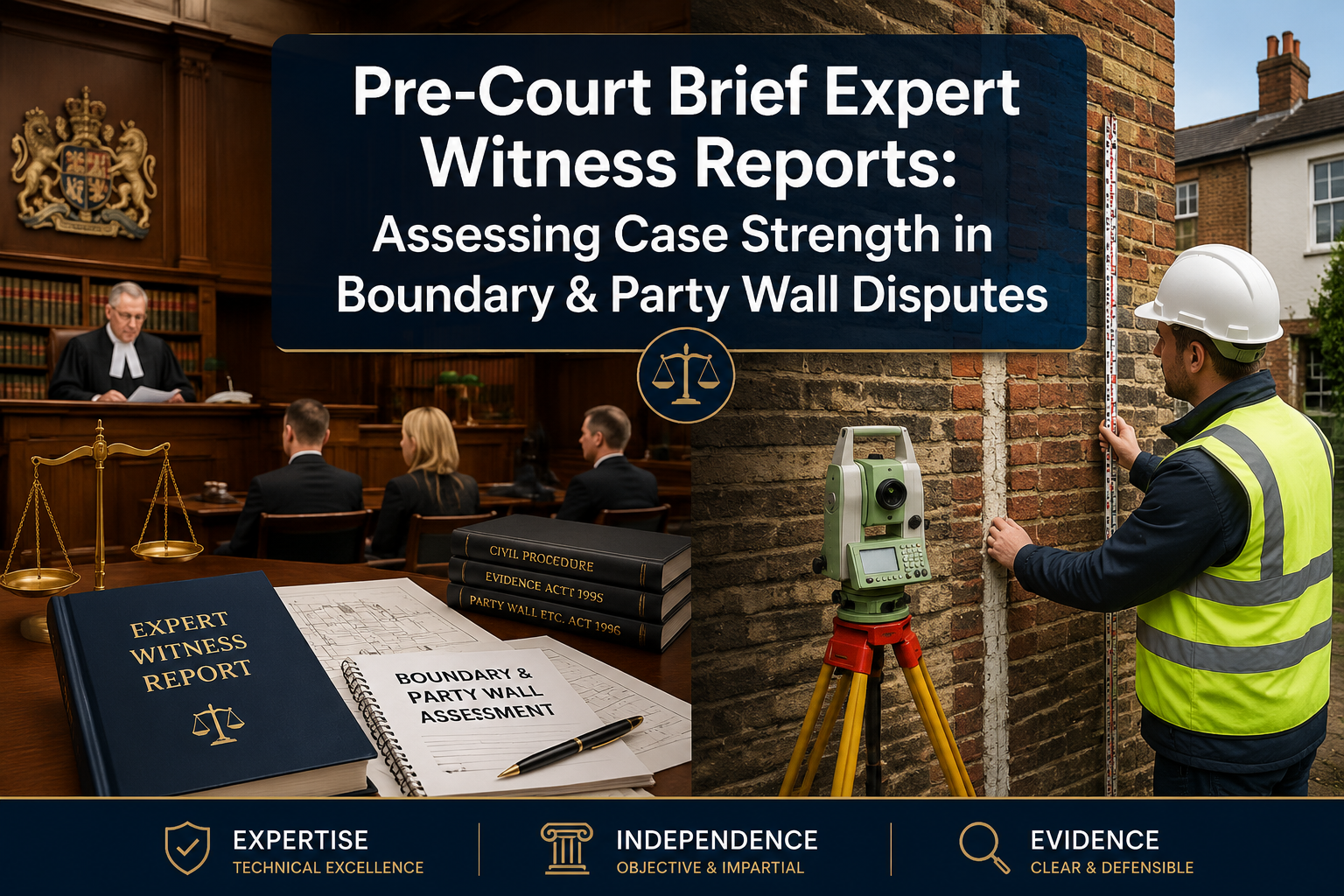

Boundary and party wall disputes cost UK property owners an estimated £1.5 billion in legal fees every year — yet a significant proportion of those cases were never strong enough to win in the first place. The growing demand for Pre-Court Brief Expert Witness Reports: Assessing Case Strength in Boundary and Party Wall Disputes reflects a sharp shift in how solicitors, surveyors, and property owners approach litigation strategy in 2026. Rather than committing to full-scale court proceedings from the outset, the smartest practitioners now commission a focused, cost-effective initial report to test the merits of a claim before a single court fee is paid.
This article explains exactly what these pre-court reports involve, how they are structured, what they cost, and — critically — when a qualified expert witness surveyor should advise a client to walk away.
Key Takeaways 📋
- Pre-court expert witness reports provide an early, objective assessment of case viability before costly litigation begins.
- A well-structured report can identify weak claims early, saving clients thousands in unnecessary legal fees.
- Fee structures for initial viability reports typically range from £500 to £2,500 depending on complexity and location.
- Recent legal developments in 2026 confirm that out-of-court expert reports can carry full evidentiary weight when properly commissioned.
- Surveyors in regions like Surrey and Cornwall are increasingly offering tiered report packages to serve both residential and commercial clients.
What Is a Pre-Court Brief Expert Witness Report?
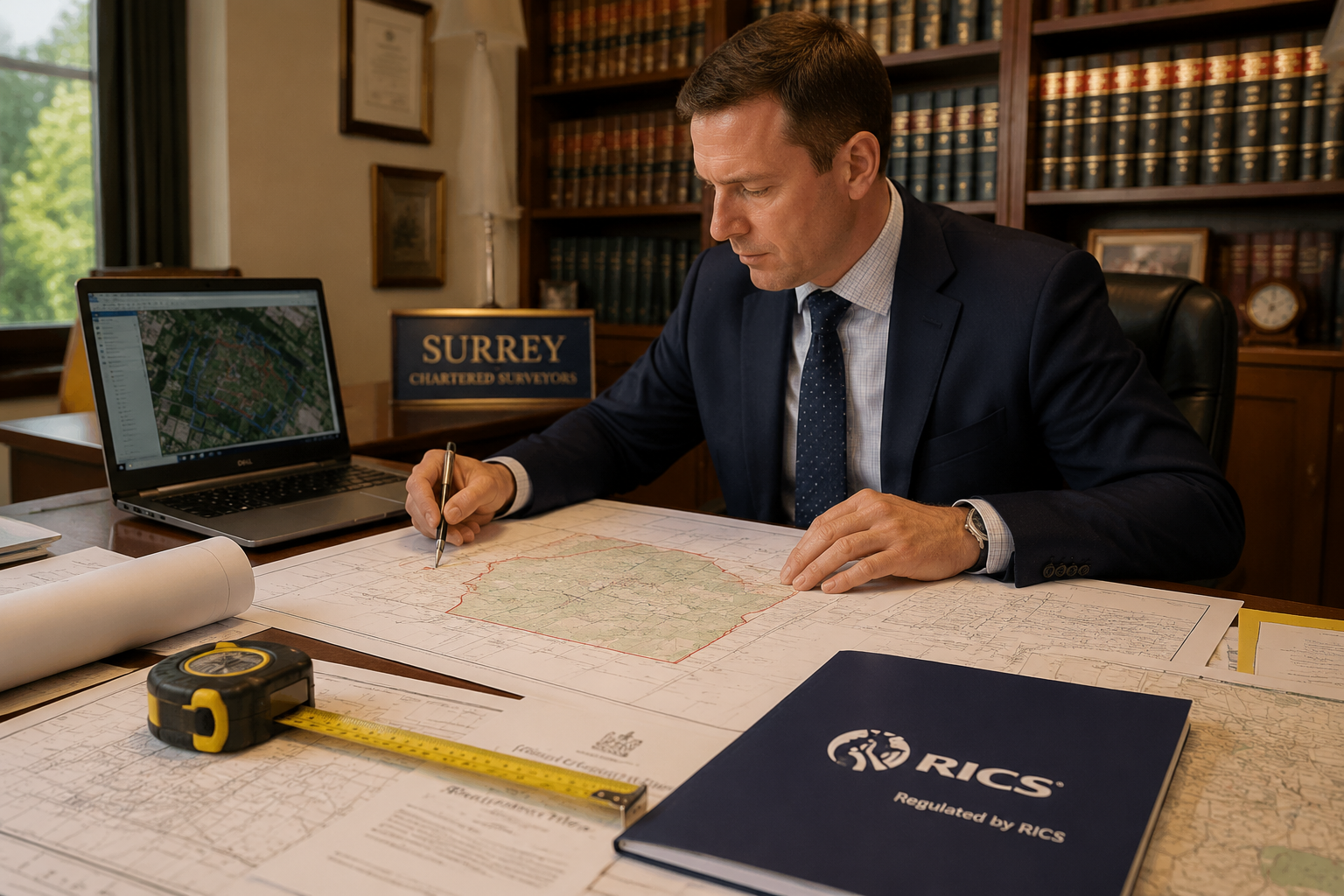
A pre-court brief expert witness report is a preliminary professional assessment prepared by a qualified surveyor or expert witness before formal legal proceedings begin. Its primary purpose is to evaluate whether a client's claim — whether relating to a boundary dispute or a party wall disagreement — has sufficient merit to justify the time and expense of litigation.
These reports differ from full expert witness reports in scope and cost. They are deliberately concise, targeted, and designed to answer one core question: "Does this case have a realistic chance of success?"
What the Report Typically Covers
A thorough pre-court brief will generally address the following:
| Section | Purpose |
|---|---|
| Evidence Review | Analysis of title deeds, Land Registry data, historical maps |
| Site Inspection Summary | Physical observations of the boundary or party wall |
| Legal Framework Overview | Relevant legislation (e.g., Party Wall etc. Act 1996) |
| Case Strength Assessment | Objective rating of claim viability (strong / moderate / weak) |
| Risk Factors | Identification of weaknesses that could undermine the claim |
| Recommendation | Proceed, negotiate, or withdraw |
💬 "The most valuable thing an expert witness can tell a client before court is not what they want to hear — it's what they need to hear."
The Legal Landscape in 2026: Why Pre-Court Reports Matter More Than Ever
The legal environment surrounding expert witness testimony has shifted considerably. In January 2026, the French Cour de Cassation ruled that judges may rely exclusively on out-of-court expert investigations when conducted under a binding contract between parties with jointly-appointed experts [4]. This landmark decision reinforces the evidentiary authority of pre-court assessments and signals a broader international trend toward trusting properly commissioned expert reports.
In the UK, the recovery of the property market in 2026 has directly correlated with a rise in boundary disputes [5]. As house prices climb and garden boundaries become flashpoints between neighbours, the demand for expert witness surveyor services has surged — particularly in high-density suburban areas of Surrey and the rural-residential interface zones of Cornwall.
Meanwhile, the US Federal Circuit Court confirmed in Barry v. DePuy Synthes Co. (January 2026) that methodological criticisms of expert testimony go to the weight of evidence, not its admissibility [3]. This matters for UK practitioners too: it signals that courts are increasingly reluctant to exclude expert evidence entirely, making the quality and rigour of pre-court reports all the more important as a foundation for litigation.
The Rise of Augmented Reality in Case Presentation 🖥️
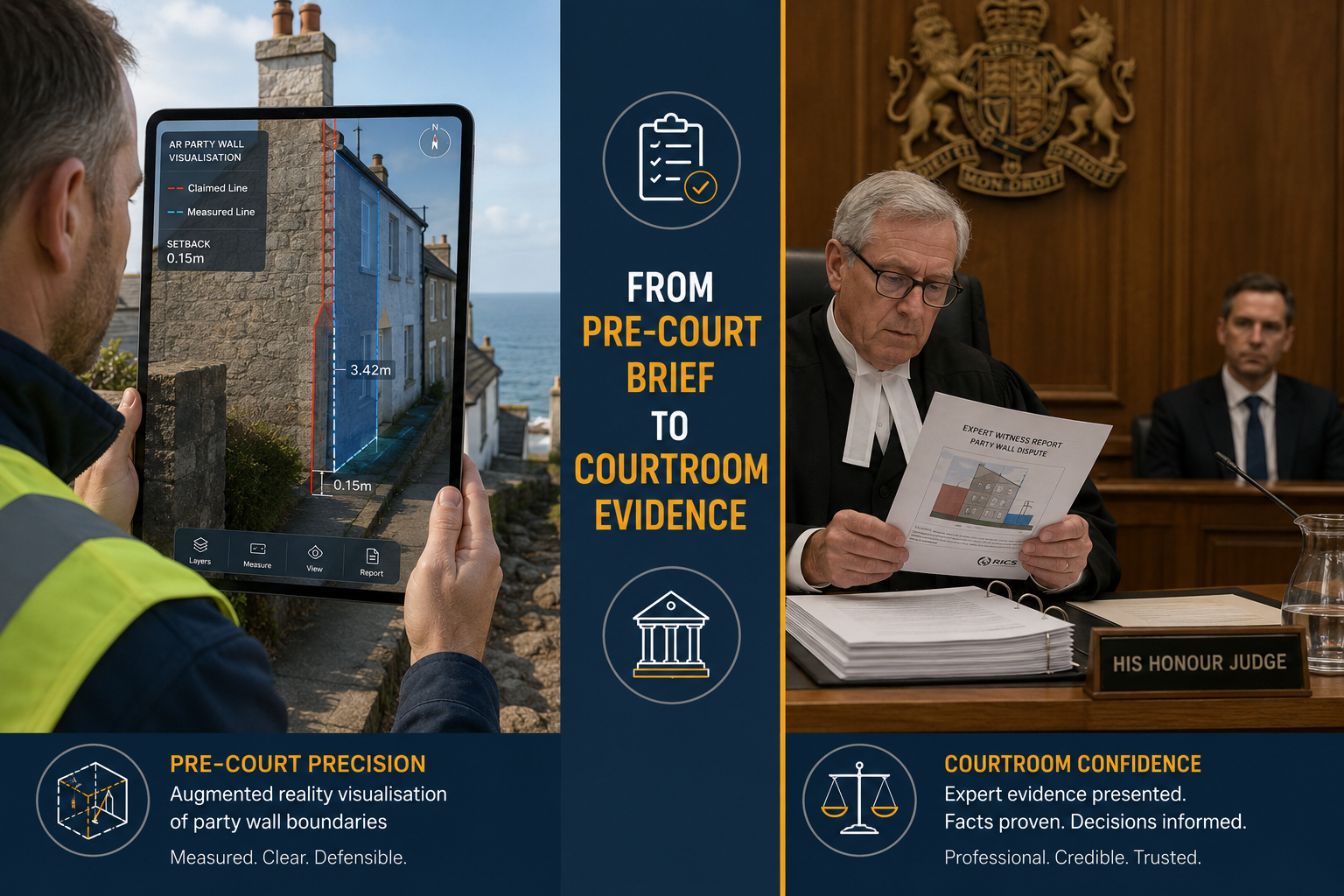
One of the most significant practical developments for expert witnesses in 2026 is the mainstreaming of augmented reality (AR) tools for courtroom presentation. What was once a speculative technology has become a practical option for visualising complex party wall and boundary disputes for judges who may have limited technical knowledge [1]. Pre-court reports that incorporate AR-ready data — such as 3D boundary overlays and photographic evidence tagged to GPS coordinates — are increasingly preferred by solicitors preparing for litigation.
How Pre-Court Brief Expert Witness Reports Are Structured: Assessing Case Strength in Boundary and Party Wall Disputes
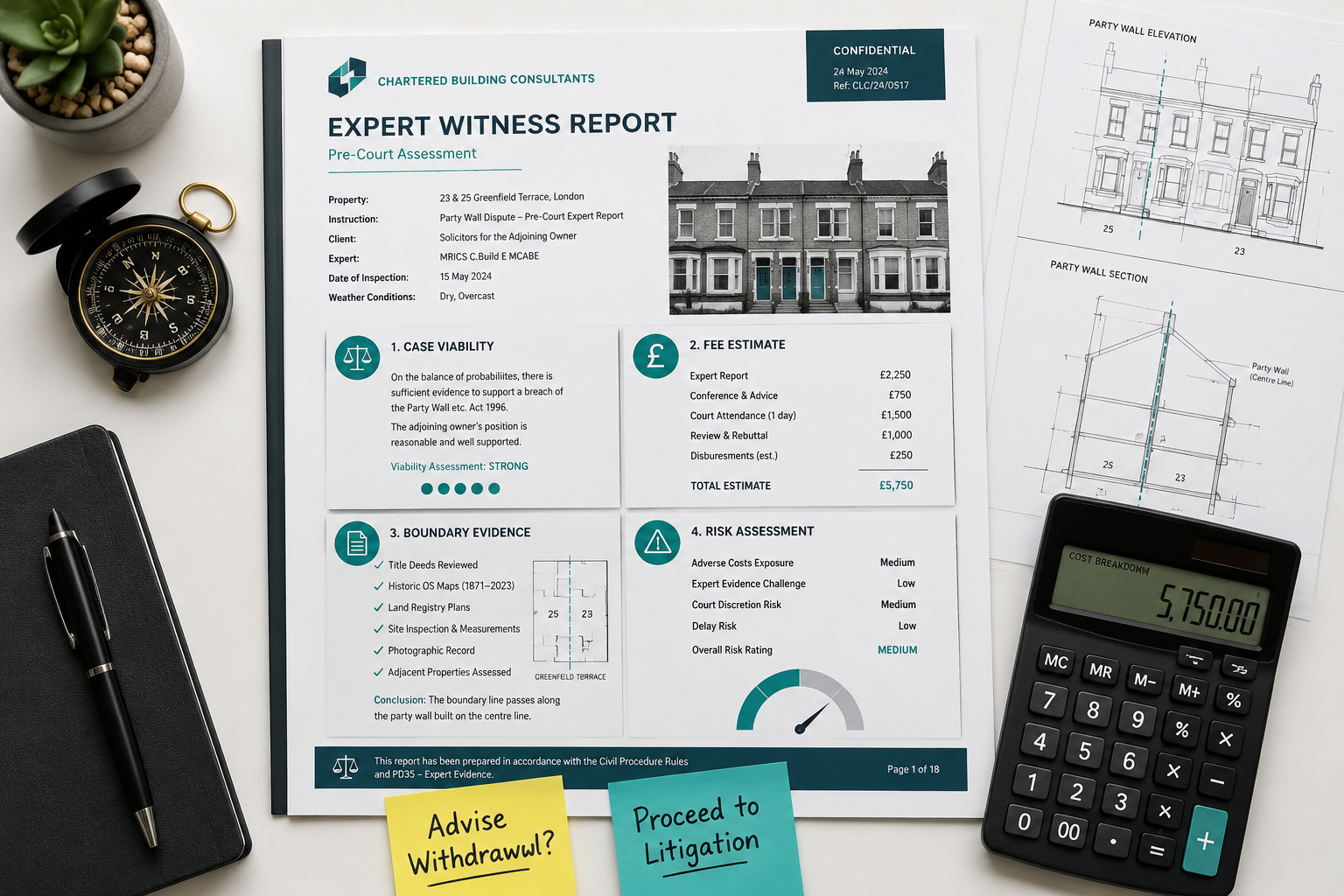
The structure of a pre-court brief report follows a logical progression from evidence gathering to professional opinion. Here is how a well-organised report typically unfolds in practice.
Stage 1: Initial Instructions and Scope Agreement
The surveyor receives a brief from the instructing solicitor or directly from the property owner. The scope is agreed in writing, including:
- The specific dispute (boundary encroachment, party wall damage, obstruction in party wall works, etc.)
- Documents to be reviewed
- Whether a site visit is required
- The agreed fee and timeline
Stage 2: Document and Evidence Review
This is the analytical core of the report. The expert reviews:
- Title deeds and conveyance plans (often the primary source of boundary definition)
- Land Registry title plans (noting their limitations — OS maps are not definitive boundary documents)
- Historical Ordnance Survey maps and aerial photography
- Party Wall Notices (or evidence that a party wall notice was not served)
- Previous survey reports, correspondence, and photographs
Stage 3: Site Inspection (Where Required)
Not every pre-court report requires a full site visit, but many do. A brief site inspection — typically one to two hours — allows the expert to:
- Physically verify the boundary features (walls, fences, hedges)
- Assess any visible damage to party walls or shared structures
- Photograph evidence in context
- Identify discrepancies between physical features and title plan representations
Stage 4: Case Strength Assessment
This is the most commercially valuable section. The expert provides a frank, objective opinion on:
- Strength of evidence (documentary, physical, witness)
- Legal vulnerabilities (adverse possession claims, ambiguous deeds, limitation periods)
- Proportionality — is the potential outcome worth the cost of litigation?
- Alternative dispute resolution options (mediation, Party Wall Award process)
Stage 5: Recommendation
The report concludes with a clear recommendation. This may be:
✅ Proceed — the case has strong merit and good prospects of success
⚠️ Negotiate — the case has moderate merit; settlement is advisable
❌ Withdraw — the case is unlikely to succeed; litigation is not recommended
Fee Structures: What Pre-Court Reports Cost in Practice
One of the most common questions from clients is: "How much will this cost before we even get to court?" The answer depends on the complexity of the dispute, the volume of documents, and whether a site visit is required.
Typical Fee Ranges in 2026
| Report Type | Typical Fee Range | Includes |
|---|---|---|
| Desktop Review Only | £500 – £900 | Document analysis, written opinion |
| Desktop + Brief Site Visit | £900 – £1,800 | Above + 1-2 hour inspection, photographs |
| Complex Multi-Issue Report | £1,800 – £2,500+ | Multiple boundaries, structural issues, AR data |
💡 Surrey Practice Example: A chartered surveying firm in Guildford recently introduced a fixed-fee pre-court viability report at £750 for residential boundary disputes under 10 metres in length. This transparent pricing model has significantly increased early engagement from solicitors who previously delayed instructing experts due to cost uncertainty.
💡 Cornwall Practice Example: A specialist surveying practice serving rural Cornwall offers a tiered package: a £600 desktop review for agricultural boundary disputes, with an optional £400 add-on for a half-day site visit. This structure reflects the travel costs involved in serving remote locations while keeping the initial commitment affordable.
Understanding party wall costs in general is helpful context for clients budgeting for any stage of a dispute — from initial advice through to full litigation support.
When Should a Surveyor Advise Withdrawal? ⚠️
Perhaps the most professionally demanding aspect of pre-court brief work is advising a client that their case is not worth pursuing. This requires both technical confidence and clear communication skills.
Common Grounds for Recommending Withdrawal
- Ambiguous title deeds with no clear boundary definition and no supporting physical evidence
- Limitation period issues — adverse possession claims that have crystallised in the other party's favour
- Disproportionate cost-to-outcome ratio — where the disputed strip of land is worth less than the likely legal costs
- Weak witness evidence — where the client's account conflicts with documentary or physical evidence
- No party wall agreement in place but works already completed, limiting remedies available
A professional expert witness has an overriding duty to the court — not to the client who is paying the fee. This independence is what gives pre-court reports their credibility. The UK Register of Expert Witnesses maintains a vetted list of experts with specific boundary dispute expertise, providing a useful resource for solicitors seeking qualified professionals [2].
Specialist directories operated by organisations such as SEAK, Inc. also provide focused listings of boundary dispute expert witnesses, helping legal teams identify practitioners with the right credentials for case strength assessment [6].
Pre-Court Brief Expert Witness Reports: Assessing Case Strength in Boundary and Party Wall Disputes — Best Practice Guidance
The following best practice principles apply to surveyors preparing pre-court briefs in 2026.
✅ Do's
- Maintain impartiality — write as if the report will be read by a judge, not just the instructing party
- State limitations clearly — if documents are missing or a site visit was not possible, say so
- Use plain language — courts and clients benefit from clear, jargon-free writing
- Quantify uncertainty — distinguish between "probable", "possible", and "speculative" conclusions
- Recommend ADR where appropriate — mediation or a Party Wall Award can resolve disputes faster and cheaper than litigation
❌ Don'ts
- Never overstate the strength of a case to secure further instructions
- Avoid advocacy — the report must reflect the evidence, not the client's preferred outcome
- Don't ignore adverse evidence — cherry-picking facts undermines credibility
- Avoid vague conclusions — a recommendation must be actionable
For cases involving structural complexity alongside boundary issues — such as disputes over shared chimneys and chimney stacks — the pre-court report should clearly flag whether additional specialist input (e.g., structural engineering) is needed before a full litigation strategy is formed.
Surveyors preparing reports for loft conversion-related party wall disputes should also be aware of the specific technical and legal considerations covered in guidance on party wall loft conversions.
The Expert Witness's Duty: Independence Above All
European jurisprudence now formally recognises party autonomy in expert selection — meaning that courts will generally defer to jointly-appointed or contractually agreed experts [4]. However, judges retain the discretion to disregard reports where there is a serious breach of adversarial principles or where expert impartiality is in question [4].
This places a premium on the independence and professional standing of the expert. For UK surveyors, RICS membership and adherence to the RICS Practice Statement on Expert Witnesses are the baseline requirements. Beyond that, a demonstrable track record of balanced, court-tested reporting is what distinguishes a highly credible expert from a hired advocate.
The Federal Circuit's 2026 ruling further confirms that methodological criticisms — such as challenges to survey techniques or measurement approaches — should be weighed by the fact-finder rather than used to exclude testimony entirely [3]. This is good news for pre-court reports: even if opposing counsel challenges the methodology, the report retains its place in evidence.
Conclusion: Act Early, Spend Wisely, Decide Confidently
The case for commissioning Pre-Court Brief Expert Witness Reports: Assessing Case Strength in Boundary and Party Wall Disputes has never been stronger. In 2026, with property disputes rising, legal costs escalating, and courts increasingly receptive to well-prepared expert evidence, the pre-court report is the most cost-effective tool available to any party considering litigation.
Actionable Next Steps
- Instruct a qualified expert witness surveyor early — ideally before solicitors begin drafting pleadings
- Agree the scope and fee in writing — use a fixed-fee structure where possible to manage client expectations
- Request a clear viability recommendation — the report should tell you whether to proceed, negotiate, or withdraw
- Consider AR-enhanced reporting for complex disputes where visual presentation to a judge will be critical
- Explore ADR options in parallel — mediation and the Party Wall Award process can resolve many disputes without court at all
For expert witness surveying services tailored to boundary and party wall disputes, or to explore the full range of expert witness surveyor support available, speak to a qualified RICS-registered professional who can assess your specific situation with the independence and rigour the process demands.
References
[1] Augmented Reality In Expert Witness Reports Visualizing Party Wall Disputes For 2026 Courtroom Impact – https://nottinghillsurveyors.com/blog/augmented-reality-in-expert-witness-reports-visualizing-party-wall-disputes-for-2026-courtroom-impact
[2] Boundary Disputes – https://www.jspubs.com/expert-witness/si/b/boundary-disputes/
[3] Finding That Expert Testimony Aligns With The District Courts Claim Construction The Federal Circuit Backs Its Admissibility – https://haugpartners.com/article/finding-that-expert-testimony-aligns-with-the-district-courts-claim-construction-the-federal-circuit-backs-its-admissibility/
[4] News Out Of Court Expert Reports Full Evidentiary Weight When Contractually Agreed – https://www.theworldlawgroup.com/membership/news/news-out-of-court-expert-reports-full-evidentiary-weight-when-contractually-agreed
[5] Expert Witness Essentials For 2026 Boundary Disputes Strengthening Cases In A Recovering Property Market – https://nottinghillsurveyors.com/blog/expert-witness-essentials-for-2026-boundary-disputes-strengthening-cases-in-a-recovering-property-market
[6] Boundary Disputes Expert Witness – https://seakexperts.com/keywords/boundary-disputes-expert-witness