

Courts dismissed or heavily penalised expert witness reports in a significant proportion of property valuation disputes last year — not because the valuations were wrong, but because the reports failed basic procedural compliance tests. For surveyors appointed as expert witnesses, getting the numbers right is only half the battle. The other half is navigating the rules that govern how those numbers are presented, disclosed, and defended.
This guide breaks down Civil Procedure Rules Compliance in Valuation Expert Witness Reports: 2026 Updates for Surveyors, with a particular focus on Practice Direction 35, updated impartiality declaration requirements, and practical strategies for handling insufficient data in property cases.
Key Takeaways
- ⚖️ Practice Direction 35 sets the structural and ethical framework for all expert witness reports in England and Wales — non-compliance can result in report rejection and cost sanctions.
- 📋 Mandatory disclosure elements must be present in every report, including a precise statement of truth, full qualifications, and a list of prior expert testimony.
- 🔒 2026 rule updates in multiple jurisdictions now extend work-product protection to draft reports and attorney-expert communications — surveyors should understand what this means for their working process.
- 📊 Insufficient data must be declared transparently, with clear caveats — courts will not excuse silence on data gaps.
- 🏛️ Court appearance preparation is as important as report quality — surveyors should rehearse cross-examination on methodology and assumptions.
Understanding Practice Direction 35: The Foundation of Compliance
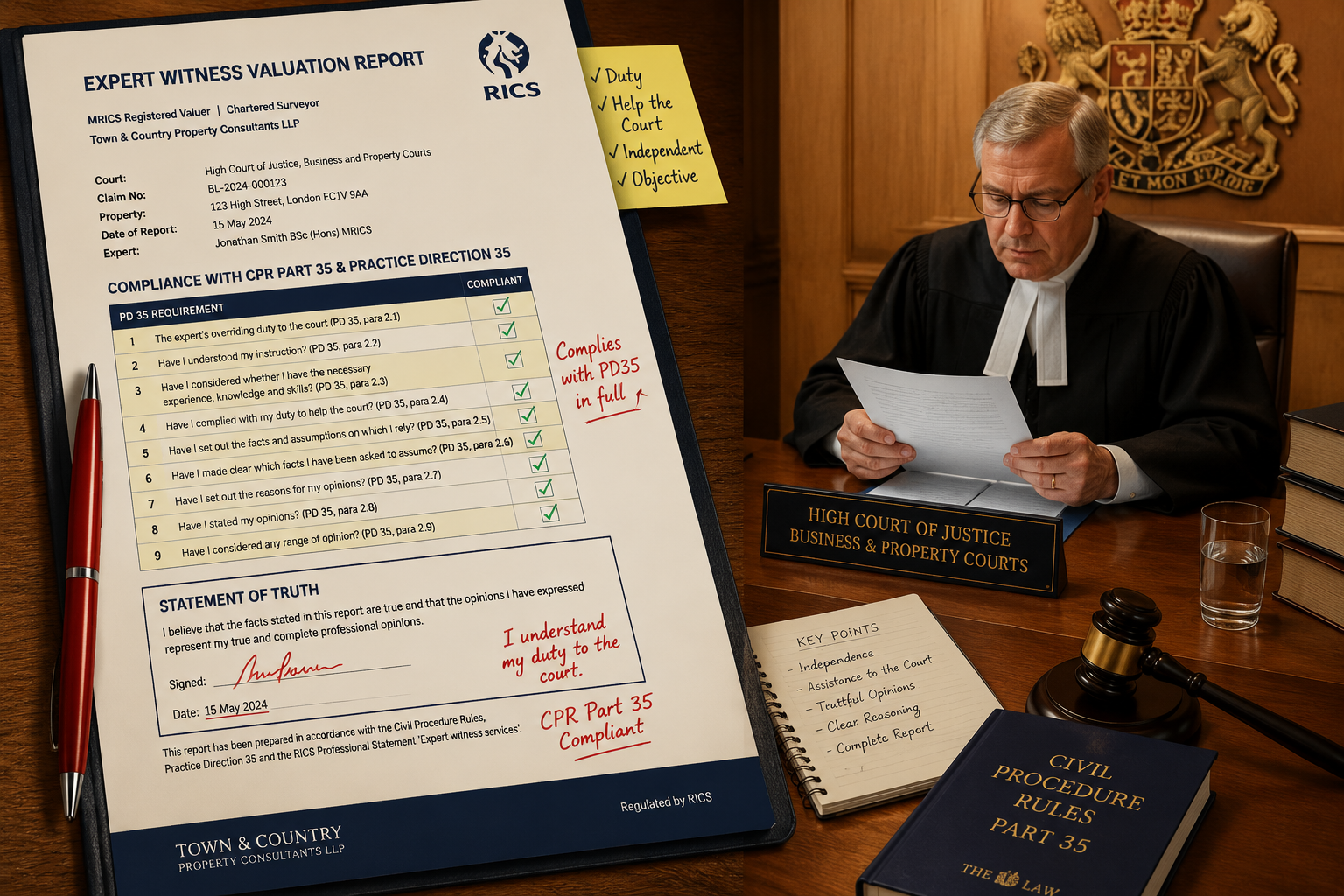
Practice Direction 35 (PD35) sits at the heart of expert witness obligations in England and Wales. It supplements Part 35 of the Civil Procedure Rules and sets out precisely what courts expect from experts — including surveyors appointed in property valuation disputes.
What PD35 Requires
Every compliant valuation expert witness report must address the following:
| Requirement | Detail |
|---|---|
| Expert's duty | Declared overriding duty to the court, not the instructing party |
| Scope of instructions | Clear summary of what the expert was asked to do |
| Facts relied upon | Distinction between facts and assumptions |
| Methodology | Explanation of the valuation approach used |
| Opinions | Clear, reasoned conclusions |
| Statement of truth | Signed declaration of impartiality and accuracy |
| Qualifications | Full professional credentials and relevant experience |
💡 Pull Quote: "An expert's report that omits the statement of truth is not merely deficient — it is inadmissible." [1]
The Impartiality Declaration: 2026 Updates
One area receiving increased judicial scrutiny in 2026 is the impartiality declaration. Courts have made clear that boilerplate language is insufficient. The declaration must:
- Confirm the expert understands their duty to the court
- State that opinions are genuinely held and not influenced by the instructing party
- Acknowledge that if the expert's view changes, they will notify the court promptly
For surveyors handling contested valuations — such as RICS Red Book valuations or collective enfranchisement disputes — this declaration carries particular weight. Tribunals and courts in leasehold and landlord-tenant matters have increasingly scrutinised whether a surveyor's opinion genuinely reflects market evidence or has been shaped by client pressure.
Handling Insufficient Data in Property Cases
Property valuation disputes frequently involve incomplete comparable evidence, restricted access to the subject property, or historical data gaps. PD35 does not excuse a report from addressing these issues — it requires the expert to:
- Identify the data gap explicitly — state what information was unavailable and why
- Explain the impact — quantify, where possible, how the gap affects the opinion
- Provide a range, not false precision — where data is thin, a range of values with stated assumptions is more defensible than a single figure
- Flag assumptions clearly — distinguish between facts confirmed by inspection and assumptions made in the absence of data
Surveyors preparing expert witness reports in dilapidations or reinstatement cost disputes should pay particular attention here. A reinstatement cost valuation based on limited access must clearly caveat that limitation — failure to do so exposes the report to challenge on completeness grounds.
Mandatory Disclosure Elements and 2026 Rule Updates
Civil Procedure Rules Compliance in Valuation Expert Witness Reports: 2026 Updates for Surveyors cannot be understood without examining the mandatory disclosure framework — both under English procedural rules and the parallel developments in other common law jurisdictions that increasingly influence practice.
Core Mandatory Disclosure Elements
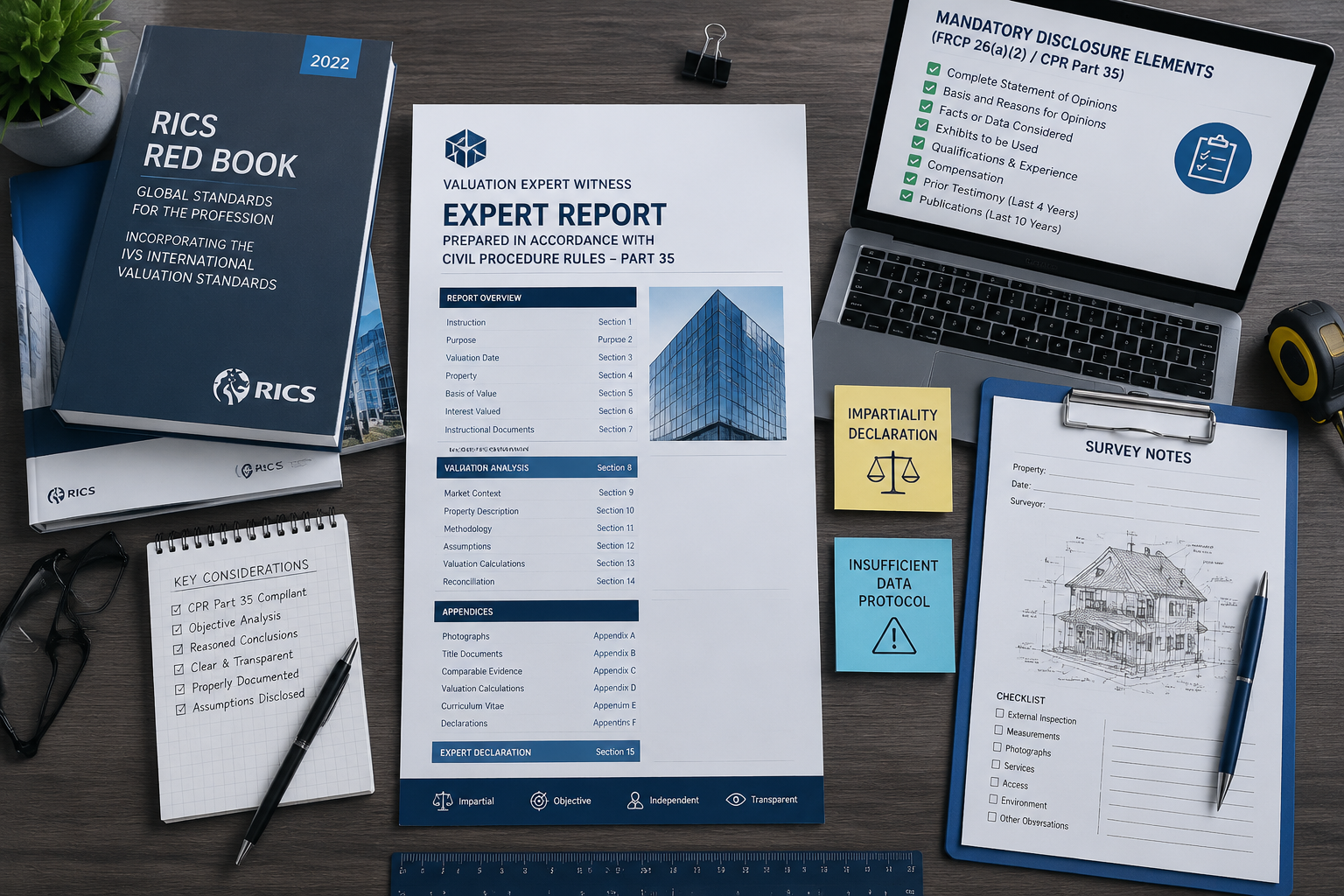
Drawing from established procedural requirements [5][6], every expert witness report in a valuation dispute must include:
- ✅ Complete statement of opinions — all conclusions, not just those favourable to the instructing party
- ✅ Basis and reasoning — the full methodology, including comparable evidence and adjustments
- ✅ Facts and data considered — everything reviewed, including material that cuts against the opinion
- ✅ Supporting exhibits — plans, photographs, comparable schedules, and market data
- ✅ Qualifications — RICS membership status, relevant experience, publications (last 10 years)
- ✅ Prior testimony list — cases in which the expert has given evidence (last 4 years) [5]
- ✅ Compensation statement — the basis on which the expert is being paid [5]
The compensation statement requirement surprises many surveyors. It does not require disclosure of the exact fee, but it must confirm whether the expert is being paid on a fixed fee, hourly rate, or — critically — whether any element of payment is contingent on outcome. Contingency-based fees for expert witnesses are incompatible with the duty to the court.
2026 Jurisdictional Updates: Work-Product Protection
A significant 2026 development affecting expert witness practice is the extension of work-product protection to draft reports and attorney-expert communications.
In March 2026, the New Mexico Rules of Civil Procedure Committee recommended amendments to Rule 1-026(B)(6) NMRA, providing explicit work-product protection to draft expert reports and disclosures, mirroring federal protections under FRCP 26(b)(4) [2]. Similarly, South Carolina recently amended its Rules of Civil Procedure to add Rule 26(b)(4)(D), creating trial-preparation protection for attorney-expert communications — with limited exceptions for compensation discussions and attorney-provided facts [3].
Under the Federal Rules framework, communications between attorneys and reporting experts are protected regardless of form, except where they:
- Relate to compensation for study or testimony
- Identify facts or data the attorney provided to the expert [4]
What does this mean for UK surveyors?
While these are US developments, they reflect a broader international trend toward protecting the working relationship between legal teams and expert witnesses. In England and Wales, the principle that an expert's draft reports and working notes may be disclosable has long created tension. Surveyors should:
- Keep clear records distinguishing factual instructions from opinion development
- Avoid allowing instructing solicitors to rewrite substantive sections of reports
- Understand that any communication that changes the substance of an opinion may be disclosable
The Supplementation Duty
The duty to supplement is often overlooked. If new market evidence emerges after the report is filed — a comparable sale, a planning decision, a change in market conditions — the expert has a duty to update their disclosure [6]. For surveyors in long-running property disputes, this means:
- Monitoring market conditions throughout proceedings
- Issuing supplemental reports when material new evidence arises
- Ensuring all additions are disclosed before the pretrial deadline
Report Templates, Pre-Submission Checklists, and Court Appearance Preparation

Civil Procedure Rules Compliance in Valuation Expert Witness Reports: 2026 Updates for Surveyors extends beyond drafting — it encompasses the entire lifecycle of the expert's involvement, from initial instruction through to oral evidence.
A Practical Report Template for Valuation Disputes
The following structure reflects PD35 requirements and best practice for 2026:
Section 1 — Introduction
- Expert's name, qualifications, and RICS membership number
- Instructing party and solicitors
- Date of instruction and scope of instructions
- Summary of the question(s) to be addressed
Section 2 — Expert's Declaration
- Statement of duty to the court
- Confirmation of impartiality
- Statement that opinions are genuinely held
Section 3 — Summary of Facts and Instructions
- Facts provided by the instructing party
- Facts established by inspection and independent research
- Assumptions made (with reasons)
Section 4 — Methodology
- Valuation approach selected (comparative, income, residual, etc.) — see methods of valuation for a fuller breakdown
- Reasons for approach chosen
- Comparable evidence reviewed and adjustments applied
Section 5 — Opinions and Conclusions
- Clear statement of the expert's opinion(s)
- Where a range is given, explanation of the upper and lower bounds
- Any caveats arising from data limitations
Section 6 — Statement of Truth
- Signed declaration in the prescribed form
Section 7 — Appendices
- Comparable schedules, photographs, plans, market data
Pre-Submission Compliance Checklist ✅
Before filing any valuation expert witness report, surveyors should complete the following review [1]:
| Check | Confirmed? |
|---|---|
| Instructions clearly summarised | ☐ |
| All questions in the instruction letter addressed | ☐ |
| Methodology explained and justified | ☐ |
| Comparable evidence included and adjusted | ☐ |
| Data gaps identified and caveated | ☐ |
| Assumptions clearly distinguished from facts | ☐ |
| Qualifications and prior testimony list included | ☐ |
| Compensation basis stated | ☐ |
| Statement of truth signed | ☐ |
| PD35 compliance double-checked | ☐ |
⚠️ Warning: Courts increasingly dismiss reports lacking full compliance with procedural rules and may impose costs on the party relying on deficient evidence [1]. A single missing element — such as the statement of truth — can render an otherwise excellent report inadmissible.
Consequences of Non-Compliance
The penalties for procedural non-compliance are significant [1]:
- Report rejection — the court may refuse to admit the evidence
- Cost sanctions — the instructing party may face adverse cost orders
- Permission to rely on expert withdrawn — in serious cases, the party loses their expert evidence entirely
- Reputational damage — surveyors whose reports are rejected face professional scrutiny
For surveyors involved in complex disputes — including ATED valuations, dilapidations surveys, or charities act valuations — the stakes are particularly high given the financial values involved.
Preparing for Court Appearance
Filing a compliant report is necessary but not sufficient. Surveyors giving oral evidence must be prepared for rigorous cross-examination on every aspect of their methodology and assumptions.
Practical preparation steps:
- Re-read the report thoroughly — know every figure, assumption, and comparable cited
- Anticipate challenges — identify the weakest points in the methodology and prepare clear explanations
- Understand the opposing report — read the other side's expert evidence carefully; courts expect experts to engage with competing opinions
- Joint expert meetings — in many cases, the court will direct a without-prejudice meeting between experts to narrow the issues; prepare a clear list of agreed and disputed points
- Stay within expertise — if a question falls outside the expert's area of competence, say so clearly; overreaching damages credibility
- Maintain impartiality under pressure — cross-examination is designed to expose bias; the expert's duty is to the court, not to win the argument for the instructing party
💡 Pull Quote: "The expert who changes their opinion under cross-examination without good reason destroys their credibility. The expert who maintains an untenable position destroys their integrity. The skill is knowing the difference."
Conclusion: Actionable Next Steps for Surveyors in 2026
The landscape for Civil Procedure Rules Compliance in Valuation Expert Witness Reports: 2026 Updates for Surveyors has never been more demanding — or more consequential. Courts are applying stricter scrutiny to expert evidence, and the procedural framework is evolving to reflect both the complexity of modern litigation and the need to protect the integrity of the expert-client working relationship.
Here are the immediate actions surveyors should take:
- 📋 Adopt a standardised report template that incorporates all PD35 requirements — do not rely on adapting old reports
- ✍️ Review impartiality declarations — ensure they go beyond boilerplate and genuinely reflect the expert's position
- 🔍 Build a data gap protocol — establish a consistent approach to identifying, quantifying, and caveating insufficient data
- 📅 Monitor supplementation obligations — set calendar reminders to review whether new market evidence requires disclosure updates
- 🏛️ Invest in court appearance preparation — consider mock cross-examination sessions before high-value hearings
- 📚 Stay current with rule changes — the 2026 amendments in multiple jurisdictions signal continued evolution; surveyors should monitor RICS guidance and CPD updates
For surveyors seeking expert witness appointments or looking to ensure their valuation reports meet the highest standards of procedural compliance, working with experienced registered RICS valuers who understand both the technical and procedural dimensions of expert evidence is essential.
Procedural compliance is not a bureaucratic obstacle — it is the foundation on which credible expert evidence is built. Get it right, and the valuation opinion stands. Get it wrong, and even the most technically sound report may never reach the court.
References
[1] Expert Witness Report – https://capitalexpertservices.com/articles/expert-witness-report/
[2] Proposal 2026 008 Expert Witness Protection From Compelled Disclosure Comments Begin On P. 9 – https://supremecourt.nmcourts.gov/wp-content/uploads/sites/2/2026/03/Proposal-2026-008-Expert-Witness-Protection-from-Compelled-Disclosure-comments-begin-on-p.-9.pdf
[3] Excluding Expert Exchanges Protecting Attorney Expert Communications – https://hedrickgardner.com/blog/excluding-expert-exchanges-protecting-attorney-expert-communications/
[4] Rules Update Changes To Federal Rule 26 – https://www.butlersnow.com/wp-content/uploads/pdfs/attorney_publications/rules-update-changes-to-federal-rule-26.pdf
[5] Rule 26 Federal Rules Of Civil Procedure A Disclosure Guide For Expert Witnesses – https://www.expertinstitute.com/resources/insights/rule-26-federal-rules-of-civil-procedure-a-disclosure-guide-for-expert-witnesses/
[6] Rule 26 – https://www.law.cornell.edu/rules/frcp/rule_26