

Nearly one in three party wall disputes in England and Wales escalates beyond informal agreement — and the single most common reason is the wrong surveyor being appointed at the outset. For homeowners, developers, and commercial property owners navigating notifiable works in 2026, choosing the right Party Wall Act specialist surveyor from RICS-listed experts is not a formality. It is a decision that directly determines whether a project runs smoothly or ends in costly legal confrontation.
This guide profiles the credentials, selection criteria, and professional standards that define the best RICS-accredited party wall surveyors operating today — with practical case examples drawn from boundary disputes and notifiable works scenarios.
Key Takeaways 📋
- RICS accreditation is the baseline, not the ceiling — the updated 8th edition of RICS Party Wall Legislation and Procedure raises professional expectations significantly for 2026.
- Specialist experience matters more than general surveying qualifications when selecting a party wall expert for complex disputes.
- The Third Surveyor mechanism is a critical safeguard in disputed cases — your chosen surveyor must understand how and when to invoke it.
- A Schedule of Condition prepared before works begin is one of the most protective documents available to both building and adjoining owners.
- Fee transparency and notice procedures are now formally addressed in updated RICS guidance — surveyors who cannot explain their fee structure clearly should raise concern.
What Makes a True Party Wall Act Specialist Surveyor?
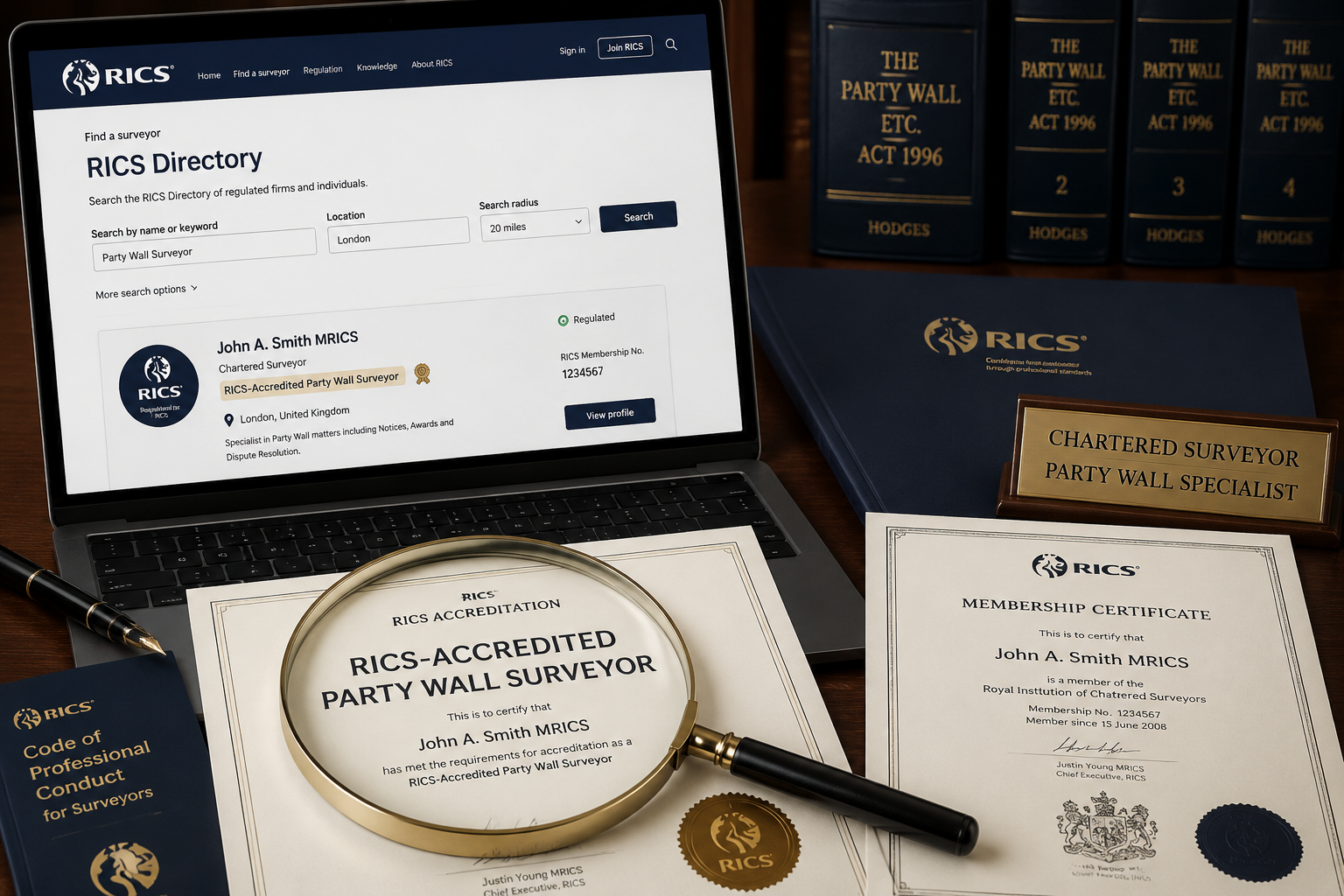
The title "party wall surveyor" is not legally protected in the UK. Any individual — regardless of qualifications — can technically accept an appointment under the Party Wall etc. Act 1996. This makes the RICS credential not just desirable but essential when selecting from listed experts for 2026 disputes.
RICS Accreditation: The Professional Standard
The Royal Institution of Chartered Surveyors (RICS) reissued its Party Wall Legislation and Procedure professional standard in May 2023, providing comprehensive guidance for members accepting party wall instructions [1]. This document establishes expectations that go beyond minimum legal compliance, setting a higher bar for professional conduct, fee practices, and dispute resolution [4].
Crucially, RICS has launched consultation on a draft 8th edition of this standard, which introduces:
- Enhanced appendices and revised letters of appointment
- Updated terms and a new draft award document
- Strengthened guidance on fee practices and Third Surveyor use
- Clearer procedures for service of notices and public engagement [2]
💬 "The updated 8th edition is designed to strengthen guidance on regulatory and conduct matters — a direct signal that the profession is raising its standards for 2026 and beyond." — RICS Consultation Announcement [2]
Core Credentials to Look For
When evaluating any surveyor from RICS-listed directories, verify the following:
| Credential | What It Means |
|---|---|
| MRICS / FRICS | Full chartered membership of RICS — the professional baseline |
| Building Surveying pathway | Relevant specialism for party wall work |
| Party Wall Act CPD evidence | Demonstrates active engagement with evolving standards |
| Professional Indemnity Insurance | Mandatory for RICS members; verify it covers party wall work |
| RICS Firms registration | The firm, not just the individual, is regulated |
The RICS Find a Surveyor platform (ricsfirms.com) allows property owners to search specifically for party wall specialists in their area, filtering by location and specialism [3]. This is the most reliable starting point for building a shortlist.
How to Select from RICS-Listed Experts for 2026 Disputes
Selecting the right party wall surveyor from RICS-listed experts for 2026 disputes requires more than checking a name against a directory. The following criteria separate genuinely specialist practitioners from generalists who occasionally handle party wall matters.
1. Volume and Complexity of Party Wall Caseload
A surveyor handling 50+ party wall appointments per year will have encountered the full spectrum of disputes — from straightforward loft conversions to complex basement excavations triggering the three-metre rule. Ask directly:
- How many party wall appointments do you handle annually?
- What proportion involve dissent and formal Award proceedings?
- Have you acted as Third Surveyor in disputed cases?
2. Experience with Notifiable Works Categories
Not all party wall work is equal. The Act covers three distinct categories of notifiable works, each with different procedural requirements:
- Line of Junction works — new walls on or at the boundary
- Party Structure works — alterations to shared walls, floors, or structures
- Adjacent Excavation works — digging within 3 or 6 metres of a neighbour's structure
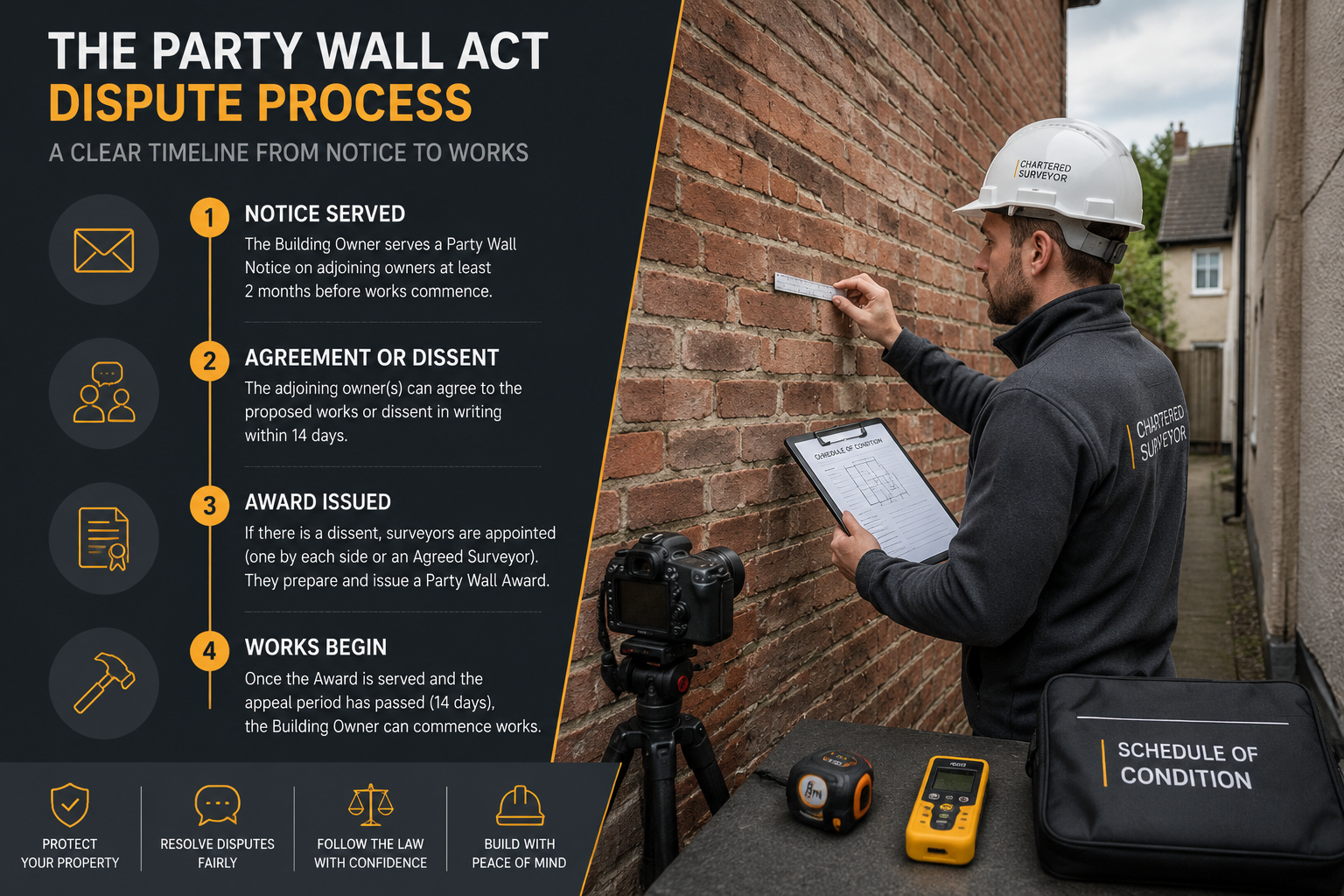
A specialist surveyor should be fluent in all three. For complex excavation cases — increasingly common in London where basement extensions continue to drive disputes — experience with Schedule of Condition reports for party walls is non-negotiable. This document records the pre-works condition of the adjoining property and is the primary defence against spurious damage claims after construction.
3. Notice Procedures and Compliance Record
One of the most common triggers for escalation is a party wall notice that was never properly served. Understanding the implications of a party wall notice not being served — or served incorrectly — is a fundamental competency. Ask your prospective surveyor to walk you through their notice service process and how they handle situations where a building owner has proceeded without consent.
Similarly, if works have already begun without agreement, understanding what happens when there is no party wall agreement in place is critical knowledge your surveyor must possess.
4. Fee Transparency and Structure
The updated RICS 8th edition draft specifically addresses fee practices — a recognition that opaque or disproportionate fees have been a source of friction in party wall disputes [2]. When selecting a surveyor, request:
- A written fee estimate before appointment
- Clarity on whether fees are fixed, hourly, or stage-based
- Confirmation of who bears the cost (typically the building owner)
For a detailed breakdown of what to expect, reviewing party wall costs in advance helps property owners budget accurately and identify surveyors whose fees are disproportionate to the scope of works.
Case Examples: Boundary and Notifiable Works Disputes in Practice
Understanding how specialist surveyors operate in real dispute scenarios is the most practical way to assess their value. The following case types illustrate where RICS expertise makes the decisive difference.
Case Example 1: Loft Conversion — Dissent and Award Proceedings
A homeowner in North West London served party wall notices for a loft conversion involving steel beam insertion through a shared party wall. The adjoining owner dissented, triggering the formal Award process. The building owner's appointed RICS surveyor:
- Prepared a detailed Schedule of Condition of the adjoining property before works commenced
- Liaised with the adjoining owner's surveyor to agree working hours, methodology, and access provisions
- Drafted a Party Wall Award in line with guidance for party wall awards that satisfied both parties without Third Surveyor referral
Outcome: Works completed on schedule. A post-works damage claim by the adjoining owner was successfully defended using the pre-works Schedule of Condition.
🔑 Key lesson: A thorough Schedule of Condition, prepared by a specialist, is worth more than any insurance policy in a post-works dispute.
Case Example 2: Basement Excavation — Three-Metre Rule Triggered
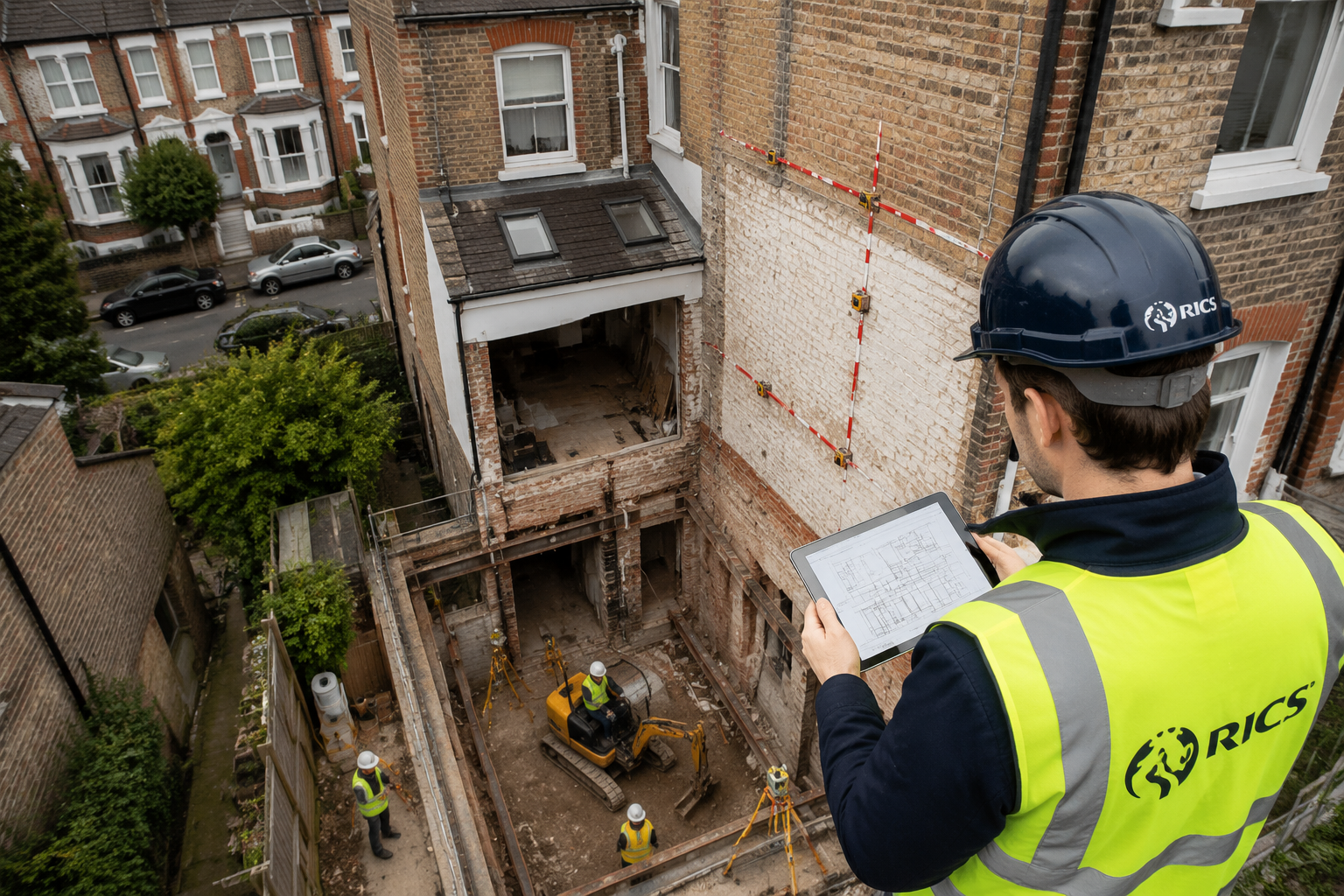
A developer in Central London planned a two-storey basement extension adjacent to a Victorian terrace. The excavation fell within three metres of the neighbour's foundations, engaging Section 6 of the Act. The specialist surveyor:
- Identified that the works also triggered the six-metre rule due to the depth of excavation
- Commissioned structural engineer input on foundation underpinning methodology
- Ensured consent for party wall work was properly documented before any ground was broken
- Engaged an expert witness surveyor when the adjoining owner threatened injunctive relief
Outcome: Injunction threat withdrawn after the Award was served. Works proceeded with agreed monitoring protocols in place.
🔑 Key lesson: Complex excavation cases require a surveyor with structural knowledge and litigation awareness — not just procedural competence.
Case Example 3: Boundary Dispute — Line of Junction Notice
A residential developer sought to build a new boundary wall on the line of junction between two plots. The adjoining owner claimed the proposed wall encroached on their land. The specialist surveyor:
- Reviewed title plans and Land Registry data alongside the party wall notice
- Recommended a boundary survey to resolve the underlying land ownership question before proceeding
- Advised the building owner that proceeding without resolving the boundary question could invalidate the party wall process entirely
Outcome: Boundary survey confirmed the correct line of junction. Notice was re-served correctly. Works proceeded without further dispute.
🔑 Key lesson: Party wall expertise and boundary knowledge overlap — a specialist who understands both disciplines prevents procedural errors that can derail entire projects.
The Third Surveyor: A Critical Safeguard Often Overlooked
When the two appointed surveyors cannot agree — whether on the terms of an Award, the scope of works, or a damage claim — the matter is referred to a Third Surveyor, selected at the outset of the dispute by the two appointed surveyors [2].
The Third Surveyor is not an arbitrator or mediator. Their role is to make a binding determination on the specific point of disagreement. This mechanism is frequently misunderstood, and some surveyors — particularly generalists — are unfamiliar with the procedural nuances involved.
When evaluating RICS-listed experts for 2026 disputes, ask specifically:
- Have you ever been appointed as Third Surveyor?
- How do you approach Third Surveyor selection at the outset of an appointment?
- Can you explain the circumstances under which a Third Surveyor determination can be appealed?
The RICS Boundaries and Party Walls Working Group continues to produce updated professional guidance on this mechanism, incorporating recent case law [3]. A surveyor who references current case law in their answers demonstrates the kind of active professional engagement that separates true specialists from occasional practitioners.
Building Your Shortlist: Practical Selection Criteria for 2026
The following checklist consolidates the most important selection criteria when choosing from Party Wall Act Specialist Surveyors listed by RICS for 2026 disputes:
✅ Pre-Appointment Checklist
- Confirmed MRICS or FRICS status via RICS Find a Surveyor
- Firm registered with RICS (not just the individual)
- Demonstrated party wall specialism — not just general building surveying
- Written fee estimate provided before appointment
- Clear explanation of the notice service process
- Evidence of CPD in party wall law and RICS updated standards
- Professional Indemnity Insurance confirmed and current
- Experience with Third Surveyor appointments
- Ability to prepare Schedule of Condition reports
- References from previous party wall appointments available
Questions to Ask During Initial Consultation
- How many party wall Awards have you drafted in the past 12 months?
- Have you handled cases involving the three-metre excavation rule?
- What is your approach when an adjoining owner refuses to appoint their own surveyor?
- How do you handle a situation where the building owner has already started works without serving notice?
- Are you familiar with the draft 8th edition of RICS Party Wall Legislation and Procedure? [2]
RICS Standards in 2026: What Has Changed and Why It Matters
The professional landscape for party wall surveyors is more regulated in 2026 than at any previous point. The RICS compliance framework now establishes expectations that exceed minimum legal requirements under the Party Wall etc. Act 1996 [4].
Key changes affecting surveyor selection include:
Enhanced fee guidance — The draft 8th edition addresses disproportionate fees directly, giving adjoining owners stronger grounds to challenge excessive charges [2].
Revised letters of appointment — Standardised appointment documentation reduces ambiguity about the surveyor's role and obligations [2].
Updated notice templates — Clearer notice documentation reduces the risk of procedural invalidity, which has been a growing source of dispute [1].
Strengthened public engagement guidance — Surveyors are now expected to communicate more clearly with both building and adjoining owners throughout the process [2].
For property owners in areas with high construction activity — including chartered surveyors in London and surrounding regions — these changes mean that the quality gap between specialist and generalist surveyors is wider than ever. Selecting a surveyor who actively engages with RICS updated standards is no longer optional — it is a practical risk management decision.
Conclusion: Actionable Next Steps for 2026
Selecting the right party wall surveyor is one of the most consequential decisions in any construction project involving shared boundaries or structures. The stakes are high: a poorly managed party wall dispute can delay works by months, generate five-figure legal costs, and permanently damage neighbourly relations.
Here are the immediate next steps to take:
- Start with the RICS Find a Surveyor directory — filter specifically for party wall specialists in your area, not just general building surveyors.
- Verify credentials independently — confirm MRICS/FRICS status and firm registration directly with RICS before making contact.
- Request a written fee estimate — any surveyor unwilling to provide this upfront should be removed from your shortlist.
- Ask about the 8th edition — a surveyor familiar with the updated RICS consultation demonstrates active professional engagement.
- Commission a Schedule of Condition early — before any works begin, this document is your most powerful protection against future damage claims.
- Seek specialist advice if works have already started — if notice was not served correctly, specialist guidance on proceeding without a party wall agreement is urgently needed.
The right RICS-listed party wall specialist does not just manage paperwork — they protect property rights, preserve professional relationships, and keep construction projects on track. In 2026, with professional standards higher than ever and construction activity continuing to generate disputes, that expertise has never been more valuable.
References
[1] Party Wall Legislation And Procedure – https://www.rics.org/profession-standards/rics-standards-and-guidance/sector-standards/building-surveying-standards/party-wall-legislation-and-procedure
[2] RICS Launches Consultation On Updated Party Wall Practice Guidance – https://www.rics.org/news-insights/rics-launches-consultation-on-updated-party-wall-practice-guidance
[3] Party Walls – https://www.ricsfirms.com/helplines/party-walls/
[4] Party Wall Surveys And Neighbour Disputes During 2026's Construction Uptick: RICS Compliance Framework – https://nottinghillsurveyors.com/blog/party-wall-surveys-and-neighbour-disputes-during-2026s-construction-uptick-rics-compliance-framework
[5] RICS Consults On Updated Party Wall Practice Guidance – https://www.lexisnexis.co.uk/legal/news/rics-consults-on-updated-party-wall-practice-guidance