

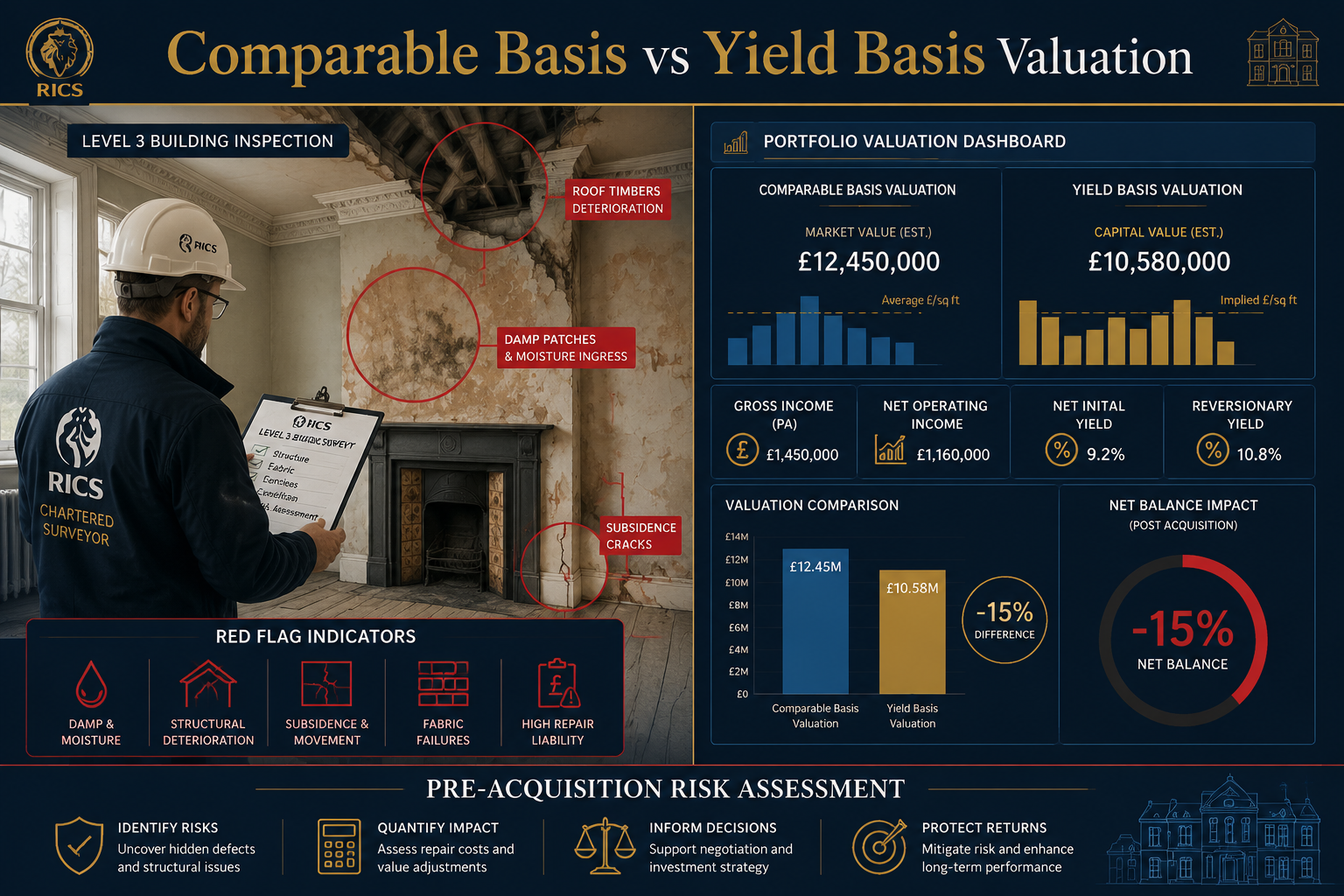
The March 2026 RICS Residential Market Survey recorded a house price net balance of -15% — one of the most sobering valuation signals seen in recent years, and a stark reminder that recovery in UK property markets is neither linear nor guaranteed [2]. For investors assembling or expanding portfolios above the £1 million threshold, that single data point encapsulates a broader truth: buying on optimism without rigorous technical evidence is how portfolios bleed value quietly, one undisclosed defect at a time.
Pre-acquisition building surveys for £1m+ portfolios: mitigating valuation risks in recovering markets is not simply a compliance exercise. It is the primary mechanism by which serious investors separate real asset value from aspirational developer projections, stress-test yield assumptions against physical reality, and protect acquisition prices from post-purchase erosion. This article sets out exactly how to approach that process in 2026's uneven, recovering market landscape.
Key Takeaways 📋
- RICS surveyors use dual valuation methods — comparable and yield basis — and prioritise real transaction evidence over developer-supplied figures [1]
- A -15% RICS house price net balance in March 2026 means automated valuation models are particularly unreliable; professional survey data is essential [2]
- Red flags including poor condition, weak rent evidence, and tenant risk trigger conservative valuations that can derail acquisitions or renegotiate purchase prices [1]
- Pre-acquisition surveys must cover technical, environmental, and financial risk — from asbestos and drainage to EPC compliance and reinstatement costs [7]
- Sector concentration matters: office obsolescence and multifamily yield compression are live threats that surveys must stress-test in 2026 [3][4]

Why Valuation Risk Is Elevated for £1m+ Portfolios in 2026
The Recovery Is Real — But Uneven
Capital is broadly returning to UK and global real estate markets in 2026. However, that recovery is distributed unevenly across sectors and geographies [3]. Many asset managers continue to face pressure from declining fundraising volumes, compressed cash-on-cash returns, and upcoming debt maturities — all of which tighten acquisition yields and increase the frequency of valuation disputes [3].
For investors targeting portfolios above £1 million, this uneven recovery creates a deceptively dangerous environment. Headline market optimism can mask asset-level problems that only a thorough technical survey will expose.
💬 "Surveyors value evidence from real transactions, not developer spreadsheets." [1]
This distinction matters enormously. When a vendor presents a portfolio with projected rental income and implied yields, the instinctive response is to model those numbers forward. But RICS-qualified surveyors take a fundamentally different approach: they verify rent against achieved prices in comparable transactions, not asking prices or pro-forma assumptions [1].
The Dual Valuation Framework Surveyors Apply
Professional surveyors assessing high-value portfolios typically employ two complementary methods [1]:
| Method | How It Works | Best Used For |
|---|---|---|
| Comparable Basis | Analyses actual recent sales of similar units in nearby locations | Residential and mixed-use portfolios |
| Yield Basis | Applies market rent against risk-adjusted yields | Commercial and income-producing assets |
| Blended Approach | Combines both methods for cross-validation | £1m+ portfolios with mixed asset classes |
Neither method is reliable in isolation for complex portfolios. The comparable basis can be distorted by thin transaction volumes in recovering markets; the yield basis is only as good as the rent evidence underpinning it. A pre-acquisition survey provides the independent technical data that makes both methods defensible.
What Pre-Acquisition Building Surveys for £1m+ Portfolios Actually Examine
Technical Condition: The Foundation of Valuation Integrity
At the core of any pre-acquisition survey for a high-value portfolio is a rigorous physical inspection of each asset. For portfolios above £1 million, a RICS Level 3 commercial building survey is typically the appropriate instrument — it provides the depth of analysis needed to identify latent defects that could materially affect value or generate significant future capital expenditure.
Key technical areas examined include:
- 🏗️ Structural integrity — movement, cracking, subsidence indicators (a specialist subsidence survey may be commissioned separately where risk is elevated)
- 🌧️ Roof condition — covering, drainage, guttering, and hidden water ingress via professional roof surveys
- ☣️ Asbestos-containing materials — particularly in commercial and pre-2000 residential stock, where asbestos surveys are a legal and financial necessity
- 🚿 Drainage systems — blocked or deteriorating drains are a frequent source of undisclosed liability, making a drainage survey a prudent addition
- 🧱 Floor slabs and foundations — particularly relevant for commercial units, where a solid floor slab survey can reveal costly remediation requirements
Each of these elements feeds directly into the valuation. Poor condition triggers downward adjustments — and in a market where the RICS net balance is already negative, surveyors apply those adjustments conservatively [1][2].
The Red Flags That Kill Deals (or Renegotiate Them)
Experienced surveyors identify specific red flags that cause them to apply conservative valuations [1]. For portfolio investors, understanding these triggers is essential for pre-underwriting deals before formal acceptance:
🚩 Valuation Red Flags to Watch For:
- Weak rent evidence — Claimed rental income not supported by comparable market transactions
- Poor physical condition — Significant deferred maintenance, structural defects, or EPC non-compliance
- High-risk tenant profiles — Short leases, single tenants, or tenants in financially stressed sectors
- Geographic concentration — Over-exposure to a single market or postcode that amplifies local risk
- Sector obsolescence — Office assets facing hybrid work headwinds represent "a wobble in the foundation" for portfolio valuations [4]
- Yield compression without justification — Multifamily assets priced at yields unjustifiably low relative to economic conditions [4]
A pre-acquisition survey is the mechanism for surfacing these issues before contracts are exchanged — not after. The cost of a thorough survey is trivial compared to the cost of acquiring a portfolio with undisclosed structural liabilities or inflated rental projections.
EPC Compliance and Environmental Risk
In 2026, energy performance is no longer a secondary concern for portfolio valuations. Regulatory pressure on minimum EPC ratings continues to tighten, and assets with poor energy performance face both capital expenditure requirements and void risk as tenants increasingly prioritise running costs.
Environmental and regulatory factors — including legal changes, occupancy impacts, and cost-of-capital fluctuations — are now primary drivers of valuation volatility [3]. A pre-acquisition survey should explicitly assess EPC ratings across the portfolio and model the capital cost of bringing sub-threshold assets into compliance.
Structuring Pre-Acquisition Building Surveys for £1m+ Portfolios: Mitigating Valuation Risks Across Asset Classes
Tailoring the Survey Scope to Asset Type
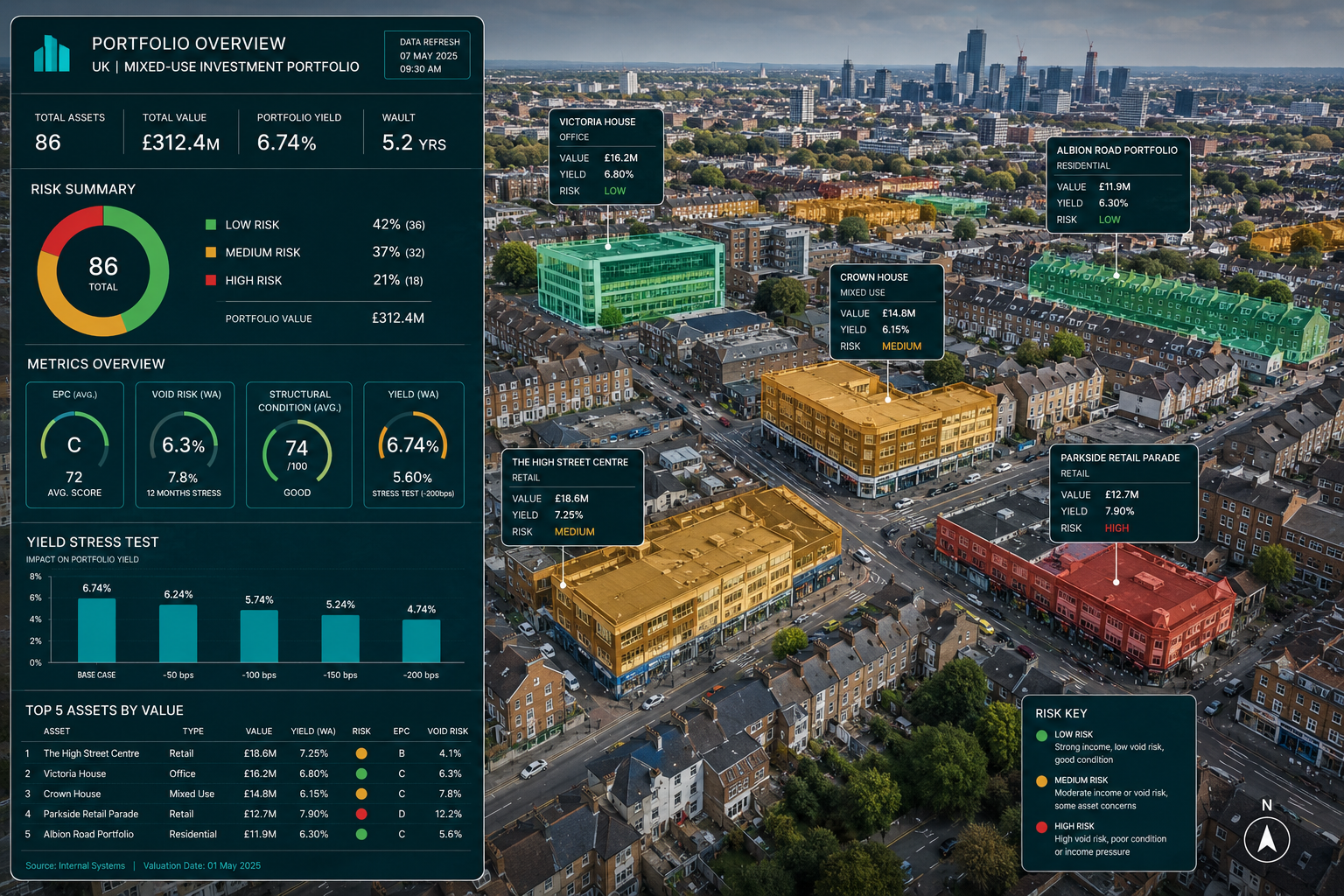
Pre-acquisition surveys for high-value portfolios are not one-size-fits-all. Reports should be tailored to specific client requirements and property characteristics — generic templates are inadequate for transactions of this scale [7]. The survey scope must reflect the asset class, age, construction type, and intended use.
Residential Portfolio Components:
For residential elements within a mixed portfolio, a RICS home survey may be appropriate for standard stock, but older or complex properties warrant a full Level 3 structural survey. Where specific defects have already been flagged, a specialist defect survey provides targeted analysis.
Commercial Portfolio Components:
Commercial assets require assessment of not just physical condition but also compliance with current regulations, service charge structures, and the schedule of dilapidations position — particularly relevant where leases are approaching expiry.
Leasehold Assets:
Leasehold properties within a portfolio introduce additional complexity. Lease length, ground rent structures, and service charge histories all affect valuation. Understanding the leasehold position of each asset is essential before acquisition.
Reinstatement Cost Valuations: The Insurance Risk
One element frequently overlooked in portfolio pre-acquisition due diligence is the reinstatement cost valuation — the assessed cost of rebuilding each asset in the event of total loss. Under-insurance is a significant risk in recovering markets where construction costs have risen sharply.
A reinstatement cost valuation ensures that insurance coverage is adequate and that the acquisition price reflects the true replacement cost of the physical assets. For a £1m+ portfolio, even a modest percentage gap between insured value and actual reinstatement cost represents a material uninsured liability.
Stock Condition Surveys for Portfolio-Wide Assessment
Where a portfolio contains multiple units — particularly residential or mixed-use stock — a stock condition survey provides a systematic assessment of condition across all assets. This approach generates a capital expenditure forecast that can be modelled into the acquisition price and financing structure.
This is particularly valuable in 2026's market, where RICS surveyor data consistently outperforms automated valuation models in identifying condition-related risks that algorithms cannot detect from transaction data alone [2].
Using Drone Technology for Large or Complex Sites
For portfolios that include large commercial sites, industrial assets, or properties with difficult roof access, drone surveys provide cost-effective aerial inspection capability. Drone surveys can identify roof defects, boundary issues, and external condition problems that would otherwise require expensive access equipment — and they generate photographic evidence that strengthens the surveyor's report.
Integrating Survey Findings Into Portfolio Valuation and Negotiation
From Survey Report to Acquisition Price Adjustment
The true value of a pre-acquisition survey is not just the technical report — it is the negotiating leverage that report generates. When survey findings identify material defects, deferred maintenance, or compliance gaps, investors have a documented, independent basis for price renegotiation.
In a market where the RICS house price net balance sits at -15% [2], vendors are increasingly receptive to evidence-based price adjustments. A survey that identifies £80,000 of remediation work on a £1.2 million portfolio element is not a deal-breaker — it is a renegotiation tool.
Practical steps for integrating survey findings:
- Quantify all identified defects with cost estimates from the surveyor or a specialist contractor
- Model the impact on yield — deferred maintenance affects net income as well as capital value
- Assess the EPC upgrade cost and factor into the acquisition price or negotiate a vendor contribution
- Review the reinstatement cost valuation against current insurance schedules
- Stress-test the yield basis against conservative rent assumptions, not vendor projections [1]
Sector-Specific Valuation Risks in 2026
The 2026 investment landscape presents distinct valuation risks by sector that pre-acquisition surveys must address [4]:
🏢 Office Assets:
Class B and C office buildings face accelerating obsolescence from hybrid work adoption. Office remains the highest-risk sector for portfolio valuation uncertainty, with sector-wide repricing creating significant gaps between vendor expectations and market reality [4]. Pre-acquisition surveys for office-inclusive portfolios must assess not just physical condition but functional obsolescence and the cost of conversion or repurposing.
🏠 Multifamily/Residential:
Despite strong long-term fundamentals, significant investor hesitation exists around current acquisition yields being unjustifiably low relative to lower-growth economic projections [4]. Surveys must stress-test rental income assumptions rigorously.
🏭 Industrial and Logistics:
Generally the most resilient sector, but pre-acquisition surveys should assess structural capacity, loading specifications, and EPC compliance — particularly for older stock.
💻 Specialist Assets (Data Centres, Healthcare):
Data centres rank above all other property sectors in 2026 investor acquisition priorities [5], but specialist technical due diligence requirements are correspondingly high.
The Cost-Benefit Case for Pre-Acquisition Surveys on High-Value Portfolios
The economics of pre-acquisition surveys are straightforward. For a portfolio valued above £1 million, a comprehensive survey programme — including structural surveys, specialist defect reports, asbestos assessments, and drainage surveys — typically represents less than 0.5% of the acquisition value.
Against that cost, investors must weigh:
- The risk of acquiring undisclosed structural defects requiring six-figure remediation
- The valuation impact of EPC non-compliance across multiple units
- The negotiating leverage generated by documented defect evidence
- The insurance exposure from inadequate reinstatement cost valuations
- The lender confidence generated by independent RICS-qualified technical reports
In recovering markets where automated valuation models are demonstrably less reliable [2], the independent judgment of a qualified surveyor is not a luxury — it is the primary risk management tool available to portfolio investors.
Conclusion: Actionable Next Steps for Portfolio Investors in 2026
Pre-acquisition building surveys for £1m+ portfolios: mitigating valuation risks in recovering markets is ultimately about one thing — buying with evidence, not assumption. In a market where RICS data signals valuation pressure, where office assets face structural obsolescence, and where yield compression in residential sectors is under scrutiny, the investors who protect and grow portfolio value are those who commission rigorous independent technical assessments before every significant acquisition.
Actionable next steps:
✅ Commission a RICS Level 3 survey on every commercial or complex residential asset in the target portfolio — not a desktop valuation or automated model output
✅ Add specialist surveys for asbestos, drainage, subsidence, and roof condition where age, construction type, or location warrants additional scrutiny
✅ Request a reinstatement cost valuation to close the insurance gap and verify that acquisition pricing reflects true replacement costs
✅ Stress-test all rental income claims against comparable transaction evidence — not vendor projections or developer spreadsheets [1]
✅ Use survey findings as a negotiation instrument — quantify defects, model yield impact, and present a documented case for price adjustment
✅ Engage RICS-registered valuers who combine real-time market data with physical inspection findings for the most accurate portfolio valuation in uncertain conditions [2]
The difference between a portfolio that performs and one that disappoints often comes down to what was discovered — or missed — before the ink dried on the acquisition documents.
References
[1] Watch – https://www.youtube.com/watch?v=rq408XyXbUI
[2] Navigating Uncertainty In Spring 2026 Valuations How Rics Real Time Surveyor Data Outperforms Automated Valuation Models – https://nottinghillsurveyors.com/blog/navigating-uncertainty-in-spring-2026-valuations-how-rics-real-time-surveyor-data-outperforms-automated-valuation-models
[3] Will Commercial Real Estate Valuations Improve 2026 – https://privatewealth.brookfield.com/insight/will-commercial-real-estate-valuations-improve-2026
[4] 2026 Real Estate Investors Playbook – https://shooracapital.com/2026-real-estate-investors-playbook/
[5] Reading Materials – Miami 2026 CLE – https://www.crefc.org/common/Uploaded%20files/CLE/Reading%20Materials%20-%20Miami%202026%20CLE.pdf
[7] Pre Acquisition Surveys – https://www.propitas.com/our-services/building-surveys/pre-acquisition-surveys/