

Over 40% of UK neighbour disputes that escalate to formal legal proceedings involve shared walls — yet most property owners have never heard of the UK Register of Expert Witnesses until they are already in the middle of a conflict. Choosing the right professional from that register is not a formality. It is often the single decision that determines whether a Party Wall Act dispute costs thousands or tens of thousands of pounds to resolve.
This guide covers Party Wall Act Listed Experts: Profiles, Selection Criteria, and Success Rates for 2026 Disputes in full — from understanding what these specialists actually do, to evaluating their credentials, regional reach, and track record before you appoint one.
Key Takeaways
- 🏠 The Party Wall Act 1996 applies only in England and Wales — expert availability varies significantly by region [2]
- 📋 A Party Wall Award is a legally binding document; the quality of the expert who drafts it directly affects dispute outcomes [3]
- ⏱️ Neighbours have just 14 days to respond to a Party Wall notice — missing this deadline triggers automatic dissent and mandatory surveyor involvement [3]
- 🔍 RICS credentials, case history, and regional expertise are the three core selection criteria for choosing a listed expert in 2026 [5]
- 💷 When a neighbour dissents, the building owner typically pays all surveyor fees — making expert selection a financial priority, not just a procedural one [3]
Understanding the Role of Party Wall Act Listed Experts
Before evaluating individual profiles, it helps to understand exactly what a Party Wall Act expert does — and why the distinction between a general surveyor and a listed specialist matters so much in 2026.
What Makes Someone a "Listed Expert"?
The UK Register of Expert Witnesses, maintained by JS Publications, includes professionals who have declared expertise in the Party Wall Act 1996 [1]. Listing on this register is not automatic. Experts must demonstrate relevant qualifications, professional standing, and in many cases, a history of preparing expert witness reports for courts or formal dispute proceedings.
However, being listed is not the same as being regulated. The register is a directory, not a licensing body. This means that due diligence on the part of the appointing party remains essential.
💬 "A listing tells you someone claims expertise. Their credentials, case history, and professional indemnity insurance tell you whether that claim holds up."
The Scope of Party Wall Act Expertise
Party Wall Act specialists operate within a specific legal framework — the Party Wall etc. Act 1996 — which governs work on or near shared walls, boundary walls, and excavations close to neighbouring properties [2]. Their core responsibilities include:
- Serving and interpreting Party Wall notices
- Conducting Schedule of Condition surveys to document pre-existing property states
- Drafting legally binding Party Wall Awards
- Resolving disputes between building owners and adjoining owners
- Providing expert witness reports in litigation
For a deeper understanding of what triggers these obligations, see this guide on what is a party wall dispute and how the formal process begins.
Geographic Limitations to Be Aware Of
The Party Wall Act applies exclusively to England and Wales [2]. Professionals listed as Party Wall experts in Scotland or Northern Ireland are operating under entirely different legal frameworks. This geographic boundary is a critical filter when searching any expert register — including JS Publications — for 2026 disputes.
Profiles of Party Wall Act Listed Experts: What the Directories Reveal
The JS Publications register is the most widely referenced directory for Party Wall Act Listed Experts: Profiles, Selection Criteria, and Success Rates for 2026 Disputes research [1]. Here is what the directory structure typically reveals — and what it does not.
What Expert Profiles Typically Include
| Profile Element | What It Tells You | What It Doesn't Tell You |
|---|---|---|
| Name & firm | Basic identification | Quality of work output |
| Qualifications (RICS, MRICS, FRICS) | Professional standing | Specific Party Wall experience depth |
| Geographic coverage | Regional availability | Local court familiarity |
| Contact details | How to reach them | Fee structure or dispute success rate |
| Self-declared expertise areas | Broad specialisms | Case volume or complexity handled |
Most directory listings are self-reported. There is no independent verification of success rates or case outcomes in any publicly available register as of 2026. This is a known gap in the market — and it places the burden of vetting firmly on the property owner or their solicitor.
The RICS Credential Hierarchy
When reviewing expert profiles, RICS membership grade is one of the most reliable public indicators of competence:
- AssocRICS — Associate level; suitable for standard cases
- MRICS — Member level; the benchmark for most Party Wall appointments
- FRICS — Fellow level; senior practitioners with extensive track records
In 2026, RICS is actively consulting on updated Party Wall practice guidance [5], which means the standards for expert conduct are evolving. Experts who are actively engaged with RICS consultation processes — and who can demonstrate awareness of the proposed changes — are likely to be better positioned for complex disputes.
Common Dispute Types Where Expert Profiles Matter Most
The most frequently cited triggers for Party Wall expert involvement in 2026 include [2]:
- 🏗️ Loft conversions — structural work affecting roof and wall junctions
- 💧 Damp proof course insertion — requires careful boundary work
- 🏚️ Foundation excavations — especially near the three-metre rule zone
For projects involving excavation near neighbouring foundations, understanding what is the three-metre rule is essential context before appointing any expert.
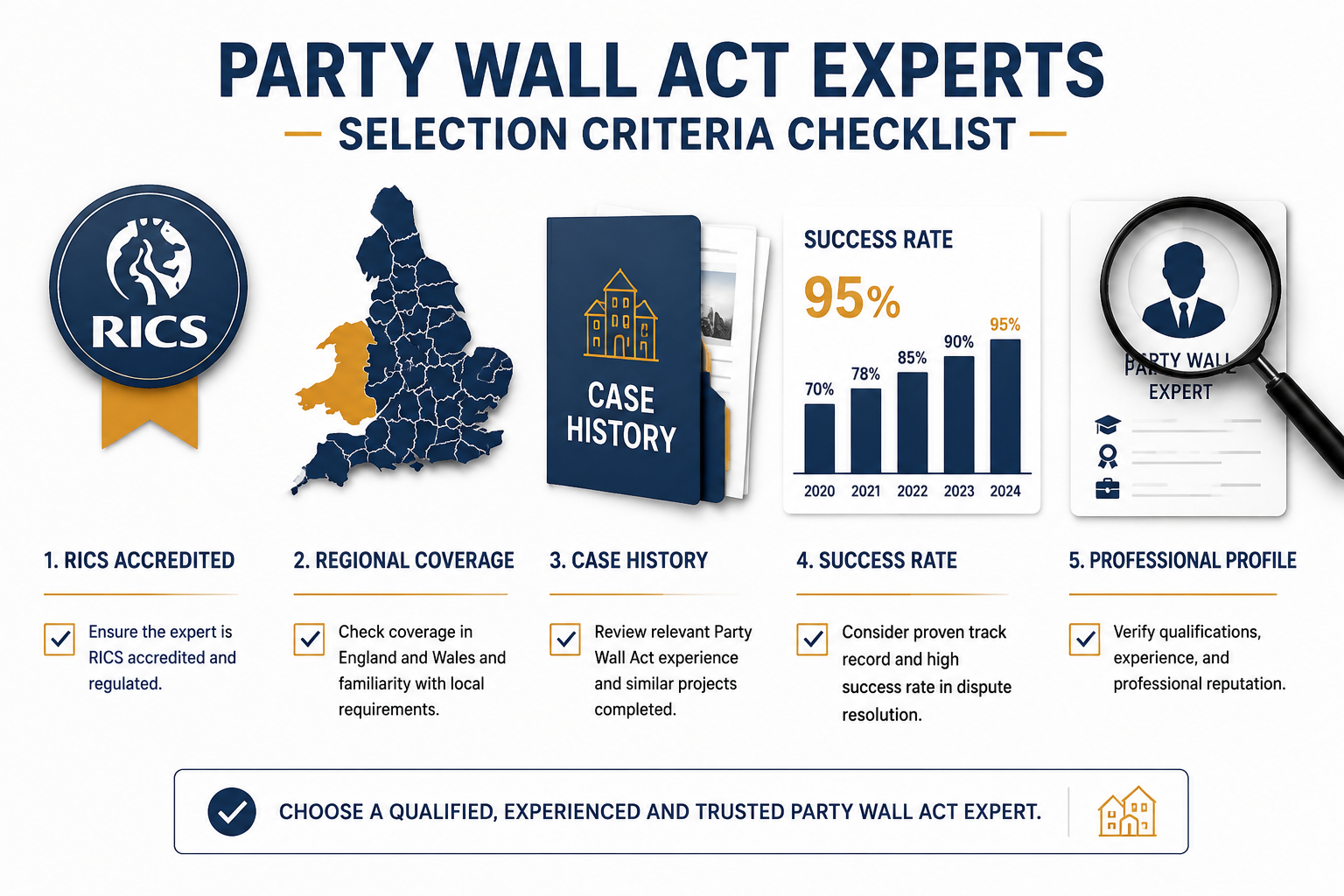
Selection Criteria for Party Wall Act Listed Experts in 2026 Disputes
Choosing the right expert from a directory listing requires applying structured criteria. The following framework reflects current best practice for Party Wall Act Listed Experts: Profiles, Selection Criteria, and Success Rates for 2026 Disputes selection in 2026.
Criterion 1: RICS Accreditation and Continuing Professional Development
RICS accreditation remains the gold standard for Party Wall surveyors in England and Wales [5]. When reviewing a listed expert, confirm:
- Active RICS membership (verifiable on the RICS public register)
- Membership of the Faculty of Party Wall Surveyors (FPWS) where applicable
- Evidence of CPD activity related to the 2026 RICS guidance consultation
The RICS consultation on updated Party Wall practice guidance signals that 2026 is a transitional year for professional standards [5]. Experts who are ahead of these changes offer a meaningful advantage in complex or contentious disputes.
Criterion 2: Regional Expertise and Local Court Familiarity
Party Wall disputes that escalate beyond the Award stage — into county court proceedings — benefit enormously from an expert who knows the local judicial landscape. Key questions to ask:
- How many Party Wall cases have they handled in your specific region?
- Have they provided expert witness testimony in your local county court?
- Are they familiar with local planning constraints (e.g., conservation areas, listed buildings)?
For property owners in London and the South East, where Party Wall disputes are most concentrated, working with local chartered surveyors who combine Party Wall expertise with regional knowledge is a significant practical advantage.
Criterion 3: Case History and Complexity Handled
No public register currently publishes success rates for individual Party Wall experts [1]. However, proxy indicators of case quality include:
- Published expert witness reports or court-cited opinions
- Membership of professional bodies that require peer review (FPWS, RICS)
- Client testimonials referencing specific dispute types (loft conversions, extensions, excavations)
- Experience preparing reports that comply with CPR Part 35 (Civil Procedure Rules for expert witnesses) [6]
💬 "An expert who has never had their report tested in court is an unknown quantity. Ask directly: have your reports been subject to cross-examination?"
Criterion 4: Fee Transparency and Conflict of Interest
When a neighbour dissents from a Party Wall notice, the building owner typically pays the surveyor fees for both sides [3]. This creates a financial incentive for some surveyors to prolong disputes. Selecting an expert with:
- Clear, written fee schedules provided upfront
- No financial relationship with the other party's surveyor
- A stated policy on conflict of interest disclosure
…significantly reduces the risk of fee escalation. For context on what happens when no formal agreement is in place, see this resource on proceeding without a party wall agreement.
Criterion 5: Communication Style and Availability
Party Wall disputes are time-sensitive. The 14-day notice response window [3] means that expert availability at short notice is not a luxury — it is a procedural requirement. Assess:
- Typical response time to initial enquiries
- Whether they use a dedicated Party Wall case management system
- Willingness to explain the process clearly to non-specialist clients
Success Rates: What the Data (and Its Absence) Tells Us
One of the most searched questions in 2026 is: "What is the success rate of Party Wall Act experts?" The honest answer is that no centralised, publicly available database tracks individual expert success rates in Party Wall disputes.
Why Success Rate Data Is Limited
- Party Wall Awards are private legal documents between the parties involved
- There is no mandatory reporting mechanism to any central register [1]
- Court proceedings arising from Party Wall disputes represent a small minority of total cases
- The competitive surveying market in 2026 has intensified, but public performance data has not kept pace [4]
Proxy Metrics That Function as Success Indicators
In the absence of formal success rate data, the following metrics serve as reliable proxies:
| Proxy Metric | How to Obtain It | What It Indicates |
|---|---|---|
| Court citation history | Legal databases (Westlaw, LexisNexis) | Expert report quality |
| RICS disciplinary record | RICS public register | Professional conduct |
| FPWS membership status | Faculty of Party Wall Surveyors | Specialist peer recognition |
| Client referral rate | Direct reference requests | Repeat engagement quality |
| Award challenge rate | Ask the expert directly | Robustness of Awards drafted |
The Role of the Party Wall Award in Dispute Outcomes
The Party Wall Award is the central output of any expert's work [3]. A well-drafted Award:
- Clearly defines the scope of permitted works
- Sets out access rights and notification requirements
- Specifies damage liability and the process for claims
- Includes a pre-work Schedule of Condition to protect both parties
For guidance on what a well-structured Award should contain, see this detailed resource on guidance for party wall award.
Poor Awards — those that are vague on scope or silent on damage liability — are the primary driver of post-Award disputes. An expert's track record in drafting robust Awards is therefore the closest available proxy for "success rate."
For cases where property damage does occur during party wall works, understanding damage to property in party wall situations is critical to protecting your position.
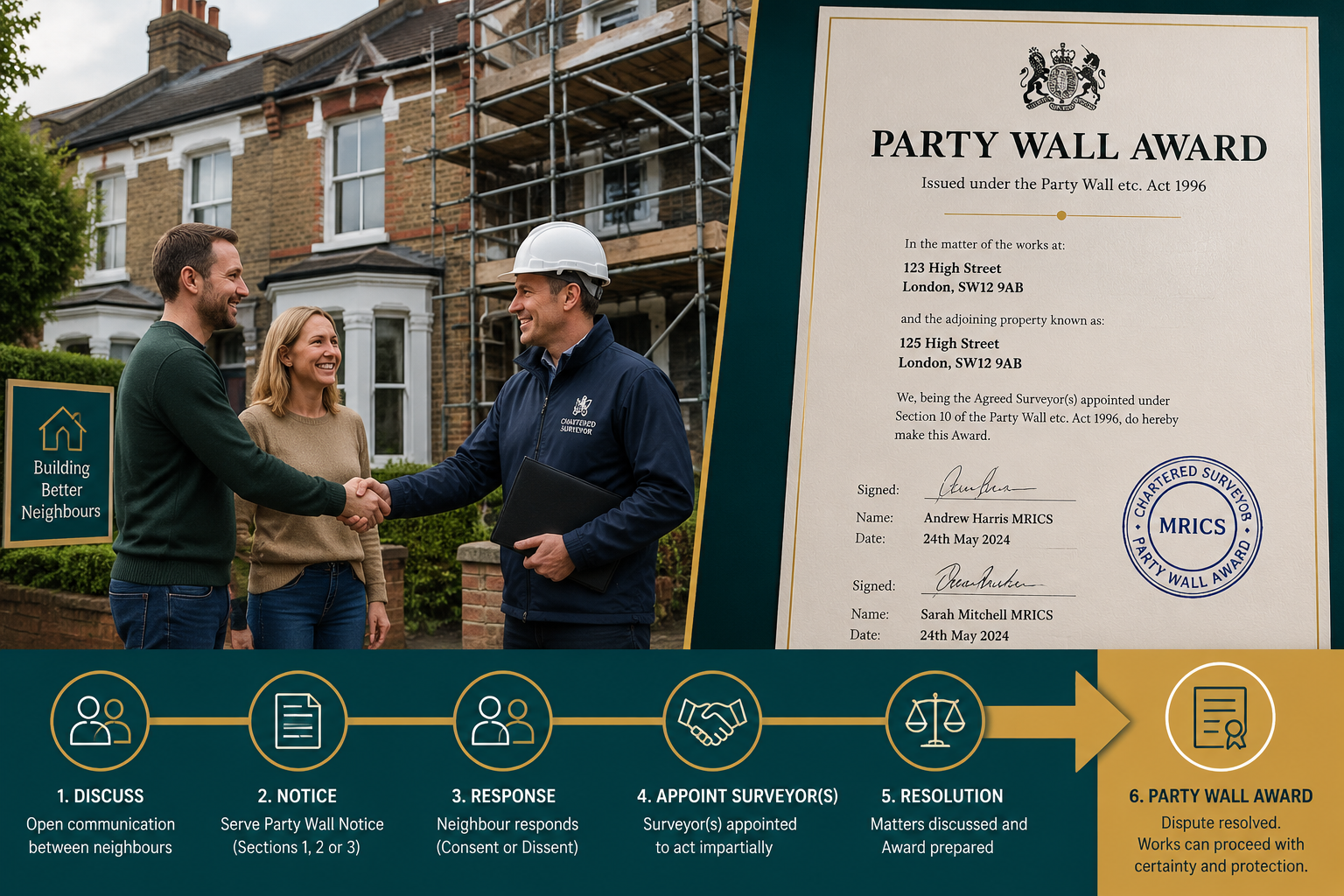
Practical Steps for Appointing a Listed Expert in 2026
Step-by-Step Appointment Process
- Identify candidates via the JS Publications register [1] and RICS Find a Surveyor tool
- Verify RICS membership on the RICS public register
- Check FPWS membership for specialist Party Wall accreditation
- Request a written fee schedule and conflict of interest declaration
- Ask for references from cases involving similar dispute types
- Confirm regional availability and response time commitments
- Review sample reports to assess clarity and legal robustness
When to Appoint an Expert Witness vs. an Agreed Surveyor
Not every Party Wall matter requires a listed expert witness. The distinction matters:
- Agreed Surveyor: Appointed jointly by both parties; handles straightforward cases; lower cost
- Party Wall Surveyor (each party): Appointed separately when parties cannot agree; each surveyor advocates for their client's interests
- Expert Witness: Required when disputes escalate to court; must comply with CPR Part 35; highest level of formal qualification needed [6]
For complex cases — particularly those involving expert witness testimony — the distinction between a competent Party Wall surveyor and a court-qualified expert witness is significant and should not be overlooked.
Red Flags When Reviewing Expert Profiles
🚩 No verifiable RICS or FPWS membership
🚩 Refusal to provide written fee schedules upfront
🚩 No experience with your specific dispute type (e.g., loft conversion vs. excavation)
🚩 Cannot name a single case where their Award was tested or challenged
🚩 Conflict of interest with the opposing party's surveyor
Conclusion: Choosing the Right Expert Is the Dispute
The search for Party Wall Act Listed Experts: Profiles, Selection Criteria, and Success Rates for 2026 Disputes ultimately leads to one core insight: the quality of the expert you appoint is the dispute strategy. No register publishes success rates. No directory guarantees outcomes. What the data does confirm is that RICS accreditation, specialist FPWS membership, regional experience, and a track record of robust Party Wall Awards are the most reliable predictors of a favourable resolution.
Actionable Next Steps
✅ Start with the JS Publications register and cross-reference every candidate against the RICS public register
✅ Request written fee schedules before any formal appointment
✅ Ask specifically about 2026 RICS guidance changes — an expert who cannot discuss them may not be current
✅ Prioritise regional expertise if your dispute is likely to reach county court
✅ Commission a Schedule of Condition survey before any works begin, regardless of dispute status
✅ Seek independent legal advice if the Award produced is vague or contested
For property owners navigating these decisions, working with experienced professionals who combine Party Wall expertise with broader surveying knowledge — including RICS building surveys — provides the most comprehensive protection.
References
[1] Party Wall Act – https://www.jspubs.com/expert-witness/si/p/party-wall-act/
[2] Party Wall Agreement – https://hoa.org.uk/advice/guides-for-homeowners/i-am-improving/party-wall-agreement/
[3] Simple Guide To Party Wall Notice Reply – https://fpws.uk/simple-guide-to-party-wall-notice-reply/
[4] Avoiding Party Wall Disputes In 2026 Construction Boom Surveyor Best Practices For Notice Procedures And Early Neighbour Engagement – https://nottinghillsurveyors.com/blog/avoiding-party-wall-disputes-in-2026-construction-boom-surveyor-best-practices-for-notice-procedures-and-early-neighbour-engagement
[5] Rics Consults On Updated Party Wall Practice Guidance – https://www.lexisnexis.co.uk/legal/news/rics-consults-on-updated-party-wall-practice-guidance
[6] Party Wall Expert Witness Reports Lessons From Recent Uk Litigation And Rics Best Practices – https://nottinghillsurveyors.com/blog/party-wall-expert-witness-reports-lessons-from-recent-uk-litigation-and-rics-best-practices
[7] Party Wall Faqs – https://christopheranthony.org.uk/party-wall-faqs/