
Only 38% of contested divorce property valuations in England and Wales are resolved without a court hearing — meaning the majority end up before a judge who must weigh competing expert opinions on some of the most emotionally and financially significant assets a couple owns. Getting the expert witness report right from the start is not optional; it is the difference between a fair outcome and a costly, protracted dispute.
Expert Witness Reports for Matrimonial Property Valuations: RICS Protocols and Diminution Challenges in 2026 Divorces sit at the intersection of property law, surveying practice, and family court procedure. This guide walks through every critical stage — from accepting instructions to surviving cross-examination — with a clear focus on CPR Part 35 compliance, RICS Red Book standards, and the specific diminution pitfalls that are tripping up valuers in 2026's still-uneven property market.
Key Takeaways 📌
- CPR Part 35 governs all expert evidence in civil and family proceedings; non-compliance can render a report inadmissible.
- RICS Red Book Global Standards and the Surveyors Acting as Expert Witnesses professional statement are the twin pillars of compliant matrimonial valuations. [4]
- Diminution in value — caused by structural defects, short leases, or market volatility — is one of the most contested issues in 2026 divorce cases.
- RICS accreditation through the Expert Witness Accreditation Service (EWAS) is increasingly expected by courts and is a credibility benchmark. [2]
- A single joint expert (SJE) appointment is preferred by family courts, but understanding when separate experts are justified is equally important.
What Is an Expert Witness Report in Matrimonial Property Valuations?
A matrimonial property valuation is not the same as a standard market appraisal. When a marriage breaks down and the family home — or a portfolio of investment properties — must be divided, the court needs an independent, impartial, evidence-based opinion of value. That opinion is delivered through a formal expert witness report.
The expert's primary duty is to the court, not to the party who instructed them. This principle, embedded in CPR Part 35.3, is the foundation of every compliant report. Any surveyor who allows their opinion to be shaped by their client's preferred outcome risks being dismissed as a partisan advocate rather than a neutral expert.
"The overriding duty of an expert witness is to help the court on matters within their expertise — this duty overrides any obligation to the person instructing them." — CPR Part 35.3
In 2026, family courts are scrutinising expert reports more rigorously than ever. The combination of a stabilising but regionally uneven housing market, rising numbers of high-net-worth divorces, and stricter judicial case management means that Expert Witness Reports for Matrimonial Property Valuations: RICS Protocols and Diminution Challenges in 2026 Divorces have never been more technically demanding. [1]
RICS Protocols: The Regulatory Framework for Matrimonial Valuations
The RICS Red Book and Professional Standards
Every matrimonial valuation instructed for court proceedings must comply with the RICS Valuation – Global Standards (Red Book). The Red Book mandates a formal written valuation with a defined basis of value — typically Market Value (MV) as defined by the International Valuation Standards Council (IVSC). A Red Book valuation is not a desktop estimate or a price guide; it is a professionally accountable, signed opinion of value that carries legal weight.
Key Red Book requirements for matrimonial reports include:
- Written terms of engagement before inspection
- Disclosure of any conflict of interest
- Reasoned methodology — comparable evidence, income approach, or residual method as appropriate
- Signed declaration of the valuer's independence
For a deeper understanding of how valuers arrive at their figures, the methods of valuation used in formal reports — from the comparable method to the investment approach — are worth reviewing before instructing an expert.
The RICS Expert Witness Accreditation Service (EWAS)
RICS maintains an accredited expert witness register to ensure that experts appearing in court are suitably experienced, genuinely impartial, and free from conflicts of interest [2]. In 2026, RICS accreditation through EWAS is increasingly treated as a baseline credibility requirement by family court judges, particularly in high-value or contested cases [1].
RICS Dispute Resolution Services can also nominate expert witnesses in specialist areas when the parties cannot agree on a joint appointment [2]. This is particularly relevant in complex cases involving:
- Listed buildings or heritage properties
- Commercial or mixed-use assets
- Properties with significant structural defects
- Leasehold properties with short or defective leases
The Surveyors Acting as Expert Witnesses Professional Statement
The RICS professional statement Surveyors Acting as Expert Witnesses (5th edition) sets out mandatory requirements for RICS members acting in this capacity [4]. Compliance is not voluntary. Key obligations include:
| Requirement | Detail |
|---|---|
| Duty to the court | Overrides duty to client at all times |
| Single Joint Expert protocol | Preferred in family proceedings |
| Written questions | Must respond to CPR Part 35.6 questions within 28 days |
| Meetings of experts | Must engage in without-prejudice discussions if directed |
| Statement of truth | Must be signed by the expert personally |
Step-by-Step Guide: Preparing a CPR Part 35-Compliant Matrimonial Valuation Report
This is where theory meets practice. The following steps address the most common pitfalls in preparing Expert Witness Reports for Matrimonial Property Valuations: RICS Protocols and Diminution Challenges in 2026 Divorces.
Step 1: Accepting Instructions Correctly ✅
Before agreeing to act, the surveyor must:
- Confirm they have no conflict of interest with either party or their legal representatives
- Establish the basis of the instruction — are they a single joint expert (SJE) or a party-appointed expert?
- Agree written terms of engagement that comply with both CPR Part 35 and the RICS professional statement [4]
- Confirm the valuation date — this is critical in divorce proceedings where the relevant date may be the date of separation, the date of the hearing, or another agreed date
⚠️ Common pitfall: Accepting verbal instructions or failing to clarify the valuation date. Courts have rejected reports where the date of value was ambiguous.
Step 2: Conducting the Inspection 🏠
A thorough physical inspection is non-negotiable. For matrimonial purposes, the surveyor should:
- Inspect all rooms and accessible areas, including outbuildings and garages
- Photograph and document any defects, alterations, or features affecting value
- Note any planning consents or building regulation certificates (or their absence)
- Assess lease terms where the property is leasehold — short leases are a significant diminution factor in 2026
For properties where structural issues are suspected, commissioning a specialist defect survey before finalising the valuation report can prevent the expert's opinion from being undermined by undisclosed defects.
Step 3: Selecting and Analysing Comparable Evidence 📊
The comparable method is the primary approach for residential matrimonial valuations. In 2026's regionally volatile market, selecting truly comparable evidence requires care:
- Use Land Registry sold prices within 6 months where possible (12 months maximum)
- Adjust comparables for material differences in size, condition, tenure, and location
- Document every adjustment with a reasoned explanation — courts expect transparency
- Consider the impact of regional price divergence: London and the South East continue to show different trajectories from the Midlands and North [1]
💡 Pro tip: Always include a sensitivity analysis showing how the valuation changes if the market moved ±5% from the valuation date. This pre-empts cross-examination on market timing.
Step 4: Addressing Diminution in Value 📉
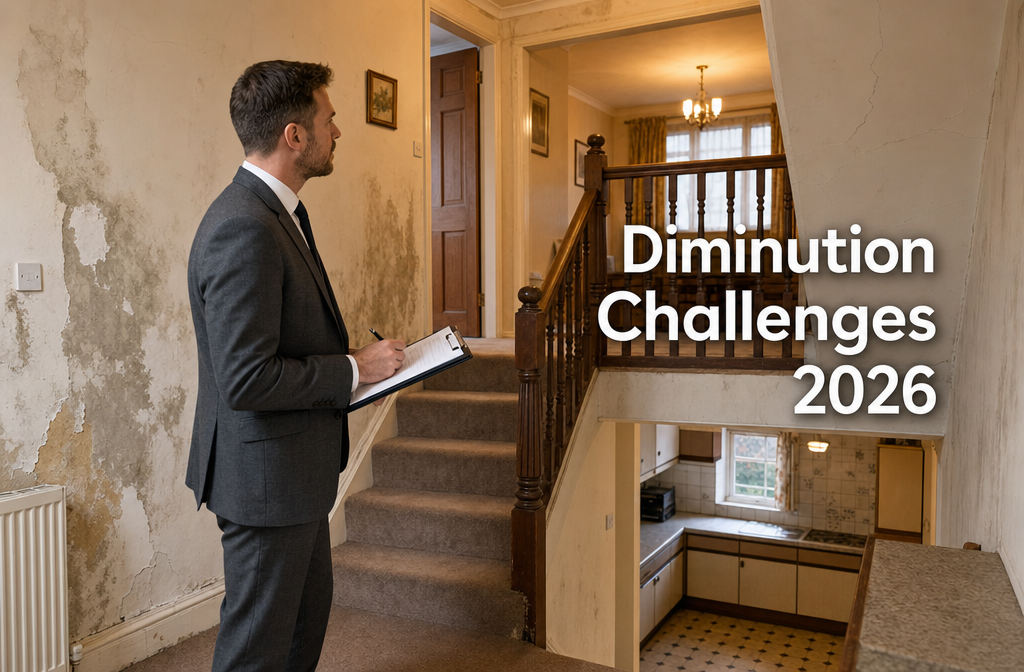
Diminution is the reduction in a property's market value caused by a specific factor. It is one of the most contested issues in matrimonial valuations and deserves its own section.
Common diminution factors in 2026 divorce cases:
- Structural defects — subsidence, damp, roof failure, non-standard construction
- Short leases — properties with fewer than 80 years remaining suffer significant stigma and mortgage-ability issues; see lease extension valuation for the methodology
- Planning issues — unauthorised extensions, breaches of planning conditions
- Environmental factors — flood risk, proximity to contaminated land, Japanese knotweed
- Party wall damage — where neighbouring works have caused measurable harm; the principles in damage to property in party wall disputes are directly applicable
The expert must quantify diminution with evidence, not assertion. A statement that "the damp reduces value by £15,000" without comparable evidence of how the market prices similar defects will be challenged. The surveyor should:
- Identify the defect or factor
- Quantify the cost of remediation (if relevant)
- Analyse how the market responds to that defect using comparable sales
- Express the diminution as a percentage or absolute figure with a reasoned range
Step 5: Structuring the Report to CPR Part 35 Requirements 📋
A CPR Part 35-compliant report must contain the following elements:
- Details of the expert's qualifications and experience relevant to the instruction
- Statement of the facts relied upon
- The expert's opinion with full reasoning
- A summary of conclusions
- A statement that the expert understands their duty to the court and has complied with it
- A statement of truth in the prescribed form
- Disclosure of any literature or other material relied upon
The report should also include a declaration of instructions — what the expert was asked to do and by whom. In SJE appointments, the instructions from both parties' solicitors must be acknowledged [4].
For an example of how formal valuation reports are structured in practice, reviewing valuation reports in Canterbury provides useful context on professional report standards.
Step 6: Responding to Written Questions and Expert Meetings 🤝
Under CPR Part 35.6, any party may put written questions to the expert within 28 days of the report being served. The expert must answer these questions, and the answers form part of the report.
If the court directs a meeting of experts, the surveyor must:
- Engage constructively and in good faith
- Prepare a joint statement identifying areas of agreement and disagreement
- Not allow their client's legal team to dictate the content of the joint statement
Diminution Challenges Specific to 2026 Divorce Cases
Market Volatility and the Valuation Date Problem
The 2026 property market presents a specific challenge: regional price stabilisation masks significant local volatility. A property valued in January 2026 may show a materially different figure by the time of a final hearing in October 2026 [3]. Expert witnesses must:
- Clearly state the valuation date and explain why that date was chosen
- Flag market movement between the valuation date and the report date
- Consider whether a second inspection is warranted if significant time has passed
Leasehold Complications 🔑
Short-lease properties remain a major source of dispute in 2026 matrimonial cases. When one spouse wishes to retain the property and the other wants a cash equivalent, the unexpired lease term dramatically affects value. A property with 72 years remaining is worth materially less than one with 95 years, and the difference is not linear.
The expert must address:
- The current market value with the existing lease
- The value after a statutory lease extension (using the Leasehold Reform, Housing and Urban Development Act 1993 methodology)
- The cost of the extension and who bears it
Non-Standard Construction and Insurance Considerations 🏗️
Properties built with non-standard construction — concrete panels, timber frame, or steel frame — often suffer lender-imposed restrictions that reduce their market value. In matrimonial cases, the expert must address both the open market value and the mortgageability of the property, since a spouse awarded a property they cannot remortgage faces a practical injustice.
Where reinstatement cost is relevant (for example, in disputes about insurance adequacy following damage), an insurance reinstatement valuation provides a separate but complementary figure that may be relevant to the overall asset division picture.
Single Joint Expert vs. Party-Appointed Expert: Which Applies?
Family courts strongly prefer a Single Joint Expert (SJE) for property valuations in divorce proceedings. The SJE is instructed by both parties jointly, owes an equal duty to both, and their report carries significant weight with the court.
When a party-appointed expert may be justified:
- The property is highly unusual or specialist (e.g., a working farm, a listed building)
- There is a significant discrepancy between an earlier SJE report and a party's own evidence
- The SJE has made a material error that the party wishes to challenge
Even where party-appointed experts are used, the court will typically direct them to meet and produce a joint statement. The expert witness services offered by qualified chartered surveyors cover both SJE and party-appointed roles, with full CPR Part 35 compliance.
Common Pitfalls and How to Avoid Them ⚠️
| Pitfall | Risk | Solution |
|---|---|---|
| Ambiguous valuation date | Report rejected or given reduced weight | State date explicitly in the instruction letter |
| Inadequate comparable evidence | Opinion challenged as unsupported | Use minimum 3 comparables with documented adjustments |
| Failure to quantify diminution | Diminution claim dismissed | Use market evidence, not cost alone |
| Partisan language | Expert treated as advocate | Use neutral, measured language throughout |
| Missing statement of truth | Report inadmissible | Use prescribed CPR wording verbatim |
| No conflict of interest check | Expert disqualified | Conduct formal check before accepting instructions |
The Role of the Divorce Valuation Specialist
Not every RICS-qualified surveyor is equipped to act as an expert witness in matrimonial proceedings. The combination of technical valuation expertise, court procedure knowledge, and the ability to withstand cross-examination requires specific experience. RICS EWAS accreditation is the recognised benchmark [2].
When selecting an expert, solicitors and parties should look for:
- RICS membership (MRICS or FRICS)
- EWAS accreditation or equivalent court experience
- Local market knowledge — a valuer unfamiliar with the subject property's micro-market will struggle under cross-examination
- Experience of matrimonial proceedings specifically, not just commercial or mortgage valuation work [5]
Conclusion: Actionable Next Steps for 2026 Matrimonial Valuations
The stakes in matrimonial property valuations are high — for the parties, their legal teams, and the expert witnesses involved. A poorly prepared report does not just lose a case; it can damage a surveyor's professional reputation and expose them to regulatory sanction.
Here are the key actions to take right now:
- ✅ Confirm RICS Red Book compliance before accepting any matrimonial valuation instruction
- ✅ Check EWAS accreditation status — if not yet accredited, begin the application process
- ✅ Use a written instruction checklist that captures the valuation date, basis of value, and conflict of interest declaration before inspection
- ✅ Build a diminution evidence file — gather comparable sales data that supports any value adjustments for defects, lease length, or planning issues
- ✅ Review CPR Part 35 and the RICS Surveyors Acting as Expert Witnesses professional statement before every new instruction
- ✅ Engage early with the other side's expert — proactive communication reduces the scope of dispute and demonstrates good faith to the court
The 2026 landscape for Expert Witness Reports for Matrimonial Property Valuations: RICS Protocols and Diminution Challenges in 2026 Divorces rewards preparation, rigour, and impartiality. Surveyors who invest in those qualities will find themselves in demand — and their reports will carry the weight they deserve.
References
[1] Expert Witness Testimonies In 2026 Valuation Disputes Rics Strategies Amid Stabilising House Prices And Regional Divides – https://nottinghillsurveyors.com/blog/expert-witness-testimonies-in-2026-valuation-disputes-rics-strategies-amid-stabilising-house-prices-and-regional-divides
[2] RICS Register Of Accredited Expert Witnesses March 2026 – https://www.rics.org/content/dam/ricsglobal/documents/surveying/RICS-Register-of-Accredited-Expert-Witnesses_March-2026.pdf
[3] Expert Witness Valuations In 2026s Stabilizing Market Rics Standards For Mortgage Disputes And Property Disagreements – https://nottinghillsurveyors.com/blog/expert-witness-valuations-in-2026s-stabilizing-market-rics-standards-for-mortgage-disputes-and-property-disagreements
[4] Surveyors Acting As Expert Witnesses – https://www.rics.org/profession-standards/rics-standards-and-guidance/sector-standards/dispute-resolution-standards/surveyors-acting-as-expert-witnesses
[5] RICS Valuation Expert Witness Services – https://edsltd.com/rics-valuation-expert-witness-services/