Construction defect claims in England and Wales are rising sharply — and 2026 data confirms that managing these disputes has become one of the most pressing challenges facing property owners, contractors, and insurers alike [5]. At the centre of almost every successful claim sits a single professional: the building surveyor. Their expert report must do two distinct but inseparable jobs — prove what went wrong and calculate precisely what it costs.
Building Survey Expertise in Construction Defect Litigation: From Diagnosis to Quantum Valuation in Expert Reports is not simply about inspecting a leaky roof or a cracked wall. It is about producing a forensically rigorous, legally admissible document that guides courts, mediators, and insurers from the first visible symptom all the way through to a defensible financial remedy. This article explains how that dual role works, why it matters, and what a high-quality expert report must contain.
Key Takeaways 📋
- Diagnosis and quantum are inseparable — a credible expert report addresses both defect causation and financial loss within a single, cohesive document.
- Forensic methodology must follow a structured five-step framework to withstand legal scrutiny and Daubert-style admissibility challenges.
- Digital tools — including laser scanning and BIM — are now setting new standards for expert evidence in construction defect litigation.
- Quantum valuation covers repair costs, diminution in value, and consequential losses; each requires a distinct but linked methodology.
- RICS-accredited surveyors acting as expert witnesses carry a primary duty to the court, not to the instructing party.
The Dual Role of the Building Surveyor in Construction Defect Litigation
Most property disputes involve a simple question: who owes what to whom? Answering it requires two separate bodies of evidence — technical and financial. In practice, the most efficient and persuasive approach is to combine both within a single expert report prepared by a building surveyor with the right credentials and methodology.
Why One Report Is Stronger Than Two
Legal teams sometimes commission separate technical and valuation reports. This creates risk. Inconsistencies between documents can be exploited in cross-examination. A single cohesive report, authored by a qualified expert witness surveyor with both diagnostic and valuation competence, eliminates that vulnerability. It also reduces costs and shortens the pre-trial timetable.
💬 "The expert's primary duty is to the court, not to the party who instructs them." — CPR Part 35, Civil Procedure Rules
The dual-role surveyor must therefore maintain strict objectivity throughout. Their findings on causation directly feed into the quantum section, creating an unbroken chain of logic that courts and mediators find compelling.
Expanding Scope of Claims in 2026
Construction defect litigation is no longer limited to traditional physical failures such as leaky plumbing, foundation cracks, or mould. Claims now extend to "failure to perform" against new sustainable building standards and energy performance targets [5]. Statutes of repose can extend up to ten years from project completion, meaning surveyors are increasingly called upon to investigate buildings where the original construction team has long since dispersed [5].
This expanding scope makes the surveyor's investigative rigour more important than ever. A thorough RICS specialist defect survey forms the foundation of any defensible expert report.
Building Survey Expertise in Construction Defect Litigation: The Forensic Investigation Framework
Forensic building surveyors now follow a structured five-step methodology that mirrors the standards applied in engineering and legal practice [4]. Each stage builds directly on the last, creating a documented audit trail that supports both diagnosis and quantum.
Step 1 — Investigation Planning 🔍
Before a single measurement is taken, the surveyor must define the scope of investigation. This includes:
- Reviewing contract documents, specifications, and planning permissions
- Identifying applicable building regulations and British Standards
- Establishing which parties may bear responsibility
- Agreeing access arrangements with all interested parties
Poor planning at this stage is the most common reason expert reports are challenged. A clear methodology statement at the outset signals credibility.
Step 2 — Data Collection and Onsite Investigation
Thorough visual inspection remains the cornerstone of any defect investigation [3]. However, modern practice demands far more than the naked eye. The surveyor must record:
- As-built assemblies and their deviation from design intent
- Photographic and video evidence with GPS timestamps
- Material samples for laboratory analysis where appropriate
- Moisture readings, thermal imaging, and structural movement data
For complex cases, laser scanning now creates comprehensive as-built records that can withstand legal admissibility challenges far more effectively than traditional documentation methods [4]. Building Information Modelling (BIM) embedded in contracts also provides time-stamped records of design decisions and change orders that are increasingly admissible as expert evidence [4].
Step 3 — Testing Protocol Development
Not every defect is visible. The surveyor must design a testing programme proportionate to the claim. Common tests include:
| Test Type | Defect Category | Purpose |
|---|---|---|
| Borescope inspection | Concealed voids, insulation gaps | Confirm as-built vs. specification |
| Water penetration testing | Cladding, windows, roofing | Identify ingress pathways |
| Carbonation depth testing | Concrete structures | Assess durability failure |
| Dye tracing | Drainage, waterproofing | Map water movement |
| Thermal imaging | Insulation, air leakage | Quantify performance failure |
A damp survey or roof survey may form a discrete component of the wider forensic investigation, particularly where moisture ingress is the primary allegation.
Step 4 — Root Cause Analysis
Current standards require the surveyor to assess all failure mechanisms, not just the most obvious [4]. Root causes typically fall into one or more of the following categories:
- ❌ Design errors — inadequate specifications or detailing
- ❌ Code inconsistencies — non-compliance with Building Regulations
- ❌ Workmanship failures — deviation from specification during construction
- ❌ Material defects — substandard or inappropriate products
- ❌ Site changes — unauthorised variations during construction
- ❌ Maintenance gaps — owner or occupier failure post-completion
- ❌ Material degradation — premature deterioration beyond expected service life
Identifying the correct root cause is critical because it determines who bears liability and therefore who is responsible for the quantum.
Step 5 — Presentation of Conclusions
The final stage transforms technical findings into a legally usable document. Expert reports in English courts must comply with CPR Part 35 and the accompanying Practice Direction. Key requirements include:
- A statement of the expert's qualifications and independence
- A clear summary of instructions received
- A statement of truth
- An unambiguous opinion on causation
- A clearly reasoned quantum section
Expert witnesses providing construction defect litigation services typically offer forensic evaluations, standard of care assessments, allocation of responsibility, cost of repair analysis, and post-litigation repair design [1].
Building Survey Expertise in Construction Defect Litigation: From Diagnosis to Quantum Valuation in Expert Reports
The transition from diagnosis to quantum is where many expert reports fall short. Identifying a defect is one skill; translating it into a defensible financial figure is another. The two must be logically connected within the same document.
Understanding Quantum in Construction Defect Claims
Quantum refers to the financial value of the loss suffered. In construction defect litigation, this typically encompasses three distinct heads of loss:
1. Cost of Repair (Reinstatement)
This is the most common head of quantum and requires the surveyor to produce a schedule of works setting out:
- The scope of remedial works required to restore the building to the standard it should have achieved
- Unit rates sourced from recognised price books (e.g., BCIS, Spon's) or competitive tender
- Preliminaries, contingencies, and professional fees
- VAT treatment appropriate to the circumstances
The cost of repair figure must be reasonable and proportionate. Courts will not award the cost of gold-plated remediation where a more modest solution would adequately address the defect.
2. Diminution in Value
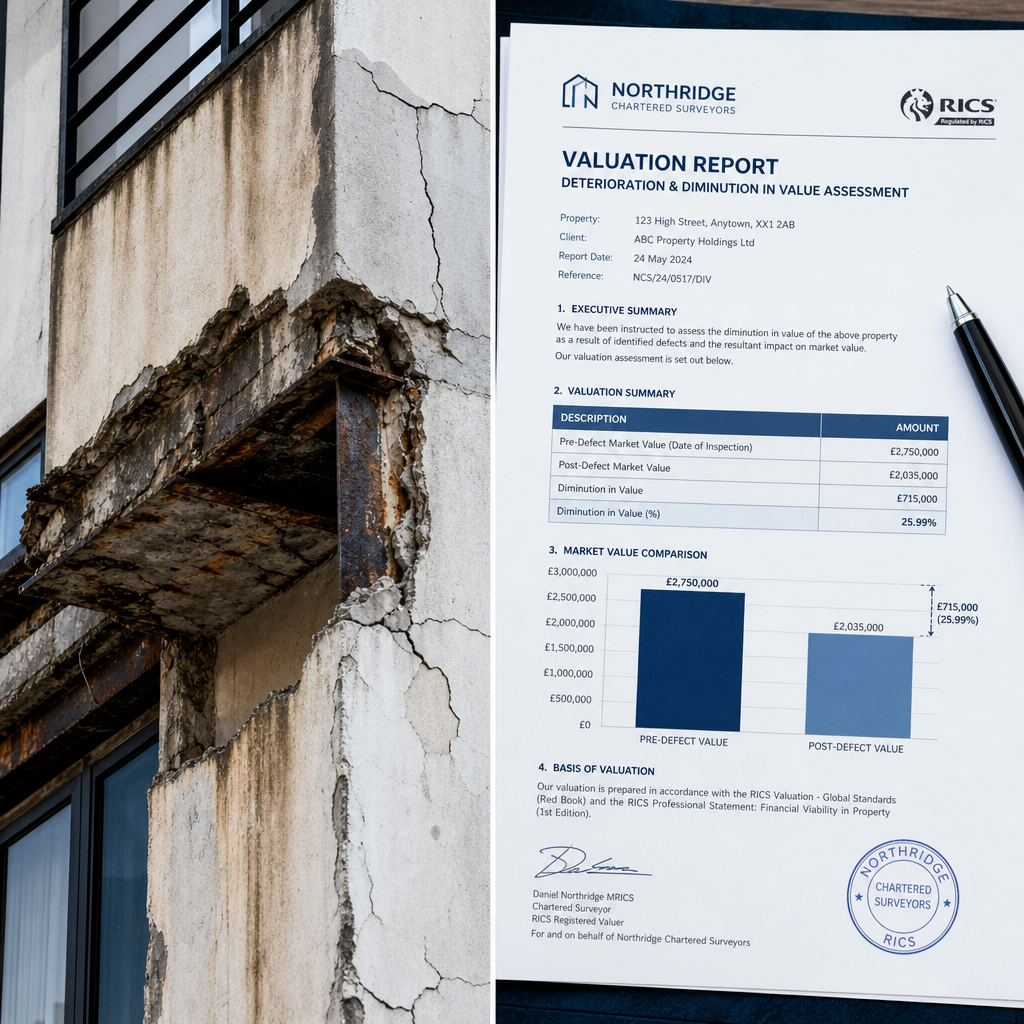
Where full reinstatement is not possible, or where the market perceives a residual stigma even after repair, the claimant may seek diminution in value — the difference between what the property is worth with the defect and what it would be worth without it.
This requires the surveyor to apply formal valuation methodology. Understanding valuation factors and methods of valuation is therefore a core competency for any surveyor acting in this capacity. The comparison method, investment method, and residual method may each be relevant depending on the property type and the nature of the defect.
3. Consequential Losses
Beyond repair costs and diminution, claimants may also recover:
- Temporary accommodation costs during remediation
- Loss of rent where investment properties are affected
- Increased insurance premiums following disclosure obligations
- Professional fees incurred in investigating and managing the claim
Each head of loss must be evidenced and linked back to the causation findings. A surveyor providing insurance reinstatement valuation services will be familiar with the intersection between defect costs and insurance recovery.
Connecting Diagnosis to Quantum: The Single-Report Strategy
The most persuasive expert reports follow a clear narrative structure:
Defect Identified → Root Cause Established → Responsible Party Identified
→ Remedial Works Specified → Cost Calculated → Diminution Assessed
Each section references the previous one. The quantum section should never introduce new defects not identified in the diagnostic section. This internal consistency is what separates a report that settles a claim from one that invites a counter-report.
💡 Pro tip: Courts respond well to reports that include a Scott Schedule — a tabular summary listing each defect, its cause, the remedial works required, and the associated cost. This format makes complex multi-defect claims immediately legible to judges and mediators.
Allocation of Responsibility
Where multiple contractors, subcontractors, or design professionals are involved, the surveyor must address apportionment. This requires:
- A clear understanding of each party's contractual obligations
- Analysis of where the chain of responsibility broke down
- A reasoned opinion on percentage contributions to the loss
Specialist building envelope analysis — covering cladding, roofing, windows, and waterproofing systems — often requires in-depth forensic analysis to identify causes of system failures and apportion responsibility accurately [2].
Standards, Credentials, and Admissibility in 2026
Who Qualifies as an Expert Witness Surveyor?
Not every building surveyor is qualified to act as an expert witness. The role demands:
- RICS membership (MRICS or FRICS) with relevant specialism
- Demonstrable expertise in the defect type under investigation
- Familiarity with CPR Part 35 and the duties it imposes
- Experience of court proceedings or at minimum formal dispute resolution
The expert witness surveyor must be able to defend their methodology under cross-examination. This means every assumption, every price rate, and every causation opinion must be traceable to a recognised source or professional standard.
Admissibility Challenges
Courts increasingly apply rigorous admissibility standards to expert evidence. Laser scanning and BIM-derived evidence are now setting new benchmarks because they provide objective, time-stamped, independently verifiable records [4]. Reports relying solely on visual inspection without supporting measurements or testing are more vulnerable to challenge.
The surveyor should also be aware of the Ikarian Reefer principles (upheld in English case law) which require expert witnesses to:
- Provide independent assistance to the court
- Never act as an advocate for the instructing party
- State clearly when a question falls outside their expertise
- Distinguish between fact and opinion
Commercial Properties and Complex Claims
Commercial defect claims carry additional complexity. A commercial building survey must account for operational disruption, tenant obligations, and the interaction between defects and dilapidations. A schedule of dilapidations may run alongside a defect claim, requiring the surveyor to carefully delineate which elements of disrepair are attributable to the builder's failure and which represent normal wear and tear.
Conclusion: Actionable Next Steps for Property Owners and Legal Teams
Building Survey Expertise in Construction Defect Litigation: From Diagnosis to Quantum Valuation in Expert Reports demands a surveyor who can operate simultaneously as a forensic investigator, technical analyst, and financial quantifier. The single-report strategy — linking causation directly to quantum within one coherent document — is the most effective approach for achieving early settlement or a successful court outcome.
Actionable Steps ✅
- Instruct early. Engage a qualified RICS expert witness surveyor as soon as a potential claim is identified — before evidence degrades or limitation periods approach.
- Preserve evidence. Do not carry out emergency repairs without first obtaining photographic, video, and measurement records. Notify all potentially liable parties before remediation begins.
- Demand a dual-role report. Insist that your surveyor's report addresses both causation and quantum. Separate reports create inconsistency risk.
- Check credentials. Confirm that your surveyor holds RICS accreditation, has relevant specialism in the defect type, and has experience of formal dispute resolution or court proceedings.
- Use a Scott Schedule. For multi-defect claims, request that the report includes a tabular schedule linking each defect to its cause, remedy, and cost.
- Consider digital evidence. Where the claim value justifies it, commission laser scanning or BIM analysis to create an objective, admissible record of as-built conditions.
The rise in construction defect claims in 2026 means that the quality of expert evidence has never mattered more [5]. A well-constructed expert report — forensically rigorous, financially precise, and legally compliant — is not just a document. It is the difference between a claim that succeeds and one that fails.
References
[1] Construction Defect Litigation – https://www.charlestaylor.com/en/claims-solutions/technical-services-overview/engineering-technical-services/construction-defect-litigation/
[2] Litigation Consulting – https://www.gciconsultants.com/building-envelope-services/litigation-consulting/
[3] Onsite Investigation Of Construction Defect Claims – https://www.petefowler.com/2026-webinar-calendar/2026/02/26/onsite-investigation-of-construction-defect-claims
[4] Construction Claims And Disputes – https://rimkus.com/article/construction-claims-and-disputes/
[5] Construction Defect Claims – https://inszoneinsurance.com/blog/construction-defect-claims