Expansive soil damage creates larger financial losses to homeowners than floods, hurricanes, and tornadoes combined[1]. This startling reality hits bungalow owners particularly hard as spring 2026 brings unpredictable thaw cycles to clay-rich regions. Understanding Subsidence Risks in Bungalow Valuations: Level 3 Survey Essentials for Clay Soil Thaw Cycles in Spring 2026 has become critical for buyers, sellers, and mortgage lenders navigating today's property market.
Single-story bungalows face unique structural vulnerabilities during seasonal soil movement. Their shallow foundations and wide footprints make them especially susceptible to differential settlement when clay soils expand and contract. As weather patterns shift in 2026, property valuations increasingly reflect these subsidence concerns, with comprehensive Level 3 surveys becoming the gold standard for risk assessment.
Key Takeaways
- Approximately 25% of all homes suffer damage from expansive clay soils, with bungalows facing heightened risk due to shallow foundation design[1]
- Level 3 surveys provide essential subsidence detection through detailed structural analysis, soil assessment, and crack monitoring protocols
- Spring 2026 thaw cycles create critical inspection windows when clay soil movement becomes most visible and measurable
- Valuation adjustments for subsidence range from 10-30% depending on severity, remediation costs, and insurance implications
- RICS red flags include progressive cracking, door/window misalignment, and seasonal movement patterns requiring immediate professional assessment
Understanding Clay Soil Behavior During Spring Thaw Cycles
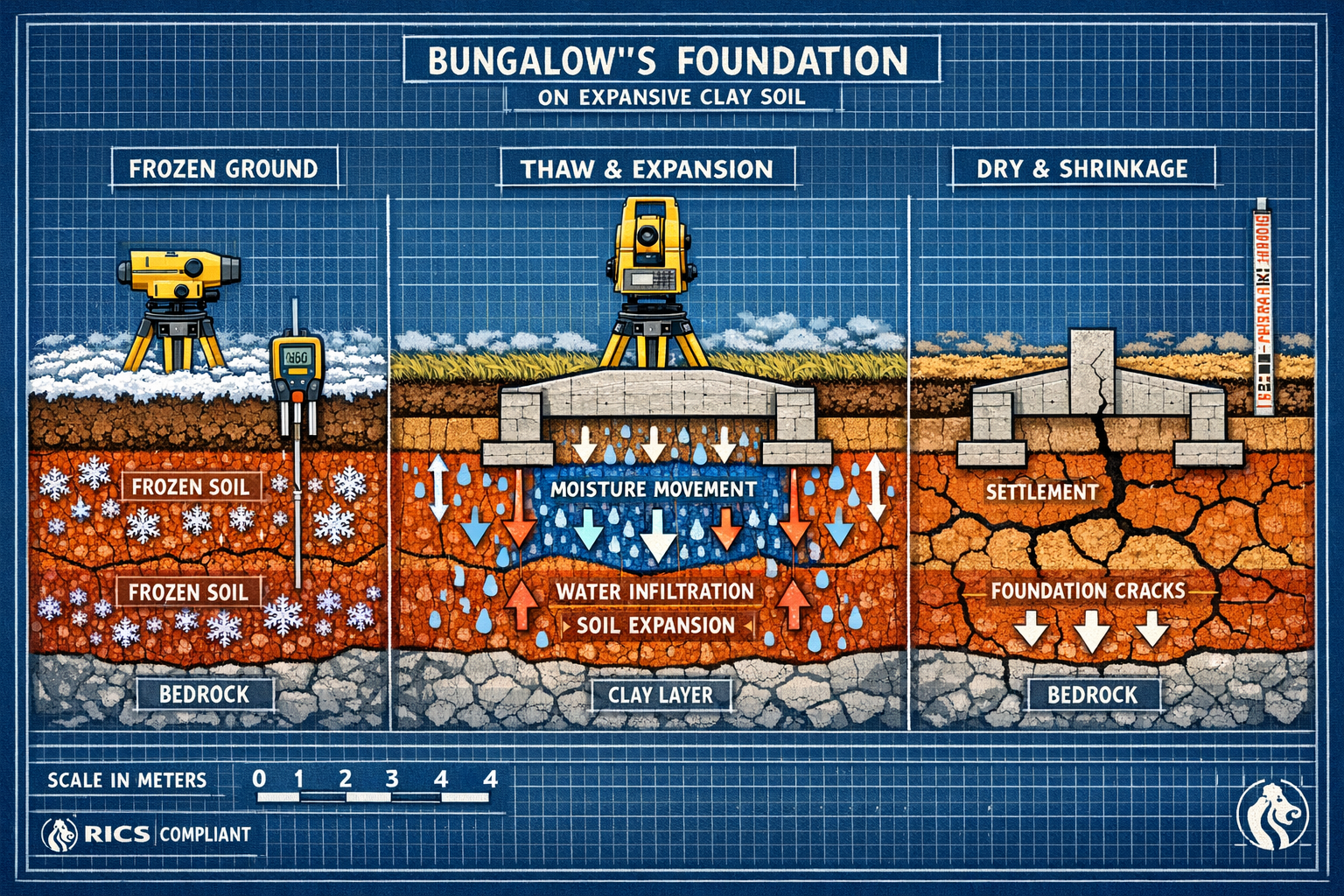
Clay soils contain minerals that behave like microscopic sponges. During wet periods, these particles absorb water and swell dramatically. As conditions dry, they shrink with equal force. This expansion-contraction cycle creates enormous pressure against foundations—pressure that can exceed the structural capacity of many bungalow designs.
The 2026 Spring Thaw Phenomenon
Spring 2026 presents particularly challenging conditions for property owners. After winter freezing, clay soils undergo rapid thaw as temperatures rise. This process releases trapped moisture while simultaneously allowing new water infiltration from spring rainfall. The result? Maximum soil movement occurs precisely when many property transactions take place.
In the Midwest, common spring issues include frost heave in winter, settlement during spring thaw, basement wall cracking, and water intrusion[1]. For bungalows built on clay-rich ground, these seasonal shifts manifest as:
- Differential settlement where one section of the foundation moves independently from another
- Heave pressure pushing upward against floor slabs and foundation walls
- Lateral soil movement creating shear forces on structural elements
- Moisture accumulation in foundation zones leading to progressive deterioration
Geographic Vulnerability Zones 🌍
Certain regions face elevated subsidence risks. The Chesapeake Bay region experiences land subsidence rates from 1.1 to 4.8 millimeters per year, with land subsidence causing more than half of observed relative sea level rise[3]. While this data reflects coastal subsidence from different mechanisms, it illustrates how ground movement compounds property risks.
Clay-rich areas across the UK, particularly in Southeast England, face similar seasonal challenges. Properties in Essex, Hertfordshire, and Surrey regions require heightened scrutiny during spring assessments. Our chartered surveyors in Hertfordshire regularly encounter clay soil subsidence during spring survey seasons.
Why Bungalows Demand Specialized Level 3 Survey Attention
Bungalows present a unique structural profile that amplifies subsidence risks. Unlike two-story homes where upper floor weight helps stabilize foundations, single-story designs lack this counterbalancing mass. Their wide footprints also mean foundation perimeters extend across larger soil areas, increasing exposure to differential movement.
Structural Characteristics That Increase Vulnerability
Foundation depth limitations: Most bungalows built before 1990 feature shallow strip foundations, typically 450-600mm deep. Modern building regulations require greater depth in clay soils, but existing properties remain vulnerable.
Load distribution patterns: Single-story structures concentrate weight along perimeter walls rather than distributing it through multiple floor levels. When clay soil shrinks beneath one section, the entire structure experiences stress.
Roof loading dynamics: Bungalow roofs often span greater distances without intermediate support. Any foundation movement directly impacts roof structure integrity, creating visible distress in ceiling lines and gable ends.
The Level 3 Survey Advantage for Subsidence Detection
A Level 3 survey (formerly called a Building Survey) provides the comprehensive analysis essential for identifying subsidence risks. Unlike basic homebuyer reports, Level 3 surveys include:
✅ Detailed structural assessment examining every accessible area
✅ Crack pattern analysis distinguishing settlement from active subsidence
✅ Drainage system evaluation identifying water management failures
✅ Soil condition observations noting clay type and moisture indicators
✅ Movement monitoring recommendations specifying crack gauge placement
✅ Remediation cost estimates for identified defects
Professional subsidence surveys employ specialized techniques to detect early warning signs before they escalate into major structural failures. For bungalow buyers, this investment protects against potentially catastrophic financial losses.
Subsidence Risks in Bungalow Valuations: Level 3 Survey Essentials for Spring 2026 Inspections

Conducting effective Level 3 surveys during spring thaw periods requires specific protocols. The timing coincides with maximum soil movement, making defects most visible while also presenting inspection challenges from wet conditions.
Critical Inspection Elements for Clay Soil Properties
External foundation examination: Surveyors must inspect the entire foundation perimeter, noting:
- Crack locations, widths, and orientations
- Step cracking in brickwork (classic subsidence indicator)
- Horizontal cracks at damp-proof course level
- Gaps between walls and ground level
- Drainage system condition and water pooling
Internal structural assessment: Inside the property, surveyors document:
- Diagonal cracks extending from door/window corners
- Floor level variations measured with laser levels
- Door and window operation difficulties
- Ceiling cracks and separation from walls
- Plaster distortion and bulging
Soil and drainage analysis: Understanding ground conditions requires:
- Visual soil type identification in inspection pits
- Drainage system functionality testing
- Gutter and downpipe condition assessment
- Ground slope and water runoff patterns
- Vegetation proximity to foundations (tree root risks)
Advanced Monitoring Techniques 📊
Spring 2026 surveys increasingly incorporate technology-enhanced monitoring:
| Monitoring Method | Application | Cost Range | Timeframe |
|---|---|---|---|
| Tell-tale crack gauges | Track crack width changes | £50-150 | 6-12 months |
| Precision level surveys | Measure floor/wall movement | £300-600 | 3-6 months |
| Thermal imaging | Detect moisture infiltration | £200-400 | Single visit |
| Ground penetrating radar | Assess soil voids/cavities | £500-1,200 | Single visit |
| Borehole investigations | Determine soil composition | £800-2,000 | Single visit |
Professional structural surveys integrate these techniques based on initial findings. When subsidence indicators appear, extended monitoring periods become essential before finalizing valuations.
Seasonal Timing Considerations
Early spring (March-April): Optimal inspection window as thaw reveals winter damage. Soil remains saturated, making moisture-related issues visible.
Late spring (May-June): Secondary inspection period as soil begins drying. Comparison with early spring findings reveals progressive movement.
Avoid summer surveys alone: Clay shrinkage during dry periods can temporarily close cracks, masking underlying problems. Always request winter or spring inspection data.
RICS Red Flags and Valuation Adjustment Formulas
The Royal Institution of Chartered Surveyors (RICS) provides clear guidance on subsidence risk assessment. Understanding these red flags helps buyers and sellers anticipate valuation impacts.
Primary RICS Warning Indicators 🚩
Progressive cracking: Cracks wider than 3mm that show evidence of recent movement require immediate investigation. Surveyors look for:
- Clean crack edges (indicating recent formation)
- Displaced materials or debris
- Seasonal opening/closing patterns
- Multiple cracks in similar orientations
Structural distortion: Beyond visible cracks, surveyors measure:
- Door frames out of square by more than 10mm
- Window sills showing deviation from horizontal
- Floor slopes exceeding 1:100 gradient
- Wall lean greater than 1:150 from vertical
Drainage defects: Water management failures frequently trigger subsidence:
- Blocked or damaged underground drains
- Leaking joints allowing soil erosion
- Inadequate surface water disposal
- Soakaways too close to foundations
Vegetation risks: Trees and large shrubs near bungalows create subsidence through:
- Water extraction from clay soils (causing shrinkage)
- Root penetration beneath foundations
- Seasonal moisture variation in root zones
- Species-specific risk levels (poplars, willows, oaks highest risk)
Valuation Adjustment Calculations
When subsidence evidence appears, valuations reflect both remediation costs and market stigma. Typical adjustments follow this framework:
Minor subsidence (historic, stabilized):
- Valuation reduction: 5-10%
- Remediation costs: £5,000-15,000
- Insurance implications: Possible higher premiums
- Market impact: Limited buyer concern with proper documentation
Moderate subsidence (active, requiring intervention):
- Valuation reduction: 15-25%
- Remediation costs: £25,000-45,000
- Insurance implications: Specialist cover required
- Market impact: Significant buyer hesitation, mortgage difficulties
Severe subsidence (major structural compromise):
- Valuation reduction: 30-50%
- Remediation costs: £50,000-100,000+
- Insurance implications: Possible uninsurability
- Market impact: Severely restricted buyer pool
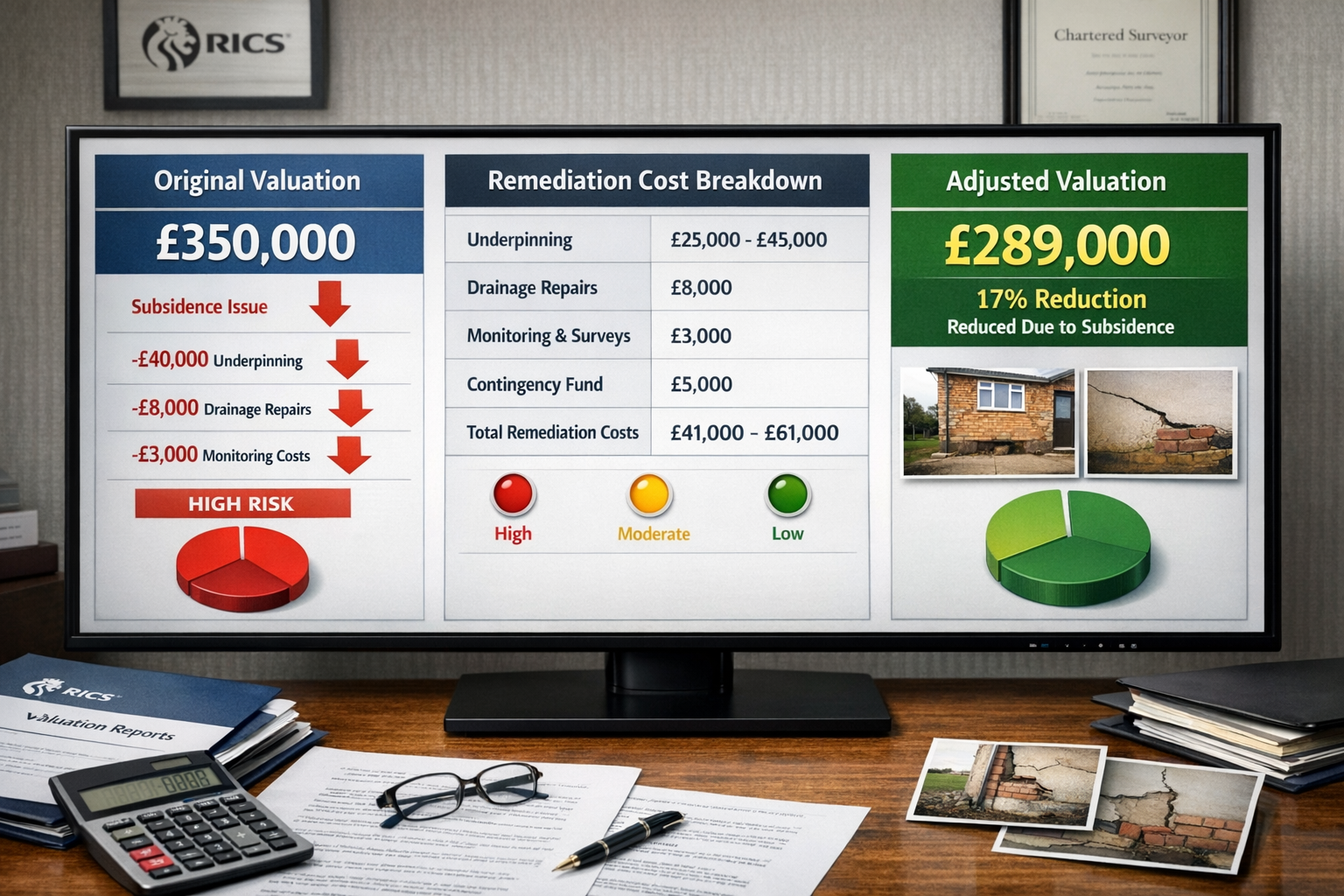
Example Valuation Scenario
Property: 3-bedroom bungalow, clay soil region
Market value (no defects): £350,000
Survey findings: Active subsidence, 5mm progressive cracks, drainage failure
Valuation adjustment:
- Underpinning costs: £35,000
- Drainage repairs: £8,000
- Monitoring period: £2,000
- Market stigma factor: 15%
- Adjusted valuation: £262,500 (25% reduction)
Professional valuation factors extend beyond simple cost calculations. Mortgage lenders often require specialist reports, and insurance complications can persist for years after remediation.
Essential Survey Components for Spring 2026 Clay Soil Assessments
Comprehensive Level 3 surveys addressing Subsidence Risks in Bungalow Valuations: Level 3 Survey Essentials for Clay Soil Thaw Cycles in Spring 2026 must include specific deliverables.
Mandatory Report Sections
Executive summary: Clear risk categorization using traffic light system (red/amber/green) for subsidence concerns.
Detailed crack mapping: Floor plans showing every crack location, width, orientation, and severity rating.
Photographic evidence: Comprehensive imagery documenting all defects with measurement scales visible.
Soil condition assessment: Description of observed soil types, moisture conditions, and drainage functionality.
Remediation recommendations: Prioritized action plan with cost estimates and urgency ratings.
Monitoring protocols: Specific instructions for crack gauge placement and measurement schedules.
Insurance implications: Clear statement on insurability and potential premium impacts.
Specialist Investigations to Request
When initial surveys reveal concerning indicators, additional investigations become necessary:
Soil analysis: Laboratory testing determines clay mineral content, plasticity index, and shrink-swell potential. Costs range £600-1,200 but provide definitive soil behavior data.
Trial pit excavations: Physical inspection of foundation depth and condition. Essential when original construction details are unavailable. Budget £400-800 per pit.
Drainage CCTV surveys: Camera inspection of underground pipes identifies leaks and blockages. Our drainage survey services reveal hidden water management failures.
Arboricultural assessment: Professional tree surveys calculate water demand and root spread. Critical when mature trees stand within 1.5x their height from the property.
Understanding Survey Costs and Timelines
Level 3 surveys for bungalows typically cost £800-1,500 depending on property size and location. When subsidence concerns exist, expect:
- Initial survey: 4-6 hours on-site, 2-3 weeks for report delivery
- Monitoring period: 6-12 months for seasonal movement assessment
- Follow-up inspection: 2-3 hours on-site, 1 week for supplementary report
For detailed cost breakdowns, review our guide on structural survey pricing.
Remediation Strategies and Their Impact on Valuations
Understanding repair options helps buyers and sellers negotiate realistic price adjustments. Not all subsidence requires underpinning—the most expensive intervention.
Treatment Hierarchy
1. Drainage improvements (£5,000-12,000)
Many subsidence cases resolve through proper water management:
- Repairing leaking drains
- Installing surface water drainage
- Improving gutter systems
- Creating adequate ground slopes
2. Vegetation management (£500-5,000)
Removing or managing problem trees:
- Professional tree removal
- Root barrier installation
- Pruning and crown reduction
- Species replacement with low-water-demand alternatives
3. Crack repair and monitoring (£2,000-8,000)
For minor, stabilized movement:
- Crack stitching with helical bars
- Resin injection stabilization
- Cosmetic repairs after monitoring period
- Ongoing surveillance programs
4. Underpinning (£25,000-100,000+)
Reserved for severe cases:
- Mass concrete underpinning
- Mini-piled foundations
- Resin injection underpinning
- Structural strengthening works
Insurance Considerations 💷
Subsidence claims history significantly impacts property marketability. Key points:
- Previous claims: Properties with claim history face higher premiums (often 20-50% increases)
- Excess levels: Subsidence excess typically £1,000-5,000 compared to standard £100-250
- Specialist insurers: Some properties require non-standard insurance markets
- Disclosure requirements: Legal obligation to inform buyers of subsidence history
Properties with completed, guaranteed remediation work often secure standard insurance after 10-year guarantee periods expire.
Regional Variations and Local Expertise
Clay soil distribution varies significantly across regions. Properties in areas with London Clay, Gault Clay, or Oxford Clay face different risk profiles than those on chalk or sandstone.
High-Risk UK Regions
Southeast England: Extensive London Clay deposits create widespread subsidence vulnerability. Our chartered surveyors in North London and South West London regularly assess clay soil properties.
East of England: Essex and parts of Suffolk contain reactive clay soils. Properties in these areas benefit from surveyors familiar with local geology.
Thames Valley: Areas around Guildford, Weybridge, and surrounding towns feature clay-rich soils. Our chartered surveyors in Guildford and Weybridge provide specialized local knowledge.
Selecting Qualified Surveyors
When commissioning Level 3 surveys for subsidence assessment, verify:
✅ RICS qualification: AssocRICS or MRICS designation minimum
✅ Structural engineering expertise: Additional qualifications in building pathology
✅ Local experience: Familiarity with regional soil conditions
✅ Insurance backing: Professional indemnity coverage for survey work
✅ Specialist equipment: Access to monitoring and diagnostic tools
Finding local chartered surveyors with clay soil expertise ensures accurate risk assessment and realistic remediation recommendations.
Legal and Mortgage Implications
Subsidence findings trigger multiple legal and financial considerations that extend beyond simple valuation adjustments.
Seller Disclosure Obligations
Property sellers must disclose known subsidence issues. The TA6 Property Information Form specifically asks about:
- Structural movement or subsidence
- Insurance claims for subsidence
- Underpinning or structural repairs
- Ongoing monitoring arrangements
Failure to disclose can result in legal action after completion, with buyers claiming misrepresentation. Accurate, honest disclosure protects sellers while allowing informed buyer decisions.
Mortgage Lender Requirements
When Level 3 surveys identify subsidence concerns, mortgage lenders typically require:
Retention of funds: Lenders withhold completion money until remediation completes. Retention amounts usually cover 150% of estimated repair costs.
Specialist valuation: Standard mortgage valuations become insufficient. Lenders commission detailed structural reports from their approved surveyors.
Monitoring evidence: For historic subsidence, lenders demand proof of stability through 12-month monitoring data.
Insurance confirmation: Proof of subsidence insurance coverage at standard market terms.
Engineer's certification: Completed remediation work requires structural engineer sign-off and guarantees.
Negotiation Strategies
Buyers discovering subsidence through Level 3 surveys have several options:
1. Price renegotiation: Request reduction reflecting remediation costs plus market stigma factor (typically total 15-30% depending on severity).
2. Seller-funded repairs: Negotiate for seller to complete remediation before completion, with appropriate guarantees.
3. Retention arrangements: Proceed at reduced price with funds held in escrow for post-completion repairs.
4. Transaction withdrawal: Exercise survey contingency clause to exit purchase without penalty.
Successful negotiations balance realistic cost assessments with market conditions and seller motivation.
Future-Proofing Bungalow Purchases Against Subsidence
Beyond immediate survey findings, buyers should consider long-term subsidence risk management.
Climate Change Considerations
Weather patterns in 2026 and beyond show increasing volatility. Clay soils face:
- More intense rainfall events: Causing rapid soil saturation and swelling
- Extended dry periods: Creating severe shrinkage and cracking
- Temperature extremes: Accelerating freeze-thaw cycles
- Seasonal unpredictability: Making traditional movement patterns less reliable
Properties with robust drainage, adequate foundation depth, and managed vegetation better withstand these challenges.
Preventive Maintenance Programs
Bungalow owners can minimize subsidence risks through:
Annual drainage inspection: Professional CCTV surveys every 3-5 years (£200-400) identify developing problems before they cause structural damage.
Vegetation management: Maintain trees at safe distances (generally 1.5x mature height from foundations). Remove high-risk species near buildings.
Gutter maintenance: Clean gutters twice yearly, ensure downpipes discharge away from foundations (minimum 1.5m distance).
Foundation zone monitoring: Annual visual inspection of external walls, recording any new cracks or changes.
Soil moisture management: Consider irrigation during extreme drought to minimize clay shrinkage (controversial but sometimes recommended by engineers).
Warranty and Insurance Protection
New bungalow buyers should secure:
Structural warranty: 10-year NHBC or similar coverage for new builds
Subsidence insurance: Comprehensive coverage with reasonable excess levels
Guarantee documentation: Retain all remediation work guarantees (typically 10 years)
Survey records: Maintain complete survey history for future transactions
Conclusion
Subsidence Risks in Bungalow Valuations: Level 3 Survey Essentials for Clay Soil Thaw Cycles in Spring 2026 represents a critical knowledge area for anyone involved in bungalow transactions on clay soils. The financial stakes are enormous—with approximately 25% of homes experiencing expansive soil damage and losses exceeding those from natural disasters[1].
Spring 2026's thaw cycles create both challenges and opportunities. The seasonal soil movement reveals defects that might otherwise remain hidden, allowing comprehensive Level 3 surveys to provide accurate risk assessments. For bungalows, with their unique structural vulnerabilities, this detailed investigation becomes essential rather than optional.
Key Actions for Buyers
- Commission Level 3 surveys for any bungalow on clay soil, especially during spring inspection windows
- Engage RICS-qualified surveyors with local clay soil expertise and structural engineering knowledge
- Request specialist investigations when initial findings suggest subsidence concerns
- Obtain 12-month monitoring data for properties showing any movement indicators
- Verify insurance availability and understand premium implications before committing to purchase
- Negotiate valuations realistically using documented remediation costs and market stigma factors
Key Actions for Sellers
- Conduct pre-sale surveys to identify and address subsidence issues proactively
- Maintain comprehensive documentation of any previous remediation work and guarantees
- Complete honest disclosure forms to avoid future legal complications
- Consider pre-emptive repairs for minor issues that might derail transactions
- Gather monitoring evidence demonstrating stability for historic movement
Moving Forward
The property market increasingly recognizes subsidence as a manageable risk rather than an automatic deal-breaker. Professional assessment through comprehensive Level 3 surveys, realistic valuation adjustments, and appropriate remediation create pathways for successful transactions even when clay soil movement occurs.
For bungalow owners and buyers navigating spring 2026's challenging conditions, expert guidance makes the difference between costly mistakes and informed decisions. Engaging qualified professionals early in the process protects investments and ensures structural safety for years to come.
Ready to protect your bungalow investment? Contact experienced structural survey specialists who understand clay soil behavior and can provide the comprehensive Level 3 assessment your property deserves. Don't let subsidence risks undermine your property value—invest in professional expertise that identifies problems early and guides effective solutions.
References
[1] The Complete Guide To Foundation Inspections What Every Homeowner Must Know – https://www.amerisave.com/learn/the-complete-guide-to-foundation-inspections-what-every-homeowner-must-know
[2] Study Finds That Subsidence Groundwater Over Pumping Could Limit Future Water Deliveries – https://water.ca.gov/News/Blog/2025/May-25/Study-Finds-That-Subsidence-Groundwater-Over-Pumping-Could-Limit-Future-Water-Deliveries
[3] Why Land Subsidence Matters More Than Sea Level Rise – https://www.greenbuildinglawupdate.com/2026/02/articles/climate-change/why-land-subsidence-matters-more-than-sea-level-rise/