

Nearly 40% of rental properties in England face potential valuation adjustments due to incomplete PRS database registration—a compliance gap that could render Section 8 eviction notices invalid and trigger penalties exceeding £30,000. As the Private Rented Sector Database enters its phased rollout in late 2026, surveyors must now incorporate landlord registration status as a critical valuation factor, fundamentally changing how rental properties are assessed and priced.
PRS Database Compliance in Valuation Surveys: 2026 Adjustments for Section 8 Notices and Landlord Registration Risks represents a seismic shift in property valuation methodology. With the Renters' Rights Act provisions taking effect on May 1, 2026, the relationship between database compliance, possession proceedings, and market value has become inseparable. Surveyors conducting RICS building surveys must now verify registration status alongside traditional structural and legal considerations.
This comprehensive guide examines how the PRS Database impacts property valuations, provides surveyor tactics for identifying non-compliant properties, and outlines value adjustment methodologies for properties facing Section 8 eviction proceedings.
Key Takeaways
- Registration is mandatory for valid Section 8 notices: Unregistered landlords cannot serve legally valid possession notices, making database compliance essential for property marketability and valuation[2]
- Valuation adjustments range from 5-15%: Non-compliant properties typically require value reductions of 5-7% for registration delays, 8-12% for missing safety certificates, and up to 15% for multiple compliance failures
- Database rollout begins late 2026: The PRS Database launches progressively through 2027-2028, with existing landlords receiving transition periods but new landlords required to register before advertising[2]
- Comprehensive property data is required: Landlords must upload full property details including EPC ratings, Gas Safety Certificates, EICR reports, HMO licences, and tenancy information within 14-28 days of changes[2]
- Penalties create significant financial exposure: Non-registration fines range from £5,000 to £30,000, with additional rent repayment orders potentially reaching 24 months of rental income[2]
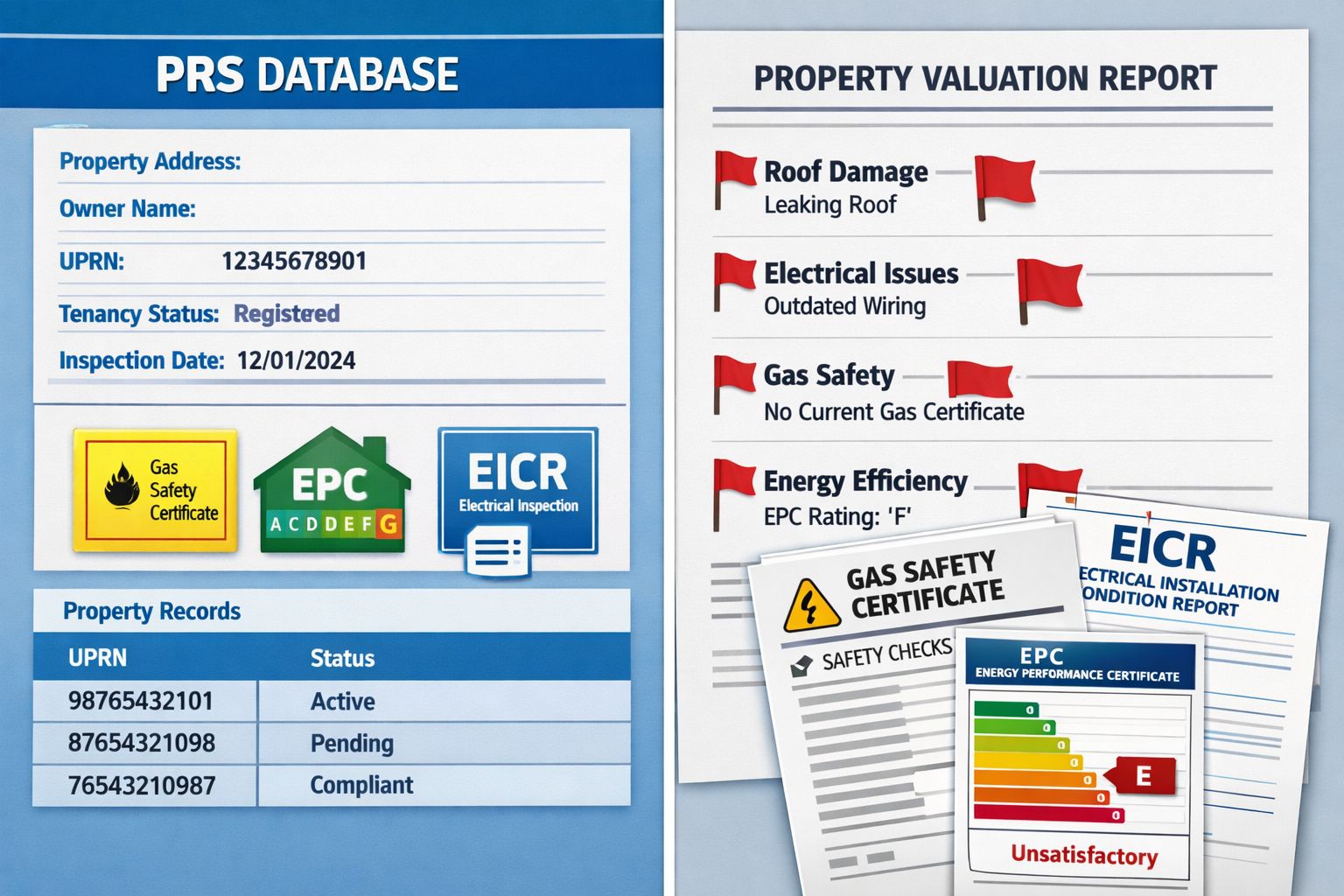
Understanding PRS Database Compliance Requirements and Their Impact on Property Valuations
The Private Rented Sector Database represents the most comprehensive landlord registration system ever implemented in England. Unlike previous voluntary schemes, this mandatory database creates a digital audit trail of every rental property, linking compliance certificates directly to Unique Property Reference Numbers (UPRNs) and enabling real-time enforcement by local authorities[4].
Core Registration Requirements
The PRS Database requires landlords to register and maintain detailed property information across multiple compliance categories:
📋 Mandatory Registration Data:
- Full property address with UPRN verification
- Property type and number of habitable rooms
- Current tenancy status (occupied/vacant)
- EPC rating with certificate reference number
- HMO licence details (where applicable)
- Gas Safety Certificate (CP12) reference
- EICR (Electrical Installation Condition Report) reference
- Landlord contact information and verification
This comprehensive data requirement transforms the database into a live compliance monitoring system. Local authorities can now instantly identify properties lacking current safety certificates, unlicensed HMOs, or unregistered landlords[2]. For surveyors conducting stock condition surveys or property valuations, database registration status has become a critical due diligence checkpoint.
Timeline and Phased Implementation
The database rollout follows a carefully structured timeline designed to manage the registration of approximately 4.6 million rental properties:
| Phase | Timeline | Requirements |
|---|---|---|
| Database Launch | Late 2026 | Database Operator designated, regional rollout begins[4] |
| Existing Landlords | 2027 | Transition period for registration of current portfolios[2] |
| New Landlords | From launch | Must register before advertising or letting[2] |
| Full Compliance | 2027-2028 | All rental properties registered with current certificates[2] |
| Ongoing Updates | Continuous | 14-28 day update requirement for changes[2] |
Impact on Property Valuations
Database compliance directly affects property values through multiple mechanisms. When conducting valuation surveys, surveyors must now assess compliance status as a material factor affecting marketability, rental income continuity, and legal possession rights.
🏠 Valuation Impact Categories:
Immediate Marketability Risk (5-7% adjustment): Properties with unregistered landlords face restricted market appeal, as prospective buyers cannot legally let the property until registration completes. This creates a transaction delay premium that reduces immediate market value.
Possession Rights Impairment (8-12% adjustment): The inability to serve valid Section 8 notices fundamentally undermines landlord rights. Properties where possession proceedings may be necessary (high-risk tenancies, rent arrears history) require substantial value adjustments reflecting this legal impediment[2].
Safety Certificate Deficiencies (3-8% per certificate): Missing or expired Gas Safety Certificates, EICRs, or EPC ratings create immediate compliance costs plus potential enforcement action. Each missing certificate compounds the valuation adjustment.
Penalty Exposure (Variable): Properties facing enforcement action carry additional risk premiums. The £5,000-£30,000 penalty range, combined with potential rent repayment orders of up to 24 months, creates substantial financial exposure that must be reflected in valuations[2].
Database Access and Verification Protocols
Surveyors conducting property valuations in 2026 must implement new verification protocols to assess database compliance. While the full database remains accessible primarily to local authorities and enforcement agencies, landlords receive unique registration numbers and compliance dashboards that can be verified during survey inspections.
✅ Surveyor Verification Checklist:
- Request PRS Database registration number from landlord
- Verify registration certificate matches property UPRN
- Check current status of Gas Safety Certificate (CP12)
- Confirm EICR inspection date (required every 5 years)
- Validate EPC rating and certificate reference
- Review HMO licence status (if applicable)
- Document any compliance gaps in survey report
- Calculate appropriate valuation adjustments
This verification process integrates seamlessly with existing RICS building survey protocols, adding a compliance verification layer to traditional structural and condition assessments.
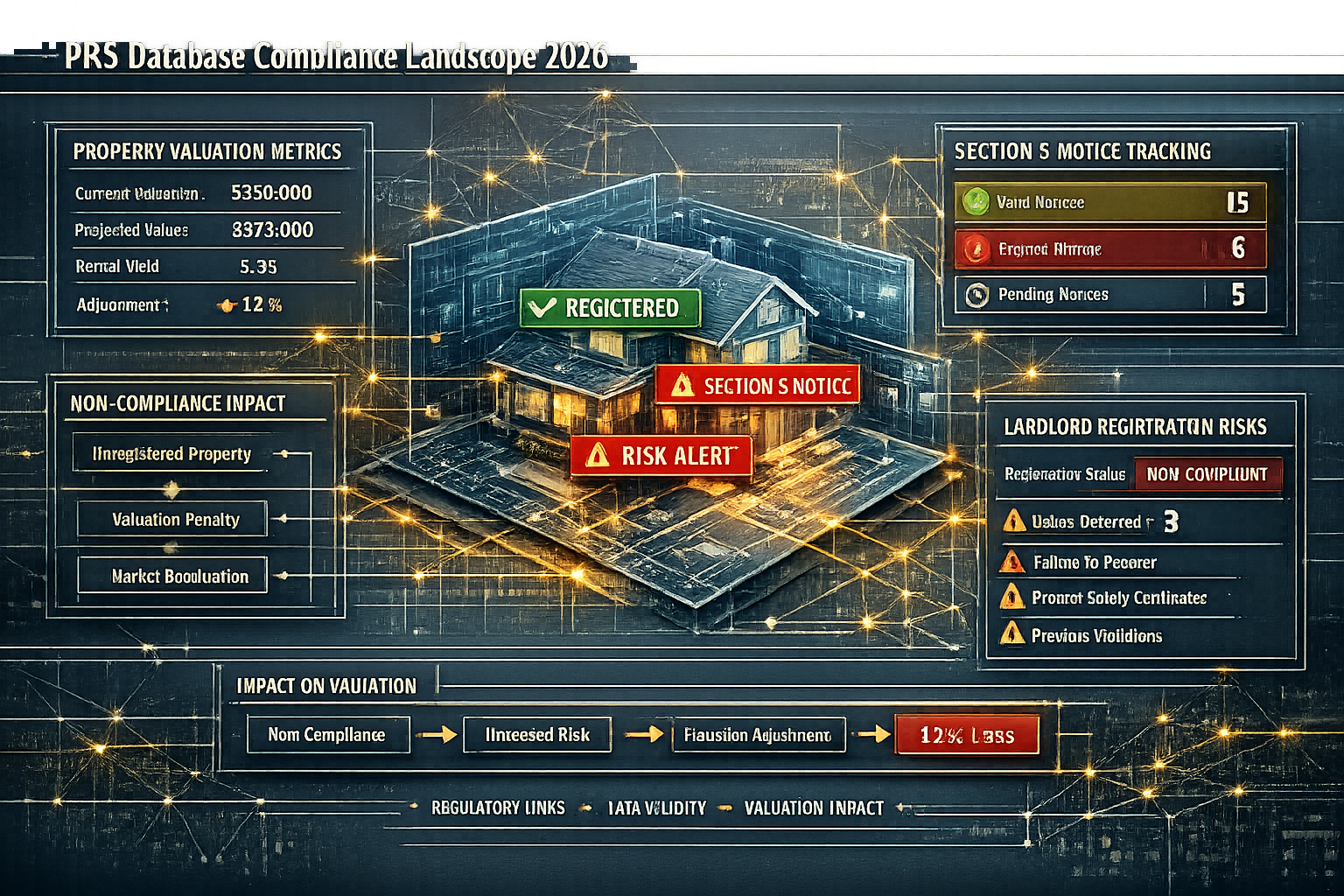
PRS Database Compliance in Valuation Surveys: Section 8 Notice Validity and Eviction Process Implications
The connection between PRS Database registration and Section 8 possession proceedings represents the most significant enforcement mechanism in the new compliance framework. Under the Renters' Rights Act provisions effective May 1, 2026, an unregistered landlord cannot serve a valid Section 8 possession notice, rendering the entire eviction process legally impossible[2].
This requirement fundamentally changes how surveyors must assess rental property values, particularly for properties with problematic tenancies or where possession proceedings may become necessary.
Section 8 Notice Requirements Under the 2026 Framework
Section 8 notices allow landlords to seek possession based on specific legal grounds, each with prescribed notice periods and evidentiary requirements. However, database registration now serves as a mandatory precondition for all Section 8 proceedings[3].
⚖️ Key Section 8 Grounds and Notice Periods:
Ground 8 – Rent Arrears (4 weeks' notice): Applies when rent is at least 2 months in arrears. Requires proof of arrears, valid tenancy agreement, and protected deposit. Database registration must be current before notice service[6].
Ground 14 – Antisocial Behaviour (Immediate notice): Covers nuisance, illegal activity, or breach of tenancy terms. Despite immediate notice, court proceedings cannot commence without valid registration[6].
Ground 1 – Landlord Sale or Occupation (4 months' notice): Allows possession when landlord intends to sell or occupy. Requires written notice at tenancy start and current database registration[6].
Ground 14A – Serious Rent Arrears (2 weeks' notice): Applies when rent is at least 3 months in arrears. Mandatory ground but still requires registration compliance[6].
The Registration-Eviction Connection
The legislative linkage between database registration and possession proceedings creates a critical vulnerability for non-compliant landlords. This vulnerability must be reflected in property valuations, particularly for:
- Properties with current rent arrears exceeding 2 months
- Tenancies involving documented antisocial behaviour
- Properties where landlord sale or occupation is anticipated
- High-turnover rental properties with frequent tenancy changes
When conducting valuation assessments, surveyors must evaluate the probability of possession proceedings becoming necessary and adjust values accordingly based on registration status.
Deposit Protection as Additional Prerequisite
Beyond database registration, Section 8 notice validity requires proper deposit protection. Failure to protect a tenant's deposit within 30 days of receipt prevents service of valid Section 8 notices and exposes landlords to compensation claims of 1-3 times the deposit amount[6].
This creates a dual compliance requirement that surveyors must verify:
- PRS Database Registration: Current and complete
- Deposit Protection: Valid scheme registration (DPS, MyDeposits, or TDS)
Properties lacking either component face compounded valuation adjustments reflecting multiple compliance failures.
Valuation Adjustments for Section 8 Notice Impairment
When database non-compliance prevents valid Section 8 notice service, surveyors must apply structured valuation adjustments reflecting the impaired possession rights:
📊 Section 8 Impairment Valuation Matrix:
| Scenario | Risk Level | Adjustment Range |
|---|---|---|
| Registered, compliant, no arrears | Baseline | 0% |
| Unregistered, no current issues | Low | 5-7% |
| Unregistered with minor arrears (1 month) | Medium | 8-10% |
| Unregistered with significant arrears (2+ months) | High | 12-15% |
| Unregistered + antisocial behaviour issues | Very High | 15-20% |
| Unregistered + unprotected deposit | Critical | 18-22% |
These adjustments reflect the time delay, legal costs, and uncertainty associated with achieving possession when registration compliance must be completed before proceedings can commence.
Case Study: Valuation Impact Analysis
Consider a two-bedroom rental property in South London with a market value of £450,000 when fully compliant. The property has:
- Unregistered landlord (database non-compliant)
- Current tenant with 2.5 months rent arrears (£3,750)
- Valid Gas Safety Certificate and EICR
- Properly protected deposit
Valuation Adjustment Calculation:
- Base market value: £450,000
- Registration delay adjustment: -7% (£31,500)
- Section 8 impairment (arrears scenario): -12% (£54,000)
- Total adjustment: -19% (£85,500)
- Adjusted valuation: £364,500
This substantial reduction reflects the landlord's inability to commence possession proceedings until registration completes, the extended arrears accumulation during the compliance period, and the legal uncertainty surrounding eventual possession.
Court Process and Timeline Implications
Even after achieving database registration, the Section 8 court process involves multiple stages that affect property values:
- Notice Period: 4 weeks to 4 months depending on ground
- Court Application: Form N5 submission with £355 fee
- Hearing Scheduling: 4-8 weeks from application
- Possession Order: 14-42 days execution period
- Bailiff Enforcement: Additional 2-4 weeks if required
When registration must be completed before this timeline begins, the total possession period can extend 6-12 months, creating substantial rental income loss and legal cost exposure that must be reflected in valuations.
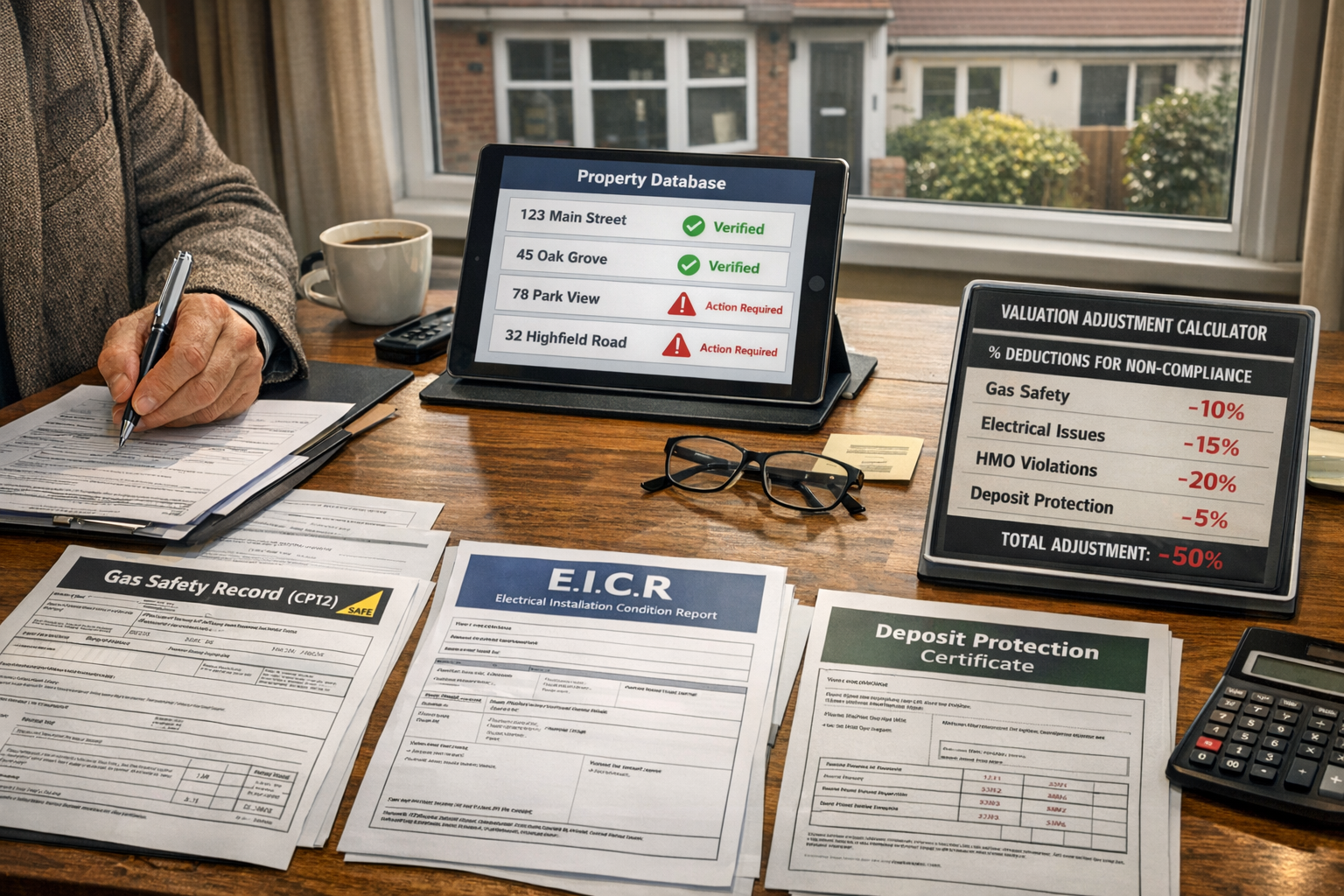
PRS Database Compliance in Valuation Surveys: Surveyor Tactics for Flagging Non-Compliance and Adjusting Values
Professional surveyors must now integrate PRS Database compliance verification into standard valuation methodologies. This section provides practical tactics for identifying non-compliant properties, documenting compliance gaps, and applying appropriate value adjustments.
Pre-Inspection Compliance Assessment
Effective compliance assessment begins before site inspection. Surveyors should request comprehensive documentation from landlords or selling agents as part of the initial instruction:
📄 Pre-Inspection Documentation Request:
- PRS Database registration certificate with unique reference number
- Current Gas Safety Certificate (CP12) dated within 12 months
- EICR report dated within 5 years
- EPC certificate with rating clearly visible
- HMO licence (if property has 3+ unrelated tenants)
- Deposit protection certificate and prescribed information
- Tenancy agreement(s) for current occupants
- Rent payment history for previous 12 months
This documentation package allows surveyors to identify compliance gaps before conducting site inspections, enabling more accurate valuation assessments and targeted inspection protocols.
On-Site Compliance Verification
During property inspections, surveyors should implement systematic compliance verification procedures that complement traditional structural assessments:
🔍 On-Site Verification Protocol:
Gas Safety Compliance: Verify CP12 certificate displayed or available, check certificate covers all gas appliances observed during inspection, confirm annual inspection date is current, photograph certificate for survey records.
Electrical Safety Compliance: Request EICR report, verify inspection date within 5-year requirement, review any remedial work recommendations, check if remedial work has been completed.
Energy Performance: Confirm EPC rating matches certificate, check certificate is displayed or available to tenants, verify certificate reference number matches database registration.
HMO Licensing: Count habitable rooms and occupants, determine if HMO licensing applies (3+ unrelated tenants), verify licence number and expiry date, check licence conditions are being met.
This systematic approach ensures compliance verification integrates seamlessly with structural surveys and condition assessments.
Compliance Gap Documentation
When compliance deficiencies are identified, surveyors must document findings with sufficient detail to support valuation adjustments and provide clear remediation guidance:
📝 Compliance Gap Documentation Template:
Deficiency Identified: [Specific compliance failure]
Regulatory Requirement: [Relevant legislation or regulation]
Remediation Cost: [Estimated cost to achieve compliance]
Remediation Timeline: [Expected time to complete]
Penalty Exposure: [Potential fines or enforcement action]
Valuation Impact: [Recommended adjustment percentage]
This structured documentation provides transparency for clients and supports defensible valuation adjustments based on objective compliance criteria.
Valuation Adjustment Methodologies
Surveyors must apply consistent, defensible methodologies when adjusting property values for compliance deficiencies. The following framework provides structured guidance:
💰 Compliance Adjustment Framework:
Direct Cost Method: Calculate immediate costs to achieve compliance (registration fees, certificate renewals, remedial work) and apply as direct deduction from market value. Appropriate for minor, easily remediated deficiencies.
Income Impairment Method: Calculate rental income loss during compliance remediation period, apply appropriate yield to capitalize income loss into capital value adjustment. Appropriate for properties with current tenancies where compliance work requires tenant cooperation or property access.
Comparable Evidence Method: Identify recent sales of similar properties with known compliance issues, analyze price adjustments achieved in those transactions, apply comparable adjustment percentages to subject property. Most defensible method when comparable evidence exists.
Risk Premium Method: Assess probability and magnitude of enforcement action, calculate expected value of penalties and legal costs, apply risk-adjusted premium to reflect uncertainty. Appropriate for properties with serious compliance failures or enforcement action pending.
Specific Adjustment Calculations
Example 1: Missing Gas Safety Certificate
Property: 3-bedroom terraced house, market value £320,000
Deficiency: Gas Safety Certificate expired 4 months ago
Remediation: £150 inspection + £500 potential repairs = £650
Timeline: 2 weeks to arrange inspection and complete repairs
Penalty exposure: £5,000-£7,000 if enforcement action initiated
Section 8 impairment: Cannot serve valid notice until compliant
Valuation Adjustment:
- Direct cost: £650
- Penalty risk (20% probability): £1,200 (£6,000 × 0.20)
- Section 8 delay (if needed): 3% (£9,600)
- Total adjustment: £11,450 (3.6%)
- Adjusted value: £308,550
Example 2: Unregistered Property with Multiple Deficiencies
Property: 2-bedroom flat, market value £275,000
Deficiencies: No PRS registration, EICR expired, deposit not protected
Remediation: Registration £50 + EICR £250 + deposit protection £0 = £300
Timeline: 4-6 weeks for full compliance
Penalty exposure: £5,000 registration + £1,200 deposit compensation = £6,200
Section 8 impairment: Cannot serve notice, tenant has 1 month arrears
Valuation Adjustment:
- Direct costs: £300
- Penalty exposure (high probability): £5,000
- Deposit compensation claim: £1,200
- Section 8 delay premium: 8% (£22,000)
- Total adjustment: £28,500 (10.4%)
- Adjusted value: £246,500
Integration with RICS Valuation Standards
All compliance-related valuation adjustments must align with RICS Red Book standards and professional valuation principles. When preparing Red Book valuations, surveyors should:
- Clearly state assumptions regarding compliance status in valuation reports
- Document evidence obtained to verify compliance (or non-compliance)
- Apply adjustments consistently across comparable properties
- Provide detailed reasoning for adjustment percentages applied
- Highlight material uncertainty where compliance status cannot be verified
- Recommend specialist legal advice where complex compliance issues exist
Reporting Compliance Findings to Clients
Effective communication of compliance issues requires clear, actionable reporting that enables clients to make informed decisions:
📋 Compliance Reporting Best Practices:
Executive Summary: Highlight critical compliance deficiencies in report summary, quantify total valuation impact of compliance issues, provide clear remediation recommendations.
Detailed Findings: Document each compliance deficiency separately, include photographic evidence where relevant, explain regulatory requirements and deadlines, estimate remediation costs and timelines.
Valuation Impact: Show baseline market value (compliant scenario), itemize each compliance adjustment, present final adjusted valuation, provide sensitivity analysis for different compliance scenarios.
Recommendations: Prioritize compliance remediation by urgency, identify quick wins vs. complex remediations, suggest specialist advisors where needed, outline timeline for achieving full compliance.
This structured approach ensures clients understand both the compliance landscape and its financial implications, enabling informed transaction decisions.
Ongoing Compliance Monitoring
For surveyors conducting monitoring surveys or providing ongoing valuation services for property portfolios, implementing systematic compliance tracking protocols is essential:
- Maintain compliance calendars tracking certificate expiry dates
- Schedule proactive renewal reminders 60-90 days before expiry
- Monitor PRS Database updates and regulatory changes
- Review local authority enforcement priorities and targeting
- Track penalty cases and enforcement trends in relevant jurisdictions
- Update valuation models as compliance landscape evolves
This proactive approach helps clients maintain compliance and protects property values from avoidable compliance-related deductions.
Conclusion
The introduction of mandatory PRS Database registration and its linkage to Section 8 possession proceedings has fundamentally transformed rental property valuations in 2026. Surveyors must now integrate compliance verification into standard valuation methodologies, applying structured adjustments that reflect the material impact of registration status on property marketability, possession rights, and financial exposure.
Key action steps for surveyors:
✅ Implement pre-inspection compliance documentation requests to identify deficiencies before site visits and enable accurate valuation assessments.
✅ Develop systematic on-site verification protocols that integrate compliance checks with traditional structural and condition assessments.
✅ Apply consistent, defensible valuation adjustment methodologies based on direct costs, income impairment, comparable evidence, or risk premiums as appropriate.
✅ Document compliance findings comprehensively to support valuation conclusions and provide clear remediation guidance to clients.
✅ Monitor regulatory developments as the PRS Database rolls out through 2027-2028 and enforcement priorities evolve.
For landlords and property investors, maintaining current PRS Database registration and compliance certificates is no longer optional—it's essential for protecting property values and preserving possession rights. Properties with compliance deficiencies face valuation adjustments ranging from 5-22% depending on the severity and combination of issues, representing substantial financial exposure that can be avoided through proactive compliance management.
Surveyors conducting property valuations in 2026 and beyond must embrace this expanded scope of practice, integrating regulatory compliance assessment with traditional valuation skills to provide comprehensive, accurate assessments that reflect the full spectrum of factors affecting rental property values in the post-Renters' Rights Act landscape.
References
[1] Party Wall Implications Of Renters Rights Act 2026 Survey Protocols For Prs Database And Section 8 Notice Compliance – https://nottinghillsurveyors.com/blog/party-wall-implications-of-renters-rights-act-2026-survey-protocols-for-prs-database-and-section-8-notice-compliance
[2] Private Rented Sector Database – https://www.augustapp.com/blog/private-rented-sector-database
[3] Renting And Letting In 2025 What Landlords And Tenants Need To Know – https://cch-solicitors.co.uk/renting-and-letting-in-2025-what-landlords-and-tenants-need-to-know/
[4] The 2026 Landlord Compliance Guide – https://www.crownluxuryhomes.com/the-2026-landlord-compliance-guide/
[5] The Renters Rights Act 2025 Key Implications For Living Sector Lenders 3 31 2026 – https://www.klgates.com/The-Renters-Rights-Act-2025-Key-Implications-for-Living-Sector-Lenders-3-31-2026
[6] Landlord Compliance Checklist 2026 – https://tenancypack.co.uk/guides/landlord-compliance-checklist-2026