
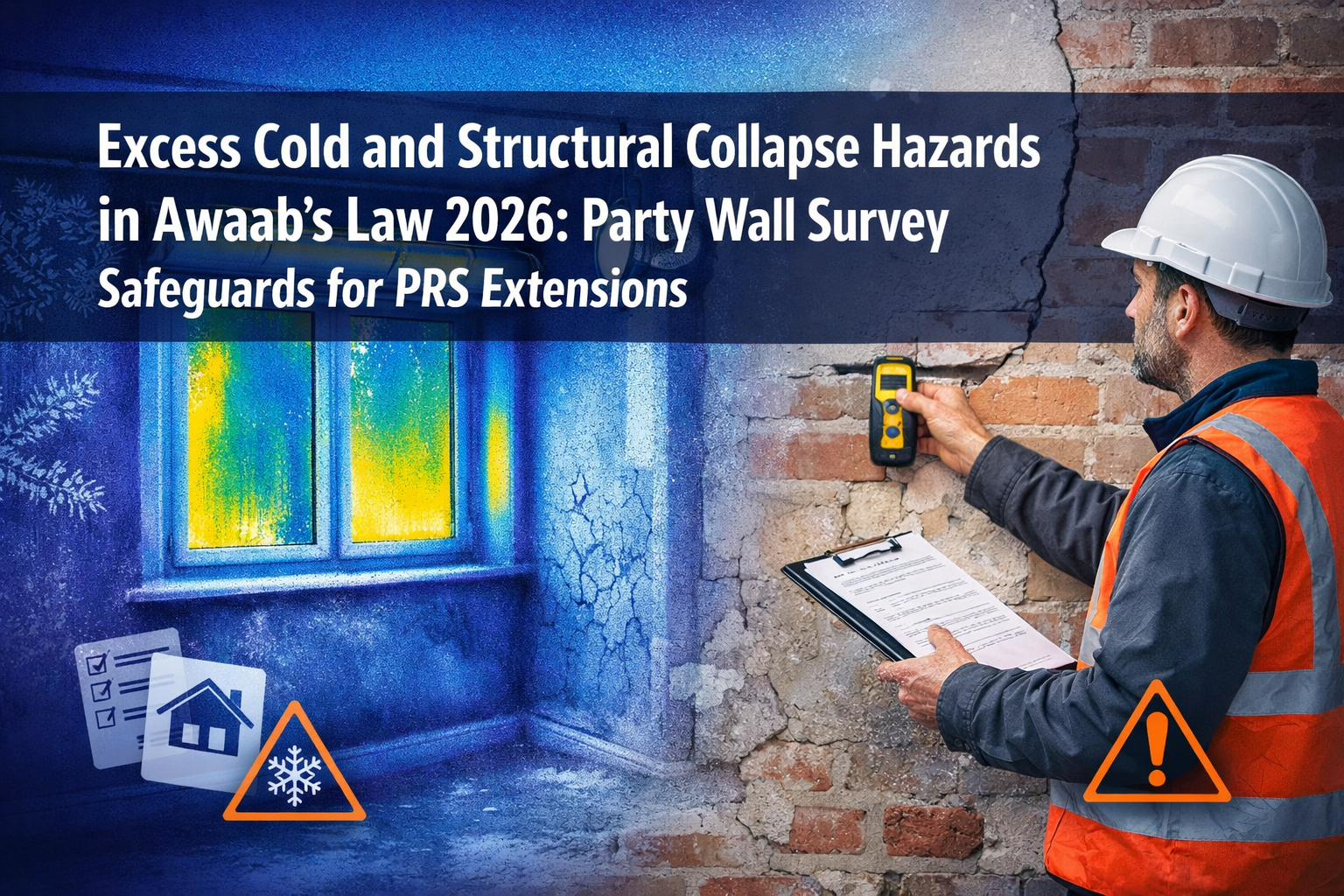
A two-year-old child died from prolonged exposure to mould in a social housing property in 2020. That tragedy sparked regulatory change that now extends far beyond damp and mould. In 2026, Excess Cold and Structural Collapse Hazards in Awaab's Law 2026: Party Wall Survey Safeguards for PRS Extensions become critical compliance requirements for private rental sector landlords, demanding systematic hazard identification and rapid remediation protocols that fundamentally reshape how surveyors approach party wall works and building assessments.
The expanded legislation transforms party wall surveys from simple boundary documentation exercises into comprehensive hazard detection protocols. Surveyors must now identify pre-existing structural deficiencies that could constitute collapse risks while simultaneously assessing thermal performance failures that create excess cold conditions. This dual mandate requires enhanced technical competence and documentation rigour that many practitioners are still developing.
Key Takeaways
- Awaab's Law expands in 2026 to cover excess cold, structural collapse, fire, electrical hazards, and six other categories beyond the original damp and mould focus[2]
- Emergency hazards require 24-hour response, with automatic escalation when vulnerable residents (elderly, infants, pregnant women) are affected[2]
- Party wall surveyors must document structural deficiencies that could constitute collapse hazards during award preparation[1]
- Excess cold assessment becomes mandatory for building surveyors working on private rental properties under the new regulations[3]
- Notification trigger date of October 27, 2025 means only hazards reported after this date qualify as Awaab's Law cases[2]
Understanding the 2026 Expansion of Awaab's Law
The original Awaab's Law focused exclusively on damp and mould hazards in social housing. The 2026 expansion dramatically broadens the scope to include excess cold, excess heat, falls, structural collapse, fire, electrical hazards, explosions, and domestic/personal hygiene hazards where they present significant risk of harm[2].
This expansion reflects a fundamental shift in regulatory philosophy. Rather than treating housing hazards as isolated maintenance issues, the legislation now recognizes them as interconnected threats requiring systematic identification and prioritized remediation.
What Constitutes Excess Cold Under the New Framework
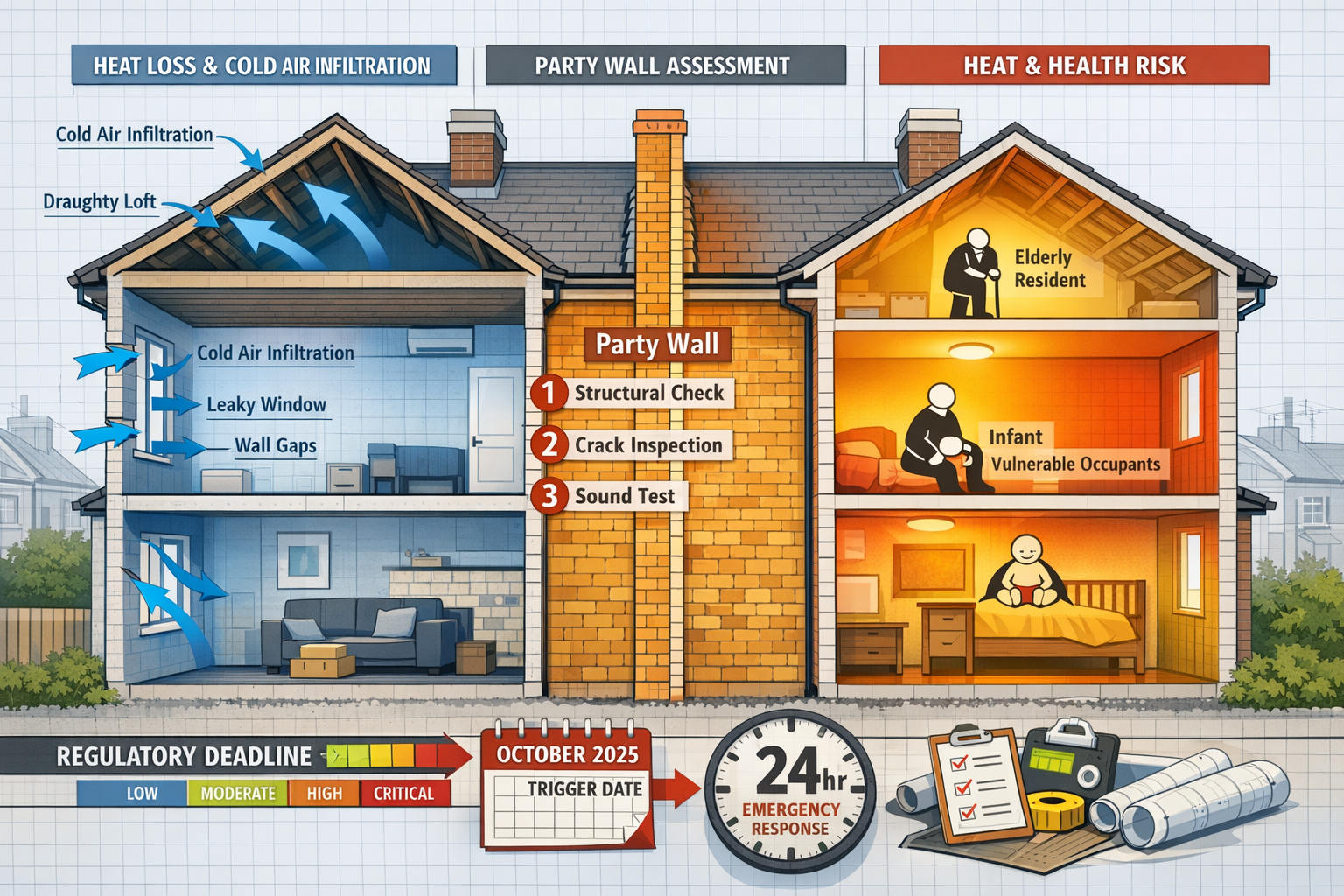
Excess cold hazards occur when inadequate heating, insulation, or thermal performance creates indoor temperatures that pose health risks to occupants. The legislation specifically recognizes that certain vulnerable groups face disproportionate harm from cold conditions:
- Elderly residents aged 65 and over
- Infants under one year
- People with cardiovascular disease
- Individuals with respiratory conditions
When these vulnerable groups occupy properties with excess cold hazards, the situation automatically escalates to emergency status requiring 24-hour remediation[2].
Structural Collapse Hazards: Definition and Scope
Structural collapse hazards encompass any building defect or deterioration that could reasonably lead to partial or complete failure of load-bearing elements. This includes:
- Foundation movement and subsidence
- Wall bulging or leaning beyond acceptable tolerances
- Lintel failure above openings
- Roof structure deterioration
- Floor joist decay or overloading
- Party wall instability or separation
The legislation doesn't require surveyors to predict catastrophic failure, but rather to identify conditions where structural integrity has degraded to levels presenting significant risk of harm[1].
Party Wall Survey Protocols for Excess Cold and Structural Collapse Hazards in Awaab's Law 2026
Party wall works create unique vulnerability windows where pre-existing hazards can worsen or new hazards can emerge. The 2026 expansion requires surveyors to integrate Awaab's Law hazard assessment into standard party wall procedures.
Enhanced Schedule of Condition Requirements
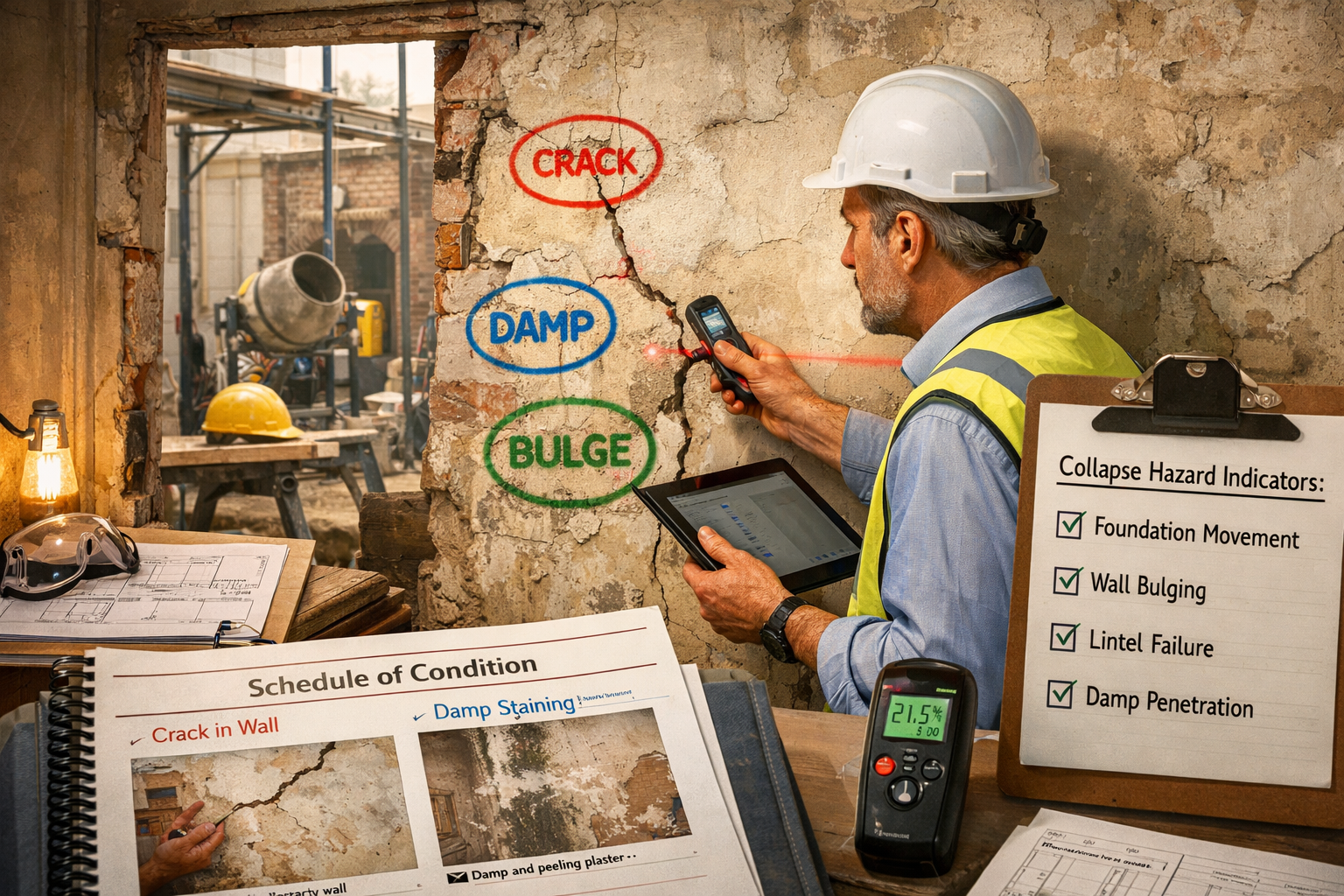
Traditional party wall schedules of condition documented visible defects primarily to establish baseline conditions for damage claims. Under the expanded framework, these schedules must now explicitly identify and categorize potential Awaab's Law hazards.
Pre-Work Assessment Checklist:
✅ Thermal Performance Indicators
- Single-glazed windows in habitable rooms
- Inadequate loft insulation (below 270mm)
- Solid wall construction without insulation
- Broken or ineffective heating systems
- Visible condensation patterns indicating cold bridging
✅ Structural Integrity Markers
- Crack patterns suggesting foundation movement
- Wall tie failure in cavity walls
- Timber decay in load-bearing elements
- Inadequate lateral restraint at floor levels
- Previous underpinning or structural repairs
This enhanced documentation serves dual purposes: protecting the building owner from wrongful damage claims while simultaneously creating an evidence trail for Awaab's Law compliance[1].
The Three-Meter Rule and Hazard Proximity
The three-meter rule governs when excavation works near neighboring properties require party wall notices. When such works occur adjacent to properties with identified excess cold or structural collapse hazards, surveyors must assess whether the proposed works could exacerbate existing conditions.
Critical Considerations:
- Excavation adjacent to properties with foundation movement may accelerate subsidence
- Vibration from demolition work could trigger collapse in weakened structures
- Removal of buttressing elements may destabilize party walls with pre-existing lean
- Disruption to heating systems during works could create temporary excess cold conditions
Surveyors must document these interactions in party wall awards and recommend appropriate protective measures or work sequencing adjustments.
Documentation Requirements for Party Wall Awards
When preparing party wall awards under the expanded Awaab's Law framework, surveyors must include specific hazard-related documentation:
| Documentation Element | Purpose | Awaab's Law Relevance |
|---|---|---|
| Thermal imaging survey results | Identify cold spots and insulation failures | Excess cold hazard evidence |
| Structural movement monitoring data | Establish baseline for existing defects | Structural collapse risk assessment |
| Heating system condition report | Document adequacy of thermal comfort provision | Vulnerable occupant protection |
| Moisture meter readings | Identify damp penetration affecting structure | Combined damp and structural hazards |
| Photographic evidence with annotations | Create visual record of pre-existing conditions | Compliance evidence and damage protection |
This comprehensive documentation protects all parties: building owners gain evidence against false damage claims, adjoining owners receive proper notice of risks, and landlords obtain the hazard intelligence needed for Awaab's Law compliance[1].
When Party Wall Work Triggers Awaab's Law Obligations
Party wall works can transform latent hazards into active compliance issues. Consider these scenarios:
Scenario 1: Loft Conversion Exposing Thermal Deficiencies
A party wall loft conversion in a terraced property reveals that the adjoining property has virtually no loft insulation. The surveyor's thermal imaging shows the neighboring property losing significant heat through the roof space. If vulnerable occupants reside in that property, the landlord now has constructive knowledge of an excess cold hazard requiring action.
Scenario 2: Excavation Revealing Foundation Defects
Excavation for a basement extension exposes the foundation of the adjoining property, revealing significant deterioration and inadequate depth. This discovery creates documented awareness of a potential structural collapse hazard that the adjoining property owner (if a landlord) must now address under Awaab's Law timelines.
The notification trigger date of October 27, 2025 means that hazards discovered or reported after this date fall under the new compliance requirements[2]. Party wall surveyors effectively become hazard notification agents, creating compliance obligations for landlords through their professional assessments.
Implementing Excess Cold and Structural Collapse Safeguards in PRS Extensions
Private rental sector landlords face distinct challenges implementing the expanded Awaab's Law requirements. Unlike social housing providers with dedicated compliance teams, many PRS landlords operate small portfolios with limited technical resources.
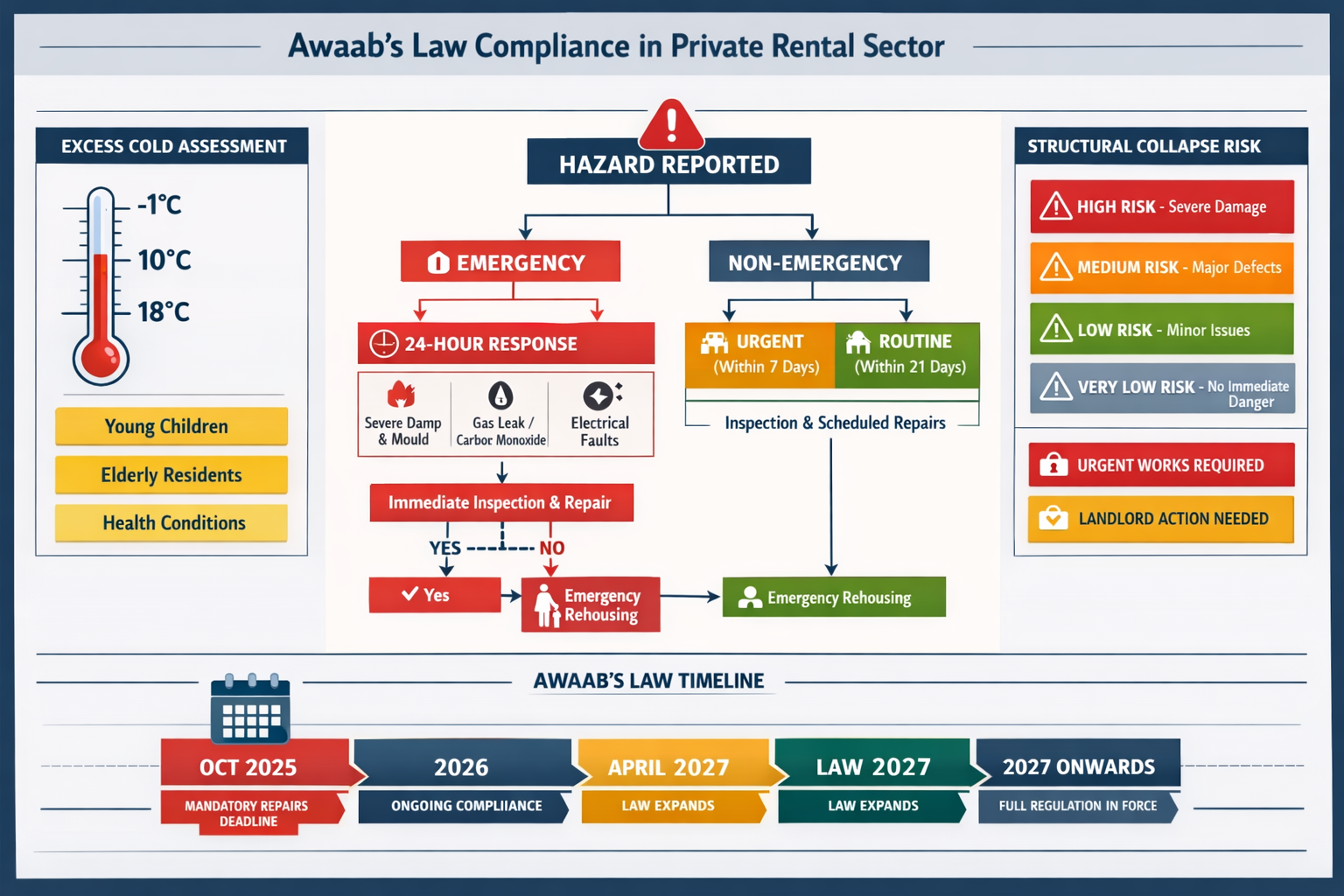
The 24-Hour Emergency Response Requirement
The legislation establishes strict remediation timelines based on hazard severity:
- Emergency hazards: 24 hours to make safe or provide alternative accommodation
- Urgent hazards: 7 days for remediation planning and commencement
- Non-urgent hazards: 28 days for completion of remedial works
Emergency status is automatically triggered when hazards affect vulnerable residents, including children under five, elderly people, pregnant women, and those with respiratory or cardiovascular conditions[2].
For structural collapse hazards, emergency status typically applies when:
- Structural elements show active progressive failure
- Occupants face imminent risk from unstable components
- Recent events (storms, adjacent excavation) have compromised stability
- Professional assessment identifies critical safety concerns
For excess cold hazards, emergency designation occurs when:
- Heating systems have completely failed during cold weather
- Vulnerable groups (elderly 65+, infants under one year, cardiovascular patients) are present
- Indoor temperatures fall below safe thresholds for extended periods
- Alternative heating provision is inadequate or unavailable
Vulnerability-Based Escalation Protocols
The legislation recognizes that identical hazards pose different risk levels depending on occupant characteristics. A moderately cold property might constitute a non-urgent hazard for healthy adults but an emergency for an elderly resident with heart disease.
Vulnerable Groups Requiring Escalation:
🔴 Highest Priority (Automatic Emergency Status)
- Infants under one year (excess cold)
- Elderly residents 65+ (excess cold)
- Pregnant women (multiple hazard categories)
- Severe respiratory conditions (excess cold, damp)
- Cardiovascular disease patients (excess cold)
🟡 Enhanced Priority (Reduced Timelines)
- Children under five years
- Moderate respiratory conditions
- Mobility impairments (structural/falls hazards)
- Immunocompromised individuals
Landlords must maintain current information about occupant vulnerability status to apply appropriate escalation protocols[2].
Integrating Structural Surveys with Awaab's Law Compliance
Structural surveys traditionally focused on informing purchase decisions or identifying repair requirements. Under the expanded framework, these surveys become compliance documentation tools for PRS landlords.
Enhanced Survey Scope Requirements:
-
Thermal Performance Assessment
- Infrared thermography of building envelope
- Heating system capacity and condition evaluation
- Insulation adequacy across all building elements
- Identification of cold bridging and thermal bypass
-
Structural Integrity Evaluation
- Foundation condition and movement indicators
- Load-bearing wall and beam assessment
- Roof structure condition and load capacity
- Party wall stability and connection adequacy
-
Hazard Categorization and Prioritization
- Assignment of hazard severity ratings
- Identification of vulnerable occupant implications
- Remediation timeline recommendations
- Cost estimation for compliance works
Many landlords are now commissioning structural surveys specifically to establish their Awaab's Law compliance baseline before the October 2025 notification trigger date.
Coordinating Party Wall Works with Hazard Remediation
When party wall works occur in properties with identified Awaab's Law hazards, careful coordination prevents compliance breaches and protects occupant safety.
Best Practice Coordination Strategies:
Strategy 1: Pre-Work Hazard Remediation
Address identified hazards before commencing party wall works. This approach eliminates the risk of work-related exacerbation and ensures vulnerable occupants aren't exposed to additional risks during construction.
Strategy 2: Simultaneous Remediation
Incorporate hazard remediation into the party wall works scope. For example, a party wall extension project could include structural strengthening of identified weaknesses and thermal upgrade of the party wall structure.
Strategy 3: Temporary Protection Measures
When immediate remediation isn't feasible, implement temporary safeguards during works:
- Temporary heating provision during system disruption
- Structural propping to prevent movement during excavation
- Enhanced monitoring of vulnerable areas
- Alternative accommodation for vulnerable occupants
The party wall surveyor plays a crucial coordination role, ensuring that consent for party wall work incorporates appropriate hazard management provisions.
Common Pitfalls and How to Avoid Them
❌ Pitfall 1: Treating Party Wall Surveys as Pure Boundary Exercises
Many surveyors continue using pre-2026 templates that focus exclusively on structural damage protection without addressing hazard identification requirements.
✅ Solution: Update survey templates and checklists to explicitly incorporate Awaab's Law hazard categories. Train surveyors in thermal imaging and structural risk assessment techniques.
❌ Pitfall 2: Failing to Communicate Hazard Findings to Landlords
Surveyors identify potential hazards during party wall assessments but don't explicitly notify landlords of their Awaab's Law implications.
✅ Solution: Include dedicated hazard notification sections in party wall awards. Clearly state when findings create compliance obligations for property owners.
❌ Pitfall 3: Inadequate Documentation of Pre-Existing Conditions
Basic photographic records without detailed annotations, measurements, or context fail to provide the evidence trail needed for compliance demonstration.
✅ Solution: Implement comprehensive documentation protocols including annotated photographs, thermal images, structural measurements, and written descriptions linking findings to specific hazard categories.
❌ Pitfall 4: Ignoring Vulnerable Occupant Status
Landlords and surveyors assess hazards without considering whether vulnerable groups occupy the property, missing the escalation triggers that convert routine issues into emergencies.
✅ Solution: Establish occupant vulnerability screening as a standard first step in all hazard assessments. Maintain confidential records of vulnerability factors affecting timeline requirements.
Preparing for the 2027 Full Expansion
While the 2026 expansion addresses the most critical hazard categories, the legislation will expand again in 2027 to include all remaining hazards listed in the Housing Health and Safety Rating System (HHSRS). This comprehensive scope will eventually cover 29 separate hazard categories.
Additional Hazard Categories Coming in 2027:
- Entry by intruders
- Lighting inadequacy
- Noise disturbance
- Domestic hygiene, pests, and refuse
- Food safety hazards
- Water supply quality
- Sanitation and drainage
- Crowding and space deficiencies
- Volatile organic compounds
Landlords and surveyors should begin developing competence in these additional areas now rather than waiting for the 2027 implementation deadline.
Building a Comprehensive Hazard Management System
Forward-thinking PRS landlords are implementing comprehensive hazard management systems that address current and future Awaab's Law requirements:
System Component 1: Regular Hazard Audits
Schedule systematic property inspections covering all current and anticipated hazard categories. Many landlords are adopting 12-month audit cycles with interim checks after significant events (storms, tenant reports, adjacent construction).
System Component 2: Vulnerability Tracking
Maintain confidential records of occupant vulnerability factors affecting hazard escalation requirements. Update these records when tenancies change or occupant circumstances evolve.
System Component 3: Response Protocol Documentation
Develop written procedures specifying how different hazard types and severity levels will be addressed. Include contractor contact lists, temporary accommodation arrangements, and communication templates.
System Component 4: Compliance Evidence Repository
Create organized filing systems (physical and digital) storing hazard assessments, remediation records, contractor certifications, and occupant communications. This evidence trail demonstrates compliance if disputes or enforcement actions arise.
The Role of Professional Surveys in Ongoing Compliance
One-time surveys cannot maintain ongoing Awaab's Law compliance. Properties deteriorate, occupant vulnerability changes, and adjacent works create new hazard risks. Professional surveys serve different functions across the compliance lifecycle:
Baseline Compliance Survey (Before October 2025)
Comprehensive assessment establishing the property's hazard status before the notification trigger date. Identifies remediation priorities and creates initial compliance documentation.
Pre-Acquisition Due Diligence Survey
For investors purchasing PRS properties, specialized surveys quantify Awaab's Law compliance costs and risks. These assessments inform purchase price negotiations and investment return calculations.
Post-Remediation Verification Survey
Independent verification that remedial works successfully eliminated identified hazards. Creates evidence that compliance obligations have been satisfied.
Periodic Compliance Audit
Regular re-assessment identifying new hazards emerging through deterioration or changed circumstances. Maintains ongoing compliance and prevents accumulation of unaddressed issues.
Party Wall Triggered Assessment
Hazard evaluation prompted by adjacent party wall works that could affect or reveal property conditions. Addresses both damage protection and compliance obligations.
Practical Action Steps for Landlords and Surveyors
The expanded Awaab's Law requirements demand immediate action from both property professionals and landlords. Waiting until enforcement actions begin creates unnecessary risk and potentially unmanageable remediation backlogs.
For Private Rental Sector Landlords
Immediate Actions (Complete Before October 2025):
- Commission comprehensive hazard surveys for all PRS properties focusing on excess cold and structural collapse risks
- Identify vulnerable occupants and document their vulnerability factors in confidential records
- Prioritize emergency hazards affecting vulnerable groups for immediate remediation
- Establish relationships with qualified contractors capable of rapid response
- Review insurance coverage to ensure adequate protection for hazard-related claims
Ongoing Compliance Actions:
- Implement annual hazard audit cycles with professional surveyor involvement
- Update vulnerability records when tenancies change or circumstances evolve
- Monitor adjacent properties for party wall works that could affect your property
- Maintain comprehensive documentation of all hazard assessments and remediation
- Budget appropriately for compliance-related capital expenditure
For Party Wall Surveyors
Enhanced Competence Development:
- Obtain thermal imaging certification and equipment for excess cold assessment
- Develop structural risk assessment skills beyond standard defect identification
- Study the Housing Health and Safety Rating System to understand hazard categorization
- Update professional indemnity insurance to cover expanded scope of practice
- Create enhanced survey templates incorporating Awaab's Law requirements
Practice Protocol Updates:
- Revise standard party wall awards to include hazard identification sections
- Develop landlord notification procedures for identified compliance issues
- Establish coordination protocols between party wall and building survey services
- Create client education materials explaining Awaab's Law implications
- Document continuing professional development in hazard assessment techniques
For Building Surveyors
The expanded legislation significantly affects building survey practice. Surveyors conducting Level 3 RICS Building Surveys on PRS properties must now explicitly address Awaab's Law hazard categories.
Survey Report Enhancements:
- Dedicated hazard categorization sections separate from general defect descriptions
- Vulnerability consideration prompts reminding clients to disclose occupant factors
- Timeline recommendations based on hazard severity and occupant vulnerability
- Cost implications of compliance-driven remediation requirements
- Prioritized action plans distinguishing emergency, urgent, and routine items
Many surveyors are developing specialized Awaab's Law compliance survey products specifically designed for PRS landlord clients.
Conclusion
The expansion of Awaab's Law in 2026 to include excess cold and structural collapse hazards fundamentally transforms private rental sector compliance obligations and professional surveying practice. The legislation's 24-hour emergency response requirements for hazards affecting vulnerable residents create unprecedented urgency around issues that previously received routine maintenance attention.
Party wall survey safeguards provide the critical intersection where hazard identification meets compliance obligation. Surveyors conducting party wall assessments now serve dual functions: protecting property owners from damage claims while simultaneously creating the hazard awareness that triggers landlord compliance duties. This expanded role demands enhanced technical competence, comprehensive documentation protocols, and clear communication of compliance implications to all parties.
The October 27, 2025 notification trigger date creates a clear timeline for action. Landlords who commission comprehensive hazard surveys before this date gain valuable intelligence without immediately triggering strict remediation timelines. Those who delay face the prospect of discovering multiple emergency-status hazards simultaneously, creating impossible compliance demands and potential enforcement action.
Success in this new regulatory environment requires:
- Proactive hazard assessment before the notification trigger date
- Enhanced surveyor competence in thermal and structural risk evaluation
- Comprehensive documentation systems creating compliance evidence trails
- Vulnerability-aware prioritization ensuring appropriate hazard escalation
- Coordinated approaches integrating party wall works with hazard remediation
The 2027 expansion to all HHSRS hazard categories will further intensify these requirements. Property professionals and landlords who develop robust hazard management systems now will find the transition manageable. Those who treat the 2026 expansion as an isolated compliance exercise will face repeated disruption as each new hazard category comes into force.
The tragic death that inspired Awaab's Law demonstrated the deadly consequences of inadequate housing conditions. The expanded legislation recognizes that excess cold and structural collapse hazards pose equally serious risks to vulnerable occupants. By integrating comprehensive hazard assessment into party wall survey protocols, the property industry can ensure that neighboring works become opportunities for hazard identification and remediation rather than sources of additional risk.
Take action now: Commission professional surveys addressing excess cold and structural collapse hazards, establish vulnerability tracking systems, and develop relationships with qualified contractors capable of rapid response. The regulatory framework is clear, the timelines are strict, and the consequences of non-compliance are severe. Proactive landlords and competent surveyors will navigate this transition successfully while protecting vulnerable occupants and maintaining compliant, safe rental properties.
For comprehensive property assessment services addressing Awaab's Law compliance requirements, explore our structural survey services and party wall expertise. Professional guidance ensures you meet the expanded 2026 requirements while protecting your property investment and fulfilling your duty of care to tenants.
References
[1] Awaabs Law Extensions To Prs In 2026 Party Wall And Building Survey Protocols For New Hazard Categories – https://nottinghillsurveyors.com/blog/awaabs-law-extensions-to-prs-in-2026-party-wall-and-building-survey-protocols-for-new-hazard-categories
[2] Awaabs Law Policy Web Version 10 – https://www.southernhousing.org.uk/media/cxvlllnp/awaabs-law-policy-web-version-10.pdf
[3] Building Surveys And Awaabs Law 2026 Extensions Identifying Electrical Fire And Temperature Hazards In Prs Properties – https://nottinghillsurveyors.com/blog/building-surveys-and-awaabs-law-2026-extensions-identifying-electrical-fire-and-temperature-hazards-in-prs-properties