

Subsidence claims in the UK have surged by 68% since 2024, with single-story bungalows on clay soils experiencing the most severe structural damage during unprecedented freeze-thaw cycles. This dramatic increase has forced surveyors to completely overhaul their inspection protocols, moving far beyond simple visual assessments to comprehensive foundation analysis that can mean the difference between a safe purchase and a financial disaster.
Level 3 Building Surveys for Bungalows in High-Risk Subsidence Zones: 2026 Protocols Amid Clay Soil Thaw Cycles represent the most thorough property inspection methodology available today. These specialized surveys address the unique vulnerability of single-story structures built on expansive clay soils, which contract during dry periods and expand when saturated—a cycle that has intensified dramatically due to recent climate patterns.
Key Takeaways
✅ Bungalows face heightened subsidence risk due to shallow foundations and concentrated load distribution on clay soils experiencing extreme weather cycles
✅ 2026 protocols mandate advanced foundation analysis including ground-penetrating radar, moisture monitoring, and seasonal movement tracking beyond standard visual inspections
✅ Clay soil thaw cycles create critical assessment windows requiring surveyors to evaluate properties during specific seasonal conditions for accurate risk determination
✅ Comprehensive Level 3 surveys cost more but prevent catastrophic losses by identifying subsidence indicators that basic surveys routinely miss in high-risk zones
✅ Documentation requirements have expanded to include soil composition analysis, drainage system evaluation, and vegetation impact assessments as standard practice
Understanding Level 3 Building Surveys for Bungalows in High-Risk Subsidence Zones
What Makes Level 3 Surveys Essential for Bungalows
Level 3 surveys—previously known as full structural surveys—represent the most comprehensive property inspection available to homebuyers and property owners. Unlike Level 2 HomeBuyer Reports, these detailed assessments examine every accessible part of a property, providing in-depth analysis of structural condition, defects, and repair recommendations.[1]
Bungalows present unique challenges that make Level 3 surveys particularly critical:
- Shallow foundation systems typically extend only 0.9-1.2 meters below ground level
- Single-story load distribution concentrates structural weight differently than multi-story buildings
- Roof structure exposure to temperature extremes without upper-floor insulation buffer
- Older construction methods common in bungalows built between 1950-1980
- Limited structural redundancy compared to two-story properties
When these factors combine with high-risk subsidence zones, the potential for catastrophic structural failure increases exponentially. A comprehensive subsidence survey becomes not just advisable but essential for informed decision-making.
The Clay Soil Subsidence Challenge in 2026
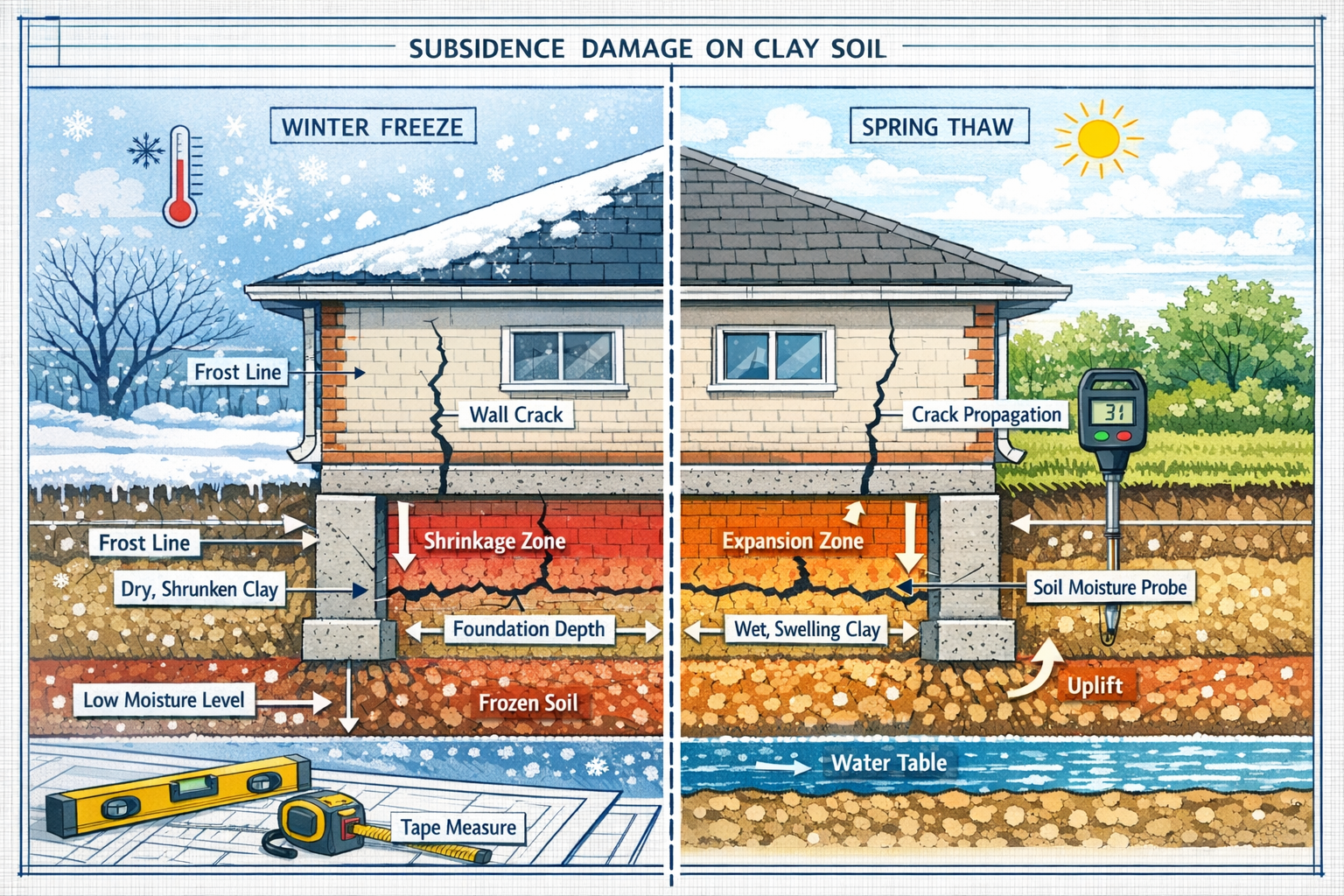
Clay soils contain minerals that expand when wet and contract when dry—a property called plasticity. This volumetric change creates enormous pressure on building foundations, particularly during rapid transition periods.
The 2026 climate patterns have created unprecedented challenges:
🌡️ Extended winter freeze periods followed by rapid spring thaws
💧 Intense rainfall events saturating clay soils quickly
☀️ Prolonged summer droughts causing severe clay contraction
🌳 Vegetation stress leading to inconsistent moisture extraction patterns
These cycles create what engineers call "differential settlement"—where different parts of a foundation move at different rates, generating the structural cracks and distortions that characterize subsidence damage.
The 2026 Protocol Updates for Level 3 Building Surveys
Enhanced Foundation Investigation Requirements
The 2026 protocols for Level 3 Building Surveys for Bungalows in High-Risk Subsidence Zones introduce mandatory foundation assessment procedures that go far beyond previous standards:
Ground Investigation Components:
| Assessment Type | Purpose | Technology Used |
|---|---|---|
| Soil Composition Analysis | Identify clay content and plasticity index | Laboratory testing of core samples |
| Foundation Depth Verification | Confirm adequate depth for soil type | Ground-penetrating radar (GPR) |
| Moisture Content Mapping | Assess seasonal variation potential | Electromagnetic moisture sensors |
| Load Distribution Analysis | Evaluate structural weight transfer | Structural engineering calculations |
| Drainage System Evaluation | Identify water management deficiencies | CCTV drain surveys and flow testing |
These enhanced requirements stem from recognition that visual inspection alone cannot identify subsidence risk before movement occurs. By the time cracks appear, structural damage has already progressed significantly.
Professional structural surveys now incorporate these technological assessments as standard practice in designated high-risk zones.
Seasonal Timing Considerations
The 2026 protocols establish specific timing requirements for conducting surveys in clay soil regions:
Optimal Survey Windows:
- Late Winter/Early Spring (February-March) – Maximum soil saturation reveals expansion-related stress
- Late Summer/Early Autumn (August-September) – Maximum contraction exposes shrinkage patterns
- Comparative Analysis – Properties showing active subsidence require surveys in both seasons
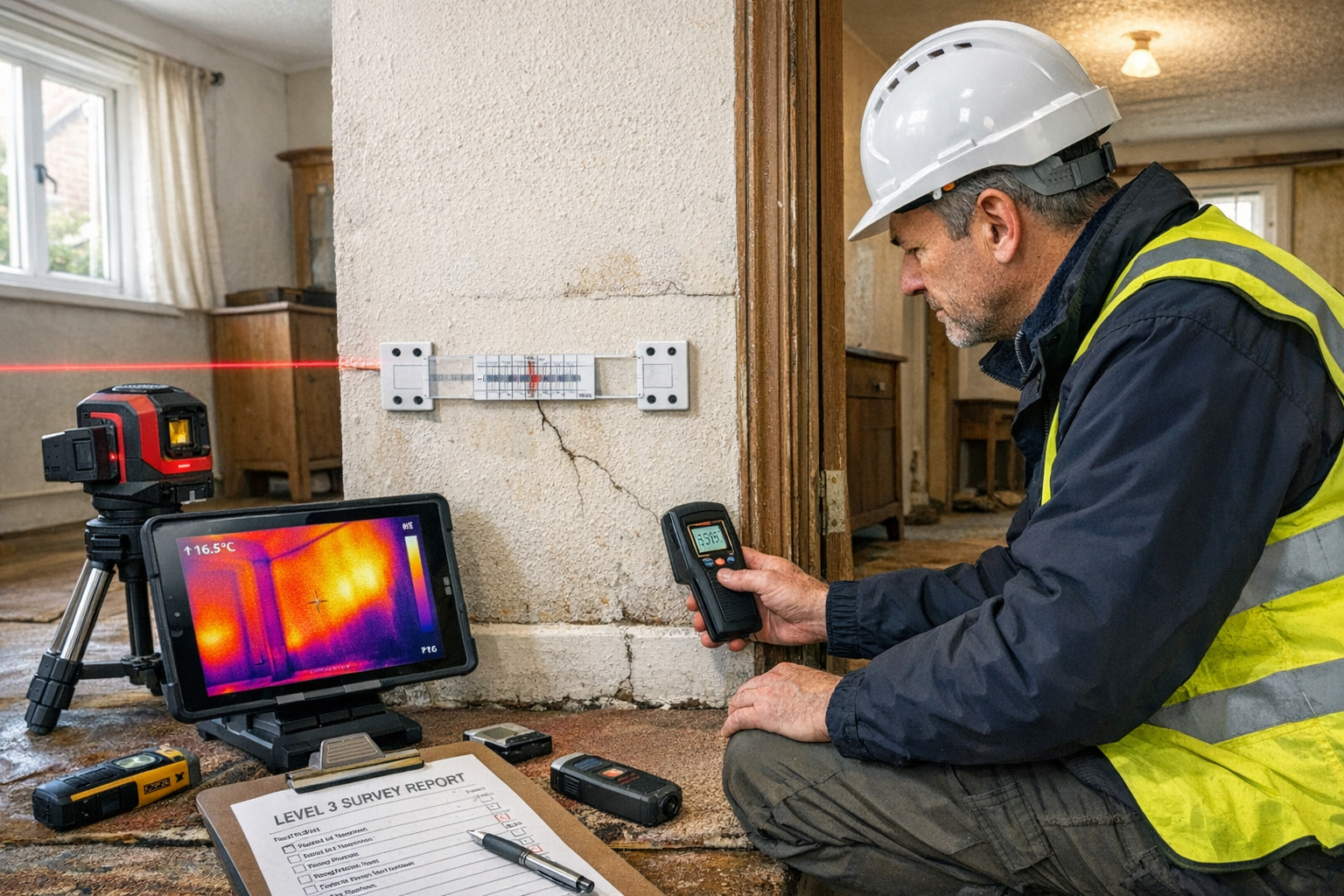
This seasonal approach allows surveyors to observe the full range of foundation movement rather than capturing a single static moment. For properties with suspected subsidence, monitoring surveys track movement over extended periods using precision measurement equipment.
Critical Assessment Areas in Bungalow Subsidence Surveys
Foundation and Substructure Examination
The foundation inspection forms the cornerstone of any subsidence assessment. For bungalows in high-risk zones, surveyors must evaluate:
External Foundation Assessment:
- Visible foundation exposure through trial pits or existing excavations
- Foundation type identification (strip, trench fill, raft, or piled)
- Construction material condition (concrete deterioration, brick frost damage)
- Foundation depth adequacy for local soil conditions
- Differential settlement indicators (stepped cracking patterns)
Subfloor Space Investigation:
For bungalows with suspended floors, accessible subfloor areas provide invaluable diagnostic information:
✓ Ground level changes indicating soil movement
✓ Moisture accumulation suggesting drainage problems
✓ Ventilation adequacy affecting timber condition
✓ Service pipe condition and potential leak sources
✓ Foundation wall integrity from interior perspective
Properties without accessible subfloor spaces require more extensive external investigation and may need specialized damp surveys to assess moisture-related risks.
Structural Movement Indicators
Experienced surveyors look for specific patterns that distinguish subsidence from other forms of structural movement:
Subsidence-Specific Crack Patterns:
🔴 Diagonal cracks wider at top than bottom, typically at 45-degree angles
🔴 Stepped cracking following mortar joints in brickwork
🔴 Cracks wider than 3mm requiring immediate investigation
🔴 Progressive widening over time (documented through monitoring)
🔴 External-to-internal crack continuation indicating foundation-level issues
Location-Specific Indicators:
- Corner cracking where building sections meet
- Window and door frame distortion preventing proper operation
- Floor level changes creating slopes or unevenness
- Wall lean or bulging visible from external observation
- Separation between walls and floors creating visible gaps
The difference between Level 2 and Level 3 surveys becomes particularly apparent in subsidence assessment—Level 2 reports note visible defects but don't provide the detailed analysis necessary for understanding causation and required remediation.
Drainage and Water Management Systems
Water management failures represent the leading cause of subsidence in clay soils. The 2026 protocols require comprehensive drainage assessment:
Surface Water Management:
- Rainwater goods condition (gutters, downpipes, gullies)
- Surface water discharge points and adequacy
- Ground level slopes directing water away from foundations
- Paving and hard landscaping creating water concentration
- Soakaway location and functionality
Below-Ground Drainage:
- Foul and surface water drain condition via CCTV survey
- Pipe material and joint integrity assessment
- Drainage fall adequacy for proper flow
- Connection points and potential leak sources
- Tree root intrusion into drainage systems
Critical: A single leaking drain can saturate clay soil adjacent to foundations, creating localized expansion that triggers differential settlement. This makes drainage assessment non-negotiable in high-risk zones.
Vegetation Impact Analysis
Trees and large shrubs significantly affect clay soil moisture content through transpiration—the process of drawing water from soil through roots and releasing it through leaves.
High-Risk Vegetation Species:
🌳 Oak – Extracts up to 250 liters daily, roots extend 1.5x tree height
🌳 Willow – Extremely high water demand, aggressive root systems
🌳 Poplar – Deep root penetration, extensive lateral spread
🌳 Elm – Moderate water demand but extensive root networks
🌳 Ash – Significant water extraction in mature specimens
The 2026 protocols require surveyors to:
- Identify all trees within 1.5x mature height of the property
- Assess species, maturity, and health condition
- Evaluate historical tree removal creating rehydration risk
- Recommend vegetation management strategies
- Consider seasonal transpiration variations
Rehydration subsidence occurs when trees are removed, allowing previously desiccated clay to reabsorb moisture and expand—sometimes causing more damage than the original shrinkage.
Advanced Technology in 2026 Subsidence Protocols
Ground-Penetrating Radar and Geophysical Methods
Modern subsidence assessment increasingly relies on non-invasive technology that reveals subsurface conditions without destructive investigation:
Ground-Penetrating Radar (GPR) Applications:
- Foundation depth and construction verification
- Void detection beneath foundations
- Soil density variation mapping
- Underground service location
- Historical disturbance identification
Electromagnetic Conductivity Mapping:
This technology identifies moisture content variations in clay soils, revealing areas of saturation or desiccation that indicate subsidence risk before structural damage manifests.
Thermal Imaging and Moisture Detection
Infrared thermography reveals temperature differentials that indicate:
- Moisture penetration through cracked foundations
- Air infiltration at structural separations
- Insulation deficiencies affecting thermal stress
- Service pipe leaks beneath floor slabs
Combined with resistance-based moisture meters, these tools provide quantitative data about property condition that supports accurate risk assessment.
Digital Documentation and Monitoring Systems
The 2026 protocols emphasize comprehensive documentation:
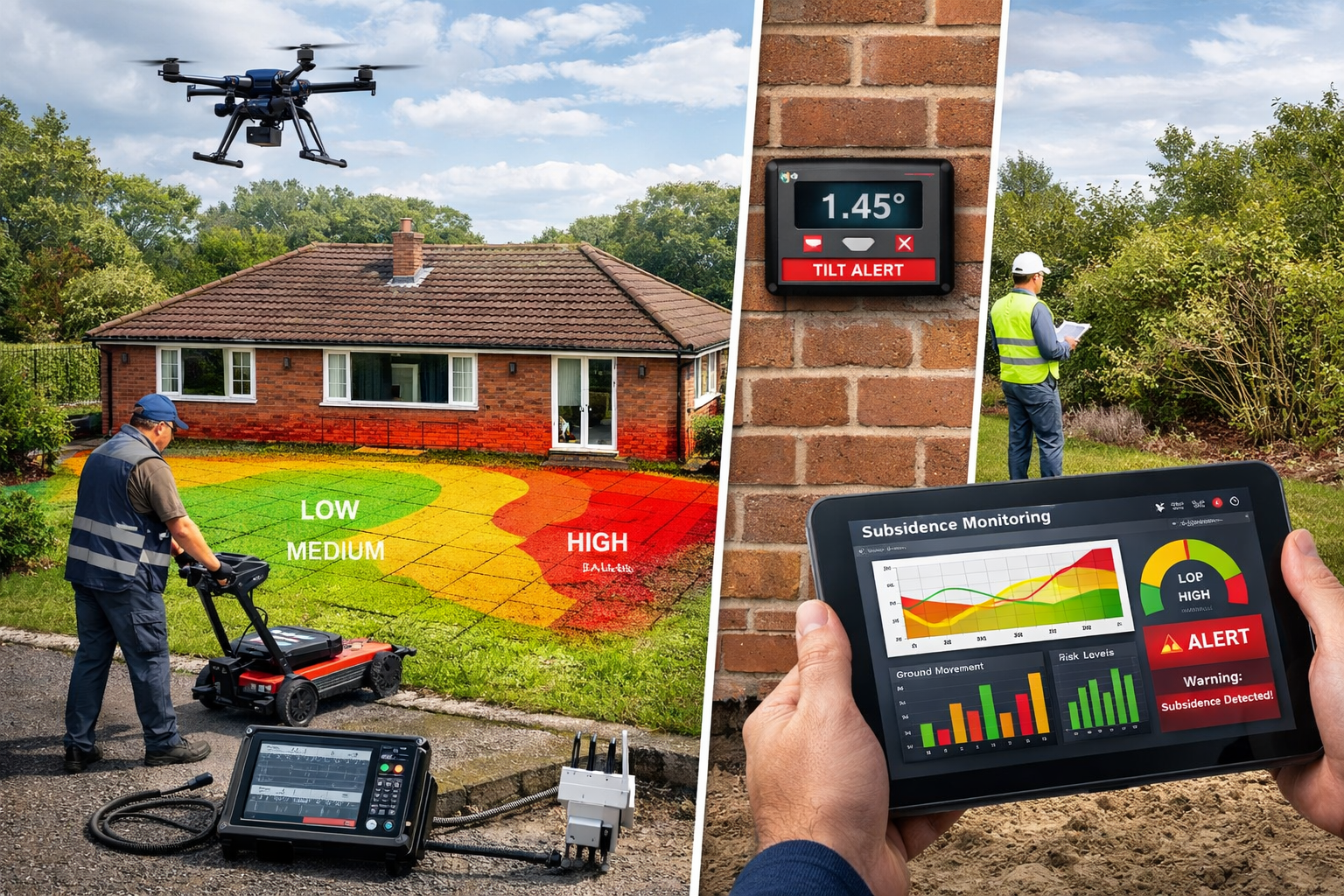
📊 Digital crack monitoring using photogrammetry to measure changes over time
📊 Laser scanning creating 3D models for precise measurement
📊 Drone surveys capturing roof condition and site context
📊 GPS-referenced photography enabling temporal comparison
These technologies support the detailed reporting requirements of Level 3 surveys while providing objective evidence for insurance claims and remediation planning. Drone surveys have become particularly valuable for assessing roof condition and site drainage patterns.
Interpreting Survey Results and Risk Assessment
Understanding Risk Classification Systems
Surveyors classify subsidence risk using standardized categories that inform decision-making:
Risk Category Framework:
| Risk Level | Characteristics | Recommended Action |
|---|---|---|
| Low Risk | No visible movement, favorable soil conditions, adequate foundations | Proceed with standard precautions |
| Moderate Risk | Minor historic movement, clay soils present, adequate drainage | Enhanced monitoring, insurance disclosure |
| High Risk | Active movement indicators, inadequate foundations, poor drainage | Detailed investigation before purchase |
| Severe Risk | Progressive structural damage, foundation failure evident | Remediation essential before occupation |
These classifications help buyers understand the financial and safety implications of proceeding with a property purchase in subsidence-prone areas.
Cost Implications of Subsidence Findings
Understanding the financial impact of subsidence helps inform purchase negotiations:
Typical Remediation Costs (2026):
💷 Minor underpinning (localized areas): £10,000-£25,000
💷 Extensive underpinning (multiple walls): £25,000-£75,000
💷 Complete foundation replacement: £75,000-£150,000+
💷 Drainage system replacement: £5,000-£15,000
💷 Structural repairs (crack stitching, wall ties): £3,000-£12,000
These figures don't include consequential costs such as temporary accommodation, interior redecoration, or insurance premium increases. A comprehensive structural survey provides detailed cost estimates for identified remediation work.
Insurance Considerations
Subsidence history dramatically affects property insurability:
Insurance Impact Factors:
- Properties with subsidence claims face higher premiums (typically 25-100% increase)
- Some insurers exclude subsidence cover for affected properties
- Excess amounts increase substantially (often £1,000-£5,000)
- Monitoring requirements may be imposed as policy conditions
- Claim history follows the property, not the owner
Buyers must obtain insurance quotes before exchange of contracts to ensure the property remains financially viable.
Selecting the Right Surveyor for High-Risk Assessments
Essential Qualifications and Experience
Not all surveyors possess the specialized knowledge required for complex subsidence assessment:
Required Credentials:
✓ RICS membership (Royal Institution of Chartered Surveyors)
✓ Structural engineering background or collaboration
✓ Subsidence-specific experience in clay soil regions
✓ Professional indemnity insurance adequate for property value
✓ Local knowledge of geological conditions
Working with local chartered surveyors who understand regional soil conditions and construction practices provides significant advantages in risk assessment accuracy.
Questions to Ask Potential Surveyors
Before commissioning a Level 3 survey in a high-risk zone, ask:
- How many subsidence surveys have you conducted in the past year?
- What technology do you use for foundation assessment?
- Do you collaborate with structural engineers for complex cases?
- Will you provide quantified repair cost estimates?
- What is your typical report turnaround time?
- Do you offer follow-up consultation to explain findings?
- Can you provide references from recent subsidence assessments?
These questions help identify surveyors with genuine expertise rather than general practitioners attempting complex specialized work.
The Survey Process: What to Expect
Pre-Survey Preparation
Effective surveys require property access and information gathering:
Property Owner Responsibilities:
- Provide access to all areas including lofts and subfloors
- Share any known history of movement or repairs
- Identify location of service shut-off valves
- Remove stored items blocking inspection access
- Provide building control documentation for alterations
Buyer Responsibilities:
- Communicate specific concerns to the surveyor
- Request additional investigation of particular areas
- Understand survey scope and limitations
- Arrange attendance if desired (though not required)
On-Site Investigation Duration
Level 3 surveys for bungalows in high-risk zones typically require:
⏱️ Standard bungalow (2-3 bedrooms): 4-6 hours on-site
⏱️ Larger bungalow (4+ bedrooms): 6-8 hours on-site
⏱️ Complex cases (active subsidence): Multiple visits over weeks/months
This extended timeframe reflects the thoroughness required to properly assess subsidence risk—significantly longer than basic surveys that may take only 2-3 hours.
Report Delivery and Content
Comprehensive Level 3 survey reports include:
Standard Report Sections:
- Executive summary with key findings and risk assessment
- Detailed condition analysis organized by building element
- Photographic evidence with annotations highlighting defects
- Repair recommendations with priority classifications
- Cost estimates for identified remediation work
- Risk ratings for subsidence and other major defects
Reports typically arrive 7-14 days after site inspection, though complex cases requiring specialist consultation may take longer. The investment in a thorough survey—while more expensive than basic options—provides essential information for the most significant financial decision most people make.
Remediation Strategies When Subsidence is Identified
Underpinning Techniques for Bungalows
When subsidence damage requires foundation strengthening, several underpinning methods suit bungalow construction:
Traditional Mass Concrete Underpinning:
- Excavation beneath existing foundations in sections
- Concrete placement to extend foundation depth
- Sequential work to maintain structural stability
- Suitable for most subsidence scenarios
- Cost-effective for localized problems
Piled Underpinning:
- Installation of mini-piles beneath foundations
- Transfer of load to stable soil strata below clay
- Minimal excavation required
- Faster installation than mass concrete
- Higher cost but less disruptive
Resin Injection:
- Expanding polymer resin injected beneath foundations
- Fills voids and stabilizes soil
- Minimal excavation and disruption
- Not suitable for all subsidence types
- Relatively new technology with limited long-term data
The choice of method depends on subsidence cause, soil conditions, building construction, and budget constraints. Professional structural engineering advice ensures appropriate technique selection.
Alternative Approaches to Foundation Stabilization
Not all subsidence requires underpinning:
Non-Invasive Solutions:
🔧 Drainage improvement resolving water-related soil movement
🔧 Vegetation management controlling moisture extraction
🔧 Crack monitoring confirming movement has ceased
🔧 Cosmetic repair where structural stability is confirmed
🔧 Acceptance and disclosure for minor historic movement
These approaches cost significantly less than underpinning and may be appropriate where movement has stabilized and structural integrity remains adequate.
Regulatory Compliance and Building Control
Building Regulations Requirements
Subsidence remediation work requires compliance with building regulations:
Notification Requirements:
- Underpinning work requires Building Control approval
- Structural calculations must be submitted and approved
- Inspections at key stages verify compliant construction
- Completion certificates provide evidence for future buyers
Failure to obtain proper approvals creates legal complications and affects property value and insurability.
Party Wall Considerations
For semi-detached or terraced bungalows, underpinning often triggers Party Wall Act requirements:
- Formal notices must be served on adjoining owners
- Party wall awards document agreed procedures
- Independent surveyors may be appointed
- Condition surveys protect against damage claims
Understanding these legal requirements prevents costly disputes and delays.
Future-Proofing Against Climate Change Impacts
Adapting to Increased Weather Extremes
Climate projections suggest continued intensification of the freeze-thaw cycles affecting clay soils. Property owners can implement protective measures:
Proactive Risk Reduction:
🛡️ Enhanced drainage systems with increased capacity
🛡️ Rainwater harvesting reducing soil moisture variation
🛡️ Strategic vegetation planting providing controlled moisture extraction
🛡️ Foundation moisture barriers limiting clay contact with water
🛡️ Regular monitoring detecting movement before major damage occurs
These measures represent long-term investments in property stability and value protection.
The Role of Ongoing Monitoring
For properties in high-risk zones, even without current subsidence evidence, establishing baseline monitoring provides valuable protection:
Monitoring Program Elements:
- Annual crack width measurement at key locations
- Photographic documentation enabling temporal comparison
- Professional inspection every 3-5 years
- Drainage system maintenance and inspection
- Vegetation management following established protocols
This proactive approach identifies problems early when remediation costs remain manageable.
Conclusion
Level 3 Building Surveys for Bungalows in High-Risk Subsidence Zones: 2026 Protocols Amid Clay Soil Thaw Cycles represent an essential safeguard for property buyers and owners facing unprecedented environmental challenges. The combination of single-story structural characteristics, shallow foundation systems, and increasingly volatile clay soil behavior creates risks that demand comprehensive professional assessment.
The enhanced protocols introduced in 2026 acknowledge that visual inspection alone cannot adequately evaluate subsidence risk. Ground-penetrating radar, moisture mapping, seasonal monitoring, and advanced documentation techniques now form the standard of care for properties in designated high-risk areas. While these thorough investigations cost more than basic surveys, they provide the detailed information necessary to make informed decisions about properties representing substantial financial commitments.
Take Action Today
If you're considering purchasing a bungalow in a clay soil region, or own one and have noticed concerning signs of movement, don't delay professional assessment:
- Commission a Level 3 survey from a RICS-qualified surveyor with subsidence expertise
- Request specific foundation investigation including soil analysis and drainage assessment
- Obtain insurance quotes before committing to purchase
- Budget for potential remediation based on survey findings
- Establish monitoring protocols for ongoing risk management
The investment in comprehensive survey work provides peace of mind and protects against the catastrophic costs of undetected subsidence. In 2026's challenging climate conditions, thorough due diligence isn't optional—it's essential for protecting your property investment and ensuring long-term structural safety.
For expert assistance with subsidence surveys and comprehensive property assessment, consult qualified professionals who understand the complex interplay between building construction, soil behavior, and environmental factors affecting property stability.
References
[1] What Does A Level 3 Survey Include 2025 – https://surveymatch.co.uk/what-does-a-level-3-survey-include-2025/
[2] Why Land Subsidence Matters More Than Sea Level Rise – https://www.greenbuildinglawupdate.com/2026/02/articles/climate-change/why-land-subsidence-matters-more-than-sea-level-rise/