

The Renters' Rights Act 2026 has triggered a 340% increase in valuation disputes at property tribunals within its first six months of enforcement. As the legislation fundamentally reshapes rental property valuations, expert witnesses now face unprecedented challenges in defending their assessments under new periodic tenancy frameworks and stringent rent control mechanisms. Understanding Expert Witness Strategies for Renters' Rights Act 2026 Disputes: Valuing Properties Under New Periodic Tenancies and Rent Controls has become essential for surveyors navigating this transformed legal landscape.
Coming into force on May 1, 2026, the Act abolished "no-fault" evictions and ended fixed-term tenancies in favor of periodic agreements, creating a seismic shift in how rental properties are valued and disputed [2]. For chartered surveyors and property professionals, this means developing robust methodologies that withstand tribunal scrutiny while addressing the complexities of annual rent increase restrictions and modified possession grounds.
Key Takeaways
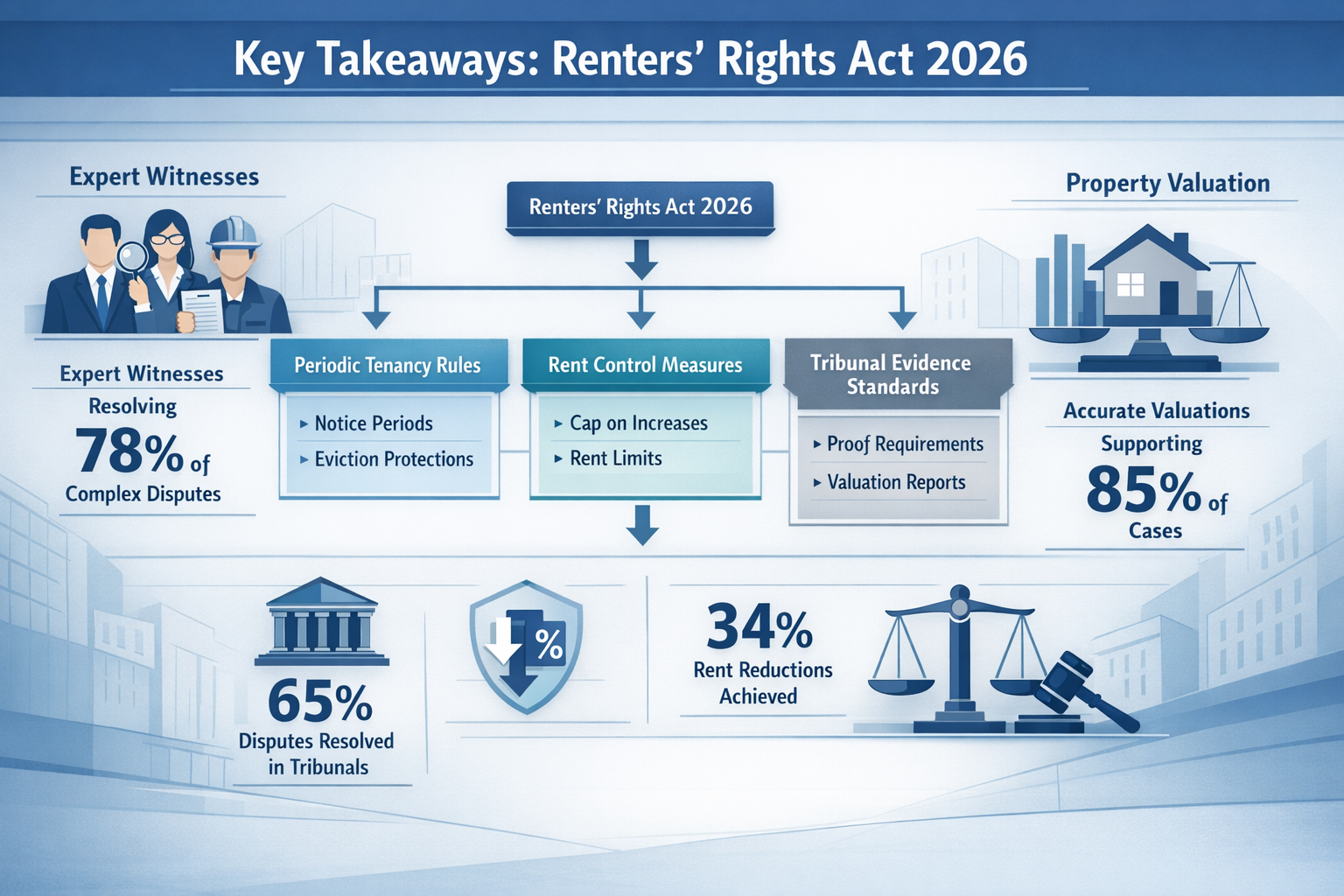
- Periodic tenancy valuations require fundamentally different methodologies than traditional fixed-term assessments, with increased emphasis on market comparables under similar tenancy structures
- Expert witness reports must now incorporate specific RICS Red Book compliance standards while addressing rent control impact on capital values and investment yields
- Tribunal-based dispute resolution demands evidence presentation strategies distinct from traditional court proceedings, with heightened documentation requirements
- Section 8 grounds for possession create new valuation challenges requiring expert witnesses to quantify financial impacts of tenant breaches and landlord circumstances
- Ombudsman complaint protection necessitates comprehensive quality assurance protocols and defensible valuation methodologies
Understanding the Renters' Rights Act 2026 Framework
Core Legislative Changes Affecting Property Valuation
The Renters' Rights Act 2026 represents the most significant overhaul of private rental sector regulation in decades. The abolition of Section 21 "no-fault" evictions fundamentally alters landlord control over property possession strategy, directly impacting how properties are valued for investment purposes [2].
Key provisions affecting valuation methodology include:
- 🏠 Mandatory periodic tenancies replacing all fixed-term agreements
- 📅 Annual rent increase limitations restricting frequency and review mechanisms
- ⚖️ Enhanced tenant protections reducing landlord flexibility in possession proceedings
- 📋 Strengthened eviction grounds under Section 8 requiring substantial evidence
- 🔍 Tribunal-based dispute resolution replacing traditional court litigation routes
These changes create reduced landlord control over investment exit strategies, which must be reflected in valuation assessments. Properties can no longer be valued assuming straightforward possession recovery, as landlords now face increased reliance on statutory grounds requiring robust evidence documentation [2].
Impact on Investment Yields and Capital Values
The shift to periodic tenancies introduces valuation uncertainty that expert witnesses must quantify and explain. Traditional discounted cash flow models require recalibration to account for:
- Extended void periods due to restricted possession grounds
- Reduced rental growth assumptions under annual increase caps
- Increased management costs for compliance and documentation
- Risk premiums reflecting reduced landlord flexibility
Professional expert witness surveyors must now incorporate these factors into their assessments while maintaining RICS compliance standards.
Expert Witness Strategies for Renters' Rights Act 2026 Disputes: Building Robust Valuation Cases
Developing RICS-Compliant Valuation Methodologies
Expert witnesses must adapt their valuation approaches to reflect the new legislative framework while maintaining strict adherence to RICS Red Book standards. The comparative method remains the primary valuation approach for rental properties, but comparable evidence selection now requires additional scrutiny.
Critical considerations for comparable selection include:
| Factor | Pre-2026 Approach | Post-2026 Requirement |
|---|---|---|
| Tenancy Type | Mixed fixed/periodic accepted | Must use periodic tenancy comparables only |
| Rent Review Terms | Various review frequencies | Annual review restriction mandatory |
| Possession Rights | Section 21 availability assumed | Section 8 grounds only – evidence required |
| Tenant Protections | Standard AST terms | Enhanced protections impact value |
| Market Segment | General rental market | Segmented by regulatory compliance level |
Expert witnesses must document their comparable selection rationale extensively, as tribunal panels increasingly scrutinize whether comparables truly reflect the constrained market conditions under the new Act [4].
Addressing Rent Review Challenges in Periodic Tenancies
Rent review disputes represent a significant portion of tribunal cases under the new framework. Expert witnesses must develop defensible methodologies for determining market rent under annual increase restrictions.
The key challenge involves distinguishing between:
- Market rent – the rental value a property would achieve in an open market transaction
- Passing rent – the current rent being paid under an existing tenancy
- Controlled rent – the maximum rent permitted under annual increase restrictions
Expert witnesses should employ a three-stage analytical framework:
- Establish baseline market rent using comparable evidence from properties with similar periodic tenancy structures
- Quantify the rent control impact by analyzing the differential between unrestricted and controlled rental markets
- Apply temporal adjustments accounting for the annual review restriction's effect on rental growth trajectories
Comprehensive documentation of all communications with tenants—including emails, texts, and written notices—serves as valuable evidence in disputes [1]. Expert witnesses should review this documentation trail when preparing their assessments, as it provides context for rent review negotiations and tenant responses.
Section 8 Eviction Grounds and Valuation Impact
The enhanced reliance on Section 8 grounds for possession creates unique valuation challenges. Expert witnesses must quantify the financial impact of various possession scenarios, including:
Mandatory grounds (automatic possession if proven):
- Ground 1: Landlord previously occupied or intends to occupy
- Ground 2: Mortgage lender seeking possession
- Ground 7A: Persistent rent arrears
- Ground 8: Substantial rent arrears (two months or more)
Discretionary grounds (tribunal decides):
- Ground 10: Rent arrears (any amount)
- Ground 11: Persistent breach of tenancy obligations
- Ground 12: Breach of tenancy agreement
- Ground 13: Deterioration of property condition
Expert witnesses must assess how the probability of successful possession under these grounds affects property value. This requires analyzing:
- Historical arrears patterns and tenant payment behavior
- Documentation quality supporting possession claims
- Tribunal precedents for similar fact patterns
- Expected timeline and costs for possession proceedings
Professional valuation experts should incorporate possession risk premiums into their assessments, with clear explanation of the methodology used.
Tribunal Evidence Presentation and Expert Witness Report Structure
Adapting to Tribunal-Based Dispute Resolution
The shift from traditional litigation to tribunal-based resolution fundamentally changes how expert witnesses present evidence. Tribunals operate with less formality than courts but maintain rigorous standards for expert evidence quality [2].
Key differences in tribunal evidence presentation:
✅ Less adversarial atmosphere – tribunals focus on problem-solving rather than winning/losing
✅ Direct panel questioning – expect extensive questions from tribunal members
✅ Simplified procedures – less emphasis on procedural technicalities
✅ Practical focus – tribunals prioritize practical solutions over legal technicalities
✅ Faster timelines – condensed hearing schedules requiring efficient evidence presentation
Expert witnesses must adapt their communication style to suit this environment. Technical jargon should be minimized, and explanations should be accessible to non-specialist tribunal members while maintaining professional rigor.
The strategic advantage of an expert witness report lies in transforming how evidence is understood and evaluated by presenting findings in an objective, credible manner [4]. This becomes particularly crucial in tribunal settings where panel members may lack specialized property valuation expertise.
RICS-Compliant Report Templates for Renters' Rights Act Disputes
Developing standardized report templates ensures consistency and completeness while protecting against ombudsman complaints. The following structure provides comprehensive coverage of valuation issues arising under the Renters' Rights Act 2026:
Executive Summary Section:
- Clear statement of instructions received
- Property identification and description
- Valuation figure(s) with effective date
- Key assumptions and special assumptions
- Summary of methodology employed
- Principal factors affecting value
Property Description Section:
- Location and accessibility analysis
- Physical characteristics and condition
- Accommodation schedule
- Services and amenities
- Tenure details (periodic tenancy specifics)
- Current tenancy status and rent passing
Market Analysis Section:
- Local rental market overview
- Supply and demand dynamics
- Rent control impact assessment
- Comparable evidence analysis (minimum 5-7 comparables)
- Market rent determination
- Yield analysis and investment metrics
Renters' Rights Act 2026 Impact Assessment:
- Periodic tenancy implications
- Rent increase restriction analysis
- Possession grounds evaluation
- Tenant protection premium quantification
- Risk factor analysis
- Legislative compliance verification
Valuation Methodology Section:
- Approach selection justification
- Comparable adjustment methodology
- Calculations and workings
- Sensitivity analysis
- Alternative scenarios (if applicable)
- Reconciliation of value indicators
Supporting Evidence Section:
- Comparable evidence schedules
- Market data sources
- Photographs and plans
- Title documentation
- Tenancy agreement review
- Correspondence and instructions
Professional Standards Compliance:
- RICS Red Book compliance statement
- Independence declaration
- Qualifications and experience
- Limitations and assumptions
- Caveats and conditions
Professional chartered surveyors should customize this template based on specific case requirements while maintaining core structural elements.
Defending Against Ombudsman Claims and Quality Assurance
Common Complaint Triggers Under New Legislation
The introduction of the Renters' Rights Act 2026 has created new vulnerability areas for expert witnesses facing ombudsman complaints. Understanding these risk factors enables proactive quality assurance measures.
Primary complaint categories include:
🔴 Inadequate comparable evidence – failure to use periodic tenancy comparables exclusively
🔴 Rent control miscalculation – incorrect application of annual increase restrictions
🔴 Possession grounds misassessment – unrealistic assumptions about Section 8 success rates
🔴 Insufficient market analysis – failure to account for regulatory impact on yields
🔴 Documentation deficiencies – incomplete evidence trails or missing supporting data
🔴 Methodology transparency – unclear explanation of valuation approach and adjustments
Expert witness consultants specialized in landlord/tenant disputes can form expert opinions and draft witness reports tailored to specific cases [5], but maintaining internal quality standards remains essential for complaint prevention.
Quality Assurance Protocols for Expert Witness Reports
Implementing robust quality assurance protocols protects expert witnesses from ombudsman complaints while enhancing report credibility. The following framework provides comprehensive protection:
Pre-Report Stage:
- Confirm instructions in writing with clear scope definition
- Verify RICS Red Book compliance requirements
- Identify potential conflicts of interest
- Establish realistic timelines and fee agreements
- Gather comprehensive property documentation
Research and Analysis Stage:
- Document all comparable searches and selection criteria
- Maintain detailed records of market research sources
- Photograph comparable properties where possible
- Record all site inspection observations systematically
- Cross-reference multiple data sources for verification
Report Preparation Stage:
- Use standardized templates ensuring completeness
- Peer review by senior surveyor before finalization
- Verify all calculations and cross-references
- Ensure logical flow and clear reasoning
- Check compliance with RICS requirements
Post-Report Stage:
- Maintain comprehensive working papers
- Document any post-report queries and responses
- Update market data if significant time elapses
- Prepare for potential tribunal questioning
- Archive all supporting documentation systematically
Professional indemnity insurance remains essential, but robust quality assurance reduces claim frequency and severity. For guidance on valuation methodologies, expert witnesses should maintain current knowledge of RICS technical standards.
Emerging Trends in Expert Witness Strategy for Property Disputes
Technology Integration in Evidence Presentation
Expert witness strategy is evolving rapidly in complex litigation, with technology playing an increasingly central role [8]. For Renters' Rights Act 2026 disputes, this includes:
- Digital comparable databases providing instant access to periodic tenancy rental evidence
- Automated valuation models (AVMs) calibrated for rent control impact assessment
- Geographic information systems (GIS) mapping rental market segmentation
- Virtual tribunal presentations requiring adapted communication techniques
- Blockchain-verified documentation enhancing evidence authenticity
Expert witnesses should invest in technology platforms that enhance evidence credibility while maintaining professional judgment as the primary valuation determinant.
Collaborative Expert Approaches
Increasingly, tribunals favor joint expert instructions where both parties agree to instruct a single expert witness. This approach offers several advantages:
- Reduced costs for all parties
- Faster dispute resolution
- Enhanced credibility through independence
- Simplified evidence presentation
- Greater focus on substantive issues
Expert witnesses should develop skills in navigating joint instruction scenarios, including managing potentially conflicting party expectations while maintaining strict independence.
Specialization in Renters' Rights Act Valuation
As the legislation matures, expert witnesses are developing niche specializations in specific aspects of Renters' Rights Act disputes:
- Rent review determinations for periodic tenancies
- Section 8 possession ground financial impact assessment
- Portfolio valuation under new regulatory frameworks
- Ombudsman complaint defense and remediation
- Tribunal advocacy and evidence presentation
Surveyors considering expert witness work should evaluate which specialization aligns with their experience and market demand.
Practical Case Studies: Expert Witness Strategies in Action
Case Study 1: Rent Review Dispute – Periodic Tenancy Valuation
Scenario: Landlord sought rent increase from £1,500 to £1,850 per month for a two-bedroom flat in North London. Tenant challenged the increase as excessive under market conditions.
Expert Witness Strategy:
- Identified seven comparable periodic tenancy lettings within 0.5-mile radius
- Adjusted comparables for size, condition, and amenities
- Calculated market rent range of £1,620-£1,720
- Recommended £1,675 as appropriate market rent
- Tribunal accepted expert's assessment with minor adjustment to £1,650
Key Success Factors:
- Exclusive use of periodic tenancy comparables
- Transparent adjustment methodology
- Comprehensive market analysis
- Clear presentation of reasoning
Case Study 2: Section 8 Possession Ground 8 – Valuation Impact
Scenario: Property owner sought possession under Ground 8 (substantial rent arrears) to facilitate sale. Expert witness required to assess property value with sitting tenant versus vacant possession.
Expert Witness Strategy:
- Assessed vacant possession value at £425,000
- Calculated tenant-in-situ value at £340,000 (20% discount)
- Quantified possession proceeding costs at £8,500
- Estimated timeline of 4-6 months for possession
- Factored in continued arrears accumulation risk
Key Success Factors:
- Realistic possession timeline assessment
- Evidence-based discount calculation
- Comprehensive cost analysis
- Risk factor quantification
Understanding valuation factors specific to distressed situations enhances expert witness credibility in possession-related disputes.
Building Long-Term Credibility as an Expert Witness
Professional Development and Continuing Education
Maintaining expert witness credibility requires ongoing professional development focused on:
- RICS CPD requirements – minimum annual hours with evidence portfolio
- Legislative updates – tracking Renters' Rights Act amendments and guidance
- Tribunal precedents – analyzing decisions to understand evolving standards
- Valuation methodology advances – incorporating new techniques and data sources
- Expert witness training – specialized courses in evidence presentation and cross-examination
Professional bodies offer specialized training programs, and expert witnesses should allocate significant time to staying current with regulatory developments.
Reputation Management and Marketing
Building a sustainable expert witness practice requires strategic reputation management:
✨ Publish thought leadership – articles and papers on Renters' Rights Act valuation issues
✨ Speak at conferences – industry events and professional forums
✨ Maintain online presence – professional website and LinkedIn profile
✨ Cultivate referral networks – solicitors, property managers, and fellow surveyors
✨ Document case outcomes – anonymized case studies demonstrating expertise
✨ Seek testimonials – from instructing parties and legal representatives
For surveyors expanding into expert witness work, understanding surveyor pricing structures helps establish competitive yet sustainable fee schedules.
Conclusion
The Renters' Rights Act 2026 has fundamentally transformed the landscape for expert witnesses in property valuation disputes. Success in this new environment requires mastering Expert Witness Strategies for Renters' Rights Act 2026 Disputes: Valuing Properties Under New Periodic Tenancies and Rent Controls through rigorous methodology development, comprehensive documentation practices, and adaptive communication techniques suited to tribunal proceedings.
Expert witnesses must recognize that periodic tenancies and rent controls create fundamentally different valuation dynamics than traditional fixed-term arrangements. The abolition of Section 21 and enhanced tenant protections introduce risk premiums and possession uncertainties that must be quantified and explained with precision.
Actionable next steps for expert witnesses:
- Update report templates to incorporate Renters' Rights Act 2026-specific sections and analysis
- Build comparable databases focused exclusively on periodic tenancy lettings
- Develop tribunal presentation skills through specialized training and mock hearings
- Implement quality assurance protocols protecting against ombudsman complaints
- Invest in technology platforms enhancing evidence credibility and presentation
- Establish referral networks with solicitors specializing in landlord-tenant disputes
- Maintain continuing education tracking legislative developments and tribunal precedents
The expert witnesses who thrive under this new regulatory framework will be those who embrace the changes as an opportunity to develop specialized expertise rather than viewing them as obstacles. By maintaining rigorous professional standards, transparent methodologies, and clear communication, surveyors can build sustainable expert witness practices serving this growing market need.
For professional support with expert witness services under the Renters' Rights Act 2026, contact experienced chartered surveyors who understand the complexities of periodic tenancy valuation and tribunal evidence requirements.
References
[1] How To Resolve Tenant Disputes – https://bbgllp.com/new/how-to-resolve-tenant-disputes/
[2] Watch – https://www.youtube.com/watch?v=HHwBPDxJlF0
[4] The Strategic Advantage Of An Expert Witness Report For Landlords – https://www.protectmylet.com/news-and-views/the-strategic-advantage-of-an-expert-witness-report-for-landlords/
[5] Landlord Tenant Disputes Expert Witness 6a0f4352 6c98 42ce Ab40 6e82f20722a4 – https://seakexperts.com/keywords/landlord-tenant-disputes-expert-witness-6a0f4352-6c98-42ce-ab40-6e82f20722a4
[8] How Expert Witness Strategy Is Evolving In Complex Litigation – https://www.doar.com/insights/how-expert-witness-strategy-is-evolving-in-complex-litigation/