
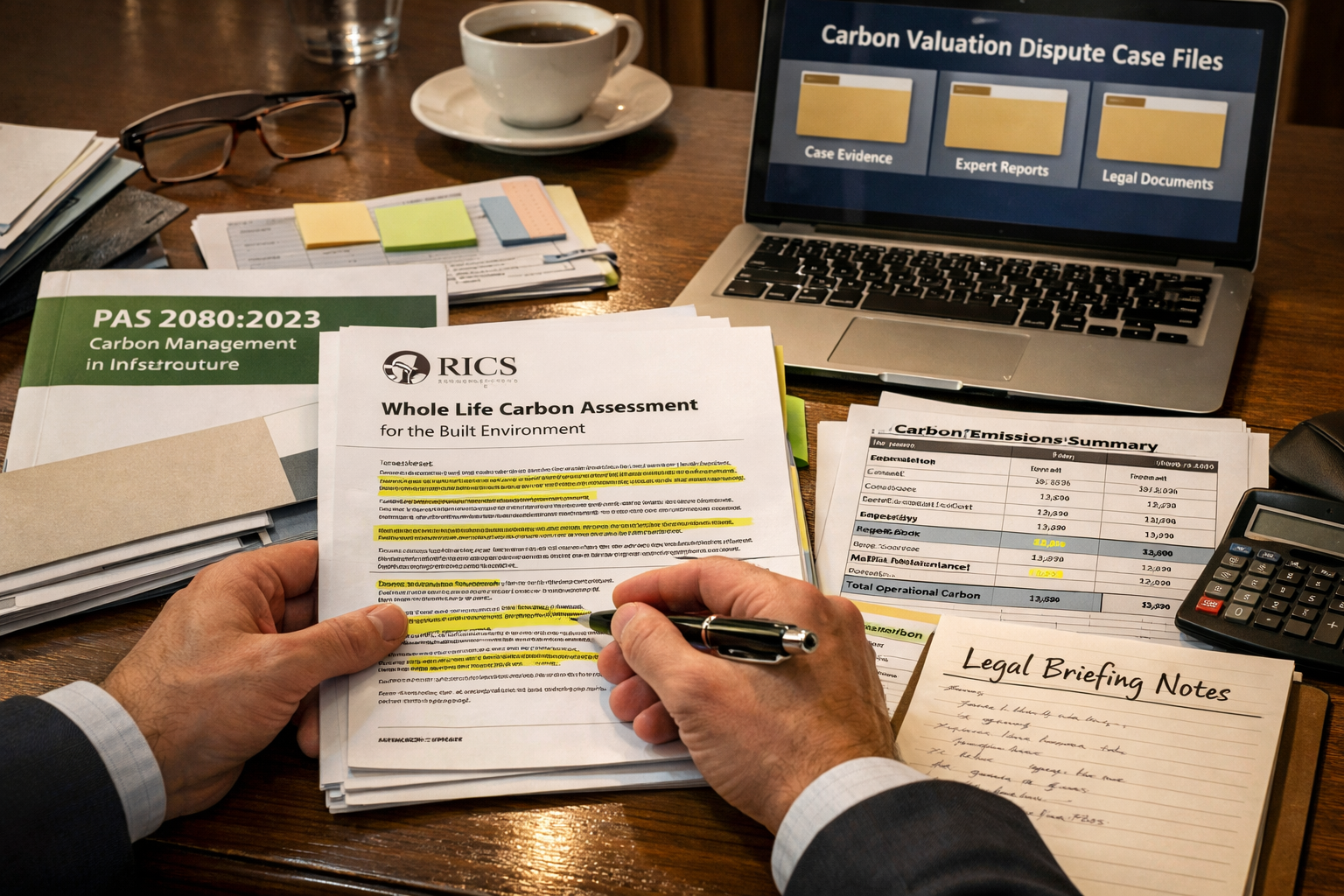
The UK construction sector faces over £2.3 billion in potential carbon-related litigation claims as property valuations increasingly incorporate whole life carbon assessments. With courts now accepting carbon-adjusted valuations as material factors in property disputes, surveyors must master the intersection of RICS Whole Life Carbon Assessment (WLCA) standards and PAS 2080:2023 frameworks to provide credible expert testimony. Expert Witness Preparation for Whole Life Carbon Valuation Disputes: RICS PAS 2080 Applications in 2026 Litigation has become an essential competency for chartered surveyors navigating this emerging legal landscape.
As sustainable property disputes escalate throughout 2026, the demand for qualified expert witness surveyors who understand carbon valuation methodologies has surged. This article equips surveyors with evidence-building techniques, procedural frameworks, and precedent reviews necessary for defending carbon-adjusted valuations in court.
Key Takeaways
- PAS 2080:2023 provides the management framework while RICS WLCA delivers the measurement methodology—expert witnesses must demonstrate proficiency in both standards
- Carbon-adjusted valuations require robust evidence chains linking assessment methodologies to financial impacts, supported by lifecycle carbon data across modules A1-D
- Court precedents from 2025-2026 establish carbon performance as a material valuation factor, making expert witness preparation essential for property professionals
- RICS's updated expert witness standards (5th edition) specifically address sustainability metrics and carbon assessment testimony requirements
- Effective litigation preparation demands collaboration between surveyors, structural engineers, and carbon consultants to build defensible technical positions
Understanding the Legal Framework for Carbon Valuation Disputes in 2026
The Convergence of Sustainability Standards and Property Law
The legal landscape surrounding whole life carbon assessments has transformed dramatically since 2024. Courts now recognize that carbon performance directly impacts property value, creating a new category of valuation disputes. This shift stems from regulatory changes, investor demands for ESG compliance, and the growing body of evidence linking carbon efficiency to long-term asset performance.
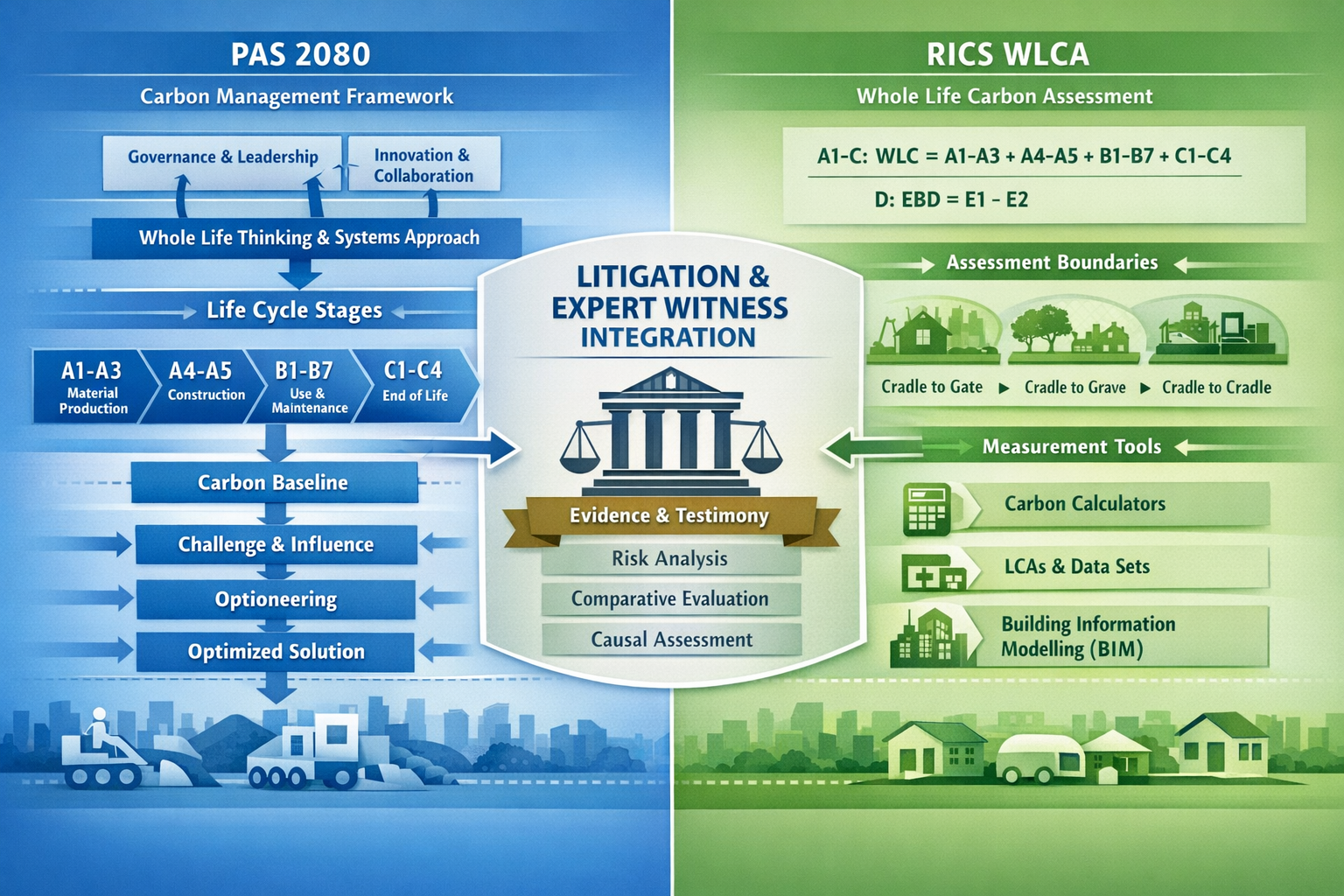
Expert Witness Preparation for Whole Life Carbon Valuation Disputes: RICS PAS 2080 Applications in 2026 Litigation requires understanding how these standards interact within legal proceedings. The RICS WLCA standard focuses specifically on measuring carbon across a building's lifecycle, while PAS 2080:2023 establishes the governance processes and management requirements for carbon reduction [2].
Key Regulatory Drivers
Several regulatory frameworks have elevated carbon considerations in property disputes:
- Building Safety Act 2022 implications for carbon performance
- Future Homes Standard compliance requirements
- UK Net Zero Strategy targets affecting property valuations
- TCFD reporting obligations for commercial property portfolios
- Renters Rights Act 2026 provisions linking energy efficiency to property values
Surveyors providing commercial valuation services must now account for these regulatory pressures when assessing property worth. The failure to properly quantify carbon impacts can result in material valuation errors, triggering professional negligence claims.
Establishing Material Relevance in Court
For carbon assessments to influence court decisions, expert witnesses must demonstrate materiality—proving that carbon performance meaningfully affects property value. This requires:
✅ Quantifiable financial impacts from carbon performance differences
✅ Market evidence showing buyer/tenant preferences for low-carbon properties
✅ Regulatory compliance costs associated with high-carbon buildings
✅ Future-proofing considerations affecting long-term asset value
✅ Operational cost differentials between high and low-carbon properties
The burden of proof rests on establishing clear causation between carbon metrics and valuation outcomes—a challenge that demands rigorous methodology and comprehensive documentation.
Mastering RICS WLCA and PAS 2080:2023 for Expert Testimony
Distinguishing Between Measurement and Management
A fundamental requirement for Expert Witness Preparation for Whole Life Carbon Valuation Disputes: RICS PAS 2080 Applications in 2026 Litigation involves understanding the distinct roles of these complementary standards.
RICS WLCA provides the measurement framework, offering globally applicable guidance for quantifying carbon across building lifecycles [3]. The standard acknowledges that while the methodology is universal, numerical assumptions are UK-focused due to data availability, with guidance for adapting to local contexts.
PAS 2080:2023 specifies the process and requirements to manage carbon throughout the entire building and infrastructure lifecycle [2]. It establishes governance frameworks, leadership principles, decision-making processes, and collaboration requirements across the value chain.
| Standard | Primary Focus | Application in Litigation | Expert Witness Role |
|---|---|---|---|
| RICS WLCA | Carbon measurement and quantification | Establishing baseline carbon values and assessment methodologies | Demonstrating accurate carbon calculations |
| PAS 2080:2023 | Carbon management processes | Proving adherence to industry best practices in carbon reduction | Showing proper governance and decision-making |
Lifecycle Carbon Assessment Modules
Expert witnesses must thoroughly understand the carbon assessment boundary modules when presenting evidence:
Modules A1-A5 (Embodied Carbon – Product & Construction)
- A1-A3: Material extraction, transport, and manufacturing
- A4: Transport to site
- A5: Construction and installation processes
Module B (Operational Carbon – Use Stage)
- B1: Use of building
- B2-B5: Maintenance, repair, replacement, refurbishment
- B6-B7: Operational energy and water use
Modules C1-C4 (End of Life)
- Deconstruction, transport, waste processing, and disposal
Module D (Beyond Building Lifecycle)
- Benefits and loads beyond the system boundary
When providing expert witness services, surveyors must articulate which modules apply to the specific dispute and justify any exclusions with clear rationale.
RICS 2026 Training Programme and Professional Competence
RICS currently delivers the Global Certificate in Whole Life Carbon Assessment (2026 Edition) training programme, with instruction from experienced practitioners like Alan Northen FRICS MCIArb, who brings over 30 years of expertise in quantifying, measuring, and valuing construction work [1]. This certification has become increasingly important for surveyors seeking to provide credible expert testimony.
Courts expect expert witnesses to demonstrate:
🎓 Formal training in WLCA methodologies
🎓 Practical experience applying carbon assessments to real properties
🎓 Continuing professional development in sustainability standards
🎓 Understanding of data sources including EPD databases and carbon factors
🎓 Familiarity with calculation tools and software platforms
The credibility of expert testimony often hinges on demonstrating this professional competence during cross-examination.
Evidence-Building Techniques for Carbon Valuation Disputes
Constructing a Defensible Assessment Methodology
Expert Witness Preparation for Whole Life Carbon Valuation Disputes: RICS PAS 2080 Applications in 2026 Litigation demands meticulous documentation of assessment methodologies. Courts scrutinize the technical basis for carbon calculations, making transparency essential.
Core Evidence Requirements:
- Clear Assessment Boundaries – Define precisely which lifecycle modules are included and excluded, with justification for boundary decisions
- Data Source Documentation – Identify all carbon factor databases, Environmental Product Declarations (EPDs), and calculation tools used
- Assumption Registers – Maintain comprehensive records of all assumptions, including service life expectations, replacement cycles, and operational patterns
- Sensitivity Analysis – Demonstrate how variations in key assumptions affect carbon outcomes
- Quality Assurance Processes – Document internal review procedures and third-party verification steps
Linking Carbon Performance to Financial Impact
The critical challenge in carbon valuation disputes involves translating carbon metrics into monetary values. Expert witnesses must establish credible valuation adjustments based on carbon performance differences.
Valuation Adjustment Methodologies:
Comparable Evidence Approach
- Identify market transactions showing price premiums/discounts for carbon performance
- Adjust for other value-affecting factors to isolate carbon impact
- Build statistical models demonstrating correlation between carbon metrics and prices
Income Capitalization Approach
- Quantify operational cost savings from reduced energy consumption
- Calculate avoided regulatory compliance costs
- Project rental premium potential for low-carbon properties
- Apply appropriate capitalization rates to income differentials
Cost Approach
- Estimate retrofit costs to achieve carbon performance parity
- Calculate replacement cost differentials for low-carbon specifications
- Account for functional obsolescence in high-carbon buildings
These methodologies align with established methods of valuation while incorporating carbon-specific considerations.
Building the Evidence Chain
Successful expert testimony requires an unbroken evidence chain connecting technical assessments to valuation conclusions:
Step 1: Technical Assessment → Document carbon performance using RICS WLCA methodology
Step 2: Benchmarking → Compare against relevant standards and market norms
Step 3: Materiality Analysis → Demonstrate significance of carbon performance differences
Step 4: Market Research → Gather comparable evidence and market sentiment data
Step 5: Financial Modeling → Translate carbon impacts into monetary adjustments
Step 6: Sensitivity Testing → Validate conclusions under alternative scenarios
Each link in this chain must withstand cross-examination, requiring comprehensive supporting documentation.
Addressing Data Limitations and Uncertainties
Carbon assessments inherently involve uncertainties that opposing counsel will exploit. Expert witnesses must proactively address limitations:
Common Data Challenges:
- Incomplete building specifications for existing properties
- Limited availability of product-specific EPDs
- Uncertainty in future energy grid carbon intensity
- Variability in occupant behavior affecting operational carbon
- Long-term material durability assumptions
Mitigation Strategies:
- Use conservative assumptions favoring the opposing position
- Conduct sensitivity analysis showing impact ranges
- Apply industry-standard defaults from recognized databases
- Document decision hierarchies for data selection
- Acknowledge limitations explicitly in expert reports
This transparent approach enhances credibility and demonstrates professional integrity—qualities courts value highly in expert witnesses.
Procedural Requirements and Court Presentation Strategies
RICS Expert Witness Standards Update
RICS launched a public consultation on August 26, 2025 for the 5th edition of its professional standard on "Surveyors acting as expert witnesses" [4]. While specific content details remain under consultation, the update is expected to address:
- Sustainability metrics reporting in expert witness reports
- Carbon assessment testimony requirements and protocols
- Digital evidence presentation standards for complex technical data
- Collaboration protocols with other technical experts
- Disclosure obligations for carbon calculation methodologies
Surveyors engaged in Expert Witness Preparation for Whole Life Carbon Valuation Disputes: RICS PAS 2080 Applications in 2026 Litigation should monitor these updated standards closely, as courts will expect compliance with the latest professional guidance.
Expert Report Structure for Carbon Disputes
An effective expert witness report addressing carbon valuation must follow a clear structure:
1. Executive Summary
- Key conclusions and valuation adjustments
- Brief methodology overview
- Material limitations or qualifications
2. Expert's Qualifications and Instructions
- Relevant credentials in carbon assessment and valuation
- Summary of instructions received
- Confirmation of independence and duty to the court
3. Property and Context Description
- Physical characteristics affecting carbon performance
- Regulatory context and compliance requirements
- Market positioning and comparable properties
4. Carbon Assessment Methodology
- RICS WLCA and PAS 2080 application
- Assessment boundaries and lifecycle modules
- Data sources and calculation tools
- Key assumptions and sensitivity factors
5. Carbon Performance Analysis
- Baseline carbon assessment results
- Benchmarking against standards and comparables
- Identification of material performance differences
6. Valuation Impact Analysis
- Methodology for translating carbon to value
- Market evidence supporting adjustments
- Financial modeling and calculations
- Sensitivity analysis and range of outcomes
7. Conclusions and Opinion
- Clear statement of valuation adjustment
- Confidence levels and limitations
- Response to specific questions posed
8. Appendices
- Detailed calculations and data tables
- Supporting market evidence
- Relevant standards and guidance excerpts
- CV and declaration of independence
This structure ensures compliance with Civil Procedure Rules Part 35 while addressing the technical complexity of carbon valuation disputes.
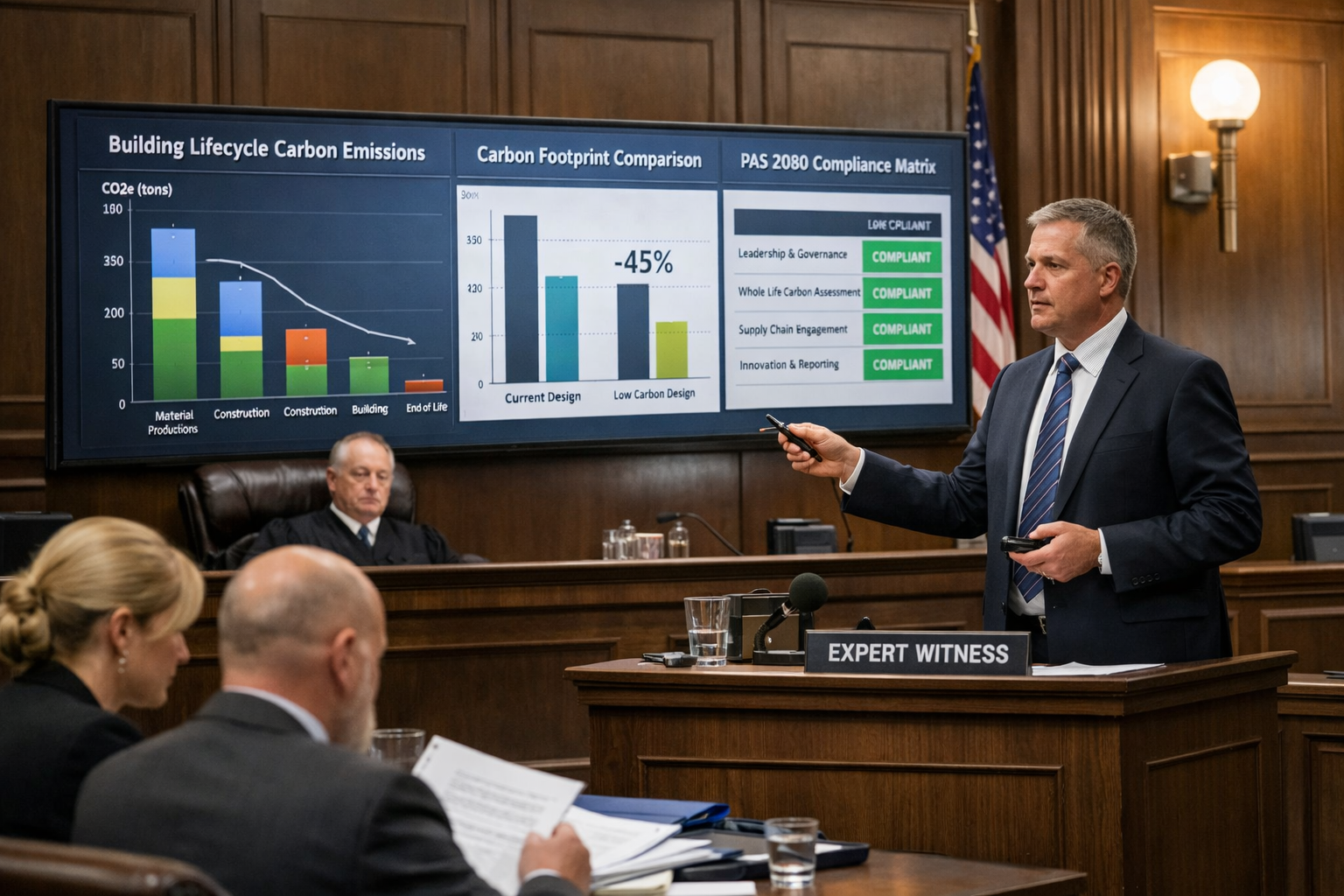
Cross-Examination Preparation
Effective cross-examination preparation distinguishes competent expert witnesses from exceptional ones. Opposing counsel will probe for weaknesses in methodology, assumptions, and conclusions.
Anticipated Challenge Areas:
Methodology Questions
- "Why did you select this particular carbon factor database?"
- "How do you account for uncertainties in future energy grid decarbonization?"
- "Isn't your assessment boundary arbitrary?"
Valuation Linkage Questions
- "Where is the market evidence that buyers actually pay premiums for lower carbon?"
- "Haven't you simply assumed a correlation that doesn't exist?"
- "Could other factors explain the price differences you've identified?"
Professional Competence Questions
- "How many carbon assessments have you personally conducted?"
- "When did you complete your WLCA training?"
- "Are you a carbon specialist or primarily a valuer?"
Preparation Strategies:
✔️ Rehearse responses to anticipated questions with legal counsel
✔️ Prepare supporting exhibits that can be referenced quickly
✔️ Know your calculations intimately to explain without reference materials
✔️ Maintain professional composure when challenged aggressively
✔️ Acknowledge limitations honestly rather than defending indefensible positions
✔️ Use plain language to explain technical concepts to non-specialist judges
The ability to communicate complex carbon assessment methodologies in accessible terms often determines the persuasiveness of expert testimony.
Coordinating with Other Technical Experts
Carbon valuation disputes frequently require testimony from multiple experts, including:
- Structural engineers addressing building performance and retrofit feasibility
- MEP engineers evaluating operational energy systems
- Quantity surveyors providing cost estimates for carbon reduction measures
- Carbon consultants offering specialized lifecycle assessment expertise
- Valuation surveyors focusing on market evidence and valuation methodology
Effective coordination requires:
📋 Joint meetings to align technical positions and identify areas of agreement
📋 Consistent assumptions across different expert reports
📋 Clear delineation of each expert's scope and opinions
📋 Cross-referencing between reports to build cohesive evidence
📋 Unified presentation strategy when multiple experts testify
This collaborative approach mirrors the systems thinking principles embedded in PAS 2080, which emphasizes value chain collaboration for effective carbon management [2].
Case Study Applications and Emerging Precedents
Residential Development Carbon Dispute (2025)
A landmark case from late 2025 established important precedents for carbon valuation disputes. A developer challenged a local authority's rejection of planning permission based on whole life carbon assessments that allegedly undervalued the scheme.
Key Issues:
- Disagreement over appropriate assessment boundaries
- Dispute regarding operational carbon assumptions
- Challenge to valuation methodology linking carbon to land value
Expert Witness Contributions:
- Demonstrated compliance with RICS WLCA methodology
- Provided sensitivity analysis showing impact ranges
- Presented market evidence of carbon-related value adjustments
Outcome:
The court accepted the expert's carbon assessment methodology but required additional market evidence to support the magnitude of valuation adjustments. This case highlighted the importance of robust market research alongside technical carbon calculations.
Commercial Property Acquisition Dispute (2026)
An ongoing 2026 case involves a commercial property acquisition where the buyer claims material misrepresentation regarding carbon performance, seeking valuation adjustments totaling £4.2 million.
Dispute Elements:
- Alleged overstatement of building carbon efficiency
- Disagreement over retrofit costs to achieve stated performance
- Challenge to income capitalization approach for operational savings
Expert Witness Challenges:
- Establishing baseline carbon performance from limited documentation
- Quantifying market rental impact of carbon performance differences
- Defending assumptions about future regulatory costs
This case demonstrates the growing sophistication of carbon-related property disputes and the critical role of expert witness testimony in resolving technical disagreements.
Lessons from Early Precedents
Early carbon valuation disputes reveal several consistent patterns:
🔍 Courts favor conservative assumptions when significant uncertainties exist
🔍 Market evidence carries substantial weight in establishing valuation adjustments
🔍 Transparency in methodology enhances expert credibility
🔍 Acknowledged limitations don't necessarily undermine conclusions
🔍 Collaboration between experts produces more persuasive evidence
These precedents inform best practices for Expert Witness Preparation for Whole Life Carbon Valuation Disputes: RICS PAS 2080 Applications in 2026 Litigation.
Technical Tools and Resources for Expert Witnesses
Carbon Assessment Software Platforms
Several software platforms support RICS WLCA-compliant assessments:
OneClick LCA
- Comprehensive lifecycle assessment tool
- Integrated EPD database
- RICS WLCA methodology alignment
- Suitable for expert witness calculations
eTool
- Building lifecycle carbon calculator
- Scenario comparison capabilities
- Detailed reporting for litigation support
IMPACT Whole Life Carbon
- RICS-endorsed calculation tool
- Standardized assessment framework
- Audit trail for expert witness requirements
When selecting tools for litigation support, prioritize platforms with:
- Transparent calculation methodologies
- Comprehensive audit trails
- Industry recognition and acceptance
- Detailed reporting capabilities
- Technical support for expert witness applications
Data Sources and Databases
Credible carbon assessments require reliable data sources:
EPD Databases:
- EPD Hub (UK)
- EC3 Tool (Embodied Carbon in Construction Calculator)
- IBU Environmental Product Declarations
- BREEAM Material Database
Carbon Factor Sources:
- DEFRA Conversion Factors (UK Government)
- ICE Database (Inventory of Carbon & Energy)
- RICS Carbon Factors
- National calculation methodologies
Expert witnesses must document which data sources were used for each element of the assessment and justify selection decisions when alternatives exist.
Professional Development Resources
Maintaining expertise requires ongoing professional development:
- RICS Global Certificate in WLCA – Essential foundation training [1]
- ICE Carbon Management Training – Complementary PAS 2080 focus
- UKGBC Advancing Net Zero Programme – Policy and practice updates
- Expert Witness Institute Courses – Litigation skills development
- Technical webinars on emerging carbon assessment methodologies
Surveyors providing specialist defect survey services alongside expert witness work benefit from cross-disciplinary training that enhances technical credibility.
Ethical Considerations and Professional Obligations
Duty to the Court vs. Client Interests
Expert witnesses face a fundamental tension between serving the instructing party and maintaining independence. The duty to the court supersedes client loyalty, requiring:
⚖️ Objective analysis regardless of implications for the instructing party
⚖️ Full disclosure of limitations and uncertainties
⚖️ Acknowledgment of opposing expert's valid points
⚖️ Refusal to advocate beyond supportable technical conclusions
⚖️ Transparency about methodology and assumptions
This independence distinguishes expert witnesses from advocates, maintaining the integrity of technical evidence presented to courts.
Managing Conflicts of Interest
Carbon valuation disputes may present subtle conflicts requiring careful management:
Prior Relationships
- Previous work for parties involved in the dispute
- Ongoing professional relationships with opposing experts
- Financial interests in relevant property or development sectors
Methodological Preferences
- Strong advocacy for particular carbon assessment approaches
- Published positions that may appear biased
- Commercial interests in specific calculation tools or databases
RICS professional standards require full disclosure of potential conflicts, allowing courts to assess whether they materially affect the expert's independence.
Documentation and Record-Keeping
Comprehensive documentation serves multiple purposes:
- Supporting expert testimony with detailed evidence
- Demonstrating professional diligence in assessment methodology
- Enabling peer review and quality assurance processes
- Protecting against professional negligence claims
- Facilitating disclosure obligations in litigation
Best practices include:
📁 Maintaining detailed calculation workbooks with clear audit trails
📁 Preserving all versions of reports and correspondence
📁 Recording meeting notes and instructions received
📁 Documenting data source selection decisions
📁 Retaining supporting market evidence and research materials
This documentation discipline proves invaluable during cross-examination when opposing counsel challenges specific aspects of the assessment methodology.
Future Developments in Carbon Valuation Litigation
Regulatory Evolution
The regulatory landscape continues evolving, creating new litigation contexts:
Anticipated Developments:
- Mandatory carbon performance disclosure requirements
- Standardized carbon valuation adjustment methodologies
- Integration with freehold valuation practices
- Enhanced enforcement mechanisms for carbon compliance
- Penalties for material carbon misrepresentation
These regulatory changes will generate additional disputes requiring expert witness testimony, making early preparation essential for surveyors.
Technological Advancements
Emerging technologies will transform carbon assessment practices:
Digital Twins
- Real-time operational carbon monitoring
- Predictive modeling for lifecycle performance
- Enhanced accuracy in operational carbon forecasting
AI-Enhanced Assessment
- Automated carbon calculations from BIM models
- Pattern recognition in market evidence
- Scenario optimization for carbon reduction strategies
Blockchain Verification
- Immutable records of carbon performance data
- Enhanced transparency in supply chain embodied carbon
- Trusted verification for expert witness evidence
Expert witnesses must stay current with these technological developments to maintain credibility in increasingly sophisticated disputes.
International Harmonization
Carbon assessment methodologies are gradually harmonizing internationally, affecting UK litigation:
Global Developments:
- ISO standards for carbon assessment
- International valuation guidance incorporating carbon
- Cross-border recognition of carbon credentials
- Harmonized EPD formats and databases
The RICS WLCA standard already provides globally applicable guidance while acknowledging regional data variations [3], positioning UK surveyors well for international disputes.
Conclusion
Expert Witness Preparation for Whole Life Carbon Valuation Disputes: RICS PAS 2080 Applications in 2026 Litigation represents a critical competency for modern chartered surveyors. As carbon performance increasingly influences property values, disputes requiring expert testimony will proliferate throughout the construction and real estate sectors.
Key Success Factors:
✅ Master both RICS WLCA measurement methodologies and PAS 2080 management frameworks
✅ Build robust evidence chains linking carbon performance to financial impacts
✅ Maintain comprehensive documentation supporting all assessment decisions
✅ Develop clear communication skills for explaining technical concepts in court
✅ Stay current with evolving standards, regulations, and technological tools
✅ Uphold professional independence and ethical obligations
✅ Collaborate effectively with other technical experts
Actionable Next Steps
Surveyors seeking to develop expert witness capabilities in carbon valuation should:
- Complete RICS Global Certificate in WLCA to establish foundational competence [1]
- Gain practical experience conducting carbon assessments on diverse property types
- Study the updated RICS expert witness standards when published [4]
- Build relationships with legal professionals specializing in construction and property disputes
- Develop case study portfolios demonstrating carbon assessment expertise
- Participate in professional networks focused on sustainability and expert witness practice
- Monitor emerging case law establishing precedents for carbon valuation disputes
The intersection of sustainability metrics and property valuation creates unprecedented opportunities for surveyors who invest in developing specialized expertise. Those who master Expert Witness Preparation for Whole Life Carbon Valuation Disputes: RICS PAS 2080 Applications in 2026 Litigation will position themselves as essential contributors to resolving the complex disputes that will define property law in the coming decade.
For surveyors already providing expert witness services, integrating carbon assessment competencies represents a natural evolution of professional practice. The technical rigor, analytical precision, and communication skills that characterize effective expert testimony translate directly to this emerging specialization.
As the built environment sector accelerates its transition toward net zero carbon, the demand for qualified expert witnesses who can navigate the technical and legal complexities of carbon valuation will only intensify. Early investment in developing these capabilities will yield substantial professional dividends while contributing to the broader sustainability transformation of the property industry.
References
[1] Wlca Delivering The Future Of Carbon Assessment In The Built Environment – https://www.rics.org/news-insights/wlca-delivering-the-future-of-carbon-assessment-in-the-built-environment
[2] Rics And Ice Harmonise Messaging On Carbon Assessment And Manage – https://www.rics.org/news-insights/rics-and-ice-harmonise-messaging-on-carbon-assessment-and-manage
[3] Whole Life Carbon Assessment – https://www.rics.org/profession-standards/rics-standards-and-guidance/sector-standards/construction-standards/whole-life-carbon-assessment
[4] Rics Launches Global Consultation On Updated Expert Witness Standard – https://wholelifecarbon.com/article/rics-launches-global-consultation-on-updated-expert-witness-standard