A two-year-old child died from prolonged exposure to mould in a social housing property in 2020. This tragedy led to legislation that now extends far beyond damp and mould concerns. In 2026, Awaab's Law expands to cover electrical hazards, fire risks, excess temperatures, and structural collapse across the private rental sector—creating urgent new responsibilities for landlords and surveyors alike.
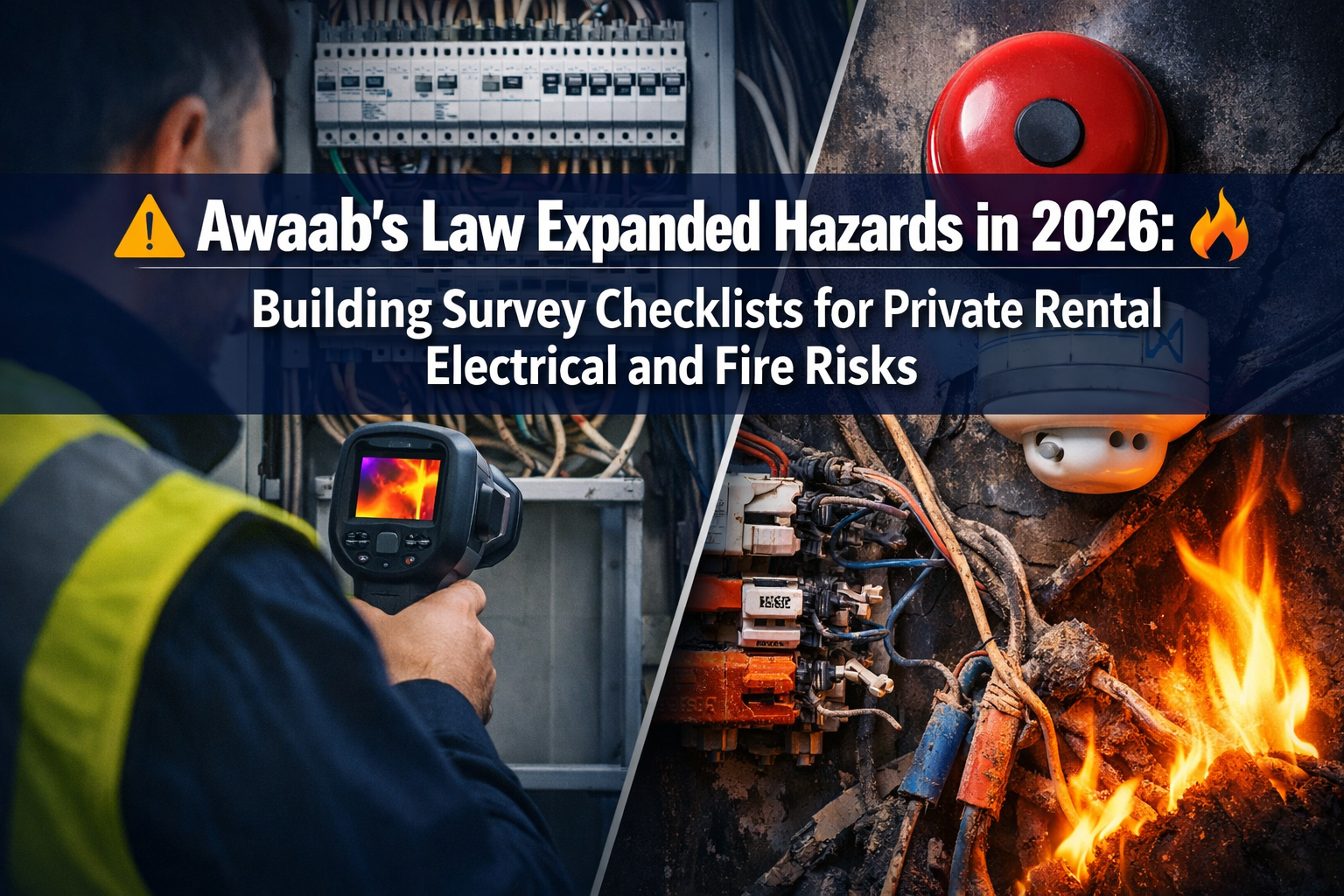
Understanding Awaab's Law Expanded Hazards in 2026: Building Survey Checklists for Private Rental Electrical and Fire Risks is now essential for property professionals conducting assessments in the private rented sector (PRS). The Phase 2 expansion introduces strict investigation and remediation timelines that demand updated surveyor protocols and comprehensive hazard identification procedures.
Key Takeaways
- ⚡ Six new hazard categories join damp and mould in 2026: electrical hazards, fire risks, excess cold, excess heat, structural collapse, and hygiene/food safety concerns
- ⏰ 24-hour emergency deadlines require landlords to investigate and remediate confirmed emergency hazards or provide alternative accommodation
- 📋 Updated building survey checklists must now identify electrical defects, fire safety failures, and temperature extremes during property assessments
- 📝 Written investigation summaries must be provided to tenants within 3 working days of hazard assessment completion
- ⚖️ Unlimited fines and enforcement orders await non-compliant landlords, plus potential compensation claims from affected tenants
What Are the Expanded Hazards Under Awaab's Law in 2026?
The 2026 Phase 2 expansion of Awaab's Law represents a fundamental shift in rental property safety obligations. Originally focused exclusively on damp and mould hazards, the legislation now encompasses six additional hazard categories that surveyors must identify during property assessments [2].
The Six New Hazard Categories
Electrical Hazards include exposed wiring, defective consumer units, inadequate earthing systems, and other electrical defects presenting significant risk of shock, burns, or fire [3]. These hazards frequently appear in older rental properties where electrical installations haven't been updated to current standards.
Fire Risks cover inadequate fire detection systems, blocked escape routes, absence of fire doors, and combustible materials in common areas. The expansion requires person-centred fire risk assessments through direct conversation with residents to understand individual evacuation needs [2].
Excess Cold addresses inadequate heating systems, poor insulation, and structural defects causing dangerously low indoor temperatures. This category particularly affects vulnerable tenants during winter months.
Excess Heat encompasses properties lacking adequate ventilation, excessive solar gain, and structural issues creating dangerously high temperatures—an increasingly relevant concern as climate patterns shift.
Structural Collapse and Explosions include serious structural defects, gas leaks, and conditions that could lead to catastrophic failure of building elements.
Domestic and Personal Hygiene, Sanitation, and Food Safety cover inadequate bathroom facilities, sewage issues, and conditions preventing proper food storage and preparation.
Why These Hazards Matter for Surveyors
The expanded scope fundamentally changes how building surveys must be conducted. Traditional RICS building surveys now require enhanced protocols specifically targeting these hazard categories [5]. Surveyors must adopt new assessment methodologies that go beyond visual inspection to include thermal imaging, electrical testing recommendations, and fire safety evaluations.
The Housing Health and Safety Rating System (HHSRS) provides the framework for hazard assessment, with Phase 3 planned for 2027 to extend regulations to all remaining HHSRS hazards except overcrowding [4].
Building Survey Checklists for Electrical and Fire Hazards in Private Rentals
Implementing Awaab's Law Expanded Hazards in 2026: Building Survey Checklists for Private Rental Electrical and Fire Risks requires systematic assessment protocols that identify potential dangers before they threaten tenant safety. Professional surveyors must now integrate specialized electrical and fire risk evaluation into standard property assessments.
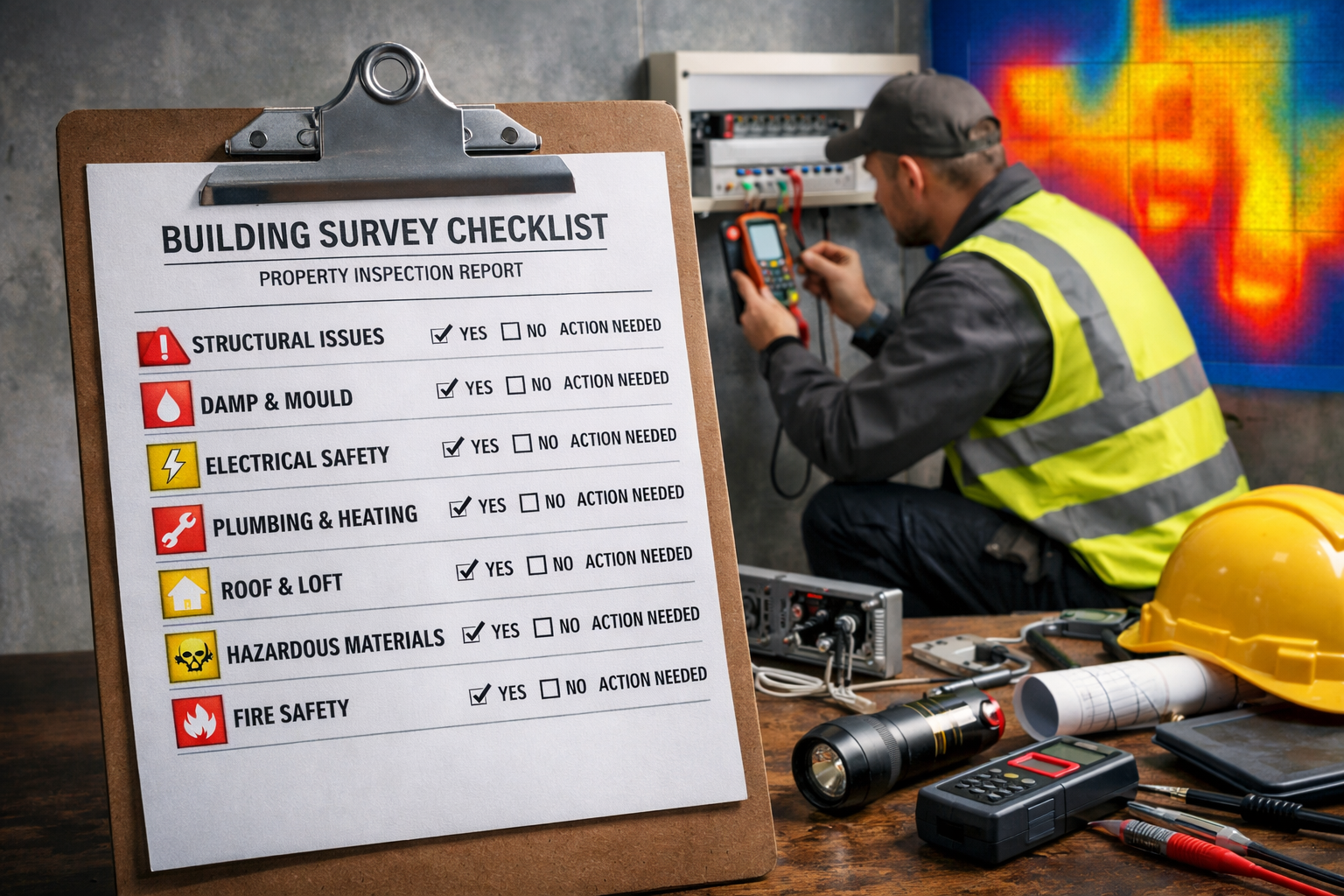
Electrical Hazard Assessment Checklist
Consumer Unit Inspection forms the foundation of electrical hazard assessment. Surveyors should document:
- Age and type of consumer unit (modern RCD-protected units vs. outdated fuse boxes)
- Presence and functionality of residual current devices (RCDs)
- Evidence of overloading or unauthorized modifications
- Labelling clarity and circuit identification
- Signs of overheating, burning, or melting components
Visible Wiring Conditions require careful documentation throughout the property:
- Exposed wiring in accessible areas
- Damaged cable insulation or protective conduits
- Extension leads used as permanent solutions
- Socket outlets showing signs of burning or loose connections
- Light fittings with exposed terminals or damaged components
Electrical Installation Age and Compliance indicators include:
- Date of last Electrical Installation Condition Report (EICR)
- Presence of outdated wiring systems (rubber, fabric-covered cables)
- Adequate earthing and bonding arrangements
- Appropriate circuit protection for wet areas (bathrooms, kitchens)
Professional structural surveys should always recommend a qualified electrician conduct a full EICR when electrical concerns are identified, as surveyors typically lack the specialist qualifications for definitive electrical safety certification.
Fire Risk Assessment Checklist
Fire Detection and Alarm Systems must be evaluated comprehensively:
✅ Smoke alarms present on every floor
✅ Alarms located in appropriate positions (hallways, landings)
✅ Functional testing capability and battery backup
✅ Interconnected alarm systems in larger properties
✅ Heat detectors in kitchens where appropriate
✅ Carbon monoxide detectors near combustion appliances
Escape Routes and Emergency Egress require detailed assessment:
- Clear, unobstructed escape routes from all habitable rooms
- Window opening mechanisms in upper floors (emergency egress)
- Fire doors present and functional (self-closing mechanisms intact)
- Emergency lighting in common areas of multi-unit buildings
- External escape routes free from obstacles
Fire Spread Prevention Measures include:
- Fire-resistant materials in appropriate locations
- Cavity barriers and fire stopping in concealed spaces
- Compartmentation integrity in converted properties
- Combustible material storage away from ignition sources
- Kitchen extraction systems properly maintained
Person-Centred Fire Risk Considerations represent a new requirement under the 2026 expansion. Surveyors should note any property features that might affect vulnerable residents' ability to evacuate, including:
- Accessibility challenges for mobility-impaired residents
- Complex escape routes requiring multiple direction changes
- Upper floor accommodations without secondary escape options
- Properties housing residents with sensory impairments
A comprehensive Level 3 RICS building survey provides the detailed assessment necessary to identify these hazards effectively.
Temperature Hazard Assessment
Excess Cold Evaluation should document:
- Heating system type, age, and adequacy for property size
- Insulation presence in lofts, walls, and floors
- Window condition and thermal performance
- Draught-proofing effectiveness
- Thermal bridging or cold spots indicating structural issues
Excess Heat Assessment includes:
- Ventilation adequacy (natural and mechanical)
- Solar gain management (shading, glazing type)
- Loft and roof space ventilation
- Thermal imaging revealing heat retention issues
Surveyors can recommend damp surveys when temperature extremes correlate with moisture problems, as these issues frequently occur together.
Compliance Timelines and Surveyor Responsibilities Under Awaab's Law 2026
The 2026 expansion establishes strict statutory deadlines that transform how quickly landlords must respond to identified hazards. Understanding these timelines is crucial for surveyors providing assessment services to rental property owners.
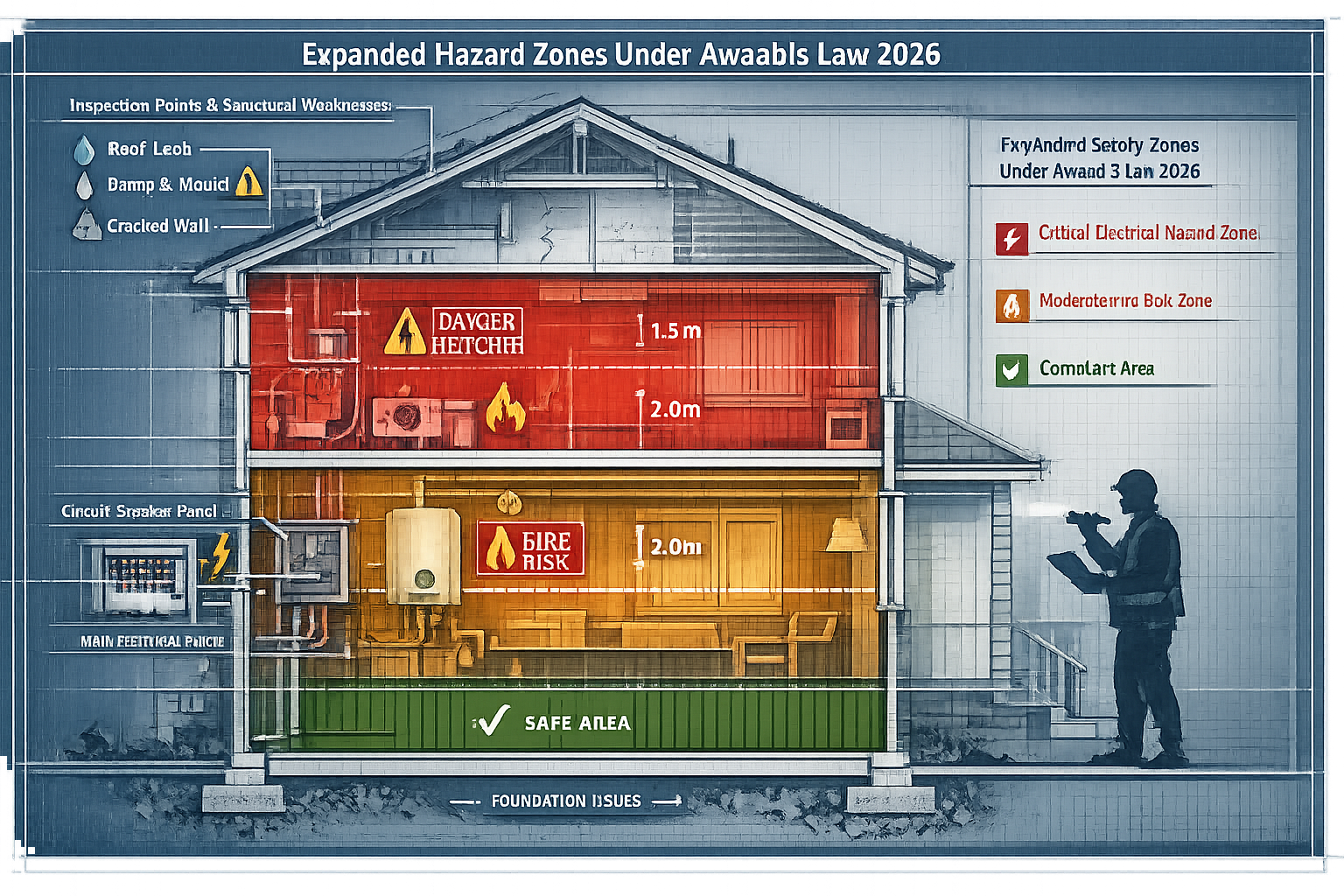
Emergency Hazard Response Timeline
24-Hour Investigation Requirement begins when a landlord forms a reasonable belief that an emergency hazard exists. This belief might arise from:
- Tenant reports of electrical burning smells or sparking
- Visible fire safety system failures
- Surveyor identification during routine inspection
- Third-party notifications from neighbors or emergency services
The investigation must be completed within 24 hours of this awareness, not from when the hazard first appeared [2].
24-Hour Remediation Deadline applies once an emergency hazard is confirmed. Landlords must either:
- Make the hazard safe within 24 hours, or
- Provide suitable alternative accommodation at their expense
Emergency hazards include situations presenting immediate risk of serious harm or death, such as exposed live electrical wiring, complete fire alarm system failure in multi-occupancy buildings, or structural elements at risk of imminent collapse [4].
Significant Hazard Response Timeline
10 Working Days for Investigation applies to significant hazards that don't meet the emergency threshold but still present considerable risk. These might include:
- Partial electrical system defects not immediately dangerous
- Missing smoke alarms in some areas
- Heating system failures during mild weather
- Moderate structural concerns
3 Working Days for Written Summary requires landlords to provide tenants with investigation findings within three working days of completing the assessment [2]. This summary must include:
- Description of the hazard identified
- Assessment of risk level
- Planned remediation approach
- Expected timeline for completion
5 Working Days to Commence Remediation means safety works must begin within five working days of investigation conclusion. For complex works requiring specialist contractors or planning permissions, commencement must occur no later than 12 weeks after investigation [4].
Surveyor Documentation Requirements
Professional surveyors conducting building surveys for rental properties must now provide:
Hazard Identification Reports clearly categorizing findings as:
- Emergency hazards (immediate action required)
- Significant hazards (10-day investigation timeline)
- Minor defects (standard maintenance)
Photographic Evidence documenting:
- Electrical defects with clear location identification
- Fire safety equipment conditions
- Temperature-related structural issues
- Comparative images showing hazard context
Remediation Recommendations specifying:
- Immediate temporary safety measures
- Required specialist assessments (EICR, fire risk assessment)
- Permanent remediation approaches
- Estimated urgency and cost implications
Tenant Communication Templates helping landlords meet the three-day written summary requirement with clear, accessible language explaining identified hazards.
Enforcement Consequences for Non-Compliance
Landlords failing to meet Awaab's Law timelines face severe penalties:
⚠️ Enforcement orders compelling specific actions within defined timeframes
💰 Unlimited fines with no statutory maximum penalty
📜 Compensation orders requiring payment to affected tenants
⚖️ Legal cost liability for enforcement proceedings
🏚️ Rent repayment orders if properties become uninhabitable due to unaddressed hazards [3]
These consequences make thorough surveyor assessment more valuable than ever, as early hazard identification allows landlords to address issues proactively before tenant complaints trigger enforcement action.
Implementing Enhanced Survey Protocols for 2026 Compliance
Successfully navigating Awaab's Law Expanded Hazards in 2026: Building Survey Checklists for Private Rental Electrical and Fire Risks requires surveyors to adopt enhanced assessment methodologies and documentation practices that exceed traditional survey standards.
Technology-Enhanced Hazard Detection
Thermal Imaging Cameras have become essential tools for identifying:
- Electrical hotspots indicating overloaded circuits or poor connections
- Heat loss patterns revealing excess cold hazards
- Thermal bridging and insulation deficiencies
- Hidden moisture issues related to temperature extremes
Modern thermal imaging provides objective evidence of temperature-related hazards that visual inspection alone cannot detect. This technology particularly benefits Level 2 homebuyer surveys where detailed investigation may be limited.
Electrical Testing Equipment allows preliminary assessment of:
- Socket outlet functionality and polarity
- RCD trip testing (where safe to perform)
- Voltage presence detection
- Earth continuity indicators
While surveyors should not attempt comprehensive electrical testing without appropriate qualifications, basic testing equipment helps identify obvious defects requiring specialist follow-up.
Moisture Meters and Humidity Sensors connect temperature hazards to damp conditions:
- Condensation risk assessment in cold properties
- Relative humidity measurements indicating ventilation inadequacy
- Material moisture content suggesting structural temperature issues
Specialist Referral Protocols
Surveyors must establish clear referral pathways to qualified specialists:
Qualified Electricians (NICEIC/NAPIT Registered) for:
- Electrical Installation Condition Reports (EICRs)
- Consumer unit replacement recommendations
- Remedial electrical works specifications
Fire Safety Engineers for:
- Comprehensive fire risk assessments
- Fire door certification and testing
- Complex fire safety system design
Heating Engineers (Gas Safe Registered) for:
- Boiler safety inspections
- Heating system adequacy assessments
- Carbon monoxide risk evaluation
Structural Engineers for:
- Serious structural defect assessment
- Load-bearing element evaluation
- Collapse risk quantification
Establishing relationships with these specialists enables surveyors to provide landlords with complete remediation pathways, not just hazard identification.
Survey Report Template Enhancements
Modern survey reports for rental properties should include:
Awaab's Law Compliance Section with:
- Explicit hazard categorization (emergency/significant/minor)
- Timeline requirements for each identified hazard
- Landlord legal obligations summary
- Tenant notification recommendations
Hazard Priority Matrix presenting:
- Risk level (high/medium/low)
- Urgency (immediate/10-day/routine)
- Estimated remediation cost
- Potential enforcement consequences if unaddressed
Photographic Appendix with:
- Annotated images highlighting specific defects
- Thermal imaging results with temperature scales
- Comparative images showing hazard context
- Location plans identifying hazard positions
Specialist Referral Recommendations including:
- Required specialist assessment types
- Suggested timeline for specialist engagement
- Typical specialist assessment costs
- Contact details for qualified professionals
Continuing Professional Development
Surveyors must maintain current knowledge through:
📚 Awaab's Law Guidance Review – Regular consultation of updated government guidance as implementation evolves
🎓 Specialist Training Courses – CPD in electrical hazard identification, fire risk assessment, and thermal imaging interpretation
🤝 Professional Network Development – Relationships with specialist contractors for referral and knowledge exchange
📊 Case Study Analysis – Learning from enforcement actions and compliance failures in the sector
The Royal Institution of Chartered Surveyors (RICS) continues developing specific guidance for surveyors working with Awaab's Law requirements, making ongoing professional development essential.
Client Communication Best Practices
Effective communication with landlord clients should:
✅ Explain Legal Context – Clearly outline Awaab's Law requirements and consequences
✅ Prioritize Actions – Present findings in order of urgency and legal timeline
✅ Quantify Costs – Provide realistic cost estimates for remediation works
✅ Offer Solutions – Suggest practical approaches to hazard remediation
✅ Document Advice – Maintain clear records of recommendations provided
This approach positions surveyors as compliance partners rather than simply problem identifiers, adding significant value to the surveyor-client relationship.
Preparing for Phase 3: Future Hazard Expansions in 2027
While 2026 focuses on electrical, fire, and temperature hazards, Phase 3 expansion in 2027 will extend Awaab's Law to all remaining Housing Health and Safety Rating System (HHSRS) hazards except overcrowding [4]. Forward-thinking surveyors should begin preparing assessment protocols for:
Asbestos Hazards requiring:
- Visual identification of potential asbestos-containing materials
- Referral protocols for asbestos surveys
- Understanding of asbestos management plans
Surveyors already conducting surveys for asbestos have a head start on this requirement.
Biocide and Chemical Hazards including:
- Lead paint identification in pre-1960s properties
- Chemical storage assessment in mixed-use buildings
- Pesticide and biocide residue concerns
Carbon Monoxide and Combustion Gas Hazards beyond basic detector presence:
- Ventilation adequacy for combustion appliances
- Flue and chimney condition assessment
- Combustion appliance positioning and clearances
Radon and Radiation Hazards particularly in:
- High-risk geographic areas
- Basement and ground floor accommodations
- Properties with specific geological characteristics
Developing comprehensive stock condition survey methodologies now will position surveyors advantageously when Phase 3 implementation begins.
Conclusion
Awaab's Law Expanded Hazards in 2026: Building Survey Checklists for Private Rental Electrical and Fire Risks represents the most significant shift in rental property safety obligations in decades. The expansion from damp and mould to encompass electrical hazards, fire risks, temperature extremes, and structural concerns creates new responsibilities for landlords and surveyors alike.
The legislation's strict timelines—24 hours for emergency hazards, 10 working days for significant hazards—demand proactive assessment and swift remediation. Surveyors must adopt enhanced protocols incorporating thermal imaging, electrical defect identification, and comprehensive fire risk evaluation to provide landlords with the detailed information necessary for compliance.
Actionable Next Steps
For Landlords:
- Commission comprehensive RICS building surveys for all rental properties before tenancy commencement
- Establish relationships with qualified electricians, fire safety specialists, and heating engineers
- Implement regular inspection schedules identifying hazards before tenant complaints arise
- Develop tenant communication protocols for hazard reporting and investigation updates
- Budget for remediation works addressing identified hazards within statutory timelines
For Surveyors:
- Update survey report templates to include Awaab's Law compliance sections
- Invest in thermal imaging equipment and electrical testing tools
- Develop specialist referral networks for comprehensive hazard assessment
- Pursue CPD in electrical hazard identification and fire risk assessment
- Review government guidance regularly as implementation evolves
For Property Professionals:
- Integrate Awaab's Law considerations into property acquisition due diligence
- Factor compliance costs into rental property investment analysis
- Advise clients on proactive hazard identification benefits
- Monitor enforcement actions and case law as the legislation matures
The tragic circumstances that prompted Awaab's Law remind us that property safety is not merely a compliance exercise—it protects vulnerable residents from preventable harm. By implementing robust assessment protocols and prioritizing hazard identification, surveyors play a crucial role in creating safer rental housing across the private rented sector.
The 2026 expansion is not the end of this legislative journey. With Phase 3 approaching in 2027, forward-thinking property professionals should view comprehensive hazard assessment as the new standard of practice, not an optional enhancement. Those who embrace these enhanced protocols now will be best positioned to serve clients effectively as rental property safety requirements continue to evolve.
References
[1] Awaabs Law 2026 Hazard Expansions Surveyor Protocols For Electrical Fire And Excess Heat Risks In Rentals – https://nottinghillsurveyors.com/blog/awaabs-law-2026-hazard-expansions-surveyor-protocols-for-electrical-fire-and-excess-heat-risks-in-rentals
[2] Awaabs Law Guidance For Social Landlords Timeframes For Repairs In The Social Rented Sector – https://www.gov.uk/government/publications/awaabs-law-guidance-for-social-landlords/awaabs-law-guidance-for-social-landlords-timeframes-for-repairs-in-the-social-rented-sector
[3] Awaabs Law Comes Into Force What Does It Mean For Construction – https://www.trowers.com/insights/2025/november/awaabs-law-comes-into-force-what-does-it-mean-for-construction
[4] Awaabs Law Is Here The Surveyors Guide For Compliance – https://www.surventrix.com/blog/awaabs-law-is-here-the-surveyors-guide-for-compliance
[5] Building Surveys And Awaabs Law 2026 Extensions Identifying Electrical Fire And Temperature Hazards In Prs Properties – https://nottinghillsurveyors.com/blog/building-surveys-and-awaabs-law-2026-extensions-identifying-electrical-fire-and-temperature-hazards-in-prs-properties
[6] Awaabs Law What Property Managers And Surveyors Must Know – https://www.howdengroup.com/uk-en/awaabs-law-what-property-managers-and-surveyors-must-know