

UK homeowners in flood-risk areas now face insurance premiums up to 400% higher than properties in low-risk zones, while the government commits £7.9 billion over ten years to protect homes from flooding. This dramatic shift has transformed how chartered surveyors approach property assessments, with Building Surveys for Flood-Resilient Properties: 2026 Protocols Amid Rising UK Insurance Premiums becoming essential knowledge for anyone purchasing, insuring, or maintaining properties in vulnerable locations. Modern RICS building surveys now prioritize drainage systems, flood barriers, and resilience features as core valuation factors rather than supplementary considerations.
The FloodReady action plan, published in October 2025, establishes comprehensive protocols through 2035 for building flood resilience across UK properties and infrastructure.[1] These protocols directly influence how surveyors conduct assessments, what buyers should expect from property inspections, and how insurance companies calculate premiums. Property Flood Resilience (PFR) measures have moved from optional upgrades to essential features that significantly impact property values and insurability.
Key Takeaways
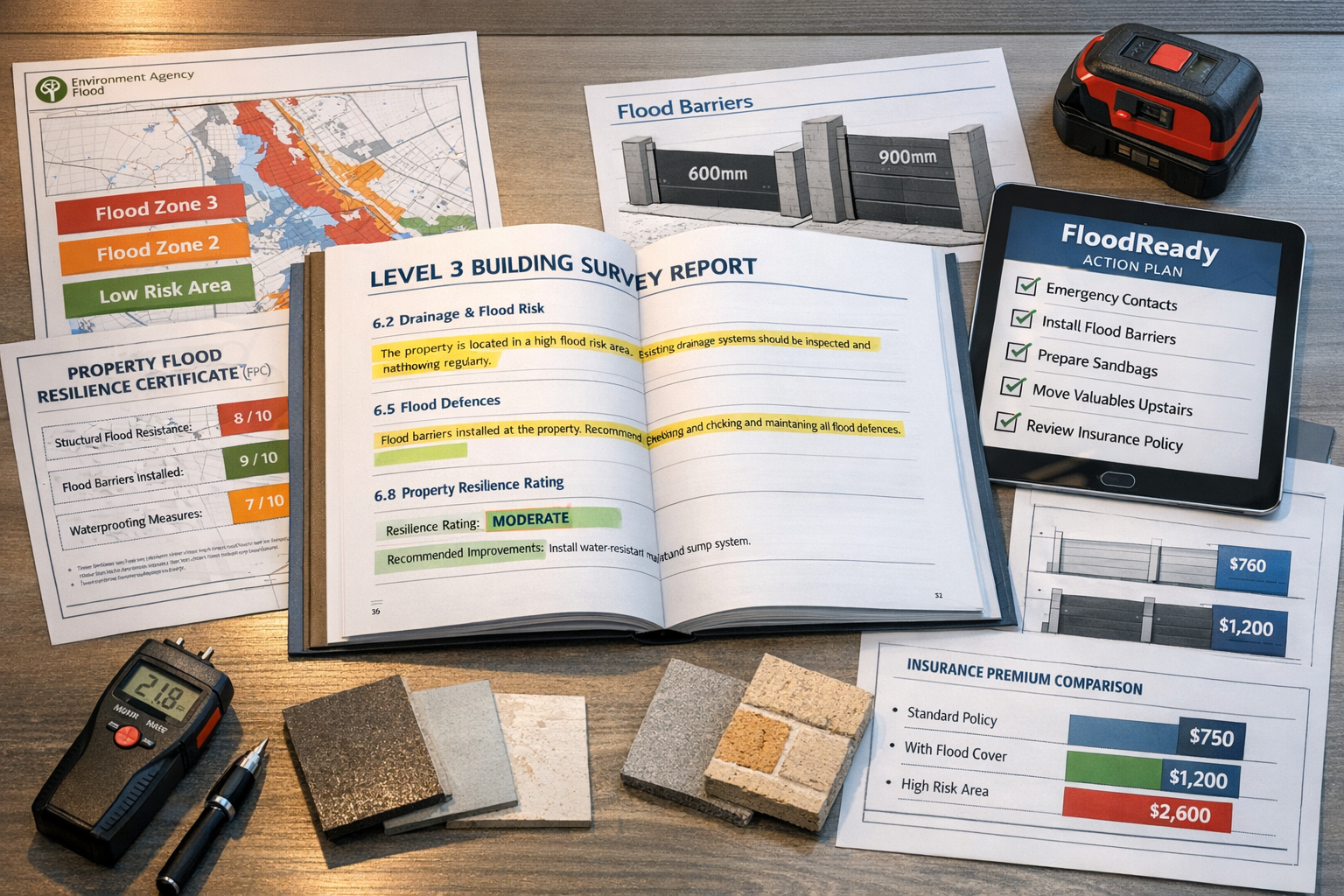
- Standard PFR survey heights now established at 600mm minimum with common practice at 900mm for enhanced protection[7]
- Comprehensive retrofit costs average below £1,200 per property for multiple resilience interventions including flood doors and moisture-resistant materials[1]
- Property Flood Resilience Certificates (FPCs) becoming standardized assessment tools across housing associations, insurers, and lenders[1]
- Level 3 surveys now incorporate detailed drainage analysis, flood defense evaluation, and resilience feature assessment as core components
- Insurance premium reductions available for properties with documented PFR installations and current flood resilience certifications
Understanding Building Surveys for Flood-Resilient Properties: 2026 Protocols Amid Rising UK Insurance Premiums
The landscape of property surveying has undergone fundamental transformation as flood events increase across the UK. Traditional building surveys focused primarily on structural integrity, damp issues, and general maintenance concerns. However, Building Surveys for Flood-Resilient Properties: 2026 Protocols Amid Rising UK Insurance Premiums require surveyors to evaluate properties through an entirely different lens—one that assesses both current flood defenses and potential for resilience improvements.
The FloodReady Framework
The FloodReady action plan establishes six core themes that guide property assessments:[1]
- Regulatory frameworks integration into planning and building standards
- Market standardization for PFR suppliers and installers
- Quality assurance protocols for resilience interventions
- Property certification systems (FPCs)
- Funding mechanisms including the £7.9 billion government investment
- Community engagement and awareness programs
These themes directly influence how chartered surveyors conduct Level 3 building surveys for properties in flood-risk areas. Surveyors must now evaluate whether properties comply with emerging standards, identify gaps in flood protection, and provide detailed recommendations for resilience improvements.
Core PFR Interventions in 2026 Surveys
Modern building surveys assess the presence and quality of standardized PFR interventions:[1]
External Defenses:
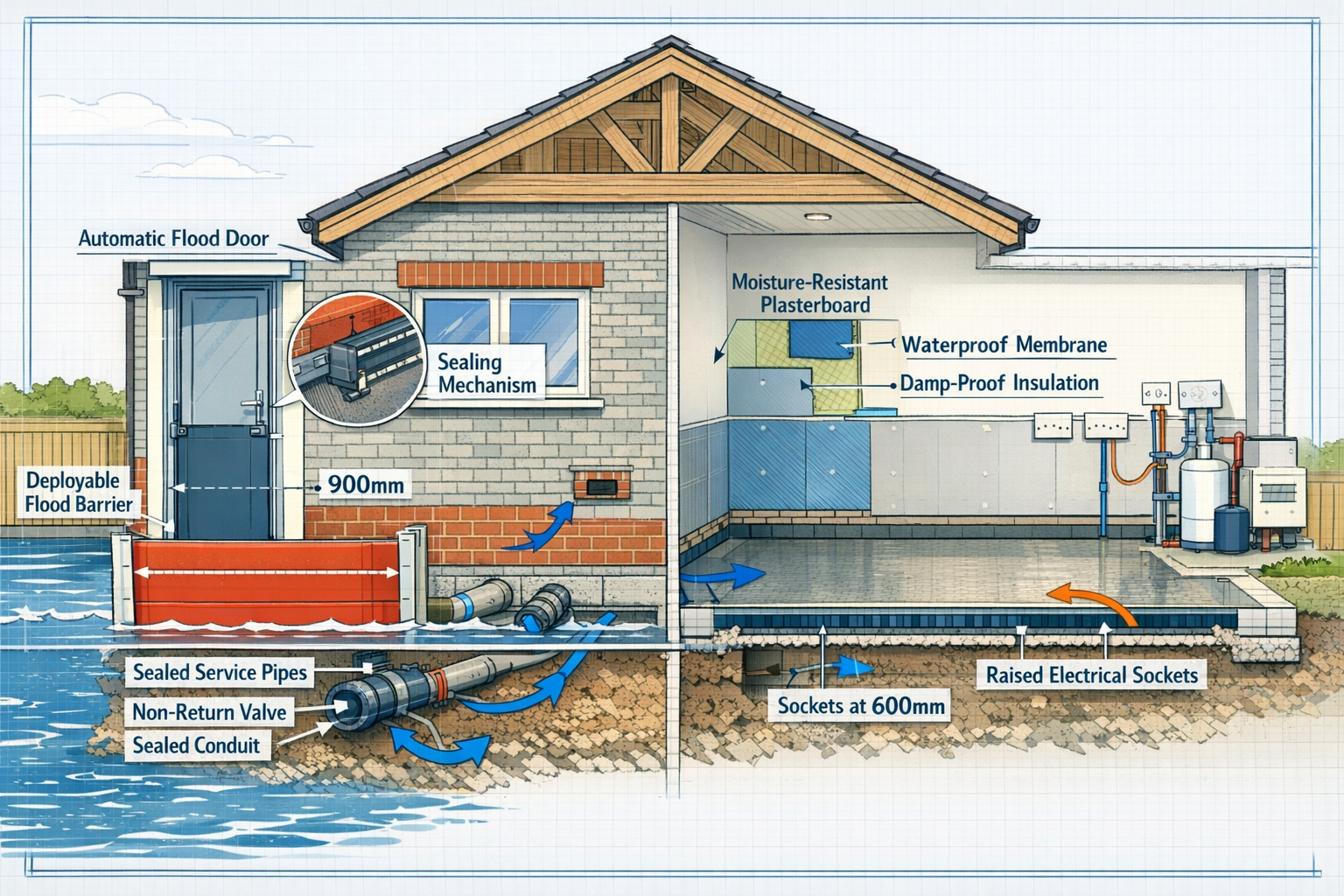
- 🚪 Flood doors and barriers (600-900mm height specifications)
- 🔒 Self-closing air brick covers
- 🚫 Non-return valves on drainage systems
- 🔐 Sealed service entry points for utilities
Internal Resilience Measures:
- 🧱 Moisture-resistant plasterboard on lower walls
- ⚡ Elevated electrical sockets above flood lines
- 🪵 Water-resistant flooring materials
- 💧 Enhanced drainage and pumping systems
Surveyors conducting comprehensive RICS home surveys must document the presence, condition, and effectiveness of these features. Properties lacking adequate flood resilience face valuation derating that reflects increased insurance costs and potential flood damage expenses.
How 2026 Protocols Transform Property Valuations and Insurance Costs
The connection between building survey findings and insurance premiums has never been more direct. Insurance companies now request detailed PFR assessments before issuing policies for flood-risk properties, and surveyors must provide evidence-based evaluations that insurers can use for premium calculations.
Valuation Derating for Flood-Risk Properties
Properties in flood-risk zones without adequate resilience measures face significant valuation reductions in 2026:
| Flood Risk Level | PFR Measures Present | Typical Valuation Impact | Insurance Premium Impact |
|---|---|---|---|
| High Risk (Flood Zone 3) | Comprehensive | -5% to -10% | Standard +20-30% |
| High Risk (Flood Zone 3) | Minimal/None | -15% to -25% | +200% to +400% |
| Medium Risk (Flood Zone 2) | Comprehensive | -2% to -5% | Standard +10-15% |
| Medium Risk (Flood Zone 2) | Minimal/None | -8% to -15% | +100% to +200% |
| Low Risk (Flood Zone 1) | Any level | Minimal impact | Standard rates |
These valuation adjustments reflect both the increased insurance costs buyers will face and the potential for flood damage that could require expensive repairs. Surveyors must clearly document these factors in their reports, helping buyers understand the true cost of property ownership in flood-prone areas.
Property Flood Resilience Certificates (FPCs)
The formalization of FPCs as standardized assessment tools represents a major shift in Building Surveys for Flood-Resilient Properties: 2026 Protocols Amid Rising UK Insurance Premiums.[1] These certificates provide:
✅ Detailed resilience ratings based on installed PFR measures
✅ Improvement pathway recommendations with cost estimates
✅ Insurance company recognition for premium calculations
✅ Standardized assessment criteria across surveyors and regions
✅ Property marketing advantages for resilient homes
Chartered surveyors now incorporate FPC assessments into comprehensive building survey reports, providing buyers with clear documentation of flood resilience levels. Properties with current FPCs demonstrating comprehensive PFR measures command premium prices compared to similar properties without documented flood protection.
The £1,200 Resilience Investment Threshold
Government pilot programs demonstrate that comprehensive PFR installations average below £1,200 per property.[1] This relatively modest investment can:
- Reduce insurance premiums by 30-50% annually
- Prevent property devaluation of 10-20% in flood-risk areas
- Minimize flood damage costs by 70-80% during flood events
- Accelerate post-flood recovery from months to weeks
Surveyors guide buyers through cost-benefit analyses, demonstrating how PFR investments often pay for themselves within 2-3 years through insurance savings alone. Specific defect reports can detail exact PFR installation requirements and projected costs for properties requiring resilience upgrades.
Government Investment and Emerging Standards for Flood-Resilient Properties
The UK government's commitment of £7.9 billion over ten years for flood protection drives standardization across the property sector.[1] This investment funds not only large-scale flood defenses but also individual property resilience programs that directly impact building survey protocols.
Schools PFR Program: A Model for Residential Standards
The Department for Education's £57-68 million schools PFR program (2026-2030) establishes procurement and installation standards that influence residential property assessments.[3] Regional contracts covering approximately five areas target schools in high-risk flood zones, with installations required to meet rigorous quality and performance standards.
These institutional standards inform residential PFR expectations, with surveyors increasingly applying similar quality benchmarks when evaluating private properties. The program demonstrates government commitment to flood resilience as a fundamental property requirement rather than optional enhancement.
UKRI Research Initiative: Innovation in Flood Resilience
The Engineering and Physical Sciences Research Council's £2.5 million NetworkPlus research initiative (announced February 2026) brings together engineers, environmental scientists, and social scientists to address PFR adoption challenges.[6] This interdisciplinary approach generates innovation roadmaps that influence:
- New PFR technologies and installation methods
- Cost reduction strategies for widespread adoption
- Performance monitoring systems for installed measures
- Integration protocols with other building improvements
Surveyors conducting Building Surveys for Flood-Resilient Properties: 2026 Protocols Amid Rising UK Insurance Premiums must stay current with emerging technologies and standards developed through this research network. Properties incorporating cutting-edge PFR solutions may qualify for enhanced insurance terms and valuation premiums.

Integration with Building Regulations and Planning
Government work to strengthen PFR into regulatory frameworks, building codes, and planning systems ensures new homes and businesses are inherently resilient to flooding.[1] This regulatory integration affects building surveys in several ways:
For New Construction:
- Surveyors verify PFR compliance in new-build assessments
- Commercial building surveys must evaluate flood resilience in business properties
- Planning approval documentation includes PFR specifications
For Retrofit Projects:
- Flood resilience considerations integrate with energy efficiency upgrades
- Damp surveys now assess flood-related moisture risks
- Building safety improvements incorporate flood protection measures
Standard Survey Heights and Protection Levels
Government guidelines establish 600mm (2 feet) as the safe water entry resistance height, though many flood-risk buildings achieve protection at approximately 900mm (3 feet).[7] Surveyors must measure and document actual protection heights, comparing them to:
- Historical flood levels in the property's location
- Environment Agency flood depth predictions for various scenarios
- Insurance company minimum requirements for coverage
- Neighboring property protection levels for context
Properties protected to only 600mm in areas with historical flooding above that level receive negative survey comments and valuation adjustments. The 900mm standard increasingly represents best practice for comprehensive protection.
Conducting Comprehensive Flood-Resilient Property Surveys in 2026
Modern building surveys for flood-risk properties require specialized knowledge and systematic evaluation protocols. Chartered surveyors must assess both existing flood defenses and opportunities for resilience improvements, providing buyers with actionable intelligence for property decisions.
Enhanced Drainage System Evaluation
Drainage assessment has evolved from basic functionality checks to comprehensive flood resilience evaluation. Surveyors now examine:
Surface Water Management:
- 🌊 Property grading and water flow patterns
- 🚰 Gutter and downspout capacity and condition
- 💧 Surface drainage systems and soakaways
- 🏞️ Landscape features affecting water accumulation
Subsurface Drainage:
- 🔍 Inspection of underground drainage networks
- 🚫 Non-return valve presence and functionality
- 🔧 Connection points and potential flood entry routes
- 📊 Drainage capacity relative to flood risk levels
Properties with inadequate drainage receive detailed recommendations for improvements, with cost estimates based on current PFR installation standards. Roof surveys incorporate water management assessments, as roof drainage significantly impacts overall flood resilience.
Flood Barrier and Defense Assessment
Surveyors evaluate installed flood defenses against standardized criteria:
Physical Barriers:
- Flood doors: seal quality, height specifications, ease of deployment
- Temporary barriers: storage, installation time, effectiveness ratings
- Permanent defenses: walls, berms, landscaping features
- Access points: garage doors, basement entries, service areas
Automated Systems:
- Self-closing air bricks: functionality testing, maintenance condition
- Automatic flood gates: sensor operation, power backup systems
- Pumping systems: capacity, redundancy, maintenance history
The survey report documents whether installed measures meet the 600mm minimum standard or achieve the 900mm best practice level, with clear recommendations for upgrades where deficiencies exist.
Moisture-Resistant Materials and Internal Resilience
Internal resilience measures minimize damage and accelerate recovery when flooding occurs. Surveyors assess:
Wall and Floor Materials:
- Moisture-resistant plasterboard installation on lower walls
- Water-resistant flooring (tiles, sealed concrete, specialized products)
- Skirting boards and trim using water-tolerant materials
- Paint and sealant products designed for flood resilience
Electrical and Utility Protection:
- Socket heights relative to flood risk levels
- Consumer unit and meter positioning
- Service entry point sealing and protection
- Backup power systems for critical equipment
Properties lacking internal resilience measures face longer recovery times and higher damage costs during flood events. Surveyors quantify these risks, helping buyers understand the full implications of purchasing properties without adequate internal protection.
Documentation and Certification Requirements
Comprehensive Building Surveys for Flood-Resilient Properties: 2026 Protocols Amid Rising UK Insurance Premiums include detailed documentation:
📋 Survey Report Sections:
- Flood risk assessment and historical flood data
- Existing PFR measures inventory and condition
- Compliance with current standards (600mm/900mm)
- Gaps and deficiencies in flood protection
- Recommended improvements with cost estimates
- Insurance implications and premium projections
- Property Flood Resilience Certificate status
This documentation supports buyers in negotiating purchase prices, planning renovation budgets, and securing appropriate insurance coverage. Surveyors increasingly coordinate with insurance providers, sharing survey findings that directly influence policy terms and premiums.
Insurance Strategies and Buyer Guidance for Flood-Risk Properties
Chartered surveyors play a crucial advisory role beyond technical property assessment. Buyers purchasing flood-risk properties need strategic guidance on insurance, financing, and long-term property management.
Navigating Insurance Premium Negotiations
Survey findings directly impact insurance negotiations. Surveyors help buyers by:
Providing Evidence-Based Documentation:
- Detailed PFR measure inventories for insurer review
- Professional photographs of flood defenses and resilience features
- Compliance certifications and installation records
- Maintenance history and upgrade timelines
Quantifying Risk Reduction:
- Calculating flood damage probability with existing measures
- Demonstrating effectiveness of installed PFR interventions
- Comparing property resilience to neighborhood standards
- Projecting recovery times and damage costs for various scenarios
Properties with comprehensive PFR measures and current FPCs often qualify for specialized insurance products with significantly lower premiums than standard flood-risk policies. Surveyors connect buyers with insurers who recognize and reward flood resilience investments.
Valuation Negotiation Strategies
Survey findings provide leverage for purchase price negotiations:
For Properties Lacking PFR Measures:
- Request price reduction equal to 1.5-2x the cost of required PFR installations
- Factor in 3-5 years of elevated insurance premiums
- Account for potential flood damage during installation delay period
- Consider opportunity cost of capital invested in resilience improvements
For Properties with Existing PFR:
- Verify installation quality and standard compliance
- Confirm maintenance records and warranty coverage
- Assess whether measures meet evolving 2026 standards
- Evaluate upgrade needs for optimal insurance terms
Buyers armed with detailed survey findings and cost projections negotiate from positions of knowledge rather than uncertainty. Choosing the right property survey becomes critical for flood-risk properties where Level 3 comprehensive surveys provide essential information that simpler assessments miss.
Long-Term Property Management Planning
Surveyors guide buyers in developing long-term flood resilience strategies:
Immediate Actions (0-6 Months):
- Install critical PFR measures identified in survey
- Obtain Property Flood Resilience Certificate
- Secure appropriate insurance coverage
- Establish maintenance protocols for flood defenses
Medium-Term Improvements (6-24 Months):
- Upgrade to 900mm protection standard if currently at 600mm
- Integrate PFR with other renovations and improvements
- Enhance drainage and water management systems
- Join community flood action groups and warning systems
Long-Term Resilience (2-10 Years):
- Monitor emerging PFR technologies and standards
- Participate in government-funded resilience programs
- Maintain and upgrade flood defenses as needed
- Document all improvements for future property sales
This strategic approach transforms flood-risk properties from liabilities into manageable assets with appropriate protections and insurance coverage.
Future Outlook: Flood Resilience as Standard Practice
Building Surveys for Flood-Resilient Properties: 2026 Protocols Amid Rising UK Insurance Premiums represent the beginning of a fundamental shift in UK property standards. As climate change increases flood frequency and severity, the protocols established in 2026 will become baseline expectations rather than specialized assessments.
Market Transformation Through 2035
The FloodReady action plan's ten-year framework through 2035 will progressively normalize flood resilience across the property market:[1]
2026-2028: Foundation Phase
- PFR standards formalized in building regulations
- FPC adoption accelerates across housing associations and insurers
- Government funding drives widespread installation programs
- Surveyor training and certification programs expand
2029-2032: Integration Phase
- New construction includes PFR as standard features
- Retrofit programs reach majority of high-risk properties
- Insurance products differentiate based on resilience levels
- Property valuations fully incorporate flood resilience factors
2033-2035: Maturity Phase
- PFR measures become universal expectations in flood-risk areas
- Advanced technologies and materials reduce installation costs
- Comprehensive flood resilience data available for all properties
- Market penalties severe for properties lacking adequate protection
Professional Development for Surveyors
Chartered surveyors must continuously update their knowledge and skills to meet evolving standards. Professional development priorities include:
- Technical training on new PFR technologies and installation methods
- Regulatory updates as building codes incorporate flood resilience requirements
- Insurance industry collaboration to understand underwriting criteria
- Environmental science fundamentals for flood risk assessment
- Cost estimation skills for PFR installation and maintenance
The UKRI research initiative and professional organizations provide ongoing education resources, ensuring surveyors maintain expertise in this rapidly evolving field.[6]
Technology Integration in Flood-Resilient Surveys
Emerging technologies enhance survey accuracy and efficiency:
Digital Assessment Tools:
- 📱 Mobile apps for standardized PFR measure documentation
- 🎥 Drone surveys for drainage pattern analysis
- 📊 3D modeling for flood scenario visualization
- 💾 Cloud-based data sharing with insurers and buyers
Predictive Analytics:
- AI-powered flood risk modeling
- Historical data integration for property-specific predictions
- Climate change scenario planning
- Cost-benefit optimization for PFR investments
These technologies enable surveyors to provide increasingly sophisticated analyses, helping buyers make informed decisions about flood-risk properties with confidence in their long-term resilience and insurability.
Conclusion
Building Surveys for Flood-Resilient Properties: 2026 Protocols Amid Rising UK Insurance Premiums have transformed property assessment from routine structural evaluation to comprehensive flood resilience analysis. With insurance premiums in flood-risk areas increasing by 200-400% for properties lacking adequate protection, and government investment of £7.9 billion driving standardization of PFR measures, buyers and homeowners must prioritize flood resilience in property decisions.
The establishment of standardized protocols—including 600mm minimum protection heights, comprehensive PFR intervention checklists, and Property Flood Resilience Certificates—provides clear frameworks for property assessment and improvement. Retrofit costs averaging below £1,200 per property make comprehensive flood resilience achievable for most homeowners, with insurance premium savings often recovering investments within 2-3 years.
Actionable Next Steps
For Property Buyers:
- Commission a comprehensive Level 3 RICS building survey for any property in flood-risk zones
- Request detailed PFR assessment and Property Flood Resilience Certificate status
- Obtain insurance quotes reflecting survey findings before finalizing purchases
- Budget for PFR installations if properties lack adequate flood defenses
- Negotiate purchase prices accounting for required resilience improvements
For Current Homeowners:
- Arrange professional flood resilience assessment of existing properties
- Prioritize PFR installations meeting 900mm best practice standards
- Obtain Property Flood Resilience Certificate to reduce insurance premiums
- Maintain detailed records of all flood defense installations and upgrades
- Review insurance policies annually as PFR measures improve property resilience
For Property Professionals:
- Update survey protocols to incorporate 2026 FloodReady standards
- Develop relationships with PFR specialists and insurance providers
- Invest in professional development for flood resilience assessment
- Implement digital tools for standardized PFR documentation
- Educate clients on long-term benefits of comprehensive flood resilience
The convergence of climate change, insurance market pressures, and government investment in flood resilience creates both challenges and opportunities in the UK property market. Properties with comprehensive flood protection will command premium valuations and enjoy affordable insurance, while those lacking adequate resilience face increasing market penalties. Professional building surveys incorporating 2026 protocols provide the essential intelligence buyers need to navigate this transformed landscape successfully.
References
[1] Floodready An Action Plan To Build The Resilience Of People And Properties – https://www.gov.uk/government/publications/floodproof-an-action-plan-to-build-resilience/floodready-an-action-plan-to-build-the-resilience-of-people-and-properties
[2] Flood And Coastal Erosion Risk Management Funding Policy Guidance – https://www.gov.uk/government/publications/flood-and-coastal-erosion-risk-management-funding-policy-guidance/flood-and-coastal-erosion-risk-management-funding-policy-guidance
[3] find-tender.service.gov.uk – https://www.find-tender.service.gov.uk/Notice/006106-2026/PDF
[4] Property Flood Resilience – https://rabconsultants.co.uk/property-flood-resilience/
[5] Flood Ready An Action Plan To Build The Resilience Of People And Properties – https://www.housing.org.uk/resources/flood-ready-an-action-plan-to-build-the-resilience-of-people-and-properties/
[6] Networkplus In Property Flood Resilience – https://www.ukri.org/opportunity/networkplus-in-property-flood-resilience/
[7] Ft Q R38 Property Flood Resilience Pfr Booklet Download Version – https://thefloodhub.co.uk/wp-content/uploads/2021/05/FT-Q-R38-Property-Flood-Resilience-PFR-booklet-DOWNLOAD-VERSION.pdf
[8] Flood Funding Reform 2026 The New Fcerm Guidance Explained – https://www.unda.co.uk/news/flood-funding-reform-2026-the-new-fcerm-guidance-explained/