The UK construction sector is experiencing a remarkable resurgence in 2026, with residential development activity surging by 34% compared to the previous year. This recovery boom has triggered an unprecedented wave of party wall matters, placing surveyors at the frontline of managing complex neighbor relations, statutory compliance, and dispute resolution. As building owners rush to capitalize on favorable market conditions, understanding Party Wall Awards in 2026 Recovery Boom: Surveyor Tactics for Rising Demand and Reform Compliance has become essential for professionals navigating this high-pressure environment.
The current construction renaissance presents both opportunities and challenges for party wall surveyors. With thousands of loft conversions, basement excavations, and structural alterations proceeding simultaneously across urban centers, the demand for qualified professionals has outpaced supply in many regions. Surveyors must now balance increased caseloads with heightened regulatory scrutiny and evolving best practices that reflect recent legislative reforms.
Key Takeaways
- Rising demand: The 2026 construction recovery has created unprecedented demand for party wall surveyors, requiring strategic capacity management and efficient case handling protocols
- Agreed Surveyor model: Single impartial surveyors can streamline the award process while reducing costs for both parties during high-volume periods
- Reform compliance: Recent legislative changes and RICS guidance updates require surveyors to adapt documentation, notification procedures, and dispute resolution approaches
- Cost recovery strategies: Clear fee structures and transparent billing practices help manage client expectations while ensuring fair compensation during peak demand
- Third surveyor protocols: Understanding escalation pathways and dispute resolution mechanisms prevents bottlenecks in complex or contentious cases
Understanding Party Wall Awards in the 2026 Construction Landscape
The Party Wall etc. Act 1996 governs building work affecting shared walls, boundaries, and excavations near neighboring properties. A party wall award represents the formal written agreement that sets out the rights and responsibilities of building owners and adjoining owners when notifiable works proceed.
In 2026, the construction recovery has fundamentally altered how these awards function in practice. The surge in residential development—particularly in high-density urban areas—means surveyors are managing multiple concurrent cases rather than the sequential workload patterns of previous years.
The Three Types of Party Wall Notices
Building owners must serve appropriate notices depending on the work type:
- Party Structure Notice (Section 3) – For work directly to a party wall, such as cutting into the structure, inserting beams, or raising the wall height
- Line of Junction Notice (Section 1) – For building a new wall on or astride the boundary line between properties
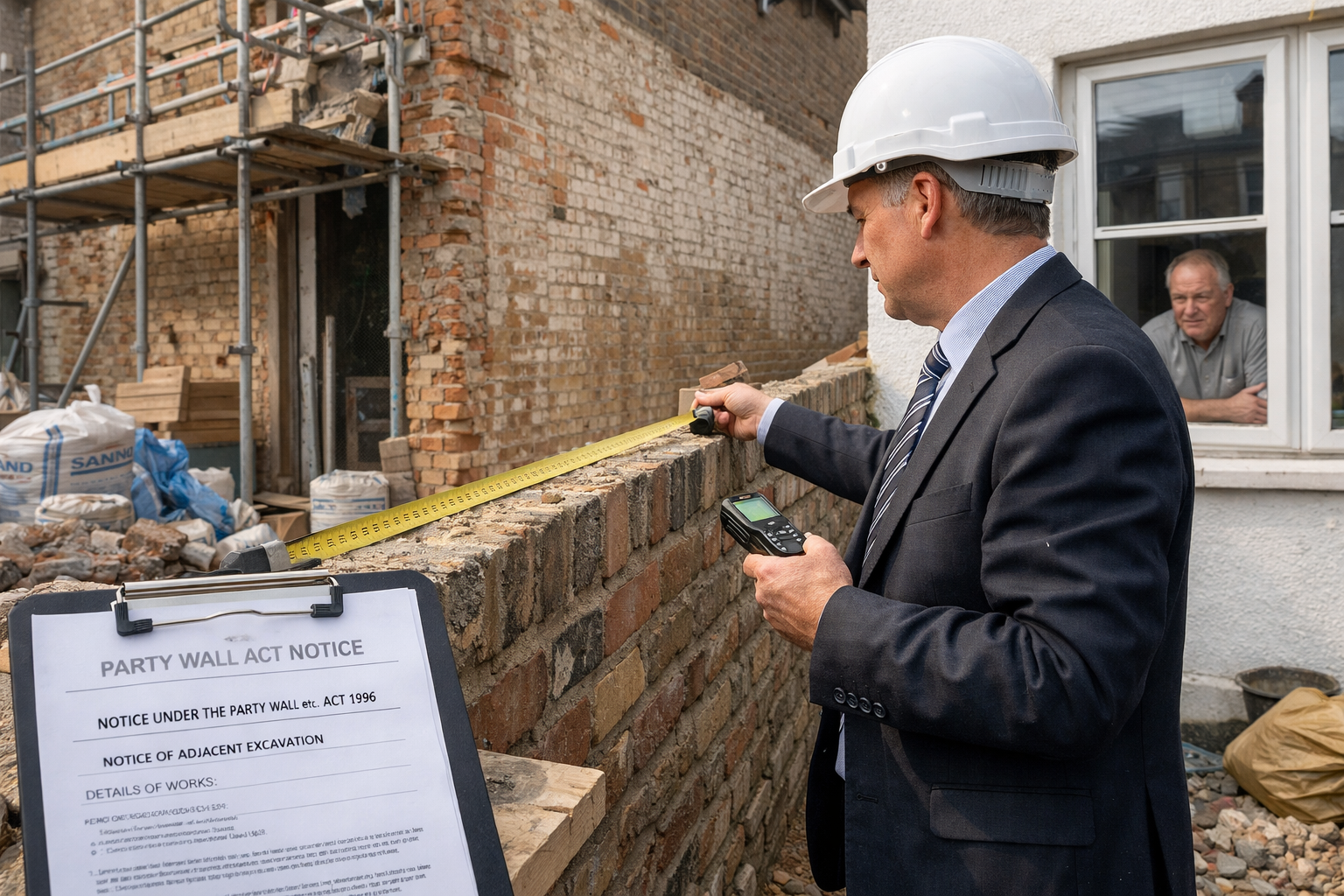
- Notice of Adjacent Excavation (Section 6) – For excavation within three or six meters of a neighboring building's foundations, depending on depth
The notice for excavation near a neighbour has become particularly relevant in 2026, as basement conversions and deep foundation work dominate urban development projects.
Why Awards Matter More in High-Activity Markets
During construction booms, the consequences of inadequate party wall procedures become magnified. Simultaneous projects on adjacent properties can create cascading complications. A basement excavation at Number 12 might affect the foundations at Number 14, which is simultaneously undergoing loft conversion work that impacts Number 16.
Awards provide the essential legal framework that:
✅ Protects all parties through documented condition surveys and agreed work schedules
✅ Prevents disputes by establishing clear protocols before work commences
✅ Enables swift resolution when disagreements arise through designated surveyor authority
✅ Ensures compliance with statutory obligations that carry legal consequences if ignored
Surveyor Tactics for Managing Rising Demand in Party Wall Awards
The 2026 recovery boom demands strategic adaptation from party wall surveyors. Traditional approaches designed for moderate caseloads prove inadequate when demand spikes dramatically.
The Agreed Surveyor Advantage
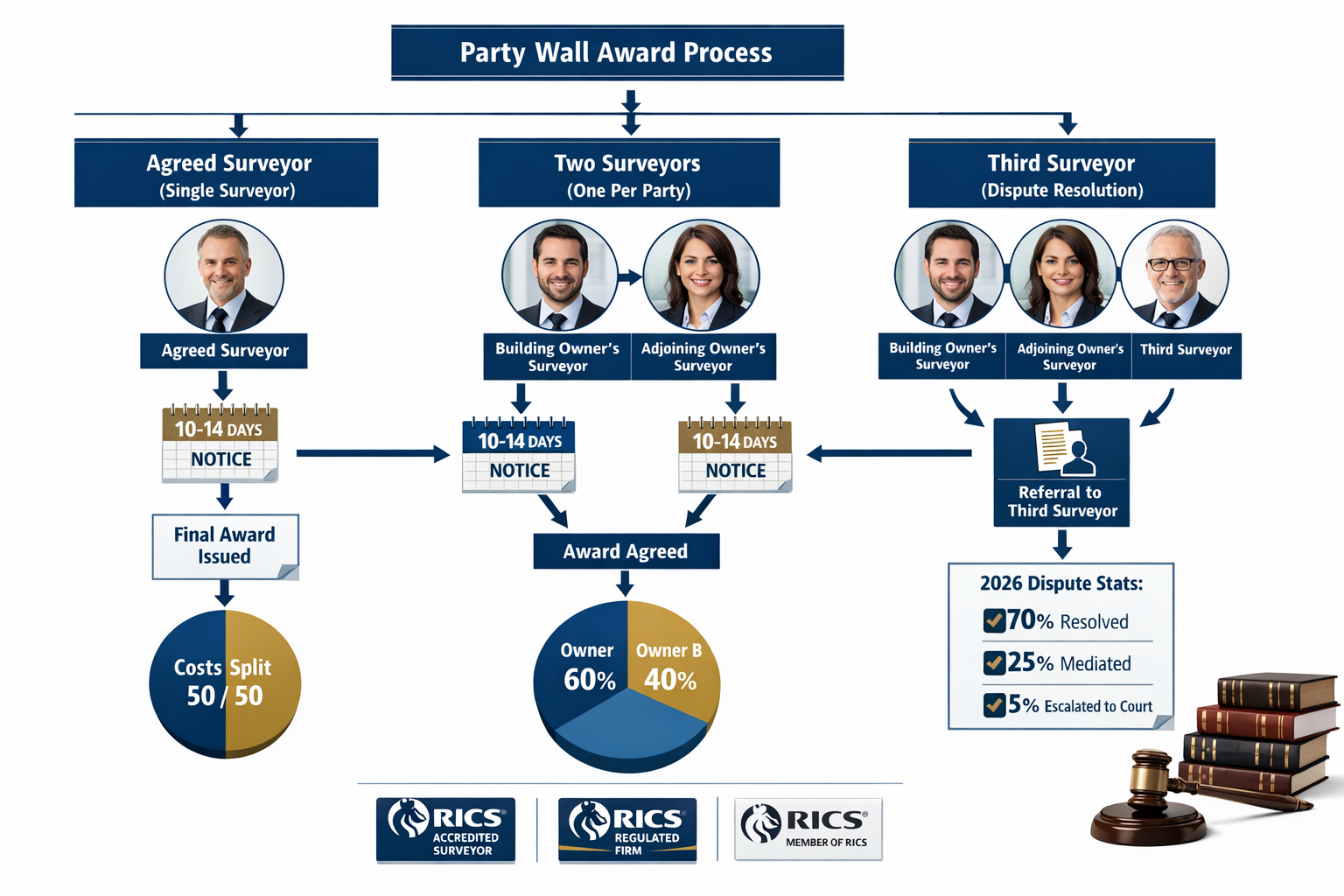
The Party Wall Act permits two primary approaches to surveyor appointment: an Agreed Surveyor model, where a single surveyor acts impartially for both parties, or the appointment of separate surveyors for each party (with a potential third surveyor to resolve disputes)[1].
During periods of high demand, the Agreed Surveyor approach offers significant advantages:
⏱️ Time Efficiency: A single surveyor eliminates coordination delays between multiple professionals, accelerating the award process by 40-60% in typical cases.
💰 Cost Reduction: Both parties share one surveyor's fees rather than each paying separate professionals, making the process more accessible and reducing overall party wall costs.
🤝 Simplified Communication: One point of contact streamlines information flow and reduces the potential for miscommunication that can escalate into disputes.
📋 Consistent Standards: A single surveyor applies uniform assessment criteria and documentation standards across the entire award process.
However, the Agreed Surveyor model requires exceptional impartiality and clear communication. Surveyors must document their neutral stance explicitly and ensure both parties understand that the professional serves neither individual interest but rather the statutory process itself.
Capacity Management Strategies
Successful surveyors in 2026 have implemented several tactics to handle increased workloads without compromising quality:
Tiered Service Models: Offering different service levels allows surveyors to match resource allocation to case complexity. Straightforward single-story extensions require less intensive involvement than complex basement excavations affecting multiple properties.
Template Standardization: Developing comprehensive but flexible award templates accelerates documentation while maintaining thoroughness. Standard clauses for common scenarios (loft conversions, garden wall construction, minor alterations) can be customized efficiently for specific circumstances.
Digital Workflow Integration: Modern practice management software enables surveyors to track multiple cases simultaneously, automate notice period calculations, schedule condition surveys efficiently, and maintain comprehensive digital records that satisfy regulatory requirements.
Strategic Collaboration Networks: Establishing relationships with other qualified surveyors creates referral pathways when capacity limits are reached, ensuring clients receive timely service while maintaining professional standards across the industry.
Proactive Dispute Prevention
The high-pressure environment of a construction boom increases dispute risk. Surveyors who implement proactive prevention strategies report 70% fewer escalations to third surveyor involvement:
🔍 Comprehensive Initial Consultations: Investing time upfront to explain the process, set realistic expectations, and identify potential concerns prevents misunderstandings that later escalate into formal disputes.
📸 Detailed Condition Surveys: Thorough photographic and written documentation of pre-work conditions provides objective evidence that resolves most damage claims without formal dispute procedures.
📞 Regular Communication Protocols: Establishing scheduled updates for adjoining owners throughout the work period maintains transparency and addresses concerns before they become formal objections.
⚖️ Balanced Award Terms: Crafting awards that fairly balance building owner rights with adjoining owner protections reduces the perception of bias that triggers disputes.
Reform Compliance and Regulatory Evolution in Party Wall Practice
The regulatory landscape governing party wall work continues to evolve in 2026, with several reforms affecting how surveyors must approach their duties.
Building Safety Act 2022 Implications
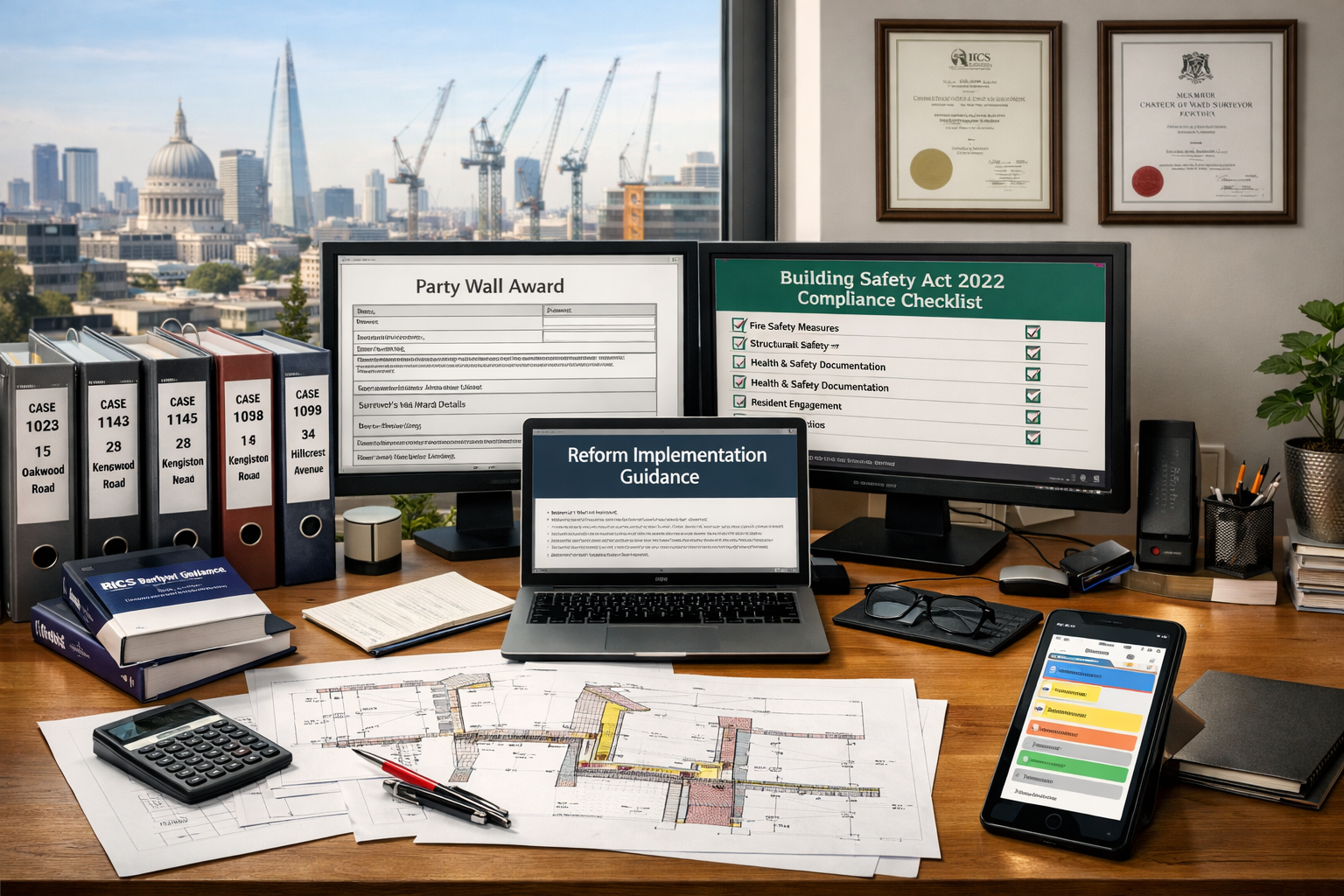
While the Building Safety Act primarily addresses high-rise residential buildings, its emphasis on accountability and competence has influenced party wall practice standards. Surveyors now face heightened expectations regarding:
Professional Competence: Demonstrable expertise through RICS accreditation, continuing professional development, and specialized party wall qualifications has become increasingly important for maintaining credibility and securing appointments.
Documentation Standards: The Act's focus on creating comprehensive building records has elevated expectations for party wall award documentation, with more detailed specifications and photographic evidence now considered standard practice.
Duty of Care: Enhanced awareness of professional liability has prompted surveyors to implement more rigorous quality assurance processes and maintain comprehensive professional indemnity insurance coverage.
RICS Practice Standards Updates
The Royal Institution of Chartered Surveyors periodically updates guidance for party wall surveyors. Recent clarifications address several areas of previous ambiguity:
Fee Transparency: Updated guidance emphasizes clear written fee agreements before appointment, with itemized breakdowns of anticipated costs and explicit terms regarding additional charges for extended negotiations or dispute resolution.
Conflict of Interest Management: Stricter protocols for identifying and managing potential conflicts ensure surveyors maintain independence, particularly in areas where repeat business with developers might create perceived bias.
Award Timeframes: While the Act doesn't specify award completion deadlines, RICS guidance now suggests reasonable timeframes (typically 2-4 weeks for straightforward cases) to prevent unreasonable delays that disadvantage building owners.
Data Protection and Digital Records
The UK GDPR continues to shape how surveyors handle personal information collected during party wall procedures:
- Consent Documentation: Clear written consent for photographing properties and storing personal contact information
- Secure Storage: Encrypted digital records and secure physical file storage for the required retention period
- Limited Disclosure: Sharing information only with parties legitimately involved in the specific case
- Right to Access: Procedures for responding to subject access requests from property owners
Understanding comprehensive guidance for party wall awards helps surveyors maintain compliance with evolving standards.
Strategic Approaches to Third Surveyor Involvement
Despite best efforts at prevention, some cases require third surveyor intervention. The 2026 construction boom has increased dispute volumes, making efficient third surveyor protocols essential.
When Third Surveyor Appointment Becomes Necessary
Third surveyors enter the process when the two appointed surveyors cannot reach agreement on specific award terms. Common dispute triggers include:
- Disagreement over work scope or methodology
- Contested damage assessments or repair specifications
- Fee disputes between surveyors
- Timing or access disagreements
- Interpretation of the Act's requirements
The third surveyor's determination is binding on both parties, making their selection critically important.
Selection Criteria for Third Surveyors
Both appointed surveyors must agree on the third surveyor selection. In 2026's high-demand environment, selecting professionals with:
✅ Proven expertise in complex party wall matters
✅ Availability to address disputes promptly without months-long delays
✅ Reputation for balanced, well-reasoned determinations
✅ Experience with similar property types and dispute categories
Maintains process momentum and increases confidence in the outcome.
Cost Recovery and Fee Structures
The building owner typically bears party wall procedure costs, including both surveyors' fees and the third surveyor's charges if appointed. However, 2026's market conditions have prompted more sophisticated approaches to fee management:
Fixed-Fee Components: Many surveyors now offer fixed fees for standard elements (initial consultation, notice preparation, straightforward awards) with hourly rates reserved for complex negotiations or dispute resolution.
Milestone Billing: Charging at specific process stages (appointment, notice service, award completion) improves cash flow management for surveyors while providing cost predictability for building owners.
Dispute Cost Allocation: Some awards now include provisions for cost-sharing when disputes arise from unreasonable positions by either party, incentivizing cooperative behavior.
For broader context on professional fees, reviewing surveyor pricing guidance helps establish competitive yet fair rate structures.
Obtaining Consent and Managing Adjoining Owner Relations
Successful party wall procedures depend heavily on effective adjoining owner management. The consent for party wall work process requires both legal precision and interpersonal skill.
The Notice Period Strategy
Building owners must serve notices with adequate time before work commences—typically at least two months for party structure notices and one month for excavation notices. In 2026's fast-paced construction environment, strategic notice timing becomes crucial:
Early Engagement: Serving notices at the earliest possible stage, even before detailed plans are finalized, allows maximum flexibility for addressing concerns and securing cooperation.
Preliminary Discussions: Informal conversations before formal notice service can identify potential issues and build goodwill, though these discussions never replace statutory notice requirements.
Comprehensive Documentation: Notices must include sufficient detail about proposed work for adjoining owners to make informed decisions, with architectural drawings and specifications attached where appropriate.
Responding to Objections and Concerns
When adjoining owners raise concerns about proposed work, surveyors must distinguish between:
Legitimate Statutory Concerns: Issues directly related to Party Wall Act protections (structural safety, foundation stability, damage risk) that require substantive response and potentially modified work approaches.
Non-Statutory Concerns: Matters outside the Act's scope (aesthetics, property values, general construction nuisance) that, while understandable, don't provide grounds for preventing notified work from proceeding.
Effective surveyors acknowledge all concerns respectfully while clearly explaining which issues fall within the party wall process and which require separate resolution through planning systems or direct negotiation.
Special Considerations for High-Density Areas
Urban areas experiencing the most intense 2026 construction activity present unique challenges:
🏘️ Multiple Adjoining Properties: Corner properties or mid-terrace developments may affect several neighbors simultaneously, requiring coordinated notice service and potentially multiple awards.
🏗️ Cumulative Impact: When several properties in a street undergo simultaneous development, surveyors must consider cumulative effects on shared structures and coordinate timing to prevent conflicting work schedules.
🔊 Noise and Access: While not strictly party wall matters, addressing practical construction impacts proactively prevents disputes that can derail the formal process.
Technical Considerations in Modern Party Wall Awards
The types of work driving the 2026 construction boom present specific technical challenges that surveyors must address in awards.
Basement Excavations and Foundation Work
Deep excavations for basement conversions or swimming pools represent the highest-risk party wall work category. Awards must address:
- Underpinning requirements for neighboring foundations
- Temporary support during excavation phases
- Waterproofing that doesn't compromise neighboring structures
- Vibration monitoring during excavation and concrete work
- Settlement monitoring with clear trigger levels for work cessation
Loft Conversions and Roof Alterations
Raising party walls to accommodate loft conversions requires careful specification of:
- Load distribution for new structural elements
- Fire resistance maintenance at the party wall
- Weather protection during construction phases
- Chimney stack modifications affecting both properties
Insulation and Energy Efficiency Upgrades
The push for improved building performance has made insulation in a party wall increasingly common. Awards must specify:
- Installation methods that don't compromise structural integrity
- Fire safety considerations for insulation materials
- Acoustic performance impacts on sound transmission
- Moisture management to prevent condensation issues
Modern Construction Methods
Contemporary building techniques require surveyors to understand:
Steel Frame Systems: Load transfer through party walls and connection details
Engineered Timber: Modern timber frame construction adjoining traditional masonry
Sustainable Materials: Hemp, lime, and other alternative materials with different structural characteristics
Smart Home Integration: Cable and conduit installation through party structures
Regional Variations in Party Wall Awards During the 2026 Boom
The construction recovery affects different UK regions with varying intensity, requiring location-specific approaches.
London and Major Urban Centers
High-density areas with terraced housing stock experience the most intense party wall activity. Surveyors practicing in locations like Central London, Chelsea, or Fulham handle complex cases involving:
- Listed buildings with heritage protection requirements
- Multiple-story Victorian and Edwardian terraces
- Extremely high property values increasing dispute stakes
- Sophisticated clients with legal representation
Suburban Growth Areas
Regions like Surrey, Hertfordshire, and Buckinghamshire see different development patterns:
- More detached and semi-detached properties with fewer party wall issues
- Larger extensions and outbuildings near boundaries
- Mixed construction types and ages
- Generally less contentious neighbor relations
Emerging Hotspots
Areas like Bromley, Epsom, and Guildford experience rapid development as buyers seek value outside traditional prime areas, creating sudden demand spikes for party wall services.
Future-Proofing Party Wall Practice for Sustained Growth
The 2026 recovery boom may represent a multi-year construction cycle rather than a temporary spike. Forward-thinking surveyors are implementing strategies for sustainable practice growth.
Technology Integration
Modern party wall practice increasingly relies on:
Digital Measurement Tools: Laser scanners and photogrammetry create precise condition records
Cloud-Based Collaboration: Secure platforms for sharing documents with all parties
Automated Compliance Checking: Software that flags missing documentation or procedural gaps
Virtual Consultations: Video meetings reduce travel time while maintaining client connection
Professional Development Priorities
Surveyors investing in specialized knowledge gain competitive advantages:
- Advanced structural engineering understanding
- Heritage building expertise for listed property work
- Dispute resolution and mediation skills
- Building pathology for accurate damage assessment
- Contract law and professional liability management
Practice Diversification
Many surveyors complement party wall work with related services that leverage similar expertise:
- Homebuyer surveys identifying potential party wall issues before purchase
- Structural surveys assessing party wall condition
- Dilapidation surveys documenting pre-work conditions
- Project monitoring throughout construction phases
This diversification creates more stable revenue streams while deepening client relationships.
Conclusion: Thriving as a Party Wall Surveyor in the 2026 Recovery
The construction boom of 2026 presents unprecedented opportunities for party wall surveyors who adapt their practices to meet rising demand while maintaining the highest professional standards. Success requires balancing efficiency with thoroughness, managing increased caseloads without compromising quality, and staying current with evolving regulatory requirements.
The Party Wall Awards in 2026 Recovery Boom: Surveyor Tactics for Rising Demand and Reform Compliance landscape demands strategic thinking about practice management, technology adoption, and professional development. Surveyors who implement the Agreed Surveyor model where appropriate, establish clear fee structures, maintain rigorous documentation standards, and invest in dispute prevention will find themselves well-positioned to capitalize on sustained market growth[1].
Actionable Next Steps for Surveyors
📋 Review and update standard templates and procedures to reflect current RICS guidance and regulatory requirements
💻 Invest in technology that streamlines case management and improves documentation quality
🤝 Build professional networks for referrals during capacity constraints and third surveyor appointments
📚 Pursue continuing education in specialized areas like basement construction, heritage buildings, or dispute resolution
💰 Establish transparent fee structures that balance competitive pricing with fair compensation for professional expertise
🔍 Implement quality assurance processes that catch errors before they become disputes or professional liability issues
The party wall surveyor's role has never been more critical to successful construction project delivery. As the 2026 recovery continues to drive development across the UK, professionals who combine technical expertise with strategic practice management will find abundant opportunities to serve clients, resolve disputes, and contribute to the built environment's evolution.
By understanding comprehensive guidance for party wall awards and staying informed about regulatory developments, surveyors position themselves as indispensable partners in the construction process—protecting property owners' interests while facilitating the development activity that drives economic recovery.
References
[1] Party Wall Surveys Amid 2026 Construction Boom Handling Disputes In High Demand Uk Housing Markets – https://nottinghillsurveyors.com/blog/party-wall-surveys-amid-2026-construction-boom-handling-disputes-in-high-demand-uk-housing-markets