

A single misspelled name on a party wall notice cost a London developer three months of construction delays and £47,000 in additional holding costs. The adjoining owner successfully challenged the notice's validity, forcing a complete restart of the statutory process. This scenario plays out dozens of times each month across England and Wales, yet remains entirely preventable.
Understanding Invalid Party Wall Notices: Common Drafting Errors That Trigger Injunctions and Project Delays is essential for any building owner planning construction work that affects shared boundaries. The Party Wall etc. Act 1996 establishes strict requirements for valid notices, and even minor oversights can render the entire document legally unenforceable. When disputes escalate to injunctions, projects grind to a halt while legal processes unfold, creating cascading financial consequences.
This guide examines the specific information requirements that determine notice validity, documents the most frequent drafting pitfalls that lead to enforcement challenges, and provides a practical compliance framework to protect your project timeline.
Key Takeaways
- Accurate owner and property details are non-negotiable; incomplete names or addresses invalidate the entire notice and prevent proper legal service
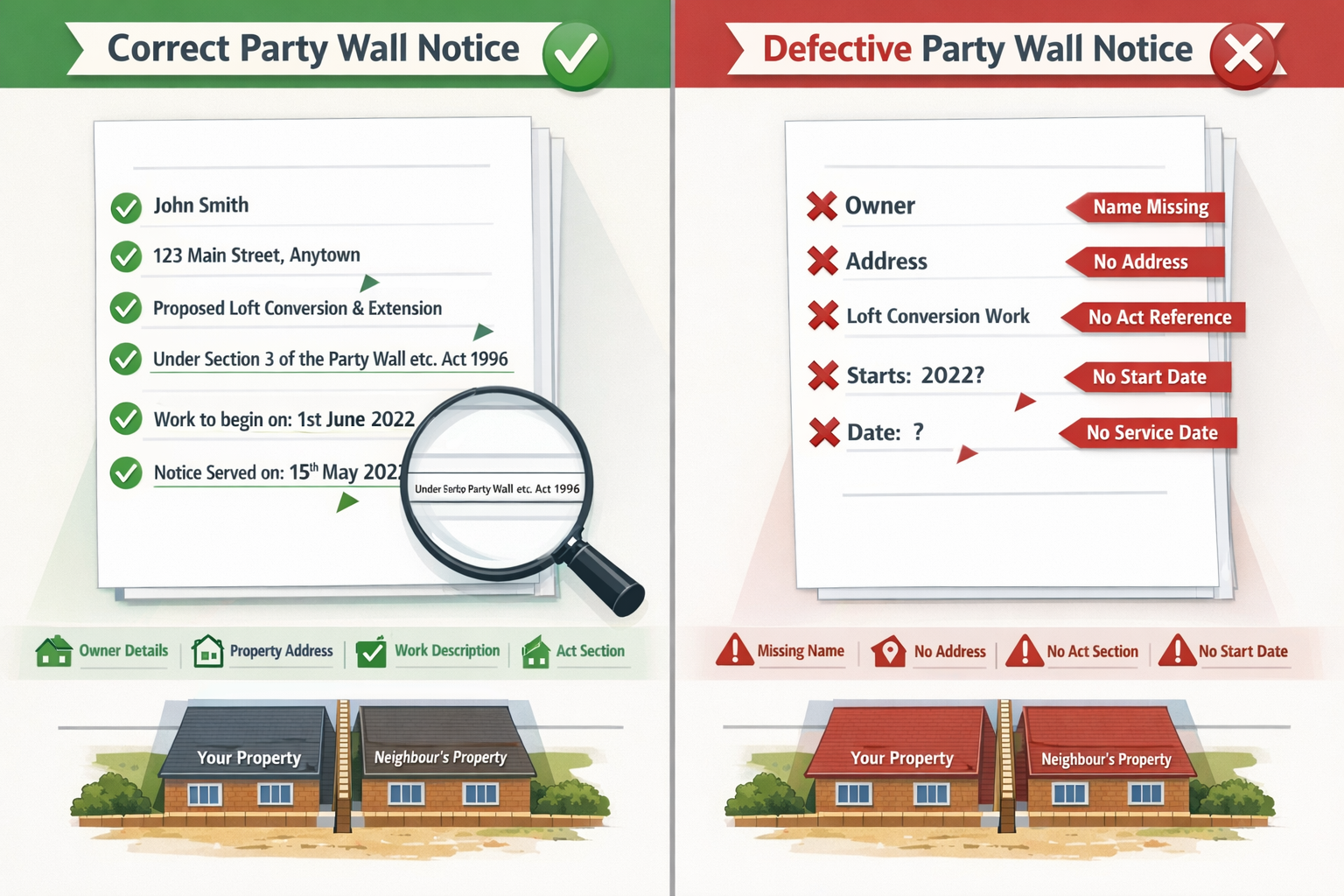
- Mandatory information elements include building owner details, property address, clear work description, correct Act section, proposed start date, and service date
- Two-month minimum notice periods for most works must be strictly observed; insufficient lead time automatically invalidates the proposed commencement date
- Project-specific documentation such as plans, sections, and elevations are legally required for excavation and structural works
- Generic template misuse accounts for the majority of defective notices, as online forms lack project-specific detail and contextual accuracy
Understanding the Legal Framework for Valid Party Wall Notices
The Party Wall etc. Act 1996 creates a statutory framework that balances a building owner's right to develop their property with an adjoining owner's right to protection from damage. Valid notices serve as the foundation of this entire process, triggering specific timelines and procedural requirements that govern how works proceed [8].
The Three Notice Types Under the Act
The Act establishes three distinct notice categories, each addressing different construction scenarios:
Section 1 Notices (Line of Junction Works) apply when building a new wall astride or up to the boundary line between properties. These notices require at least one month before works commence [2].
Section 2 Notices (Party Structure Works) cover repairs, alterations, or modifications to existing party walls and structures. This category includes cutting into party walls, removing chimney breasts, inserting damp-proof courses, and raising or thickening party walls. These require two months notice [2].
Section 6 Notices (Excavation Works) address foundations and excavations within three or six meters of an adjoining property, depending on depth. The three-meter rule determines when these notices become necessary. These also require two months notice [3].
Why Notice Validity Matters
A defective notice creates no legal obligation for the adjoining owner to respond. Without a valid notice, the entire statutory process fails to commence, meaning:
- No 14-day consent period begins ⏰
- No dispute resolution mechanism activates
- No legal protection exists for the building owner
- Works conducted under an invalid notice constitute trespass
When an adjoining owner identifies notice defects, they can seek an injunction to halt works immediately. Courts consistently uphold these challenges when fundamental validity requirements are not met [4].
Common Drafting Errors in Invalid Party Wall Notices That Trigger Legal Challenges
Research into party wall disputes reveals consistent patterns in notice defects. Understanding these common errors helps building owners avoid the pitfalls that lead to project delays and legal intervention.
Inaccurate Owner and Property Details
The single most critical error involves incorrect identification of parties or properties. A notice must accurately identify:
- The full legal name of the building owner (not nicknames or abbreviations)
- The complete postal address of the building owner's property
- The full legal name of each adjoining owner
- The complete postal address of each adjoining property [1]
Even minor variations can prove fatal to notice validity. Cases have failed due to:
- Using "Mr. J. Smith" when the legal owner is "John Michael Smith"
- Omitting flat numbers in converted properties
- Incorrect house numbers or street names
- Missing postcode information
When multiple people own a property jointly, all owners must be named on the notice. Missing even one joint owner renders the notice defective [2].
Vague or Unclear Description of Works
The Act requires a clear description that allows the adjoining owner to understand exactly what is proposed. Generic descriptions such as "general building works" or "renovations" fail this test completely [2].
Insufficient descriptions commonly include:
- "Loft conversion" (without specifying structural alterations)
- "Extension works" (without dimensions or party wall implications)
- "Foundation work" (without depth or proximity details)
- "Wall repairs" (without specifying which wall or what repairs)
Adequate descriptions must specify:
| Element | Required Detail |
|---|---|
| Location | Which specific wall, floor, or boundary |
| Nature | Cutting, inserting, removing, excavating, building |
| Extent | Dimensions, depth, height, thickness |
| Materials | Steel beams, concrete, masonry specifications |
| Structural impact | Load-bearing changes, support alterations |
For loft conversions, the notice must specify whether works involve cutting into the party wall for steel beam insertion, raising the party wall height, or both [2].
Missing Supporting Plans and Sections
Written descriptions alone rarely satisfy statutory requirements for complex works. The Act specifically requires plans and sections for certain notice types, particularly excavation works [2].
Essential drawings include:
📐 Site plans showing property boundaries and excavation locations
📐 Cross-sections illustrating excavation depth relative to adjoining foundations
📐 Structural drawings showing beam positions, wall cutting locations, and load paths
📐 Elevation drawings for works affecting party wall height or external appearance
Without these supporting documents, adjoining owners cannot properly assess the proposed works' impact. This deficiency alone can invalidate notices for excavation near a neighbour or structural alterations [2].
Professional surveyors consistently emphasize that plans must be drawn to scale, properly dimensioned, and clearly labeled. Hand-drawn sketches without measurements rarely meet the legal standard [7].
Incorrect Statutory Route Selection
Choosing the wrong section of the Act represents a fundamental error that undermines the entire legal basis for the notice. This mistake often occurs when building owners or inexperienced advisors fail to properly analyze which parts of the Act apply to their specific project [2].
Common misapplications include:
- Using Section 1 (new wall) notices for works on existing party walls
- Serving Section 2 notices for excavation works requiring Section 6
- Failing to serve multiple notice types when projects involve several work categories
- Confusing party wall works with boundary wall works outside the Act's scope
Many projects require multiple notices under different sections. For example, a rear extension with basement excavation typically needs both Section 2 notices (for cutting into the party wall for structural support) and Section 6 notices (for foundation excavation) [2].
Insufficient Notice Periods
The Act mandates specific minimum notice periods that cannot be shortened without the adjoining owner's written consent:
- One month for Section 1 (line of junction) works
- Two months for Section 2 (party structure) works
- Two months for Section 6 (excavation) works [3]
These periods run from the date of service (when the notice is delivered), not from the date written on the notice. A notice served 55 days before proposed works commence fails to meet the two-month requirement [3].
Critical timing errors include:
- Counting from the wrong start date
- Failing to account for postal delivery time
- Not allowing for weekends and bank holidays in calculations
- Attempting to backdate notices
When building owners realize they've missed the deadline, they cannot simply change the proposed start date on an already-served notice. The entire notice must be withdrawn and re-served with a compliant start date, adding further delays [3].
Failure to Identify All Relevant Adjoining Owners
The Act requires service on every adjoining owner whose property is affected by the proposed works. Missing even one affected party invalidates the process for that owner, leaving the building owner exposed to legal challenge [2].
Identification challenges arise with:
- Semi-detached and terraced properties where works affect multiple neighbours
- Converted flats with multiple leaseholders in adjoining buildings
- Leasehold properties where both the leaseholder and freeholder may require notice
- Commercial properties with complex ownership structures
- Absentee landlords requiring additional tracing efforts
For excavation works, the affected zone extends three or six meters from the building owner's property, potentially encompassing multiple adjoining owners who must all receive proper notice [2].
When ownership is unclear, building owners should conduct Land Registry searches to identify all legal owners. Assumptions about ownership frequently prove incorrect and lead to defective notice service [1].
Use of Generic Templates Without Customization
Online party wall notice templates proliferate across the internet, promising simple solutions to complex legal requirements. However, treating these templates as "fill-in-the-blank" forms represents one of the most common paths to invalid notices [2].
Template pitfalls include:
- Pre-populated text that doesn't match actual project details
- Generic work descriptions that lack project specificity
- Boilerplate language that omits mandatory information
- Incorrect Act section references for the actual works planned
- Missing fields for essential project-specific details
Templates cannot account for the unique circumstances of each project. They particularly fail for complex works involving multiple notice types, unusual structural configurations, or properties with complicated ownership arrangements [7].
Professional party wall surveyors emphasize that templates should serve only as starting points, requiring substantial customization and legal review before service. Many recommend avoiding templates entirely in favor of bespoke notices drafted specifically for each project [2].
Project Types Most Vulnerable to Notice Drafting Errors
Certain construction projects generate higher rates of defective notices due to their complexity and the multiple statutory requirements they trigger.
Rear Extensions
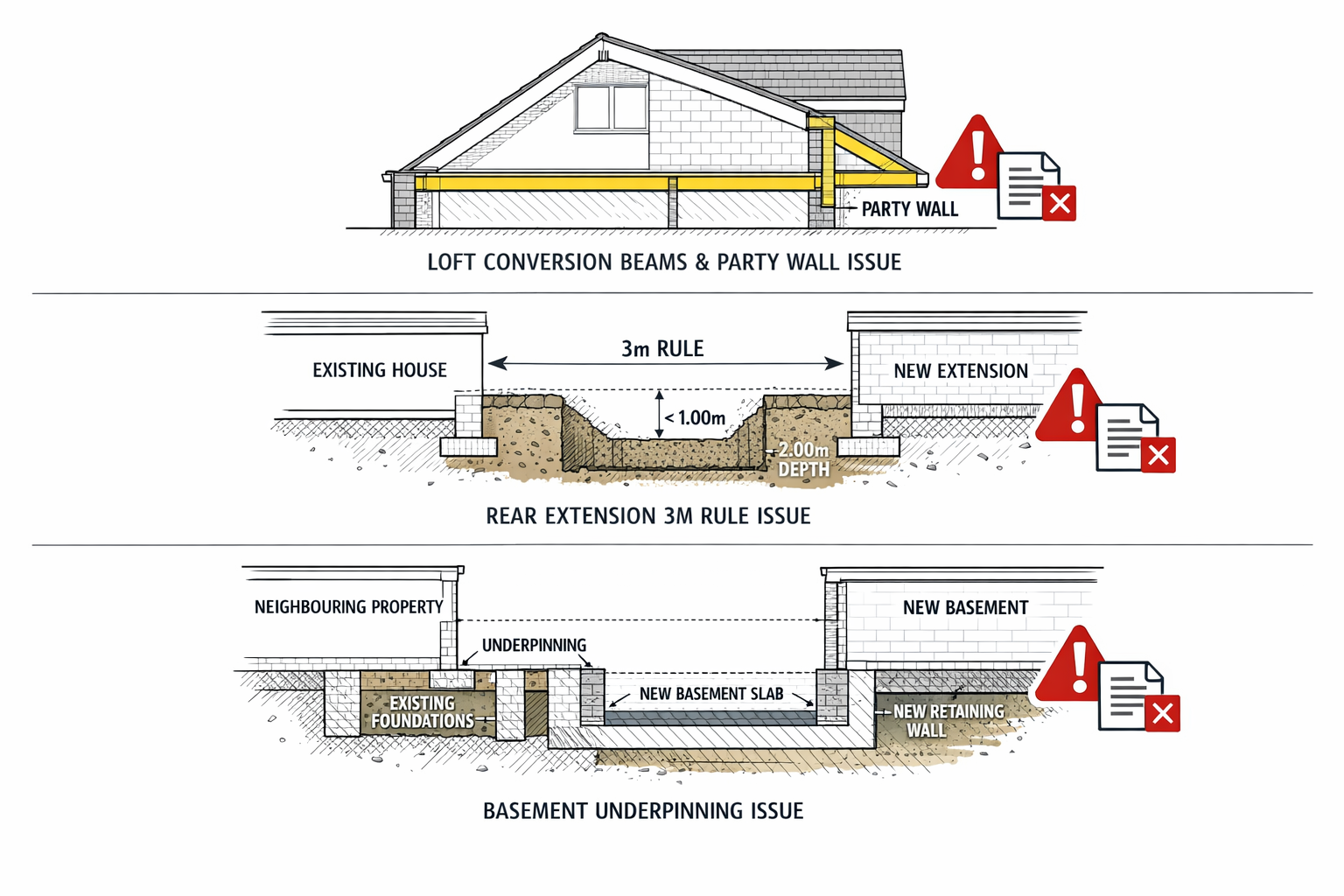
Single and multi-story rear extensions frequently involve both party structure works (cutting into party walls for steel beam support) and excavation works (foundations near adjoining properties). Each aspect requires separate notices under different Act sections [2].
Common errors include serving only one notice type when both Sections 2 and 6 apply, or failing to adequately describe the structural connection points where beams will be inserted into party walls.
Loft Conversions
Loft conversion projects commonly require party wall notices when works involve raising the party wall height, cutting into party walls for structural support, or inserting steel beams to create open-plan spaces [2].
Defective notices often fail to specify whether the party wall will be raised, by how much, and what structural alterations are required. Generic descriptions like "loft conversion with party wall works" provide insufficient detail for adjoining owners to assess impact.
Basement Excavations and Conversions
Basement projects trigger Section 6 excavation notices when digging occurs within the prescribed distances of adjoining foundations. These notices require precise technical information about excavation depth, proximity to boundaries, and underpinning methods [2].
Errors frequently involve:
- Incorrect depth measurements relative to adjoining foundations
- Missing structural engineer's drawings showing underpinning details
- Failure to identify all properties within the affected zone
- Inadequate description of temporary support measures
Chimney Breast Removals
Removing chimney breasts in semi-detached or terraced properties affects the party wall structure and requires Section 2 notices. These works alter load distribution and may impact the adjoining owner's corresponding chimney breast [2].
Defective notices often fail to specify:
- Whether removal is ground floor only or extends to upper floors
- What structural support will replace the removed masonry
- How loads will be redistributed across the party wall
- Whether the adjoining owner's chimney breast will require additional support
Consequences of Invalid Party Wall Notices and Project Delays
When notices fail to meet statutory requirements, the consequences extend far beyond simple administrative inconvenience. The financial and temporal impacts can fundamentally alter project viability.
Immediate Legal Consequences
An invalid notice creates no legal obligation for the adjoining owner. The statutory timeline never commences, meaning:
- The 14-day consent period doesn't begin
- The dispute resolution process cannot activate
- No party wall award can be agreed or determined
- The building owner has no legal authority to proceed
If works commence under an invalid notice, the building owner commits trespass against the adjoining owner's property. This exposes the building owner to:
- Injunction applications to halt works immediately ⚖️
- Damages claims for any harm caused
- Legal costs for both parties
- Potential contempt proceedings if injunctions are breached [4]
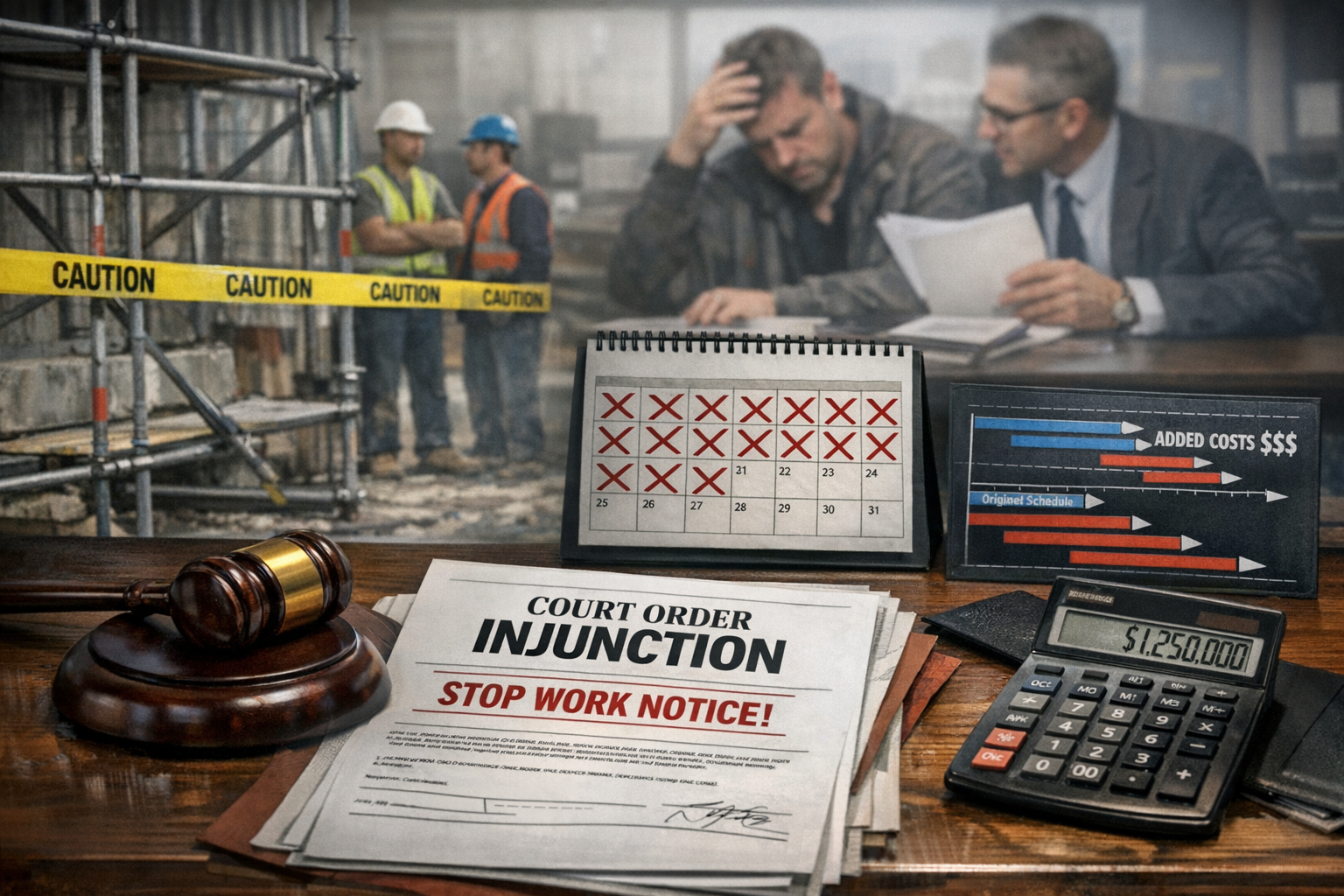
Courts consistently grant injunctions when building owners proceed without valid notices, viewing the statutory process as a mandatory prerequisite to works affecting shared boundaries [4].
Project Timeline Impacts
Rectifying an invalid notice requires completely restarting the statutory process. This means:
Minimum additional delays:
- Drafting and serving corrected notices: 1-2 weeks
- Statutory response period: 14 days (for consent) or immediate (for dissent)
- Surveyor appointment and award preparation: 4-8 weeks (if dissent occurs)
Total delay impact: Typically 2-4 months added to the project timeline [3]
For commercial developments or projects with time-sensitive financing, these delays can prove catastrophic. Construction teams must be stood down, materials orders cancelled or stored, and subsequent trades rescheduled.
Financial Consequences
The cost implications of invalid notices compound quickly:
💷 Holding costs – Mortgage payments, insurance, and property taxes continue during delays
💷 Contractor demobilization and remobilization – Costs for standing down and restarting work crews
💷 Material storage or cancellation – Fees for storing ordered materials or penalties for cancelled orders
💷 Legal fees – Costs for defending injunction applications and rectifying notice defects
💷 Lost rental income – Delayed completion postpones revenue generation for investment properties
💷 Price escalation – Material and labor cost increases during extended timelines
Industry data suggests invalid notice delays cost building owners between £15,000 and £75,000 depending on project scale and complexity [1].
Relationship Damage
Beyond financial and temporal costs, invalid notices severely damage neighbour relations. Adjoining owners who discover defective notices often feel:
- Disrespected by apparent carelessness
- Suspicious of the building owner's intentions
- Motivated to oppose the project more vigorously
- Justified in taking adversarial positions
This relationship deterioration makes subsequent negotiations more difficult and increases the likelihood of formal disputes requiring surveyor involvement, even after corrected notices are served [7].
Compliance Checklist: Preventing Invalid Party Wall Notices
Systematic verification prevents the drafting errors that trigger injunctions and delays. This checklist provides a structured approach to notice validation before service.
Pre-Notice Preparation
Before drafting any notice:
✅ Conduct Land Registry searches to identify all legal owners of adjoining properties
✅ Obtain detailed architectural and structural drawings showing proposed works
✅ Determine which sections of the Act apply to your specific project
✅ Calculate correct notice periods based on work type and proposed start date
✅ Identify whether multiple notices are required for different work elements
✅ Engage a qualified party wall surveyor for complex projects
Mandatory Information Verification
Every notice must include:
✅ Building owner's full legal name exactly as it appears on property title
✅ Building owner's complete postal address including postcode
✅ Adjoining owner's full legal name exactly as it appears on property title
✅ Adjoining owner's complete postal address including postcode
✅ Property address where works will occur (if different from building owner's address)
✅ Clear, specific description of proposed works with dimensions and materials
✅ Correct Act section (Section 1, 2, or 6) for the notice type
✅ Proposed start date allowing sufficient statutory notice period
✅ Date of service (the date notice will be delivered)
Work Description Standards
Ensure descriptions specify:
✅ Precise location – Which wall, floor, or boundary is affected
✅ Nature of works – Specific actions (cutting, inserting, removing, excavating)
✅ Dimensions – Height, width, depth, thickness measurements
✅ Materials – Concrete grade, steel beam specifications, masonry type
✅ Structural implications – Load-bearing changes, support alterations
✅ Access requirements – Whether entry to adjoining property is needed
Supporting Documentation Requirements
Attach all necessary drawings:
✅ Site location plan showing property boundaries and work locations
✅ Floor plans indicating party wall positions and proposed alterations
✅ Cross-sections showing excavation depths relative to adjoining foundations
✅ Structural details illustrating beam positions and connection methods
✅ Elevations for works affecting party wall height or external appearance
All drawings must be:
- Drawn to scale with scale noted
- Properly dimensioned
- Clearly labeled with property boundaries
- Professionally prepared (not hand sketches)
Service Method Verification
Ensure proper service:
✅ Serve notices by hand delivery with signed receipt, or
✅ Send by recorded delivery post with tracking, or
✅ Use process server with affidavit of service
✅ Retain proof of service date for statutory period calculations
✅ Serve on all identified adjoining owners simultaneously
✅ Keep copies of all served notices and supporting documents
For properties where owners cannot be located, the Act provides alternative service methods, but these require strict compliance with statutory procedures [8].
Professional Review Standards
Before serving notices:
✅ Have a qualified party wall surveyor review all notices and supporting documents
✅ Verify Act section selection matches actual works planned
✅ Confirm notice periods meet statutory minimums with margin for error
✅ Double-check all names and addresses against Land Registry records
✅ Ensure work descriptions provide sufficient detail for informed consent
✅ Validate that all supporting drawings are complete and accurate
Professional review typically costs £200-500 but prevents errors that generate delays costing tens of thousands of pounds [7].
When to Seek Professional Party Wall Surveying Services
While building owners can technically draft and serve their own notices, the complexity of party wall legislation and the severe consequences of errors make professional assistance highly advisable for most projects.
Projects Requiring Professional Input
Mandatory professional involvement is recommended for:
- Projects requiring multiple notice types under different Act sections
- Basement excavations or underpinning works near adjoining foundations
- Structural alterations involving load redistribution across party walls
- Properties with complex ownership structures (multiple flats, commercial units)
- Works where adjoining owners have already expressed concerns or opposition
- High-value projects where delay costs exceed professional fees
- Situations where party wall disputes have already emerged
What Professional Surveyors Provide
Qualified party wall surveyors offer comprehensive services including:
📋 Initial assessment – Determining which parts of the Act apply
📋 Notice drafting – Preparing legally compliant notices with proper descriptions
📋 Drawing coordination – Ensuring architectural drawings meet statutory requirements
📋 Service management – Handling proper notice delivery and proof of service
📋 Negotiation – Liaising with adjoining owners to facilitate consent
📋 Award preparation – Drafting party wall awards if disputes arise
📋 Condition surveys – Preparing schedules of condition to document pre-work property status
Professional involvement significantly reduces the risk of defective notices and provides insurance against costly errors [7].
Selecting Qualified Professionals
When engaging party wall surveyors, verify:
✅ RICS membership (Royal Institution of Chartered Surveyors)
✅ Specialist party wall experience (not just general surveying)
✅ Professional indemnity insurance covering party wall work
✅ Local market knowledge of your area's property types
✅ Clear fee structure with no hidden charges
✅ References from recent party wall projects
The party wall services provided by qualified professionals represent cost-effective insurance against project-threatening delays.
Rectifying Invalid Notices: The Correction Process
When defects are identified in served notices, prompt correction minimizes delay impacts. However, the rectification process requires careful handling to preserve neighbour relations and legal standing.
Identifying Notice Defects
Defects may be identified by:
- The adjoining owner reviewing the notice
- The adjoining owner's surveyor during initial assessment
- The building owner's surveyor during quality review
- Legal advisors representing either party
- Courts during injunction applications
Common indicators of defects include:
- Adjoining owner questioning notice validity
- Requests for clarification about work descriptions
- Challenges to the proposed start date
- Identification of missing mandatory information
- Discovery of incorrect property or owner details [1]
Withdrawal and Re-Service
The standard correction process involves:
Step 1: Formal Withdrawal
Issue written notice to all served parties withdrawing the defective notice. This prevents confusion about which notice is operative [3].
Step 2: Defect Analysis
Identify all errors requiring correction, not just the initially discovered problem. Comprehensive review prevents multiple correction cycles [3].
Step 3: Corrected Notice Preparation
Draft new notice addressing all identified defects with professional review to ensure no additional errors [3].
Step 4: Re-Service
Serve corrected notice to all adjoining owners with proper service method and proof. The statutory timeline begins fresh from this new service date [3].
Step 5: Communication
Accompany corrected notice with explanatory letter acknowledging the error, apologizing for inconvenience, and confirming the new timeline [3].
Managing Adjoining Owner Relations
Transparent communication during correction helps preserve working relationships:
- Acknowledge errors promptly without defensive explanations
- Apologize genuinely for the inconvenience and confusion
- Explain corrections clearly so adjoining owners understand what changed
- Provide realistic timelines for the corrected process
- Offer direct contact for questions or concerns
Building owners who handle corrections professionally often salvage neighbour relations despite initial errors. Those who become defensive or dismissive typically face increased opposition [7].
Legal Considerations During Correction
If works have already commenced under an invalid notice:
⚠️ Cease all works immediately upon discovering the defect
⚠️ Secure the site to prevent further trespass
⚠️ Seek legal advice about potential liability
⚠️ Negotiate with adjoining owner to avoid injunction proceedings
⚠️ Document all actions taken to rectify the situation
Continuing works after discovering notice invalidity substantially worsens legal exposure and almost guarantees injunction applications [4].
Conclusion
Invalid party wall notices represent entirely preventable obstacles that derail construction projects and generate unnecessary costs. The drafting errors examined throughout this guide—inaccurate owner details, vague work descriptions, missing supporting documentation, incorrect statutory route selection, insufficient notice periods, failure to identify all adjoining owners, and misuse of generic templates—account for the vast majority of defective notices that trigger injunctions and delays.
The financial stakes are substantial. A notice requiring correction adds 2-4 months to project timelines and costs between £15,000 and £75,000 in holding costs, legal fees, and contractor demobilization. Yet these consequences stem from errors that systematic verification and professional review readily prevent.
Actionable Next Steps
For building owners planning party wall works:
- Engage qualified professionals early – Party wall surveyors provide cost-effective insurance against expensive errors
- Conduct thorough ownership research – Land Registry searches identify all parties requiring notice service
- Invest in detailed drawings – Professional architectural and structural drawings satisfy statutory requirements
- Allow generous timelines – Start the notice process 3-4 months before desired work commencement to accommodate any corrections
- Verify every detail – Use the compliance checklist provided in this guide before serving any notice
- Maintain open communication – Engage adjoining owners early and transparently to build cooperative relationships
For projects already underway:
- Review existing notices immediately – Verify compliance with all mandatory requirements before works commence
- Seek professional validation – Have a qualified surveyor review notices even if already served
- Correct defects promptly – Address identified problems through formal withdrawal and re-service
- Document everything – Maintain comprehensive records of all notices, service dates, and communications
The Party Wall etc. Act 1996 provides a balanced framework that protects both building owners' development rights and adjoining owners' property interests. Valid notices activate this framework effectively. Invalid notices trigger costly legal challenges that benefit no one. By understanding the specific information requirements, avoiding common drafting pitfalls, and implementing systematic verification processes, building owners can ensure their notices withstand scrutiny and their projects proceed on schedule.
When party wall notice issues arise, professional guidance from experienced chartered surveyors provides the expertise necessary to navigate complex statutory requirements successfully. The investment in proper notice preparation pays dividends through avoided delays, preserved neighbour relations, and projects that proceed smoothly from notice service through completion.
References
[1] Invalid Party Wall Notices – https://england.surveyone.co.uk/invalid-party-wall-notices/
[2] What Makes A Party Wall Notice Valid – https://www.houricanassociates.com/party-wall-news/what-makes-a-party-wall-notice-valid/
[3] Invalid Party Wall Notices – https://timgreenwood-associates.co.uk/news/invalid-party-wall-notices/
[4] The Failure Of Section 10 4 Of The Party Wall Act – https://www.adamjoseph.co.uk/the-failure-of-section-10-4-of-the-party-wall-act
[7] Party Wall Surveyor Mistakes – https://stokemont.com/advice/party-wall-surveyor-mistakes/
[8] Preventing And Resolving Disputes In Relation To Party Walls – https://www.gov.uk/government/publications/preventing-and-resolving-disputes-in-relation-to-party-walls