Basement conversion projects in the UK now face rejection rates exceeding 40% during mortgage underwriting, primarily due to incomplete structural assessments and missing party wall documentation. As property owners increasingly look underground to expand living space in 2026, the intersection of rigorous building surveys and complex party wall legislation has become the critical factor determining project viability, legal compliance, and long-term property value.
Understanding Building Surveys for Basement Conversions: Structural Risk Assessment and Party Wall Implications is no longer optional for homeowners, developers, or construction professionals. With the Building Safety Regulator tightening enforcement and mortgage lenders demanding comprehensive documentation, the technical requirements for basement projects have evolved into a specialized discipline requiring expert coordination between chartered surveyors, structural engineers, and party wall practitioners.
Key Takeaways
- Level 3 RICS Building Surveys are now recommended for all habitable basement conversions, particularly where water ingress or missing documentation exists
- Party Wall Act compliance is mandatory for excavations within three meters of neighboring foundations, with formal Awards required before work commences
- Structural Risk Assessments (SRAs) have become central to building safety compliance under the Building Safety Act 2022, especially for higher-risk buildings
- Pre-conversion surveys must include moisture mapping, foundation analysis, and soil investigation to identify hidden risks that could derail projects
- Missing warranties and non-compliant waterproofing are leading causes of mortgage refusal and reduced property values
Understanding Building Survey Requirements for Basement Conversions
The Evolution of Survey Standards in 2026
The landscape of building surveys for basement conversions has transformed significantly following regulatory changes and increased scrutiny from mortgage lenders. Level 3 RICS Building Surveys have become the gold standard for properties with existing or planned basement conversions, replacing the previously acceptable Level 2 assessments for most scenarios [3].
This shift reflects growing awareness of the complex structural challenges inherent in basement projects. Unlike standard property surveys, basement conversion assessments must evaluate:
- Existing foundation depths and load-bearing capacity 🏗️
- Soil conditions and water table levels
- Current moisture ingress and drainage systems
- Structural integrity of existing walls and floors
- Proximity to neighboring properties and shared structures
For properties with converted basements lacking proper documentation, a RICS Level 3 Building Survey provides the comprehensive analysis necessary to identify hidden defects, assess compliance with building regulations, and determine whether retrospective approvals are feasible.
Pre-Conversion Survey Protocols
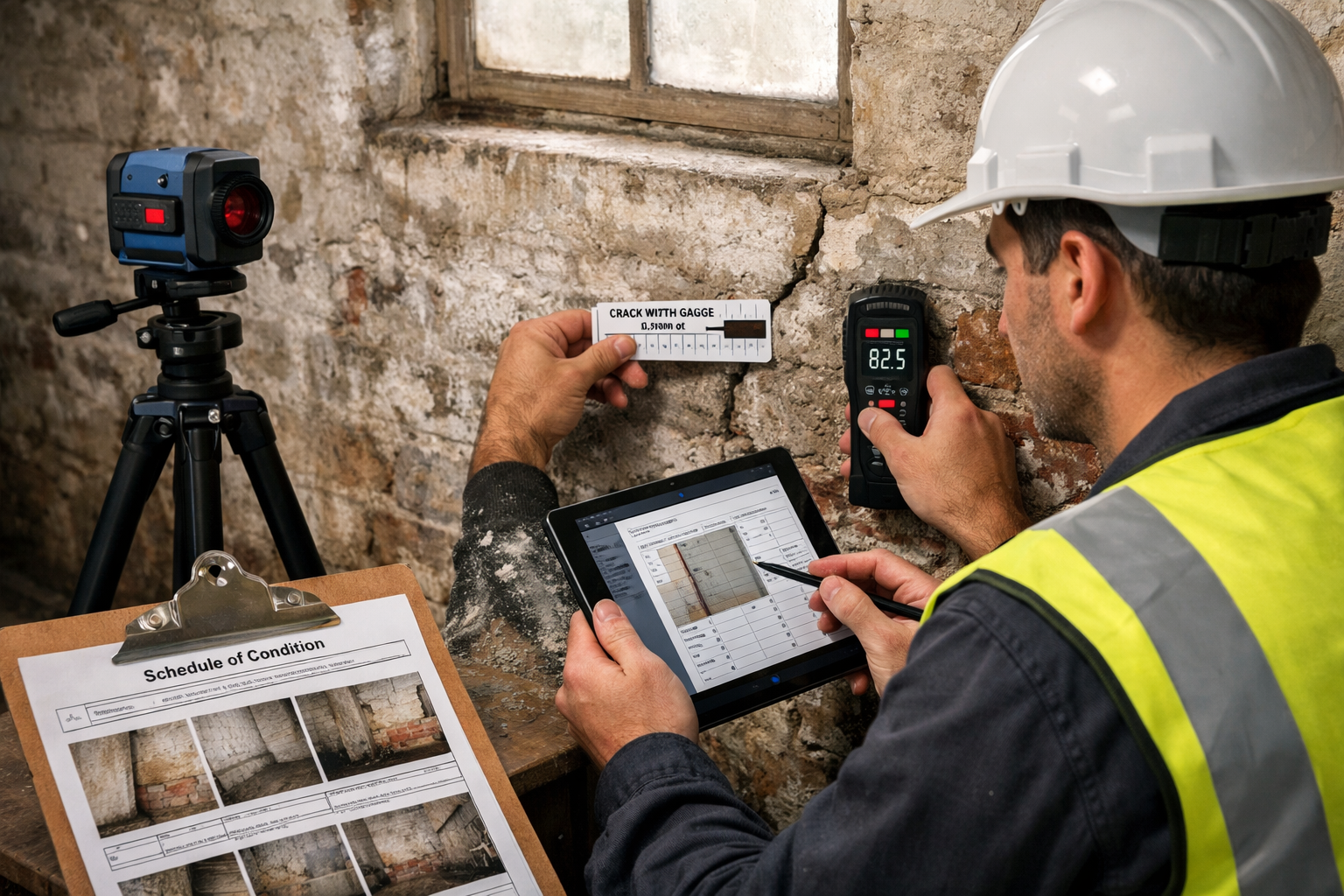
Before any basement conversion work begins, a thorough pre-conversion survey must establish baseline conditions. This diagnostic phase requires non-invasive moisture mapping and salt sampling to identify existing damp problems, substrate compatibility issues, and potential sources of future water ingress [2].
The pre-conversion survey should include:
| Survey Component | Purpose | Key Deliverables |
|---|---|---|
| Moisture Mapping | Identify existing water ingress patterns | Thermal imaging reports, moisture meter readings |
| Salt Sampling | Detect hygroscopic salts that attract moisture | Laboratory analysis of wall samples |
| Foundation Survey | Assess existing foundation depth and condition | Measured foundation depths, structural integrity assessment |
| Soil Investigation | Determine ground conditions and bearing capacity | Soil type classification, water table level |
| Structural Analysis | Evaluate load-bearing walls and floor capacity | Structural calculations, safe load limits |
Professional surveyors conducting these assessments must comply with BS6576 and BS8102 standards for basement moisture-proofing, as failure to meet these requirements results in Building Control rejection and mortgage refusals [2].
Documentation and Certification Requirements
The documentation trail for basement conversions has become increasingly critical in 2026. Mortgage lenders now routinely reject applications where conversion documentation is incomplete or involves non-standard warranties [2].
Essential documentation includes:
- Building Control Completion Certificates for structural works
- Approved waterproofing system warranties (typically 10-year minimum)
- Structural engineer's calculations and drawings
- Party Wall Awards (where applicable)
- Electrical and gas safety certificates
- Planning permission (if external changes or habitable rooms created)
Missing any of these documents can reduce property value by 10-15% and create significant obstacles during sale transactions. A comprehensive structural survey conducted before purchase can identify these documentation gaps early.
Structural Risk Assessment: Core Components and Compliance
The Building Safety Act 2022 and Structural Risk Assessments
The introduction of the Building Safety Act 2022 has fundamentally changed how structural risks are assessed and managed, particularly for higher-risk buildings. The Building Safety Regulator now explicitly requires that structural safety forms an essential element of overall building safety, with property owners obligated to manage and mitigate risks under Section 83 of the Act [6].
While basement conversions in standard residential properties may not typically qualify as Higher-Risk Buildings (HRBs), the regulatory framework has established new expectations for structural risk assessment across all construction projects. The Building Safety Regulator has refused to issue Building Assessment Certificates (BACs) where insufficient attention has been paid to structural safety considerations [6].
Components of a Comprehensive Structural Risk Assessment
A thorough Structural Risk Assessment (SRA) for basement conversions must evaluate both local and global structural failure modes. This systematic approach involves:
1. Load Path Analysis 📊
- Tracing how loads transfer from roof to foundations
- Identifying critical structural elements
- Assessing impact of proposed alterations on load distribution
- Evaluating adequacy of existing structural members
2. Foundation Adequacy Assessment
- Determining existing foundation type and depth
- Calculating bearing capacity for increased loads
- Assessing need for underpinning or reinforcement
- Evaluating impact on adjacent properties
3. Excavation Risk Evaluation
- Analyzing soil stability during excavation
- Assessing temporary works requirements
- Identifying risks to neighboring foundations
- Planning excavation sequencing to minimize risk
4. Water and Moisture Risk Assessment
- Evaluating groundwater pressure and water table levels
- Assessing flood risk and drainage capacity
- Identifying potential water ingress routes
- Specifying appropriate waterproofing systems
The Confidential Reporting Programme for Structural Safety (CROSS) has documented cases of incompetent basement design where inadequate structural assessment led to foundation failure, neighboring property damage, and costly remediation [8]. These failures typically stem from insufficient soil investigation, inadequate temporary works design, or failure to account for water pressure.
Risk Scoring and Mitigation Strategies
Modern structural risk assessments employ systematic risk scoring methodologies that evaluate both likelihood and impact of potential failure modes [7]. This approach, now mandated for Safety Case Reports in higher-risk buildings, provides a framework applicable to basement conversion projects:
Risk Matrix for Basement Conversions:
- High Risk: Excavation within 1 meter of neighboring foundations without adequate temporary support
- Medium Risk: Underpinning required but soil conditions favorable and proper sequencing planned
- Low Risk: Minimal excavation depth, no impact on neighboring properties, stable soil conditions
For each identified risk, the structural engineer must specify mitigation measures, which may include:
- Temporary propping and shoring systems
- Phased excavation sequences
- Enhanced foundation designs
- Monitoring of adjacent properties
- Contingency measures for unexpected conditions
Properties requiring subsidence surveys before basement conversion work should receive particular attention, as existing ground movement may indicate soil instability that could be exacerbated by excavation.
Compliance with Building Regulations and Standards
Basement conversions must comply with multiple regulatory frameworks:
Building Regulations Approved Documents:
- Part A (Structure): Structural stability and loading
- Part C (Site Preparation and Resistance to Contaminants): Waterproofing and damp-proofing
- Part B (Fire Safety): Means of escape from basement levels
- Part F (Ventilation): Adequate ventilation for habitable spaces
- Part M (Access): Accessibility requirements
British Standards:
- BS 8102:2022: Code of practice for protection of below ground structures against water ingress
- BS 6576: Code of practice for installation of chemical damp-proof courses
- BS 8004: Code of practice for foundations
Non-compliance with these standards not only risks Building Control rejection but can also invalidate insurance coverage and create liability for future structural problems [5].
Party Wall Act Implications for Basement Excavations
When Party Wall Act 1996 Applies to Basement Projects
The Party Wall Act 1996 creates specific obligations for basement conversion projects that affect shared structures or involve excavation near neighboring properties. Understanding these requirements is crucial, as failure to serve proper notices can result in injunctions halting construction and potential damages claims.
Basement conversions typically trigger Party Wall Act provisions under three scenarios:
Section 1: Work to Existing Party Walls
- Cutting into party walls for structural beams
- Inserting damp-proof courses through party walls
- Raising party walls to increase basement ceiling height
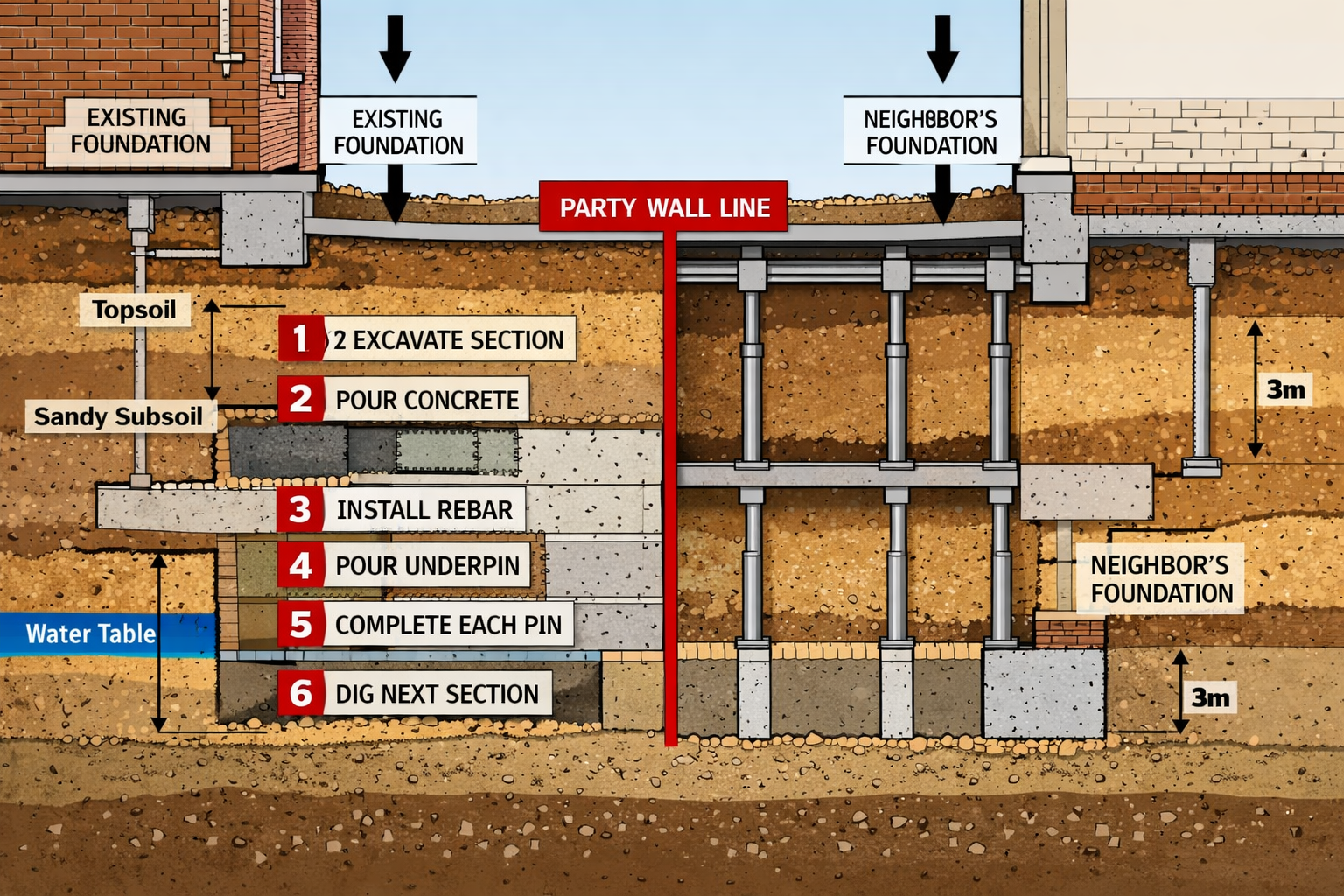
- Underpinning party walls
Section 2: Building New Walls at Boundaries
- Constructing new basement walls along boundary lines
- Building retaining walls for excavated areas adjacent to boundaries
Section 6: Excavation Near Neighboring Foundations
This section is most commonly triggered by basement conversions and applies when:
- Excavating within 3 meters of a neighboring building's foundation AND going deeper than that foundation
- Excavating within 6 meters of a neighboring building's foundation AND going deeper than a 45-degree line drawn downward from the bottom of that foundation
The Party Wall Notice and Award Process
The formal Party Wall process involves multiple stages, each with specific timeframes and requirements:
1. Initial Notice Service 📋
The Building Owner must serve formal notice to Adjoining Owners at least:
- Two months before starting work under Section 1 or 2
- One month before starting excavation under Section 6
Proper notice for excavation near a neighbor must include detailed plans showing excavation depths, proximity to neighboring foundations, and proposed methods of working.
2. Consent or Dissent
Adjoining Owners have 14 days to respond:
- Consent: Work may proceed (though Schedule of Condition still recommended)
- Dissent or No Response: Party Wall Award process begins
- Counter-Notice: Adjoining Owner requests additional works
3. Surveyor Appointment
When an Award is required:
- Each party appoints a surveyor, or
- Both parties agree to a single Agreed Surveyor
- Surveyors must act impartially despite appointment by one party
4. Schedule of Condition
Before work commences, surveyors prepare a detailed Schedule of Condition documenting:
- Existing cracks and defects in neighboring properties
- Photographic evidence of current condition
- Detailed descriptions of finishes and structural elements
- Baseline measurements for future comparison
5. Party Wall Award Drafting
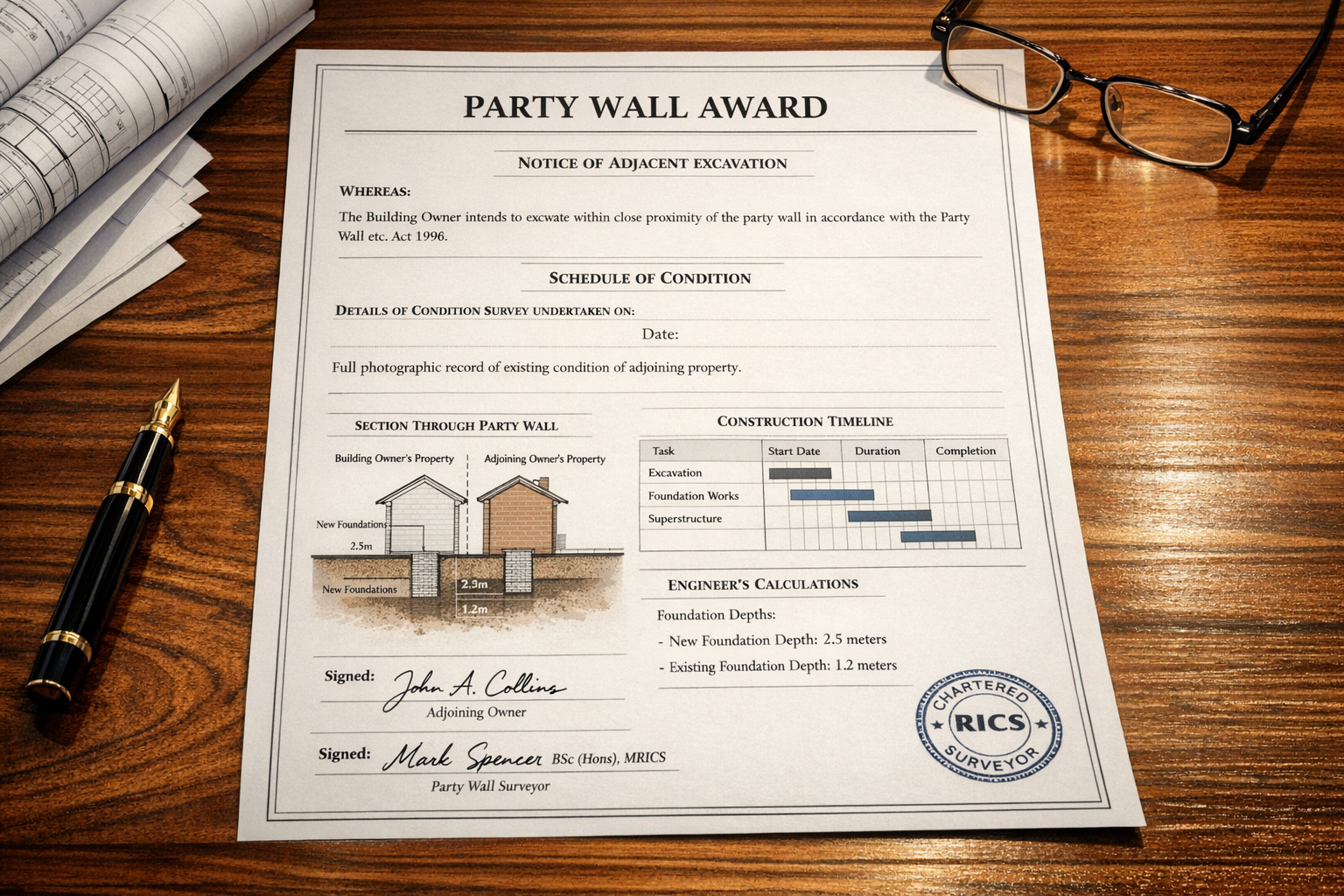
The Award is a legally binding document that specifies:
- Precise description of proposed works
- Working hours and access arrangements
- Security for expenses (if required)
- Dispute resolution procedures
- Rights and obligations of both parties
For complex basement projects involving significant excavation, the Award may include specific requirements for:
- Temporary works design approval
- Vibration monitoring during excavation
- Regular inspection schedules
- Notification protocols for unexpected conditions
- Remediation procedures for any damage caused
Common Party Wall Complications in Basement Projects
Basement conversions present unique party wall challenges that require careful management:
Underpinning Adjacent Foundations
When basement excavation goes deeper than neighboring foundations, underpinning may be necessary to maintain support. The Party Wall Award must specify:
- Underpinning methodology (mass concrete, piled, etc.)
- Sequencing to minimize risk
- Monitoring requirements
- Contingency measures
Differential Settlement Risks
Excavation can alter ground conditions and load distribution, potentially causing settlement in adjacent properties. Risk mitigation includes:
- Pre-work monitoring installations
- Regular surveyor inspections during construction
- Defined trigger levels for work suspension
- Remediation protocols if movement occurs
Water Table Impacts
Basement waterproofing systems can redirect groundwater, potentially affecting neighboring properties. The Award should address:
- Drainage design coordination
- Sump pump discharge arrangements
- Monitoring for water ingress in adjacent basements
- Responsibility for drainage maintenance
Access Requirements
Basement excavation often requires access through neighboring properties for:
- Soil removal when rear access is limited
- Installation of temporary supports
- Construction of retaining walls at boundaries
The Award must specify access rights, timing, and compensation arrangements.
Consequences of Non-Compliance
Proceeding without proper party wall agreements creates significant legal and financial risks:
- Injunctions: Courts can order immediate work stoppage
- Damages Claims: Liability for damage to neighboring properties without the protection of a properly executed Award
- Retrospective Costs: Appointing surveyors after disputes arise typically costs 2-3 times more than proactive compliance
- Mortgage Issues: Lenders may refuse to lend on properties with unresolved party wall disputes
- Sale Complications: Conveyancing solicitors will identify missing party wall documentation
The costs of party wall compliance (typically £1,500-£3,000 for straightforward cases) are minimal compared to the risks of non-compliance, which can result in project delays costing tens of thousands of pounds and potential damages claims.
Integrating Surveys, Risk Assessments, and Party Wall Procedures
The Coordinated Approach to Basement Conversion Planning
Successful basement conversion projects in 2026 require seamless integration of three distinct but interdependent professional disciplines:
1. Building Survey Phase
- Establishes baseline property condition
- Identifies existing defects and structural concerns
- Determines feasibility of proposed conversion
- Highlights party wall and structural risk factors
2. Structural Risk Assessment Phase
- Evaluates specific risks associated with proposed design
- Specifies foundation requirements and temporary works
- Calculates loads and structural adequacy
- Produces detailed engineering drawings and specifications
3. Party Wall Compliance Phase
- Serves required notices to affected neighbors
- Documents pre-work conditions
- Establishes legal framework for construction impacts
- Provides dispute resolution mechanism
These phases should overlap and inform each other rather than proceeding sequentially. For example, the building survey findings may reveal foundation depths that affect both structural design and party wall notice requirements.
Professional Team Assembly
A typical basement conversion project requires coordination among:
- Chartered Building Surveyor: Conducts pre-acquisition or pre-conversion surveys, identifies regulatory compliance issues
- Structural Engineer: Designs foundations, temporary works, and structural alterations; produces calculations for Building Control
- Party Wall Surveyor: Manages Party Wall Act compliance, prepares Schedules of Condition and Awards
- Architect: Designs space layout, prepares planning applications if required
- Waterproofing Specialist: Specifies and oversees installation of BS8102-compliant systems
- Principal Contractor: Executes works in accordance with approved designs and party wall requirements
For complex projects, a single firm offering integrated services can streamline coordination and reduce the risk of miscommunication between specialists. Local chartered surveyors with basement conversion experience can often provide or coordinate multiple services.
Timeline Considerations for Basement Conversion Projects
Understanding the sequential requirements and mandatory waiting periods is essential for realistic project planning:
Pre-Construction Phase (3-6 months):
- Week 1-2: Initial building survey and feasibility assessment
- Week 3-6: Structural engineer's design and calculations
- Week 7-8: Party Wall notices served
- Week 9-16: Party Wall Award negotiation (if required)
- Week 12-20: Building Control application and approval
- Week 16-24: Schedule of Condition prepared
Construction Phase (3-6 months):
- Excavation and underpinning (if required)
- Structural works and waterproofing
- Services installation
- Finishes and completion
- Building Control final inspection
Post-Construction Phase (1-2 months):
- Final party wall inspection
- Completion certificate issuance
- Warranty registration
- Documentation compilation for future sale
Attempting to compress these timelines by skipping steps or working without proper approvals creates significant risks and often results in longer overall project durations due to enforcement actions or remediation requirements.
Cost Implications of Comprehensive Assessment
While thorough surveys, structural assessments, and party wall compliance add upfront costs, they represent sound financial planning:
Typical Professional Fees:
- Level 3 Building Survey: £800-£1,500
- Structural Engineer Design: £2,000-£5,000
- Party Wall Surveyor (Building Owner): £1,500-£3,000
- Party Wall Surveyor (Adjoining Owner): £1,200-£2,500 (paid by Building Owner)
- Schedule of Condition: £500-£1,000 per property
Total Professional Fees: £6,000-£13,000
These costs should be viewed against:
- Total project cost: Typically £50,000-£150,000 for basement conversion
- Risk of failure: Projects proceeding without proper assessment face 30-40% chance of significant problems requiring costly remediation [4]
- Property value increase: Well-executed basement conversions can add 15-20% to property value
- Mortgage lending: Proper documentation ensures mortgageability, protecting future resale value
Quality Assurance and Monitoring
Throughout the construction phase, ongoing monitoring ensures compliance with approved designs and early detection of problems:
Structural Monitoring:
- Regular inspections by structural engineer at key stages
- Monitoring of adjacent properties for movement
- Verification of foundation depths and concrete quality
- Confirmation of waterproofing installation standards
Party Wall Monitoring:
- Periodic inspections by party wall surveyors
- Documentation of any variations from approved methods
- Investigation of neighbor complaints
- Final inspection and comparison to Schedule of Condition
Building Control Inspections:
- Foundation inspection before concrete pour
- Structural frame inspection
- Damp-proofing inspection
- Final inspection before completion certificate
Monitoring surveys using precise leveling equipment or automated systems may be specified in Party Wall Awards where significant excavation creates measurable settlement risk.
Emerging Trends and Future Considerations
Regulatory Evolution in 2026 and Beyond
The regulatory landscape for basement conversions continues to evolve, with several trends shaping requirements:
Enhanced Structural Safety Focus
Following high-profile building failures, regulators are extending principles from the Building Safety Act 2022 to a broader range of projects. While basement conversions in standard residential properties don't currently fall under Higher-Risk Building classifications, the emphasis on comprehensive structural risk assessment is influencing Building Control expectations [6].
Digital Documentation Requirements
Building Control bodies increasingly require digital submission of structural calculations, waterproofing specifications, and as-built drawings. This trend toward digital building information improves long-term record-keeping and facilitates future alterations or sales.
Climate Change Adaptation
Rising water tables and increased rainfall intensity in many UK regions are prompting stricter waterproofing standards and enhanced drainage requirements for basement conversions. Properties in flood-risk areas face additional scrutiny and may require specialized flood-resilient design features.
Technology Integration in Survey and Assessment Processes
Advanced technologies are transforming how building surveys and structural assessments are conducted:
Non-Invasive Investigation Methods:
- Ground Penetrating Radar (GPR): Locates existing foundations, utilities, and voids without excavation
- Thermal Imaging: Identifies moisture ingress patterns and thermal bridging
- 3D Laser Scanning: Creates precise as-built models for structural analysis
- Acoustic Tomography: Detects voids and defects in masonry
Digital Monitoring Systems:
- Automated Crack Monitoring: Provides continuous measurement of structural movement
- Tilt Sensors: Detect rotation or settlement in adjacent structures
- Vibration Monitoring: Ensures construction activities remain within acceptable limits
- Water Level Monitoring: Tracks groundwater table fluctuations
These technologies enhance the accuracy of pre-construction assessments and provide objective evidence for party wall purposes, potentially reducing disputes.
Insurance and Warranty Considerations
The insurance landscape for basement conversions has become more complex and stringent:
Professional Indemnity Insurance
All professionals involved in basement conversion design and supervision should carry adequate Professional Indemnity Insurance. Building Owners should verify coverage before appointment, as claims arising from defective design or inadequate supervision can emerge years after completion.
Structural Warranty Products
Several providers offer structural warranties specifically for basement conversions, typically providing 10-year coverage for:
- Structural defects in foundation and underpinning works
- Waterproofing system failures
- Damage to adjacent properties (when properly notified and assessed)
These warranties have become increasingly important for mortgage lending, with many lenders now requiring them for properties with recent basement conversions [5].
Latent Defects Insurance
For higher-value conversions or where resale is anticipated within 5-10 years, Latent Defects Insurance provides additional protection beyond standard warranties. This coverage can significantly enhance property marketability.
Sustainability and Energy Efficiency
Modern basement conversions increasingly incorporate sustainability features:
Thermal Performance
Basement walls and floors require insulation to meet Building Regulations Part L requirements. Achieving good thermal performance in below-ground spaces presents unique challenges:
- Balancing insulation thickness with ceiling height constraints
- Managing condensation risk at cold surfaces
- Integrating insulation with waterproofing systems
Natural Lighting and Ventilation
Creating habitable basement spaces requires addressing:
- Light wells or sunken courtyards for natural light
- Mechanical ventilation with heat recovery (MVHR) systems
- Egress windows for fire safety and natural ventilation
Sustainable Construction Methods
- Recycled or low-carbon concrete alternatives
- Permeable drainage systems to reduce surface water runoff
- Heat pump integration utilizing stable ground temperatures
These sustainability features should be integrated into initial structural design rather than retrofitted, requiring early coordination between structural engineers, architects, and building services designers.
Conclusion
Building Surveys for Basement Conversions: Structural Risk Assessment and Party Wall Implications represent a complex intersection of technical disciplines that demands professional expertise and careful coordination. The regulatory environment in 2026 has elevated expectations for comprehensive assessment, thorough documentation, and proactive risk management throughout the conversion process.
Successful basement conversion projects share common characteristics: they begin with thorough Level 3 building surveys that establish baseline conditions and identify potential obstacles; they incorporate detailed structural risk assessments that evaluate all failure modes and specify appropriate mitigation measures; and they address Party Wall Act requirements proactively, establishing clear legal frameworks before construction begins.
Actionable Next Steps for Property Owners
If you're considering a basement conversion project:
- Commission a comprehensive building survey from a chartered surveyor experienced in basement conversions before committing to purchase or beginning design work
- Engage a structural engineer early in the planning process to assess feasibility and provide preliminary cost estimates
- Identify party wall requirements by measuring distances to neighboring foundations and consulting a party wall surveyor
- Verify existing documentation for any previous basement work, including Building Control certificates and waterproofing warranties
- Assemble a coordinated professional team with demonstrated basement conversion experience
- Budget realistically for both professional fees and construction costs, including contingencies for unexpected conditions
- Plan timelines that accommodate mandatory notice periods and approval processes
For properties with existing basement conversions, consider commissioning a specialist defect survey if documentation is incomplete or if moisture problems, cracking, or other defects are evident.
The investment in comprehensive surveys, structural assessments, and proper party wall compliance protects property value, ensures legal compliance, and provides peace of mind that your basement conversion will deliver lasting benefits rather than costly problems. In an era of heightened regulatory scrutiny and sophisticated mortgage underwriting, cutting corners on professional assessment is a false economy that exposes property owners to significant financial and legal risks.
References
[1] Structural Report On Basement Conversion – https://www.structures-made-easy.co.uk/key-structural-information/structural-report-on-basement-conversion/
[2] Basement Conversions Decoded Avoid Invisible Risks And Unlock Real Value – https://www.sussexdampexperts.com/basement-conversions-decoded-avoid-invisible-risks-and-unlock-real-value/
[3] Survey For Basements And Cellars 2025 – https://surveymatch.co.uk/survey-for-basements-and-cellars-2025/
[4] Risks Rising From Commercial Building Conversions – https://www.munichre.com/specialty/north-america/en/insights/construction-and-engineering/risks-rising-from-commercial-building-conversions.html
[5] Basement Conversions Technical Bulletin – https://insurance.archgroup.com/basement-conversions-technical-bulletin/
[6] Structural Risk Assessments And The Future Of Building Safety – https://www.arkworkplacerisk.co.uk/resources/structural-risk-assessments-and-the-future-of-building-safety/
[7] Pioneering Structural Risk Assessments For Higher Risk Buildings – https://www.cundall.com/ideas/blog/pioneering-structural-risk-assessments-for-higher-risk-buildings
[8] Incompetent Basement Design 1294 – https://www.cross-safety.org/uk/safety-information/cross-safety-report/incompetent-basement-design-1294
[9] Basement Conversions That Last How Real Value And Legal Compliance Are Built In – https://www.insituscp.co.uk/basement-conversions-that-last-how-real-value-and-legal-compliance-are-built-in/