Construction disputes between neighbors reached a seven-year high in 2025, with over 40% stemming from improper party wall procedures. As property development continues to surge across England and Wales in 2026, understanding Party Wall Awards Explained: Enforcing Agreements and Avoiding Injunctions in 2026 has become essential for property owners, developers, and construction professionals seeking to avoid costly legal battles and project delays.
The Party Wall Act 1996 provides a robust framework for managing construction work that affects shared boundaries, but many property owners remain unaware of their obligations until disputes escalate. A party wall award serves as the cornerstone of this process—a legally binding document that protects all parties involved while ensuring construction proceeds smoothly. This comprehensive guide walks through the complete lifecycle of party wall awards, from initial notice to enforcement, with practical strategies to prevent injunctions during the ongoing construction boom.
Key Takeaways
- Party wall awards are legally binding agreements prepared by surveyors that define construction terms, safeguards, and responsibilities for work affecting shared boundaries
- The 14-day response window is critical—neighbors must respond to party wall notices within this timeframe, or surveyors must be appointed to resolve the matter
- Awards are non-transferable—they remain personal to the original parties and cannot be passed to new property owners
- Proper documentation and compliance significantly reduce the risk of court injunctions that can halt construction and result in substantial financial losses
- Retrospective awards can address post-construction disputes, but prevention through proper advance procedures remains far more cost-effective
Understanding Party Wall Awards: The Legal Foundation
What Is a Party Wall Award?
A party wall award is a formal legal document prepared by one or more surveyors that sets out the specific details of proposed construction work affecting a party wall, party structure, or boundary.[5] This binding agreement establishes the terms under which building work can proceed while protecting the interests of both the building owner (the person undertaking the work) and the adjoining owner (the neighbor).
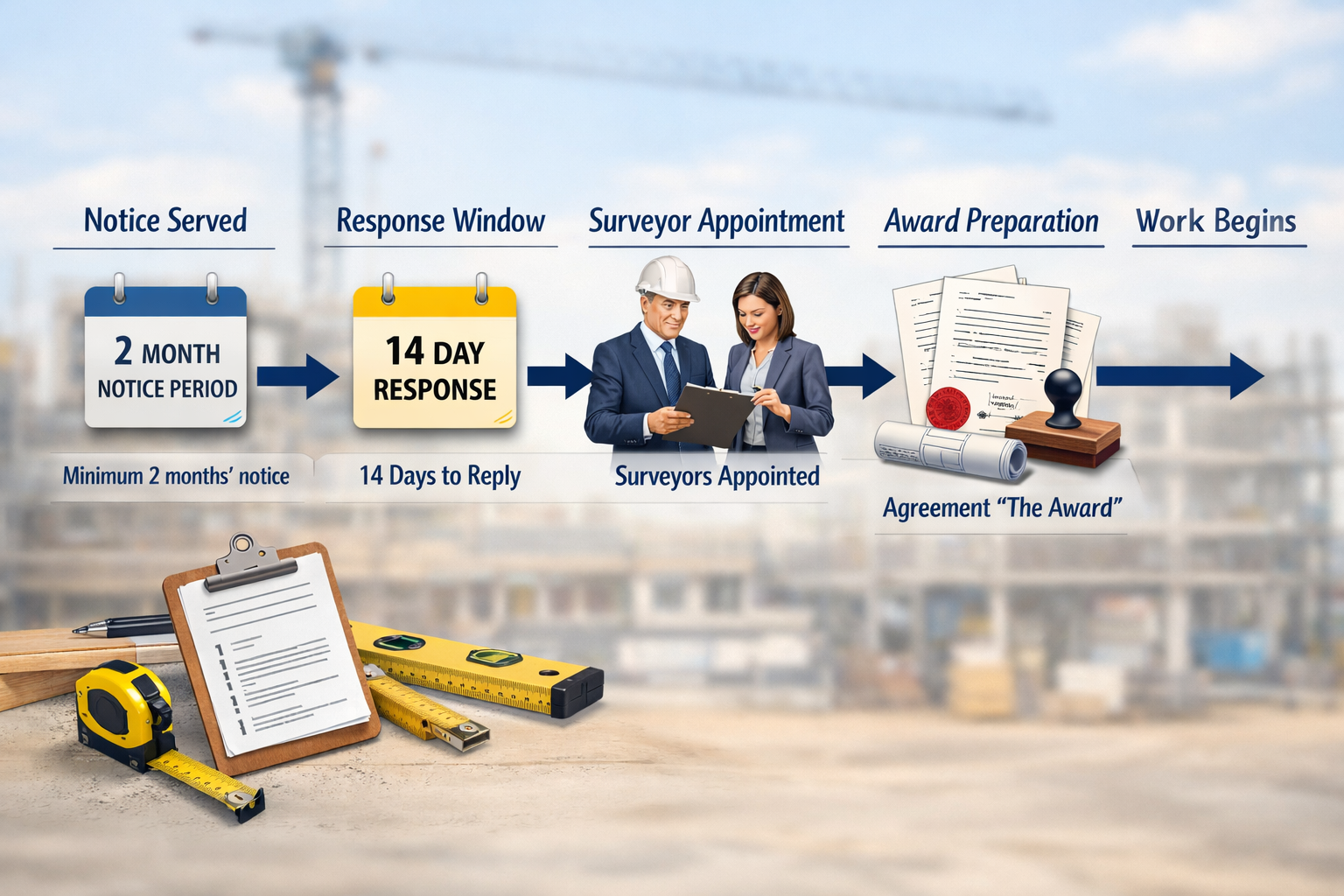
The Party Wall Act 1996 governs these procedures throughout England and Wales, requiring building owners to serve formal notice on neighbors at least two months before starting work on or near shared boundaries.[6] The award functions as both a permission document and a protective mechanism, ensuring that:
- 📋 Work specifications are clearly defined
- 🏗️ Construction methods are agreed upon
- 🛡️ Safeguards protect the adjoining property
- 💰 Cost responsibilities are established
- ⏰ Access rights and timing are documented
Types of Work Requiring Party Wall Awards
Not all construction work requires a party wall award, but several common scenarios trigger the Act's requirements:
| Work Type | Award Required? | Notice Period |
|---|---|---|
| Building on boundary line | ✅ Yes | 1 month |
| Work to existing party wall | ✅ Yes | 2 months |
| Loft conversions affecting party walls | ✅ Yes | 2 months |
| Excavations within 3 meters | ✅ Yes | 1 month |
| Insulation work on party walls | ✅ Yes | 2 months |
| Internal decorating only | ❌ No | N/A |
| Minor repairs not affecting structure | ❌ No | N/A |
Understanding when the Act applies prevents the common mistake of proceeding without proper notice—a situation that can lead to immediate injunctions and forced work stoppages.
The Legal Status of Party Wall Awards
Party wall awards carry significant legal weight. Once issued, they become binding on both parties and their successors in title for the specific works described.[5] However, a critical limitation exists: awards are personal to the original parties and cannot be assigned or transferred to new adjoining owners.[3]
This non-transferability creates important implications for property transactions. Buyers cannot rely on previously entered awards, meaning new owners may need to renegotiate terms or establish fresh agreements for ongoing or planned work. This characteristic makes understanding party wall procedures essential during property purchases.
The Party Wall Award Process: From Notice to Enforcement
Step 1: Serving the Party Wall Notice
The party wall process begins when a building owner serves formal notice on adjoining owners. The notice must include:
- Detailed description of proposed works
- Start date (at least 2 months in future for most work)
- Building owner's contact information
- Clear explanation of the adjoining owner's rights
Proper service is crucial. The notice must be delivered correctly—typically by hand, recorded delivery, or through a process server. Failure to serve notice properly can invalidate the entire process and expose building owners to legal action.
Step 2: The 14-Day Response Window
After receiving notice, adjoining owners have 14 days to respond in one of three ways:[5]
- Consent to the proposed work (no award needed if unconditional)
- Dissent or raise concerns (triggers award process)
- Fail to respond (deemed dissent, requires surveyor appointment)
"The 14-day response period is non-negotiable under the Act. Missing this deadline doesn't mean consent—it triggers the formal dispute resolution mechanism."
Many disputes arise from misunderstanding this timeline. Adjoining owners who fail to respond within 14 days haven't consented; instead, they've triggered the requirement for surveyor involvement.
Step 3: Appointing Surveyors
When disagreement occurs or no response is received, surveyors must be appointed. Three scenarios exist:
Agreed Surveyor Approach 🤝
Both parties agree to appoint a single surveyor to act impartially for both sides. This approach typically costs less and resolves matters more quickly.
Two Surveyor Approach 👥
Each party appoints their own surveyor, who then work together to prepare the award. If they cannot agree, they appoint a third surveyor to make final decisions.
Default Appointment ⚖️
If the adjoining owner refuses to appoint a surveyor, the building owner's surveyor can make the appointment on their behalf after following proper procedures.
Understanding party wall costs helps both parties budget appropriately. The building owner typically bears all reasonable surveyor fees, including those of the adjoining owner's surveyor.[8]
Step 4: Preparing the Award
The appointed surveyor(s) conduct a thorough assessment and prepare the award document, which typically includes:
- Detailed work description with technical specifications
- Schedule of condition documenting the adjoining property's current state
- Access provisions specifying when and how the building owner can access neighboring property
- Working hours and noise restrictions
- Security measures to protect the adjoining property
- Insurance requirements and indemnities
- Dispute resolution procedures for issues arising during work
The schedule of condition proves particularly valuable, providing photographic and written evidence of the adjoining property's pre-work condition. This documentation becomes crucial if damage claims arise later.
Step 5: Serving and Enforcing the Award
Once prepared, the award must be served on both parties. From the service date, either party has 14 days to appeal to the County Court if they believe the award is unfair or incorrect.[6]
If no appeal is filed, the award becomes fully enforceable. Building owners must:
- ✅ Comply with all award conditions
- ✅ Provide required notices before starting work
- ✅ Allow surveyor inspections during construction
- ✅ Address any damage promptly
- ✅ Maintain proper insurance coverage
Failure to comply with award terms can result in injunctions, damages claims, and personal liability for building owners.

Enforcing Party Wall Awards and Avoiding Injunctions in 2026
Common Enforcement Challenges
Even with a properly prepared award, enforcement issues can arise during construction. The most frequent challenges include:
Exceeding Award Scope 🚧
Building owners sometimes extend work beyond what the award covers, whether intentionally or through scope creep. Any work not specified in the award requires fresh notice and potentially a supplementary award.
Access Disputes 🚪
Awards typically grant specific access rights, but disagreements about timing, duration, or extent of access commonly occur. Clear communication and documented access schedules prevent most conflicts.
Damage Claims 💥
Despite precautions, construction work sometimes causes damage to adjoining properties. The schedule of condition becomes essential evidence when determining whether damage resulted from the building work.
Timeline Violations ⏰
Starting work before the notice period expires, working outside permitted hours, or causing excessive delays can all breach award terms and trigger enforcement action.
Understanding Injunctions: The Nuclear Option
An injunction represents the most serious enforcement mechanism available to adjoining owners. Courts can issue injunctions that:
- Immediately halt all construction work
- Require removal of completed work
- Impose substantial financial penalties
- Award legal costs to the successful party
Injunctions typically arise in three scenarios:
- No notice served – Work proceeds without following Party Wall Act procedures
- Award breach – Building owner violates specific award terms
- Excessive damage – Work causes significant harm beyond reasonable expectations
"Injunctions are expensive, disruptive, and damaging to all parties. Prevention through proper procedures and communication costs a fraction of the legal fees and project delays injunctions create."
Strategies to Prevent Injunctions
Building owners can significantly reduce injunction risk by implementing these proven strategies:
1. Start Early with Professional Guidance 📅
Engage party wall surveyors months before planned construction begins. Early involvement allows time for:
- Proper notice service with adequate lead time
- Thorough neighbor communication
- Detailed award preparation
- Resolution of concerns before work starts
2. Maintain Transparent Communication 💬
Regular updates to adjoining owners about:
- Construction schedules and timelines
- Any necessary scope changes
- Potential disruption periods
- Progress milestones
Many party wall disputes stem from poor communication rather than actual damage or violations.
3. Document Everything 📸
Comprehensive documentation protects all parties:
- Pre-work photographs and video
- Daily work logs and progress reports
- Communication records (emails, letters, meeting notes)
- Inspection reports and findings
- Any damage incidents and remediation
4. Respect Award Conditions Strictly ⚖️
Treat the award as non-negotiable. If circumstances require changes:
- Notify the surveyor immediately
- Obtain written approval before proceeding
- Consider supplementary awards for significant changes
- Never assume verbal agreements suffice
5. Maintain Adequate Insurance 🛡️
Ensure comprehensive insurance coverage that:
- Meets or exceeds award requirements
- Covers party wall-specific risks
- Includes adjoining property damage
- Provides sufficient liability limits
6. Conduct Regular Inspections 🔍
Schedule periodic inspections by the appointed surveyor(s):
- Before work commences (baseline condition)
- During critical construction phases
- Upon completion (final condition verification)
- When concerns arise from either party
Retrospective Awards: Addressing Post-Work Disputes
Sometimes party wall procedures aren't followed, or disputes arise after work completes. Retrospective party wall agreements can address these situations, though they're far less ideal than proper advance procedures.[6]
Retrospective awards may be necessary when:
- Work proceeded without proper notice
- Damage occurred and parties dispute responsibility
- Scope of completed work needs formal documentation
- Property sales require clarification of past work
Creating retrospective awards requires:
- Agreement from both parties to proceed
- Appointment of surveyor(s) to assess completed work
- Documentation of current property conditions
- Negotiation of any remediation or compensation
- Formal award documenting the resolution
Important limitation: Retrospective awards cannot cure fundamental procedural failures or prevent legal action for past breaches. They function best as settlement mechanisms when both parties prefer resolution over litigation.
Special Considerations for 2026
The Post-Pandemic Construction Boom
The construction industry continues experiencing unprecedented demand in 2026, with home improvements, extensions, and developments at record levels. This boom creates additional party wall considerations:
- Surveyor availability – High demand means booking surveyors well in advance
- Material delays – Supply chain issues may extend timelines beyond award specifications
- Cost fluctuations – Award cost provisions may need adjustment mechanisms
- Neighbor fatigue – Multiple nearby projects increase sensitivity to additional work
Technology and Party Wall Procedures
Digital tools increasingly support party wall processes:
- Electronic service of notices (with proper proof of delivery)
- Digital schedules of condition with timestamped photography
- Video inspection capabilities for remote surveyor involvement
- Blockchain-based award registration (emerging in some jurisdictions)
- AI-assisted damage detection and documentation
However, the fundamental legal requirements remain unchanged. Technology enhances but doesn't replace proper procedure.
Climate Considerations and Sustainability Work
Growing focus on energy efficiency and sustainability creates new party wall scenarios:
- Retrofit insulation affecting party walls
- Solar panel installations requiring structural assessment
- Heat pump installations impacting shared spaces
- Green roof systems on party structures
These works often require specialized surveyor expertise beyond traditional party wall matters, sometimes necessitating structural engineering input alongside party wall procedures.
Costs and Financial Considerations
Typical Party Wall Award Costs
Understanding costs helps parties budget appropriately:
| Item | Typical Range | Who Pays |
|---|---|---|
| Building owner's surveyor | £700-£1,500 | Building owner |
| Adjoining owner's surveyor | £700-£1,500 | Building owner |
| Third surveyor (if needed) | £1,000-£2,000 | Building owner |
| Schedule of condition | £300-£600 | Building owner |
| Award preparation | Included above | Building owner |
| Dispute resolution | £2,000-£10,000+ | Varies |
These represent typical scenarios for standard residential work. Complex commercial projects or contentious disputes can cost significantly more.[8]
Hidden Costs of Non-Compliance
Failing to follow proper procedures creates far greater expenses:
- Injunction legal fees: £5,000-£25,000+
- Work stoppage delays: Lost time, contractor standby costs
- Remediation costs: Removing and redoing non-compliant work
- Damage claims: Repairing adjoining property damage
- Relationship damage: Ongoing neighbor conflicts affecting property value
Prevention through proper party wall procedures costs a fraction of these potential expenses.
Conclusion
Party Wall Awards Explained: Enforcing Agreements and Avoiding Injunctions in 2026 requires understanding the complete lifecycle from initial notice through final enforcement. The Party Wall Act 1996 provides a robust framework that protects both building owners and their neighbors when properly followed, but shortcuts and procedural failures can result in costly injunctions, project delays, and damaged relationships.
Success depends on several key principles:
✅ Start early – Begin the party wall process months before construction
✅ Engage professionals – Qualified surveyors prevent costly mistakes
✅ Communicate clearly – Regular neighbor updates prevent misunderstandings
✅ Document thoroughly – Comprehensive records protect all parties
✅ Respect the award – Treat award conditions as binding requirements
✅ Address issues promptly – Quick responses to concerns prevent escalation
Next Steps for Building Owners
If you're planning construction work that may affect party walls in 2026:
- Assess your project against Party Wall Act requirements
- Engage a qualified party wall surveyor at least 3-4 months before planned work
- Prepare detailed work specifications for notice preparation
- Budget for all party wall costs including surveyor fees and potential awards
- Establish communication protocols with neighbors from the outset
- Review insurance coverage to ensure adequate protection
- Schedule pre-work inspections to document baseline conditions
Next Steps for Adjoining Owners
If you've received a party wall notice:
- Respond within 14 days – Don't let the deadline pass
- Review the notice carefully – Understand what work is proposed
- Consider appointing your own surveyor – Professional advice protects your interests
- Document your property's current condition – Take photographs and notes
- Communicate concerns clearly – Raise issues early in the process
- Understand your rights – Know what protections the Act provides
The construction boom of 2026 shows no signs of slowing, making party wall awareness more important than ever. Whether you're undertaking building work or responding to a neighbor's plans, proper procedures, professional guidance, and clear communication form the foundation for successful projects that avoid injunctions and maintain positive neighbor relationships.
For complex projects or contentious situations, seeking early professional advice from experienced party wall surveyors and legal advisors provides the best protection for all parties involved. The modest investment in proper procedures pays dividends through smooth project execution, protected property interests, and preserved neighborhood harmony.
References
[3] Buying Property Party Wall Award – https://osborneslaw.com/blog/buying-property-party-wall-award/
[5] Party Wall Awards – https://huntsmaneldridge.co.uk/party-wall-awards/
[6] Party Wall Agreement – https://hoa.org.uk/advice/guides-for-homeowners/i-am-improving/party-wall-agreement/
[8] Party Wall Surveyor Cost – https://hoa.org.uk/advice/guides-for-homeowners/i-am-improving/party-wall-surveyor-cost/