

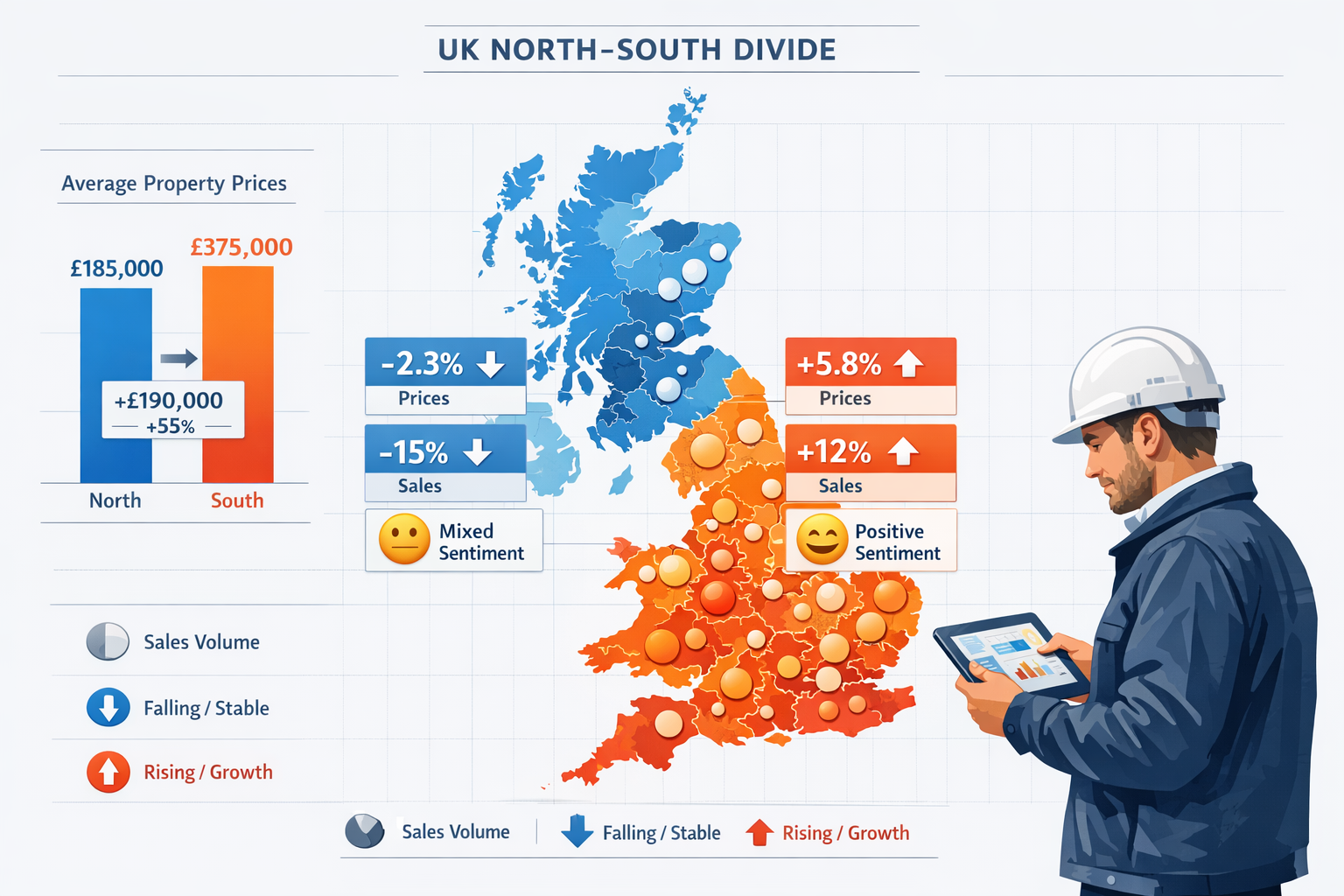
The UK property market in 2026 presents a tale of two nations. While southern regions continue to command premium valuations and attract robust buyer demand, northern markets face stagnant prices and cautious sentiment. This regional divergence creates significant challenges for property surveyors who must navigate vastly different market conditions, valuation methodologies, and client expectations across geographical boundaries. Understanding Regional Divergence in 2026 Valuations: Surveyor Strategies for North-South Price Gaps and Market Sentiment Mismatches has become essential for professionals delivering accurate, defensible valuations in an increasingly polarized market.
The divide between North and South extends beyond simple price differences. Transaction volumes, buyer sentiment, lending appetite, and market liquidity vary dramatically, requiring surveyors to adapt their approaches based on regional characteristics. This complexity demands sophisticated strategies that account for local market dynamics while maintaining professional standards and regulatory compliance.
Key Takeaways
- 📊 Price gaps between North and South UK regions have widened significantly in 2026, requiring surveyors to apply region-specific valuation adjustments and comparable selection criteria
- 🎯 Market sentiment mismatches demand different methodological approaches, with southern markets requiring premium justification while northern valuations focus on realistic pricing and risk assessment
- 🔍 Surveyors must integrate local market intelligence with standardized RICS Red Book methodologies to deliver credible valuations across diverse regional conditions
- 💡 Transaction volume disparities affect comparable evidence availability, necessitating creative sourcing strategies and expanded geographical search parameters in slower markets
- ⚖️ Expert witness work increasingly involves defending regional valuation differences, requiring comprehensive documentation of market condition variations and methodology selection rationale
Understanding Regional Divergence in 2026 Valuations Across UK Markets
The geographical split in UK property valuations reflects fundamental economic differences that have accelerated through 2026. Southern regions, particularly Greater London and the South East, continue to benefit from concentrated employment opportunities, infrastructure investment, and international buyer interest. Meanwhile, northern markets face headwinds from economic restructuring, slower wage growth, and reduced investment activity [1].
The Scale of North-South Price Gaps
Current data reveals substantial valuation disparities across UK regions. Average property prices in London and the South East exceed those in northern regions by 60-80% for comparable property types. This gap has widened by approximately 12% since 2024, creating challenges for registered RICS valuers working across multiple markets [2].
Key Regional Price Indicators (2026):
| Region | Average Price | YoY Change | Transaction Volume Change |
|---|---|---|---|
| London | £685,000 | +4.2% | +8% |
| South East | £475,000 | +3.8% | +6% |
| South West | £395,000 | +2.9% | +4% |
| North West | £245,000 | +0.8% | -2% |
| North East | £185,000 | -0.5% | -5% |
| Yorkshire | £225,000 | +0.3% | -1% |
These variations create immediate challenges for surveyors conducting valuations across regions. A property professional working in North West London applies fundamentally different market assumptions than colleagues operating in northern cities, even when assessing similar property types.
Market Sentiment Mismatches and Their Impact
Beyond raw price data, market sentiment varies dramatically between regions. Southern markets demonstrate confidence, with buyers willing to pay premiums for quality properties and accepting competitive bidding scenarios. Northern markets exhibit caution, with buyers negotiating aggressively and requiring significant price justification [3].
This sentiment divergence affects multiple valuation factors:
- Comparable evidence interpretation – Similar properties command different premiums based on regional demand
- Market exposure periods – Southern properties sell faster, affecting forced sale scenarios
- Adjustment factors – Regional markets respond differently to property characteristics
- Risk assessment – Lending institutions apply varying loan-to-value ratios by region
"The challenge for surveyors in 2026 isn't just measuring price differences—it's understanding the fundamentally different market dynamics driving those differences and translating that understanding into defensible valuations." – RICS Valuation Standards
Professionals conducting valuation assessments must recognize these sentiment variations when selecting methodologies and justifying conclusions.
Surveyor Strategies for Addressing Regional Divergence in 2026 Valuations
Effective valuation practice in 2026 requires strategic adaptations that acknowledge regional differences while maintaining professional standards. Surveyors must develop region-specific expertise while applying consistent methodological frameworks.
Methodology Selection Based on Regional Characteristics
The choice of valuation approach should reflect regional market conditions. In liquid southern markets with abundant comparable evidence, comparative method valuations provide robust support. Northern markets with limited transaction activity may require greater emphasis on investment method approaches or depreciated replacement cost for specialized properties [4].
Regional Methodology Framework:
🏠 High-Liquidity Southern Markets:
- Primary reliance on comparative method with recent sales evidence
- Tight comparable selection criteria (within 3 months, 0.5-mile radius)
- Premium adjustments for desirable characteristics well-supported by market evidence
- Market value typically reflects optimistic buyer sentiment
🏘️ Lower-Liquidity Northern Markets:
- Broader comparable search parameters (6-12 months, wider geographical area)
- Greater emphasis on investment yields and rental evidence
- Conservative adjustment factors reflecting buyer caution
- Market value considerations include realistic marketing periods
Local chartered surveyors with regional expertise provide crucial advantages in applying these differentiated approaches effectively.
Comparable Evidence Strategies Across Regions
Sourcing and analyzing comparable evidence requires region-specific strategies. Southern markets offer abundant recent transactions but require careful screening to identify truly comparable properties within rapidly appreciating markets. Northern markets present the opposite challenge—limited recent sales necessitate creative sourcing and careful temporal adjustments [5].
Best Practices for Regional Comparable Selection:
✅ Southern Market Strategies:
- Prioritize most recent transactions (last 3 months)
- Apply strict location matching within micro-markets
- Document premium features driving price variations
- Consider off-market transactions and withdrawn listings
- Account for bidding war scenarios in adjustment factors
✅ Northern Market Strategies:
- Extend search timeframe to 6-12 months for adequate sample size
- Expand geographical search radius while documenting location adjustments
- Incorporate asking price reductions as market sentiment indicators
- Consider rental yields as supporting valuation evidence
- Document extended marketing periods in market commentary
Surveyors working across regions, such as those covering both South East London and northern territories, must maintain separate comparable databases reflecting these regional differences.
Regional Adjustment Factors and Market Intelligence
Applying appropriate adjustment factors requires deep understanding of what buyers value in each regional market. Southern buyers may pay significant premiums for period features, outdoor space, or proximity to transport links. Northern buyers often prioritize practical considerations like energy efficiency and low maintenance costs [6].
Regional Adjustment Factor Variations:
| Feature | South London Impact | North England Impact |
|---|---|---|
| Period features | +8-15% | +2-5% |
| Private garden | +12-20% | +5-8% |
| Transport proximity | +10-18% | +3-6% |
| Modern efficiency | +5-8% | +8-12% |
| Parking | +8-12% | +10-15% |
These variations require surveyors to maintain regional market intelligence systems that track buyer preferences, emerging trends, and sentiment shifts. Regular engagement with local estate agents, attendance at property auctions, and monitoring of regional property portals provides essential market knowledge.
Technology and Data Integration for Regional Analysis
Modern valuation practice increasingly relies on technology to manage regional complexity. Automated Valuation Models (AVMs) provide useful baseline data but require careful interpretation and regional calibration. Surveyors must supplement algorithmic outputs with professional judgment reflecting local market nuances [7].
Technology Applications for Regional Valuation:
💻 Data Management Tools:
- Regional comparable databases with automated updates
- Market trend tracking dashboards by postcode sector
- Transaction volume monitoring and liquidity indicators
- Sentiment analysis from property portal data
📱 Field Technology:
- Mobile inspection apps with regional template adjustments
- Photographic documentation with GPS tagging
- Real-time comparable searches during site visits
- Digital measurement tools ensuring consistency
Professionals offering specialized services like insurance reinstatement valuations must ensure their technology accounts for regional variations in rebuild costs and contractor availability.
Expert Witness Approaches to Regional Divergence in 2026 Valuations and Price Gap Defense

The widening regional divide has increased disputes requiring expert witness testimony. Surveyors must defend valuation conclusions that may appear inconsistent when viewed without regional context. This demands rigorous methodology documentation and clear communication of regional market factors [8].
Building Defensible Regional Valuation Reports
Expert witness work requires valuation reports that anticipate challenges and provide comprehensive regional context. Simply stating a valuation figure without extensive market analysis proves insufficient when regional variations come under scrutiny.
Essential Components of Regional Valuation Reports:
📋 Market Context Section:
- Detailed regional market analysis with statistical support
- Transaction volume trends and liquidity indicators
- Comparative regional performance data
- Sentiment indicators and buyer behavior patterns
- Economic factors affecting regional demand
📋 Methodology Justification:
- Clear explanation of approach selection based on regional characteristics
- Discussion of alternative methods considered and rejected
- Regional-specific assumption documentation
- Comparable selection criteria with regional justification
- Adjustment factor derivation with regional market evidence
📋 Comparable Evidence Documentation:
- Comprehensive comparable schedules with location maps
- Detailed adjustment explanations referencing regional norms
- Supporting evidence from multiple sources
- Market intelligence from local agents and auction results
- Temporal adjustments reflecting regional price trends
Surveyors providing ATED valuations or capital gains tax valuations must ensure reports withstand HMRC scrutiny, particularly when values differ significantly from regional averages.
Addressing Cross-Regional Comparison Challenges
Expert witnesses frequently face challenges when opposing parties compare valuations across regions without proper context. A property valued at £400,000 in South West London might be questioned by referencing a seemingly similar property in northern England valued at £180,000.
Strategies for Defending Regional Variations:
🎯 Establish Regional Market Fundamentals:
- Present comprehensive economic data supporting regional differences
- Document employment, wage, and demographic variations
- Provide historical price trend analysis showing divergence patterns
- Reference authoritative regional market reports and indices
🎯 Demonstrate Methodology Consistency:
- Show identical methodological frameworks applied across regions
- Explain how regional inputs drive different outputs
- Document regional calibration of standard valuation approaches
- Provide sensitivity analysis showing impact of regional assumptions
🎯 Educate on Market Dynamics:
- Explain liquidity differences and their valuation impact
- Clarify sentiment variations and buyer behavior patterns
- Demonstrate how supply-demand imbalances vary regionally
- Reference comparable expert opinions supporting regional approaches
Handling Market Sentiment Mismatch Disputes
Disputes often arise when market sentiment shifts between valuation date and dispute resolution. A property valued optimistically during a southern market peak may face challenge when sentiment subsequently deteriorates. Conversely, conservative northern valuations may appear pessimistic if local markets improve [9].
Expert Witness Approaches to Sentiment Defense:
✍️ Temporal Context Documentation:
- Comprehensive market conditions analysis at valuation date
- Sentiment indicators and market intelligence from valuation period
- Transaction evidence contemporary to valuation date
- Forward-looking statements qualified with appropriate caveats
✍️ Hindsight Bias Management:
- Clear distinction between valuation date knowledge and subsequent events
- Documentation of information reasonably available at valuation date
- Explanation of how professional judgment reflected known conditions
- Rebuttal of retrospective analysis using post-valuation data
✍️ Alternative Scenario Analysis:
- Sensitivity testing showing valuation range under different assumptions
- Discussion of optimistic versus conservative approaches
- Justification of adopted position within reasonable range
- Acknowledgment of uncertainty in rapidly changing markets
Professionals conducting Red Book valuations must ensure compliance with RICS standards while providing sufficient flexibility to address regional variations and market uncertainty.
Regional Expertise and Credibility Building
Expert witness credibility depends significantly on demonstrated regional expertise. Surveyors testifying about valuations in unfamiliar regions face credibility challenges that can undermine otherwise sound technical work [10].
Building Regional Expert Witness Credibility:
🏆 Expertise Documentation:
- Maintain detailed records of regional valuation experience
- Document continuing professional development in regional markets
- Establish relationships with local market participants
- Publish or present on regional market topics
- Participate in regional professional organizations
🏆 Report Quality Indicators:
- Extensive regional market knowledge demonstration
- Local comparable evidence with detailed analysis
- References to regional market reports and data sources
- Consultation with local agents and professionals
- Site inspection observations reflecting local market understanding
🏆 Cross-Examination Preparation:
- Comprehensive regional market data compilation
- Anticipation of regional comparison challenges
- Prepared responses to alternative valuation scenarios
- Supporting documentation for all regional assumptions
- Clear articulation of regional methodology adaptations
Surveyors working across diverse locations, from Watford to Surrey, must maintain expertise across their operational territories to provide credible expert witness services.
Practical Implementation: Regional Valuation Workflows for 2026
Translating regional strategies into daily practice requires systematic workflows that embed regional considerations throughout the valuation process. Successful firms develop standardized procedures that maintain consistency while accommodating regional variations.
Regional Market Intelligence Systems
Establishing robust market intelligence systems provides the foundation for effective regional valuation practice. These systems should capture both quantitative data and qualitative market insights across operational territories.
Market Intelligence Framework Components:
📊 Quantitative Data Tracking:
- Regional price indices and transaction volumes
- Days on market statistics by postcode sector
- Asking price versus achieved price ratios
- Mortgage approval rates and lending conditions
- Rental yield trends and void periods
📊 Qualitative Intelligence Gathering:
- Regular agent consultations and market feedback
- Auction attendance and result analysis
- Development pipeline monitoring
- Infrastructure project tracking
- Local economic news and employment trends
Client Communication Strategies for Regional Variations
Clients often struggle to understand why similar properties receive different valuations across regions. Effective communication prevents disputes and manages expectations from initial instruction through report delivery.
Regional Communication Best Practices:
💬 Instruction Stage:
- Discuss regional market conditions affecting the subject property
- Set realistic valuation range expectations based on local market
- Explain regional methodology considerations
- Clarify comparable evidence availability in the area
- Address client preconceptions about regional differences
💬 Reporting Stage:
- Include comprehensive regional market commentary
- Use comparative regional data to contextualize findings
- Provide clear explanation of regional adjustment factors
- Offer visual aids showing regional market trends
- Anticipate and address potential client questions
💬 Post-Report Support:
- Offer follow-up discussions to clarify regional factors
- Provide additional market evidence if requested
- Address challenges to regional assumptions promptly
- Maintain documentation of all client communications
- Update clients on significant regional market changes
Quality Assurance for Regional Consistency
Maintaining quality across regional valuations requires systematic review processes that identify inconsistencies while respecting legitimate regional variations.
Regional QA Framework:
✔️ Technical Review Checklist:
- Regional methodology selection appropriateness
- Comparable evidence quality and regional relevance
- Adjustment factor alignment with regional norms
- Market commentary accuracy and comprehensiveness
- Assumption documentation completeness
✔️ Cross-Regional Consistency Review:
- Methodology application consistency across regions
- Adjustment factor logic and proportionality
- Report structure and content standardization
- Professional standards compliance verification
- Regional expertise demonstration adequacy
Emerging Trends Affecting Regional Divergence in 2026 Valuations
Several developing trends will influence regional valuation strategies throughout 2026 and beyond. Surveyors must monitor these factors and adapt approaches accordingly.
Remote Working Impact on Regional Demand
The stabilization of hybrid working patterns continues to influence regional property demand. Southern commuter belt areas experience sustained demand from buyers seeking larger properties while maintaining occasional office access. Northern cities benefit from remote workers relocating for affordability, though this effect remains modest compared to southern market dynamics [4].
Valuation Implications:
- Reassessment of location premium factors based on commuting patterns
- Increased value attribution to home office space in all regions
- Regional variations in outdoor space premiums
- Connectivity infrastructure becoming universal value driver
Infrastructure Investment and Regional Rebalancing
Government infrastructure commitments aim to reduce regional disparities, though implementation timelines extend beyond 2026. Surveyors must assess how announced projects affect current valuations while avoiding over-optimistic assumptions about delivery [6].
Strategic Considerations:
- Distinguish between announced, funded, and under-construction projects
- Apply appropriate risk adjustments for delivery uncertainty
- Monitor regional regeneration initiatives and their market impact
- Consider infrastructure improvements in long-term value projections
Climate Resilience and Regional Risk Variations
Climate-related risks vary significantly across UK regions, affecting valuations through insurance costs, flood risk, and energy efficiency requirements. Southern coastal areas face different challenges than northern industrial regions [5].
Regional Risk Assessment:
- Flood risk mapping and insurance availability by region
- Energy efficiency standards and retrofit costs variations
- Climate adaptation infrastructure investment patterns
- Regional building regulation enforcement differences
Conclusion
Regional Divergence in 2026 Valuations: Surveyor Strategies for North-South Price Gaps and Market Sentiment Mismatches represents one of the most significant challenges facing UK property professionals today. The widening gap between regional markets demands sophisticated approaches that balance standardized methodologies with regional market realities.
Successful surveyors in 2026 recognize that effective valuation practice requires deep regional expertise combined with rigorous adherence to professional standards. The strategies outlined—from differentiated methodology selection to comprehensive market intelligence systems—provide frameworks for delivering credible valuations across diverse market conditions.
The key to navigating regional divergence lies in documentation, expertise, and communication. Surveyors must document regional assumptions comprehensively, develop genuine expertise in their operational territories, and communicate regional factors clearly to clients and in expert witness contexts.
Actionable Next Steps for Surveyors
🎯 Immediate Actions:
- Audit current valuation reports for regional context adequacy
- Establish systematic regional market intelligence gathering processes
- Review and update comparable databases with regional segmentation
- Develop region-specific valuation templates and checklists
🎯 Medium-Term Development:
- Pursue continuing professional development focused on regional markets
- Build relationships with local market participants across operational areas
- Implement technology solutions for regional data management
- Create comprehensive regional market analysis frameworks
🎯 Long-Term Strategic Planning:
- Develop recognized regional expertise through publication and presentation
- Build expert witness capabilities with strong regional credentials
- Establish quality assurance processes ensuring regional consistency
- Monitor emerging trends affecting regional market dynamics
The regional divergence characterizing UK property markets in 2026 will likely persist for years to come. Surveyors who develop robust strategies for addressing these variations will deliver superior value to clients while building defensible expert witness credentials. By combining technical excellence with deep regional market understanding, professionals can navigate even the most complex valuation scenarios with confidence.
For surveyors seeking to enhance their regional valuation capabilities, partnering with experienced professionals who understand local market nuances provides valuable insights and collaborative opportunities. The future of valuation practice belongs to those who can master regional complexity while maintaining unwavering professional standards.
References
[1] Will Commercial Real Estate Valuations Improve 2026 – https://privatewealth.brookfield.com/insight/will-commercial-real-estate-valuations-improve-2026
[2] Rethinking Commercial Real Estate Valuations In 2026 – https://svn.com/cre-insights/cre-blog/rethinking-commercial-real-estate-valuations-in-2026/
[3] Commercial Real Estate Outlook For 2026 – https://www.pbmares.com/commercial-real-estate-outlook-for-2026/
[4] U S Commercial Real Estate In 2026 A Sector By Sector Outlook – https://www.nmrk.com/insights/thought-leadership/u-s-commercial-real-estate-in-2026-a-sector-by-sector-outlook
[5] Commercial Real Estate Outlook – https://www.deloitte.com/us/en/insights/industry/financial-services/commercial-real-estate-outlook.html
[6] Commercial Real Estate Trends – https://www.jpmorgan.com/insights/real-estate/commercial-real-estate/commercial-real-estate-trends
[7] Us Real Estate Market Outlook 2026 – https://www.cbre.com/insights/books/us-real-estate-market-outlook-2026
[8] 2026 Commercial Real Estate Outlook – https://investments.metlife.com/insights/real-estate/2026-commercial-real-estate-outlook/
[9] Top Commercial Real Estate Operational Trends To Watch In 2026 – https://www.bgsf.com/post/top-commercial-real-estate-operational-trends-to-watch-in-2026
[10] 2026 Commercial Real Estate Outlook Stabilization Selectivity And A Market That Rewards Precision – https://bbgres.com/2026-commercial-real-estate-outlook-stabilization-selectivity-and-a-market-that-rewards-precision/