

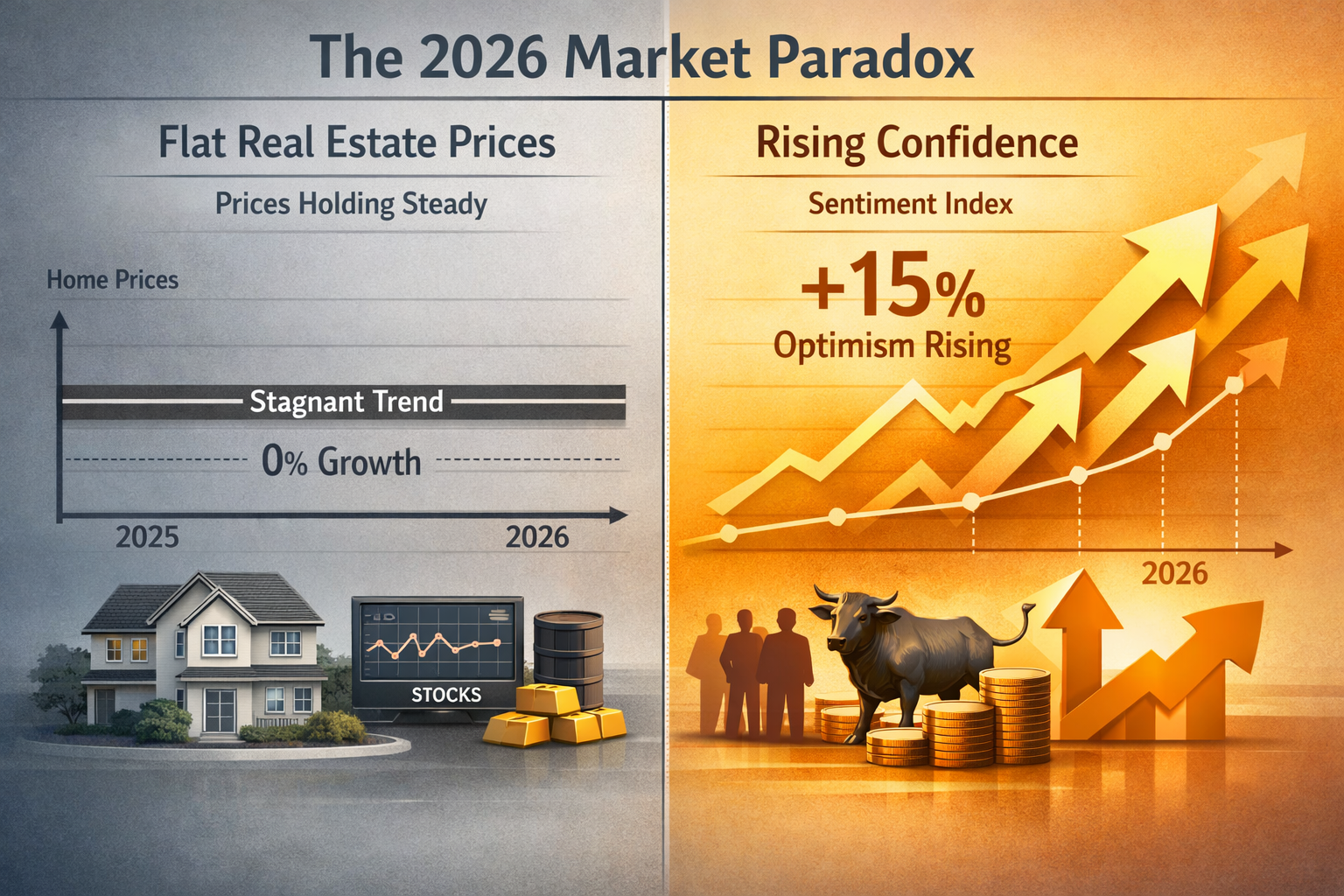
The year 2026 presents property valuers with an unusual challenge: market sentiment is improving, lenders are returning to the table, and investors are positioning for growth—yet actual transaction prices remain stubbornly flat. This paradox creates a critical question for surveyors: how do you accurately value property when current data points one direction and forward-looking indicators point another?
Understanding valuation accuracy in stabilizing markets requires surveyors to recalibrate their assessment methodologies. When price momentum remains subdued but sentiment strengthens, traditional valuation approaches that rely heavily on recent comparable sales may undervalue properties, while overly optimistic projections risk inflating assessments beyond supportable levels. The key lies in balancing current market evidence with carefully weighted forward-looking factors.

Key Takeaways
- Cap rates have stabilized across most property sectors as of mid-2026, with valuation movements now driven by asset quality and location rather than broad market repricing[1]
- Commercial real estate valuations remain approximately 17% below peak levels, creating attractive entry points while requiring careful assessment of recovery trajectories[3]
- Supply discipline and moderating construction pipelines are supporting valuation stabilization, enabling surveyors to apply more normalized methodologies after years of disruption[1]
- Quality divergence is sharpening, requiring surveyors to apply more granular adjustments between high-performing and challenged assets within the same property class[1]
- Geographic variation is significant, with coastal markets showing modest appreciation while Sun Belt regions face continued price pressure from pandemic-era construction gluts[4]
Understanding the 2026 Market Paradox: Flat Prices Meet Rising Confidence
The Disconnect Between Current Transactions and Future Expectations
Market participants in 2026 are witnessing an unusual phenomenon: pricing has found a floor across most commercial asset classes and quality levels, yet actual transaction volumes and price appreciation remain muted[3]. This stabilization follows a two-year period of credit constraints and valuation uncertainty that disrupted traditional price discovery mechanisms.
The disconnect stems from several converging factors:
📊 Current Market Conditions:
- Transaction prices showing minimal month-over-month movement
- Cap rates holding steady rather than compressing or expanding
- Limited distressed sales creating price stability
- Buyers and sellers maintaining disciplined positions
📈 Improving Sentiment Indicators:
- Commercial mortgage-backed securities issuance exceeded $125 billion in 2025—the highest since 2007[3]
- Three rate cuts in 2025 improving cash flow coverage metrics
- Increased lender participation restoring valuation confidence
- Institutional investors viewing current levels as attractive entry points[3]
This creates what surveyors must recognize as a transitional valuation environment. Properties are no longer experiencing the downward pressure of 2023-2024, but recovery momentum hasn't yet translated into measurable price appreciation. For those seeking guidance on valuation approaches during market transitions, understanding Red Book valuation standards provides essential framework for maintaining professional standards.
Regional and Sector-Specific Variations
The stabilization narrative masks significant variation across geographies and property types. J.P. Morgan projects U.S. house prices to stall at 0% appreciation nationally in 2026, but this aggregate figure conceals dramatic regional divergence[4]. Strong coastal markets like Montecito and Santa Barbara are projected to see modest home value appreciation of 3% to 6%, while West Coast and Sun Belt markets face continued price declines due to pandemic-era construction gluts[2][4].
Commercial sectors show similar variation:
| Property Sector | Valuation Trend | Key Drivers |
|---|---|---|
| Industrial | Transitioning toward balance | Slowing deliveries, stabilizing absorption[1] |
| Multifamily | Regional divergence | Oversupply in Sun Belt, strength in coastal markets[1] |
| Office | Sharp quality bifurcation | Class A stability vs. challenged secondary assets[1] |
| Retail | Selective strength | Limited new supply, stable occupancy[1] |
This variation requires surveyors to apply granular, asset-specific adjustments rather than relying on broad market trends. The price of valuation services often reflects this increased complexity, as thorough assessments in stabilizing markets demand more detailed analysis than straightforward trending markets.

Valuation Accuracy in Stabilizing Markets: Methodological Adjustments Surveyors Must Make
Weighting Current Data Against Forward-Looking Indicators
The fundamental challenge in achieving valuation accuracy in stabilizing markets lies in determining appropriate weight between backward-looking comparable transactions and forward-looking market indicators. Traditional valuation methodologies heavily emphasize recent comparable sales, but in stabilizing markets where sentiment has shifted faster than transaction prices, this approach can systematically undervalue properties.
🔍 Enhanced Comparable Analysis:
Surveyors must expand their comparable analysis beyond simple price-per-square-foot metrics to include:
- Transaction timing context: Sales from six months ago may reflect market conditions that no longer exist
- Buyer motivation analysis: Distinguishing between distressed sales, opportunistic purchases, and normalized transactions
- Financing terms: Properties sold with favorable seller financing may not reflect true market value
- Quality tier classification: Ensuring comparables match not just property type but quality level within that type[1]
📊 Incorporating Forward-Looking Adjustments:
While maintaining professional skepticism about speculative projections, surveyors can incorporate measurable forward-looking factors:
- Supply pipeline analysis: Quantifying how moderating construction will affect future supply-demand balance[1]
- Lending condition improvements: Adjusting cap rates to reflect improved financing availability[3]
- Occupancy trend analysis: Distinguishing between temporary occupancy and sustainable tenant demand
- Rent growth trajectories: Using lease renewal data and market surveys to project stabilized income
The key is applying these adjustments with documented justification rather than subjective optimism. Professional valuation reports should clearly articulate the rationale for any forward-looking adjustments and sensitivity test conclusions against alternative scenarios.
Quality Tier Differentiation in Asset Valuation
One of the most significant shifts in 2026 valuation practice is the sharpening quality divergence across property types. Office performance, for example, now diverges sharply between high-quality and challenged assets, while retail and specialty sectors benefit from limited new supply and stable occupancy[1]. This requires surveyors to apply more sophisticated quality adjustments than simple property type classifications.
Quality Assessment Framework:
| Quality Tier | Valuation Characteristics | Assessment Approach |
|---|---|---|
| Class A / Premium | Stable occupancy, institutional tenants, modern systems | Apply market cap rates with minimal risk premium |
| Class B / Standard | Moderate occupancy, mixed tenant quality, functional systems | Add quality risk premium, emphasize tenant retention |
| Class C / Challenged | Vacancy concerns, deferred maintenance, functional obsolescence | Significant risk adjustment, focus on replacement cost floor |
This differentiation extends beyond commercial properties to residential valuations as well. When conducting homebuyer surveys, surveyors must carefully assess property condition and market positioning to determine whether a home will participate in regional appreciation trends or lag due to quality concerns.
Adjusting Capitalization Rates for Market Stabilization
Capitalization rates remained generally stable as of mid-February 2026, with movements increasingly tied to asset quality and market selection rather than broad-based repricing[1]. This stability represents a significant shift from the expanding cap rates of 2023-2024 and provides surveyors with more reliable benchmarking data.
However, stability doesn't mean uniformity. Surveyors must consider:
Cap Rate Adjustment Factors:
- ✅ Credit availability: Improved lending conditions support modest cap rate compression for quality assets[3]
- ✅ Risk premium calibration: Higher-risk assets maintaining wider spreads to core properties
- ✅ Market liquidity: More active transaction markets supporting tighter cap rate ranges
- ✅ Income stability: Properties with long-term lease coverage commanding premium pricing
The transition from market distress to stabilization typically sees cap rates stabilize first, then gradually compress as confidence builds. Surveyors in 2026 are navigating the early stages of this compression, requiring careful judgment about how much future compression to incorporate into current valuations.
Practical Applications: How Surveyors Adjust Assessments When Price Momentum Remains Subdued but Sentiment Strengthens
Scenario-Based Valuation Modeling
Given the uncertainty inherent in stabilizing markets, scenario-based valuation modeling has become essential practice for professional surveyors in 2026. Rather than producing a single point estimate, comprehensive valuations should present a range of supportable values under different market trajectory assumptions.
Three-Scenario Framework:
-
Base Case (Most Likely): Assumes continued stabilization with modest improvement
- Current cap rates held constant
- Moderate rent growth aligned with inflation
- Supply-demand balance maintained
- Provides primary valuation conclusion
-
Conservative Case: Assumes slower recovery or renewed headwinds
- Slight cap rate expansion for risk
- Flat to minimal rent growth
- Extended lease-up periods
- Establishes valuation floor
-
Optimistic Case: Assumes accelerated recovery and sentiment conversion
- Modest cap rate compression
- Above-inflation rent growth
- Strong absorption and occupancy gains
- Establishes valuation ceiling
This approach provides clients with transparent risk assessment while maintaining professional objectivity. It's particularly valuable for property valuations where buyers and sellers may have significantly different views of market direction.
Incorporating Supply Pipeline Intelligence
One of the most reliable forward-looking indicators in stabilizing markets is the construction pipeline analysis. Supply discipline and moderating construction pipelines are actively supporting valuation stabilization across property types[1], making this a data-driven rather than speculative adjustment factor.
Supply Analysis Components:
📋 Pipeline Quantification:
- Units under construction with expected delivery dates
- Permitted projects not yet started
- Proposed developments in planning stages
- Historical absorption rates for context
📋 Market Impact Assessment:
- Comparison of pipeline supply to historical absorption capacity
- Geographic concentration of new supply
- Quality tier of incoming supply relative to subject property
- Timeline for supply delivery and market absorption
For example, industrial and multifamily sectors are transitioning toward balance, with deliveries slowing and absorption stabilizing[1]. Surveyors can use this documented trend to support valuations that reflect improving supply-demand fundamentals even before transaction prices fully reflect the shift.
Balancing Professional Skepticism with Market Reality
The ethical challenge for surveyors in stabilizing markets is maintaining professional skepticism while acknowledging genuine market improvement. Overvaluing properties based on sentiment rather than evidence violates professional standards, but systematically undervaluing properties by ignoring measurable forward indicators equally fails to serve clients.
Professional Standards Framework:
✅ Document all assumptions: Every forward-looking adjustment must be explicitly stated and justified
✅ Sensitivity test conclusions: Show how valuation changes under alternative assumptions
✅ Distinguish fact from projection: Clearly separate observed market data from forecasted trends
✅ Apply consistent methodology: Use the same analytical framework across comparable assignments
✅ Disclose uncertainty: Acknowledge limitations and market volatility in valuation conclusions
For surveyors working across multiple specializations—from divorce valuations to probate valuations—maintaining this balance is crucial. Different valuation purposes may require different emphasis on current versus prospective value, but all require transparent methodology and supportable conclusions.
Geographic Specificity in Valuation Adjustments
The significant geographic variation in 2026 market conditions demands location-specific analysis rather than national trend application. While aggregate statistics provide context, surveyors must ground valuations in local market fundamentals.
Location-Specific Factors:
🏘️ Local Economic Drivers:
- Employment growth and industry diversification
- Population migration patterns
- Infrastructure investment and development
- Regulatory environment and zoning changes
🏘️Submarket Supply-Demand:
- Neighborhood-level inventory analysis
- School district quality and demographic trends
- Transportation access and commute patterns
- Retail, services, and amenity availability
Strong coastal markets demonstrating 3-6% appreciation potential require different valuation approaches than Sun Belt markets facing continued price pressure[2][4]. Surveyors must resist the temptation to apply broad regional trends to specific properties without confirming local market alignment.
This geographic specificity is why chartered surveyors in specific locations often provide more accurate valuations than distant professionals relying on aggregate data—local market knowledge enables nuanced assessment of how broader trends manifest in specific submarkets.
Conclusion: Navigating Valuation Accuracy in Stabilizing Markets
The 2026 property market presents surveyors with a sophisticated challenge: valuing assets in a transitional environment where current transaction data lags improving market fundamentals. Successfully navigating valuation accuracy in stabilizing markets requires methodological evolution beyond traditional comparable sales analysis.
Key principles for surveyors in 2026:
🎯 Balance current evidence with forward indicators: Weight recent transactions appropriately while incorporating measurable forward-looking factors like supply pipelines and lending conditions
🎯 Apply granular quality differentiation: Recognize that stabilization benefits vary dramatically by asset quality, requiring tier-specific valuation approaches
🎯 Embrace scenario-based modeling: Present valuation ranges that acknowledge uncertainty while providing clear primary conclusions
🎯 Maintain geographic specificity: Ground valuations in local market fundamentals rather than national trends
🎯 Document methodology transparently: Ensure all assumptions and adjustments are explicitly stated and professionally justified
Actionable Next Steps for Property Professionals
For surveyors seeking to enhance valuation accuracy in stabilizing markets:
-
Develop enhanced comparable databases that include transaction context, financing terms, and buyer motivation—not just price and property characteristics
-
Build supply pipeline tracking systems for your primary markets, enabling data-driven forward-looking adjustments rather than subjective projections
-
Create standardized scenario modeling templates that ensure consistent application of alternative market trajectory assumptions across valuations
-
Establish quality tier classification frameworks for each property type you regularly value, with specific criteria for tier assignment and corresponding valuation adjustments
-
Invest in continuing education focused on valuation in transitional markets, ensuring your methodology evolves with market conditions
For property buyers, sellers, and investors navigating 2026 markets, understanding how surveyors adjust assessments when price momentum remains subdued but sentiment strengthens provides crucial context for interpreting valuation reports. The gap between current prices and improving fundamentals creates both opportunity and risk—accurate valuation is the tool for distinguishing between the two.
As markets continue stabilizing throughout 2026, surveyors who successfully balance current evidence with forward-looking analysis will provide the most valuable guidance to clients making significant property decisions. The methodological adjustments required today are building the foundation for valuation practice in the recovery phase ahead.
References
[1] 2026 Valuation Advisory North American Market Survey – https://www.nmrk.com/insights/market-report/2026-valuation-advisory-north-american-market-survey
[2] Is The 2026 Housing Market Stabilizing – https://www.montecito-estate.com/santa-barbara-real-estate-blog/is-the-2026-housing-market-stabilizing
[3] Will Commercial Real Estate Valuations Improve 2026 – https://privatewealth.brookfield.com/insight/will-commercial-real-estate-valuations-improve-2026
[4] Us Housing Market Outlook – https://www.jpmorgan.com/insights/global-research/real-estate/us-housing-market-outlook