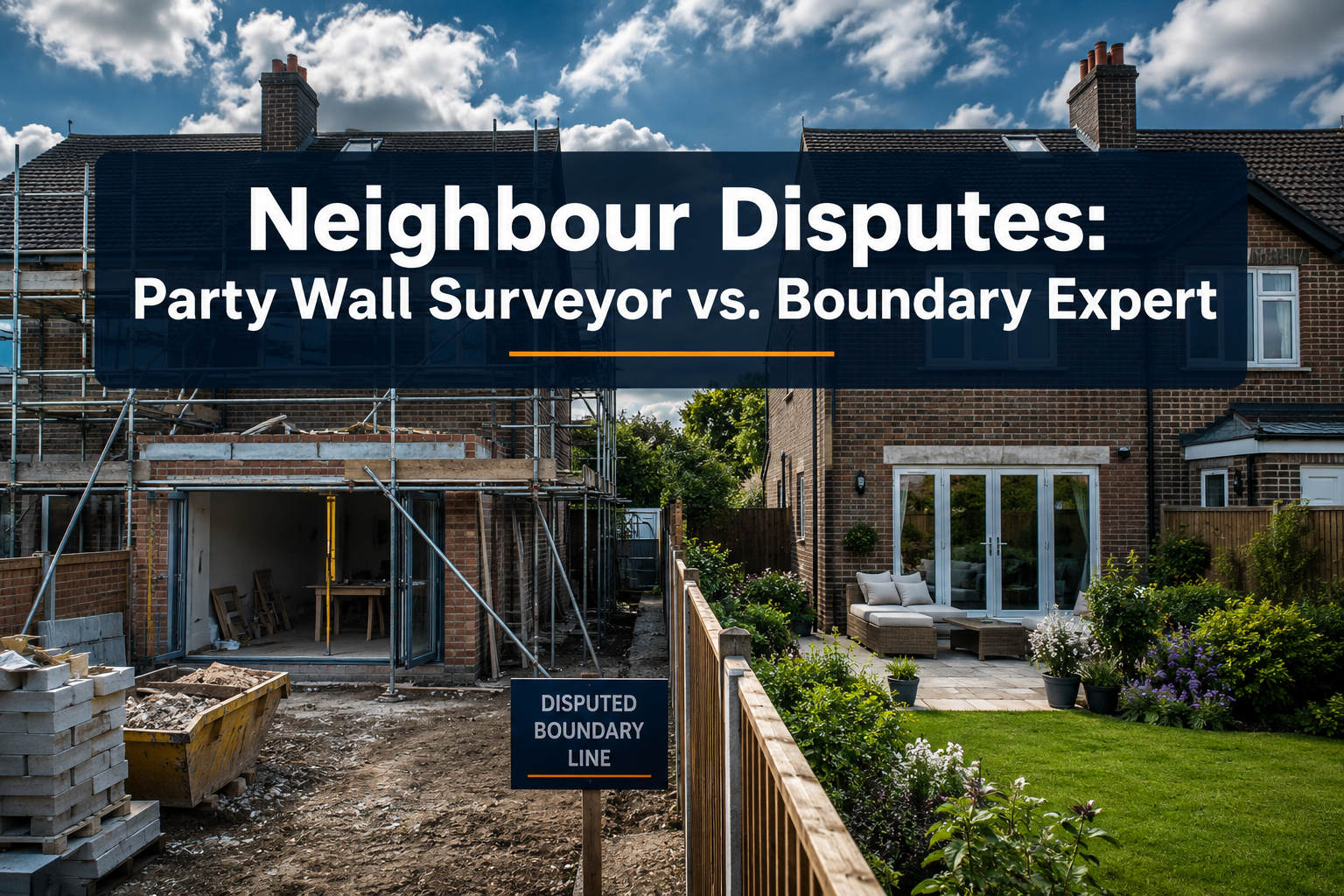
Wales is experiencing a remarkable property renaissance in 2026. With housing prices forecast to climb by 3% and homeowners increasingly choosing extensions over relocation, understanding Party Wall Surveying for Wales Home Extensions: Compliance Amid 2026 +3% Price Forecasts has never been more critical. As sustainable retrofits and home improvements surge across Cardiff, Swansea, and beyond, navigating the Party Wall etc. Act 1996 correctly protects both property owners and their neighbors from costly disputes.
This comprehensive guide explores everything Welsh homeowners need to know about party wall compliance, from initial notices to dispute resolution, all within the context of Wales's booming extension market.
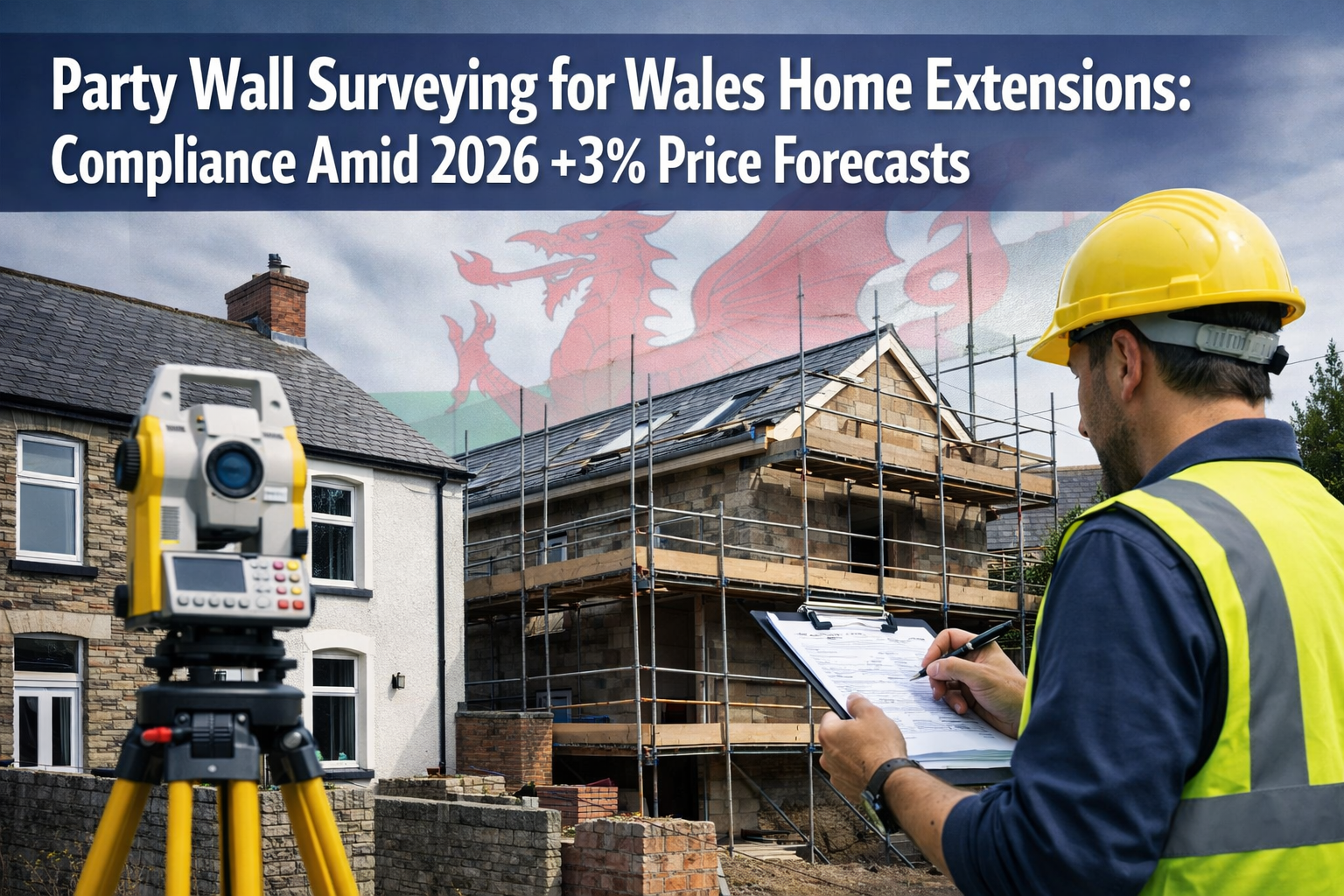
Key Takeaways 🔑
- Party Wall Act compliance is mandatory for most home extensions in Wales that affect shared walls, boundaries, or excavations near neighboring properties
- The 2026 +3% price forecast is driving increased extension activity, making early party wall surveyor engagement essential to avoid project delays
- Proper notice procedures (typically 2 months for wall works, 1 month for excavations) must be followed before construction begins
- Professional party wall surveyors help resolve disputes, prepare awards, and ensure legal compliance while protecting both parties' interests
- Costs typically range from £700-£1,500 per property for straightforward cases, though complex disputes may require higher investment
Understanding Party Wall Legislation in Wales
The Party Wall etc. Act 1996 applies throughout England and Wales, providing a legal framework for preventing and resolving disputes between neighbors when building work affects shared structures. Despite being a unified piece of legislation, its application in Wales requires careful consideration of local building regulations and the unique housing stock prevalent across Welsh communities.
What Qualifies as Party Wall Work?
Party wall work encompasses three main categories:
- Building on or at the boundary line between properties
- Work to an existing party wall or structure (walls, floors, or partitions separating buildings)
- Excavation within 3-6 meters of a neighboring building's foundation
For Welsh homeowners planning extensions, the most common scenarios include:
- Single or double-story rear extensions touching the party wall
- Loft conversions requiring structural alterations to shared walls
- Basement excavations near neighboring foundations
- New boundary walls or garden structures
Wales-Specific Considerations
Wales's housing landscape differs significantly from England's, with distinct architectural styles and community structures:
Terraced Housing Dominance 🏘️
Welsh towns feature extensive terraced housing, particularly in former mining communities and urban centers. These properties share party walls on both sides, making extension projects inherently more complex.
Building Regulations Wales 2026
Welsh building regulations continue to evolve independently, with enhanced sustainability requirements coming into effect. While party wall legislation remains consistent with England, compliance must align with Welsh-specific building control procedures.
Bilingual Documentation
Professional surveyors operating in Wales should provide documentation in both English and Welsh where appropriate, particularly in strongly Welsh-speaking regions like Gwynedd and Ceredigion.
The 2026 Property Market Context: Why Extensions Are Booming
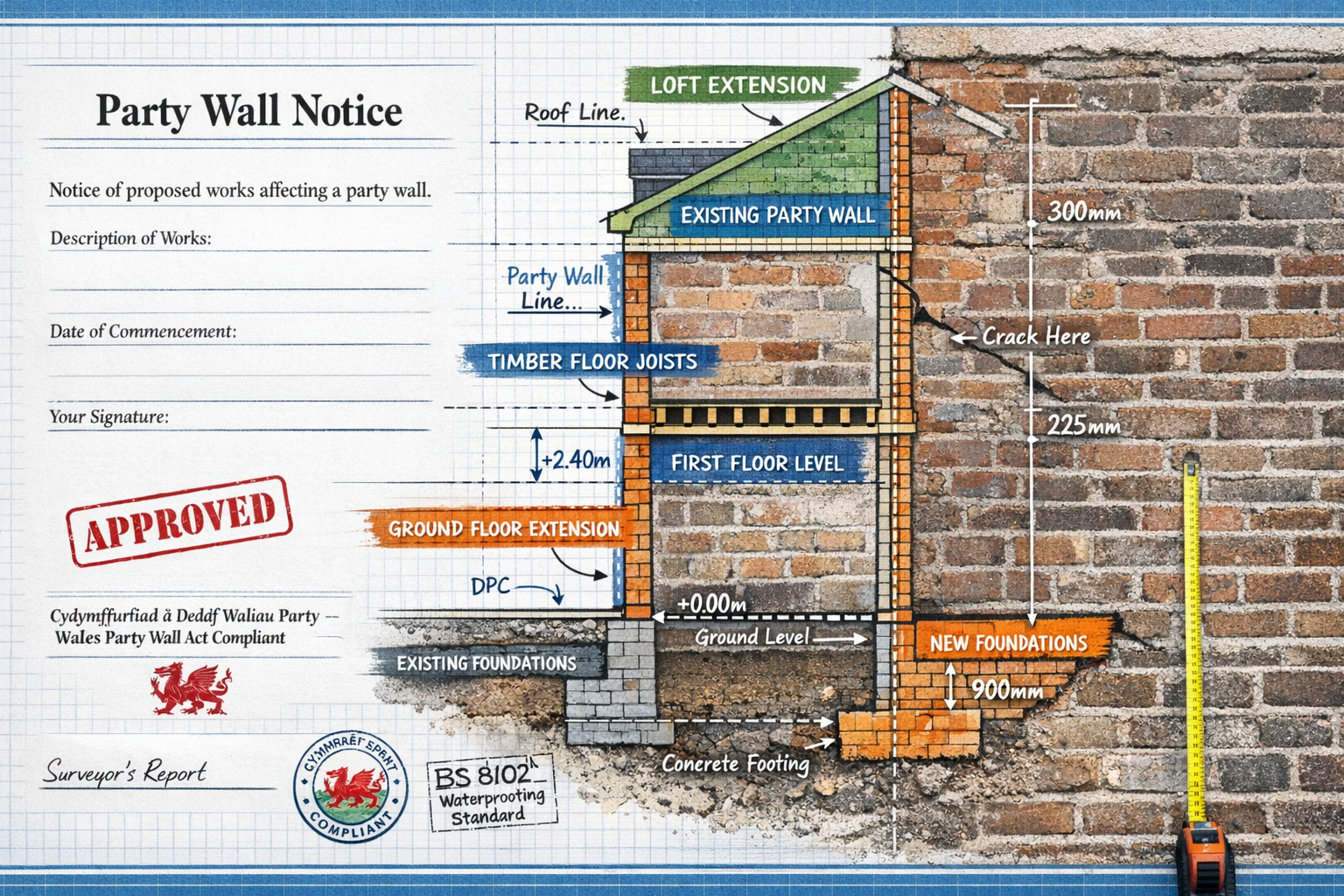
The +3% price forecast for Wales in 2026 reflects several converging factors that make home extensions increasingly attractive:
Economic Drivers
Stamp Duty Considerations 💷
With property prices rising, moving up the housing ladder incurs substantial stamp duty costs. A £300,000 property in Wales attracts £5,500 in Land Transaction Tax, making a £50,000-£80,000 extension financially preferable for many families.
Mortgage Rate Stability
As mortgage rates stabilize in 2026, homeowners are leveraging existing equity to fund extensions rather than taking on larger mortgages for new properties.
Remote Work Permanence
The continued prevalence of hybrid working means families need additional home office space, driving demand for rear extensions and loft conversions.
Sustainable Retrofit Boom
Wales leads the UK in sustainable housing initiatives, with the Welsh Government's ambitious net-zero targets encouraging:
- Insulation upgrades during extension projects
- Heat pump installations requiring additional utility space
- Solar panel arrays on new extension roofs
- Energy-efficient glazing exceeding minimum standards
These sustainable retrofits often involve party wall considerations, particularly when structural modifications affect thermal bridging or require additional foundation work.
Regional Variations Across Wales
| Region | Average Extension Cost | Party Wall Complexity | Market Activity |
|---|---|---|---|
| Cardiff | £65,000-£85,000 | High (dense terraces) | Very High |
| Swansea | £55,000-£75,000 | Medium-High | High |
| Newport | £50,000-£70,000 | High (Victorian terraces) | High |
| Wrexham | £45,000-£65,000 | Medium | Medium-High |
| Rural Powys | £60,000-£80,000 | Low (detached properties) | Medium |
Understanding your local market helps contextualize party wall surveying costs within the broader project budget.
Party Wall Surveying for Wales Home Extensions: Step-by-Step Compliance Process
Navigating Party Wall Surveying for Wales Home Extensions: Compliance Amid 2026 +3% Price Forecasts requires methodical planning and professional guidance. Here's the complete process:
Step 1: Determine If Party Wall Act Applies
Before engaging a surveyor, confirm whether your extension triggers Party Wall Act requirements. Most extensions do if they:
- Share a wall with a neighboring property
- Involve excavation within 3 meters (and below neighbor's foundation level)
- Require cutting into or removing chimney breasts on party walls
- Necessitate inserting damp-proof courses in shared walls
For detailed guidance on specific scenarios, consult our party wall services overview.
Step 2: Serve Proper Notice
Timing is Critical ⏰
- Party Structure Notice: Serve at least 2 months before work begins
- Party Wall Notice: Serve at least 2 months before work begins
- Notice of Adjacent Excavation: Serve at least 1 month before work begins
Notices must include:
- Detailed description of proposed work
- Architectural drawings showing party wall involvement
- Start date and expected duration
- Your contact information and surveyor details (if appointed)
Step 3: Neighbor's Response Options
Your neighbor has three options within 14 days:
- Consent in writing – Work can proceed without a party wall award
- Dissent or not respond – Triggers the dispute resolution process
- Request modifications – Opens negotiation period
Important: Non-response is treated as dissent, automatically initiating the surveyor appointment process.
Step 4: Surveyor Appointment
When disputes arise (or neighbors don't respond), surveyors must be appointed:
Agreed Surveyor Approach 🤝
Both parties jointly appoint one impartial surveyor, reducing costs and streamlining the process. This works well for straightforward extensions with cooperative neighbors.
Two Surveyor Approach
Each party appoints their own surveyor, who then jointly prepare the party wall award. If they disagree, they appoint a third surveyor to arbitrate. This approach suits complex projects or contentious relationships.
Step 5: Party Wall Award Preparation
The surveyor(s) will:
- Inspect both properties to document pre-construction condition
- Photograph existing defects to distinguish them from construction damage
- Assess proposed works for compliance and neighbor impact
- Prepare the award document detailing permitted works, timings, and conditions
- Specify dispute resolution mechanisms if issues arise during construction
Awards typically take 2-4 weeks to prepare for straightforward extensions.
Step 6: Construction and Monitoring
Once the award is in place:
- Provide neighbors with 14 days' notice before starting work
- Adhere strictly to award conditions
- Allow surveyor access for monitoring inspections
- Document any variations requiring award amendments
- Complete works within specified timeframes
Step 7: Post-Construction Resolution
After completion:
- Final inspection confirms no damage occurred
- Any damage identified must be remedied promptly
- Photographic evidence resolves disputes about pre-existing conditions
- Final settlement of surveyor fees occurs
Understanding Party Wall Surveying Costs in 2026
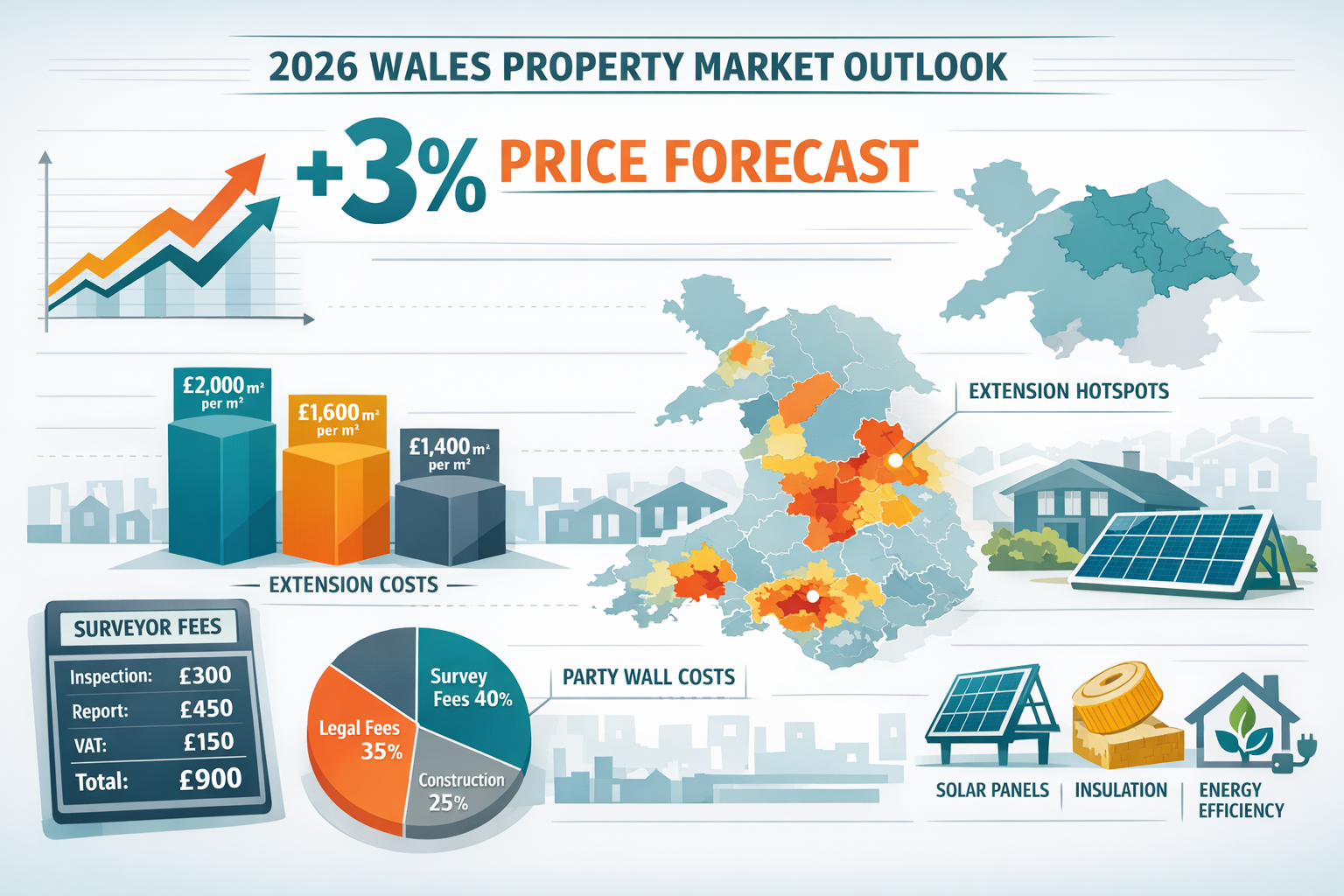
The +3% price forecast affects not just property values but also professional service costs. Party wall surveying fees in Wales typically follow these ranges:
Fee Structures
Agreed Surveyor (Single Appointment)
- Simple extension: £700-£1,000
- Complex extension with multiple walls: £1,000-£1,500
- Includes inspection, award preparation, and basic monitoring
Two Surveyor Approach
- Building owner's surveyor: £800-£1,200
- Adjoining owner's surveyor: £800-£1,200
- Total cost: £1,600-£2,400
- Building owner typically pays both fees (though this can be negotiated)
Third Surveyor (Dispute Resolution)
- Additional £1,500-£3,000 if appointed
- Only necessary when two surveyors cannot agree
Cost Factors Affecting Fees
Several variables influence final costs:
Project Complexity 🔍
- Number of affected neighbors (each requires separate process)
- Structural complexity of proposed works
- Historical building considerations
- Previous damage or defects requiring assessment
Geographic Location
Urban Cardiff and Swansea command higher fees than rural areas due to surveyor demand and travel costs.
Dispute Intensity
Contentious relationships requiring extensive negotiation increase billable hours significantly.
Monitoring Requirements
Lengthy construction periods with multiple inspection visits add ongoing costs.
Who Pays?
By default, the building owner (person undertaking the work) pays all reasonable surveyor fees, including the adjoining owner's surveyor. However:
- Unreasonable or excessive fees can be challenged
- Adjoining owners requesting unnecessary work may bear those costs
- Clear fee agreements upfront prevent disputes
For context on broader surveying costs, review our surveyor pricing guide.
Common Party Wall Disputes and Resolution Strategies
Even with proper procedures, disputes can arise. Understanding common issues helps prevent them:
Dispute Type 1: Noise and Disruption
Issue: Neighbors object to construction noise, dust, and inconvenience.
Resolution:
- Party wall awards specify working hours (typically 8am-6pm weekdays)
- Dust suppression measures must be implemented
- Advance notice of particularly disruptive phases
- Regular communication maintains goodwill
Dispute Type 2: Structural Damage Claims
Issue: Neighbors claim construction caused cracks, subsidence, or other damage.
Resolution:
- Pre-construction photographic evidence is crucial
- Schedule of condition documents existing defects
- Independent structural assessment distinguishes new from old damage
- Awards specify remediation procedures and timescales
For properties with existing structural concerns, consider a structural survey before commencing party wall procedures.
Dispute Type 3: Boundary Disagreements
Issue: Parties disagree about exact boundary location or ownership of walls.
Resolution:
- Land Registry title plans provide starting point
- Historical deeds may clarify ownership
- Boundary surveys establish precise locations
- Legal advice may be necessary for complex cases
Dispute Type 4: Unreasonable Objections
Issue: Neighbors object to reasonable extension plans without valid grounds.
Resolution:
- Party Wall Act doesn't give neighbors veto power
- Surveyors assess reasonableness objectively
- Awards can proceed despite objections if work is lawful
- Building control and planning permission remain separate processes
Dispute Type 5: Access Refusal
Issue: Neighbors refuse surveyor access for inspections.
Resolution:
- Party Wall Act grants surveyors right of access
- Reasonable notice (typically 14 days) must be given
- Persistent refusal may require court intervention
- Awards can be prepared based on available information
Understanding potential obstructions in party wall procedures helps anticipate challenges.
Integrating Party Wall Compliance with Broader Extension Planning
Party wall surveying doesn't occur in isolation. Successful Welsh home extensions require coordinated planning across multiple domains:
Planning Permission
While separate from party wall procedures, planning permission timing affects party wall notice serving:
- Obtain planning approval before serving party wall notices
- Use approved plans in party wall documentation
- Coordinate construction timelines with both approvals
- Consider permitted development rights to avoid planning delays
Building Regulations Approval
Welsh Building Regulations require separate approval:
- Structural calculations for wall modifications
- Thermal performance specifications
- Fire safety compliance for extensions
- Drainage and foundation approvals
Party wall awards complement but don't replace building control procedures.
Additional Surveys
Depending on your property's condition, consider:
- Homebuyer surveys before purchasing properties requiring extension
- Damp surveys if moisture issues affect party walls
- Asbestos surveys for pre-1999 properties undergoing wall modifications
Insurance Considerations
Notify your buildings insurance about:
- Planned extension work
- Party wall procedures underway
- Increased rebuild costs post-extension
- Temporary increased risk during construction
Some insurers require party wall awards before covering construction-related claims.
Choosing the Right Party Wall Surveyor in Wales
Selecting an appropriate surveyor significantly impacts process smoothness and cost-effectiveness:
Essential Qualifications
RICS Membership 📜
Ensure your surveyor is a Member or Fellow of the Royal Institution of Chartered Surveyors (MRICS/FRICS), indicating professional standards and insurance.
Party Wall Specialization
General surveyors may lack specific party wall expertise. Seek specialists with:
- Pyramus & Thisbe Club membership (party wall specialist organization)
- Extensive award preparation experience
- Local knowledge of Welsh building types
Professional Indemnity Insurance
Verify adequate coverage (minimum £1 million) protects all parties if errors occur.
Questions to Ask Prospective Surveyors
- How many party wall awards have you prepared in Wales?
- What's your typical timeline for award preparation?
- Can you provide references from recent Welsh extension projects?
- What's your fee structure, and what's included?
- How do you handle disputes between parties?
- Are you familiar with Welsh terraced housing construction?
- Do you offer bilingual services if required?
Red Flags to Avoid
- Surveyors unwilling to provide fixed fee quotes
- Lack of professional accreditation
- No local experience with Welsh property types
- Pressure to appoint before neighbor responds
- Unclear fee structures or hidden costs
For comprehensive surveying services, explore options with local chartered surveyors experienced in Welsh markets.
Regional Insights: Party Wall Considerations Across Wales
Wales's diverse housing stock requires tailored approaches:
South Wales Valleys
Characteristics: Dense Victorian terraced housing, former mining communities, steep topography
Party Wall Implications:
- Multiple party walls (both sides, often rear walls too)
- Historical subsidence from mining activity complicates foundation work
- Narrow plots limit extension options
- Strong community ties can ease or complicate neighbor relations
Best Practices: Comprehensive structural assessments before serving notices, community engagement, sensitivity to historical subsidence patterns.
Cardiff and Urban Centers
Characteristics: Mixed housing stock, Edwardian terraces, modern developments, high property values
Party Wall Implications:
- High surveyor demand increases costs and lead times
- Professional landlords more familiar with procedures
- Higher stakes due to property values
- Faster-paced construction timelines
Best Practices: Early surveyor engagement, premium service investment, clear documentation, professional communication.
Coastal Communities
Characteristics: Exposed locations, salt weathering, mixed construction types, tourism economy
Party Wall Implications:
- Weather-related construction delays affect award timelines
- Seasonal tourism creates timing sensitivities
- Salt damage to party walls requires careful assessment
- Second-home ownership complicates communication
Best Practices: Flexible timelines, enhanced weatherproofing specifications, proactive neighbor communication, consideration of seasonal factors.
Rural Wales
Characteristics: Detached properties, stone construction, agricultural buildings, Welsh language prevalence
Party Wall Implications:
- Fewer party wall issues (more detached properties)
- When applicable, often involves agricultural buildings
- Traditional stone construction requires specialist knowledge
- Bilingual documentation may be expected
Best Practices: Specialist stone construction surveyors, bilingual services, agricultural building expertise, respect for traditional methods.
Future-Proofing Your Extension: 2026 and Beyond
As Party Wall Surveying for Wales Home Extensions: Compliance Amid 2026 +3% Price Forecasts continues evolving, consider these forward-looking strategies:
Sustainable Design Integration
Build extensions that accommodate future upgrades:
- Oversized foundations for potential second-story additions
- Enhanced insulation exceeding current requirements
- Renewable energy readiness (solar panel structural provisions)
- Adaptable spaces for changing family needs
Digital Documentation
Modern party wall procedures increasingly leverage technology:
- 3D laser scanning creates precise pre-construction records
- Drone surveys document roof and elevation conditions
- Digital awards with embedded photographs and plans
- Electronic service of notices (with neighbor agreement)
Relationship Management
The best party wall outcomes prioritize neighbor relations:
- Early informal discussions before formal notices
- Transparent communication throughout the process
- Reasonable accommodations for neighbor concerns
- Post-construction follow-up to confirm satisfaction
Regulatory Awareness
Stay informed about evolving Welsh building regulations:
- Net-zero targets affecting extension specifications
- Fire safety updates following national reviews
- Accessibility standards for adaptable housing
- Biodiversity requirements for garden impacts
Conclusion: Navigating Party Wall Success in Wales's Growing Market
The convergence of Wales's +3% price forecast for 2026 and the ongoing home extension boom makes party wall compliance more critical than ever. Whether planning a modest single-story rear extension in Cardiff or a comprehensive sustainable retrofit in Swansea, understanding and following proper party wall procedures protects your investment, maintains neighbor relationships, and ensures legal compliance.
Key Action Steps 🎯
- Assess early whether your extension triggers Party Wall Act requirements
- Engage a qualified RICS surveyor with Welsh property experience before serving notices
- Budget appropriately for surveying costs (£700-£2,400 for typical cases)
- Serve notices with proper timing (1-2 months before construction)
- Maintain open communication with neighbors throughout the process
- Document everything with photographs and written records
- Coordinate with planning and building control for seamless project delivery
Moving Forward
The Welsh property market's strength in 2026 creates exceptional opportunities for homeowners to add value through well-planned extensions. By treating party wall compliance as an integral part of project planning rather than an afterthought, you position your extension for success while protecting all parties' interests.
Professional party wall surveying isn't merely a legal requirement—it's an investment in project certainty, neighbor relations, and long-term property value. As Wales continues its trajectory of sustainable growth and housing innovation, those who prioritize proper procedures will reap the rewards of successful, dispute-free home improvements.
For expert guidance on your Welsh home extension project, including comprehensive party wall services and structural surveys, professional surveyors provide the expertise needed to navigate 2026's dynamic property landscape with confidence.