

The property market stands on the brink of its most significant transformation in decades. As 2026 unfolds, the UK government's proposed reforms to mandate upfront property condition assessments threaten to completely reshape how, when, and why building surveyors conduct their work. For an industry accustomed to operating after offers are accepted, this shift to pre-marketing surveys represents nothing short of a revolution—one that demands immediate attention and strategic adaptation.
The Government Property Condition Assessment Reforms 2026: How Surveyors Must Adapt to Upfront Survey Requirements initiative aims to streamline property transactions, reduce fall-through rates, and provide greater transparency for buyers. However, this fundamental restructuring of the homebuying timeline creates unprecedented challenges and opportunities for surveying professionals who must now recalibrate their entire business model.
Key Takeaways
- 🏛️ Upfront survey requirements will shift property condition assessments from post-offer to pre-marketing, fundamentally changing surveyor engagement timing
- ⏱️ Surveyor workload patterns will experience dramatic redistribution, requiring capacity planning and resource allocation strategies
- 📊 Standardization pressures will increase as sellers demand consistent, comparable reports across the market
- 💻 Technology adoption becomes essential for managing increased volume and maintaining quality standards
- 📈 Market positioning opportunities emerge for surveyors who embrace reforms early and develop specialized upfront assessment services
Understanding the Government Property Condition Assessment Reforms 2026
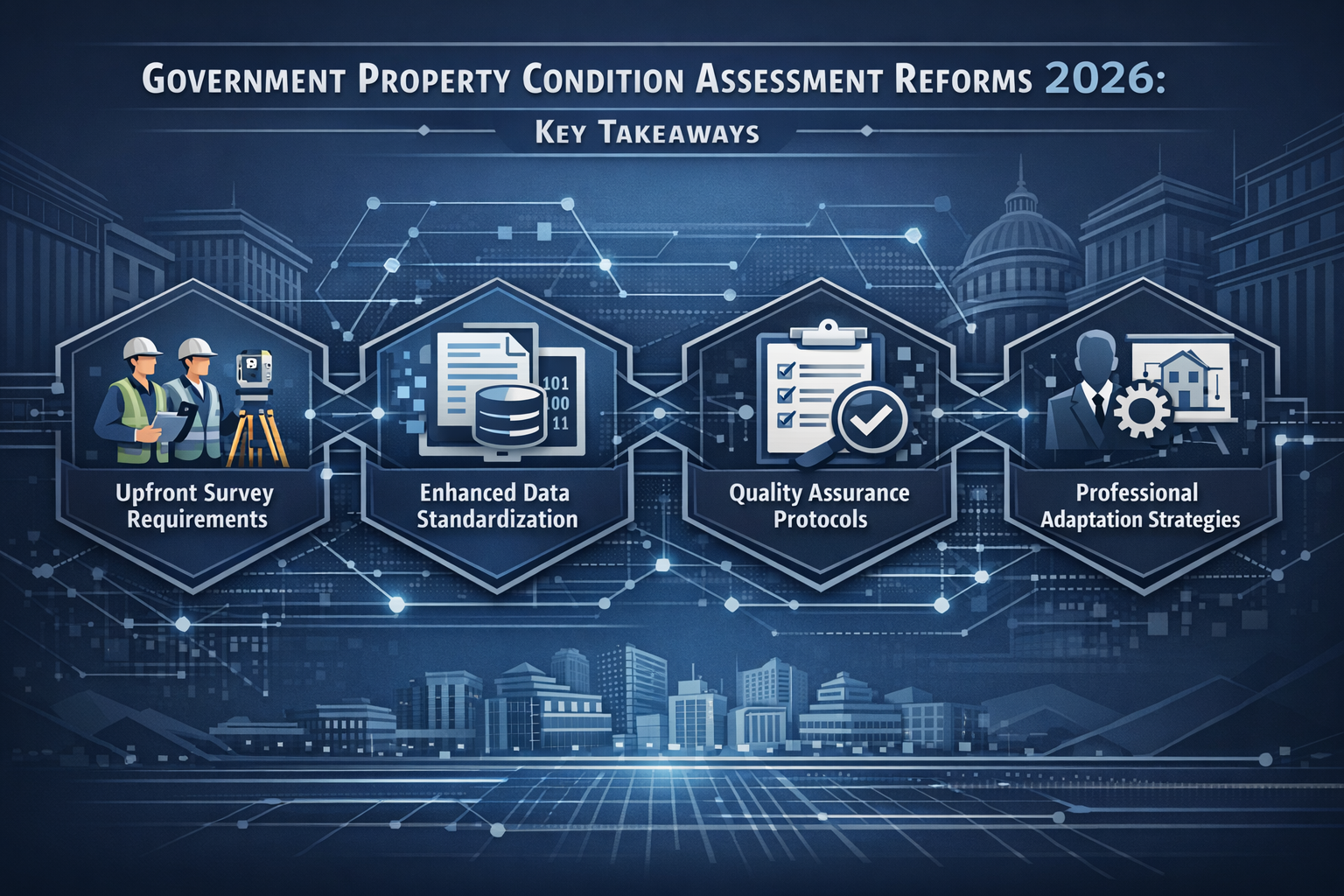
The Regulatory Landscape Shift
The proposed reforms represent the UK government's response to longstanding inefficiencies in the property transaction process. Currently, surveys typically occur after an offer has been accepted, creating a sequential bottleneck that extends transaction timelines and increases the risk of deals collapsing when unexpected defects emerge.[4]
Under the new framework, property condition assessments would become mandatory upfront requirements, meaning sellers must commission surveys before marketing their properties. This mirrors successful models implemented in other jurisdictions and addresses the estimated £270 million annually lost to failed transactions in the UK property market.
The reforms specifically target:
- Transaction speed: Reducing average completion times from 12-16 weeks to 8-10 weeks
- Fall-through rates: Decreasing the current 30% failure rate by identifying issues earlier
- Buyer confidence: Providing transparent condition information before offers are made
- Market efficiency: Eliminating duplicate surveys when multiple buyers are interested
Key Components of the 2026 Framework
The Government Property Condition Assessment Reforms 2026: How Surveyors Must Adapt to Upfront Survey Requirements encompasses several critical elements that surveyors must understand:
| Reform Component | Current Practice | 2026 Requirement | Impact on Surveyors |
|---|---|---|---|
| Survey Timing | Post-offer acceptance | Pre-marketing mandatory | Complete workflow restructuring |
| Report Standardization | Variable formats | Standardized templates | New reporting protocols |
| Validity Period | No expiration | 6-month validity window | Update procedures required |
| Accessibility | Buyer-commissioned | Seller-provided, buyer-accessible | Dual-client considerations |
| Liability Framework | Single-party reliance | Multi-party reliance potential | Insurance implications |
While these reforms draw inspiration from international best practices, they also incorporate lessons from recent developments in land surveying standards. The 2026 ALTA/NSPS updates, which became effective February 23, 2026, demonstrate how professional standards evolve to meet modern transaction requirements through enhanced precision definitions and clearer documentation protocols.[1][2]
Timeline and Implementation Expectations
Although the reforms have not yet been formally legislated, industry consultations suggest a phased implementation beginning in late 2026 or early 2027. The government has indicated:
- Consultation period: Q2-Q3 2026
- Legislation drafting: Q4 2026
- Pilot programs: Select regions in early 2027
- Full implementation: Nationwide rollout by 2028
This timeline provides a critical window for surveyors to prepare, adapt systems, and position their practices for the coming changes. Early adopters who develop upfront assessment expertise now will likely capture significant market share when reforms become mandatory.
How Surveyors Must Adapt to Upfront Survey Requirements: Operational Changes
Restructuring Client Engagement Models
The shift from buyer-commissioned to seller-commissioned surveys fundamentally alters the surveyor-client relationship. Traditionally, surveyors work exclusively for buyers, providing independent assessments that inform purchase decisions. Under upfront requirements, surveyors must navigate a more complex dynamic where sellers commission reports that multiple buyers will rely upon.[4]
Critical adaptations include:
- Client communication protocols: Developing clear terms of engagement that define responsibilities to both sellers and subsequent buyers
- Independence safeguards: Maintaining objectivity when the party paying for the survey has vested interests in favorable findings
- Report accessibility systems: Creating secure platforms where authorized parties can access survey documents
- Update mechanisms: Establishing procedures for refreshing surveys approaching their validity expiration
Professional surveyors must also reconsider their service packages. While comprehensive building surveys remain the gold standard, the upfront model may create demand for tiered assessment levels that sellers can select based on property characteristics and price points.
Workflow and Capacity Management
The Government Property Condition Assessment Reforms 2026: How Surveyors Must Adapt to Upfront Survey Requirements will dramatically reshape surveyor workload patterns. Instead of reactive scheduling based on accepted offers, surveyors will face proactive demand from sellers preparing to market properties.
Anticipated workflow changes:
- 📅 Seasonal fluctuations intensify: Spring listing season will create concentrated demand spikes
- 🔄 Predictability improves: Advance scheduling becomes possible as sellers plan marketing campaigns
- ⚡ Turnaround expectations tighten: Sellers want rapid completion to avoid marketing delays
- 📊 Volume increases significantly: Market-wide coverage rather than selective buyer-initiated surveys
Practices must invest in capacity planning tools and potentially expand surveyor teams to handle increased volume. The shift also creates opportunities for specialization, with some surveyors focusing exclusively on upfront assessments while others concentrate on specialist investigations like damp surveys or subsidence assessments.
Technology Integration Requirements
Manual processes that suffice for current volumes will buckle under the increased demand and standardization requirements of upfront assessments. Surveyors must embrace technology across multiple dimensions:
Essential technology investments:
- Digital inspection tools: Tablets with integrated photography, annotation, and measurement capabilities
- Report automation: Template-based systems that ensure consistency while maintaining quality
- Client portals: Secure platforms for document delivery and access management
- Scheduling software: Capacity management and appointment optimization tools
- Data analytics: Performance tracking and quality assurance monitoring
The integration of thermal imaging, moisture detection equipment, and drone photography—already common in specialized surveys—may become standard practice for comprehensive upfront assessments. This technological evolution parallels developments in land surveying, where enhanced precision requirements drive adoption of advanced measurement systems.[1]
Surveyors should also consider how their technology choices impact choosing the right property survey recommendations they provide to clients navigating the new landscape.
Standardization and Quality Assurance Under the New Framework
Report Standardization Pressures
One inevitable consequence of mandatory upfront surveys is pressure toward standardized reporting formats. When surveys become seller-provided documents that buyers compare across properties, market forces demand consistency and comparability.
The government is likely to mandate or strongly encourage:
- Standardized condition ratings: Uniform scales for assessing defect severity
- Required content sections: Mandatory coverage of specific building elements and systems
- Consistent terminology: Industry-wide definitions for common defects and recommendations
- Digital-first formats: Machine-readable data enabling property comparison platforms
"Standardization doesn't mean sacrificing professional judgment—it means presenting that judgment in formats that serve market efficiency while maintaining technical rigor."
Surveyors must balance these standardization requirements with the need for property-specific insights. The most successful practitioners will develop systems that efficiently produce compliant reports while preserving the detailed, contextual analysis that distinguishes professional surveys from checkbox inspections.
This challenge mirrors recent updates to land title survey standards, where the 2026 ALTA/NSPS revisions introduced new optional elements like the Conditions & Potential Encroachments Table—providing standardized frameworks for complex information while preserving professional discretion.[1]
Quality Control and Peer Review Systems
As upfront surveys gain legal and transactional significance, quality assurance becomes paramount. Surveys that multiple parties rely upon carry heightened liability exposure, making robust quality control essential.
Recommended quality assurance measures:
✅ Peer review protocols: Second-surveyor checks on complex or high-value properties
✅ Photographic documentation standards: Comprehensive visual evidence supporting findings
✅ Measurement verification: Consistent methodologies for dimensional accuracy
✅ Defect classification training: Regular calibration sessions ensuring consistent condition ratings
✅ Continuing professional development: Ongoing education on emerging building pathologies and assessment techniques
Firms should consider implementing formal quality management systems aligned with ISO standards or RICS practice frameworks. The investment in quality infrastructure not only reduces liability exposure but also becomes a competitive differentiator as buyers learn to distinguish between basic compliance surveys and truly rigorous assessments.
For specialized investigations like stock condition surveys or RICS specialist defect surveys, quality protocols must be even more stringent given their technical complexity.
Professional Indemnity Insurance Considerations
The liability landscape shifts dramatically when surveys transition from single-buyer reliance to multi-party documents. Surveyors must work with insurance providers to ensure adequate coverage for:
- Extended reliance periods: Coverage throughout the survey's 6-month validity window
- Multiple relying parties: Protection when several buyers use the same report
- Seller claims: Potential disputes if surveys are alleged to have devalued properties
- Update liability: Exposure when refreshing expiring surveys
Professional indemnity premiums will likely increase to reflect these expanded risks, necessitating adjustments to surveyor pricing structures to maintain profitability while remaining competitive.
Market Positioning and Business Strategy for 2026 Reforms

Developing Upfront Assessment Specializations
Forward-thinking surveyors recognize that Government Property Condition Assessment Reforms 2026: How Surveyors Must Adapt to Upfront Survey Requirements creates distinct market segments requiring specialized expertise:
Emerging specialization opportunities:
- Pre-marketing assessment services: Streamlined surveys optimized for seller needs and rapid turnaround
- Survey update and refresh services: Efficient protocols for extending validity of approaching-expiration reports
- Multi-property portfolio assessments: Bulk services for property developers and estate agents with multiple listings
- Remediation roadmap consulting: Advisory services helping sellers address identified defects before marketing
- Buyer verification surveys: Supplementary inspections for buyers wanting independent confirmation
Surveyors who establish expertise in these niches early will capture market share as reforms roll out. Geographic specialization also presents opportunities, with practices in high-transaction areas like chartered surveyors in Richmond or chartered surveyors in Hampstead potentially experiencing earlier and more intense demand.
Strategic Partnerships and Referral Networks
The upfront survey model creates new partnership opportunities that didn't exist in the traditional buyer-commissioned framework:
High-value partnership targets:
- 🏘️ Estate agents: Becoming preferred survey providers for their seller clients
- 🏗️ Property developers: Offering pre-sale assessment packages for new developments
- ⚖️ Conveyancing solicitors: Integrated service packages combining legal and survey work
- 💰 Mortgage brokers: Collaborative arrangements ensuring surveys meet lender requirements
- 🔧 Remediation contractors: Referral relationships for addressing identified defects
These partnerships require careful structuring to maintain independence and avoid conflicts of interest. However, when properly designed, they create efficient service delivery channels that benefit all parties while expanding surveyor market reach.
Pricing Strategy Adaptations
Upfront survey economics differ fundamentally from buyer-commissioned work. Sellers are cost-sensitive, viewing surveys as marketing expenses rather than protective investments. This creates pricing pressures that surveyors must address strategically.
Pricing considerations for upfront surveys:
- Volume discounts: Multi-property packages for agents and developers
- Tiered service levels: Basic, standard, and comprehensive options matching property complexity
- Validity extension pricing: Reduced rates for refreshing existing surveys
- Bundled services: Combined offerings with complementary professionals
- Subscription models: Regular assessment services for portfolio landlords
Transparent pricing becomes increasingly important as sellers compare surveyor costs across providers. Clear communication about what different service levels include—similar to guidance on the difference between level 2 and level 3 surveys—helps sellers make informed decisions while justifying premium pricing for comprehensive assessments.
Regional Variations and Local Market Considerations
Geographic Implementation Differences
While reforms will eventually apply nationwide, implementation timing and specific requirements may vary regionally. Surveyors operating across multiple areas—such as practices covering chartered surveyors in Surrey, chartered surveyors in Hertfordshire, and chartered surveyors in Essex—must track jurisdiction-specific variations.
Regional factors affecting implementation:
- Pilot program areas: Early-adoption regions testing reform frameworks
- Local authority variations: Council-specific requirements for listed buildings or conservation areas
- Market maturity differences: Urban vs. rural adoption rates and readiness
- Property type concentrations: Areas with unique housing stock requiring specialized approaches
Surveyors should engage with regional RICS branches and professional networks to stay informed about local implementation timelines and requirements. This geographic intelligence enables strategic resource allocation and targeted marketing as reforms roll out.
Property Type Specializations
Different property categories will experience varied impacts from upfront survey requirements:
Residential properties: Highest volume impact, requiring efficient standardized processes
Period and listed buildings: Complex assessments demanding specialist expertise and extended inspection times
New builds: Streamlined protocols focusing on construction quality and snagging
Leasehold properties: Additional considerations around schedule of condition for leasehold requirements
Commercial properties: Distinct frameworks potentially requiring RICS commercial building surveys
Surveyors should assess their current expertise mix and consider whether to specialize in specific property types or maintain generalist capabilities with associate networks for specialized requirements.
Training and Professional Development Imperatives
Skill Development Priorities
The Government Property Condition Assessment Reforms 2026: How Surveyors Must Adapt to Upfront Survey Requirements demands new competencies beyond traditional surveying skills:
Critical training areas:
- Standardized reporting systems: Mastery of mandated formats and digital platforms
- Rapid assessment techniques: Efficient inspection methodologies maintaining quality under time pressure
- Multi-party communication: Managing relationships with sellers, buyers, and intermediaries
- Technology proficiency: Digital tools, software platforms, and advanced equipment
- Risk management: Understanding liability implications and insurance requirements
- Market knowledge: Staying current on reform developments and implementation timelines
Practices should develop comprehensive training programs ensuring all surveyors achieve consistent competency levels. This investment in human capital parallels the technical precision improvements seen in recent land surveying standard updates, where refined definitions of Relative Positional Precision ensure consistent measurement practices across the profession.[1][2]
Continuing Professional Development Strategies
RICS and other professional bodies will likely introduce specific CPD requirements related to upfront survey competencies. Proactive surveyors should:
- Attend reform-focused seminars: Industry events addressing implementation strategies
- Participate in pilot programs: Volunteer for early-adoption initiatives providing hands-on experience
- Engage in peer learning: Professional networks sharing best practices and lessons learned
- Pursue specialist certifications: Credentials demonstrating upfront assessment expertise
- Monitor international practices: Learning from jurisdictions with established upfront survey systems
The investment in professional development not only ensures compliance but creates competitive advantages as expertise becomes a market differentiator.
Navigating the Transition Period
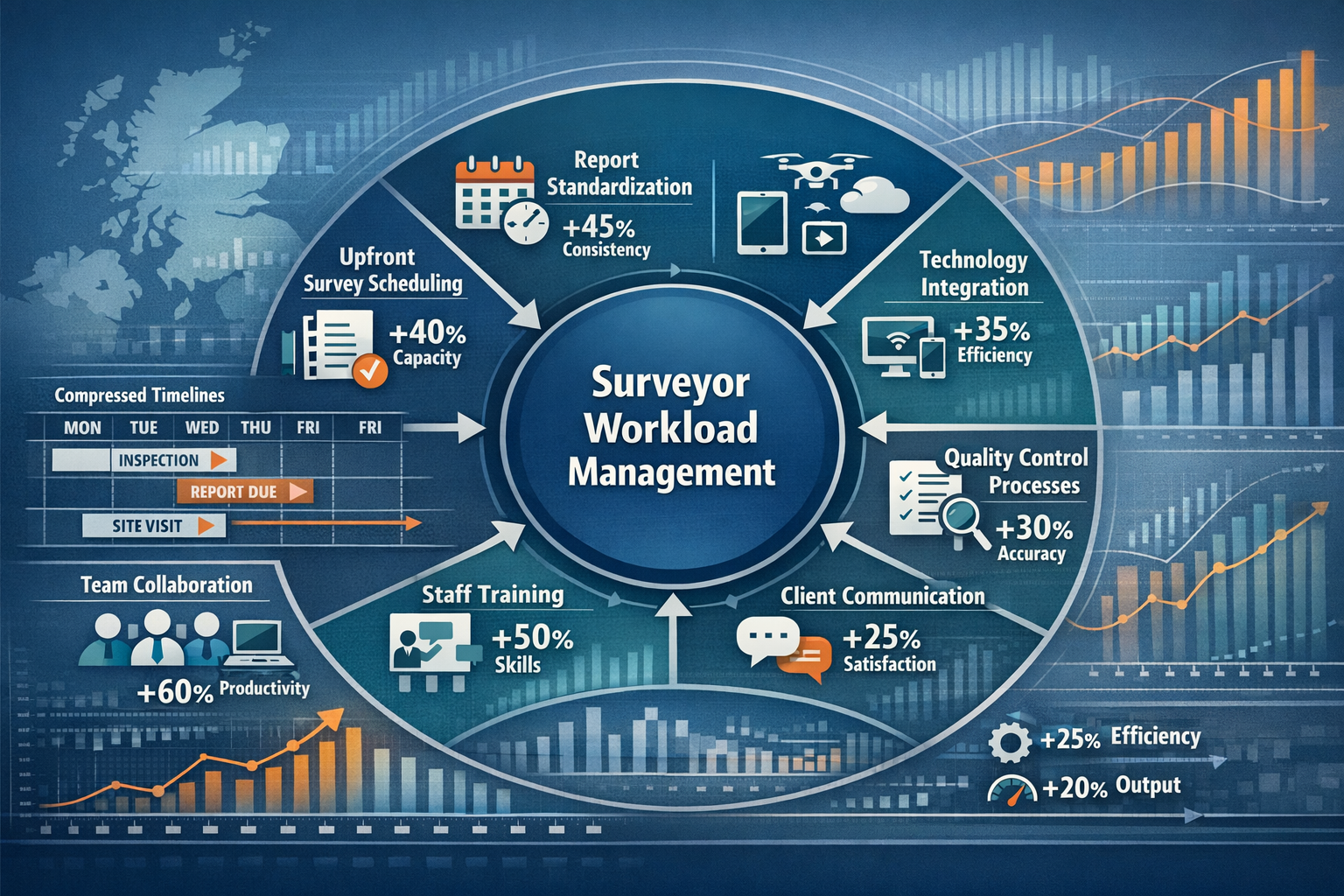
Dual-System Operations
During the implementation phase, surveyors will operate in a hybrid environment where some properties require upfront surveys while others follow traditional post-offer processes. This dual-system reality demands operational flexibility:
Transition management strategies:
- 📋 Clear client communication: Explaining which system applies to specific transactions
- 🗓️ Flexible scheduling: Accommodating both proactive upfront and reactive post-offer work
- 💼 Dual pricing structures: Separate fee schedules for different engagement models
- 📊 Performance tracking: Monitoring efficiency and profitability across both systems
- 🔄 Continuous adaptation: Regular process refinement based on practical experience
Practices that successfully navigate this transition period will emerge stronger and better positioned when reforms become universal. The ability to operate efficiently under both frameworks demonstrates adaptability and professional capability.
Client Education Initiatives
Both sellers and buyers will face learning curves understanding the new system. Surveyors who invest in client education create competitive advantages:
Effective education approaches:
- Explanatory content: Blog posts, videos, and guides explaining upfront survey benefits
- Comparative analyses: Clear presentations showing traditional vs. reformed process differences
- FAQ resources: Comprehensive answers to common questions about timing, costs, and implications
- Consultation services: Preliminary discussions helping sellers understand survey options
- Buyer guidance: Resources helping purchasers interpret and verify upfront survey reports
This educational investment positions surveyors as trusted advisors rather than mere service providers, building long-term client relationships that extend beyond individual transactions. Resources like guides on how long does a homebuyers survey take can be updated to reflect new timelines under reformed processes.
Conclusion
The Government Property Condition Assessment Reforms 2026: How Surveyors Must Adapt to Upfront Survey Requirements represents a watershed moment for the surveying profession. While the transition presents undeniable challenges—from workflow restructuring and technology investments to liability considerations and pricing pressures—it also creates unprecedented opportunities for surveyors who approach reforms strategically.
The fundamental shift from post-offer to pre-marketing assessments will increase survey volumes, improve transaction predictability, and elevate the profession's role in property markets. Surveyors will no longer be reactive participants engaged after key decisions are made, but proactive enablers of transparent, efficient transactions from the outset.
Success in this new landscape requires:
✅ Immediate preparation: Beginning system adaptations now, before reforms become mandatory
✅ Technology investment: Adopting digital tools that enable efficient, standardized reporting
✅ Quality focus: Implementing robust quality assurance protecting reputation and limiting liability
✅ Strategic positioning: Developing specialized services and partnerships capturing new market segments
✅ Continuous learning: Staying informed about regulatory developments and best practices
The surveyors who thrive will be those who recognize that these reforms, while disruptive, ultimately strengthen the profession by making property condition assessments central to every transaction rather than optional buyer protections. By embracing change, investing in capabilities, and positioning practices strategically, surveyors can transform regulatory requirements into competitive advantages.
The transition period offers a critical window for preparation. Practices should conduct comprehensive readiness assessments, identifying gaps in technology, processes, and capabilities. Developing pilot programs with forward-thinking estate agents and sellers provides invaluable practical experience before mandatory implementation.
As 2026 progresses and reforms move from proposal to legislation, the surveying landscape will fundamentally transform. Those who adapt early, invest wisely, and position strategically will not merely survive this transition—they will emerge as market leaders in a more transparent, efficient, and professional property sector.
The question is not whether to adapt to upfront survey requirements, but how quickly and effectively your practice will embrace this inevitable evolution. The time to begin is now.
References
[1] Alta Nsps Land Title Surveys 2026 Standards – https://cretelligent.com/alta-nsps-land-title-surveys-2026-standards/
[2] Key Updates To The 2026 Alta Nsps Land Title Survey Standards – https://ltaal.org/key-updates-to-the-2026-alta-nsps-land-title-survey-standards/
[3] The 2026 Minimum Standard Detail Requirements For Alta Nsps Land Title Surveys – https://amerisurv.com/2026/02/01/the-2026-minimum-standard-detail-requirements-for-alta-nsps-land-title-surveys/
[4] Homebuying Process Reforms 2026 How Mandatory Upfront Surveys Will Transform Building Surveyor Workloads – https://nottinghillsurveyors.com/blog/homebuying-process-reforms-2026-how-mandatory-upfront-surveys-will-transform-building-surveyor-workloads
[5] What Smart Cre Players Are Doing Differently In 2026 – https://www.partneresi.com/resources/articles/what-smart-cre-players-are-doing-differently-in-2026/
[6] What The 2026 Altansps Updates Mean For Cre Professionals – https://www.globest.com/2025/12/22/what-the-2026-altansps-updates-mean-for-cre-professionals/