
Surveyor Council Housing: Your Complete Guide to Professional Property Assessments in 2026
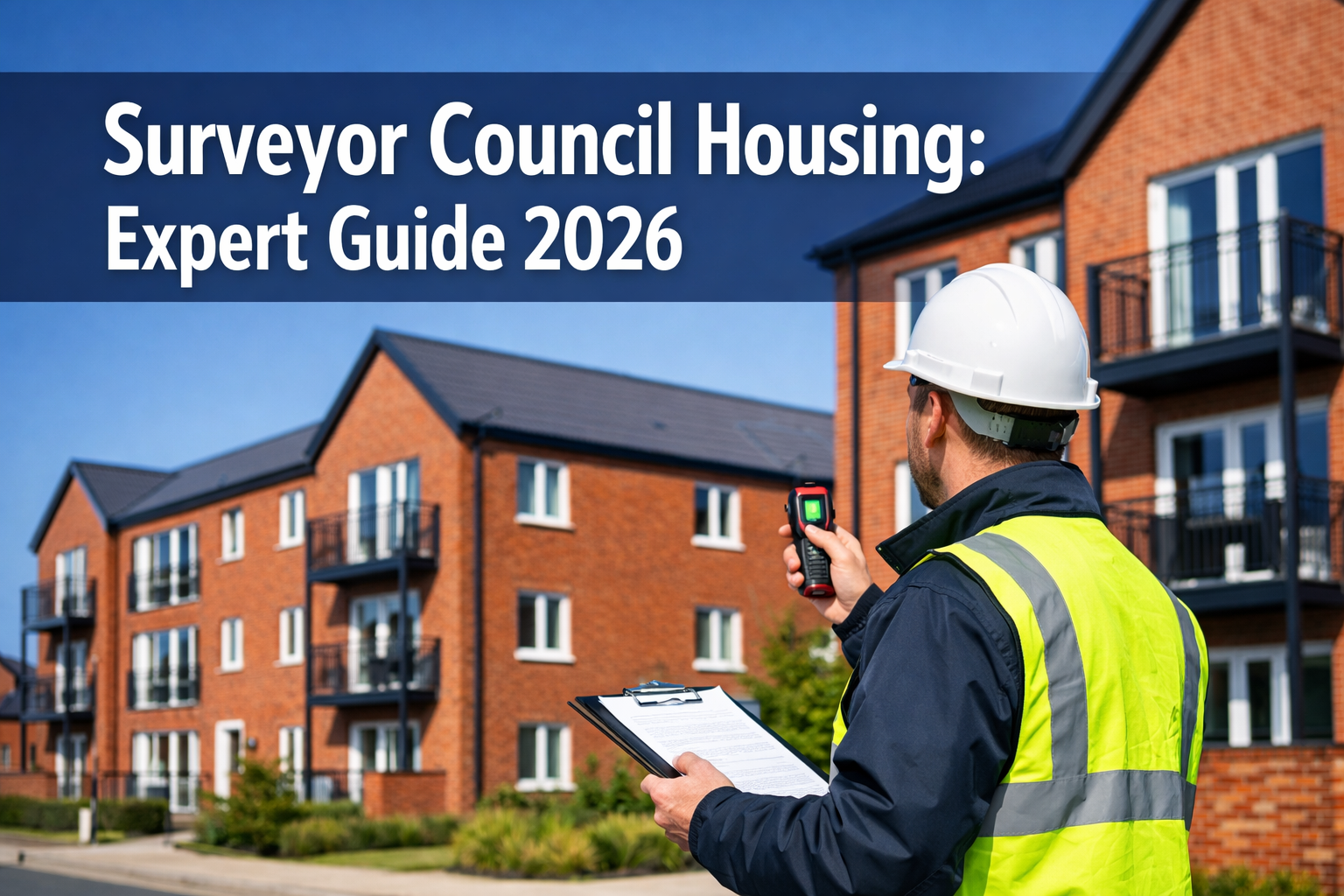
When purchasing or managing council housing properties, one critical decision can save thousands of pounds and prevent years of headaches: hiring a qualified surveyor council housing specialist. Whether you’re a tenant exercising your Right to Buy, a local authority managing social housing stock, or a property professional navigating the complexities of former council properties, understanding the role of surveyors in this unique sector is absolutely essential. In 2026, with council housing stock increasingly diverse and aging infrastructure presenting new challenges, professional surveying services have never been more important for protecting your investment and ensuring safe, habitable living conditions.
Key Takeaways
- 🏘️ Specialist knowledge required: Council housing properties have unique construction methods and materials that require surveyors with specific experience in social housing stock
- 📋 Multiple survey types available: From basic Condition Reports to comprehensive Building Surveys, choosing the right level depends on property age, condition, and your circumstances
- 💷 Cost-effective investment: Professional surveys typically cost £400-£1,500 but can identify issues worth tens of thousands of pounds in repairs
- 🔍 Right to Buy considerations: Tenants purchasing council properties need specialized surveying advice to understand discount implications and true property value
- ⚖️ Legal protections: Proper surveying documentation provides essential evidence for disputes, defect claims, and warranty issues specific to council housing
Understanding Surveyor Council Housing Services
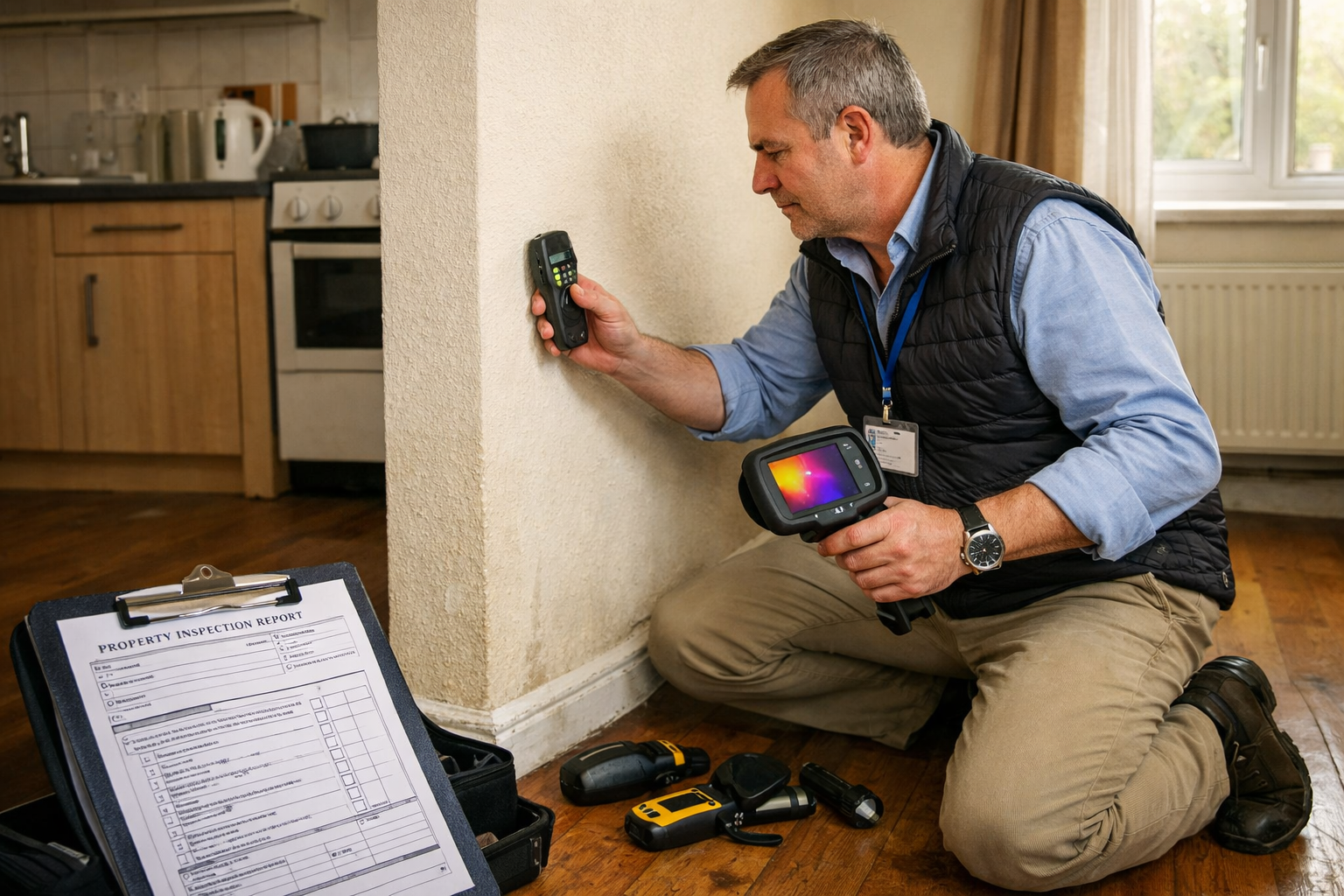
The term surveyor council housing encompasses a specialized branch of property surveying focused on social housing stock, former local authority properties, and the unique challenges these buildings present. Unlike standard residential properties, council housing often features distinctive construction methods, materials, and maintenance histories that require expert knowledge.
What Makes Council Housing Different?
Council housing properties built between the 1950s and 1980s frequently utilized non-traditional construction methods such as:
- Concrete panel systems (Wimpey No-fines, Airey houses, Reema constructions)
- Steel frame structures with concrete or brick cladding
- Prefabricated components assembled on-site
- System-built high-rise blocks with specific structural considerations
- Asbestos-containing materials common in properties built before 2000
These construction techniques, while innovative for their time, now present specific challenges including concrete carbonation, steel corrosion, thermal bridging, and potential structural defects. A surveyor experienced in council housing recognizes these issues immediately and knows exactly what to investigate.
The Role of Professional Surveyors in Council Housing
Professional surveyors serving the council housing sector provide several critical services:
Pre-Purchase Surveys: When tenants exercise their Right to Buy or investors purchase former council properties, comprehensive surveys reveal the true condition and help negotiate fair prices. Canterbury Surveyors specializes in these assessments, understanding both the technical and financial implications.
Stock Condition Surveys: Local authorities commission these to assess their entire housing portfolio, planning maintenance schedules and budget allocations effectively.
Defect Analysis: Identifying and diagnosing specific problems like concrete cancer, cavity wall insulation failures, or cladding issues requires specialized expertise.
Valuation Services: Determining market value for Right to Buy calculations, mortgage purposes, or asset management requires understanding council housing discount schemes and market dynamics.
Types of Surveys for Council Housing Properties
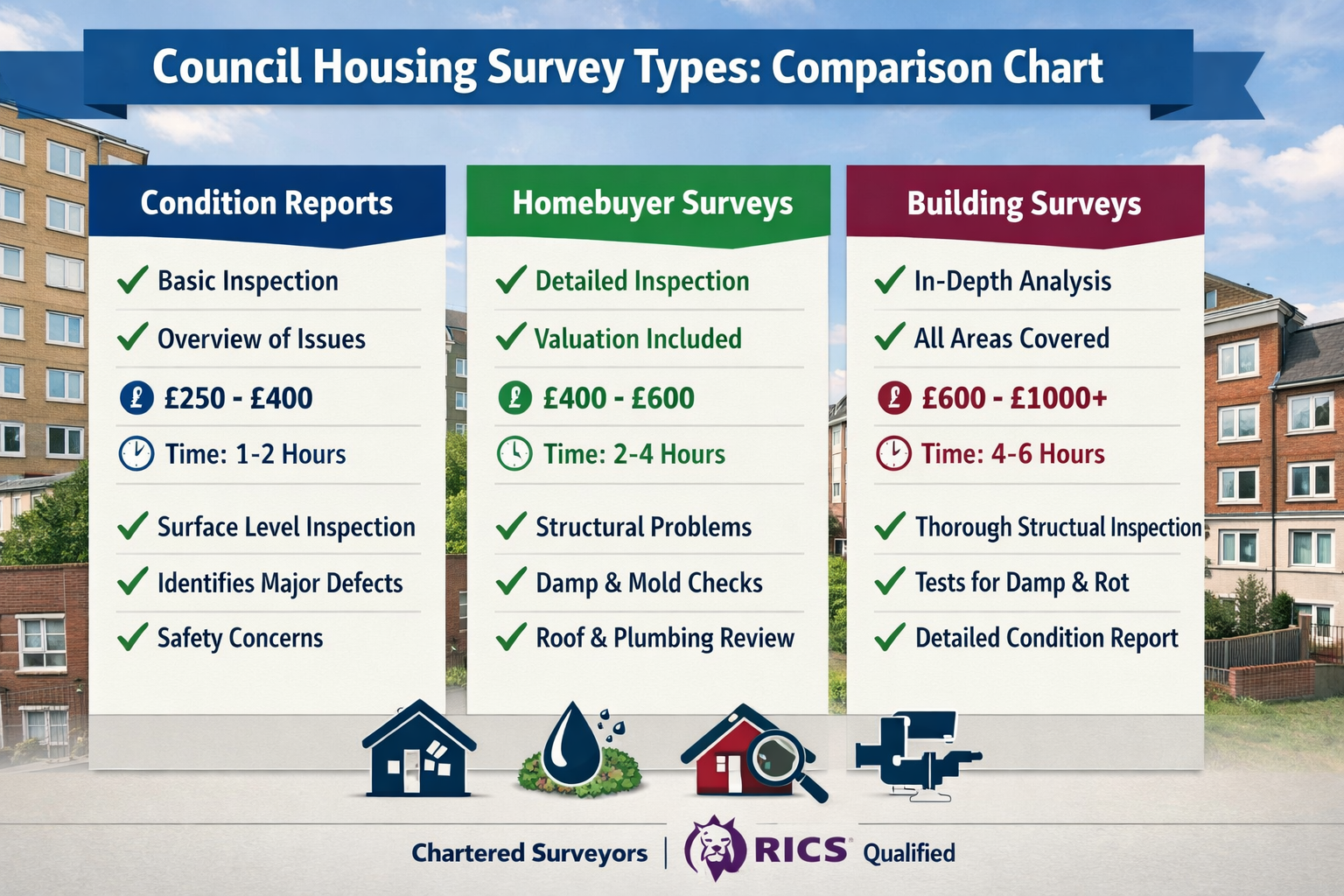
Selecting the appropriate survey type is crucial when dealing with council housing. The Royal Institution of Chartered Surveyors (RICS) provides standardized survey levels, but their application to council housing requires careful consideration.
Level 1: RICS Condition Report
Best for: Modern council properties (built post-2000) in excellent condition with no visible defects.
This basic survey provides:
- Traffic light rating system (Red, Amber, Green) for property elements
- Overview of condition without detailed investigation
- No valuation included
- Typical cost: £400-£600
Important note: This survey type is rarely recommended for council housing due to the age and construction methods of most social housing stock. Most council properties warrant more detailed investigation.
Level 2: RICS HomeBuyer Survey
Best for: Council properties built post-1980 in reasonable condition, or well-maintained properties with standard construction.
This mid-tier survey includes:
- More detailed inspection than Level 1
- Market valuation and insurance rebuild cost
- Identification of urgent defects and potential problems
- Advice on repairs and ongoing maintenance
- Typical cost: £600-£900
For those considering this option, understanding the difference between Level 2 and Level 3 surveys helps make an informed decision.
Level 3: RICS Building Survey (Full Structural Survey)
Best for: Council properties built before 1980, non-traditional construction, properties requiring renovation, or those with visible defects.
This comprehensive survey provides:
- Detailed inspection of all accessible areas
- In-depth analysis of construction methods and materials
- Identification of defects with repair advice and cost estimates
- Assessment of alterations and planning compliance
- Specific investigation of council housing concerns (concrete condition, steel corrosion, etc.)
- Typical cost: £800-£1,500+
Recommendation: For most council housing purchases, particularly Right to Buy scenarios, a Level 3 Building Survey represents the best value. The additional cost is minimal compared to the comprehensive information provided about properties with potentially complex construction issues.
Learn more about structural survey pricing to budget appropriately for your council housing assessment.
Specialist Surveys for Council Housing
Beyond standard RICS surveys, council housing often requires additional specialist investigations:
| Survey Type | Purpose | Typical Cost |
|---|---|---|
| Damp & Timber Survey | Identifies moisture penetration, rising damp, condensation, and timber decay | £200-£400 |
| Asbestos Survey | Locates and assesses asbestos-containing materials | £300-£600 |
| Electrical Condition Report | Tests electrical installations (often outdated in council properties) | £150-£300 |
| Concrete Testing | Assesses concrete carbonation and reinforcement corrosion | £500-£1,200 |
| Thermal Imaging Survey | Identifies heat loss, insulation gaps, and hidden moisture | £300-£500 |
Many council properties benefit from damp surveys given the prevalence of condensation and penetrating damp in social housing stock.
Right to Buy and Surveyor Council Housing Considerations
The Right to Buy scheme, reintroduced and expanded in recent years, allows eligible council tenants to purchase their homes at significant discounts. However, this opportunity comes with important surveying considerations that every prospective buyer must understand.
Understanding Your Right to Buy Discount
Tenants qualify for discounts ranging from 35% to 70% of the property’s market value, depending on:
- Length of tenancy (minimum 3 years required)
- Property type (flats receive higher discounts than houses)
- Maximum discount caps (£87,200 in London, £65,400 elsewhere in England as of 2026)
Critical point: The discount is calculated based on the property’s market value, which your mortgage lender will require to be verified by a professional valuation. This is where engaging a surveyor council housing specialist becomes essential.
Why Standard Valuations Aren’t Enough
Many Right to Buy purchasers make the mistake of relying solely on the council’s valuation or their mortgage lender’s basic assessment. This approach carries significant risks:
- Council valuations may not fully reflect defects or necessary repairs
- Lender valuations are designed to protect the lender, not the buyer
- Neither provides detailed condition information about construction defects, maintenance needs, or future costs
The Smart Approach: Independent Survey Before Purchase
Commissioning your own independent survey before completing a Right to Buy purchase provides:
Negotiating power: Identifying significant defects allows you to negotiate a reduced purchase price or request repairs before completion.
Informed decision-making: Understanding the true condition helps you decide whether to proceed, particularly if major works are needed soon after purchase.
Financial planning: Accurate repair cost estimates enable proper budgeting for post-purchase works.
Mortgage protection: Serious defects identified early prevent mortgage offers being withdrawn late in the process.
“We regularly see Right to Buy purchasers who discover major structural issues within months of completion. A £900 survey could have identified these problems and saved them £20,000+ in unexpected repairs. In council housing, where construction methods vary widely, professional surveying isn’t optional—it’s essential.” — Senior Surveyor, Canterbury Surveyors
Common Issues Found in Right to Buy Surveys
Based on thousands of council housing surveys conducted across the UK, these issues appear most frequently:
Concrete-related problems (40% of pre-1980 council properties):
- Concrete carbonation reducing structural integrity
- Spalling concrete revealing corroded reinforcement
- Concrete panel joint failures in system-built properties
Damp and condensation (55% of council flats):
- Inadequate ventilation systems
- Failed cavity wall insulation
- Penetrating damp from poor maintenance
- Condensation mold in bathrooms and bedrooms
Roof defects (35% of council houses):
- Aging flat roof coverings requiring replacement
- Missing or damaged roof tiles
- Inadequate roof insulation
- Blocked or damaged guttering systems
Electrical installations (60% of properties over 30 years old):
- Outdated wiring not meeting current regulations
- Insufficient electrical outlets
- Lack of RCD protection
- Obsolete consumer units requiring replacement
Understanding surveyor pricing helps Right to Buy purchasers budget for both the survey and any identified remedial works.
Choosing the Right Surveyor for Council Housing
Not all surveyors possess equal expertise in council housing properties. Selecting the right professional requires careful consideration of several factors.
Essential Qualifications and Experience
RICS Membership: Ensure your surveyor is a Member (MRICS) or Fellow (FRICS) of the Royal Institution of Chartered Surveyors. This guarantees professional standards, insurance, and regulatory oversight.
Council Housing Experience: Specifically ask about experience with:
- Non-traditional construction methods
- System-built properties
- Concrete panel constructions
- High-rise residential buildings
- Right to Buy transactions
Local Knowledge: Surveyors familiar with council housing in your specific area understand local construction patterns, common defects, and regional building practices. Canterbury Surveyors operates across London and the South East, with extensive knowledge of council housing stock in these regions.
Questions to Ask Potential Surveyors
Before commissioning a surveyor council housing assessment, ask these critical questions:
- How many council housing surveys do you complete annually? (Look for specialists conducting 50+ per year)
- Are you familiar with [specific construction type] properties? (Name your property’s construction method)
- What does your survey include, and what additional costs might arise?
- How long will the survey take, and when will I receive the report? (Understand typical survey durations)
- Can you provide references from recent Right to Buy clients?
- What professional indemnity insurance do you carry? (Minimum £1 million recommended)
- Will you be available to discuss the report and answer questions?
Red Flags to Avoid
Steer clear of surveyors who:
- Offer significantly cheaper rates than competitors (often indicates rushed or inadequate surveys)
- Cannot provide evidence of RICS membership
- Have no specific council housing experience
- Refuse to provide sample reports
- Are unavailable for post-survey discussions
- Use subcontractors without disclosing this upfront
Understanding Survey Costs and Value
Survey costs vary based on property size, location, and survey type, but typical 2026 ranges include:
Small council flat (1-2 bedrooms):
- Level 2: £600-£750
- Level 3: £800-£1,000
Medium council house (2-3 bedrooms):
- Level 2: £700-£850
- Level 3: £900-£1,200
Large council house (4+ bedrooms):
- Level 2: £800-£950
- Level 3: £1,000-£1,500
Additional specialist surveys: £200-£600 each
While these costs may seem significant, consider that the average council housing repair issue identified in surveys costs £8,500 to remedy. A comprehensive survey provides exceptional value by:
- Identifying problems before legal commitment
- Enabling price negotiation
- Preventing catastrophic post-purchase discoveries
- Providing evidence for warranty claims
- Creating maintenance planning roadmaps
Common Defects in Council Housing: What Surveyors Look For
Understanding the specific defects that surveyor council housing specialists investigate helps property buyers appreciate the value of professional assessments.
Non-Traditional Construction Defects
Concrete Panel Systems: Properties built using systems like Wimpey No-fines, Airey, or Reema constructions present unique challenges:
- Carbonation: Carbon dioxide penetrates concrete, reducing pH and causing steel reinforcement corrosion
- Panel joint failures: Joints between concrete panels deteriorate, allowing water penetration
- Thermal bridging: Poor insulation at panel joints creates cold spots and condensation
- Structural movement: Inadequate panel connections may allow differential movement
Steel Frame Constructions: Properties with steel frames clad in concrete or brick require careful assessment of:
- Corrosion: Moisture reaching steel frames causes expansion and structural weakness
- Cladding attachment: Corroded fixings may compromise cladding security
- Fire protection: Inadequate fire protection to structural steel
- Cavity wall tie failure: Corroded wall ties in cavity construction
Damp and Moisture Problems
Damp issues affect over half of all council housing properties surveyed, manifesting as:
Rising Damp:
- Failed or absent damp-proof courses
- Bridged damp-proof courses from external ground levels
- Penetration through solid walls in older properties
Penetrating Damp:
- Defective rainwater goods (gutters, downpipes)
- Cracked or porous external walls
- Failed cavity wall insulation trapping moisture
- Roof defects allowing water ingress
Condensation:
- Inadequate ventilation systems
- Poor heating provision
- Thermal bridging at construction junctions
- Occupant lifestyle factors
For properties showing signs of moisture problems, commissioning a detailed damp and timber report provides comprehensive analysis and remedial recommendations.
Roof and External Envelope Issues
Council housing roofs, particularly flat roofs common on 1960s-1980s properties, frequently exhibit:
- Felt deterioration: Aging bituminous felt becomes brittle and cracks
- Ponding: Inadequate falls allow water pooling and accelerated deterioration
- Flashing failures: Defective upstand flashings allow water penetration
- Insulation inadequacy: Original insulation often fails to meet current standards
Services and Installations
Electrical, heating, and plumbing systems in council housing often require attention:
Electrical Systems:
- Outdated wiring (rubber or fabric insulation)
- Insufficient circuit protection
- Obsolete consumer units
- Lack of earthing or bonding
Heating Systems:
- Aging boilers beyond economic repair
- Inefficient storage heaters
- Inadequate heating capacity
- Poor system controls
Plumbing:
- Lead pipework requiring replacement
- Corroded steel or iron pipes
- Inadequate water pressure
- Outdated bathroom and kitchen fittings
Asbestos Concerns
Properties built before 2000 commonly contain asbestos in:
- Artex textured coatings
- Floor tiles and adhesives
- Pipe lagging and insulation
- Cement roof sheets and panels
- Partition walls and ceiling panels
Professional surveyors identify suspected asbestos-containing materials and recommend specialist testing where appropriate.
The Survey Process: What to Expect
Understanding the surveyor council housing inspection process helps property buyers prepare effectively and maximize the value of their investment.
Before the Survey
Scheduling: Surveys typically occur 1-2 weeks after booking, depending on surveyor availability. Right to Buy purchasers should schedule surveys as early as possible in the purchase process.
Access arrangements: Ensure the property is accessible, with all areas available for inspection including:
- Loft spaces (if safely accessible)
- Basements or cellars
- Garages and outbuildings
- External areas and boundaries
Utilities: Where possible, ensure heating, electrical, and water systems are operational for testing.
Documentation: Provide the surveyor with any available information:
- Council maintenance records
- Previous repair invoices
- Planning permissions for alterations
- Guarantees or warranties
- Building control certificates
During the Survey
Professional surveys of council housing typically take 2-4 hours depending on property size and complexity. The surveyor will:
- Conduct external inspection: Examining roof, walls, windows, doors, drainage, and grounds
- Perform internal inspection: Assessing all rooms, floors, ceilings, walls, and internal services
- Test systems: Checking heating, electrical outlets, plumbing, and ventilation
- Take measurements: Recording dimensions, levels, and specific defect locations
- Photograph defects: Documenting issues for the report
- Use specialist equipment: Moisture meters, spirit levels, binoculars, ladders (for limited height access)
Note: Surveyors conduct non-invasive inspections. They will not move furniture, lift carpets, or remove fixtures without prior agreement. Some defects may be hidden and undetectable without invasive investigation.
After the Survey
Report delivery: Comprehensive reports typically arrive within 5-7 working days of the inspection. Rush services may be available for additional fees.
Report contents: Professional council housing surveys include:
- Executive summary: Key findings and urgent issues
- Detailed condition assessment: Room-by-room and element-by-element analysis
- Defect descriptions: Clear explanations of problems identified
- Photographic evidence: Images documenting significant defects
- Repair recommendations: Prioritized remedial works with urgency ratings
- Cost estimates: Approximate repair costs for identified issues
- Maintenance advice: Ongoing care recommendations
Follow-up consultation: Reputable surveyors offer post-report discussions to clarify findings and answer questions. This service is invaluable for understanding complex technical issues.
Acting on Survey Findings: Your Options
Receiving a survey report identifying defects in your prospective council housing purchase can feel overwhelming. However, several constructive options exist for addressing survey findings.
Negotiating Price Reductions
When significant defects are identified, buyers can:
Request price reduction: Calculate the cost of necessary repairs and request a corresponding price reduction. For Right to Buy purchases, this may involve negotiating with the council to reduce the purchase price.
Seek repair completion: Ask the council to complete essential repairs before completion. Some authorities agree to this for major structural or safety issues.
Adjust discount calculation: In some cases, if the property’s true market value is lower than initially assessed due to defects, the Right to Buy discount calculation may be revised.
Proceeding with Full Knowledge
Some buyers choose to proceed despite identified defects, accepting:
- The property’s condition reflects the discounted price
- Repairs can be completed post-purchase when convenient
- The location, size, or other factors outweigh the defects
This approach requires careful financial planning to ensure repair costs are affordable alongside mortgage payments.
Withdrawing from Purchase
Serious structural defects, particularly in non-traditional construction properties, may justify withdrawal:
- Structural instability: Significant movement, subsidence, or structural failure
- Unmortgageable defects: Issues preventing mortgage lending
- Excessive repair costs: Remedial works exceeding the property’s value
- Safety hazards: Immediate risks to occupant health or safety
While disappointing, discovering these issues before legal commitment prevents catastrophic financial losses.
Obtaining Specialist Reports
Survey findings sometimes require additional specialist investigation:
- Structural engineer reports: For significant structural concerns
- Asbestos surveys: When asbestos materials are suspected
- Electrical testing: For comprehensive electrical installation assessment
- Drainage surveys: When drainage defects are indicated
These additional reports provide detailed analysis and remedial specifications for complex issues.
Council Housing Surveys for Different Property Types
The surveyor council housing approach varies significantly based on property type, each presenting unique considerations.
Low-Rise Houses and Maisonettes
Common construction: Traditional brick cavity walls, pitched roofs, standard foundations.
Key survey focuses:
- Roof condition and insulation adequacy
- Cavity wall condition and insulation performance
- Damp-proof course effectiveness
- Window and door condition
- Garden drainage and boundaries
Typical issues: These properties generally present fewer structural concerns than high-rise or non-traditional constructions but often require updating of services and thermal efficiency improvements.
High-Rise Flats and Tower Blocks
Common construction: Concrete frame with brick or panel cladding, communal services, shared facilities.
Key survey focuses:
- Cladding type and fire safety compliance
- Concrete condition and carbonation
- Communal area condition
- Lift and fire safety equipment
- Service charge obligations
- Building insurance arrangements
Typical issues: Post-Grenfell, cladding concerns dominate high-rise surveys. Many properties require expensive remediation works, potentially affecting mortgageability and resale values.
Critical consideration: High-rise council flat purchasers must understand:
- EWS1 certificates: External Wall System certification requirements
- Service charges: Potential for significant increases for remedial works
- Mortgage restrictions: Some lenders refuse to lend on high-rise properties
- Resale implications: Cladding issues severely impact marketability
Non-Traditional Construction Properties
Common types: Wimpey No-fines, Airey houses, Reema constructions, Cornish Units, Unity houses.
Key survey focuses:
- Construction system identification
- Structural adequacy and stability
- Concrete carbonation and reinforcement condition
- Panel joint condition
- Previous remedial works and effectiveness
- Mortgage and insurance availability
Typical issues: Many non-traditional properties have been strengthened or reconstructed, but some remain in original condition with significant structural concerns.
Essential requirement: Surveyors must definitively identify the construction system and assess whether it appears on mortgage lenders’ “acceptable” lists. Many non-traditional constructions are unmortgageable without remedial works.
Converted Properties and Flats
Common construction: Victorian or Edwardian houses converted to flats, often with council ownership of some units.
Key survey focuses:
- Conversion quality and building control compliance
- Sound insulation between units
- Fire separation adequacy
- Shared services and responsibilities
- Lease terms and restrictions
- Freeholder obligations
Typical issues: Conversions vary enormously in quality. Poor conversions present ongoing maintenance challenges and potential safety concerns.
For properties with complex ownership structures, understanding leasehold considerations becomes essential alongside the physical survey.
Legal and Regulatory Considerations
Surveyor council housing assessments intersect with various legal and regulatory frameworks that buyers must understand.
Building Regulations Compliance
Council housing alterations and extensions should comply with Building Regulations. Surveyors identify:
- Unauthorized alterations: Extensions, loft conversions, or structural changes without approval
- Non-compliant works: Alterations not meeting Building Regulations standards
- Missing certificates: Absence of Building Control completion certificates
Implications: Non-compliant works may require:
- Retrospective Building Control applications
- Remedial works to achieve compliance
- Indemnity insurance (if retrospective approval is impossible)
- Reduced property value
Planning Permission
Some council housing alterations require planning permission:
- Extensions beyond permitted development rights
- Loft conversions with roof alterations
- External appearance changes in conservation areas
- Changes of use (e.g., converting garage to habitable room)
Surveyors note apparent planning issues, recommending buyers verify compliance with local planning authorities.
Energy Performance Certificates (EPCs)
All properties require valid EPCs for sale. Council housing often achieves poor ratings (E, F, or G) due to:
- Inadequate insulation
- Inefficient heating systems
- Poor glazing performance
- Air leakage
Future implications: Government proposals may eventually prevent sale or rental of properties below EPC rating C, making energy efficiency improvements increasingly important.
Fire Safety Regulations
Post-Grenfell fire safety regulations significantly impact council housing, particularly:
- High-rise buildings: Enhanced fire safety requirements
- Cladding systems: Combustible cladding removal requirements
- Communal areas: Fire door and escape route standards
- Flat entrance doors: Fire resistance requirements
Surveyors identify apparent fire safety concerns, recommending specialist fire risk assessments where appropriate.
Right to Buy Restrictions
Right to Buy properties carry specific restrictions:
- Resale restrictions: Some properties cannot be sold within 5 years without offering them back to the council
- Discount repayment: Selling within 5 years requires repaying a proportion of the discount
- Shared ownership: Some Right to Buy purchases involve shared ownership arrangements
Buyers must understand these restrictions before committing to purchase.
Maintaining Your Council Housing Property Post-Purchase
A comprehensive survey provides the foundation for effective property maintenance. Post-purchase, implementing surveyor recommendations ensures your council housing investment remains sound.
Immediate Priority Works
Surveys categorize defects by urgency:
Urgent (address within 1 month):
- Safety hazards (electrical faults, structural instability)
- Active water penetration causing damage
- Security issues (failed locks, broken windows)
- Health hazards (exposed asbestos, gas leaks)
Short-term (address within 6-12 months):
- Roof repairs before winter
- Damp issues requiring investigation and remediation
- Heating system repairs or replacement
- External decoration to prevent deterioration
Medium-term (address within 1-3 years):
- Window and door replacement
- Kitchen and bathroom upgrades
- Insulation improvements
- External repointing or rendering
Long-term (address within 3-10 years):
- Roof replacement
- Rewiring
- Central heating system replacement
- Major external works
Creating a Maintenance Plan
Use your survey report to develop a comprehensive maintenance plan:
- Prioritize works: Address urgent items first, then plan medium and long-term works
- Budget accordingly: Allocate funds for anticipated works
- Obtain quotes: Get multiple quotes for significant works
- Schedule strategically: Combine related works for efficiency (e.g., external scaffolding for roof and chimney repairs)
- Maintain records: Document all works with invoices, guarantees, and certificates
Understanding Warranties and Guarantees
Council housing may include:
- NHBC warranties: Properties built by private developers for councils
- Structural guarantees: For remedial works to non-traditional constructions
- Component guarantees: Windows, roofs, damp-proofing, etc.
Surveyors identify whether warranties exist and their remaining validity. Ensure these transfer to you at completion.
When to Commission Further Surveys
Post-purchase surveys may be necessary when:
- Planning alterations: Before extending or significantly altering the property
- Unexplained defects appear: New cracks, damp patches, or structural concerns
- Selling the property: Identifying and addressing issues before marketing
- Dispute resolution: Providing evidence for defect claims or party wall matters
Establishing a relationship with a trusted surveyor facilitates ongoing property management and provides expert advice when needed.
Finding Specialist Council Housing Surveyors in Your Area
Location matters when selecting a surveyor council housing specialist. Local knowledge of regional construction patterns, common defects, and council housing stock characteristics provides significant advantages.
Regional Surveying Services
Professional surveying firms operate across the UK, with many specializing in specific regions. For properties in London and the South East, Canterbury Surveyors’ locations cover extensive areas including:
- London boroughs: Comprehensive coverage across Central London, North London, South West London, and East London
- Home Counties: Services across Surrey, Hertfordshire, Essex, and Berkshire
- Specific localities: Targeted expertise in areas with significant council housing stock
Verifying Credentials
Before appointing any surveyor, verify:
✅ RICS membership: Check the RICS register at rics.org
✅ Professional indemnity insurance: Request confirmation of adequate coverage
✅ Client reviews: Read independent reviews on Google, Trustpilot, or industry platforms
✅ Sample reports: Request examples demonstrating report quality and detail
✅ Complaints procedure: Understand how concerns are addressed
Getting Started
To commission a council housing survey:
- Contact surveyors: Reach out to 2-3 RICS-registered firms with council housing experience
- Describe the property: Provide address, property type, construction method (if known), and age
- Discuss requirements: Explain whether this is Right to Buy, standard purchase, or other circumstances
- Compare quotes: Evaluate cost, service scope, and turnaround time
- Book the survey: Schedule at a convenient time with property access arranged
- Prepare questions: List any specific concerns to discuss with the surveyor
Contact Canterbury Surveyors to discuss your council housing survey requirements and receive expert guidance tailored to your specific circumstances.
Conclusion: Protecting Your Council Housing Investment
Purchasing council housing through Right to Buy or acquiring former local authority properties represents a significant financial commitment and life-changing opportunity. The unique construction methods, aging infrastructure, and specific defect patterns common in social housing stock make professional surveying not just advisable but absolutely essential.
A comprehensive surveyor council housing assessment provides:
🔍 Complete transparency: Understanding exactly what you’re purchasing, defects and all
💰 Financial protection: Identifying issues worth thousands before legal commitment
📊 Negotiating leverage: Evidence supporting price reductions or repair requests
🏗️ Maintenance roadmap: Clear guidance on immediate and future work requirements
⚖️ Legal safeguards: Documentation supporting warranty claims and dispute resolution
The modest investment in professional surveying—typically £800-£1,500 for comprehensive Building Surveys—pales in comparison to the average £8,500 cost of defects identified in council housing surveys. More importantly, surveys occasionally reveal catastrophic issues that would render properties unmortgageable or require repairs exceeding the property’s value. In these cases, the survey cost represents the best money ever spent, preventing financial disaster.
Your Next Steps
If you’re considering purchasing council housing in 2026:
- Research your property’s construction: Identify the building method and common issues for that type
- Budget for comprehensive surveying: Allocate funds for Level 3 Building Survey plus any specialist reports
- Engage RICS-registered specialists: Select surveyors with proven council housing experience
- Schedule early: Book surveys as soon as purchase agreements are reached
- Read reports thoroughly: Study findings carefully and ask questions about anything unclear
- Act on recommendations: Use survey findings to negotiate, plan repairs, or make informed decisions
- Maintain documentation: Keep survey reports for future reference, resale, or dispute resolution
The council housing sector offers tremendous opportunities for first-time buyers, tenants exercising Right to Buy, and property investors. However, these opportunities come with specific risks that only professional surveying can adequately address. By investing in expert assessment from qualified surveyor council housing specialists, you protect your investment, ensure safe habitable conditions, and make informed decisions based on comprehensive property knowledge.
Don’t gamble with potentially the largest financial commitment of your life. Commission a professional survey from experienced specialists who understand council housing’s unique challenges and can provide the detailed, accurate information you need to proceed with confidence.
For expert council housing surveying services backed by extensive experience, RICS qualifications, and comprehensive local knowledge, explore the full range of professional surveying services available to protect your property investment in 2026 and beyond.