
Level 2 v Level 3 Survey: The Complete Guide to Choosing the Right Property Survey in 2026
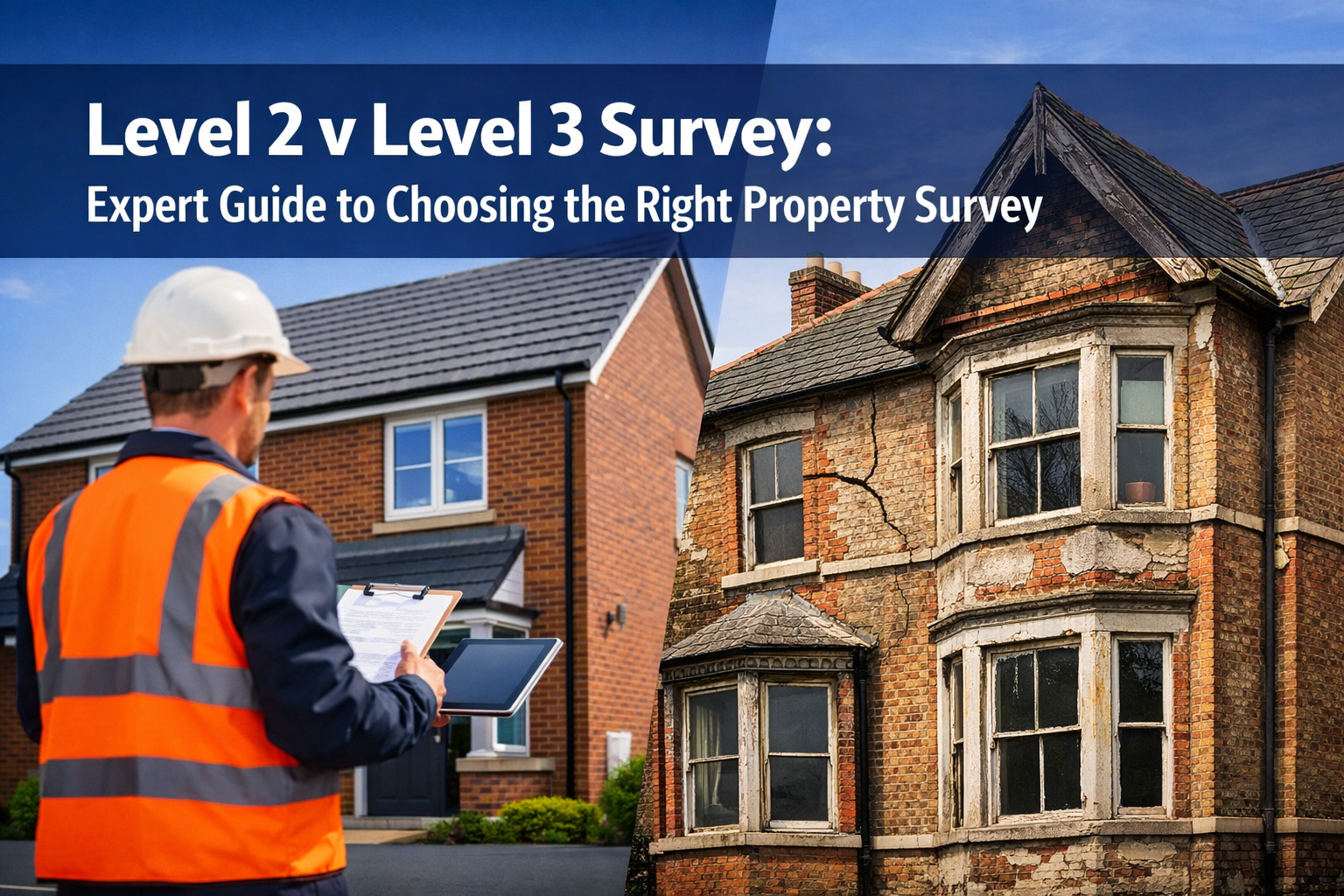
When purchasing a property, one of the most critical decisions homebuyers face is choosing between a Level 2 v Level 3 Survey. This choice can mean the difference between uncovering hidden structural issues worth thousands of pounds or proceeding blindly into a potentially costly investment. In 2026, with property prices remaining high and building standards varying significantly across different eras, understanding which RICS home survey suits your needs has never been more important.
The decision between these two survey types isn’t just about cost—it’s about matching the inspection depth to your property’s characteristics, age, and condition. Making the wrong choice could leave you exposed to unforeseen repair bills, while over-investing in an unnecessarily comprehensive survey wastes money that could be better spent elsewhere in your home purchase journey.
Key Takeaways
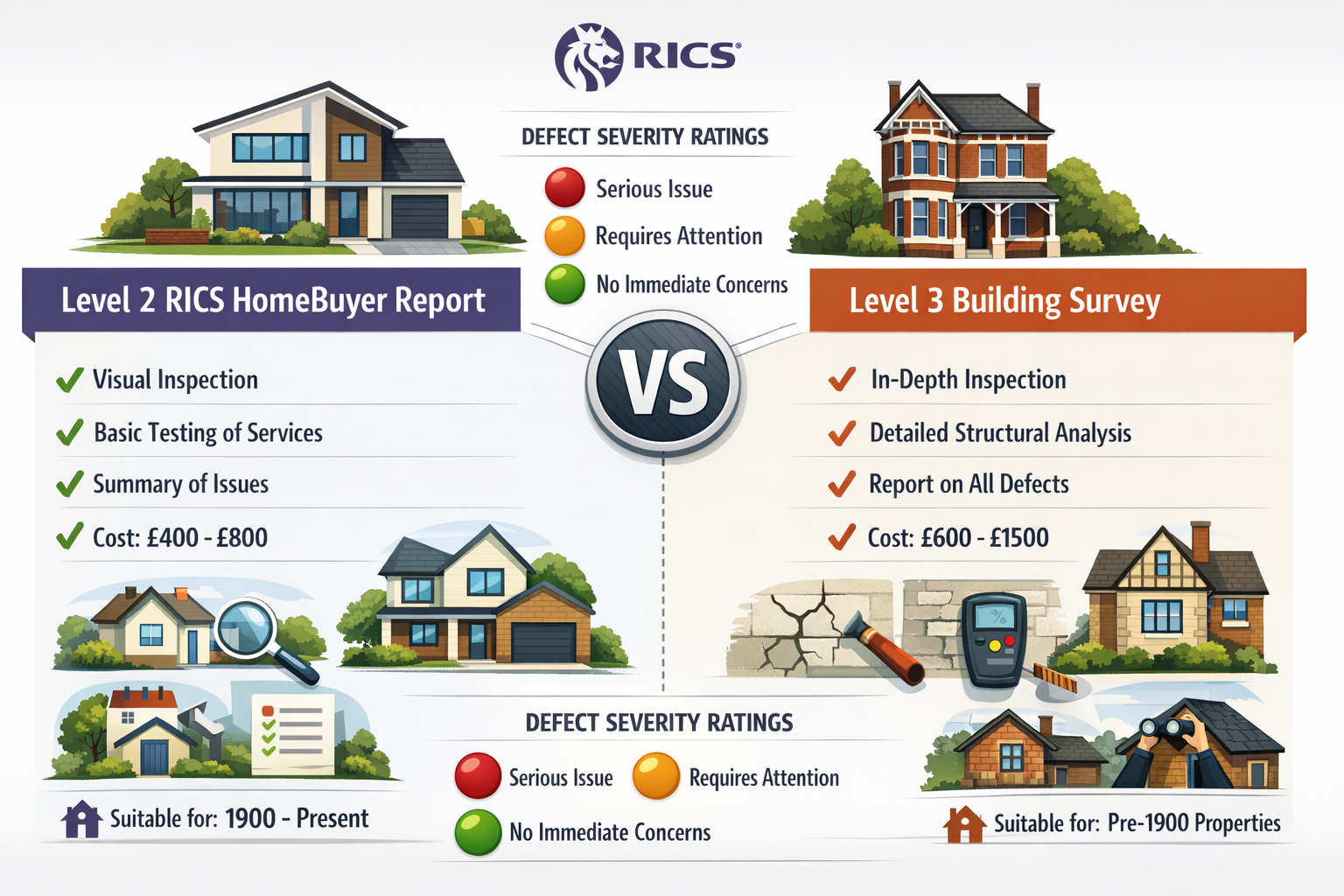
- Level 2 surveys (RICS HomeBuyer Reports) suit standard properties built after 1900 in reasonable condition, costing £400-£800 on average
- Level 3 surveys (Building Surveys) provide comprehensive assessments for older, altered, or unusual properties, typically costing £600-£1,500
- Property age and condition are the primary factors determining which survey type offers the best value and risk mitigation
- Survey findings directly impact property negotiations, with defects often leading to price reductions of 5-15% on average
- RICS standards ensure both survey types follow rigorous professional guidelines, but the inspection depth differs significantly
Understanding RICS Survey Standards and Property Assessment
The Royal Institution of Chartered Surveyors (RICS) establishes the professional framework for property surveys in the UK. In 2026, RICS maintains three distinct survey levels, with Level 2 and Level 3 representing the most commonly commissioned options for residential property purchases. These standardized survey types ensure consistent, professional property evaluation across the industry.
RICS survey standards provide homebuyers with confidence that their property inspection meets rigorous professional criteria. Chartered surveyors conducting these assessments must maintain professional indemnity insurance, adhere to ethical guidelines, and complete continuing professional development to stay current with building regulations and construction techniques.
The property assessment process under RICS guidelines focuses on identifying defects, evaluating property condition, and providing clear guidance on necessary repairs. Unlike basic valuation surveys conducted for mortgage purposes, Level 2 and Level 3 surveys prioritize the buyer’s interests, offering detailed insights into building condition and potential maintenance requirements.
Understanding these standards helps homebuyers recognize that survey costs represent investment in professional expertise rather than unnecessary expense. Canterbury Surveyors provides RICS-compliant surveys that meet these exacting standards, ensuring comprehensive property evaluation.
What is a Level 2 Survey? (RICS HomeBuyer Report)
A Level 2 survey, officially known as the RICS HomeBuyer Report, represents the middle tier of property inspection services. This survey type provides a detailed assessment of a property’s visible and accessible elements without the invasive investigation characteristic of more comprehensive surveys.
Level 2 Survey Scope and Methodology
The Level 2 survey inspection process involves a visual examination of the property’s main elements, including:
- Structural components: walls, roofs, floors, windows, and doors
- Services: visible plumbing, electrical installations, heating systems
- Exterior elements: drainage, boundaries, outbuildings
- Interior condition: decorative state, damp issues, ventilation
- Grounds: immediate property surroundings and access
Chartered surveyors conducting Level 2 surveys don’t move furniture, lift floor coverings, or conduct invasive investigations. The assessment focuses on identifying visible defects and providing condition ratings using a traffic light system:
🟢 Condition Rating 1: No repair currently needed
🟡 Condition Rating 2: Repairs or replacement requiring future attention
🔴 Condition Rating 3: Urgent defects requiring immediate attention
Ideal Properties for Level 2 Surveys
Level 2 surveys suit properties that meet specific criteria:
- Built after 1900 using conventional construction methods
- Standard construction without unusual features or materials
- Reasonable condition without obvious major defects
- Unaltered or sympathetically extended properties
- Properties under 2,000 square feet typically
For homebuyers purchasing modern suburban houses, standard semi-detached properties, or well-maintained terraced homes, the Level 2 survey provides sufficient detail to make informed decisions. According to industry data from 2026, approximately 60% of residential property transactions involve Level 2 surveys, reflecting their suitability for the majority of housing stock [1].
What Level 2 Surveys Include
A comprehensive Level 2 survey report contains:
- Executive summary highlighting key findings and urgent issues
- Condition ratings for all major building elements
- Advice on defects requiring attention
- Guidance on repairs and maintenance priorities
- Market valuation (if requested as an optional extra)
- Reinstatement cost for insurance purposes (optional)
The report typically runs 20-30 pages and arrives within 5-7 working days after the inspection. Understanding how long a homebuyers survey takes helps buyers plan their purchase timeline effectively.
Level 2 Survey Limitations
Important limitations include:
- No invasive investigation of hidden areas
- Limited assessment of inaccessible spaces like roof voids
- No detailed structural calculations or engineering analysis
- Minimal advice on repair methodologies or costs
- Brief coverage of services and installations
These limitations make Level 2 surveys unsuitable for properties with known issues, unusual construction, or significant alterations requiring specialist assessment.
What is a Level 3 Survey? (Building Survey)
The Level 3 survey, traditionally called a Building Survey or structural survey, represents the most comprehensive property inspection available to homebuyers. This detailed assessment provides an in-depth analysis of a property’s construction, condition, and defects, making it the gold standard for thorough property evaluation.
Level 3 Survey Scope and Methodology
Level 3 surveys involve extensive investigation of all accessible areas, with surveyors employing specialist equipment and techniques:
- Comprehensive structural analysis of load-bearing elements
- Detailed roof inspection including void spaces where accessible
- In-depth services assessment of plumbing, electrical, heating systems
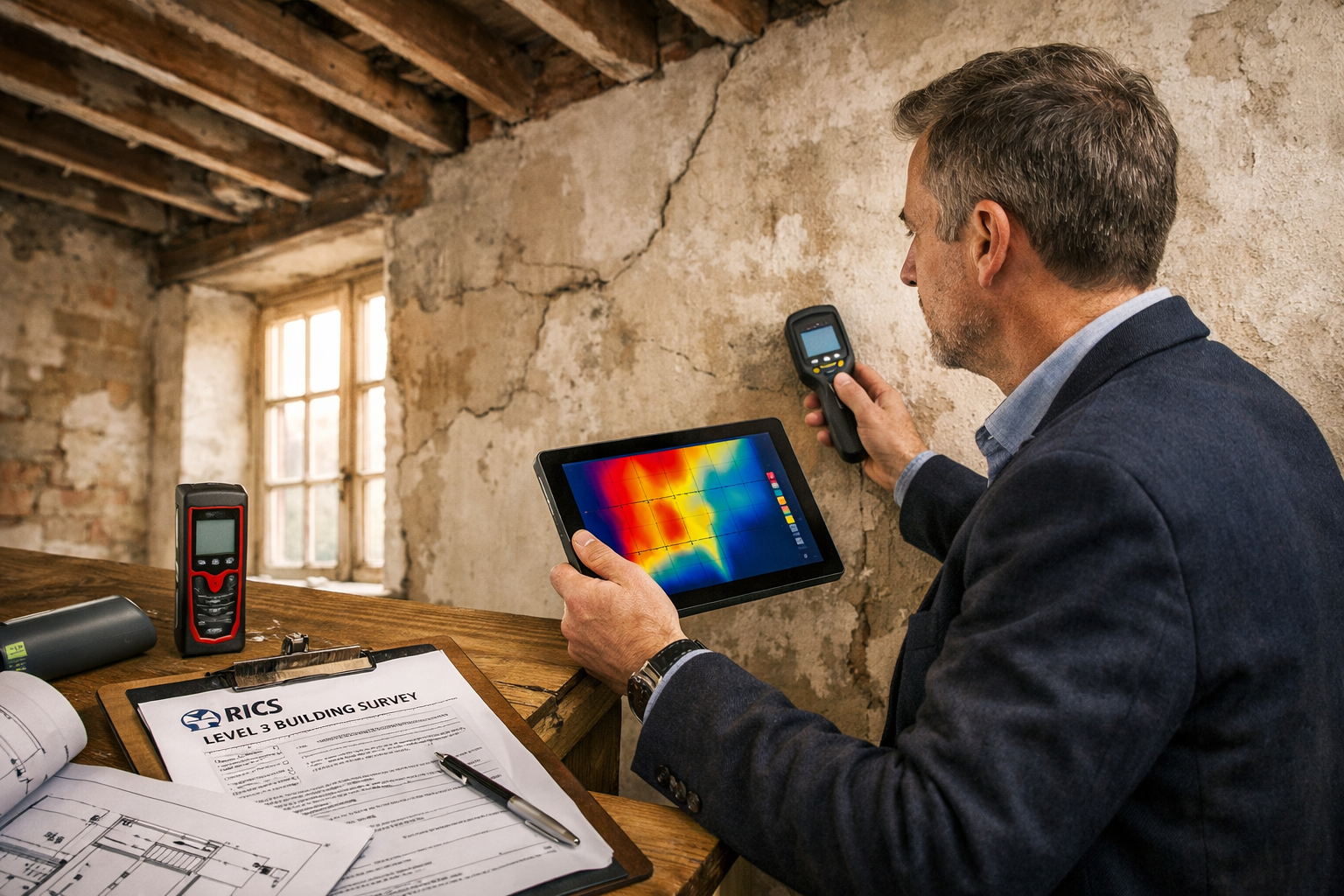
- Specialist equipment use including moisture meters, thermal imaging cameras
- Detailed defect analysis with photographic evidence
- Investigation of suspicious areas requiring closer examination
- Assessment of previous alterations and their structural implications
Unlike Level 2 surveys, chartered surveyors conducting Level 3 assessments will move furniture where necessary, lift accessible floor coverings, and investigate roof spaces, cellars, and other hidden areas. The inspection typically takes 4-8 hours depending on property size and complexity.
Ideal Properties for Level 3 Surveys
Level 3 surveys are recommended for:
- Period properties built before 1900
- Listed buildings with historical significance
- Properties in poor condition requiring renovation
- Unusual construction using non-standard materials or methods
- Significantly altered properties with multiple extensions
- Properties over 2,000 square feet with complex layouts
- Buildings with known defects requiring detailed assessment
- Commercial conversions to residential use
For buyers purchasing Victorian terraces, Georgian townhouses, barn conversions, or properties requiring significant renovation, the Level 3 survey provides essential detailed information. Industry statistics from 2026 indicate that Level 3 surveys account for approximately 25% of pre-purchase property inspections [2].
What Level 3 Surveys Include
A comprehensive Level 3 survey report contains:
- Detailed executive summary with prioritized recommendations
- Comprehensive condition assessment of all building elements
- Photographic evidence of defects and issues
- Detailed repair advice including methodologies and priorities
- Structural concerns with recommendations for specialist reports
- Services evaluation with upgrade recommendations
- Maintenance guidance for ongoing property care
- Defect cost implications (estimates where appropriate)
Level 3 survey reports typically run 40-100 pages depending on property complexity and arrive within 7-14 working days. The comprehensive nature means buyers receive detailed technical information suitable for planning renovation projects or negotiating purchase prices.
Advanced Investigation Techniques
Modern Level 3 surveys in 2026 increasingly incorporate technology:
- Thermal imaging to identify heat loss and hidden moisture
- Moisture meters for accurate damp detection
- Laser measuring devices for precise dimensional analysis
- Drone photography for roof and chimney inspection (where appropriate)
- Digital reporting with interactive photographs and annotations
These technological advances enhance survey accuracy and provide clearer evidence of property defects, making structural survey findings more actionable for buyers and their advisors.
Level 2 v Level 3 Survey: Direct Comparison
Understanding the Level 2 v Level 3 Survey differences helps buyers make informed decisions aligned with their property’s characteristics and their risk tolerance.
Comparison Table: Level 2 vs Level 3 Surveys
| Feature | Level 2 Survey | Level 3 Survey |
|---|---|---|
| Official Name | RICS HomeBuyer Report | Building Survey |
| Inspection Depth | Visual, non-invasive | Comprehensive, investigative |
| Typical Duration | 2-4 hours | 4-8 hours |
| Report Length | 20-30 pages | 40-100 pages |
| Average Cost | £400-£800 | £600-£1,500 |
| Suitable Property Age | Post-1900 | All ages, especially pre-1900 |
| Property Condition | Good to reasonable | Any condition |
| Construction Type | Standard/conventional | All types including unusual |
| Hidden Areas | Limited access | Comprehensive access |
| Defect Detail | Traffic light ratings | Detailed technical analysis |
| Repair Advice | General guidance | Specific recommendations |
| Specialist Equipment | Basic tools | Advanced diagnostic equipment |
Key Differences in Inspection Approach
Accessibility and Investigation
Level 2 surveys examine visible and accessible areas without moving furniture or lifting floor coverings. Surveyors note limitations where access proves impossible. Level 3 surveys actively investigate suspicious areas, move furniture where necessary, and access roof voids, cellars, and other hidden spaces to provide comprehensive assessment.
Defect Reporting Style
Level 2 reports use standardized condition ratings (1-3) with brief descriptions of defects. Level 3 reports provide detailed technical explanations of defects, their causes, implications, and recommended remedial actions. This difference proves crucial when planning renovation budgets or negotiating purchase prices.
Services Assessment
Level 2 surveys briefly note the presence and apparent condition of services but don’t test functionality. Level 3 surveys provide more detailed services assessment, often recommending specialist electrical or heating system inspections where concerns arise.
Cost-Benefit Analysis
When evaluating the Level 2 v Level 3 Survey decision, consider the cost-benefit relationship:
Level 2 Survey Value Proposition
For a £350,000 standard semi-detached house built in 1960, a £600 Level 2 survey represents 0.17% of the purchase price. This survey typically identifies:
- 5-8 condition rating 2 items requiring future attention
- 0-2 condition rating 3 items requiring urgent action
- Average potential negotiation leverage: £2,000-£5,000
Level 3 Survey Value Proposition
For a £450,000 Victorian terrace requiring renovation, a £1,200 Level 3 survey represents 0.27% of the purchase price. This survey typically identifies:
- 15-25 defects requiring attention
- Detailed repair cost implications
- Average potential negotiation leverage: £10,000-£30,000
The enhanced detail of Level 3 surveys often pays for itself multiple times through informed negotiation and renovation planning. Understanding surveyor pricing structures helps buyers budget appropriately.
When to Choose Each Survey Type: Decision Framework
Selecting between a Level 2 v Level 3 Survey requires evaluating multiple property characteristics and buyer circumstances. This decision framework provides clear guidance for making the optimal choice.
Choose a Level 2 Survey When:
✅ Property built after 1900 using conventional construction methods
✅ Standard construction without unusual features
✅ Reasonable condition from external inspection
✅ No obvious major defects visible during viewing
✅ Straightforward layout without complex alterations
✅ Budget-conscious purchase where comprehensive detail isn’t essential
✅ Time-sensitive transaction requiring faster turnaround
✅ Modern property built within the last 30 years
Real-World Example: Sarah purchased a 1985-built three-bedroom semi-detached house in good decorative order. Her Level 2 survey identified minor roof tile slippage (condition rating 2) and recommended gutter cleaning. The survey cost £550 and enabled her to negotiate a £1,500 price reduction for minor repairs. The inspection confirmed no major structural concerns, giving her confidence to proceed.
Choose a Level 3 Survey When:
✅ Property built before 1900 or of historical significance
✅ Listed building with preservation requirements
✅ Poor or questionable condition requiring detailed assessment
✅ Unusual construction using non-standard materials
✅ Significant alterations including extensions or conversions
✅ Planning renovation requiring detailed defect understanding
✅ Large or complex property with multiple outbuildings
✅ Visible structural concerns requiring expert evaluation
✅ Commercial to residential conversion
✅ Thatched, timber-framed, or specialist construction
Real-World Example: James purchased a Grade II listed Georgian townhouse requiring complete renovation. His £1,400 Level 3 survey identified significant structural movement, failed damp-proof course, outdated electrical systems, and roof timber decay. The detailed report enabled him to negotiate a £35,000 price reduction and plan a phased £80,000 renovation with accurate cost projections. Without this detailed assessment, he would have faced unexpected costs exceeding £50,000.
Property Age Decision Matrix
| Property Era | Recommended Survey | Rationale |
|---|---|---|
| 2000-Present | Level 2 | Modern construction standards, warranty coverage often available |
| 1980-1999 | Level 2 | Conventional construction, building regulation compliance |
| 1950-1979 | Level 2 | Standard post-war construction, known characteristics |
| 1920-1949 | Level 2 or 3 | Depends on condition and alterations |
| 1900-1919 | Level 3 | Edwardian construction, potential structural issues |
| 1850-1899 | Level 3 | Victorian era, solid wall construction, common defects |
| Pre-1850 | Level 3 | Period construction, specialist assessment essential |
Risk Assessment Considerations
Financial Risk Tolerance
Buyers with limited financial reserves for unexpected repairs should favor Level 3 surveys when property characteristics suggest potential issues. The comprehensive detail enables accurate renovation budgeting and prevents financial surprises.
Property Investment Strategy
- Owner-occupiers planning long-term residence: Level 3 surveys provide valuable maintenance planning information
- Buy-to-let investors: Level 2 surveys often sufficient for standard rental properties
- Renovation projects: Level 3 surveys essential for accurate cost projection
- Quick resale plans: Level 2 surveys adequate for properties in good condition
Hybrid Approach: Level 2 Plus Specialist Reports
Some properties benefit from a Level 2 survey supplemented with specialist reports:
- Level 2 survey + electrical inspection for properties with outdated wiring
- Level 2 survey + damp and timber report for properties showing moisture signs
- Level 2 survey + drainage survey for properties with known drainage issues
This hybrid approach can prove more cost-effective than a full Level 3 survey while addressing specific concerns. Damp and timber report costs typically range from £200-£400, making this a viable middle-ground option.
Cost Considerations and Regional Variations in 2026
Understanding survey costs helps buyers budget appropriately and recognize the value proposition of professional property assessment.
Level 2 Survey Costs in 2026
National Average Pricing:
- Small property (1-2 bedrooms): £400-£550
- Medium property (3 bedrooms): £500-£700
- Large property (4+ bedrooms): £650-£900
Regional Variations:
- London and Southeast: £550-£900 (20-30% premium)
- Midlands and North: £400-£650 (baseline pricing)
- Scotland and Wales: £380-£600 (slightly below average)
- Rural areas: £450-£750 (travel costs included)
Level 3 Survey Costs in 2026
National Average Pricing:
- Small property (1-2 bedrooms): £600-£900
- Medium property (3 bedrooms): £800-£1,200
- Large property (4+ bedrooms): £1,000-£1,800
- Very large/complex property: £1,500-£3,000+
Regional Variations:
- London and Southeast: £900-£2,000 (significant premium)
- Midlands and North: £600-£1,200 (baseline pricing)
- Scotland and Wales: £550-£1,100 (competitive pricing)
- Rural areas: £700-£1,400 (travel costs significant)
Factors Affecting Survey Costs
Property-Specific Factors:
- Property size: Larger properties require longer inspection time
- Property age: Older properties require more detailed assessment
- Property complexity: Multiple outbuildings, complex layouts increase costs
- Property access: Difficult access or remote locations add travel costs
- Property condition: Poor condition requires more detailed investigation
Market Factors:
- Surveyor qualifications: RICS chartered surveyors command premium fees
- Surveyor experience: Specialist expertise in period properties increases costs
- Local market competition: Areas with fewer surveyors see higher prices
- Seasonal demand: Spring/summer peak buying seasons may increase prices
- Turnaround requirements: Expedited surveys incur premium charges
Optional Survey Additions and Their Costs
Many surveyors offer additional services:
- Market valuation: £50-£150 additional
- Reinstatement cost assessment: £50-£100 additional
- Detailed repair cost estimates: £100-£300 additional
- Drone roof inspection: £150-£300 additional
- Thermal imaging survey: £200-£400 additional
Return on Investment: Survey Cost vs. Negotiation Power
Research from 2026 indicates that professional surveys generate significant return on investment:
- 75% of surveys identify defects enabling price negotiation [3]
- Average price reduction following survey findings: £4,200 for Level 2, £12,500 for Level 3
- Typical ROI: 7:1 for Level 2 surveys, 10:1 for Level 3 surveys
- Hidden defect discovery: 40% of surveys identify issues not visible during viewings
These statistics demonstrate that survey costs represent investment rather than expense, with most buyers recovering costs multiple times through informed negotiation.
Impact of Survey Results on Property Negotiations
Survey findings significantly influence property transactions, providing buyers with negotiating leverage and sellers with realistic expectations about property condition.
How Survey Findings Affect Purchase Prices
Negotiation Strategies Based on Survey Results:
Minor Defects (Condition Rating 2):
- Typical approach: Request price reduction of 1.5-2x estimated repair cost
- Alternative: Request seller completes repairs before completion
- Example: £2,000 roof repair estimate → £3,000-£4,000 price reduction request
Major Defects (Condition Rating 3):
- Typical approach: Request price reduction of 2-3x estimated repair cost
- Alternative: Renegotiate purchase price to reflect property condition
- Example: £15,000 structural repair estimate → £30,000-£45,000 price reduction request
Multiple Significant Issues:
- Comprehensive approach: Request overall price reduction reflecting total repair burden
- Risk premium: Add 10-15% to repair estimates for project management and contingency
- Example: £40,000 total repairs identified → £50,000-£60,000 price reduction request
Real-World Negotiation Case Studies
Case Study 1: Level 2 Survey – Modern Property
Property: 1990s four-bedroom detached house, asking price £425,000
Survey cost: £650
Findings: Boiler nearing end of life (£2,500 replacement), minor roof repairs (£1,200), gutter replacement (£800)
Negotiation: Buyer requested £6,000 reduction
Outcome: Agreed £4,500 reduction, seller replaced boiler before completion
Net benefit: £6,500 value (£4,500 reduction + £2,500 new boiler) minus £650 survey = £5,850 gain
Case Study 2: Level 3 Survey – Period Property
Property: 1880s Victorian terrace, asking price £385,000
Survey cost: £1,200
Findings: Rising damp requiring new DPC (£8,000), roof timber decay (£12,000), outdated electrical system (£6,000), structural movement requiring monitoring (£2,000)
Negotiation: Buyer requested £35,000 reduction citing total repair costs of £28,000 plus risk premium
Outcome: Agreed £28,000 reduction, buyer proceeded with phased repairs
Net benefit: £28,000 reduction minus £1,200 survey = £26,800 gain, plus informed renovation planning
When Survey Findings Lead to Withdrawal
Approximately 15% of property transactions collapse following survey findings [4]. Common reasons include:
- Structural issues requiring repairs exceeding buyer’s budget
- Undisclosed defects suggesting seller dishonesty
- Safety concerns including asbestos, electrical hazards, or structural instability
- Repair complexity beyond buyer’s capability or interest
- Lending implications where mortgage providers withdraw offers based on survey findings
“A comprehensive survey isn’t just about identifying defects—it’s about empowering buyers with knowledge to make informed decisions and negotiate from a position of strength. The most valuable surveys are those that prevent buyers from making costly mistakes.” – Senior RICS Chartered Surveyor, 2026
Mortgage Lender Considerations
Survey findings can affect mortgage lending:
- Retention clauses: Lenders may retain funds until specific repairs complete
- Reduced valuations: Serious defects may lead to lower mortgage offers
- Lending refusal: Structural issues may result in mortgage withdrawal
- Insurance requirements: Certain defects may require specialist insurance
Understanding these implications helps buyers anticipate potential financing complications and plan accordingly.
Long-Term Financial Implications of Survey Choices
The decision between a Level 2 v Level 3 Survey extends beyond immediate purchase considerations, affecting long-term property ownership costs and experiences.
Maintenance Planning and Budgeting
Level 2 Survey Benefits:
- Identifies immediate priorities requiring attention
- Provides 5-year maintenance outlook for major elements
- Helps buyers budget for anticipated repairs
- Highlights elements approaching end of serviceable life
Level 3 Survey Benefits:
- Comprehensive maintenance schedule for all building elements
- Detailed repair methodologies enabling accurate cost projection
- Long-term property care guidance
- Prioritized repair schedule supporting phased renovation planning
Hidden Defect Discovery and Cost Avoidance
Properties purchased without adequate surveys frequently reveal expensive hidden defects:
Common Hidden Defects and Costs:
- Structural movement: £5,000-£50,000 depending on severity
- Failed damp-proof course: £3,000-£15,000 for treatment and replastering
- Roof timber decay: £8,000-£25,000 for re-roofing
- Subsidence: £10,000-£100,000+ for underpinning
- Electrical rewiring: £4,000-£8,000 for typical property
- Plumbing replacement: £3,000-£10,000 for complete system
A comprehensive survey identifying these issues before purchase enables informed decision-making and prevents financial shock.
Property Insurance Implications
Survey findings affect property insurance:
Positive Implications:
- Documented property condition supports insurance claims
- Reinstatement cost assessments ensure adequate coverage
- Identified defects can be addressed, reducing future claim likelihood
Negative Implications:
- Undisclosed defects may invalidate insurance claims
- Certain defects (subsidence, flooding history) increase premiums
- Structural issues may require specialist insurance
Resale Value Considerations
Properties with documented survey history and addressed defects typically achieve:
- Faster sales: Buyers have confidence in property condition
- Higher prices: Documented maintenance supports premium pricing
- Smoother transactions: Fewer surprises during buyer’s survey
- Better negotiating position: Sellers can demonstrate property care
Conversely, properties with unaddressed defects face:
- Longer marketing periods: Buyers hesitant about visible issues
- Lower offers: Defects provide negotiating leverage for buyers
- Transaction failures: Serious issues discovered during buyer surveys
- Reputational concerns: Multiple failed sales raise red flags
Expert Insights: Chartered Surveyor Perspectives
Professional surveyors provide valuable insights into the Level 2 v Level 3 Survey decision based on thousands of property assessments.
Common Buyer Mistakes
Mistake 1: Choosing Survey Type Based Solely on Cost
Many buyers select Level 2 surveys to save money, even when property characteristics clearly indicate Level 3 assessment necessity. This false economy frequently results in expensive surprises after purchase.
Mistake 2: Assuming New Properties Don’t Need Surveys
Properties under 10 years old still benefit from professional assessment. Common issues include:
- Snagging defects not addressed by builders
- Settlement cracks requiring monitoring
- Installation defects in services
- Warranty limitations and exclusions
Mistake 3: Ignoring Survey Recommendations
Approximately 30% of buyers proceed with purchases despite serious survey concerns, often regretting this decision when facing expensive repairs [5]. Survey recommendations deserve serious consideration.
Mistake 4: Inadequate Follow-Up on Specialist Recommendations
Surveys frequently recommend specialist reports for specific concerns (electrical, drainage, structural). Buyers who ignore these recommendations often face unexpected costs.
Technology and Innovation in Property Surveys
Modern surveying increasingly incorporates advanced technology:
Thermal Imaging: Identifies heat loss, hidden moisture, and insulation defects invisible to visual inspection. Particularly valuable for energy efficiency assessment and hidden damp detection.
Moisture Meters: Provide accurate moisture content readings, distinguishing between surface condensation and penetrating damp requiring treatment.
Drone Photography: Enables safe, detailed roof and chimney inspection without expensive scaffolding or access equipment.
3D Laser Scanning: Creates detailed property models useful for renovation planning and accurate dimensional analysis.
Digital Reporting: Interactive reports with embedded photographs, annotations, and hyperlinked references improve clarity and accessibility.
These technological advances enhance survey accuracy and provide clearer evidence supporting findings. Canterbury Surveyors employs these modern techniques to deliver comprehensive property assessments.
Future Trends in Property Surveying
Emerging Developments for 2026 and Beyond:
- AI-assisted defect identification: Machine learning algorithms supporting surveyors in pattern recognition
- Blockchain property records: Immutable survey history attached to property titles
- Environmental performance assessment: Integrated energy efficiency and sustainability reporting
- Predictive maintenance modeling: Data-driven forecasts of building element lifespan
- Virtual reality property tours: Enhanced remote inspection capabilities
Frequently Asked Questions: Level 2 v Level 3 Survey
Can I upgrade from Level 2 to Level 3 after initial survey?
Yes, but this typically requires a new survey rather than simple upgrade. Some surveyors offer credit for the initial Level 2 survey cost when commissioning a subsequent Level 3 survey for the same property.
Do surveys include property valuation?
Level 2 surveys can include market valuation as an optional extra (typically £50-£150 additional). Level 3 surveys traditionally focus on condition rather than valuation, though some surveyors offer this service separately.
How long are survey reports valid?
Survey reports reflect property condition at inspection date. Generally, reports remain relevant for 3-6 months, though rapidly deteriorating conditions or significant weather events may necessitate re-inspection.
Can surveys identify every defect?
No survey can guarantee identification of every defect. Surveyors assess visible and accessible areas, noting limitations where inspection proves impossible. Hidden defects within walls, beneath floors, or in inaccessible areas may remain undetected.
What happens if defects appear after purchase that weren’t in the survey?
If defects were visible and accessible during survey but weren’t reported, buyers may have recourse against the surveyor through professional indemnity insurance. However, hidden defects in inaccessible areas typically fall outside surveyor liability.
Should I attend the survey inspection?
Most surveyors welcome buyer attendance, though they won’t provide verbal reports during inspection. Attendance helps buyers understand property layout and ask questions, though the formal written report remains the definitive assessment.
Do I need a survey for a new-build property?
Yes. New-build properties benefit from snagging surveys identifying construction defects requiring builder remediation. Professional assessment ensures warranty coverage adequately protects buyer interests.
How do surveys differ from mortgage valuations?
Mortgage valuations serve lender interests, confirming property value supports loan amount. They provide minimal condition information and don’t serve buyer interests. Separate RICS surveys protect buyer interests through comprehensive condition assessment.
Making Your Decision: Practical Next Steps
Choosing between a Level 2 v Level 3 Survey requires careful consideration of property characteristics, buyer circumstances, and risk tolerance.
Decision Checklist
Use this checklist to determine the appropriate survey type:
Property Characteristics:
- Property age (pre-1900 suggests Level 3)
- Construction type (unusual construction suggests Level 3)
- Property condition (poor condition suggests Level 3)
- Alterations and extensions (significant changes suggest Level 3)
- Property size and complexity (large/complex suggests Level 3)
- Listed status (listed buildings require Level 3)
Buyer Circumstances:
- Renovation plans (renovation projects require Level 3)
- Financial reserves (limited reserves suggest Level 3 for risk mitigation)
- Property knowledge (inexperienced buyers benefit from Level 3 detail)
- Time constraints (urgent timescales may favor Level 2)
- Risk tolerance (risk-averse buyers prefer Level 3 comprehensiveness)
If 3+ items suggest Level 3: Commission a Building Survey for comprehensive assessment
If most items suggest Level 2: RICS HomeBuyer Report provides adequate detail
If mixed signals: Consult with chartered surveyor for personalized recommendation
Selecting a Qualified Surveyor
Essential Qualifications:
- RICS membership (MRICS or FRICS designation)
- Professional indemnity insurance
- Relevant experience with property type
- Local market knowledge
- Positive client testimonials
Questions to Ask Prospective Surveyors:
- How many similar properties have you surveyed?
- What technology do you employ during inspections?
- What’s included in your standard survey fee?
- What’s your typical turnaround time?
- Do you provide follow-up consultation to discuss findings?
Contact Canterbury Surveyors for professional RICS survey services across London and the Southeast.
Preparing for Your Survey
Before Survey Day:
- Ensure surveyor has property access arrangements
- Provide any known property information (previous surveys, planning permissions)
- Clear access to loft hatches, cellars, and outbuildings
- Inform surveyor of specific concerns requiring attention
- Confirm survey scope and any optional extras required
After Receiving Your Report:
- Review thoroughly, noting all condition ratings and recommendations
- Seek clarification on technical terms or unclear findings
- Obtain specialist reports for recommended follow-up investigations
- Prepare negotiation strategy based on findings
- Consider long-term maintenance implications
- Make informed decision about proceeding with purchase
Budget Planning
Total Survey-Related Costs to Consider:
- Primary survey fee (Level 2 or Level 3)
- Optional valuation or reinstatement cost assessment
- Specialist follow-up reports (electrical, drainage, structural)
- Travel costs for remote properties
- Expedited report fees if required
Example Budget Scenarios:
Standard Purchase (Level 2):
- Level 2 survey: £600
- Market valuation: £100
- Damp and timber report: £300
- Total: £1,000
Period Property Purchase (Level 3):
- Level 3 survey: £1,200
- Structural engineer consultation: £500
- Electrical inspection: £250
- Drainage survey: £400
- Total: £2,350
These costs represent 0.2-0.5% of typical property purchase prices, providing exceptional value through risk mitigation and negotiating power.
Conclusion: Making an Informed Survey Choice
The decision between a Level 2 v Level 3 Survey significantly impacts property purchase outcomes, affecting both immediate transaction success and long-term ownership experience. While Level 2 surveys suit standard properties in reasonable condition, Level 3 surveys provide essential detailed assessment for older, altered, or unusual properties.
Key Decision Factors:
Property age, condition, and construction type represent primary considerations. Properties built before 1900, those showing visible defects, or buildings with unusual construction methods clearly benefit from Level 3 survey comprehensiveness. Modern properties in good condition typically receive adequate assessment through Level 2 surveys.
Cost-Benefit Reality:
Survey costs represent investment rather than expense. The average buyer recovers survey costs 7-10 times through informed negotiation, defect discovery, and maintenance planning. Choosing inadequate survey depth to save £500-£800 frequently results in unexpected repair costs exceeding £10,000-£30,000.
Professional Guidance Value:
RICS chartered surveyors provide expert assessment based on professional training, extensive experience, and rigorous standards. Their findings enable informed decision-making, protecting buyers from costly mistakes and providing negotiating leverage in property transactions.
Your Next Steps
- Assess your property against the decision framework provided
- Determine appropriate survey type based on property characteristics and circumstances
- Select a qualified RICS surveyor with relevant experience
- Commission your survey allowing adequate time in transaction timeline
- Review findings thoroughly and seek clarification where needed
- Obtain specialist reports for recommended follow-up investigations
- Negotiate effectively using survey findings as evidence
- Plan long-term maintenance based on survey recommendations
The property purchase represents one of life’s most significant financial decisions. Professional survey assessment provides essential protection, ensuring this investment delivers long-term value rather than expensive regret.
For expert RICS survey services tailored to your property’s specific characteristics, explore Canterbury Surveyors’ comprehensive survey options and make your property purchase with confidence.
References
[1] RICS Residential Survey Market Report 2026, Royal Institution of Chartered Surveyors
[2] UK Property Survey Statistics 2026, National Association of Property Buyers
[3] HomeOwner Alliance Survey Impact Study 2026
[4] Property Transaction Failure Analysis 2026, UK Finance
[5] Post-Purchase Property Defect Survey 2026, Which? Consumer Research